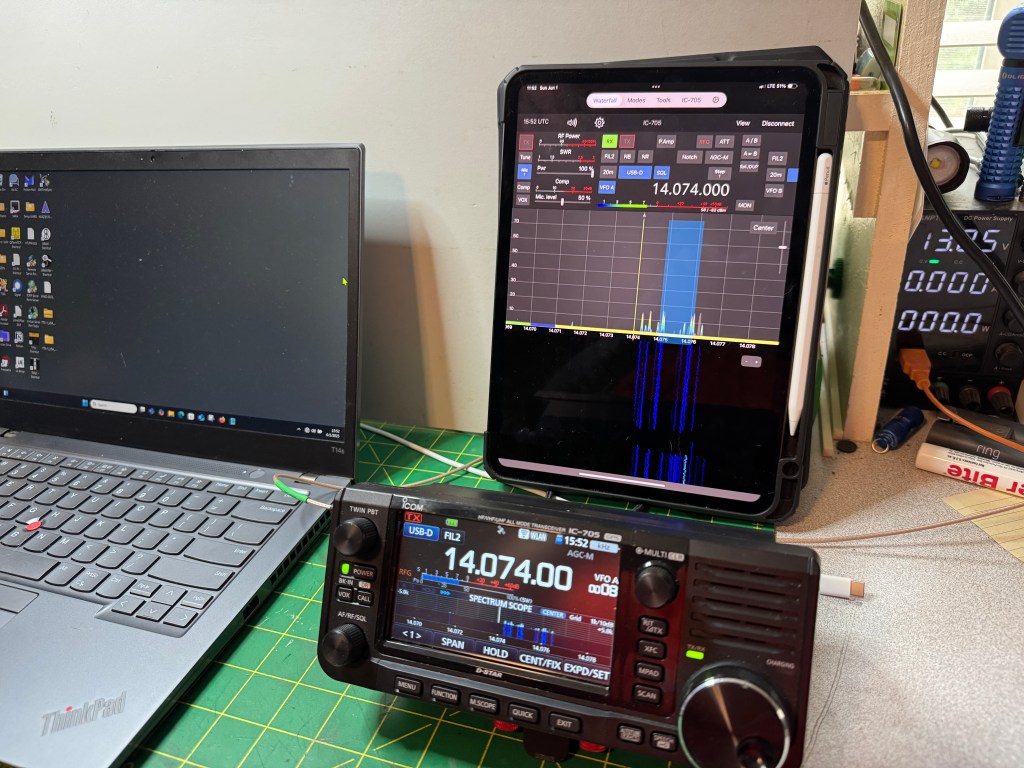
This morning I wanted to explore connectivity with the FTX1 and the IC-705. Right off the bat, the IC-705 comes standard with Bluetooth and GPS while the FTX1 requires a separate purchase for each. The Bluetooth unit cost $55 and the GPS cost $70. the IC-705 has one additional feature in that it also acts as a Wifi access point to allow you to control the radio via iPhone/iPad apps like SDR-Control SDR Control Website. With this app I can operate FT8 and CW. It has message memory and logging. The Wifi on the IC-705 is not intended for internet connection.
Getting back to the FTX1, it took a little figuring but I got it running FT8 on my Windows machine. The FTX1 is so new that there isn’t any control configurations out there on apps like WSJT. A little tinkering and I got it to work just fine. Here are the setting I used.
You want to use the enhanced com port. I also ended up using a USB C to USB A cable instead of a USB C to USB C. I was having trouble getting the latter to work and it may have been something on my part to cause it not to work. I will fool with it some more later.
UPDATE: I was able to get the radio to work with a USB C to USB C cable. However, something I missed was while WSJT software will Xmit and Receive, it will not QSY the frequency on the FTX1. I tried this with FT-891, FT-991, and FTDX10 CAT Command sets in WSJT. Usually with Icom’s there is enough compatibility between the radios that the CAT setting from one model will work with another. An example would be the IC-7610, it is pretty cross compatible with the IC-7300 command set. Hopefully this will be addressed soon.
On the IC-705 you can output GPS data through the B port. This can be used for different things, I use it sync the time on my laptop when I am using one. As far as I can see this feature is not planned for the Yaesu.
The Yaesu is still brand new, I had it 2 days and there was already an update. I am sure as the product matures, more features will be added. I like the radio; it has a certain fun factor. If someone asked me today, if I could only have one, I would pick the IC-705. But that is today, tomorrow as the FTX1 is refined, I may change my mind. In between, I plan on having fun with both. 72 de Scott
Over the past couple of years, I have spent a lot of time taking what I call big radios to the field. These are 100 watt radios that I run at reduced power usually between 20 and 35 watts. I can run digital modes all day long on a big radio at this power and it won’t even get warm. I usually take them out for a weekend camping trip.
That has gotten a little stale, I feel I have a good understanding of how those radios and antennas work and I have made 1000’s of contacts all over the world. It’s time to do something different. I have 2 wonderful QRP radios, a KX2 and an IC-705, that haven’t seen a lot of use. I have also let my CW skills slip a little. Change is in the wind. I am planning some trips using my little (QRP) radios. in addition, I may spend a few nights in a motel rather than camp. Each day I am out, I can mini rove and do a couple of parks instead of just one. I feel the change will be refreshing, kind of going back to my POTA roots.
This fall, I am planning another multi-state rove. This will be a multi-day rove hitting a park in a state and moving on. It will be a nice drive and a lot of fun. I want to try my hand at quick set-ups and tear downs. The beauty of amateur radio is the diversity of things you can do. Sometimes, you gotta due a few things for fun. 73 de Scott
My first campout for 2024 was at Vogel State Park located at the base of Blood Mountain in the Chattahoochee National Forest. It is Georgia’s second oldest state park having been established in 1931. The park contains 233 acres and includes a 22 acre lake. The park has camping, picnicking, hiking, and is known for its spectacular fall foliage. Nearby, the alpine village of Helen provides various attractions and good food. Be sure to check out the German Bakery/guesthouse.
One of my New Year’s resolutions is to improve my CW skills. This weekend, it was going to be a me and the key weekend. I am going to spend the weekend only doing CW (or so I thought). Over the past year, I used a lot of FT8 mainly because the bands were in poor shape during my camping trips. I still plan to use FT8 some but for the most part it will be CW. In addition, to help me improve my skill, I signed up for a class with CW Innovations. It is a 10 week intensive CW course. My hope is to get my speed up to where I can do the occasional contest. Those contest boys are pretty zippy.
The weather for the trip was iffy. Friday night, the park was under a winter weather advisory with freezing rain predicted. I try not to let weather stop me from an activity. When I was in the Army, they never called off a field problem due to weather. Today , while I err on the side of safety, I still go regardless of the weather. It teaches the limits of my equipment and me.
I decided to bring the Elecraft Brothers. My K3(S)/10 and my KX2. In addition to running CW, I also plan on operating at QRP levels. This is not much less than I usually run while camping which is about 25-35 watts. My antenna ended up being my 28.5 Foot random wire antenna with a 17 foot counterpoise. I also brought my EmComm II which has better NVIS capability. Often my campsite dictates which antenna I use (I ended up using the random wire due to space constraints and the chance for freezing rain). I will be using a notepad and my Lenovo T14 for logging.
It all started out innocently enough. I was finishing up a bout with the Flu which was probably Covid, and thought I was well enough to make the trip. I reserved the campsite months ago and I figured I could give it a go and if things went south, I could come home the next day.
As soon as the sun went down and the winds picked up I was not feeling well. I ended up with a scratchy throat and associated coughing along with a good case of the chills. No matter how I tried, I could not get warm. My camper has two good heaters, my small ceramic heater which is usually more than enough and the built-in overhead heater/AC unit which will bring the camper up over 90 degrees. Even with both running, I still felt chilled. It was already starting to rain so I had to wait until morning to pack things up. It was not a fun night.
The second big thing to happen was me not making any CW contacts. I called and called Friday night and only made one contact. Cell service was sketchy so it was difficult to check if I was being picked up by the RBN network. I was running 10 watts which usually is enough to at least make the required number of contacts. I was stumped. By the way, on Saturday morning, I made contact with the NCS of the EmComm net I check into on CW and LSB. Hmmm! Back to Friday night. I had about an hour and a half to make the other 9 contacts for a valid activation.
I didn’t want to do it, but I switched over to FT8. I did it to see what was going on out there and to make enough for a valid activation. My FT8 app lit up like a Christmas tree. I had contacts from the west coast and Europe with points in-between to include Canada. What a head scratcher. I’ll include a a QSO map below.
The only thing I can think of is the propagation was not falling on the ears of the hunters and with spotty cell service I could see I wasn’t making it into the RBN. The park sets down in the mountains a bit but it has had 137 valid activations so the signal does get out. It is funny that I could check into my EmComm net with the NCS in SC and not work more than one hunter.
Saturday morning, I packed up after the rain stopped and headed for the house. Back home and under the care of my good wife I began to recover. I still have some gear to dry out and a few things to fix, but that can wait a day. You can’t always have a great activation. While I planned to have a “me and the key” weekend, I was glad to have the ability to operate FT8 which saved the day. Sometimes, a little extra planning makes the difference. I enjoyed the weekend, even though I wasn’t feeling well. A little adversity does add spice to life. Till next time 72 — Scott
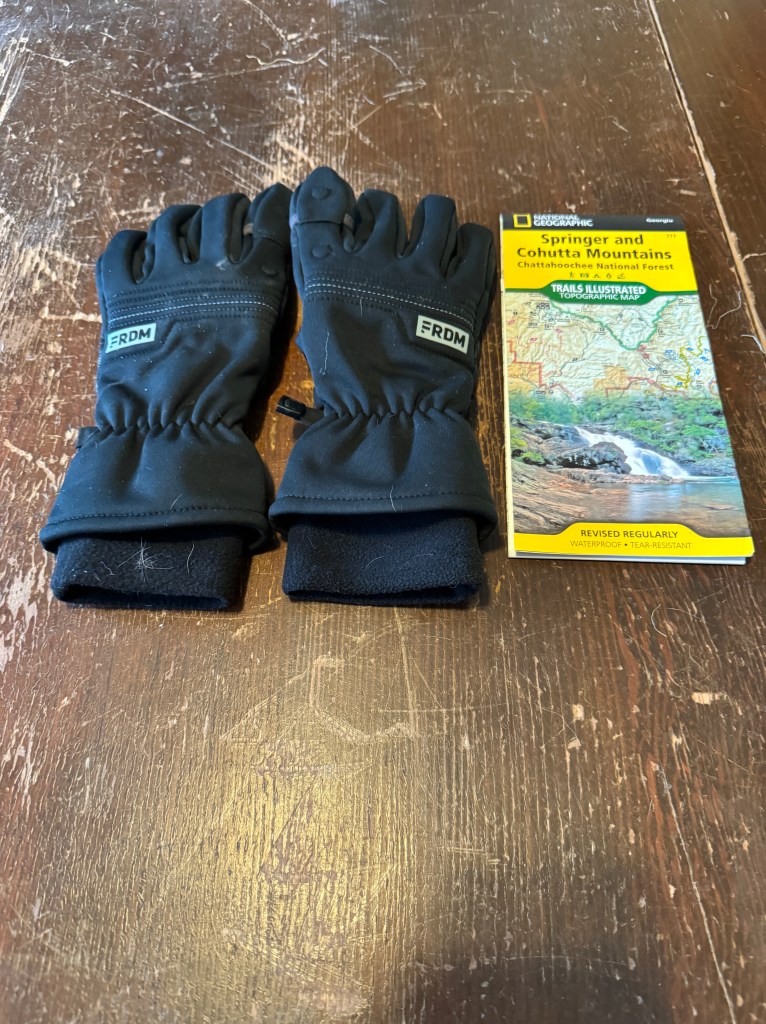
My training from the military compels me to perform an after-action report of sorts. I have found it beneficial to review an adventure as quickly as possible while the triumphs and foibles are still fresh in memory. This becomes more important as we age. Today (Thursday) is a few days after my SOTA activation on Bald Mountain. In general, things went well even though the weather was not as nice as was expected. The climb was as expected, I had to huff and puff a bit which at my age was expected. Two things that came to mind were: 1) the pack could be a little lighter (it was 15 pounds with water and my Goretex jacket) and my hands were cold enough to hinder my CW sending. For my hands, I bought a pair of warm gloves that can expose the fingertips of my thumb and index finger. Because I was warmed up from the hike, the Goretex jacket was enough to keep me warm.
I decided to lighten my load a little bit. When climbing, a lighter is better. Here is a list of my new slimmed-down version of my SOTA pack. I got the pack down to 10 lbs without water or a jacket. I probably saved about 2 pounds, but hey! two pounds is two pounds.
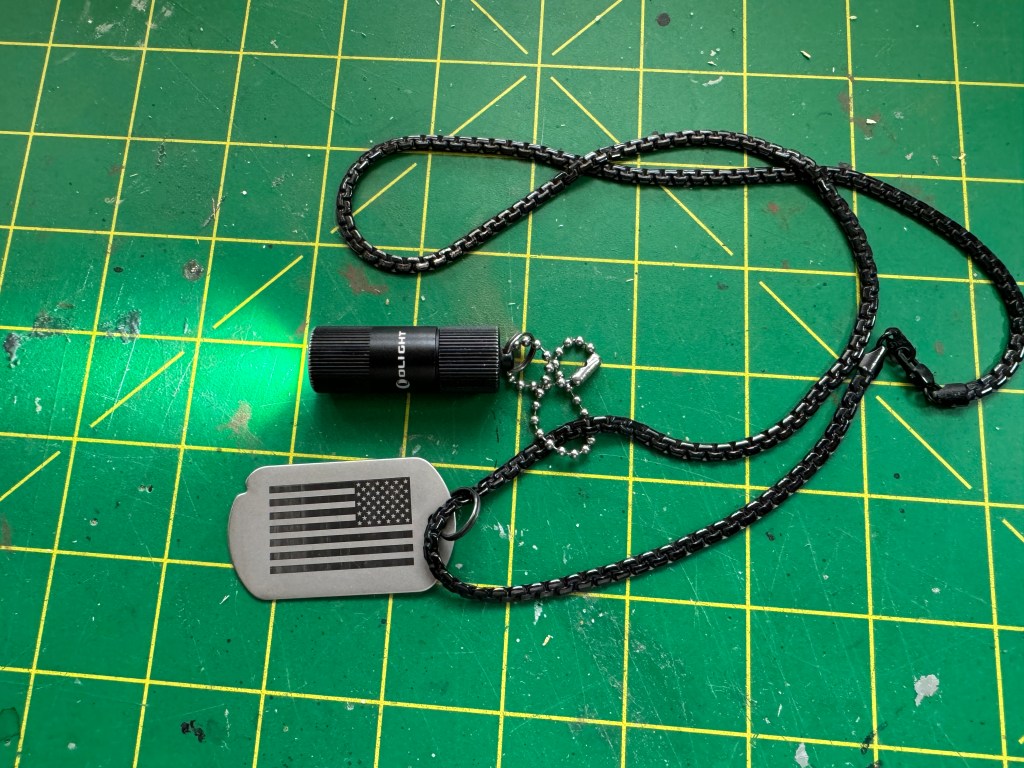
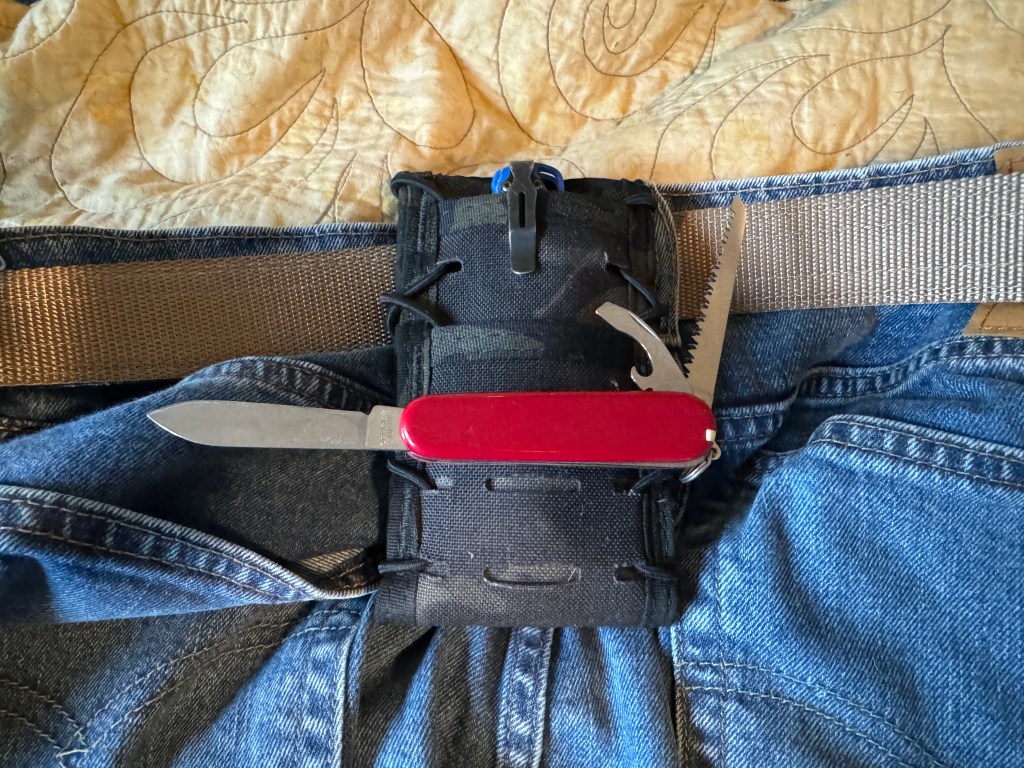
Starting with my person, this is what I carry: Wallet – minimalist Bic Mini-lighter Fischer Space Bullet Pen Swiss Army Knife Hiker iPhone Benchmade Bugout Knife Notebook 3×5 Dogtag with emergency contact info on a neck chain Olight i1r2eos flashlight on the chain with the dog tag
The Bugout rides in the same pouch as my iPhone in its own pocket. The pack I use is a Camelbak Military HAWG. It’s the old style. I’ve had it for quite a while and when I need a smallish pack, it’s the one I grab. The orange strip is highly reflective.
Attached to the left shoulder strap of the pack is a Garmin InReach Messenger. Some of the places I activate have little or no cell service so I use the Garmin to spot myself and keep the wife updated.
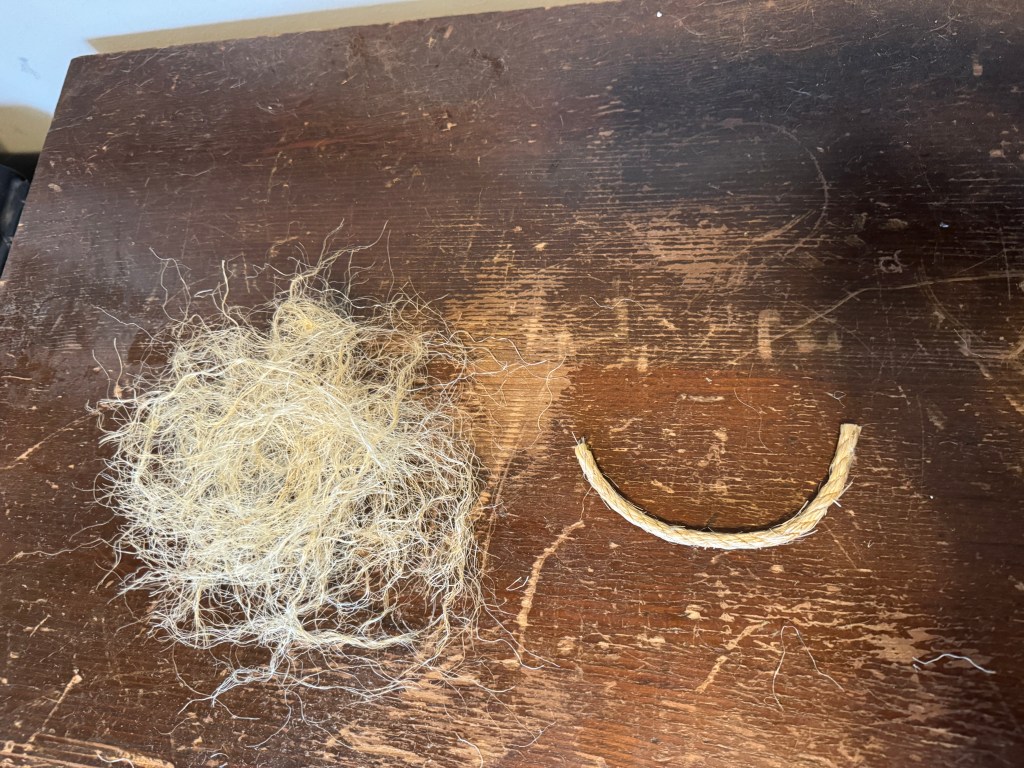
E&E Pouch In the Army, we often made Escape and Evasion pouches. A small pouch with just enough stuff to get by. This one fits in a 6 x 9″ Alocsak Pouch and weighs 10oz. Ferro Rod with carbide striker Magnesium Rod 2 – 3/8 by 8″ Sisal Rope Tropical matches (from MRE) Tinder Lighter Pine iFAK Whistle Compass Space Blanket Signal Mirror 2 – Bic Lighters
The sisal rope is great for fire starting. You take it apart and it makes a nice nest for your fire.
Considering my whereabouts will be generally known, I do have a preference for fire and signaling. Most likely, any survival situation will be short-term, and I want to be found.
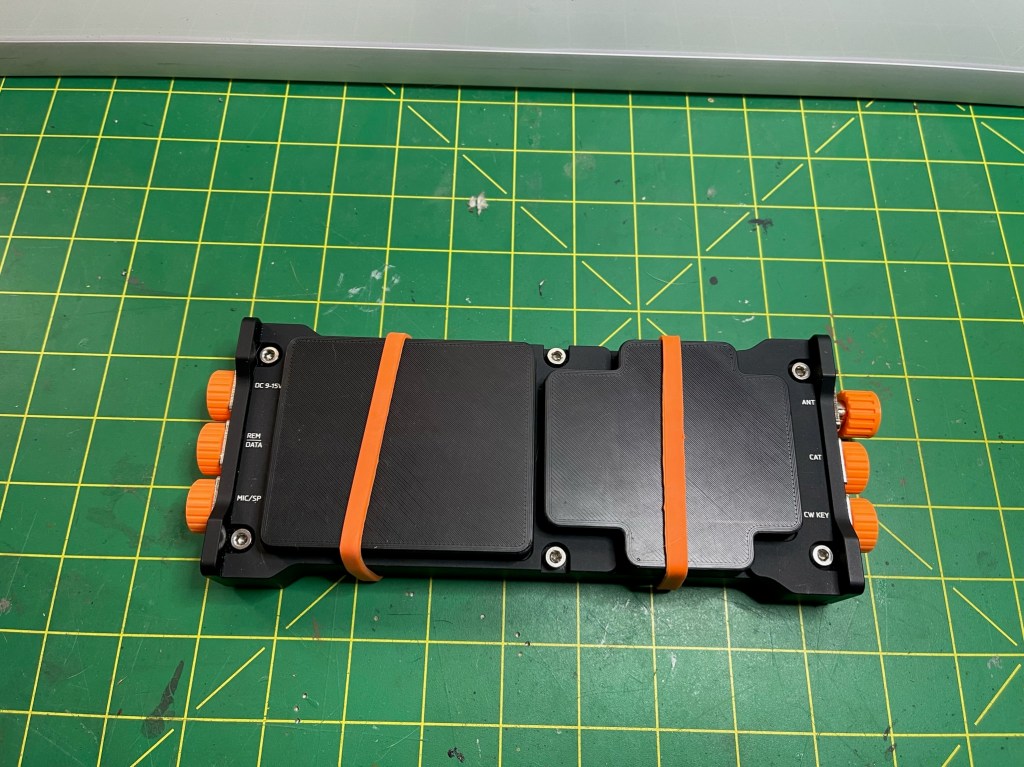
The Elecraft Bag This is the bulk of my radio gear. The Elecraft bag that came with my radio does a great job of keeping things organized. KX2 with a 3D printed cover Begali KX2 Adventure Paddle adapter 28.5′ Random Wire Antenna 17′ Counterpoise 30′ Bank Line 12 VDC power cable with Anderson Power Pole connector N0SA SOTA Paddles (swap with Begali Adventure Duo) 15′ RG-316 with choke (Chameleon) Skull Candy earbuds 8 oz Arbor weight with line
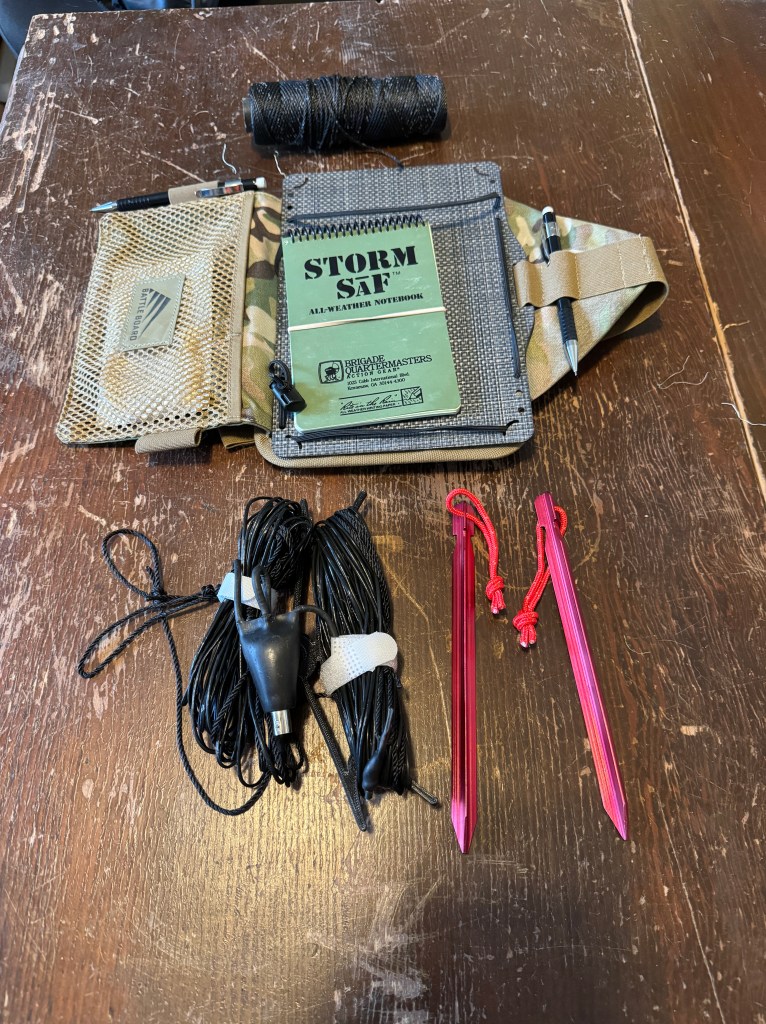
The rest of the items are dispersed within the pack 1 Liter Canteen with Cup and Spoon HeadlampSeat Cushion Contractor Trash Bag Knee Board Rite-In-The-Rain 4×6 Notepad 2 Mechanical Pencils Spool of Bank Line 2 Tent Stake Chameleon 40-meter OCF Dipole
Finally, there are some seasonal/ad hoc items such as gloves, jackets, food, and localized maps. I have plenty of room in the pack to make adjustments for conditions.
My pack contents will probably evolve over time as I use it. Right now I think there is a good balance in the pack between fun and safety. Some of the places I go are pretty remote. I always tell my wife where I am going and a general itinerary. You should do the same.
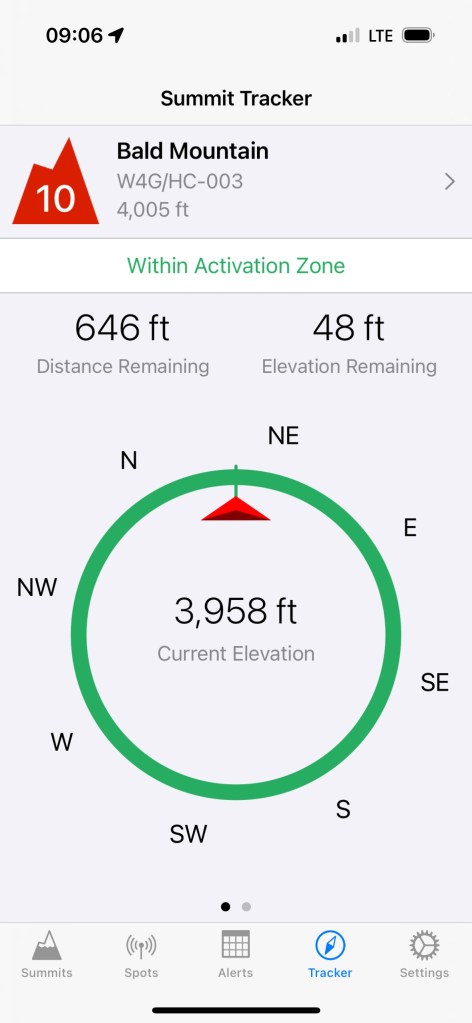
How did the KX2 do? This was the maiden voyage of the KX2. Right off the bat, I got to use it in some trying conditions. The weather was deteriorating as I walked into a cloud at the summit. It was windy and I wasn’t really sure what the weather was going to do. I figured I had enough time to make a quick activation and get down off of the mountain before the rains came. I climbed until I got well within the activation zone and set up. I strung the OCF dipole about 10 feet up and set my station right below it using the same tree as a backrest. I was going to use a Flight Deck but I didn’t want to fiddle with so I set the radio on top of the pack. Because the radio is self-contained all I had to do was plug in the antenna, paddles, and earbuds, and I was in business. I made 19 contacts logging on my notepad resting on my thigh. What helped to make the activation a success was the ease with which I got the radio working. Bing-Bam-Boom and I was on the air. As quick as I set it up, I took it down. The KX2 made it easy. I made it back to the truck to beat the drizzle. Since the activation, I added the kneeboard shown. I set it up at home and it should be easier to use than the one I had. I am still learning my way around the radio, but it is indeed going to be my main SOTA radio. Until next time 73 –de Scott
It’s official, I am retired. Fifty-three years in the making. Being on the north side of 66 does not mean you are wheelchair-bound. Maybe a little slower, but with patience and skill almost anything can be done. One of my first acts as KK4Z (ret.) was to do a SOTA activation. I chose Bald Mountain, a 10-pointer in northwest Georgia.
One of the reasons I chose a 10-pointer is I wish to get involved with a group called Southern Appalachian Summit QRPers or SASQ (SASQuatches). The group combines SOTA with a moderate level of Bushcraft. What’s not to like. There are skill-based membership requirements and one is a 10 pt SOTA activation within the past year. I wanted to get my 10-pointer in before the Park Service closes the roads to the summits during the winter.
I was originally planning on Tuesday for the trip, but the weather was going to be harsh that day. Lots of wind and rain. This is what I call the first winter storm of the season. Between the wind and the rain, it usually finishes knocking all the leaves off of the tree. So, I backed the trip up to Monday and checked the weather (Wx) – all systems go. Preflight check of the Wx 0600 hrs Monday showed VFR (good). The 10-point mountains are at least a 3-hour drive for me. Two hours on highway/improved roads and one hour on unimproved/gravel roads. That last hour covers approx. 20 miles. Along the way, I was confronted by a 6-8 pt deer who thought he was up to the challenge by a 5,000 lb Ram truck. After a few snorts, he thought better of it and scampered into the wood. Shortly after this, I heard Mussorgsky’s Night on Bald Mountain, an omen I didn’t recognize at the time. When I reached the parking lot below the summit, things weren’t so VFR. I checked the Wx again and now it showed rain on the way. The sky had closed in and the summit was in a cloud. I figured I had just enough time to reach the summit, make the required contacts, and retreat without getting too wet. When I started the trek, it was 60 degrees. By the time I reached the activation zone, the temps dropped, and the wind picked up. When I got back to the truck the thermometer registered 50 degrees. I estimated that the wind chill put temps in the low 40’s to high 30’s. Whenever I venture out, I always bring an extra layer, in this case, a Gore-Tex jacket. I forgot gloves and my CW suffered for it.
I climbed just high enough to get safely into the activation zone. My setup was quick and simple. I used a Chameleon 40-meter OCF QRP dipole. I like OCF dipoles. They do not have to get very high off the ground (10-12 feet is enough) and they are good performers. I prefer them over EFHWs. I sit on a cushion on the ground, so I use the supporting tree as a backrest. Coax is 15’ of RG-316 with a choke on one end. The radio was my new Elecraft KX2. I waited quite a while to get the radio. I did set it up at home and made one contact before taking it out. Since I was in a hurry, I set the radio on my pack and the notebook log on my thigh. The paddles were N0SA’s SOTA paddles. I got lucky and got one from his last run. I held it in my left hand. I sent a spot out and a few minutes later I sent QRL? On 7.057 MHz. I got a NO, they were waiting for me, I’ve never had that before. The wind was picking up and I had some difficulty hearing. As my hands got colder, my CW and handwriting suffered. I had a pretty good pile-up going and after 19 contacts I called QRT. There were still some calling, but Wx was not on my side.
I packed it up and headed down the mountain. By the time I got to the truck, it was starting to drizzle. I really didn’t mind the weather, I need to keep my hands warmer though.
The KX2. It was everything I had hoped it would be. I ran it 5 watts and it purred like a kitten. The quality of the received signal was great. I ran with the filter set to 1K Hz and it was fine, no overloading even with a pile-up. For SOTA, the radio is hard to beat. I like that I only have 3 cables to the radio, paddles, earbuds, and coax. Simple and easy.
Next time I will be sure to add some gloves to my pack. It was fun and I can’t wait to do the next one. If I knew retirement was going to be this much fun, I’d have done it a long time ago. 72 de Scott
I posted earlier that I was in a radio doldrum. Today I am slowly drifting back to fair skies and wind at my stern. My friend Thomas K4SWL recently posted on his blog a Field Kit Gallery showcasing operators’ various field kits: https://qrper.com/resources/field-radio-kits/ I thought I would post mine.
This is what I typically bring for a SOTA activation. I also have some general outdoor essentials like an iFAK, bug repellent, a compass, water, and of course snacks. For POTA, I am usually in my camper and bring a full-sized radio like my Elecraft K3/10. I also have an IC-705 which I like for those one-day POTA activations. The kit is pretty simple and gets the job done. Here is a list of components.
Also, I decided to take a break from everything else I have been doing and get on the air. I recently got my K3/10 back from the shop and thought I would give it a good workout at home so I wouldn’t have another calamity like I did a few months ago https://kk4z.com/2023/08/06/calamity-on-black-rock-mountain/. I set the radio up in the shack and started to make contacts. I had forgotten how far 10-watts CW can get you with a good antenna. At the home QTH, I run a 270′ OCF dipole with the apex up about 35′. I was hunting POTA activators and found I could work almost everyone I heard. I got as far north as Ontario, Canada, and as far west as TX, MO, and IA. This was still the morning and there weren’t many activators out yet. The K3/10 worked like a champ and purred like a kitten. Not hearing relays click during QSK CW is sublime. With the K3/10 cleared for field use, I have a couple of outings planned for it.
It feels good to be back in the saddle again. Absence makes the heart grow fonder, and after being away from amateur radio, even for a short while, I appreciate it all the more. 72 de Scott
I like big boxes, for radios that is. Over the last year or so I have been going portable on a regular basis. During that time I have had a good opportunity to see how I actually operate and enjoy my adventures. I was a little bit surprised. I had thought I was going to do QRP with little radios. I did some of that but what I found was I had a penchant for big box radios operating at what I call QROp or low power usually around 20-35 watts. I also found that I did a lot of FT8. Over the past year band conditions were not good and sometimes, FT8 was the only way to make contacts. I also discovered that I like to chase DX when operating portable. That is my kind of fun. In addition to that, I have a hand (or a foot) in EmComm and support a couple of different organizations.
Why I like big boxes. The first reason is I can run FT8 all day and all night at 35+ watts and the radio doesn’t even get warm. I have done that with both the FTDX10 and the IC-7300. The audio is better on big radios (the exception might be the IC-705). There are more and often bigger controls on a big box radio. The obvious advantage is I can crank up the power when I need it. Even then it is usually no more than 65 watts.
I have 3 QRP radios: IC-705, TX-500, and the TR-45L; all premium radios all great for what they do; all mostly stay at home in a box. I decided to sell two of them, the TX-500 and the TR-45L. They deserve a better home, someone who will give them a proper exercise now and again.
The TR-45L (fat) has the built-in battery and will sell for $580 shipped. The TR-500 will sell for $850 shipped. All sales final. See photos and video below. THE TX-500 IS SOLD.
What is next. Proceeds will probably be for another big box field radio. The IC-7300 is my main field radio and the FTDX10 has joined the home team. The FTDX10 really shines in the home shack. I use mainly for causal CW for things like POTA. I may be interested in another IC-7300, or a FT-710. I might even go for a FT-891 since that is a popular radio. Who knows what I might find out there that tickles my fancy. Like the FTDX10, what ever I get will have a long term review done. I will post the for sale here for a day or two before I put them up on QTH.com. 73 — Scott
Taking a little break from activations and hunting, I thought I would showcase my field radios as it stands today. I recently culled the herd and this is what I ended up with. The power draw was measured using a Watts Up inline meter, something like this: https://tinyurl.com/yc6yfvsd. Not lab quality, but certainly enough for this article.
Most of my recent activations have either been camping with my little teardrop camper or in my truck for a day trip. The desire to trek to a destination is not as romantic as it used to be. Often my radio time is fitted in with my other responsibilities.
Before I go down my list of radios, I want mention that my modes of choice are CW and Digital with CW generally being my preferred mode. When band conditions are poor as they have been these past few months I use FT8. Some might say that FT8 is easy or point and click, but to be a successful FT8 operator does take some skill.
My first radio is my IC-7300. Because of band conditions these past few months, it was my radio of choice because it is a 100 watt radio. In the field, I normally operate in the 5-10 watt range, but when the bands are bad I am in the 25-35 watt (and sometimes more) range. I also want to note that over the past few months I was working on my N1CC award which is working 10 bands at 10 different parks. Most parks are a couple of hours drive away from me so I try to get my 10 bands over the course of a weekend. Because gas prices are elevated, returning to some parks may not be an option.
I’ve had this IC-7300 since 2017. It’s a great radio and a great field radio. I have 4 radios that share much of the same menu system so I do not have to relearn the radio everytime I take it out. The filtering is excellent. The noise floor is lower than many other radios by a factor of 4. I have worked stations were the meter is not moving indicating a less than S1 reading.
With Icoms, antenna tuner integration is a simple cable connection and will also power the tuner. The only mod to the radio is I added a set of Portable Zero 7300 Escort guards https://portablezero.com/icom706.html. The radio rides in a Dewalt Tough Sytem medium case with no additional padding https://tinyurl.com/2sw8u9ub. The guards protect the knobs from bumping into the sides of the case. They also make great handles. Power consumption for this radio at idle with nothing connected to it is 0.81 amps or 810 mAh. For a 100 watt radio, that’s pretty darn good. The paddle I use with this radio is a Begali Traveler Lite. I am a fan of Begali paddles.
The next radio is my current favorite QRP radio, the IC-705. This radio is brillant. Icom packed a bunch of goodness into a samll package with an idle amp draw of 220 mAh with the charger off and 360 mAh with the charger on. That’s right down there with many other QRP rigs.
My 705 travels with a 3D printed cover for the face inside a MTM Ammo Crate https://tinyurl.com/y4j6t4nu. These are great cases for small radios and their accessories. A nice feature for this radio is it and be linked/controlled via Bluetooth. I have run FT8 and logged on my iPad using an app called SDR Control https://roskosch.de/sdr-control/. Another brillant feature of the IC-705 is it can be recharged via USB. That means both my iPad and the IC-705 can use the same charger. Some complain that the IC-705 is too heavy. When you realize that you do not need an HT for VHF/UHF (plus you get 10 watts of power), no cabling needed to hook the radio up to a laptop and as a bonus can use an iPad, and, can be charged via USB, you may have an actual savings of weight. No, it doesn’t have a built-in tuner and that has never bothered me. I have the AH-705 tuner and it is amazing. I use it to tune random wire antennas and can tune them without a UnUn or Balun. I would say the AH-705 tuner is on par with an AH-4 or even an SG-237 albeit at lower power.
The paddles for the 705 are Begali Adventure Dual. Big performance in a small package. Like all Begali products, they must be tried to be appreciated. I also use the Begali stand for the 705, it does a good job preventing the paddle from moving without adding a lot of weight. The screwdriver is a Nite-ize KMT-11-R3 that I modified by narrowing the screwdriver blade. I also have the begali base so I can use the paddle with other radios.
The paddles are stored in a little 3D printed box which holds the paddles, the base and the screwdriver. To the left of the box is another steel base from American Morse Equipment. The Begali base is a little light but has magnets on the bottom to attach to the AME base. Together, they work perfectly.
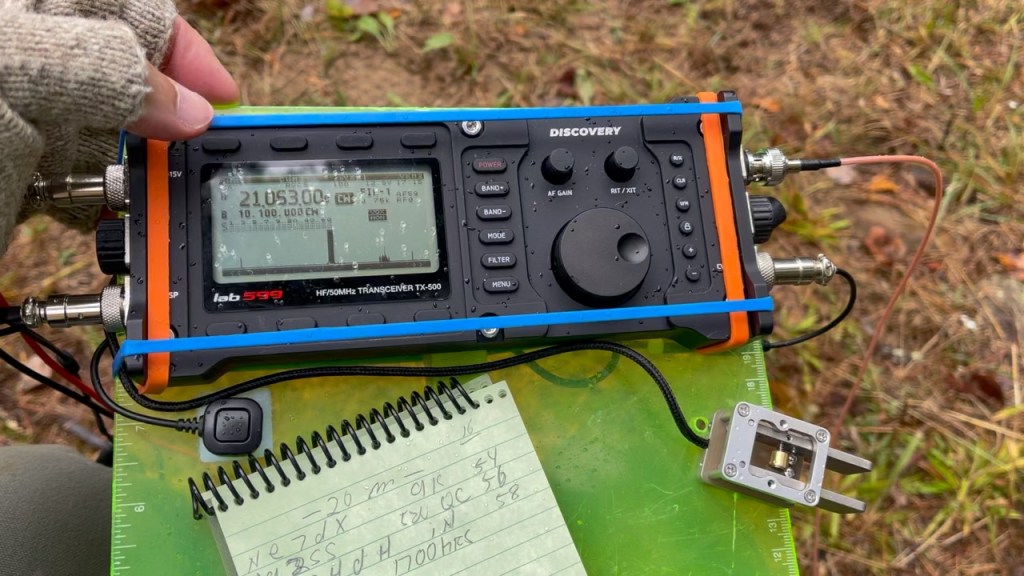
Last but not least is my Lab599 TX-500. This is a great rig for many reasons. Lightweight, simple to use, weather resistant and draws less than 100 mAh idle. It includes a waterfall on the easy to read LCD display. The receiver specs are pretty decent and I have not had any issues using it. I normally pair it with Elecraft T-1 tuner and Bioenno 3Ah battery. For travel I use 3D printed covers.
The paddles I use for this radio are Larry’s N0SA SOTA paddles. These are great paddles but last I heard he is no longer making them.
What is nice about these paddles is they are easy to hold in the hand and can be mounted to a flight deck.
These are my current radios and the paddles I use with them. Is this list set in stone? Of course not, you never know what you might find just around the corner. However, I could be quite happy with these. They are all good perfromers that give me a lot of latitude when operating in the field. Now that my N1CC is complete, I can worry a little less about quantity and a little more about quality. Hope to hear you out there — 73 Scott.
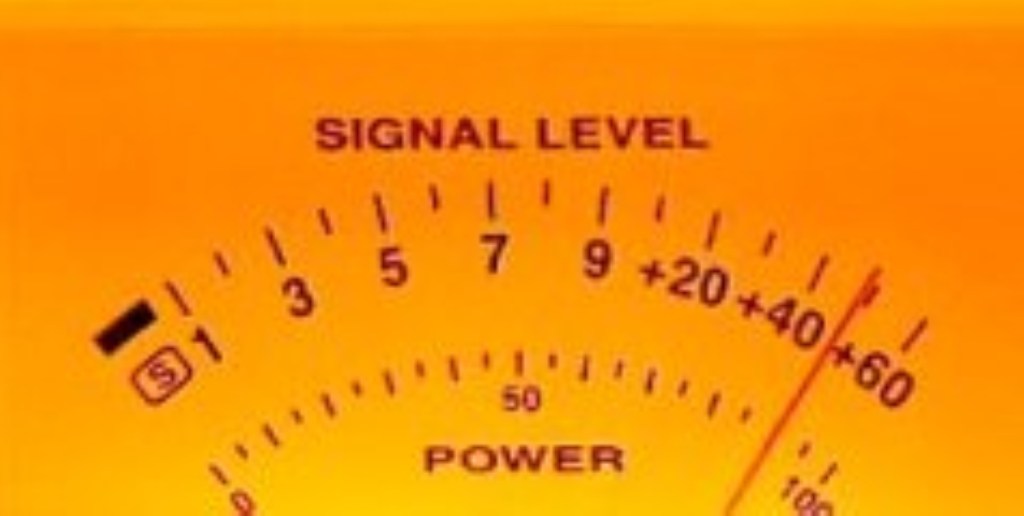
There is always a lot of talk about QRP vs QRO, 5 watts vs 10, ad nauseam. So today I thought I would run the numbers and see what the real deal is. First we need a few definitions. An S-unit in general terms is the minimum change in signal strength to be just noticeable (k3wwp.com). In more technical terms it equates to approximately 6 db in change. The decibel (dB) is a logarithmic number. Each 10 dB represents a factor of 10 difference. This may be a little out there for some so we will cut right to the shortcut. There are two types of logarithms. For calculating dB, use the common logarithm which is base 10. To see if your calculator uses the right one. Punch in 100 and then log. The answer should be 2 which equates to 10 to the second power which equals 100. This is not a technical paper but an entry way to see how changing the power levels affect the signal level of your transmitting signal. As you guessed, it is not linear.
Let me introduce an equation:
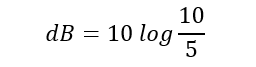
Where Power P1 is the power you wish to evaluate and reference power P2 is your starting power. Let’s take going from 5 watts to 10 watts. The equation would look like this:
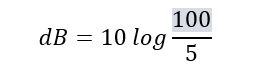
We take 10 and divide it by 5 which give us 2. Then we hit the log function on our calculator which gives us 0.301. Multiply that by 10 and you have about 3 dB in gain or about one half of an S-unit (remember 1 S-unit is equal to 6 dB). Let’s do one more by hand and tackle the QRP/QRO debate. How many S-units will increasing power from 5 watts to 100 watts give you? The equation looks like this:
Take the 100 and divide by 5 to give you 20 and then hit the log function to give you 1.301. Multiply by 10 for 13.01 dB. Divide 13.01 by 6 dB and you have 2.17 S-units. Going back to our definition that one S-unit is the minimum change in signal strength to be just noticeable shows that going from 5 watts to 100 watts is not that great of a change.
Let’s let the other shoe drop. What about going from 5 watts to 1500 watt? That will give you 4.13 S-units of gain vs 1.96 S-units going from 100 watts to 1500 watts?
This gives you a fairly easy equation to help you evaluate your needs based upon empirical data. Running 20 watts over 5 gives you 1 S-Unit. Using less power means less drain on the battery for longer operation. This is only part of the equation. Propagation, antenna, mode used, and station efficiency all play a part. Have fun and maybe don’t toss the QRP radio yet 🙂












 KK4Z
KK4Z 