FTDX10 Setup for the field

The majority of my activations are successful. In fact so far (knock on wood), I have had only one failed attempt and that was because I started too late and didn’t get my 10 contacts before the new UTC day. The time I spent in the Army was mostly with ready reaction forces or rapid reaction forces. This often entailed us getting up at 0300 hrs loading up all our gear and heading for the hills. I was in aviation and that meant a lot of gear that had to be loaded quickly. While the helicopter crews hopped in their aircraft and took off, there were still trucks and semis that had to be ready to go. This same equipment was also used in day-to-day operations so it wasn’t just sitting there waiting for something to happen. It took organization. “A place for everything and everything in its place.”

I keep my field gear packed but accessible. My big radios go in this box.

Permanent residents of the box are loosely stored with the caveat that if I take something out, I put it back when I’m done. You will notice in the bottom picture there is a bag marked IC-7300. That is all of the peripheral stuff that goes with the IC-7300/LDG Z-11 Pro to the left. When I get the FTDX10 ready, it will have its own clearly marked bag. Whichever radio I take, I can quickly see if I have the proper bag to go with it. The radio that is not in use will go in a smaller storage box to help keep things together. The antennas I use stay with my truck, always ready.

One of my first projects for the FTDX10 is the power cord.

It’s not zip cord like the Icoms, so it can get jumbled up pretty quick. Also, when operating in the field my battery or power supply is close to the radio so I do not need a long run.

The first thing I did was add heat shrink tubing to keep the wires together. Loose, they seem to tangle no matter how hard you try to keep them straight. Make sure you put the heat shrink on before you make any connections.

The butt splices are covered with heat shrink tubing so that after they are mechanically crimped, they are sealed to the wire insulation.

The finished cable is about 18″-24″ long. I guesstimated. I use Anderson Powerpole on all of my radio gear. I have been using them since the mid-2,000s. My power supply and batteries all have Powerpole connections. It’s a very safe way to keep the electrons flowing in the right direction.

With the leftover cable, I applied heat shrink tubing and Powerpoles to both ends. This gives me an extension should I ever need one.

There’s the completed project. Ready to rock.

In a couple of days, my side rails will be here and then I will see how the radio fits in the box. The FTDX10 is a little wider than the IC-7300 so it may be a tight fit. If it’s too tight, I will have to figure something else out.

So far, I am enjoying the radio and I am looking forward to getting it out in the wild. 73’s de Scott

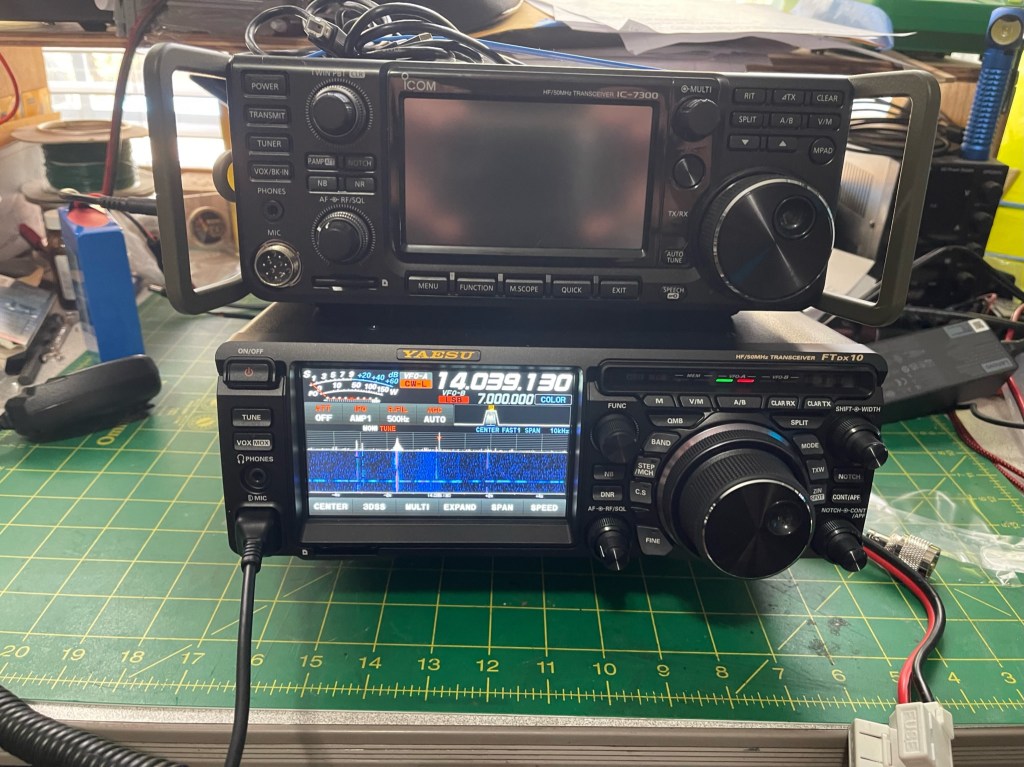
Look What Followed Me Home

Yesterday, I drove to HRO in Atlanta and picked up a Yaesu FTDX10. No, this does not replace my Icom IC-7300 which I still consider to be the best all around HF field radio out there. I bought the FTDX10 for a couple of reasons. It has been a while since I owned a Yaesu radio and I thought I would try this one out. I do tend to gravitate towards Icoms and will probably get to a couple of those reasons in this post.

Its purpose as a part of my stable of radios is going to be a field radio. Just like I have 2 QRP field radios, I now have 2 QRO field radios. This radio brings a few things to the table that the IC-7300 doesn’t and also has a few niggles absent in the Icom. In the field, I primarily operate CW and FT8. This radio has several features that enhance CW operation over the IC-7300 that are found on the IC-7610. I feel that I have an IC-7610 radio in an IC-7300 size (not totally true, but you get the idea).

Size wise, the FTDX10 and the IC-7300 are fairly close in size with the FTDX10 being about an inch wider.

The FTDX10 also weighs about 4 pounds more. Weight and size differences this small are insignificant when considering how I plan to use the radios. Mostly, it will be portable operations either operating out of my truck or my camper. I might have to lug the radios maybe 15 feet. I carry the IC-7300 in a Dewalt Tough System 2.0 medium box and plan to do the same with the Yaesu.

Setup – Display/Power. There are lots of options on the Yaesu. I would say that this is not a beginners radio. While the manual is pretty good, you still have to have some idea of what you are doing. One of the niggles I have is receive current. When I first turned on the radio, it was drawing over 2 amps in receive. The Icom only draws a little over 0.8 amps, less that half of the Yaesu. I changed the following settings to bring it down to 1.78 amps:
LED Dimmer 7
Dimmer 10
Color 5
Max HF RF Power 50 watts.
The last 2 didin’t help with the amp draw but they were set at the same time as the others. I normally don’t operate past 50 watts in the field.

Setup – SSB. I don’t plan on operating SSB in the field, but then again, you never know. I tried to setup SSB according to the manual and found I didn’t get the expected results. I had to fiddle with the settings in order to stay within the prescribed parameters. Here are the setting I used:
Mic Gain – 65
Processor Level – 71
AMC – 41
Of course MMMV. This was using the hand mic. I really like the hand mic with its controls. It has a mute button to mute the receiver as well as up/down buttons and 4 “P” buttons which perform the following:
P1 – Main Dial Lock
P2 – QMB Quick Memory Bnak
P3 – VFO A/VFO B
P4 – VFO/Memory
I may keep the microphone connected just for the convenience of the buttons. I did not set all of the parametric settings. That will be another endeavour.

Setup – CW. This is where the FTDX10 really shines. It has APF, Audio Peak Filter Zin/Spot (same as the 7610). A really nice feature is the high cut and low cut filters, which help to isolate the incoming desired signal. My initial CW settings are based upon 700 Hz sidetone:
Low Cut – 600
High Cut – 800
CW Out – 50
CW BK-IN – Full
Keyer Type – B
Ratio – 3.3
Like the Icoms, you can set the the keyer BK-IN to off, you can use the radio as a practice oscillator. One thing the FTDX10 has over the IC-7300 is it can decode CW. Often your ears are better filters, but I can see the decoder maybe helping with difficult callsigns or your brain is not firing on all cylinders that day.

Setup – FT8. Here I was surprised. My last Yaesu radio was a FTDX3000 and the computer interface was tedious at best. You had to make the radio use digital modes. It was one of the reasons I shied away from Yaesu. Icom has been doing this better since the IC-7100. However, Yaesu has learned. Now setting up for digital modes and computer logging is a breeze. Once you setup the software for FT8, on the radio you do the following:
Set Mode to USB and PRESET (both must be on or blue color)
Set Roofing Filter to 3K
That’s it. I made about 5 quick contacts on FT8 to include europe. I also set up ACLog to work with the Yaesu. Easy Peezy.

External Antenna Tuner. This has been another sore spot with me. Using an LDG tuner with an Icom is plug and play. One cable and I can tune using the radios tune button and the tuner is powered by the radio. The Yaesu on the other hand, has never been an easy fix. It seems that to use an external tuner, you had to do something extra or something different. When I bought the FTDX10, I bought an adapter cable for my LDG Z-11 Pro. It was still more fiddly than I liked.

What’s next? I am seting this up for field work. I ordered a Mat-30 antenna tuner for the radio which is supposed to work like the LDG tuner does for the Icom. Push the tuner button on the radio and it matches the antenna. I also ordred the 300 Hz filter and a pair of Portable Zero side rails. I don’t put my radios in Pelican type cases. Those cases take up too much space and in reality, the radios do not need that much protection. The side rails prevent the knobs and buttons from hitting the wall of Dewalt box while in transit and allow me to set the radio up on end which I seem to do alot while setting up and breaking down.

Where does the FTDX10 fit? I think this radio will get its most use when I am either camping with shore power or in a cabin. In general I try to go camping at least once a month where there is power available. The IC-7300 will get used in areas where I am operating under battery power. I have been an Emergency Communications Specialist for my church for 25 years and if I were to deploy to a disaster again, I would take the IC-7300. The FTDX10 is not a radio you can learn about over an hour or two. I will take a while to learn all the goodness it contains. On my POTA activations, you will still see both radios along with my QRP radios. Tnx for stopping by de Scott
My Field Radios

Taking a little break from activations and hunting, I thought I would showcase my field radios as it stands today. I recently culled the herd and this is what I ended up with. The power draw was measured using a Watts Up inline meter, something like this: https://tinyurl.com/yc6yfvsd. Not lab quality, but certainly enough for this article.

Most of my recent activations have either been camping with my little teardrop camper or in my truck for a day trip. The desire to trek to a destination is not as romantic as it used to be. Often my radio time is fitted in with my other responsibilities.

Before I go down my list of radios, I want mention that my modes of choice are CW and Digital with CW generally being my preferred mode. When band conditions are poor as they have been these past few months I use FT8. Some might say that FT8 is easy or point and click, but to be a successful FT8 operator does take some skill.

My first radio is my IC-7300. Because of band conditions these past few months, it was my radio of choice because it is a 100 watt radio. In the field, I normally operate in the 5-10 watt range, but when the bands are bad I am in the 25-35 watt (and sometimes more) range. I also want to note that over the past few months I was working on my N1CC award which is working 10 bands at 10 different parks. Most parks are a couple of hours drive away from me so I try to get my 10 bands over the course of a weekend. Because gas prices are elevated, returning to some parks may not be an option.

I’ve had this IC-7300 since 2017. It’s a great radio and a great field radio. I have 4 radios that share much of the same menu system so I do not have to relearn the radio everytime I take it out. The filtering is excellent. The noise floor is lower than many other radios by a factor of 4. I have worked stations were the meter is not moving indicating a less than S1 reading.

With Icoms, antenna tuner integration is a simple cable connection and will also power the tuner. The only mod to the radio is I added a set of Portable Zero 7300 Escort guards https://portablezero.com/icom706.html. The radio rides in a Dewalt Tough Sytem medium case with no additional padding https://tinyurl.com/2sw8u9ub. The guards protect the knobs from bumping into the sides of the case. They also make great handles. Power consumption for this radio at idle with nothing connected to it is 0.81 amps or 810 mAh. For a 100 watt radio, that’s pretty darn good. The paddle I use with this radio is a Begali Traveler Lite. I am a fan of Begali paddles.

The next radio is my current favorite QRP radio, the IC-705. This radio is brillant. Icom packed a bunch of goodness into a samll package with an idle amp draw of 220 mAh with the charger off and 360 mAh with the charger on. That’s right down there with many other QRP rigs.

My 705 travels with a 3D printed cover for the face inside a MTM Ammo Crate https://tinyurl.com/y4j6t4nu. These are great cases for small radios and their accessories. A nice feature for this radio is it and be linked/controlled via Bluetooth. I have run FT8 and logged on my iPad using an app called SDR Control https://roskosch.de/sdr-control/. Another brillant feature of the IC-705 is it can be recharged via USB. That means both my iPad and the IC-705 can use the same charger. Some complain that the IC-705 is too heavy. When you realize that you do not need an HT for VHF/UHF (plus you get 10 watts of power), no cabling needed to hook the radio up to a laptop and as a bonus can use an iPad, and, can be charged via USB, you may have an actual savings of weight. No, it doesn’t have a built-in tuner and that has never bothered me. I have the AH-705 tuner and it is amazing. I use it to tune random wire antennas and can tune them without a UnUn or Balun. I would say the AH-705 tuner is on par with an AH-4 or even an SG-237 albeit at lower power.

The paddles for the 705 are Begali Adventure Dual. Big performance in a small package. Like all Begali products, they must be tried to be appreciated. I also use the Begali stand for the 705, it does a good job preventing the paddle from moving without adding a lot of weight. The screwdriver is a Nite-ize KMT-11-R3 that I modified by narrowing the screwdriver blade. I also have the begali base so I can use the paddle with other radios.

The paddles are stored in a little 3D printed box which holds the paddles, the base and the screwdriver. To the left of the box is another steel base from American Morse Equipment. The Begali base is a little light but has magnets on the bottom to attach to the AME base. Together, they work perfectly.

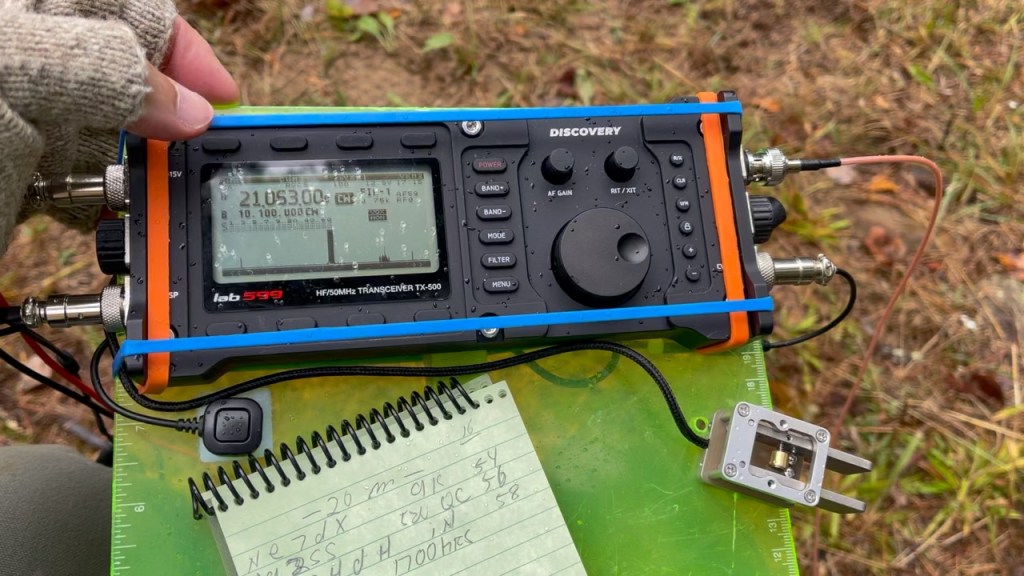
Last but not least is my Lab599 TX-500. This is a great rig for many reasons. Lightweight, simple to use, weather resistant and draws less than 100 mAh idle. It includes a waterfall on the easy to read LCD display. The receiver specs are pretty decent and I have not had any issues using it. I normally pair it with Elecraft T-1 tuner and Bioenno 3Ah battery. For travel I use 3D printed covers.

The paddles I use for this radio are Larry’s N0SA SOTA paddles. These are great paddles but last I heard he is no longer making them.

What is nice about these paddles is they are easy to hold in the hand and can be mounted to a flight deck.

These are my current radios and the paddles I use with them. Is this list set in stone? Of course not, you never know what you might find just around the corner. However, I could be quite happy with these. They are all good perfromers that give me a lot of latitude when operating in the field. Now that my N1CC is complete, I can worry a little less about quantity and a little more about quality. Hope to hear you out there — 73 Scott.

POTA Activation Florence Marina State Park K-2174

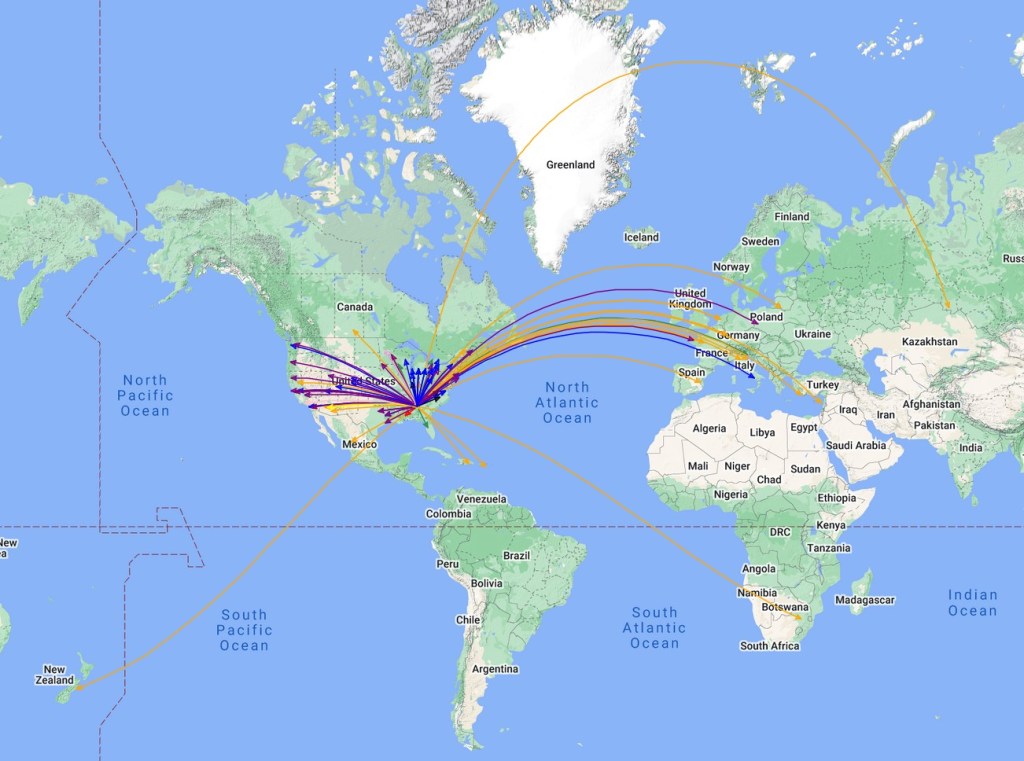
Thursday I made a quick trip to K-2174 to finish up my N1CC award. I needed one band. My wife and I made a day of it since it’s about a 2 hour drive each way. I made 43 contacts mostly on FT8. The bands were in fair shape and we were done in about an hour and a half. Here is a QSO map.

The antenna was my 29′ random wire antenna with a 17′ counterpoise. I really like this antenna. It is my current favorite. The radio was my IC-7300 running about 25 watts. While FT8 is a great mode to use when band conditions are poor, it is not my favorite. Now that my N1CC is complete I will go back to focusing on CW and QRPish. What made FT8 a good fit for N1CC was the ability to find contacts on all the different bands needed. What I didn’t like about FT8 was the lack of cohesiveness between hunters and activators. I have seen on Facebook where activators didn’t care if hunters contacted them or not and some don’t even call CQ POTA. That is not me. Below is a short video of the activation. Enjoy and 73’s — Scott

ZN-Lite II Update

I’ve had these paddles for about a year now but I haven’t used them much. Here is a link to my original review: https://kk4z.com/2021/11/24/n3zn-zn-lite-ii/. The reason is rather complex. they are small but because of their design, they can’t be held in the hand like some other paddles. If you put them on a table with the included Lexan base, they are so light, you have to use both hands to operate them. To me, it was a conundrum. These are very well-built, precision paddles and as smooth as any well-made paddle out there. My original thought was to use them for POTA. I was a little discouraged with their functionality, and even offered to sell them at one point — but I didn’t.

Here lately, I have been pairing my paddles with my various radios. My Begali Signature with my IC-7610, Begali Traveler Light with my IC-7300, Begali Adventure with my IC-705, and my N0SA SOTA paddle with my TX-500. I have a Penntek TR-45L on order. It is a CW-only radio that has a nice retro look. I thought these paddles would be a great match for this radio. What I want for this radio is a set of paddles that can be operated with one hand. The TR-45L is a tabletop radio https://www.wa3rnc.com/store/penntek-tr-45l-qrp-transceiver. I envision its use at a park during a POTA activation. I decided what my ZN-Lite II paddles needed was a heavier base. I ordered from Amazon a 3″ diameter, 1/2″ thick piece of steel.

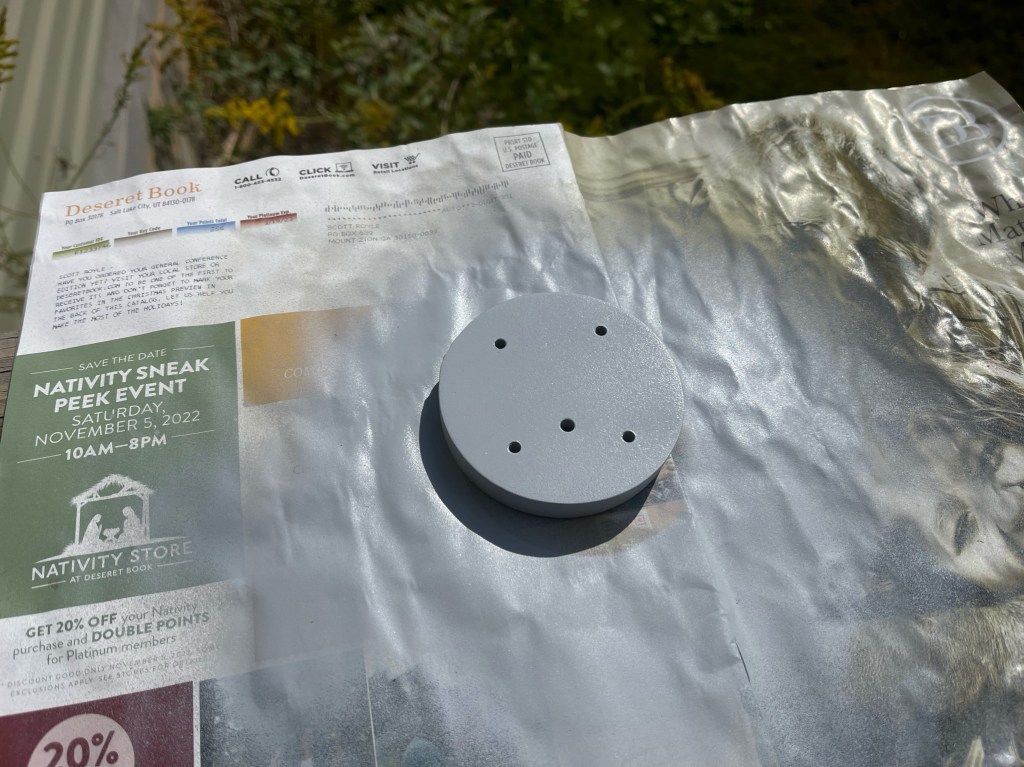
I drilled a hole to mount the paddle and 4 smaller holes to mount the rubber feet. The paddle hole is countersunk on the bottom so the screw head is below (or above) the surface of the base. That way it can be used without the feet.

The holes for the feet were drilled and tapped for 8-32 thread. I had to drill the hole all the way through because I didn’t have a bottom tap. Without a bottom tap, there would not have been enough threads in the hole if I didn’t drill all the way through. When I do these projects, I basically use hand tools and in this case, I used a cheap drill press I bought from Home Depot.

Here is a view of the base from the bottom.

Because the paddle mounting hole is offset from the center, I can mount the paddle two ways.

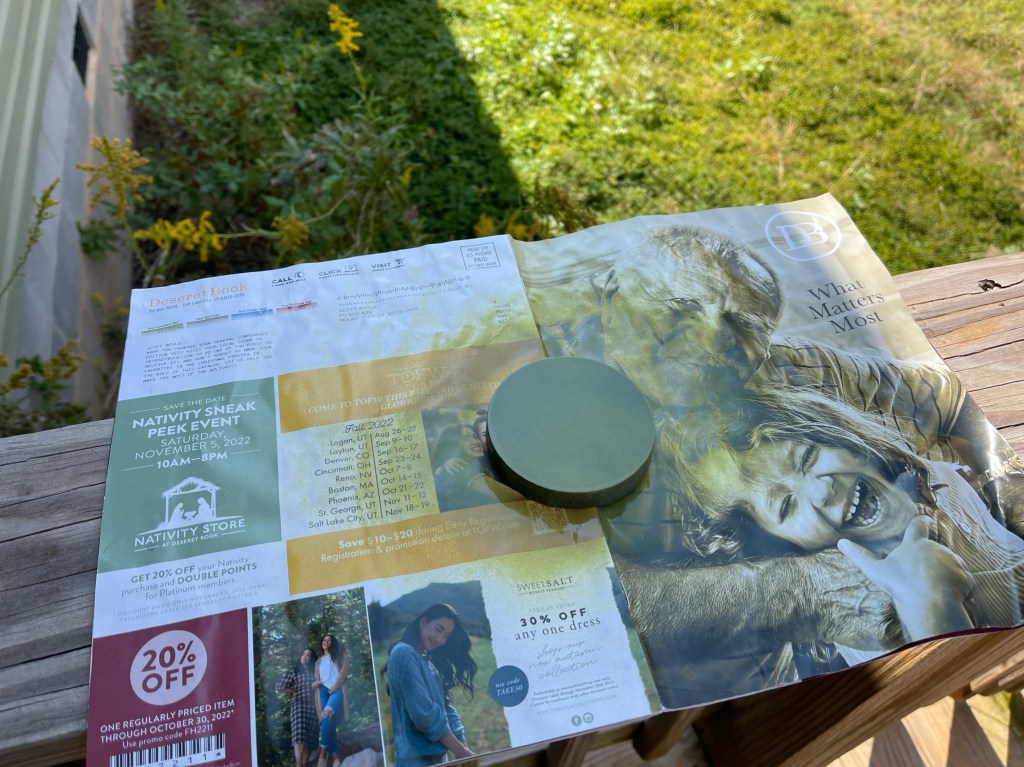
In the bottom picture, the base offers some protection for the paddles. Even though I can loosen the screw to move the paddles to where they face outboard, I found that I prefer the paddles facing inboard like the bottom picture. I feel it offers a little more stability. This mod allows me to use the paddles one-handed on most surfaces. The last step was painting. I put a coat of gray primer, followed by a coat of Nickel Metallic (Rustoleum), and finished off with a clear coat.

I didn’t go overboard with the painting. The main goal was to give the metal a little protection from corrosion. Basically one coat of each with a 15-30 minute wait time between coats. I chose the color because I thought it would complement the paddles. I think it did.

There you have it, a nice set of paddles ready for my next adventure. 73’s Scott

POTA Activation K-3683 Choccolocco WMA

This past weekend was a busy one. Saturday morning The West Georgia Amateur Radio Society provided communications for the Semper Fi Century Bike Ride. We covered routes from 33 to 100 miles on hard surface and gravel roads. It was a good opportunity to get out. This weekend was also one of the POTA Support your Parks on the Air weekend so after the bike ride, many of us headed out to Choccolocco for an overnight activation.

I enjoy these weekends. Yes, sometimes it’s a little less activating and a little more kibbitzing, but we need that in our lives, don’t we? We all set up in one of the primitive campgrounds. Everyone pitched in and brought some food for the group. My donation was chips and my wife’s fabulous Graham Cracker Cookies. They are liked so much, I no longer ask what I should bring.

Operating. This weekend I was working on finishing up my N1CC award which is working from 10 different parks on 10 different bands at each park. For this park, I needed 3 bands. My weapon of choice was FT8. FT8 does a good job of reaching out and there are plenty of folks on it so getting the numbers is a little easier. I will say that over 90-95% of my contacts are either Park to Park or from me calling CQ POTA. I want hunters to get the opportunity to get points as much as possible.

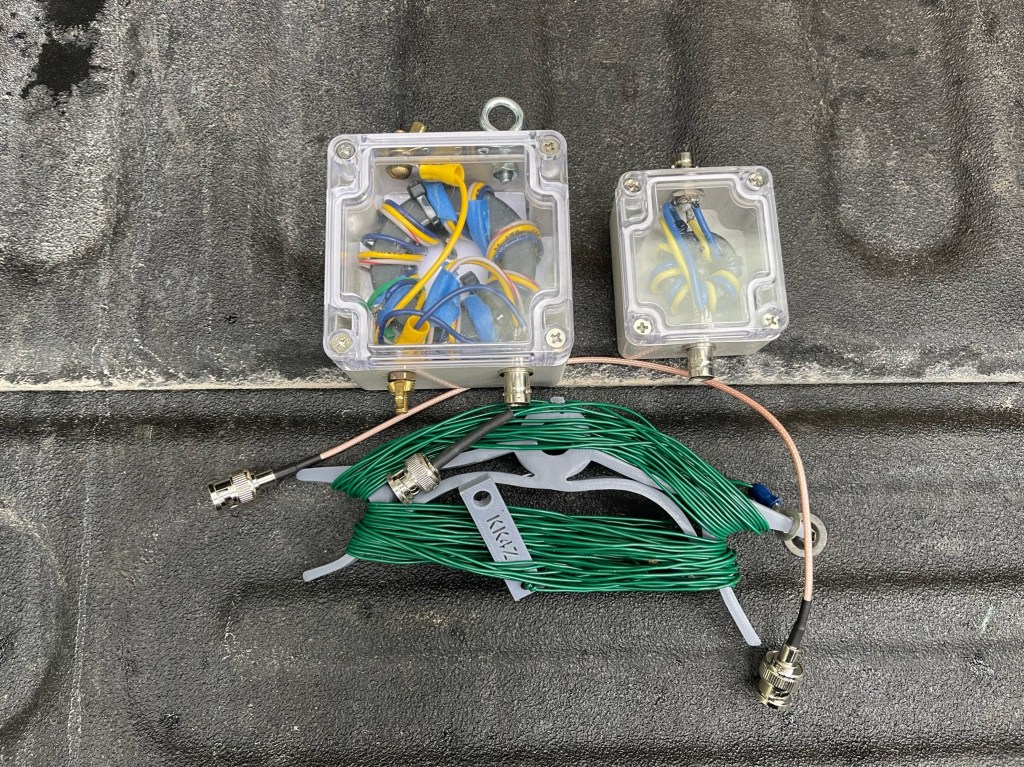
Equipment. For this trip, I brought my IC-7300. It does a great job and I can bump the power up if need be. I normally run it a about 35 watts. My antenna was my 29′ Random wire with a 17′ counterpoise. The antenna was configured as vertical using an MFJ pushup pole. I used a homebrew 9:1 UnUn and a 1:1 current balun to keep the RF where it should be. With this antenna, I can tune from160-6 meters though 160 is a little sketchy. My computer was my Thinkpad T14. Since we were at a primitive campsite which meant no power or water. I ran everything off of battery and in the end, had to crank up the generator for a little while. Digital Mode really uses power.

How did I do? Not too bad. I started Saturday afternoon and operated on and off until about 0100 Eastern Sunday morning. I made 100 contacts from 23 states and 18 countries. Here’s a map.

Unfortunately, later Sunday morning I got rather ill and had to leave early and head for the house. The rest of the group hung around until Sunday afternoon. There are already plans for a Spring campout. I am excited. Camping out is always good, camping out with friends is even better.

What’s left. I have one band at one park to complete my N1CC. Of course, I will have to make 9 other contacts but hey, that’s what we do. After the N1CC I will probably go back to QRP CW. I feel there is more community there. It’s like Cheers, “Where everybody knows your name.”

Final. Here’s a short video of the activation.

Why I’m keeping my IC-7300

I know there’s been a lot of hoopla over the new Yaesu Radios. I am sure they are fine radios and do a great job. These will be fine radios for those invested in the Yaesu environment.

I have owned Yaesus in the past, the last being the FTDX-3000. However, I always seem to gravitate back to Icom. I am not necessarily an Icom fan boy, just that currently, Icom suits me better.

I was tempted to buy the new FT-710. I looked at it long and hard. I schemed about how I was going to buy one. Part of my justification was looking at the specs where I discovered something…

The IC-7300 hears better. The noise floor for the IC-7300 is -133 dBm vs -127 dBm for the FT-710. Rob Sherwood defines noise floor as “Noise floor measures how weak a signal one can hear.” I can work signals on my IC-7300 and IC-7610 with an S0 (zero) on the meter. I’m working a station and the meter is not moving when receiving.

I hear comments about the FT-710 being quieter. It could be possible that Yaesu has a 6 dBm high pass filter creating an artificial noise floor above the actual one? This is just my opinion based on what I see in the specs. That may be why the Icom hears better and the Yaesu is quieter. Ah, but the FT-710 has better close in dynamic range. This is true. The FT-710 has about a 10 db better close in dynamic range then the IC-7300. The question becomes, do you really need it? From Rob Sherwood “What do you need in the way of close-in dynamic range? You want a number of at least 70 dB for SSB, and at least 80 dB for CW. A 10 dB safety factor would be nice, so that means you would prefer 80 dB for SSB and 90 dB for CW.” Unless you’re a hard core contester or chasing DX, the answer might be maybe not. Rob Sherwood put an IC-7300 through its paces during an ARRL 160 meter CW contest. His comment was “I have zero complaints about using it in a CW contest.” This contest would be a good test for any receiver. Like Rob I have no issues with my Icom the way I use it.

Am I telling you not to get a FT-710? Of course not. It’s a fine radio in its own right. Like I said, I was tempted. But, if you already own an IC-7300, the extra expense of buying a FT-710 and/or selling your IC-7300 may not be worth the effort. I’ve owned my IC-7300 since 2017 and can make it dance and sing. I would have to relearn the Yaesu menu architecture and it may take me a while to get the same results as the Icom. I have 4 Icoms with the same/simular menu system so for me it’s a no brainer to keep the Icom. I believe either radio is well suited for the task it was designed to do. I am not really saying the Icom is better than the Yaesu, what I am saying is that the Icom is better suited to me. YMMV. 73 Scott.

POTA Activation K-2939 Cumberland Mountain State Park

I try to get out camping about once a month. It’s good for the soul. While out I am often activating the park. Also fun and relaxing. I book my campsites 3-4 months in advance to ensure I have a place to go. Campgrounds in the southeast fill up fast. This trip was up into Tennessee to the Cumberland Mountain State Park. It was a lovely 4-hour trip with only 44 miles being on an Interstate Highway. The park is located in the Cumberland Plateau Region of Tennessee and my drive included driving through Sequatchie Valley. The valley is rather narrow and you can see the walls of the valley on both sides. I couldn’t ask for better weather. Highs in the 70’s and lows in the ’50s. After a hot summer, it’s was a welcome relief.

The campsite was cozy. This park had a higher density than I normally like, but there was lots of foliage and greenery around to set my karma right.

Band conditions were not that good and I operated FT8 on this trip. I am working on my N1CC award which is working 10 different bands from 10 different parks. Because the park was so far away (200 miles) with gas prices what they are, I wanted a one-and-done which is why I stuck to FT8. My setup was what I have been using on the past couple of trips.

The radio was my IC-7300 and the tuner was an old LDG Z-11 Pro. Since I had shore power, I used a Powerwerx Switching power supply. The computer is a Lenovo Thinkpad T14 which I bought refurbished from Lenovo. It’s a really nice computer. The mouse is a Logitech Pebble which is Bluetooth. For FT8 I also use a GPS dongle to keep the clocks on my computer and radio synced. On FT8 the further you drift from the actual time, the probability to connect to another station goes down. Even at home I sync my computer every day that I use FT8. I also keep a flash drive plugged into the computer. I use ACLog and I have it set up that it makes a backup copy to the flash drive every time the program shuts down.

The antenna is my homebrew random wire. It’s a 29-foot wire setup as a vertical using an MFJ-1910 pushup pole attached to my truck’s trailer hitch. I use one 17-foot counterpoise with a homemade 9:1 UnUn and a 1:1 current balun for a choke. I highly recommend a choke on any portable operation. Keeping RF at the antenna prevents all sorts of things on the radio. I really like this antenna. It has become my go-to antenna. I have probably made over 1,000 contacts with it from all over the world. Since there are no holes in the ground or wires in the trees, the park staff remains happy. On this trip, my campsite was next to the campground host. I can’t say enough about the antenna, it just works, it goes up and down in a couple of minutes, and didn’t cost that much to make. You do need a good tuner though. With this antenna I managed to get my 10 bands. 6-meters was dead the whole weekend so I had to to the other end — 160 meters. On digital modes, my antenna can tolerate about 65 watts max before toroids get saturated. On 160, it’s more like 35 watts. 160 was looking a little sketchy, however, I managed 2 contacts, here is one. I have used this antenna from 6-160 meters.

The IC-7300 has become one of my favorite field radios. Compact, lightweight, and full of features. It has never let me down. I bought mine back in 2017. The only protection I use on it is a set of Portable Zero rails. When I transport it, it rides in a Dewalt Tough System box with no additional padding. Every time I pull it out and plug it in, it works. I have had other brands of radios, but I always seem to head back to Icom at least for HF.

I operated from Friday afternoon until Saturday night. I made 350 QSO’s from 43 States and 18 countries. I worked them from 10 meters to 160 meters. It was a blast. I now have 8 parks with 10 different bands. I have one with 9 and one with 7. I should be able to wrap those up in the next couple of weeks. Then I think I’ll go back to low power (less than 10 watts) and get my CW mojo back in order. See you out there — Scott

POTA Activation Choccolocco Wildlife Management Area K-3683

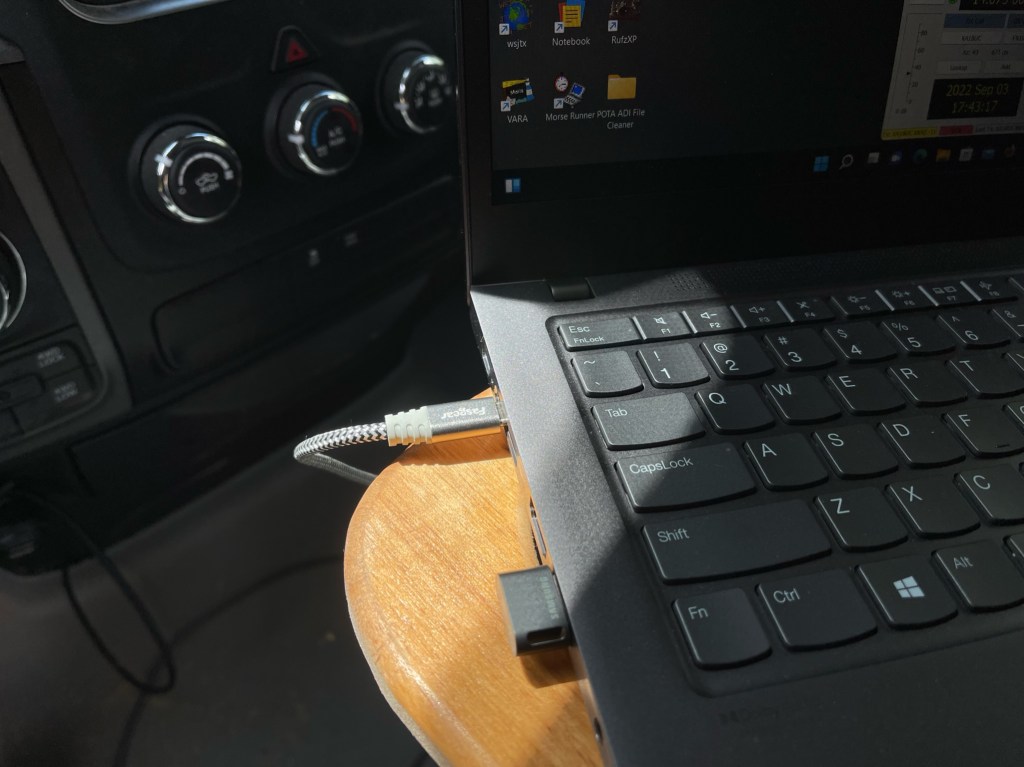
Today I was lucky enough to get away for a couple of hours and play radio. I chose Choccolocco Wildlife Management Area which resides within the Talladega National Forest for a 2-fer. The trip gave me an opportunity to try a new configuration on my laptop. I recently purchased a Lenovo ThinkPad T14s. It has 3 available USB ports. Two type A and one Type C (Thunderbolt). There is another Type C but as far as I can tell it is used for power delivery.

When I operate in the field, I use a flash drive to give ACLog a place to store a backup file when it shuts down. Makes no sense to have the backup file on the same drive. I also use a GPS dongle along with the GPS2Time app to keep my computer’s clock synced. It doesn’t take much of a time difference to lose a contact. That used up my Type A ports. To hook up the radio, I bought a USB type B to USB type C cable and tried it out. I first in error plugged the type C connector into the power delivery port and of course I had problems. When I figured out my mistake and plugged it into the correct port, things went swimmingly. It’s always good to experiment on smaller trips.

Here is the setup in the truck.

I normally have the radio setup where I can better see it, but this was a quick activation. If I ever try a RADAR event, it might look something like this.

The radio was my IC-7300 with the LDG Z-11 Pro riding piggyback. The antenna is my 29.5 foot random wire antenna with a homemade 9:1 UnUn and choke. I use a 17′ counterpoise. The coax is RG316 with BNC connectors. I was running somewhere around 40 watts. Here is a previous picture of the antenna.

The antenna is hoisted in the air via an MFJ-1910 33′ pushup pole in a trailer hitch flag holder. Nothing fancy, but gets the job done. I have since replaced the 3D printed winder with one made from ABS to resist heat better.

How did my little setup do? I think pretty well. Bands were up and down but I managed 26 contacts without breaking a sweat. I did jump around the bands a little bit, trying to get set up for 10 bands for N1CC. I managed to make it to 7. Six meters was dead and it was too early for the lower bands. My club has a campout planned for the fall Support your Parks weekend so I should be able to get the rest. I worked a lot more DX than I thought I would which was a pleasant surprise.

Thanks to all the hunters who worked me and for your patience as I tried to work through some of the pileups I had. It was a fun little trip hopefully with more in the future. Until then — 73, Scott

POTA Activation K-2168 Chattahoochee Bend State Park

Chattahoochee Bend State Park is only 17 miles from me as the crow flies but to drive there it’s 37 miles and takes about an hour. I needed 2 more bands for the 10 band per park requirement for the POTA N1CC award. Since the band that were left were nighttime bands I decided to spend the night there. This park is only a few years old. It is tucked away off the beaten path. It is a nice park, that never seems to be overly filled, which is my preference. Cell service is spotty and you are quite a ways from any grocery store.

Set up was pretty simple. I used my homemade random wire antenna with an MFJ-1910 pushup pole attached to my truck’s trailer hitch. I really like this antenna. Simple to set up and it just works.

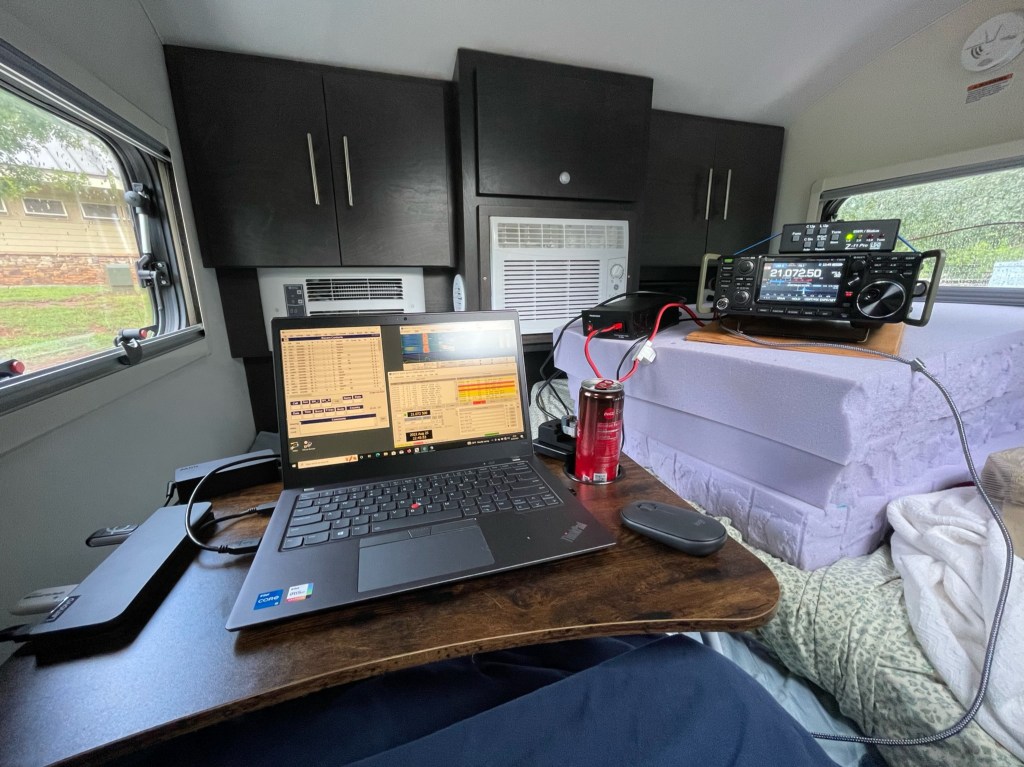
The antenna is fed with RG316 coax using BNC connectors. The exciter was my IC-7300 with an LDG Z-11 Pro to balance things out. New this trip is a Lenovo ThinkPad T14s that I bought refurbished. I also added a mini docking station. I’m kinda nerdy when it comes to computers and can be a little picky. Since it was a one-nighter and rainy, I chose not to set up outside and instead operated from inside the camper.

I decided to cut the memory foam as it is not that comfortable to sit on. This is much better. When I am solo, I will leave the extra foam at home.

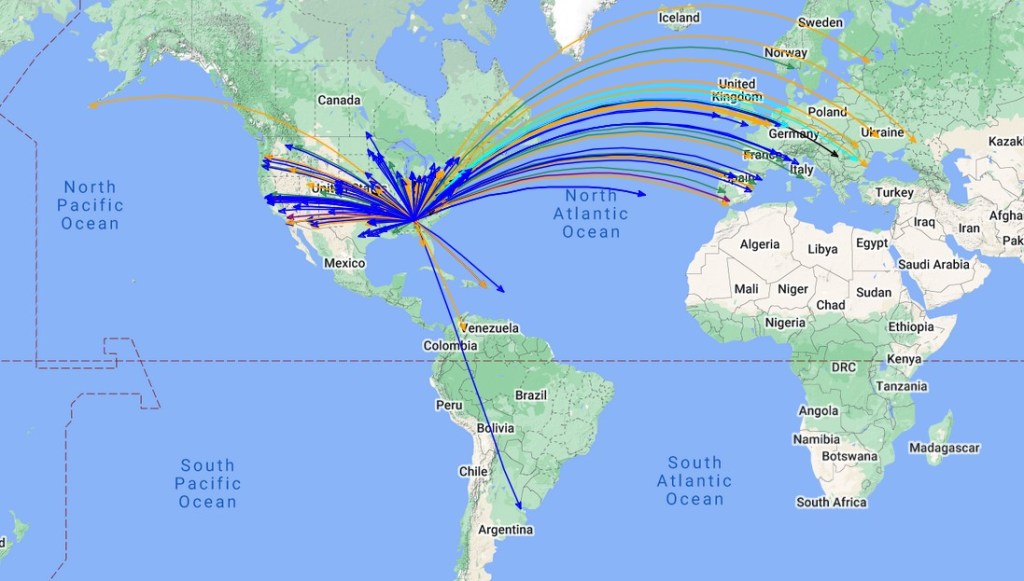
My intent was to use FT8 to get my needed 10 QSO per activation day and get the 2 bands I needed and then switch to CW. However, band conditions were not that good, often with a lot of QSB so I decided to stick with FT8, and even then sometimes had issues completing a QSO. I worked from about 1830 hrs UTC to 0530 hrs UTC or about 11 hours. All I can say is that the bands were –weird. I was working parts of the country I didn’t normally work. DX-wise, propagation was more easterly than usual. Still, I had a good night. I ended up with 200 contacts. I worked 41 States and 21 countries.

Final Thoughts? First a big kudo to all the hunters out there. We have some fantastic hunters who go out of their way to make contacts. Along with the kudo, a big thank you for being there. Probably 99% of my contacts were from me being spotted and calling CQ POTA. Here’s a YouTube video about the activation: