Syncing Computer Time

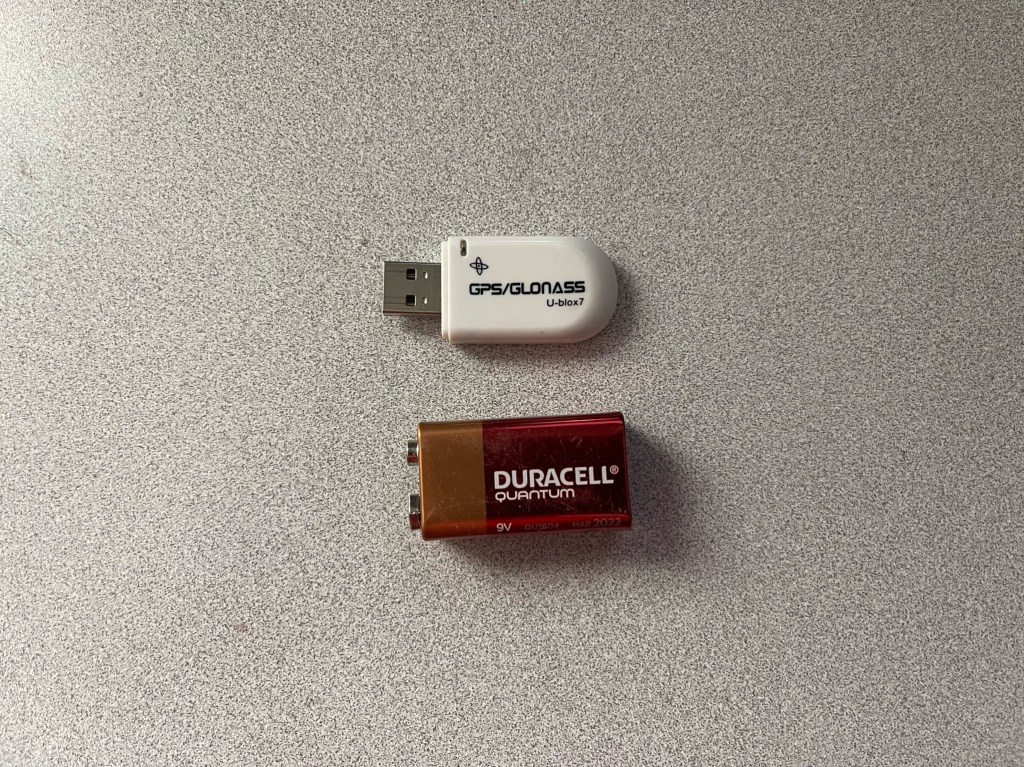
Digital modes have become a mainstay for Amateur Radio. Digital modes are used for conversations, chasing DX, POTA and SOTA, and for EmComm. Indeed we have come a long way even from the turn of the century. Some of these new modes require accurate time synchronization between the receiving and transmitting radios. Off by more than a second or two and the machines will fail to communicate. While operating from home or anywhere else where the internet is available, syncing time is easy-peasy. But what about those times when the internet and even cell service are not available? The easiest way I have discovered is to use the time signal from GPS satellites. It’s pretty easy and the cost is minimal. All you need is a USB GPS dongle like this one:

These can be found on Amazon for about $13. https://tinyurl.com/2p9enmsv.
Next, you’ll need a piece of software that will take the GPS signal, and adjust the computer clock. The one that works the best for me is BKT Time: https://www.maniaradio.it/en/bkttimesync.html


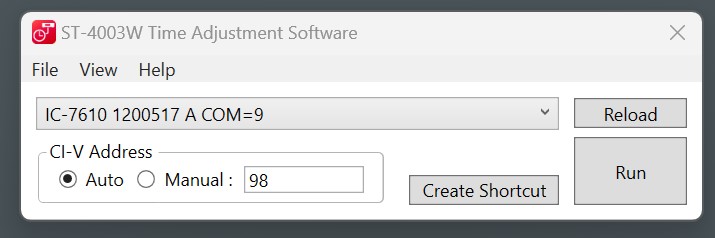
For those that have Icom radios, You can also sync your radios date and time to your computer using an app called ST-4003W which can be found here: https://www.icomjapan.com/support/firmware_driver/3428/

The whole process is pretty easy. I’ve included a short YouTube Video to help you along the way.

Just remember, I am not a great videographer, but the video will give the nuts and bolts on how to sync time. 73 – Scott

Frankentenna – Stealth Mode

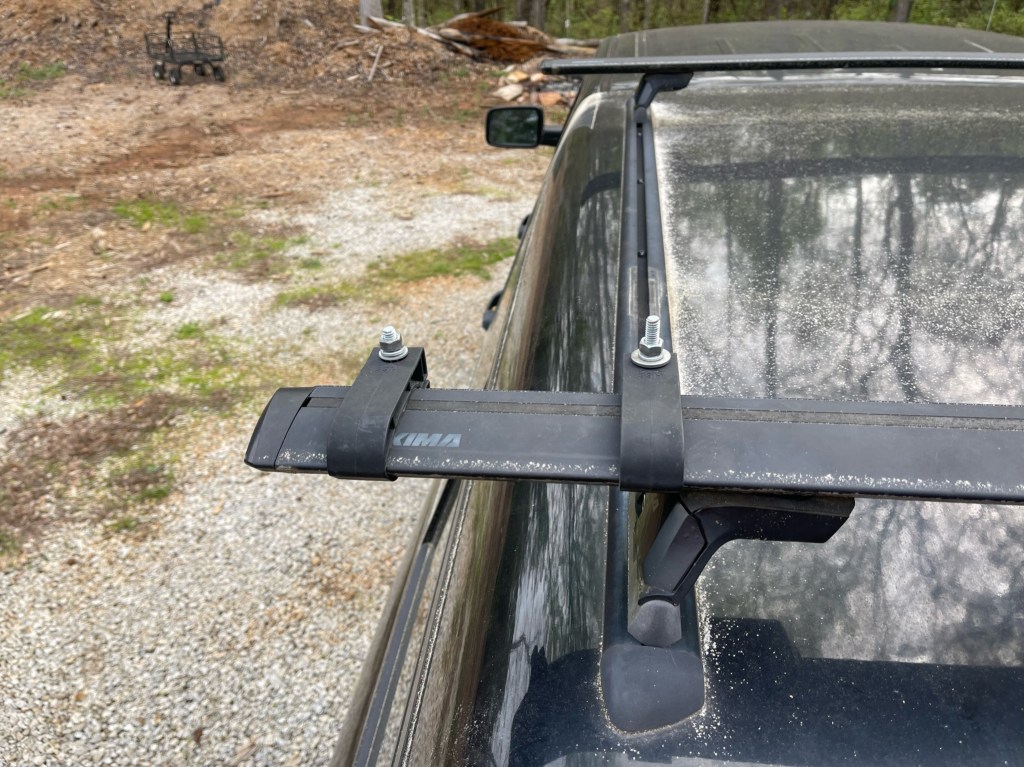
This is part two in my quest to make day activations more park (and park ranger) friendly. With day activations, you tend to be more out in the open and more readily observable. My idea was to reduce my visual signature. Part one was creating a desk for my radio so I could operate it from the cab. With this post, I am adding another modification to my Frankentenna. This antenna is set up to perform multiple roles in different configurations. The whole thing fits inside a regular Buddipole bag and stays with the truck. For this installation, I added a mount to my camper top’s cargo bars and made a ground wire attached to the truck bed. I had most of the parts on hand and spent about $10 for a piece of steel stock.

I start off with a pair of bar clamps I had from another project.

Taking the bar stock, I drilled two 5/16 holes in the end and one 3/8 hole in the center. I then cut it to length, deburred the edges and then gave it a coat of zinc chromate primer followed by a coat of Rustoleum Flat Black.

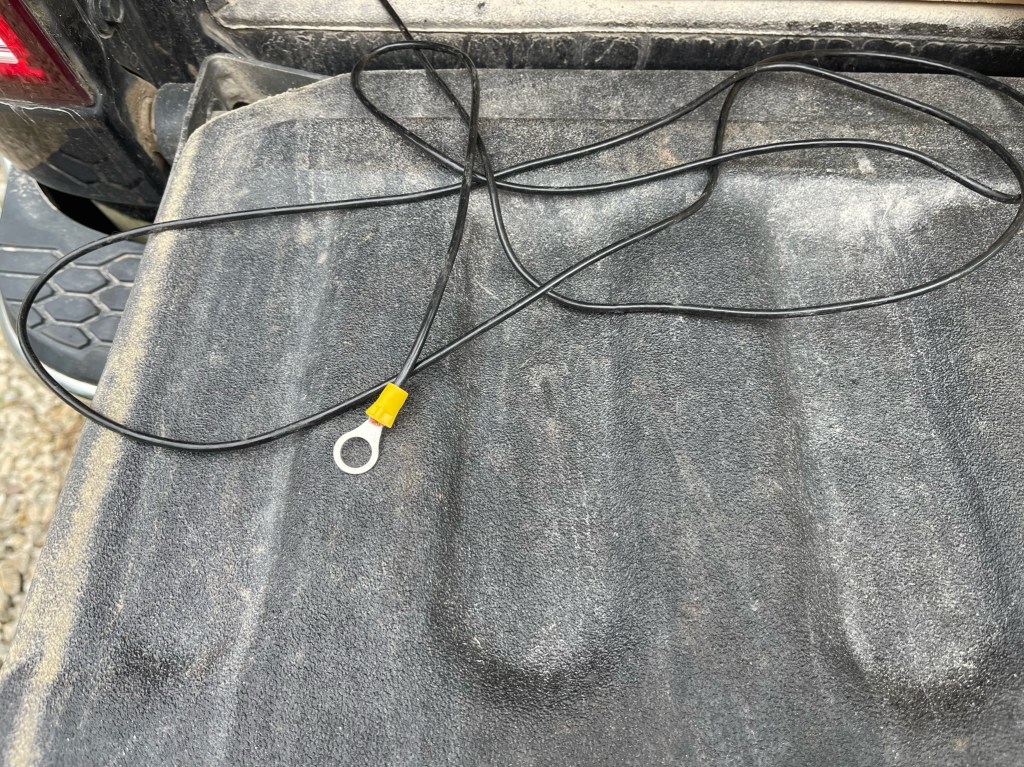
The ground wire was made from some surplus Flexweave I had. I took a grinder and ground a bare spot near the back of the truck bed, secure the wire with a sheet metal screw, and then painted it flat black.

The stuff they use on the bedliner was thick and took some doing to get even a little bare spot! Here are the parts I pulled out of the Frankentenna bag.

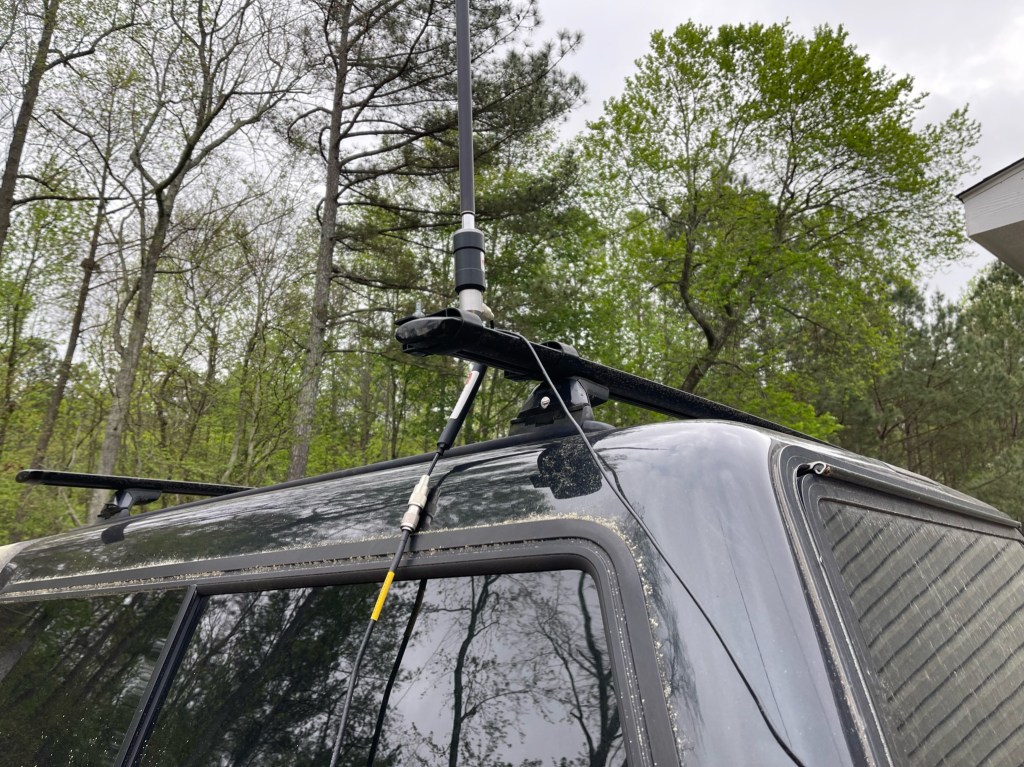
To install, I put a bolt through the bracket I made, then added the ground wire, then the Chameleon Micro, then the whip antenna (Buddipole). From there I add the choke and a length of RG-8X.

I can put this up and take it down while standing on the tailgate. No wires in the trees, no holes in the ground, and nothing to trip over. As you can see the visual impact is minimal.

How does it play? I think quite well. Checking the SWR, for 30 meters and above I am below 3.0:1. Forty meters is 3.4:1, 60 meters is 4.9:1 and 80 meters is 5.7:1. All are very usable with a good tuner. In fact, 160 meters is 8.8:1 but that’s a little sketchy.

Overall, I am pleased with the installation and I feel the performance will be similar to the other Frankentenna configurations using the whip. Now, finding the time to get out. Thanks to all who visit my blog, I appreciate you taking the time to read through my stuff. 73’s for now — Scott

Necessity is the mother of invention

Plato’s Republic he said that *our need will be the real creator* or the proverb as we know it today *necessity is the mother of invention*.  Recently, my friend Thomas K4SWL acquired a Yaesu FT-891.  During his YouTube video, he expounded on how much fun he had with it. It did indeed look like fun. During this time I was pondering about doing more day activations instead of overnights.  With the cost of everything still climbing, the need to conserve becomes apparent.  I thought an FT-891 might really be a great radio for these day activations. Then reality set in.

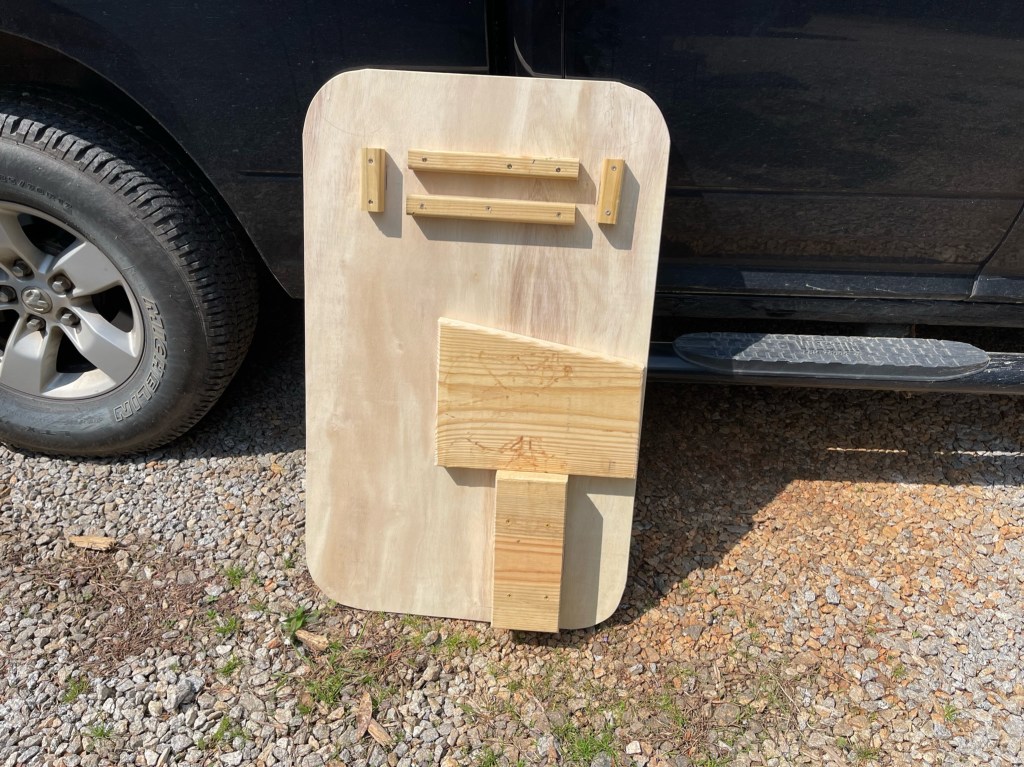
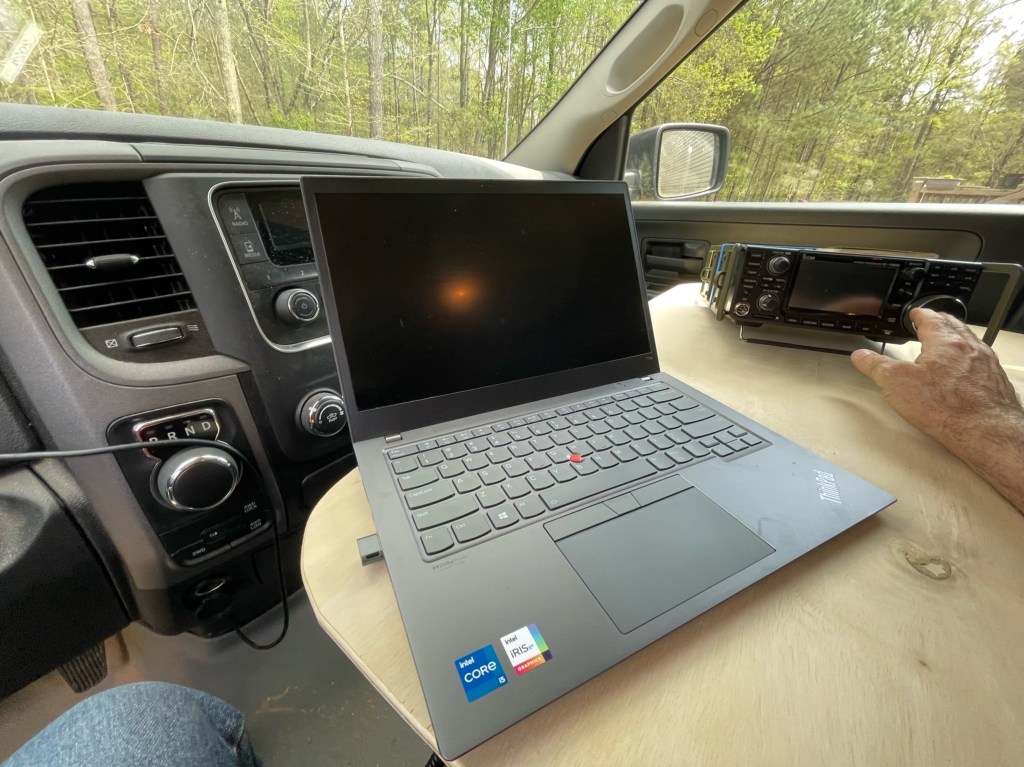
I already have a number of projects I am working on and misc things like maybe having to replace my old 33′ push-up pole, it was not in the stars nor was there a twinkle in my wife’s eye when I mentioned it. In reality, the IC-7300 is a great radio and does everything I need to do especially in the field. I don’t need another radio, I have 3 100 watt radios and 3 QRP radios. I still wanted an easy setup for these one-day activations. I want to drive to a park, set up in a few minutes, operate, tear-down in a couple of minutes, and head for home or another park. I also wanted to make my day activations park ranger friendly. To me that means trying to be inconspicuous. I have two projects planned. The first is a desk for my truck. I am making a desk to sit over the center console and front passenger seat big enough to hold my IC-7300, a laptop and a CW paddle. My plan is to secure the desk to the truck and the radio to the desk. I also wanted to make this as cheaply as possible. I used stuff I had on the property such as a half sheet of plywood and some construction lumber. The only things I had to buy were some screws and eye-bolts, about 14 dollars worth.

The plywood was cut to 24 x 38.5 inches. The length covers the center console and front seat while still allowing me to get to the heat/AC controls. I gave the corners a generous radius and I broke the edges with a router. On the underside, I used a 2 x 12 to make a spacer for the center console where the cup holder is and a leg for the other side over the passenger seat. The spacer is glued and screwed to the desktop but the leg is not attached. This is to make it easier to store. I made a socket for the leg using 2 x 2’s. It’s probably easier to look at a picture than me to try to explain. I added eye rings to the rear of the desk and use a bungee cord to secure the desk to the passenger seat. The only other thing I did, sprayed the top with polyurethane. Note. I am not a carpenter or cabinet maker. I use rough hand tools to get the job done and I am often making do with what’s on hand or what’s the cheapest way to do it.

Putting the desk in the truck, everything feels good. I brought out my IC-7300 and laptop and placed them on the desktop. There appears to be plenty of room for both plus a set of paddles. I will use the desk a few times before I decide where the radio will end up and then figure out how to secure it. I am pleased with the result. While I thought having an FT-891 would be fun, in reality, the IC-7300 is better suited to my operating style.

The desk was comfortable to use and the truck can be driven when it is installed. Without the laptop, there is plenty of space for a notepad or an iPad. Now, if I could just find the time to get out and operate. 73 — Scott

Georgia Parks on the Air at FD Roosevelt SP K-2173

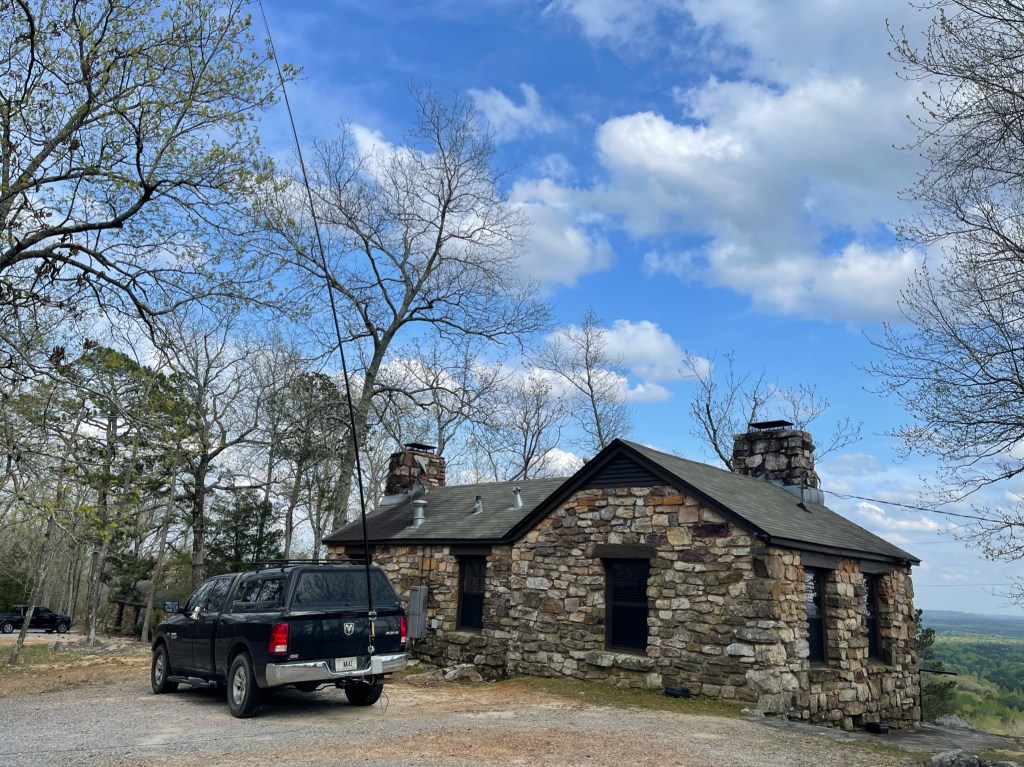
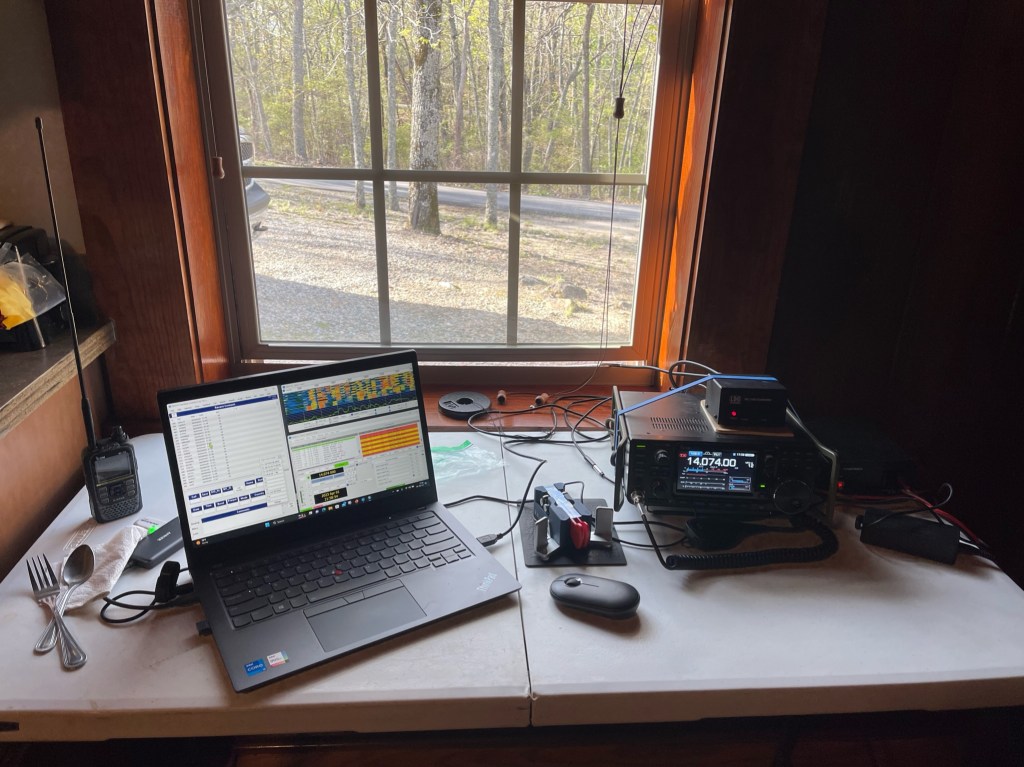
Friday evening, Mary K4SEZ and I traveled to FD Roosevelt State Park for a weekend in a very nice cabin. The cabin is located on Pine Mountain with some exceptional views. As you can guess, I brought some radios with me. I went QRV right before 1800 hrs. local to make sure all my equipment worked prior to the contest. Besides, the contest I had a regional HF net that I needed to check into Saturday morning. The contest starts at 0800 hrs local Saturday and the net was also at 0800 and lasted about 20 minutes.

Friday night was amazing! Twenty and forty meters was wide open. Using FT8, I made 223 contacts between 1800 hrs Friday and 0300 hrs Saturday morning. I worked stations as far west as Japan and Australia and as far east as Rwanda, Ukraine, and European Russia. Unfortunately, the rest of the weekend was not near as exciting. Between 0800 hrs Saturday morning and 1230 hrs Sunday, I made an additional 477 contacts. The bands were up and down and the pace was a little slower. I worked 48 States and 34 countries when it was all said and done. Sunday morning had an opening on 10 meters and I made 19 contacts many into Europe. In total, I had 700 contacts.

My antenna was my tried and true homebrew 28.5-foot random wire antenna which I named my K4SWL antenna as the original idea from Tom.  It uses one 17-foot counterpoise.  On this trip, the wire I used was 14 ga (I think), coated Flexweave I got from The Wireman many years ago.  I was using some 20-something gauge I got from SOTABeams but because I use this antenna a lot, I worried about the thin wire breaking.  I use a 9:1 UnUn with a 1:1 current BalUn to help with matching.  The antenna is matched by an LDG RT/RC 100 matching unit.  This is fairly new to and so far I like it. The tuning circuit out by the antenna helps keep stray RF out of the shack. It was also quite windy here Friday night and Saturday.  The antenna held up well.  The only issues I had were some of the sections on my MFJ push-up pole would collapse affecting the tuning.  This pole is probably nearly 20 years old and should be replaced.

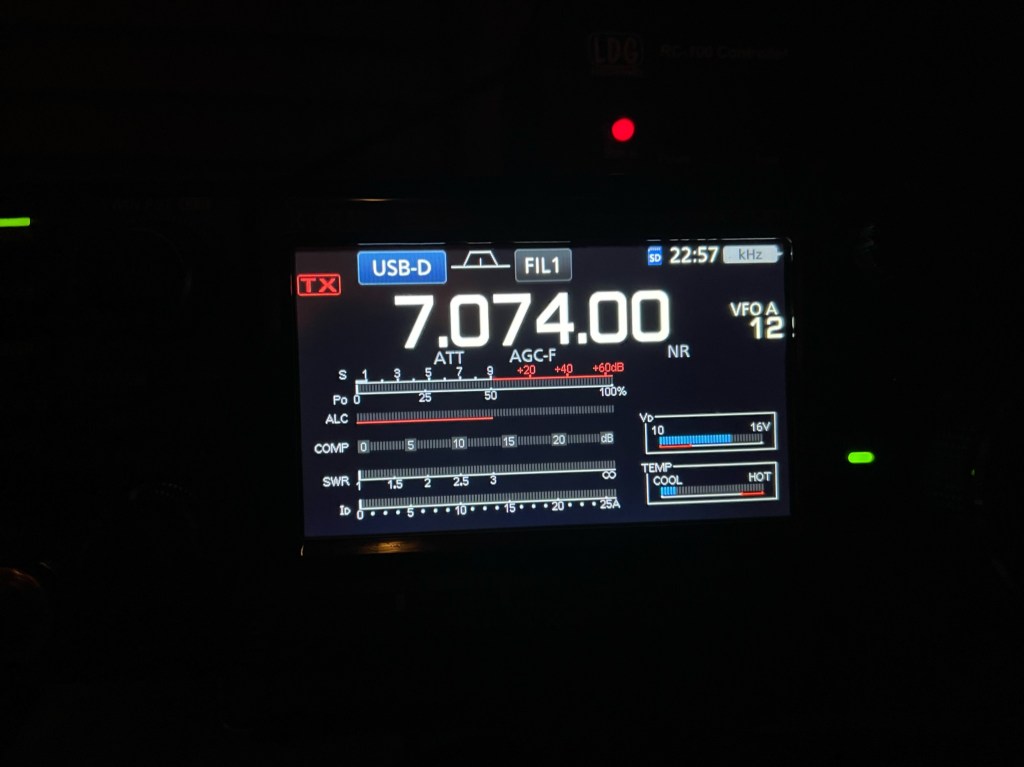
The radio was “The Rock” my IC-7300. I ran FT8 the whole time at 35-45 watts and the temperature gauge on the radio never moved past cool. Now that the FTDX10 has found a home in the shack, it’s nice to have my old friend back in the field with me.

The cabin is located on the ridge line of Pine Mountain, elevation ~1250′ ASL. Besides great views, it also gave my antenna a large aperture which may account for the many DX contacts I made.

I mainly worked FT8 as I also had to listen to a couple of conferences on the Internet and didn’t want to disturb my wife when she was doing things other than radio. We had a nice weekend away and of course, being able to bring radios is a huge bonus. When I get back home and settled, I may send the log to the GA POTA people. I don’t really contest anymore but they might find it useful for cross-checking.

Here is a YouTube Video of the activation.

Ramblings

This weekend is the Georgia Parks on the Air Contest. I will be at a park operating CW and FT8 depending on band conditions. I will not be contesting. I have participated in contests in the past, but now I look at contesting like I look at a job. Neither is really fun to me. If you see my signal, give me a call I will be uploading it into POTA and LOTW.

Radios. This weekend I will be bringing my Icom IC-7300. It is still one of my favorite radios. If I could only have one, the 7300 would be it. I still have the FTDX10 and it has become part of the home shack. It shares space with the IC-7610. The 7610 is still my workhorse and it is hooked up to the amp. It does everything well. That doesn’t mean that the FTDX10 isn’t used. I think I use them about 50/50. I like to use the FTDX10 for casual CW like hunting for POTA activators. I rarely go above 50 watts and the built-in tuner will tune my antenna well.

A side benefit of moving the FTDX10 to inside the shack, is I use it more and I am more apt to dig into the manual. There are things I like about the radio. One is the roofing filters. The filters, along with DNR do a pretty good job taming QRN and QRM. The radio is more pleasant to listen to. Another thing I like is the way split operation works. Once you set up the split, the main dial controls the receive frequency, and the outer ring controls the transmit frequency. As a chaser, I need to be able to move my transmit frequency around while keeping the receive frequency steady.

Another nice feature is the ability to transmit CW in SSB mode. The Icoms do not do this. I check into a net that also allows CW check-ins. With the 7610 I use the Memo Pad to switch between SSB and CW (with a -600 Hz transmit offset). I also use the second receiver set to the SSB freq. Once set up, when they ask for check-ins, I hit the memo pad read button, send CW and then hit the memo pad read button again to return to SSB. With the FTDX10 I set the TX Clarifier to -600 Hz and turn it on to send CW and off to send voice. Easy Peasy. The benefit with the FTDX10 is if the net moves due to QRM I am instantly ready, whereas with the 7610 I would have to reset the memo pad.

I find that I like the FTDX10 more in its role as a shack radio. It was okay in the field, but it is better at home. It sits on the left side of my desk which is ergonomically better. As I said in the past, it is a left-handed radio.

The FTDX10 is a keeper, the more I use it, the more it endears itself to me. The IC-7610 is not going anywhere. It still runs with the best of them. Is there an FTDX101 in my future? Maybe. If I get one, I would probably sell the 10 and still keep the 7610. If I make my desk just a little bit bigger…

73–Scott

LDG Tuner Mod for the IC-7300 and a Big “THANK YOU”

Thank you, Thank you, Thank you.  This blog, KK4Z.com recently surpassed 10,000 views. I never imagined that happening.  I appreciate your support as it encourages me to continue on.  KK4Z.com will remain without fees or subscriptions with the ideal of enhancing the amateur radio community by sharing my experiences and projects to spur you on to your own adventures wherever and whenever they may be.

Recently, I purchased an LDG RT-100/RC-100 (hence RT-100) for use with my Yaesu FTDX10 in the field.  As I have said previously, The FTDX10 now resides on the desk at the home QTH.  It is better suited there.  My main field radio is my trusted Icom IC-7300 so why not adapt this tuner to it. 

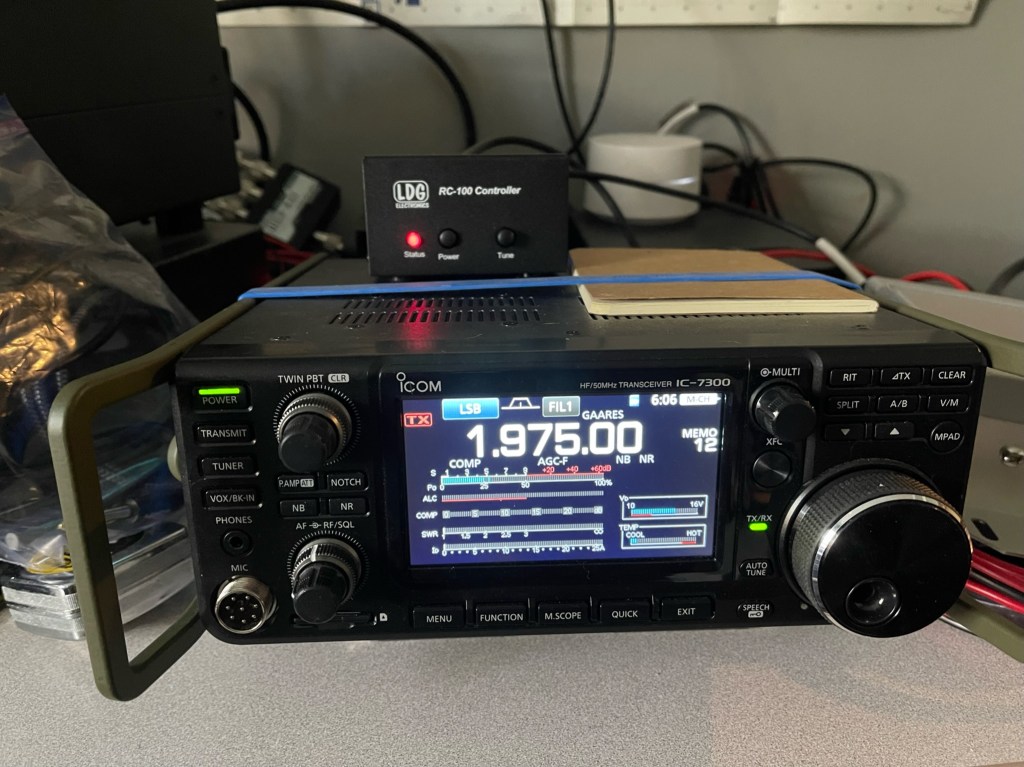
The RT-100 is an auto tuner and doesn’t require a special tuning circuit.  Icoms are set up in such a way that when using a tuner such as the LDG Z11 Pro or the Icom AH-4, the radio automatically detects the tuner and switches off the internal tuner.  It also supplies power at the tuner port through pins 3 and 4. With the RT-100, there isn’t a way to make this switch since it only requires power to operate.  What I wanted was to use the power from the tuner port on the back of the IC-7300 to power the tuner and turn off the internal tuner. I had to “trick” the IC-7300 into thinking there was a tuner there in order to get it to supply power to the RT-100 through the tuner port.  

This is accomplished a lot easier than it sounds.  Starting with a diagram created by KC2WI http://www.prnewell.com/kc2wi/Icom_tune_control/)

I only needed pins 2, 3, and 4. Pin 4 is the ground, pin 3 is power and pin 2 is what tells the radio an external tuner is present. It requires a resister in series and I used a 47K ohm 1/2 watt resistor. I did not incorporate the switch and I did not utilize pin 1. Here is a parts list:
Molex Connector https://tinyurl.com/mw24chcc
47K Ohm Resistor https://tinyurl.com/43ax8kc9
2.5mm Power Cable https://tinyurl.com/2p8d466j

Starting with the basic parts.

It’s just a matter of soldering the parts to the pins.

And putting the pins in the right holes.

The pointy end of the connector is facing up.

I added a little heat shrink and electrician’s tape and viola!

When assembling, make sure you put the pins in the right holes and in the right direction. The pins will go in either way as I found out.

How does it work? It works well. The Icom power at the tuner port is rated at 1 amp and the tuner draws about 500 milliamps. This saves me from having to make an extra power connection. The RT-100 is a tune as you go type tuner so the tune button on the radio does not work. The way I tune when not using a digital mode (software has its own tune function), is to switch the mode to AM and then hit the transmit button or PTT button if a microphone is attached. This transmits a carrier at about half the wattage of your current power level. When the tuner finishes, stop the transmit, switch the mode back, and you are ready.

My next adventure will be the first weekend in April during the GA Parks on the Air Contest. I will not be contesting, but I will be operating portable at a park using FT8 and CW. I may try some FT4 to. Hope to hear you out there – 73 – Scott

Where’s Sheldon?

Sheldon is the name I gave my FTDX10. Like Sheldon Cooper from the comedy series “Big Bang Theory”, the radio is smart but at times awkward. I bought the radio back in October 2022 to compare it with the the IC-7300 as a field radio. I used the radio at home and in the field for the past 6 months. It gave me a pretty good opportunity to put it through its paces and here are some conclusions about my overall feelings for the radio.

I wish to start by saying, I do kind of like the radio. Even though there are a lot of things I don’t like about the radio, at the end of the day, well, I kind of like it. When evaluating the radio, at times I felt like I was trying to pound a square peg in a round hole. Once I realized that, I felt I was being unfair to the radio so, in the next couple of paragraphs, I will try to right a wrong.

What the radio is not. The radio is not a field radio. It draws too much power, it is awkward to use, it is too heavy and a little too big. The ergonomics leave a little bit to be desired. My QRO field radio remains the IC-7300 and it is still the radio I recommend to people just getting started in amateur radio. After 6 months, the FTDX10 will go to the field no more.

What the radio is. I recently redid my radio desk and decided to fit the FTDX10 in the mix. At home, it is a different radio. I have it set to the left side of my desk and that improved the ergonomics. I guess I am saying that the FTDX10 is a left handed radio. I am using it as a backup radio for my IC-7610. However, I find myself drawn to it when operating CW. I have the 300 Hz roofing filter installed and on CW, it is a joy to use. One of the things I didn’t like was the Mat-30 tuner I bought for it. At home, I have a 270′ OCF dipole that tunes rather easily, so I use the radio’s internal tuner. I’ve never had much luck using external tuners with Yaesu radios, in this instance, Icoms are so much better.

Conclusion. I had originally thought I was going to sell the FTDX10. But since putting it in its proper place, in the home shack, on the left side, I believe I am going to keep it. I really enjoy using it for CW and It does make a great backup radio. I do not have it hooked up to the amplifier, so it is a 100 watt radio. The Sheldon experiment was a success. It showed some of the radio’s shortcomings, but it also showed its strong points. 73’s Scott

Macon EmComm FTX

March 11, 2023.  Saturday morning I drove down to Macon, GA for a training exercise/Field Day with the Macon congregation of my church.  I am the EmComm coordinator for about 15 of these congregations located throughout the northern half of GA. I was invited to provide technical assistance and give an overview of the EmComm structure for the state, regional, and national levels. We met at the Flat Creek State Fishing Lake (K-7465) near Perry GA.  We had an open field reserved for us and it turned out to be a beautiful day.

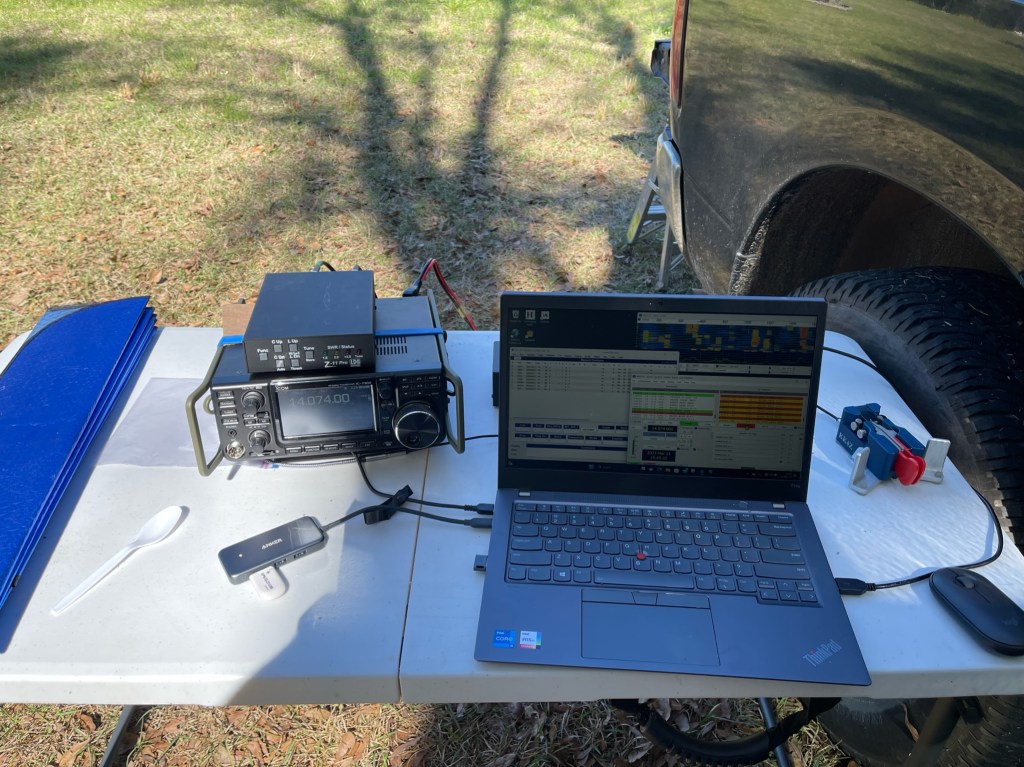
I did set up a station.


It had been a while since I used the IC-7300 in the field because I was evaluating the FTDX10 as a field radio. These little mini-exercises are a great way to check your gear and make it works the way you intended it to.  This was a prudent exercise as switching my computers back to the Icom were a little more trying than I had originally thought.  The Yaesu’s take a little more fiddling than the Icom’s and I had to unfiddle my laptop to get things going again.  Once I got that sorted, I had an issue with a new tuner.  I recently bought an LDG remote tuner to use with my random wire vertical antenna.  It worked great with the Yaesu but I could not get it to work with the Icom.  Luckily I had my old Z-100 Pro so I swapped them out and continued on.  The issue was a short between the ear cups.  When I ran the remote tuner with the Yaesu I hooked it up to a battery for power.  With the Icom, I tried to use the antenna tuner port on the radio and it didn’t work.  It wasn’t until I got home that I figured it out.  To use the remote tuner, it has to be hooked up to a battery/power-supply.  Testing at home confirmed my hypothesis. My guess is that the tuner draws more power than the Icom can handle. 

My main purpose there was to help people sort out their radios and give an overview of our EmComm program.  This is to say that I did a lot more talking and a lot less operating.  However, I did manage to demonstrate Winlink, by sending an email out to a few folks and I did a POTA activation at the park with the minimum 10 contacts.  

Here is a QSO map.


It was a good day.  I got to see some old friends and make some new ones.  I was able to help a few get their rigs in order.  I was able to sort through my own issues; better now than during a real EmComm event. After action?  I resolved the tuner issue.  I am going to sort my antennas a little differently and clean out my POTA/Portable box.  I am always looking at what I use and what I use it with.  The idea is to be able to efficiently setup a station without having to search high and low for things. A place for everything and everything in it’s place.  73’s  Scott

Where’s KK4Z?

In addition to fun things like camping and portable amateur radio operating, I do a lot of emergency communications (EmComm) work. Over the past year and half, I have been setting up a communications network for my church over a large area (about half the state of Georgia). It is now up and running fairly well and I have enough trained net control operators to turn this function over to them. I still have more EmComm work to do but now it is at the local level. I also perform EmComm duties at the regional and national level; however, that is less taxing.

Over the past couple of months I had taken a hiatus from everyday amateur radio operation with the exception of winter field day with my local club. to be honest, I needed the break. One activity I enjoy is Parks on the Air (POTA) with CW being my primary mode. I used to visit the POTA Facebook page but I was finding the crowd becoming a bit churly. I guess that’s a function of growth and POTA is rapidly growing. Fortunately, the CW side of POTA is still rather civil and my cure was to avoid Facebook. I should have avoided it all along. So after giving myself a POTA rest, I am starting to venture out into POTA land, this time sans Facebook.

My gear hasn’t changed. At home, my primary HF radio is still the IC-7610 and has been with me for 5 years now. I had thought of maybe trying a Yaesu FTDX101 but after reading some reviews where they tried the FTDX101 but went back to the IC-7610, I’ll keep mine. A common theme is the ergonomics.

I still have my FTDX10 and I compare it to the IC-7300. It is part of my long term test. Like the FTDX101, the 10 suffers from poor ergonomics. At times, it gets in the way of itself. I know everyone is using Sherwood Engineering’s test data to tout how great the FTDX10 is; however, running the FTDX10 next to the IC-7300, the IC-7300 can and does work any station the FTDX10 can, even under contest conditions. In fact, the IC-7300 has a lower noise floor by a factor of 4. I admit that the FTDX10 does sound better, but overall performance still goes to the IC-7300. At this point in the game, I am not ready to sell either one, but if one had to go, it would be the FTDX10. Both these radios are used as field radios.

While testing the above 2 radios, I have been neglecting my QRP radios. Typically, when I go camping, I bring the bigger radios. I have room in the truck/camper, so why not. At most, I have to carry them 15-20 feet. My little radios have been languishing in the dark, unused and unloved. This year, I plan to break them out more. At this time, I have 3: IC-705, TX599 and TR-45L. Of the three, the IC-705 is the favorite. It’s just a good radio, with great performance. Nothing can touch it in it’s price range. If the trend continues, bringing big radios out to the field, one or two of the little ones will go.

I hope to hear your out there. Few things are better than spending a day or even half a day in a park, on a nice day, with a radio. 73’s Scott

Winter Field Day

This year the West Georgia Amateur Radio Society (WGARS) decided to hold winter field day at Little Tallapoosa Park in Carroll County, GA. I would call the event semi-serious. I don’t think any of us are real hard-core contesters, but some of us watch the numbers. The majority of our members operate using SSB and I was the only one operating CW. The plan was for me to get as many bands as I could for multipliers. That meant I had to be able to swap bands fairly quickly in order to advantage of changing band conditions. We had five stations set up, 4 of which had bandpass filters. Because I didn’t have any bandpass filters I was located about 100 yards away from the main group.

Gear. I brought the FTDX10 with me to see how it would do in a semi-contest environment. It fed a Mat Tuner, Mat-30 tuner, and then to my 29-foot random wire antenna. This has become my favorite antenna. I logged with N3FJP WFD software and used a K1EL keyer. The computer and radio were powered by a Honda EU-2200 generator (we ran alternate power). This generator is very quiet and is very fuel efficient. The rest of my camper was fed with shore power at the campsite. I kept warm with a little ceramic heater.

Operation. This year I tried something new. Not only did I use the N3FJP software for logging but I also used it to send CW, in other words, I did everything from the keyboard. I was a little apprehensive, aren’t we all when it comes to something new? But I found it worked quite well. Band conditions, on the other hand, were not that good. They were up and down with a lot of fade. By being able to jump around I was able to work 100 contacts on 5 different bands. I was hoping for more, but there weren’t a whole lot of stations out there to work. I thought it might have been my station, but looking at the QSO Map, I was getting out okay.

Cold weather may have kept some CW ops at home. It gets harder to work a key or paddle when your hands are cold.

FTDX10. Part of my ongoing review of this radio. You really can’t get a feel for a radio or any piece of kit unless you use it over a period of time. My other radios are feeling the pain of neglect. How did it do? Not bad really. I made an effort to try the CW decoder. There were times were I really needed it due to QSB (fading). Sometimes the band would drop as I was getting the exchange. The decoder often picked up what I missed. It is not a replacement for your ears and mind. But it did help and made me a little more efficient. My hearing is not that good. The decoder is sensitive to CW speed. It does best when it is close to the sender’s speed. I set the outer dial (MVLP) to CW speed for this purpose. While I normally set the function knob to RF power, because band conditions were so variable, I set it to level (waterfall level) which allowed me to adjust the waterfall as needed. The radio performed well and I appreciate the roofing filters. I had one issue and that was I would tune across the band and about every 10 KC the waterfall would go dark and I would have to retune the antenna system. That became rather annoying. There is an example of what was going on in the activation video below. Very quickly, I got a response from one of my subscribers stating that it was the tuner and not the radio. This morning, I broke out the radio and tested it with the Mat-30 to make sure I still had the problem here at home (I did). I then swapped the Mat-30 for my old LDG Z-11 Pro and viola! The problem disappeared. You can see the results in the second video.

I think my club as a whole had a good time. It is fun to get and socialize, plus throw in a little operating. When testing a radio, or any piece of kit, You can’t really do it justice over a couple of days. I’ve had the radio for a couple of months, and as I work through the issues, I find that sometimes we don’t know each other that well yet. It’s still early in the dance. I will say that I am warming up to the radio more than I thought but I still say that if I had to choose between it and the 7300, the 7300 would still be my choice. However, that gap is getting narrower. If Yaesu would make a few software upgrades…