Night on Bald Mountain

This trip was to Cloudland Canyon State Park located in NW Georgia. It is a very nice campground about a 2 hour drive from the home QTH. I got at the campground Tuesday, around 2000Z and quickly set up. Radio du jour was the Yaesu FT710 Field which is currently under review. The antenna was my 28.5’ random wire vertical. I am also trying out my Maestro Evolve III laptop along with HAMRS Pro software.

Band conditions were a little off so I started on FT8. It was slow going but I made 15 contacts before the new day. After supper, I went back to FT8 to try to get 15 more contacts before the storms hit.

The whole time I had moderate winds and some pretty good gusts. Right before the storms I lowered the antenna and put a garbage bag over it to keep it dry. The antenna is weather sealed, but the push up pole when it gets wet, is a real pain to dry out.

How about the FT710? In general, I like the radio. I think it’s a keeper. It is fun to use and performs well. It has a few niggles that I camp about but I like it. I talk more about the issues on my YouTube video. I will say that this radio is very different than the first one I got. The first radio was probably released too early and still had growing pains. This radio just feels better. In general I feel this radio and the IC-7300 are about equal. Either one will work well.

Evolve III. This is a pleasant surprise. I paid about $122 for it and for a field laptop it does well. Last night I ran WSJT (FT8) and AcLog without any issues. I was also running. BktTimeSync with a GPS receiver in the background. It is a little slow to start up but once it’s running, it does fine. I run it with a Logitech M310 mouse.

I am also trying out HAMRS Pro. I have it on Windows, Mac, IOS (iPhone, iPad) and they all sync up. I will talk more about HAMRS in a follow up article.

This is Wednesday morning and I am going to try to do some CW before I pack up and go home. Bands conditions are so-so at the moment. I will break my normal procedure are hunt a while to try out some of HAMRS features.

I only managed to make one CW contact hunting and activating. I could tell I was getting out as I showed up on HamAlert. Here is a QSO map of the activation.
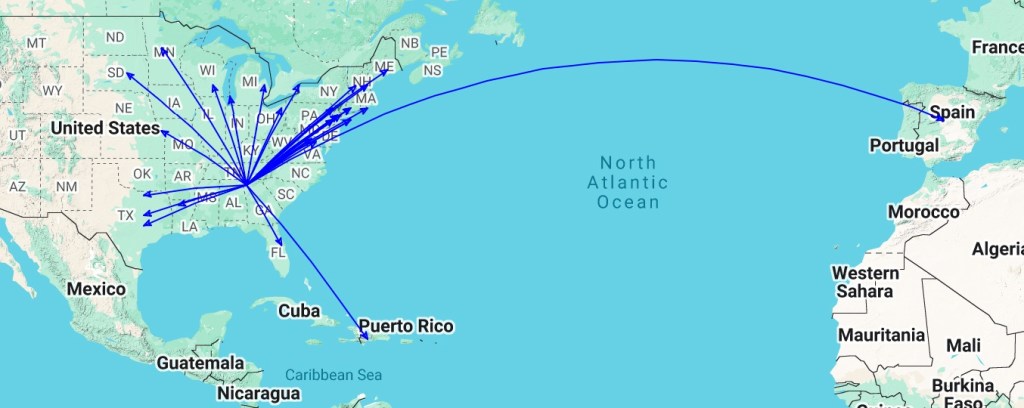
Screenshot

If I remember correctly, I had issues last time I was at Cloudland. The important thing was I got out for a while and I had fun. It isn’t always about the numbers. Below is a video about the activation and my thoughts on the FT710. Stay tuned es 73 Scott

Moving things around

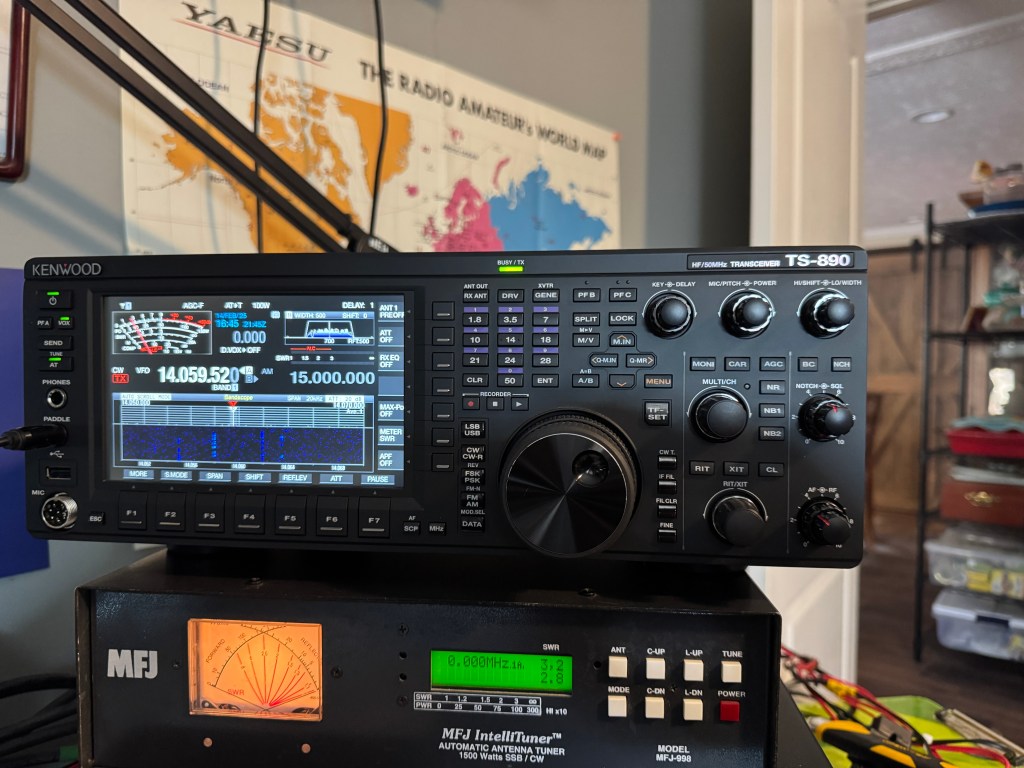
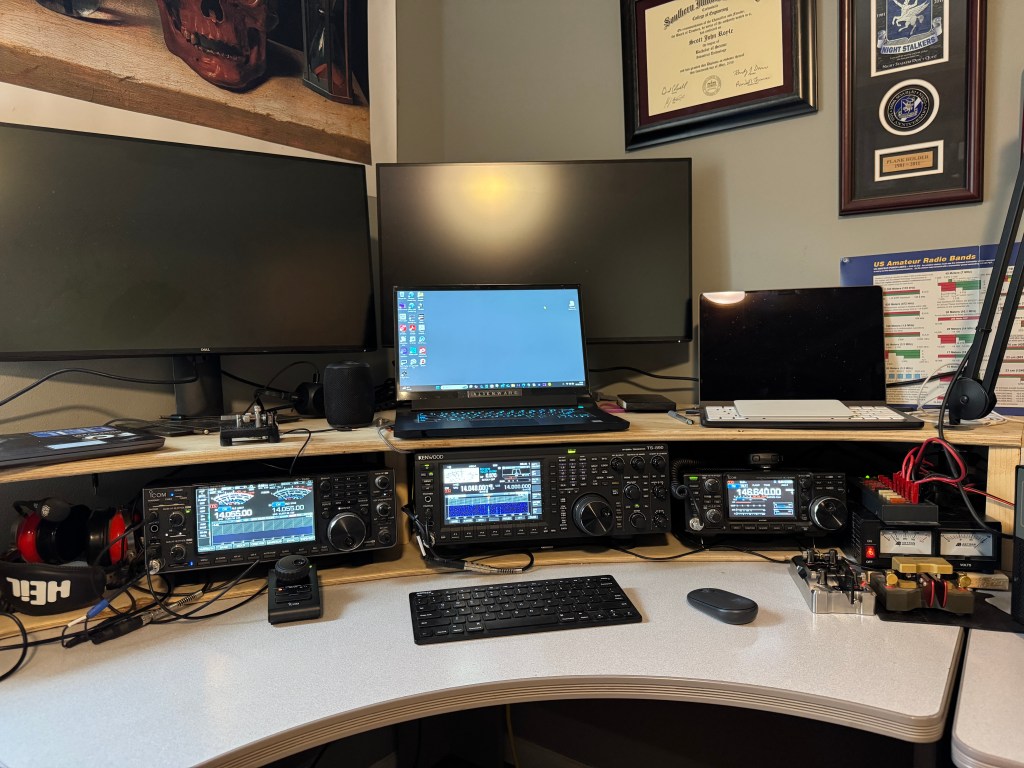
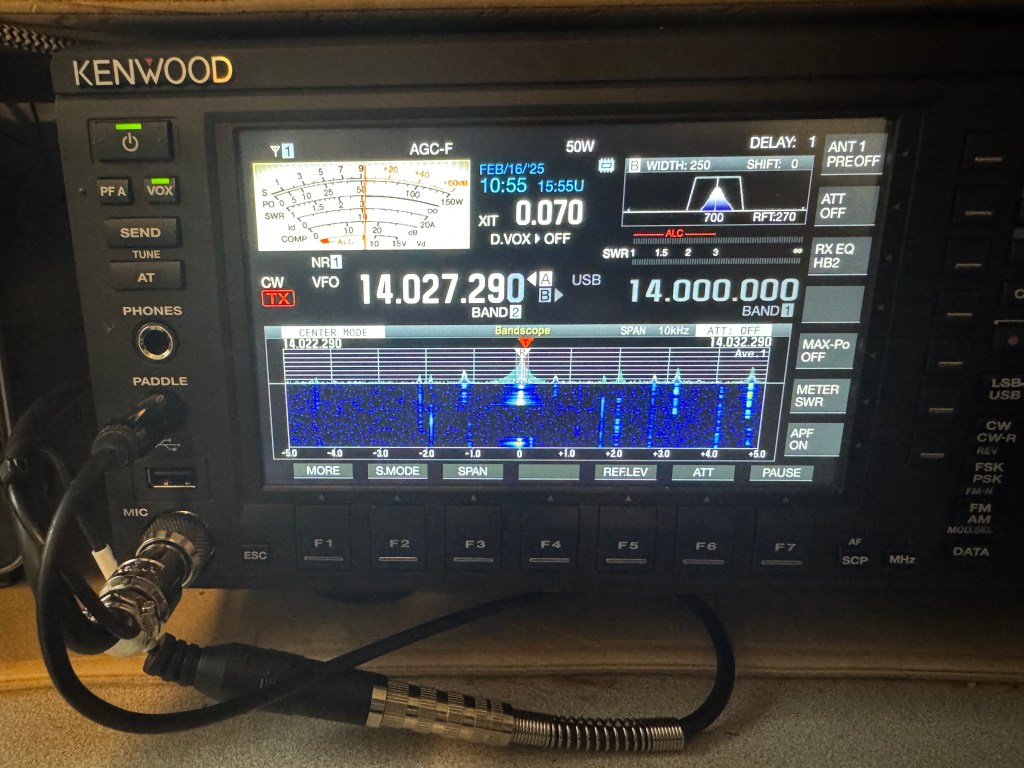
Its been a busy 2025 so far. I have been involved with MARS and that by itself has kept me occupied. I decided to change the the shack around a little to better meet my needs. I pulled the IC-7300 out of the line up and replaced it with a Kenwood TS-890s. The IC-7610 was shifted to the left which is now pretty much dedicated to MARS stuff. The TS-890s will be for everything else. I have both of my paddles hooked up to the 890 along with my Heil PR-781 microphone. I haven’t had a chance to use the 890 much but it is one heck of a radio. It is a very enjoyable radio. I am hoping to get back into CW this year. Last year was not a good year in general for radio and so far this is looking better. I want to get my code speed up. Rounding out the shack lineup is an IC-9700 for FM/DSTAR stuff.

So what about the IC-7300? That has gone back to being a field radio. That is where I enjoy it most. I also have a Yaesu FT-710 Field that is my other field radio. Over the years, I have found that I prefer big radios with better controls when I am in the field. Both radios can go down to QRP levels and if needed I can crank the power up to match band conditions. I find myself operating in the 20-35 watt range mostly and these radios can do that all day long even with digital modes like FT8.

I still have an Icom IC-705 and an Elecraft KX2 for the occasional day trip. If I am at a park, I am in my truck and I can carry a big radio 40 feet to a picnic table. I do like my little radios, but they do not see as much use as the big ones.

I have a new project I am working on. I am building a T3FD antenna to use with ALE.

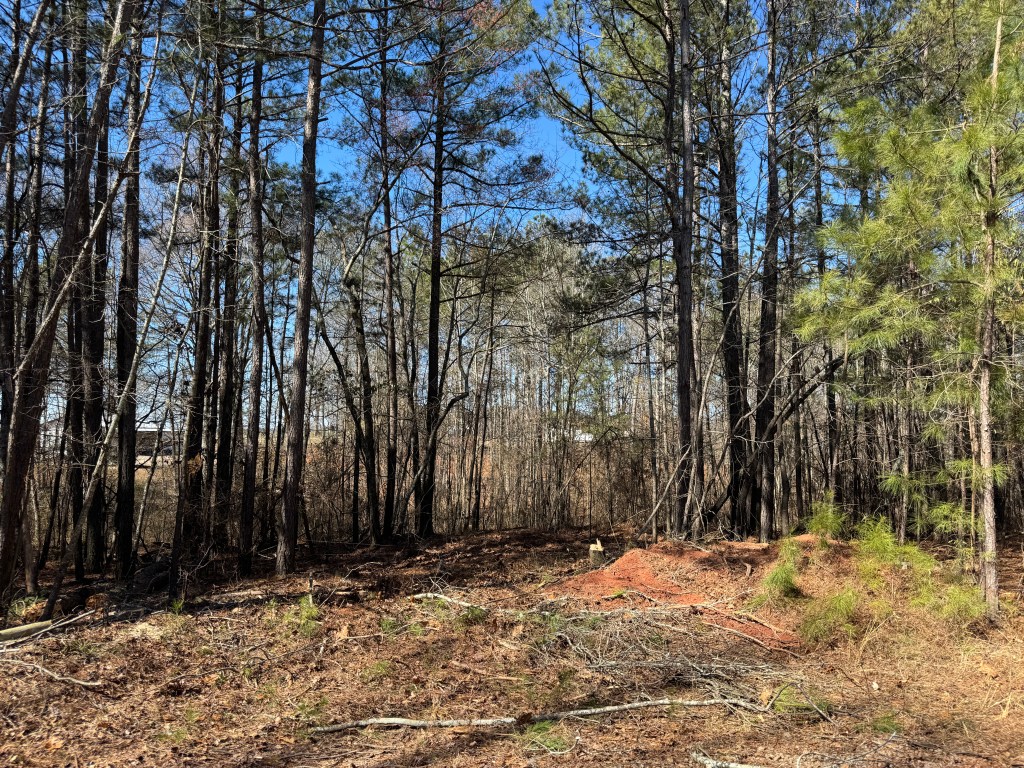
Mine will be 177′ long and it will be 90 degrees from my OCF dipole. That will give me an antenna oriented north-south (OCF) and one east-west(T3FD). In order to have the space for the antenna I had take down a few trees.

After the tree removal it looked like this.

During the last windstorm one nearby pine blew down creating a widowmaker.

These are fairly dangerous and I had to be very careful. The break was about 6′ off of the ground. Even though it looks straightforward, when the tree came down it broke into 3 pieces and actually fell back toward the stump. It was good I had an escape route planned.

The antenna will go over the top of the house, and attach to a red maple.

It will take me a couple of months to gather all the supplies I need for the antenna. Being on a fixed income doesn’t always fit into the “I want it now!” mindset.

As I write this I am recovering from a stomach bug, which can lay you out for 1 or 2 days. Another project I am working on is a mount for my Diamond RHM12 antenna. I hope everyone is doing well, that this year is better than the last, and I get the opportunity to work you. 73 de Scott

Changes

Life is full of changes. Some are expected and some are not. Over the past couple of weeks I have had some changes for the good. One is that 2025 is shaping up to be a better year than 2024. My wife and I had some trials and tribulations which hampered my radio-activity. We had deaths, surgeries, and a few other health issues that slowed us down. This year, things have appeared to clear up and I am already enjoying more amateur radio activity.

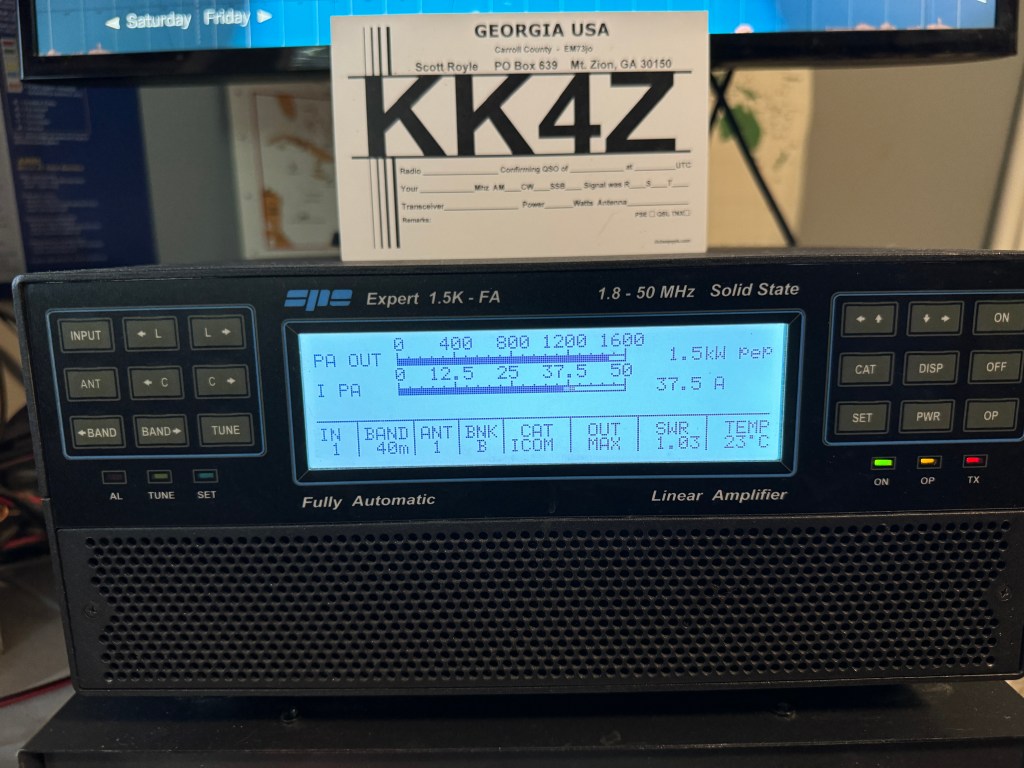
To start off, I have had another shack shake-up. In a prior post I had my SPE Expert 1.5K FA up for sale or trade. It is a great amp but I needed an amp that would do MARS and SHARES frequencies so I ended up with an SPE 2.0 K FA. When I get back from Hamcation, I had a trade offer. My amp for a TS-890s. I have never owned a Kenwood HF radio so I thought I would give it a go. The trade went smoothly.

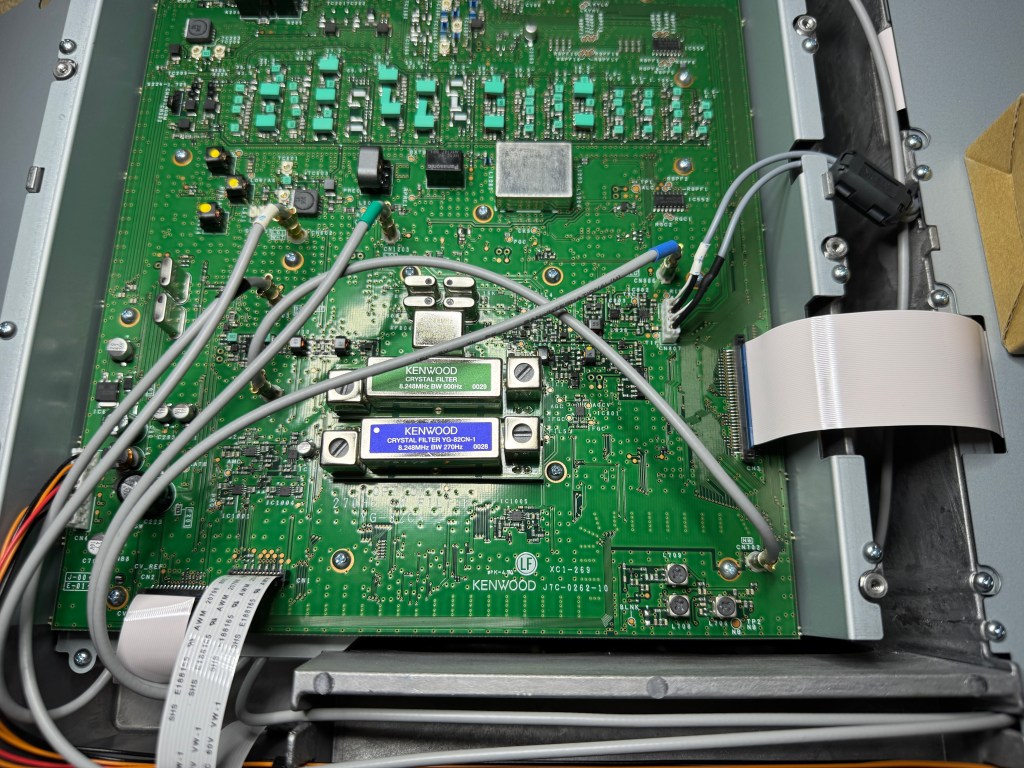
Before installing it in the shack I added the 270 Hz Roofing Filter and while I was inside, I did the MARS modification. I do not intend to use this radio for MARS, but in pinch, I am ready. My intention is to use the radio for fun and CW. I located it front and center on my desk. The IC-7610 was moved to the left which is where I set up for MARS operation. The 7610 plays very well for MARS.

As you can see in the above photo, I am using a Windows machine for radio control and logging. I really enjoy my Mac for everything else but when it comes to things radio, Windows machines are easier.

This weekend was the ARRL DX contest and the CW bands were crowded. this gave me a good opportunity to test the TS-890s. It performed very well.

The scale on the waterfall is 5 KHz on either side of the frequency. I had the 270 Hz Roofing Filter and a filter bandwidth of 250 Hz. The TS-890 easily blocked an adjacent S9+10 signal less than 500 Hz away. Even at less than 200 Hz away I could easily copy the target signal though there was some ringing. That is pretty impressive.

I am hoping to get back into CW this year. I made about 10 POTA contacts this morning with the TS-890s. It is a very pleasant experience. The TS-890s has more buttons and controls than my IC-7610 and even though I think the 7610’s ergonomics are great, The TS-890s’ is better. The 890 is a big radio and it is heavy. It’s built like a brick…

Tools of the trade for CW are my Begali Magnetic Signature and Sculpture Swing.

I joined SKCC last year but didn’t do much because of stuff. I hope to do better this year. A lofty goal I have in mind is to get my CW above 25 wpm. I think I am close. I need to practice. Hopefully this year will allow that to happen.

I hope everybody else is doing well and I hope to hear you on the air. I have a couple of camping trips coming up which should be me and the key trips. The IC-7300? It has gone back to being a field radio. Which is one arena it really shines. 73 – de Scott

Memories past and Present

This past weekend I made a trip down to Orlando Florida to experience Hamcation. It was a lot fun. I got to meet some cool people and of course came home with some radio related goodies. The Region 4 U.S. Army MARS group had a dinner Friday night and I got to connect faces to voices. It was a good time.

This was also a time for some refection. On my way down and back I traveled on Interstate 75. This was the same route I used during the 2004-2005 hurricane seasons. I provided HF radio communication for the convoy bringing relief supplies right after a hurricane. I did this 4 times in 2004 and once in 2005. Back then, communications was not as well developed as it is today.

During those trips I would check into the South CARS net or the South Coast Amateur Radio Service net. According to South CARS: “The purpose of the net is to assist those seeking to contact other amateur radio stations, or areas; to provide weather and travel information; to assist in emergencies when needed.” They operate on 7.251 MHz from 0800 to 1300 hrs Eastern. I used the net to check my radios and listen for any travel information that might have affected the mission. I joined back then (#3773)and still occasionally check in from time to time.

On this trip I was traveling solo so I dialed up 7.251 and checked into the net. While the net was operational, they kept me company and I enjoyed listening to the net. At times, it brought me back to those disaster relief days. Good memories; I felt the sense of purpose I had back then. I appreciate South CARS today as much as I did back then. I know that if I was ever called up again to provide EmComm in Region 4, South CARS would be there for me.

Other good news is I may have a trade for my amplifier. I found a TS-890s and hopefully the trade will go though by the end of the week. I am not young anymore as I have retired twice now. I know that my days of deploying are numbered as the body starts to wear out. Currently I still go camping and therefore could deploy if needed. However, as time marches on I will become more home centered. The good news is ham radio offers opportunities both home and abroad. I have a pretty good home station and I am a pretty good Net Control Station. I plan to use the TS-890s for CW and other fun things.

I’ve had a good run. I’ve got to do some exciting things in my life. In retirement, I am still busy, I still have lots to do. My focus is changing. A fixed income doesn’t mean eating Alpo, it means careful planning. If I want something, I can have it, if I plan for it. The other option would be to go back to work and that ain’t going to happen. Life is good — de 73 Scott

Hamcation 2025

This was my first Hamcation and it was a lot of fun. Lots of people, lots of food and lots of ham gear. I only spent one day there, but it was a fun-filled, packed. day.

One of the highlights of my day was the Begali Booth. Up until this point, I had 4 Begali paddles in my collection. Each one purchased directly from Begali and each one through Bruna. Buying a Begali key/paddle is like being adopted into a family. That’s how Begali treats their customers. I finally got to meet Bruna in person.

They had many of their paddles there — so many to choose from. I like to dabble with straight keys and my preference being a cootie key since they have the same back and forth motion as a paddle. Bruna had a Sculpture Swing and after sending a couple of characters, I was smitten, and I was lucky to get the last one, the display model. I also got to meet Bruna’s husband Roberto who packaged up my prize for me.

I hope to get a review done on the Sculpture Swing in the near future.

Diamond Antennas, one of my favorite brands for mobile/portable VHF/UHF antennas has a new portable HF antenna for the US market. I have seen this antenna on European website but this was the first time I have seen it in the U.S. It is a portable HF/UHF/VHF antenna that covers 7-440 MHz. With optional coils, it also covers the 3.5 and 1.8 bands.

The screwdriver portion of the antenna is 15″ long and the 1.8 MHz coil is 17″. For comparison the yellow packaging is 21″. This will be a great antenna for POTA/SOTA. I can’t wait to get this on the air.

Kenwood had a teaser for their new VHF/UHF mobile. Looks like it might be out by the end of the year. Here is a shot of a non-working model.

It looks pretty cool. I am mainly an HF guy and I stopped there to look at the TS-890. That is my current dream radio. I brought one of my amps down there to trade but the stars were not aligned. I have a nice lightly used SPE 1.5K FA up for sale or trade. I would like to get a TS-890 and may consider a FTDX101MP. I would also consider an Elecraft KPA/KAT500. It’s a great amp but it doesn’t do MARS so I had to get another amp that would (SPE 2.0K FA).

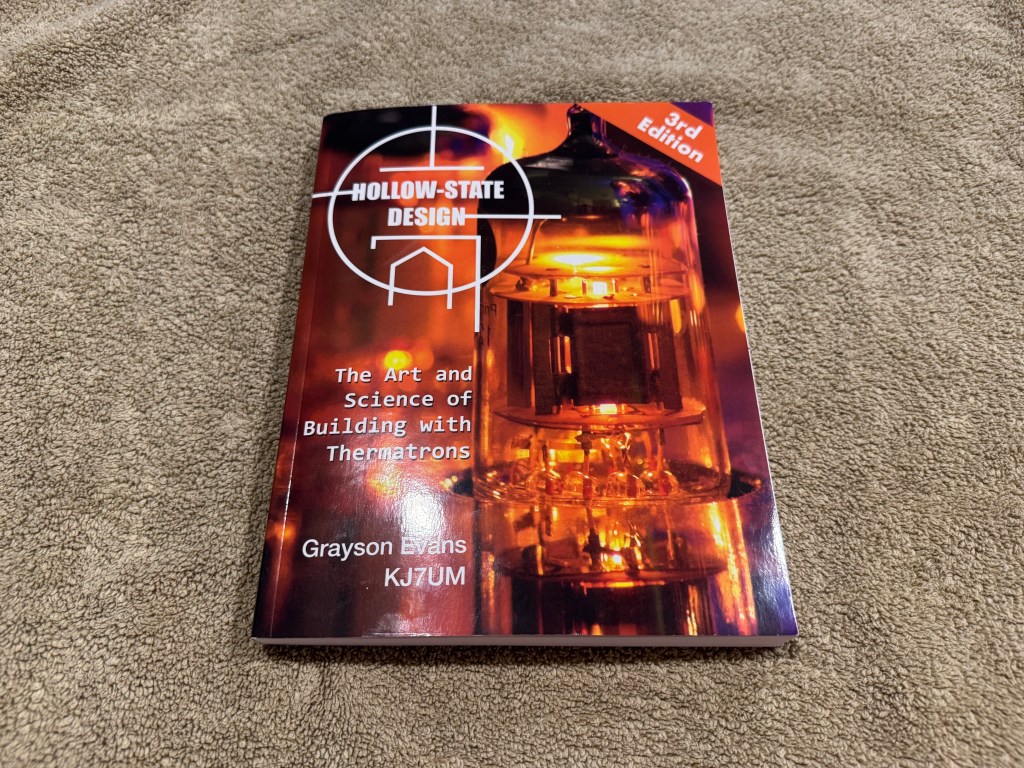
While cruisng the swap building, I came across this book:

I bought on a whim and Grayson autographed the book for me. I may never build anything out of tubes, but I thought the book would be a fun read.

I got to talk to a lot of people while I was there. I talked to one guy there that was looking to get a radio after being absent from amateur radio for many years. He was thinking about getting an IC-705. I asked him if he had any other radios and he said no. I suggested he look into getting an IC-7300 first. The 7300 is still my “if i could only have one HF radio” radio. Many times new or returning hams opt for the QRP route, not knowing how frustrating QRP can be for the less experienced. For a first or only radio I recommend a 100 watt radio. You can always turn a 100 watt radio down to 5 watts but a 5 watt radio is already at its max. A lot of times when camping, I am running CW at 20 watts.

It was fun seeing all the stuff, meeting people, and bringing home a few things. Hope to see you at the next one. 73- de Scott

Yaesu FT710 – Second Impression

Here is my first look at my second FT710. I will start with the settings I changed and then go over the list of issues I had with the first one. The first FT710 had the original firmware as it was new at the time. This one has several updates under its belt.

Settings/Changes

  1. T710,Taped Power Cables every couple of inches to reduce tangles.
  2. Added Anderson Power Poles to the power cable
  3. Turned off 3DSS
  4. Set waterfall span to 5K
  5. Set waterfall speed to slow2
  6. Set color to 6
  7. Set level to +3.5 dB, peak to level 2 and contrast to level 14
  8. Set tuner type to EXT
  9. Set Tuner/Lin Port to Linear
  10. Set keyer to Elekey B, repeat interval to 3 seconds, Weight to 2.7 and Pitch to 700Hz
  11. QSK – on
  12. Set MyCall to KK4Z and call time to 3 seconds
  13. Set Mic gain to 60 and Processor level to 65
  14. CW mode on
  15. Meter Detector to Peak
  16. Receive Audio SSB – Treble +3 Middle +5 Bass -2
  17. Receive Audio CW Treble +3 Middle +1 Bass -3
  18. Parametric Equalizer (processor on/off the same)
    1. E1 – Freq 300 Bandwidth 10 level -3
    2. E2 – Freq 1300 Bandwidth 2 level 10
    3. E3 – Freq 2400 Bandwidth 1 level 10
  19. Needs a 32gb (no larger) SD card. Scandisk Ultra SDHC UHS-I 32 GB works
  20. Mouse. Seems the only wireless mouse you can use with the radio is a Logitech M310. It does not appear to be in production anymore. I had to buy a renewed one. I got the mouse working and I think it is a good addition to the radio. It does make changing parameters easier and if you click on a signal in the waterfall, the radio will QSY to that frequency. I wasn’t sure how I was going to like using a mouse, but I think I like it.

Here are the issues from the first radio:

  1. Could not use LDG tuner with the radio — it was a surreptitious route to get a tuner to work. I started out with a different tuner, an LDG IT-100 which uses a different cable. I coupled the tuner with an LDG IC-108 cable. The cable is not listed as usable on the FT710. The other twist was setting the Tuner/Lin Port “Linear” instead of Ext Tuner. This little tidbit is not shared by Yaesu, I had to find it on an internet forum. To tune the antenna you push the tune button on the tuner (not on the radio) to get things going. This is where Icom shines. They have been using the same interface at least as far back as the IC-718 and the IC-706. A tuner I bought for my IC-706 MKIIG still works on my IC-7300 with the same cable and I can use the tune button on the radio. The other downside is you cannot use the FH-2 Remote pad when using the auto tuner as it uses the same port at the back of the radio. In addition, you cannot run an amplifier and an auto tuner at the same time. Icom has separate ports for the tuner and amplifier.
  2. No Portable Zero Rails – I use rails on all of my portable radios. Portable Zero now makes rails for the FT710.
  3. Could not use RT systems software – it took Yaesu until July 2023 to get the info to RT Systems. I have RT Systems software for almost all of my radios. RT systems software works fine now.
  4. Auto Notch — I don’t remember auto notch working on the first radio I had. It works now.
  5. Cannot edit/see QMB – another place where Icom shines. I can go into the memo pad (Icom’s QMB) and edit the entries.
  6. RJ45 mic connecter instead of Foster (Icom)- Foster connectors are more durable than the RJ45.
  7. Key clicks in the headphones using CW – They are still there but less pronounced. The CW is harsh sounding and can be fatiguing to listen to over long periods.
  8. WSJT software would change modes when switching bands
  9. Waterfall is not averaging like Kenwood’s or Icom’s. It has to be adjusted manually (and sometimes frequently)
  10. Filter only has 2 selections vs 3 for the Icom. Narrow which only has predefined values and wide which is adjustable. The Icoms have 3 selections each fully adjustable. Icoms can also adjust the filter shape (soft or sharp. The FT710 has contour and APF. Contour is like a soft notch filter and APF boosts the center frequency like a CW signal. Icoms have dedicated controls on the front panel while the Yaesu has a mix of front panel controls and menu items.

Even with all of its quirks, I like the little radio. Yaesu appears to have fixed most of its problems, at least enough to make the radio fun. I still believe this radio compares well with the IC-7300 and either will serve you well. If I could only have one, I would still go with the Icom. The Icom has a lower noise floor, the settings (ergonomics) are better, and it hears as well as the Yaesu (at least in my side by side test). For CW again, the edge goes to Icom. However, the Yaesu has its pluses. The FT710 has a slightly better audio quality let’s say more fidelity but in CW the tone is more harsh than the Icom. The Yaesu has a better attenuator with 3-steps instead of one. With the Yaesu, you can transmit CW while in SSB mode. I like the filter window on the FT710. I can see how changing the filter affects the signal.

Later this week I have Portable Zero rails coming. They are pricy, but I find them very useful on my field radios. I also have a Maestro Evolve III coming which I will setup software for the FT710 on it. I hope to have everything ready for Winter Field Day.

I think a major difference between the IC-7300 and the FT710 is settings. Yaesu gives you settings on top of settings, while the Icom gives you what you need. If you like to tinker and tweak, the FT710 is your radio. If you want to get down and operate, then Icom is the way to go. Out of the box, I had to do far less setting up with the Icoms.

Compared to the FTDX10. I owned an FTDX10 for about 18 months. If I bought one today, the cost would be about $600 more than the FT710. I’m not sure the FTDX10 is that much better than the 710. My primary use for this radio is for the field. More to follow es 73 de Scott

Deja Vu all over again

The 2025 promises to be a better year. I am looking forward to being more radio-active. I am also looking forward to more blogging and more vlogging. I am hoping to undertake some long term reviews. I have two in mind. One is going to be a Maestro Evolve III laptop computer. I know a lot of hams use them so I thought I would give one a whirl. My other project is going to be another Yaesu FT710, this time the field version. I last owned one about a year and a half ago, I traded it off after a few months of use. The radio was going through some growing pains and was probably not ready for prime time. My general thoughts back then was the radio was a likable and fun radio and compared favorably to my IC-7300. I thought I would give it another look and a fair shake since it’s been through a few firmware updates since its release in 2022.

I am hoping this FT-710 is more polished than my first one. I can see at least two firmware updates since my last 710 and the manual has been updated. Hopefully Yaesu cured those early issues. I picked up the radio yesterday. I plan on using it as a field radio for POTA activations as well as for Winter Field Day and Field day with my club. In general the IC-7300 and the FT-710 are comparable, each with their pluses and minuses. Whichever brand you are married to, either radio will probably serve you equally well. One reason I got this radio is there are many members in my club that use Yaesu radios. Having familiarity with the Yaesu system allows me to help them with their radio problems.

My initial thoughts are similar to the ones I had a year and a half ago. It is a likable radio and it has a certain fun factor. I am going through my past blog posts and YouTube videos to make list of things I found with my first FT710 and see if they have been corrected. I will also post the settings I changed on the new radio to suit me.

I like big radios when I go camping or even on POTA day trips. I like having the controls I use handy and if band conditions get ugly, I can turn up the power. I normally run 20-25 watts for CW and digital. The rare times I am on SSB, I may go as high as 50 watts. Another plus with a big radio is I can run digital modes all day long and it will not overheat the radio. I do have a couple of QRP radios and I do take them out for a spin every now and again; but I can just as easily turn my big radio down to 5 watts. I am looking forward to using it in the upcoming Winter Field Day. 73 de Scott

A new day. A new year

With 2024 drawing to a close, I felt it was time for reflection. For my household, it was disruptive. It started out with Mary’s ex husband suddenly getting sick and then dying. He is the father of my stepchildren, Mary and the kids stayed in contact with him throughout the years. She made 3 trips to Texas while I stayed home and took care of our special needs daughter.

Shortly after that, she decided she needed a hip replaced. She got scheduled for surgery a week after her examination. She had to spend 4 days in the hospital and then several months recuperating. I was doing the heavy lifting in more ways than one.

During the winter we had a very cold spell which killed about 14 50-60 foot tall pine trees. I had to bring these down with a chain saw. It took some doing as I had to make sure they fell in the right direction. They had to fall into my open field and not in the woods possibly creating widow-makers. Because of the danger involved, Mary at least wanted to be present to watch me in case something bad happened—it didn’t. I put her in out UTV so she could keep an eye on me while she continued to recuperate.

We saw the great eclipse of 2024. We were in the 85% coverage range. In reality we didn’t see that big of change. It was fun to witness it though.

This summer we had a big family reunion. We rented a huge cabin in Tennessee where we all stayed for 4 days. It was a lot of fun, but it was exhausting. It was good to see all my kids and grandkids in one location.

We saw two major hurricanes hit the southeast with Hurricane Helene doing damage in North Carolina that will take years for recovery. Fortunately, the hurricane’s path just missed us.

Amateur radio had its own shakeup in my world. After 26 years of EmComm with my church, I decided it was time to do something else. I felt the program was getting a little stale and I was getting a little stale with the program. I have since joined US Army MARS and SHARES. I am enjoying both. I have let my CW skills trail off some. At the beginning of the year I enrolled in a CW class called CW Innovations or CWI. They helped me get my code speed up. With everything that was going on with me, something had to give and it ended up being amateur radio and CW. This included most of my camping trips.

I have been retired now for a little over year and while it has been a hectic year, I still enjoy retirement. I stay busy. Looking toward the new year, I am hoping to get back to some kind of normal. So far I have winter field day with my club in January and Hamcation in February. I plan on camping in March, April and May. I have yet to make the reservations. With MARS and SHARES there is a digital component so I will work on keeping those skills current. These nets have a specific protocol and run very efficiently. It takes some getting used to, but these are some of the best nets I have been on. CW was pushed to the side but hopefully I will get back on the paddles this upcoming year. The new year holds no promises of being any better than this past year, it is my hope it will be better.

On a final note, I wish to thank all of my supporters who have stuck with me during this past tulmulteous year. I wish you all the best with a safe and prosperous New Year. God Bless and 73—de Scott

Shack Shakeup

I’ve been busy lately, doing a lot of things for a lot of different people and even having fun with the process. I have been making some changes to the way I operate and how I am adapting to such things as getting older. The first change is I have added the remote VFO IC-RC28 to the shack. In the photo above, I have the RC28 next to my paddles. I like it there as I am often cruising up and down a band when doing activities like POTA. It is more comfortable with the dial being more horizontal and it is also enough out of the way when I am using my desk — well, like a desk. Just to he left of the RC28 goes my mouse. Everything right there one, two, three.

Another change coming to the shack is a new (to me) amplifier. I am getting an SPE Expert 2.0K-FA amp. This amp is capable of 1.8 to 2.0 KW of power and is set up fro general coverage (includes outside the ham bands). I normally never use more than 1 KW so what this gives me is a lot of headroom. The 2.0 is about twice as heavy as the 1.5 which I currently own. With the additional cooling I will be able to run digital modes up to 1 KW. However, I normally do not need anymore than 100-200 watts for CONUS coverage. I am adding an amplifier interface cable to the IC-7300 so both radios can each run the amp with a push of a button. The SPE Expert 1.5K-FA will be up for sale shortly.

Antennas. I’ll be putting up a new antenna. This is be a 203′ terminated end-fed non-resonant antenna. This will be a very broadbanded antenna and will allow me to operate on 60 meters. I also have some field antennas coming and I will post about them on a different post.

Power.

I added a 100 Ah battery to the list of portable power options. This battery will give me a full weekend of operating. This battery will also provide back-up power when black-outs or brown-outs occur. I have another set of solar panels on the way. This country is heading towards power shortages as fossil fuel plants are beign shut down and not being replaced. However, our energy usage is continuing to increase. Several parts of our country are already suffering from these outages.

I do have a couple of field trips planned in the near future and of course operating from home.

The wonderful thing about amateur radio is there are so many ways to enjoy the service. I do not call amateur radio a hobby as it is a service even we can enjoy it like a hobby. Until next time, get out there and get on the air, or stay at home. 73 de Scott

Going Mobile

Goin’ Mobile, Keep me Movin’ (The Who). After recovering from my rove I decided to install the IC-7100 in my truck. I like the idea of being able to pull into a park and operate with a minimum of setup. The 7100 is nice in that it includes HF/VHF/UHF. Here are the bits an bobs I used to get this going.

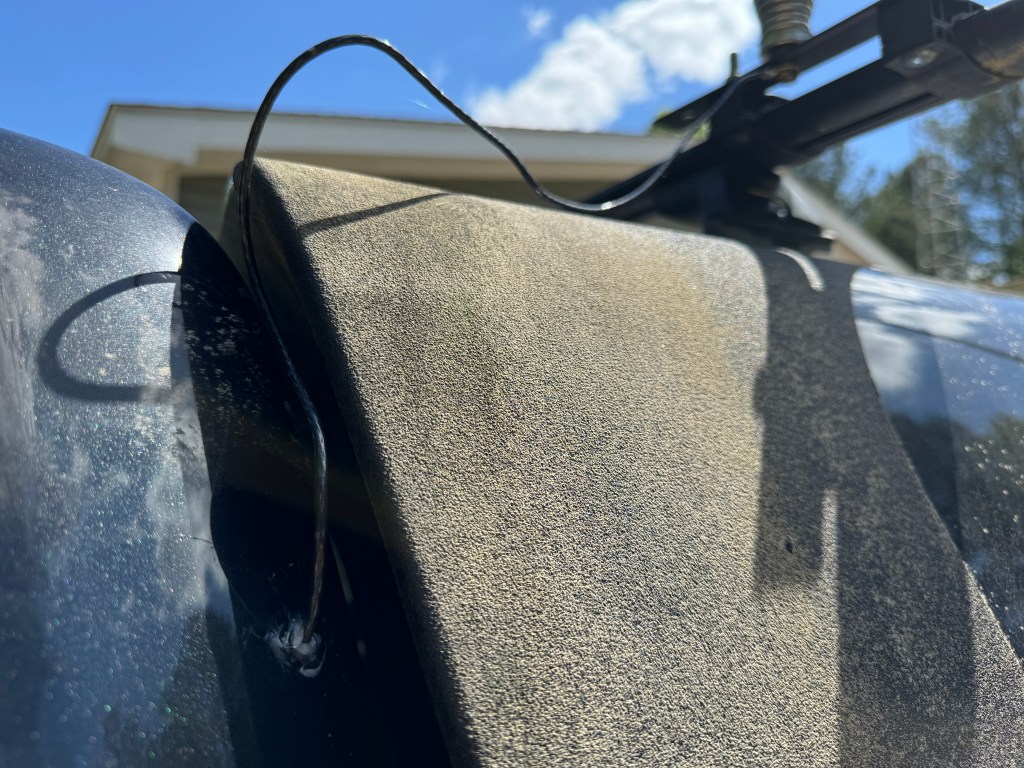
For a tuner, I used Icoms new AH-730. It replaces the AH-4 and is a much nicer unit. The AH-730 and the AH-4 are actually couplers much like the SGC SG-237. They are designed to connect directly to the wire antenna. Coax is only used between the radio and the tuner. I ran a 12 ga stranded wire from the tuner to the antenna which is mounted on my camper roof rack. It is a standard 102″ stainless steel whip. I only had to drill a small hole through the cab sheet metal, add a grommet and a little RTV and I’m done. I drilled an additional 3/8″ hole in the plate where the whip antenna attaches to the truck so I can easily add a horizontal wire for low band NVIS. All I need to do is attach the wire to the truck, stretch it out to a tree, hit the tune button and operate.

Once inside the wire is covered by the trim until it hits bottom and then is routed to the tuner.

The radio and tuner lie in the seat tray under the rear seat. Power from the battery and the UHF/VHF antenna lead are already there from the ID-4100 which was located there. All I had to do was run the control cable from the radio to the control head, attach the antenna to the tuner, the control cable from the radio to the tuner, and add some grounds. If need be, the radio can be easily removed to use outside of the truck.

The control head is mounted on my center console with a cup holder mount. I found this is a nice location for the control head, it is easy to see and manipulate the controls. Plus I also have the DTMF microphone for it. In a pinch I can run CW.

I haven’t done a lot of testing yet, but from my experience with a IC-706 MKIIG/AH-4 combo, things will be fine. Right now I have a bit of work to do on my property which unfortunately, takes priority over radio, but hopefully soon I will be able to get out to a park.

Another thing I haven’t talked about was this mobile setup also works well for EmComm. I can use the truck’s battery or one of my others to run the radio. Adding wire to the antenna will help on the lower bands; plus, the whole system is easy to deploy. Let’s hope I don’t have to use it. 73 de Scott