Shack Shakeup Continues

I have a stable of radios. I like radios. I have spent the past couple of years going through radios and finding the ones I like to use. I think I am getting close. In the shack, I like my IC-7610 and TS-890. They are big and all the controls I use are easy to get to. There performance is top notch. I am content.

QRP radios. This has been my greatest controversy. When I retired, I thought I was going to do a lot of QRP with little radios and maybe even do some SOTA. It didn’t turn out that way. I found myself using big radios at low power. They are easy to use and because of their heatsinks, they never overheat at low power. I did keep one little radio the IC-705, of all the little radios I had, the 705 was the one I grabbed the most.

Field radios. I went through a bunch of radios here too. I kept my IC-7300 which I bought new and has stayed with me over the years. I may sell it off for the new IC-7300MK2. I recently acquired a TS-590sg which went with me on my recent POTA activation at Black Rock Mountain State Park.

It was definitely a fun radio and I look forward to using it more in the future. Yesterday, an IC-7200 was delivered by UPS. The was a trade I had in the works. I always wanted an IC-7200. It’s a basic radio that has a military vibe to it. Being a Veteran, it appealed to me. The radio came with the rails and the MARS mod was already done. The radio is pristine. Power draw at idle is about 1 amp and at 20 watts it draws about 8 amps. Lowering the power level does not overly change the amp draw. Above 20 watts and the amp draw increases. Twenty watts is the happy medium. Here in the shack I had it turned on and was able to work N0SA. I have a set of his SOTA paddles from his last run before he retired. They are fun to use. I plan on taking the 7200 on my next POTA adventure.

During the past couple of years after making many POTA activations, Field Days (winter and summer), Army MARS, and SHARES I was able to shape how I operate. Some of it was a surprise as I was led in a different direction than when I started. I guess when it comes to radios, I may march to the beat of a different drummer. I prefer big radios (IC-7300 size) over little radios. I like that the controls are easier to get to and they don’t overheat. In the field I usually run around 20-35 watts. Most of the time I am in my micro-camper so I am not carrying the radios very far. I may have to lug them 50 feet to a picnic table. I recently bought one of those folding wagons so weight is no problem.

Another surprise was my use of FT8. Band conditions on many of my outings was poor. If it wasn’t for FT8, I may not have had a valid activation. Plus, I discovered I could work a lot of DX while in a park using FT8.

Yaesu’s. I don’t have any Yaesu’s. I have tried to like them, but they are just not for me. I had an FTDX10 for about 18 months, a FT-710 for about a year total, and a FTX1 for a couple of months. To me they are kind of quirky. The Icom’s and the Kenwood’s are solid performers and the ergonomics are superior. I know how to make them dance and sing. I know there are those who love Yaesu and I get it. To each his own. Find the radios that suit you best and enjoy them as I have. The journey is half the fun. 73 de Scott
Black Rock Mtn State Park – Aug 2025

Last weekend I finished up a 3-day, 1,800 mile, 7-state POTA Rove that included a radio trade. Out with the FTX1 and in with a TS-590sg. After setting up the 590, I brought it with me to Black Rock Mountain State Park to try some FT8 and if the band conditions permit, a little CW.

I arrived at the Park Friday afternoon. I have done this enough times that I am setup and ready to go within 30 minutes.  This campsite had some challenges.It was the smallest campsite I ever used.  I had space for the trailer and I had to park my truck in the picnic area.  I also had overhead power lines so I had to use a shorter antenna. The weather was cool for a change and I didn’t have to run my A/C.

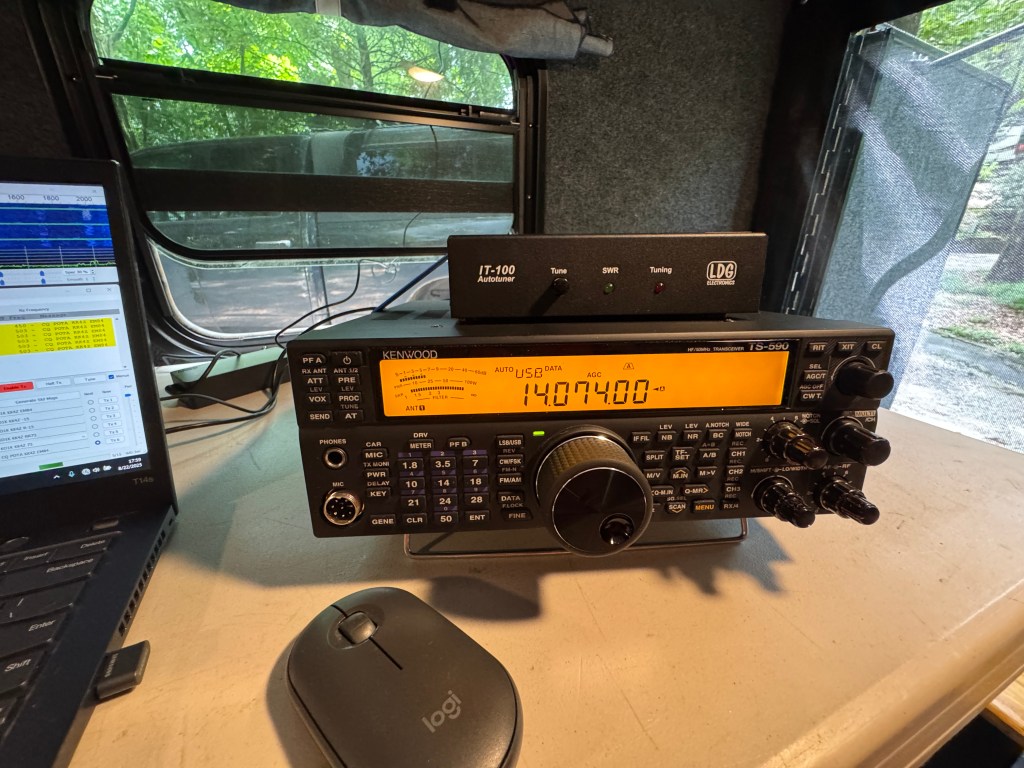
Setup was a Chameleon Micro Hybrid transformer with a 12’ whip and about a 20’ counterpoise.  The radio was my new-to-me Kenwood TS-590sg.  This was the radio’s maiden voyage and I really liked it. It performed well.  One of the main reasons I like running big radios at low power is more of the controls are readily available. Most everything in the TS-590sg is either a push button or a twist of a knob away.  Having a high performance receiver isn’t any good if you can’t get to the controls.

Band conditions were poor. The first night I only made 88 FT-8 contacts and they were a struggle.  At times the band would “white-out”, high noise and only white snow on the waterfall. At the better times QSB or fading was a constant up and down.  I would watch S7-9 signals drop to nothing during a QSO.  Saturday afternoon brought a power failure at the park. Yep, right during mid QSO.  The power was still out at 1800 hrs, so I had a decision to make – should I stay, or should I go.  As you get older one of the things that goes, is your night vision.  If I was going to leave it had to be soon, so I could still do most of my driving during daylight/evening hours.  I decided to go.  Since I have a lot of practice setting up and tearing down.  I was packed up in less than 30 minutes. As I was pulling out of the park, the power returned.  Better safe than sorry.

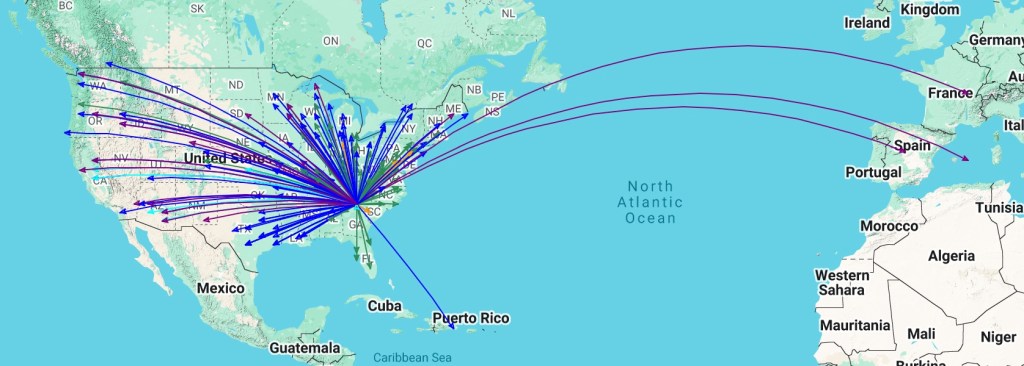
I ended up with 233 contacts, 88 short of my kilo for that park.  I will plan another trip in the fall to finish.  I am real happy with the TS-590sg.  I opened it up and found the MARS mod already done and the TXCO installed.  The radio performed well and I ran it mostly at 20 watts.  As you can see in the QSO map, Most of my contacts were CONUS. Kenwoods and Icoms have the best ergonomics. I feel the layouts were designed by people who use their radios; that ergonomics were a primary concern and not an afterthought. 

Screenshot

I also decided to trade off the FT-710 and ended up with a pristine IC-7200.  I always wanted one but the stars never aligned — until now.  I no longer have any Yaesu radios in the stable and probably won’t have any more.  Why? A couple of reasons. I prefer the ergonomics of the Icoms and the Kenwoods.  Everything I need is right there on the front panel. Easy, to see — Easy to use. I have owned a FTDX10, FT-710, and a FTX1, along with an Icom IC-7610, IC-7300, and a Kenwood TS-890s. I can tell you that whatever I hear on one radio, I can hear on the other.  There’s two reasons for this.  One is knowing where the controls are and two is knowing how to use them. There is a third factor the CSP unit, that’s Cerebral Signal Processing Unit. Half of the battle is using the CSP to process faint signals.  After 30 years, mine is pretty good.

The Yaesu radios, are not bad radios, they are not my cup of tea. I can squeeze more horsepower out of the Icoms and the Kenwoods.  I am sure there are those who can say the same about Yaesus.  I at least crossed the fence and tried them but in the end my preference is not Yaesu. YMMV.

Other happenings. I rearranged my Go Box.  My TS-590sg will not fit in it like my other radios so I got an Apache case for it from Harbor Freight and moved some antenna stuff into the Go Box. So now all my radios travel in a separate case and my Go Box has become universal.  Everything I need to run any of my field radios is in the Go Box.  These days I do more FunComm than EmComm, but I am always prepared to do either. I load the same stuff and off I go. I’ve had a busy summer and the honey-do list is growing, there is lots to do around the ranch so this may be one of the last trips for a while. I do most of my outdoor work from Fall to Spring to avoid working in the southeast hot, humid summers and the accompanying chiggers and ticks. That’s all for now,  take care and 73 de Scott

The FTX1 Cover Up

One of the things I was concerned about the FTX1 was how to protect its face while in transit. The Yaesu side rails which are not yet available are too large. They make the radio too bulky. Icom, when they made the IC-705 available also released a STL file so we could make our own covers which I did. Actually, I modified the file and my son printed it on his 3D printer.

The other day, I decided to check to see if someone had made a STL file for a FTX1 cover. They did! I downloaded the file and sent it to my son who printed it out for me (19 hours). The file was unmodified and fit the FTX1 to a tee. The file can be found here: Yaesu FTX1 3D Cover

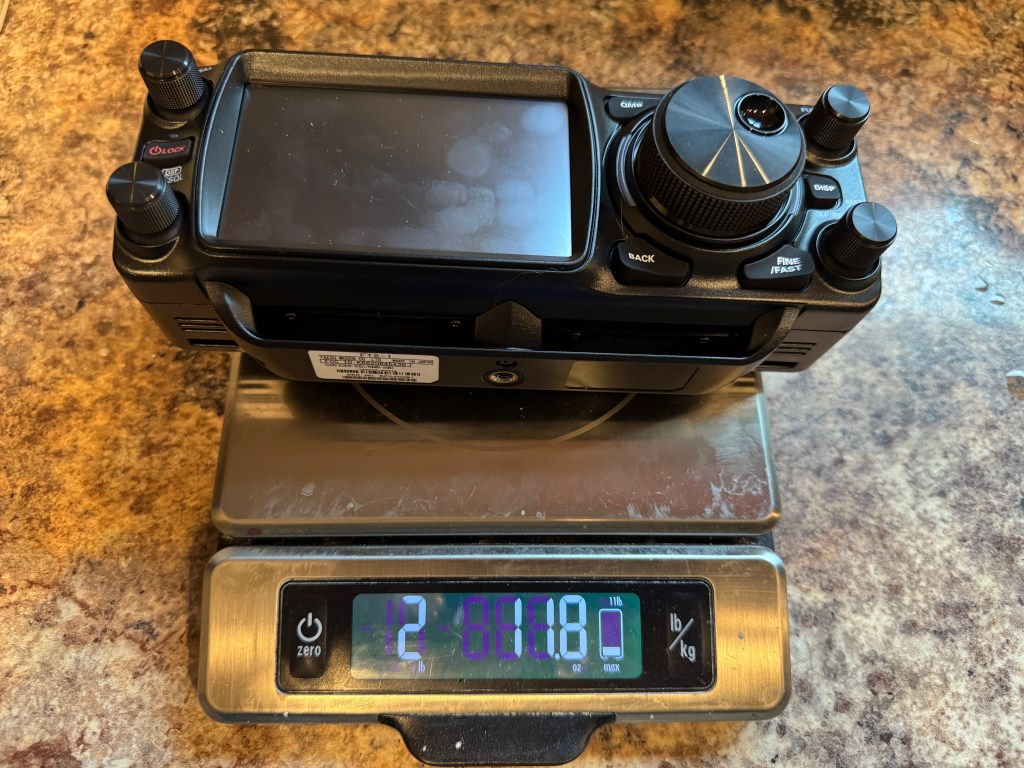
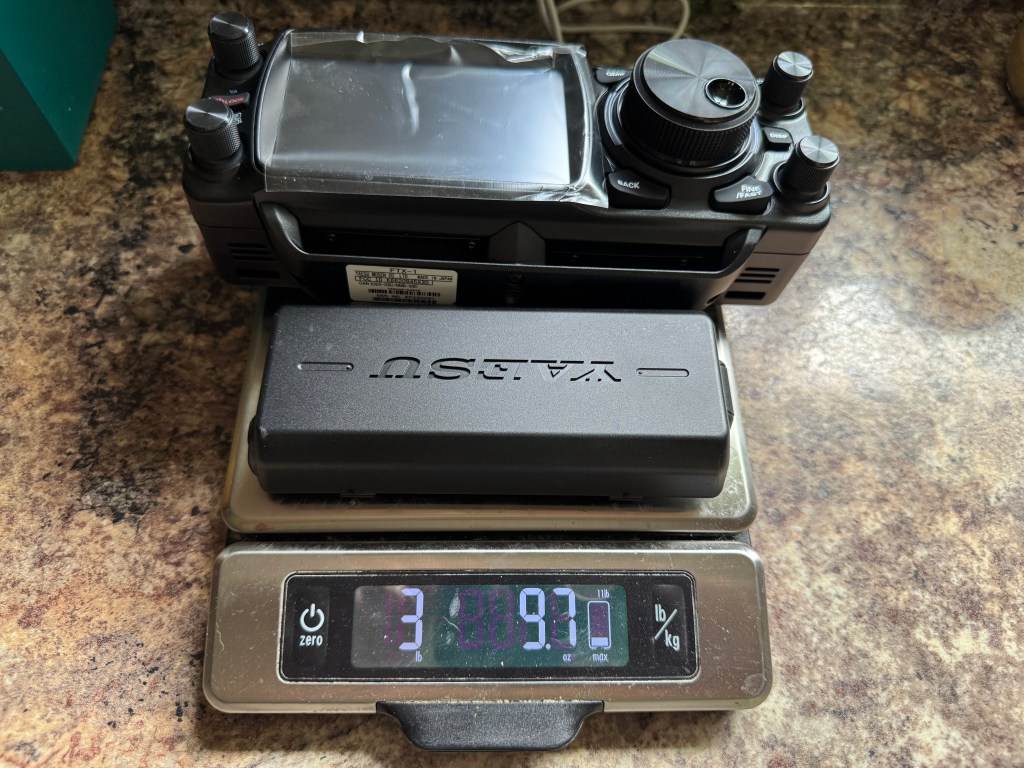
I will wrap a silicone rubber band around it to keep the radio secure in the cover. The cover weighs 6.5 oz and the whole weighs just over 4 lbs without the rubber band. For comparison, My IC-705 with cover weighs in at just under 3 lbs.

Another annoyance or at least a distraction is during CW transmit. On the FTX1 the frequency readout flashes in time to CW along with the xmit light above the main dial. It is rather bright. I shot a YouTube video showing the difference between the FTX1 and the IC-705.

Where does this leave me. Well, for one thing wondering what Yaesu was thinking. I’m not giving up on the radio, hopefully as time goes by, Yaesu will work out some of the kinks. I am a bit annoyed that Yaesu is using us as beta testers. I would expect that from a company like Xeigu which sells their radios for less than half the price of the FTX1. The FTX1 is supposed to be a premium radio at a premium price. Come on Yaesu, you can do better. I think Yaesu had an opportunity and missed the mark. As I said in a prior post, I have been very busy this summer. Hopefully soon, I will get the FTX1 out in the field. So far, as of today if I had to choose between the FTX1 and the IC-705, I would still choose the IC-705 for a QRP radio. For a full size radio, I would take the IC-7300 or the FT-710 over the FTX1 Optima. Of course, your mileage may vary. Thanks for stopping by. 72 de Scott

Dear Yaesu, New Paddles, and Life on the Farm

Dear Yaesu,
What has happened? Have you forgotten us? I don’t understand your thinking when it comes to the FTX1. The FT-817 and its variants sold well for over 20 years. It is still a cherished radio and has a strong following. The FTX1 is an okay radio. It would appear to compete with the IC-705 and as I have said, it doesn’t really compare. In the realm of QRP radios the IC-705 is still better then the FTX1.

I think many of us were hoping for an improved FT-817/FT-818. The FT-817 had a nice form factor and only weighed ~2.5 lbs with a battery and antenna. The FTX1 is clunky and weighs ~4 pounds without an antenna. I still haven’t figured out the best way to carry it.

What would be a nice QRP radio? My suggestion is taking the form factor of the FT-891 and making it a 10 watt radio (20 might even be better). Replace the the 100 watt finals with a battery or a decent antenna tuner (10:1 matching?). You could even go so far as make it an SDR radio. Make a nice pouch with a shoulder strap to carry it. Most people who run QRP don’t have a need for a waterfall. Instead use the USB port to send the signal to a a tablet/cell phone/laptop to view the waterfall there. You can also allow connectivity to a tablet/cell phone/laptop for digital modes and logging. That might put you on top again.

I don’t understand the Optima option. ~$1,900. Right now, I can get a FT-710 for $955. That would leave almost $1,000 for another radio or two. The FT-710 is a better radio. I have an FT-710 and I think it is one of your better efforts. I recently used it for Field day and it did very well. I have an FTX1 and I’m keeping it for a while to see what you do with it.

Yes, I have a preference for Icom radios, they work better for me. I have had other Yaesu radios namely FTDX10, FTDX3000, FT-950 and years ago an FT-817. I also run a Kenwood. I use what works best for me. I am not necessarily bashing you, I am offering my opinion for your consideration.

Sincerely,
Scott KK4Z

Note: right now I am not sure how the FTX1 fits into my lineup. As I said earlier, I think the IC-705 is better (at least for me YMMV). If I need something lighter I have a KX2. For Field Days and bigger events I can bring either an FT-710 or IC-7300. When I purchased this radio I was also looking at a KX3 with KXAT3 and KXFL3. Maybe if the right trade comes along…

Working on the farm.
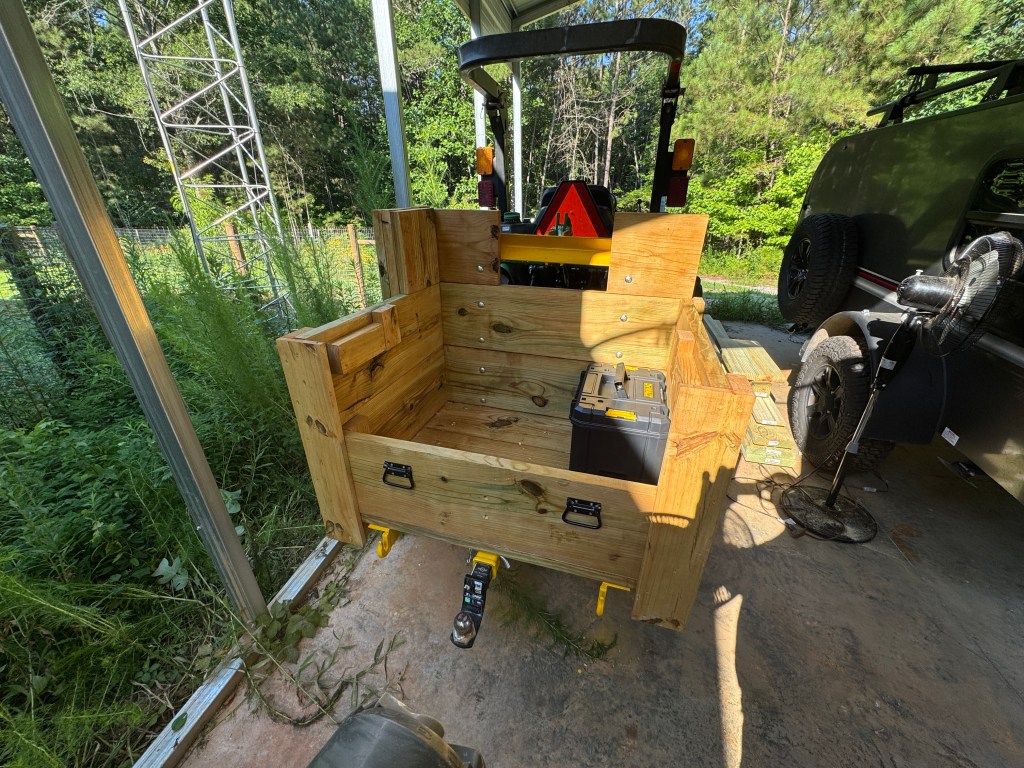
I have been busy on my property. I have 6 acres to take care of and there is always something to do. Right now I have to start getting firewood ready for winter. That means dragging downed trees to the process area, bucking, splitting and stacking. I have a John Deere 3025 tractor to help me out. A problem I was running into was how do I get my gear out to where I am working. The front end loader is okay to carry things until you need it for something else. Besides the steel of the bucket is not good for a chainsaw blade. In the past I would sometimes use my wife’s UTV. That has it’s own set of problems namely, she uses it for her stuff and it stays full. So I decided to build a cargo box for the 3 point hitch on my tractor. I got a carry-all from King Cutter which allows me to use my iMatch quick hitch.

I stopped by my local welder and had a 2″ receiver welded on along with some grab hooks. The finished project looks like this.

I can flip the tailgate up and turn it into a workbench.

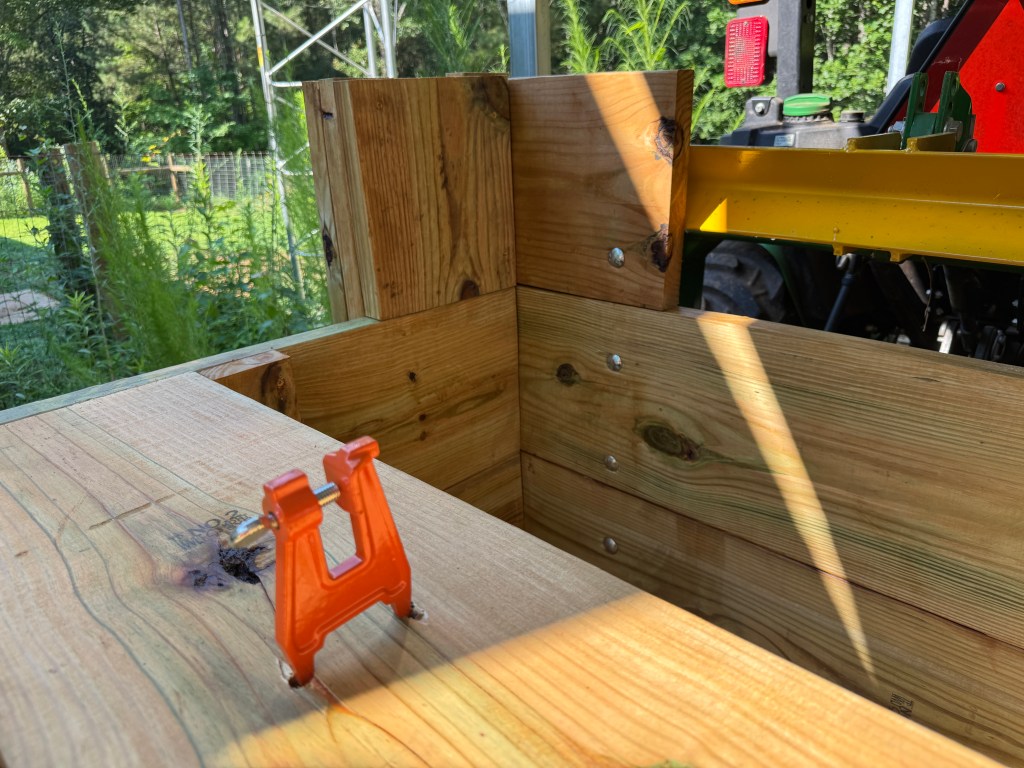
I drilled a few holes so I can mount a chainsaw vise to sharpen my chainsaw in the field.

You can see the chainsaw sheath behind the vise. It will hold my 68cc chainsaw with a 27″ bar safely.

I use a 20′ shipping container for my maintenance shed. It’s hasn’t been reorganized since we initially filled it up almost 6 years ago. Another project is to get things in the shop sorted and non-essential stuff moved to one of our other outbuildings. I need to make it more of a workshop and less of a storage shed. There are always projects to work on.

New Paddles
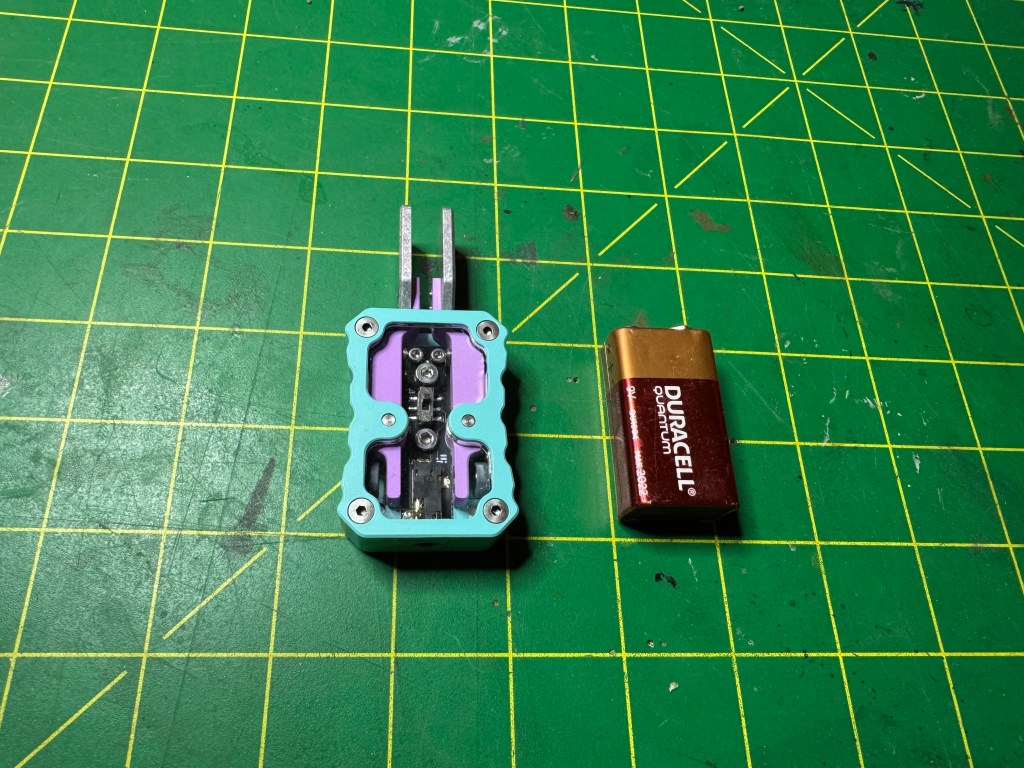
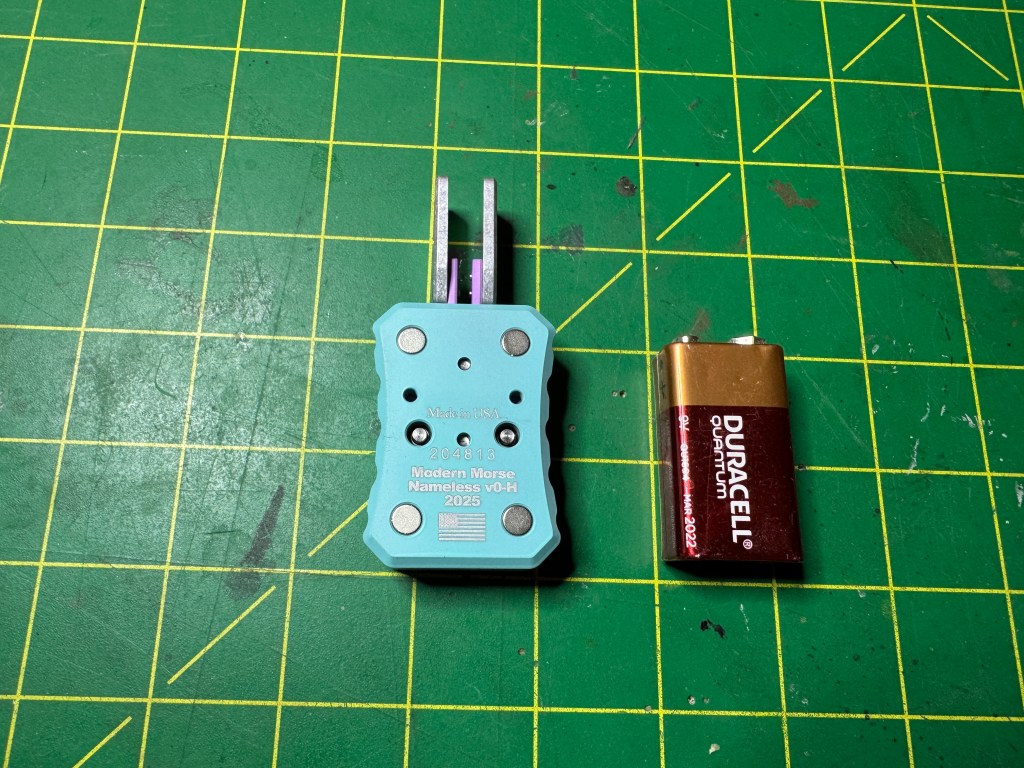
I just received a new set of paddles from Modern Morse. I haven’t taken them out to the field yet, but in house testing shows them to be very promising. They are asy to grip, comfortable in the hand and have a very smooth touch. Workmanship is superb. The paddle body and the arms are Ceracoated and the finger pieces appear to be passivated. The arms pivot on 4 small ball bearings and tension is magnetic. There is a switch inside the paddle to switch dit-dah polarity. This is nice for left handers or “booby-footed” right handers. You can now plug and play with any radio. The paddles come in a nice metal case and two hex keys. The smaller key adjusts the tension and contact spacing and the larger one is for the 4 crews that holds the top of the case to the bottom. The paddle mechanism is sealed with a plastic lid. to get to the switch, you have to loosen the four bolts and carefully lift the top off. Be careful as there are tiny washers on the paddle arm pivots. Another nice feature is the paddles come with 4 magnets on the bottom.

The colors have a nice retro feel and are pleasant to look at. They will certainly be easy to find in a pack or on the ground if dropped. The paddles fit nicely in my hand and I have no trouble sending. These are rugged paddles designed for field use. They are made in the USA by a Veteran. The first run is sold out and there will be a pause before the next run is available. You can check the status here https://www.modernmorse.com. These paddles are pricey but if you appreciate the feel of fine workmanship, they are worth it. I am happy with mine.

Final
Summer got busy and hot. Hopefully as fall approaches I will have more time to get my radios out in the field. I did manage to make it to Field Day with my club and my FT-710. I thought retirement was for leisure but I have never been busier. So much to do, so little time. 73 de Scott

IC-705 vs FTX1 receiver part 3

To some, this part of the test is where the rubber meets the road. For this portion I hooked both radios up to the same antenna and used an A/B switch to go back and forth between the radios. The signal source came from this morning’s CWops CWtest, a weekly one hour sprint. many of the signals are under 500 Hz apart and there are usually weak and strong signals in the mix.

I recorded about 5 minutes of the CWtest switching the radios back and forth approximately every 30 seconds. I made a YouTube video which I will post below. While I was recording I sat directly behind my iPhone so keep that in mind that my comments are from live first hand experience.

Receiver. Before the test, I had both radios turned on and attached to the antenna. When switched to the IC-705, I could hear faint CW signals even though the S-meter or the waterfall were not showing any indication of a signal. When I switched over to the FTX1, I couldn’t hear the signal. generally speaking, I feel that the IC-705 has a slightly lower noise floor than the FTX1. Both radios have good receivers and it would take an experienced ear to make use of the lower noise floor.

Filtering. I set the radios up the same: CW mode, no RF gain, DNR set to 2, filter width set to 250 Hz, and waterfall to 5K on each side. When the test started, I found a weak signal that had a strong signal next to it, approx. 300-500 Hz away. Both radios did a very good job even though both had some filter ringing. The desired signal was still clear and easy to copy. About halfway through, I swapped and found a strong signal with a weak signal nearby. The weak signal was about 300-500 Hz away. this time there was no ringing and the desired signal was easy to copy. Both radios performed about the same.

Audio. The FTX1 has more audio, that’s the best way I can put. It is louder, and sounds more full than the IC-705. To my ear, the audio port design, volume, and frequency response appear to be geared toward SSB and FM. However, the CW signals out of the IC-705 sounded clearer and more distinct. This may due to the smaller speaker acting more like a tweeter making the higher pitched CW signals sound clear. The FTX1’s CW sounded a little muffled. For me, when I operate CW I am usually wearing headphones or earbuds.

Summary. Performance wise, you can’t go wrong with either radio. If you are the audiophile type, the FTDX1 might be a better choice. CW ops might like the IC-705 better. I will post the YouTube video below once I get it uploaded.

FTX1 vs IC-705 Connectivity

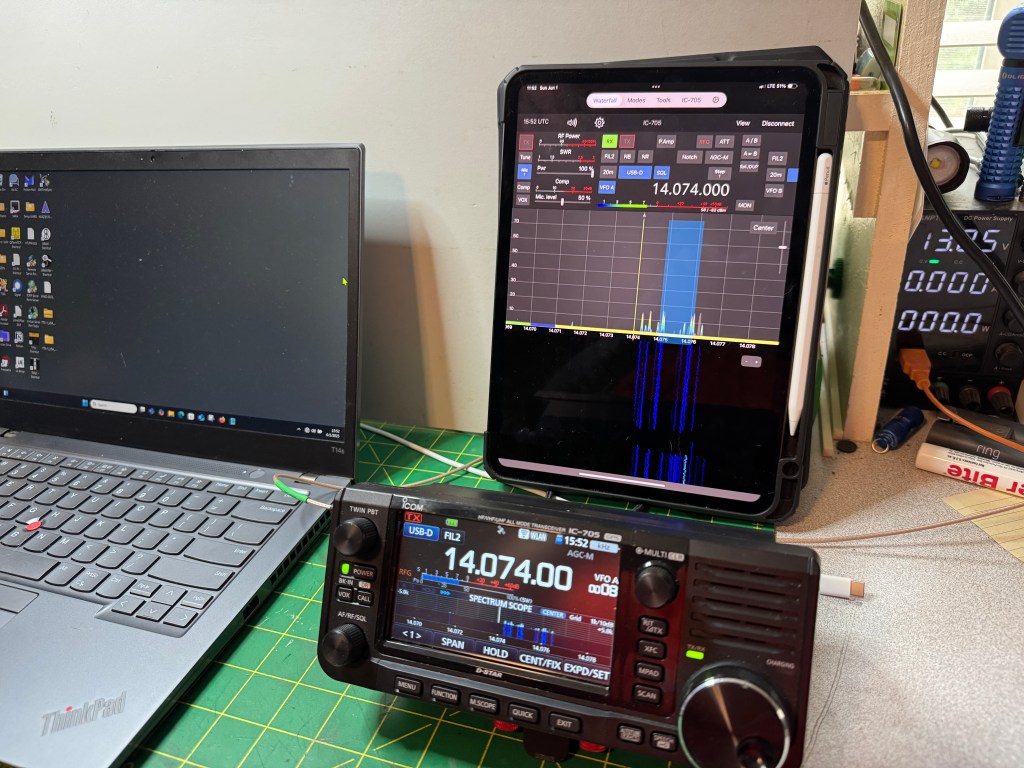
This morning I wanted to explore connectivity with the FTX1 and the IC-705. Right off the bat, the IC-705 comes standard with Bluetooth and GPS while the FTX1 requires a separate purchase for each. The Bluetooth unit cost $55 and the GPS cost $70. the IC-705 has one additional feature in that it also acts as a Wifi access point to allow you to control the radio via iPhone/iPad apps like SDR-Control SDR Control Website. With this app I can operate FT8 and CW. It has message memory and logging. The Wifi on the IC-705 is not intended for internet connection.

Getting back to the FTX1, it took a little figuring but I got it running FT8 on my Windows machine. The FTX1 is so new that there isn’t any control configurations out there on apps like WSJT. A little tinkering and I got it to work just fine. Here are the setting I used.

You want to use the enhanced com port. I also ended up using a USB C to USB A cable instead of a USB C to USB C. I was having trouble getting the latter to work and it may have been something on my part to cause it not to work. I will fool with it some more later.

UPDATE: I was able to get the radio to work with a USB C to USB C cable. However, something I missed was while WSJT software will Xmit and Receive, it will not QSY the frequency on the FTX1. I tried this with FT-891, FT-991, and FTDX10 CAT Command sets in WSJT. Usually with Icom’s there is enough compatibility between the radios that the CAT setting from one model will work with another. An example would be the IC-7610, it is pretty cross compatible with the IC-7300 command set. Hopefully this will be addressed soon.

On the IC-705 you can output GPS data through the B port. This can be used for different things, I use it sync the time on my laptop when I am using one. As far as I can see this feature is not planned for the Yaesu.

The Yaesu is still brand new, I had it 2 days and there was already an update. I am sure as the product matures, more features will be added. I like the radio; it has a certain fun factor. If someone asked me today, if I could only have one, I would pick the IC-705. But that is today, tomorrow as the FTX1 is refined, I may change my mind. In between, I plan on having fun with both. 72 de Scott

IC-705 vs FTX-1 Power

In this post I will take a look at the power requirements of both radios. Again, this is not a detailed in depth scientific experiment, more in line with what the average user would do with equipment he/she may have on hand. One of the first things I did was hook the radios up to a power supply, in this case a Samlex SEC-1223BBM and I used one of those generic power meters. At idle:

That was surprising! The Yaesu uses 155% more power at idle than the Icom. One possible way to look at that is the IC-705 with a 3.3 Ah battery may have the same operating time as the FTX-1 with a 6.1 Ah battery. This makes the Icom even lighter because it needs less battery.

Next I hooked the radios up to a dummy load and Bioenno 3 Ah battery and did a key down at 5 and 10 watts to measure the power consumed. First at 5 watts.

Interestingly enough, the IC-705 is more efficient in its power usage. It is 340 mAh less than the FTX-1. Moving on to 10 watts.

The Icom again is more efficient being 240 mAh less power draw than the FTX-1. What does this mean? I think in rough terms a 3 Ah battery with the IC-705 will give you approximately the same operating time as a 6 Ah battery for the FTX-1. If you are a drive-up POTA guy, this is no big deal. If you are a remote POTA guy or a SOTA girl, power conservation may become an issue. For me, I will use my 3 Ah battery with the IC-705 and get a 6 Ah battery for the FTX-1. Note: The IC-705 with a 3,3 Ah battery weighs 1 pound less that the FTX-1 with a 6.1 Ah battery.

Now comes my first gripe with the FTX-1. The FTX-1 uses a different power connector than my other small radios. My IC-705 and my KX2 both use the same connector. Some of my other QRP radios in the past also used the same connector. Now I have to make sure I have the right connector for the radio. In the image below, the Yaesu connector is on the right. The center hole is larger than the one on the left (Icom/Elecraft).

From here, my reviews/blog post will become more sporadic as I have to get the radio setup and taken out in the field. Unfortunately for me, POTA parks are all somewhat far away and I can’t just pop over for an activation. I do have some big trips/roves planned and I will be bringing the FTX-1 with me. In general, I like the radio, it has a nice fun factor and it does some things very well. In the near future I plan on doing an a/b test with the IC-705 during a CW contest.

One thing to note is the FTX1 can use USB C to charge the batteries however it requires PD (Power Delivery) and needs 45 watts. That would mean a USB C charger similar to one you would use to charge a laptop. The IC-705 can be charged using a regular USB A to Micro USB cable. This might become important if you are trying to save wait or space.

Stay tuned de Scott
FTX-1 vs IC-705 Physicality

I decided to take a look at the FTX-1 and see how it compares to the IC-705. I now have both (I own both) so I can take a good look at each in comparison. My intention is to treat this in a similar fashion as I did for the FT-710/IC-7300. My take is not an in depth technical review but how the radios are perceived through the eyes of a user/operator. First up is the physicality of the radios.

The screens are the same size on both radios. The FTX-1 is a little wider and the IC-705 is a little thicker.

Adding the batteries seems to equalize this as the Icom’s battery is set into the radio and the Yaesu’s sticks out.

One is wider, one is thicker, handling the two radios, I would say it’s a wash.

Weight
Here there is a difference. The Yaesu weighs more. Handling the radios, the Yaesu feels heavier than it actually is. It feels like a brick.

The FTX-1 is 6.3 ounces or 17% heavier than the IC-705. with out the batteries. Adding in the batteries.

For the Icom, I added to additional batteries to bring the total storage up to 6.3 Ah similar to the Yaesu’s 6.1 Ah battery. Even so, the IC-705 weighs less than the FTX-1 by 9.4 ounces or 16.34%. Note: The Icom with a 3.3 Ah battery weighs about 1 pound less than the FTX-1 with a 6.1 Ah battery (see the next post about power).

Size wise, I feel the radios are comparable, they would both fit in a pack or box interchangeably. Weight could be an issue for some. For those doing a POTA activation carrying their radio from the car to a park bench 50 yds away, weigh will probably not be an issue. For those who like to pack it in or do SOTA, weight would be a more critical concern. For me, my days of over hill and dale are pretty much done. If I had to travel light I would turn to my Elecraft KX2.

Next up power with some more surprises de Scott

Yeah, I might be a little fickle

I’m not afraid to tell on myself, I can own up to it. Last night I decided to go ahead and order a Yaesu FTX-1 Field. Not without reason though. I watched a few YouTube videos from hamvention with John from Yaesu talking about the FTX-1. He mentioned that the performance of the FTX-1 would be similar to the FT-710. That could be impressive. I just finished up a review on my FT-710 so I have a feel for the radio.

Another cause and effect was yesterday, I pulled my IC-705 out getting it ready for some POTA activations. I had been remiss doing QRP CW activations focusing instead on low power digital with full size radios. I have been feeling the urge to brush up on my CW skills. Back to the 705, I like the radio a lot. It does indeed push all of the buttons. I was holding it in my hand thinking it’s not so bad for a portable radio and the FTX-1 is only a little bigger…I thought I might do another comparison series this time between the 705 an the FTX-1. I have a couple of big trips planned for the fall and winter and these radios will do nicely.

Another reason that pushed me toward the FTX-1 was the price of used radios, they are over the top right now. I was looking at a KX3 and it was the same price as the FTX-1. Even some of the other used radios were more than I cared to spend for them. One thing I forgot to mention, is I have grown used to waterfall radios. I have learned to use them to help me find places in the band to operate and to do a real time check on propagation. It’s amazing what you can glean from those screens.

Hopefully, over the next couple of months I’ll put the IC-705 and the FTX-1 through their paces. Up front I will say that I have a preference for Icom radios, but the FT-710, KX2, and TS-890s have found places here at the ranch. I am not adverse to using different brand radios, I use whatever fits me best.

The new radio should be here in a couple of days and then the games begin. This should be fun. 72 de Scott

Why I didn’t Preorder the Yaesu FTX1

As information started coming out about Yaesu’s new QRP radio I was tempted to get one. However, the more I learned the less I liked about it. I have an Icom IC-705 and an Elecraft KX2 for QRP radios. My big field radios are an Icom IC-7300 and Yaesu FT-710F. I am looking for another QRP radio to do a long term review. I considered the FTX1 but gave it a pass for the following reasons.

Price. An IC-705 cost $1349.95 at HRO. The FTX1 cost $1499.95 but to be truly compatible with the IC-705, you have to add Bluetooth ($54.95) and GPS ($69.95). this brings the total to $1624.85. A spare battery for the FTX1 is $199.95. The Icom battery (BP-307) is $135.95; however, knockoffs on Amazon can be had for 2 for $59.95. I use them and they seem to work just fine. Another point are the antenna tuners. The AH-705 sells for $359.95 and can tune long wire and coax fed antennas. Yaesu chose a different path they have one tuner for coax fed antennas and one for long wire each costing $319.95 or $639.90 for both.

The optima package. It cost $1899.95 to give you a 100 watt option. To put this in perspective, you can buy a FT-710 Field for $884.95 and a FTM-510 for $499.95 for a total of $1384.90. Plus you get an antenna tuner included with the FT-710 and the 710 probably has better performance than the FTX1 on HF. As a side note, the FT-991A sells for $1229.95.

Performance. Yaesu was pretty mum about the performance of the FTX1. With the FTDX101, FTDX10, and FT-710, they touted the Rob Sherwood numbers long and loud. The only thing they said about the FTX1 was it had the same Analog to Digital Converter (ADC) as the FTDX10. ADC’s are all pretty similar in all of the SDR radios. So where does the FTX1 fall? Is it like the FT-710 or is it more like the FT-991A or the FT-891? For POTA and SOTA using SSB this is probably fine Rob Sherwood recommends a Dynamic Range Narrow Spaced number of 80 dB for contesting. For CW that number increases to 90dB. The FT-891 and the FT-991 are in the 70’s range.

My friend Thomas K4SWL who is attending Hamvention put his hands on a live FTX1. His first impression was it was much bigger than he imagined. He decided to cancel his reservation for a FTX1. Looking at how things attached to the radio, I had the same thoughts. If I am going that large, I’ll bring my IC-7300 or my FT-710F. I am curious about the current draw of the FTX1 at idle.

As folks get their hands on the radio, more details will come out. Hopefully Yaesu will be more forthcoming with information, we shall see. It seems to me that Yaesu did not listen to the QRP/POTA/SOTA community when building this radio. For sure the pricing and size seem out of whack. As for me, I am still looking for another radio to review, but at this time I will give the FTX1 a pass. 73 de Scott