Yaesu FT710 final Review and Where to Go From Here

I’ve had the Yaesu FT710 for a while now and used it mainly in the field. That was and is my intent for this radio.  In general, I feel if I am doing an activity like Field Day or a multi-day POTA activation, and I am not carrying my gear more than a few feet, why not bring a full sized but compact radio.  These radios have more operating options and the controls are generally easier to use.  In addition, running a 100 watt radio at low power (20 watts or less), the radio doesn’t even get warm.  The radio works well with digital modes.  It wasn’t that long ago that Yaesu’s were a real pain to run digital.  Icom’s have had an easy interface since the IC-7100.  Today, the FTDX10 and the FT710 both are on par with the Icom’s when it comes to digital modes.  With CW, both brands are about equal.  In general, I feel both radios are interchangeable and it would be the matter of personal preference which would determine which is best for you. In the next couple of paragraphs I will describe the pluses and minus’ of the FT710 and the IC-7300. John WD8LQT provided input from his use of my radio during the WGARS Spring Fling.

Attenuation.  The IC-7300 only gives you 18dB of attenuation while the FT710 give you 3: 6dB, 12dB, and 18db.  Your more expensive radios typically have 3 like the FT710.  In an SDR radio, attenuation is your friend.  Preamp should almost never be used.  The nod goes to the FT710.

CW Tune.  Both radios have autotune but the FT710 has a CW tuning indicator right below the S-meter. I find myself using it quit a bit.  Some CW ops crank their filters way down and if you are a little off frequency, they won’t hear you.  My buddy John WD8LQT, also liked this feature. Nod goes to the FT710.

Sound quality.  The FT710 sounds a little better, but the IC-7300 has a lower noise floor.  I do not find either one objectionable. YMMV.  Draw

Waterfall.  The IC-7300 has an averaging waterfall and the FT710 does not.  That means that the FT710’s waterfall has to be manually adjusted every time band conditions change.  John noticed that when sending CW the waterfall would flash rather brightly, enough to be a little distracting. This may have been due to the waterfall level not being adjusted properly, but it is not an issue with the Icom.  Nod to the Icom.

Ergonomics.  Here the IC-7300 is the clear winner.  It has more of the right buttons on the control panel and it is easier to get to the most needed controls. The 7300 gives you 3 adjustable filters and the Yaesu gives you 2.  To adjust the Icom, grab a knob and give it a twist.  On the Yaesu, push a knob, twist the knob, push the knob, twist the knob.

Power consumption.  The FT710 uses about 1.2 to 1.3 amps at idle with normal volume.  The IC-7300 uses about 0.85 amps.  This doesn’t matter if mains power or generator power is available but when working off of batteries this can become an issue.

Sensitivity and Selectivity. The Icom has a lower noise floor, -133 vs -127 dBm for the Yaesu. Before I get into selectivity let me explain a little about Rob Sherwoods numbers.  Most people quote the 2 KHz blocking number, that comes with a couple of caveats. First, for the most part Rob measures 2 KHz blocking with a 500 Hz filter. That’s a CW filter.  Sideband filters usually run 2.4 KHz plus.  Unless you’re a CW op, this number is irrelevant. Here is what Rod Sherwood says, “I decided to sort the table on my website by close-in dynamic range at 2-kHz spacing. This was the “acid test” for CW contest / DX pile up operation.” He further quantifies his research with the following numbers. “What do you need in the way of close-in dynamic range? You want a number of at least 70 dB for SSB, and at least 80 dB for CW. A 10 dB safety factor would be nice, so that means you would prefer 80 dB for SSB and 90 dB for CW.” In the past I have compared the IC-7300 with the FTDX10 and the FT710 during a CW contest. What ever I could hear with one, I could hear with the other. The Yaesu’s had a little less ringing but I had no problem copying the signal from any of the radios.  

What this means is either radio will serve the vast majority of operators well.  Whatever your personal preference is, go for it.  There are things I love about the FT710 and there are things I love about the IC-7300. I never feel at a disadvantage with either radio.  I plan on keeping both.

Where do I go from here? That’s a good question. I don’t have anything in line to review. I have decided to take a step back from EmComm for a while.  I’ve been doing a lot of digital lately and need to get back to the joys of CW. I also have a couple of QRP radios that need to be taken out and used.  I still enjoy the smaller radios.  I’ll take a big radio on a camping trips/Field Days and may take a little radio for a quick activation. Sometimes it’s nice to grab a small box or bag and go. I have some antennas I haven’t used in a while, I need to get them out.  

Thanks for hanging with me.  I appreciate your company.  73 de Scott
WGARS Spring Fling 2025

Today was the club’s semi-annual outing and this spring it was one of our old haunts, Cheaha State Park US-1037 in the fine state of Alabama. There are 3 things we as a club like to do, we like to eat, we like to socialize, and once in a while we talk on the radio.

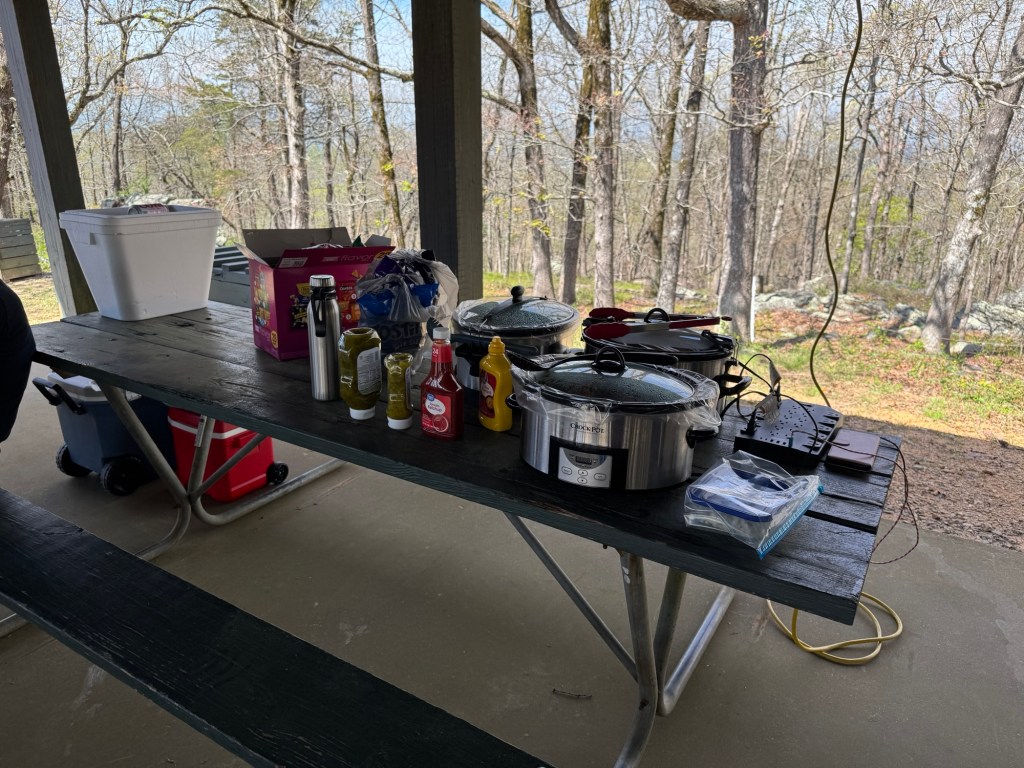
As usual, food was in abundance.

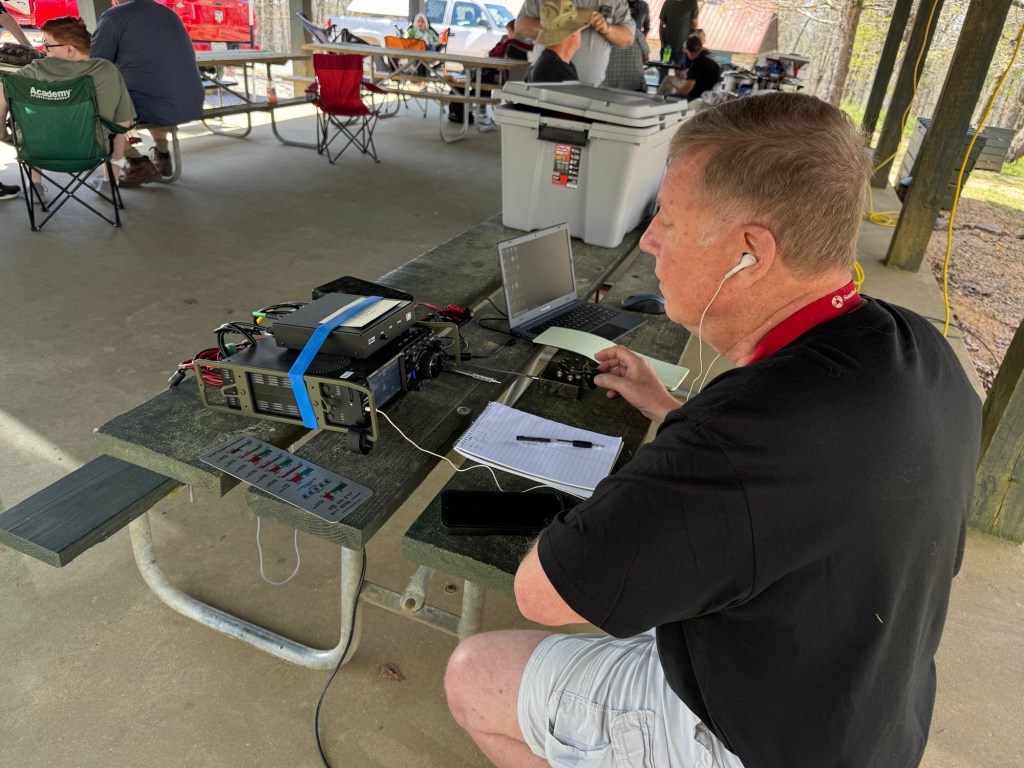
We had several stations set up under the pavilion. QRM was held to a minimum. We had Xeigu G90’s, Tru-SDR, Icom IC-705, and my Yaesu FT-710. I set the radio up and turned it over to the club President John WD8LQT. John, like me is a CW op and I wanted his opinion of the FT-710. I didn’t have to twist his arm too hard. The setup was the radio feeding a Chameleon micro transformer with a 12’ whip and about a 20’ counterpoise. The radio was powered by a 20 amp-hour Bioenno battery and the paddles were a Begali Expedition.

Band conditions were poor and it took John most of the time at the park to get his 10 contacts. There were stops for eating and chatting. Early in the activation, I decided to change antennas to be sure we had an atmospheric issue and not an equipment one. I had my Diamond RHM-12 which recently proved itself to be a good performer. Once the switch was made and some searching through the bands, John started making contacts on 20 meters. I believe it was atmospherics and not the equipment. John got his 10 contacts and we called it good.

John’s comments about the FT-710 were quite favorable. Like any radio, there are pluses and minuses. In general he thought it was a very good radio for CW. There is more commentary from John on the YouTube video posted below. John did have one epic fail. The ear buds he was using which looked rather ancient finally gave up the ghost. I took it upon myself to intervene and unceremoniously threw them in the trash. John will thank me.

My review of the FT-710 is drawling to a close. I find that I like the radio. It performs well for its price point and has some features found on more expensive radios. It has its quirks as all radios do, but none that I find overly objectionable. I plan on keeping the radio and it has found a place among my field radios. I imagine the radio may make an appearance during this year’s Field Day.

Field Day WGARS Style

Field Day, the opportunity to take our equipment to the field and test it in preparation for the “Big One”.

The West Grorgia Amateur Radio Society (WGARS) takes this seriously. We bring our radios, antennas, batteries, etc to a local park twice a year to make sure we know how to operate in the field when the time comes. But this is not the only thing we do, in fact, sometimes it becomes a much lower priority because…

We like to have fun. We like each other and we often spend a lot of time socializing with each other. We have pot-luck meals where club members and their families show off their culinary skills. This year we had some guitar playing during the off times. I can see music a growing venue in our get togethers. We had a Fox Hunt before the start of Field Day to kick things off. The kids loved it. We have some talented youth in our club. During events like Field Day we see families joing us. We have room from everyone. When we do get on the radio, the youth jump on the radio calling CQ Field Day. They do this because for them it is fun. We have no quotas, they can walk away from the radio at any time for as long as they want. If a radio isn’t manned — so what!

Our setup is evolving. Last year we lost our clubhouse and instead of finding another place, we bought an 8 x 24′ trailer that we have been modifying to suit our needs. It is great because we can have a warm (or cool), dry place to operate almost anywhere we want. We have 4 stations setup with soundproofing. It works well. We set up 5 antenna for the trailer. We have half wave dipoles for 10, 15, and 20 meters tied end to end with about 10 foot of rope in between them. We oriented these east-west. We have another antenna system comprised of 2 half wave antennas for 40 and 80 meters oriented north-south. I run a satellite station about 100 yards away with a vertical antenna. With this configuration we have little to no cross band interference.

I enjoy running the satellite station, I usally run either FT8 or CW and I am usually the only one on that mode so I can run up and down the bands without causing dupes. Like everyone else, when I want to take a break, I do.

As you can see, we are somewhat laid back, go with the flow kind of folks. Because we look at our club light-heartedly, we have little drama. I can’t think of a better club I would rather be in.

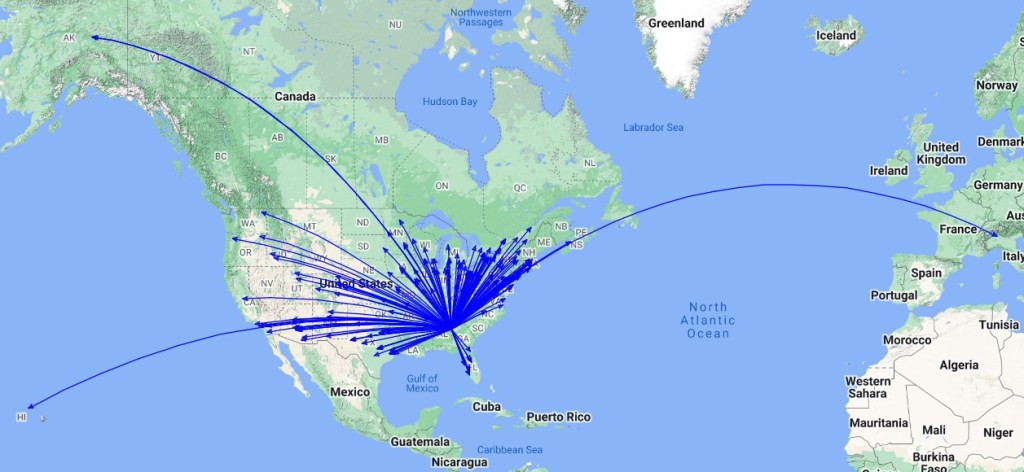
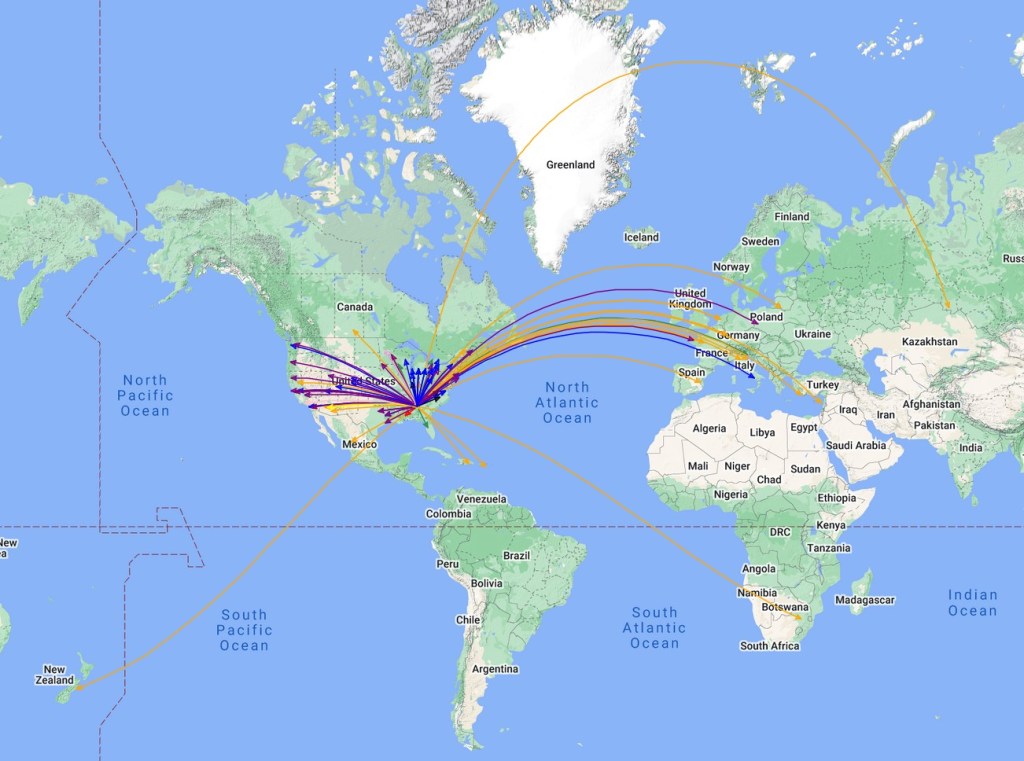
On yeah, so how did I do? I only have my log as the rest of the club was still operating when I left. Throughout Field Day we would have members come and go; operate a little, eat a little, talk a little. Band conditions were funky. At times QSB was rather sudden, often within an FT8 exchange. I operated well into the night, which I often do during my outings. I stayed up until 0200 hrs Sunday morning and was rewarded with 148 contacts to include 2 from Hawaii, 1 from Alaska, 1 from Luxemburg, and 1 from Dominican Republic. I made as least one contact in all but 10 sections in the Continental United States. I enjoy seeing how far my radio can reach. Below is a QSO map and below that a link to My YouTube video. 73 – Scott

West Georgia Amateur Radio Society Spring Fling

Saturday, the West Georgia Amateur Radio Society (WGARS) took to the field for the Spring Support Your Parks Weekend sponsored by Parks on the Air (POTA). WGARS is a pretty active club and one of the best I have belonged to. Besides local events like fox hunts and balloon launches (APRS), we take to the roads 4 times a year to a park. In the spring and fall we make the POTA Support Your Parks Weekend usually on a Saturday. For the winter and summer, we participate in Field Day and Winter Field Day.

Weather was cold, with fog. Temps were in the 50’s and not the mid 70’s predicted by the weather service. I was in shorts and a tee shirt. Luckily, I had a goretex windbreaker in the truck. Others had blankets wrapped around them.

These events are casual events for us. We normally do 3 things while out. We eat, we socialize, and we throw in a little radio along the way. This was no different. We had a picnic table full of food with hamburgers and hot dogs cooked on site by our President John WD8LQT.

Due to a lot of recent solar activity band conditions were interesting. John WD8LQT was runnning CW/SSB and I was running FT8 to reduce interference between the 2 stations. When I switched to 10 meters, I was working into Europe and South America and when I switched to 20 meters, I couldn’t get out of the Continental United States (CONUS). We each made a handful of contacts and spent a lot of time enjoying each others company.

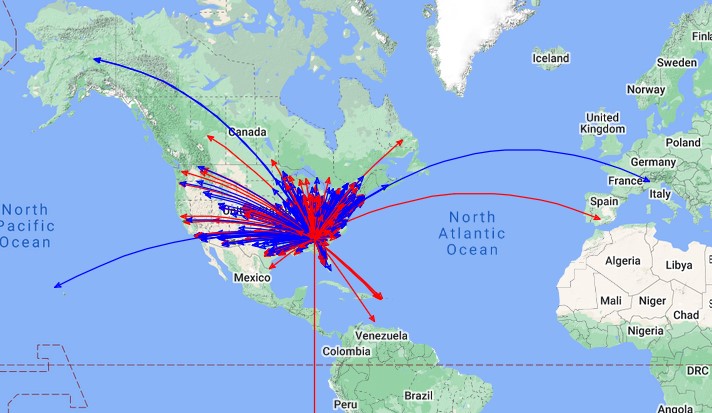
For radios, John was runnning his Xeigu G90 at 15 watts into a EFHW antenna. I was running my IC-705 at 5 watts into my 28.5′ Random Wire antenna. Towards the end my radio developed a glitch and refused to transmit. I was using my iPad via WiFi to make the FT8 contacts and I think that connection caused a setting to change. When I got home and warm, it took me about 3 minutes to figure it out. I still had a pretty good day. Here is a QSO map from my station.

The goal of these event for our club is not how many contacts we make, but how much fun we have and a large part of that is enjoying each others company. Field Day is only a couple of months away — can’t wait.

Below is a short video. It is a little jittery as I had navigate around people and chairs etc. If you’re prone to vertigo, you may wish to skip this one.

Carlos Goes Under the Knife

Carlos is my Elecraft K3…”cause he’s so smooth”. I’ve had Carlos since June, 2023. He came to me as a basic 10 watt K3. He had the 144 MHz K144XV, the KXV3 interface option and 2, 5-pole filters. I got the radio in a trade. Owning a K3 always lingered in the back of my mind, so I took the trade. That started my journey.

Carlos has gone through several iterations since I got him. First I swapped out the 2, 5-pole filters for 5, 8-pole filters (2.8 KHz, 2.1 KHz, 1.0 KHz, 400 Hz, and 250 Hz). Second, I added the KAT3 autotuner. I wanted the internal tuner so I would have less stuff to fool with when using antennas like my random wire. My next upgrade was to add the KSYN3A synthesizer and KIO3B interface. This brought my radio up to a K3S. Finally, I added the KPA3 – 100 watt internal amplifier. I wanted the amp for a couple of reasons. I enjoy Winter Field Day and ARRL Field Day with my club, the West Georgia Amateur Radio Society. I am currently one of 2 CW ops in the club so I usually run CW to help with multipliers. The QSK, the filters, and the ability to run near other radios makes it a no brainer. Also, when I operate portable while camping, I like to run a little more power than QRP; usually in the 20-35 watt range. That is more than enough power for CW. I did all the mods myself and found them pretty straight forward. Elecraft did an excellent job kitting and making the instructions. The couple times I had an issue and they were mine, Elecraft did an excellent job helping me work through it. I did have to send it in last year because of a goof I made, but while it was in the shop, they completely went over the radio and brought it up to spec.

Carlos does scratch a couple of itches. To me, it is like owning a vintage car. It has a nostalgic look and feel about it. The radio was produced from 2008 until about 2015 when the K3S came out. Mine is a later edition with the serial number 8640. The radio is a generation or more older than the current flock of radios. Like a vintage car, I may have more money into it than I should have, but if only accounting for the enjoyment factor, it is money well spent.

I was first licensed in 1995 and my first radio was an old TenTec Omni D. The K3 has a similar look and feel as the old TenTec allowing me to reminisce about all the fun I had as a Tech+ making my first HF contacts using CW. During that time I worked second shift. When I came home from work at night I was able to slip on a pair of headphones and make contacts wihtout disturbing the family until I was sleepy enough to go to bed. My first DX contacts happened then. The K3 gives me the form factor of the older radios with the performance of the newer radios. One other difference is the ergonomics of the K3, which is best in class.

I was considering acquiring an older radio for fun and the K3 fell into my lap. It has become one of my favorite radios. I use it portable for things like POTA and Field Day. Because of its QSK, it is my favorite CW radio. When not in the field, it resides on my desk as a part of the home team. I have a set of paddles and a sideswiper hooked up to it. Hopefully I will get some time today to have some CW fun. 73 — Scott

WGARS Mobile Command Center Update

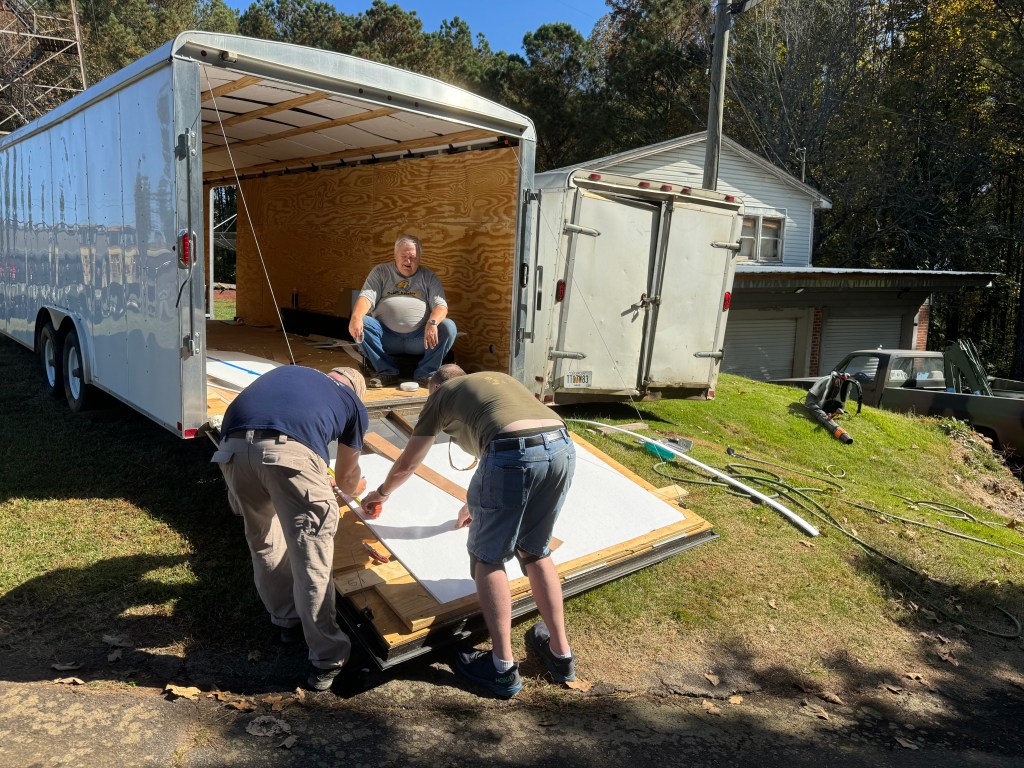
October 28, 2023. Today was another work day on the trailer. I didn’t take many pictures as today was a work day and I — worked. We got quite a bit accomplished. The roof was washed in preparation to reseal it. The ceiling was insulated and furring strips were put up. The furring strips will be used when we hang 1/4″ plywood for the ceiling. One of the final acts of the day was to insulate the rear ramp. Our goal is to be able to use the trailer by Winter Field Day. Once we get the ceiling up, we will be almost there.

The next steps include installing the Split AC system. A countertop down one side of the trailer, running electric and coax to the operating stations (approximately 4) with outside hook-ups, installing lighting, painting, and applying sound-deadening materials. We want to be able to operate all stations with a minimal amount of audio interference.

It’s really a fun project. We are fortunate to have a large talent pool to help pull everything together even when planning is sometimes “on the go”. When the project is finished, we will have a trailer set up and ready to go for FunComm and EmComm. Field Days to Emergency Communications all in one package.

It’s going to be an awesome trailer. 72 de Scott

West Georgia Amateur Radio Society at Cheaha State Park

The West Georgia Amateur Radio Society (WGARS) is a great group. We like to do three things: 1) talk on the radio, 2) get together, and 3) eat. We did all three this past weekend during the Fall Support Support Your Parks on the Air weekend (POTA). We like to do about 4 gatherings a year namely Field Day, Winter Field Day, and the Spring and Fall Support Your Parks on the Air Weekends.

This fall we went a little uptown and rented one of the pavilions at Cheaha State Park (K-1037). This gave us shelter from the elements, power for the slow cookers, and plenty of benches to set up on. There were restrooms nearby with running water. Cheaha Mountain is the tallest point in Alabama and our pavilion was just a little down from the summit.

The weather was perfect. In the morning it was in the upper 40’s rising to the mid 70’s by afternoon. As I said earlier, we like to eat. There was an abundance of food, we had Chicken and Sausage Gumbo, BBQ, baked beans, buns, garlic bread, dunkin’ donuts, coffee, soda, and I am sure I missed a few. The bottom line is we could have fed half again as many and still had leftovers. There were over a dozen of us there.

We set up three radio stations. We had a Yaesu FT-991A and an Icom IC-7300. They were running FT8, CW, and SSB. I was running an Elecraft K3(s)/10 on FT8. My original plan was to run FT8 until it got warmer out and then switch to CW. However, we had a group gather around my station and we were doing what we like to do, kibitz and socialize. With FT8 I can run the radio and join in the conversation. We had a lot of fun chatting with one another. By the end of the day, I worked 40 states and 4 countries for a total of 120 contacts. The DX were Argentina, Canada, Ecuador, and Spain. States covered all 4 corners and in between. Not bad for 10 watts!

I had the pleasure of meeting Ward W4RE. Ward is a Vietnam Veteran and what made our meeting special is that we both served with the 101st Airborne Division. We were a generation apart with me serving between wars, but anyone who has served with the 101st understands that it is not a cakewalk; we had an immediate bond. Like me, Ward is a CW op albeit, much better than I. I am hoping that during one of our future meets, Ward and I can run a CW station together.

This was the trial run for my K3(s). I upgraded my K3 to a K3S. It is a QRP radio with a max power of 12 watts. The difference between 10 watts and 100 watts is about 1.7 S-units, a small change for CW. I operated the radio pretty much the whole time I was out there and it performed flawlessly.

While my K3 was in the shop for a repair and a going over, I put my name on the list for a KX2. There is about a 3-4 month wait for them and if things didn’t work out I could always cancel the order. When I received the invoice for the KX2, I asked my wife Mary K4SEZ about it, thinking it was worth a shot and as I was getting ready to cancel the order; she got on the computer and checked the books (she’s an accountant) and said “Happy Retirement”. I was ecstatic. I retire in 54 days and I have already made plans for that little radio. It was a great weekend that was full of surprises. Winter Field Day is right around the corner — can’t wait. 72 de Scott

Field Day 2023

This weekend I got to participate with my local amateur radio club, the West Georgia Amateur Radio Society (WGARS) for Field Day. This is a great club and every event is fun. It covers a wide variety of activities, including Parks on the Air, Fox Hunts, Balloon releases, Field Day, and Winter Field Day. This year, Field Day was held at the Little Tallapoosa Park located in Carroll County Georgia. We operated as W4F, 5A GA. We did not operate 5 stations all of the time, we padded the number to allow members to bring their own rigs and operate for a short time if they desire.

I decided to make a night of it and brought my micro camper. Because I was in a group setting I set my radio up outside as there were plenty of folks to keep an eye on each other’s equipment. My original intent was to operate FT8 and CW. I have a newly acquired Elecraft K3/10 I wanted to try. However, band conditions were poor, so I relied on my IC-7300 and FT8. The club president tried CW and only made 2 contacts.

Everything worked well. The only glitch was a software one. We networked our computers together with N3FJP’s AcLog for Field Day. The glitch was with the CQ message. I set mine up for CQ FD W4F EM73. It would stay that way until I clicked on an incoming message (red). The FD would change to PACC on its own. I would have to change it back to FD before calling CQ.

I know this wasn’t isolated as I saw other stations from other groups calling CQ PACC. I had to keep an eye on it the whole time I was operating.

How did we do? I think we did okay. Our group is a little more casual than others but, by the time I left by mid-morning Sunday, we were north of 500 contacts. Here is a club QSO map.

I had a good run. I mainly ran FT8 on 20 meters. I ended up with 200 contacts from 38 states and 4 DX entities. The most fun came in the wee hours of the morning when there are DX openings to the west. I was able to make two contacts with Alaska and one with Hawaii. also about the same time I managed a contact to Italy. I didn’t hit the sack until 0400 hrs Eastern.

I was up at 0700 hrs to make the last few contacts. I wanted to pack up a little early before the heat of the day. I had a breakfast of eggs, bacon, OJ, and a pancake in a cup before heading home.

It was a lot of fun. I enjoy field operating and seeing how well my equipment does. What better way to spend a weekend than with friends and fellow amateur radio operators. Below is a short video about the event. 73 – Scott

POTA Activation K-3683 Choccolocco WMA

This past weekend was a busy one. Saturday morning The West Georgia Amateur Radio Society provided communications for the Semper Fi Century Bike Ride. We covered routes from 33 to 100 miles on hard surface and gravel roads. It was a good opportunity to get out. This weekend was also one of the POTA Support your Parks on the Air weekend so after the bike ride, many of us headed out to Choccolocco for an overnight activation.

I enjoy these weekends. Yes, sometimes it’s a little less activating and a little more kibbitzing, but we need that in our lives, don’t we? We all set up in one of the primitive campgrounds. Everyone pitched in and brought some food for the group. My donation was chips and my wife’s fabulous Graham Cracker Cookies. They are liked so much, I no longer ask what I should bring.

Operating. This weekend I was working on finishing up my N1CC award which is working from 10 different parks on 10 different bands at each park. For this park, I needed 3 bands. My weapon of choice was FT8. FT8 does a good job of reaching out and there are plenty of folks on it so getting the numbers is a little easier. I will say that over 90-95% of my contacts are either Park to Park or from me calling CQ POTA. I want hunters to get the opportunity to get points as much as possible.

Equipment. For this trip, I brought my IC-7300. It does a great job and I can bump the power up if need be. I normally run it a about 35 watts. My antenna was my 29′ Random wire with a 17′ counterpoise. The antenna was configured as vertical using an MFJ pushup pole. I used a homebrew 9:1 UnUn and a 1:1 current balun to keep the RF where it should be. With this antenna, I can tune from160-6 meters though 160 is a little sketchy. My computer was my Thinkpad T14. Since we were at a primitive campsite which meant no power or water. I ran everything off of battery and in the end, had to crank up the generator for a little while. Digital Mode really uses power.

How did I do? Not too bad. I started Saturday afternoon and operated on and off until about 0100 Eastern Sunday morning. I made 100 contacts from 23 states and 18 countries. Here’s a map.

Unfortunately, later Sunday morning I got rather ill and had to leave early and head for the house. The rest of the group hung around until Sunday afternoon. There are already plans for a Spring campout. I am excited. Camping out is always good, camping out with friends is even better.

What’s left. I have one band at one park to complete my N1CC. Of course, I will have to make 9 other contacts but hey, that’s what we do. After the N1CC I will probably go back to QRP CW. I feel there is more community there. It’s like Cheers, “Where everybody knows your name.”

Final. Here’s a short video of the activation.

POTA/SOTA Antennas and More

My amateur radio club, West Georgia Amateur Radio Society (WGARS) decided to participate in Winter Field Day. We are going to operate from Talladega National Forest in Alabama. It doesn’t take much to get me out in the woods with a radio. As a club, we will be operating QRP and I will be doing CW.

Since joining POTA, I have been more inclined to build things. I had forgotten how much fun this can be. So today, I thought I would build a couple of antennas for the outing. My first antenna will be a replacement for my speaker wire non-resonant vertical. The idea came from Thomas K4SWL using speaker wire. It was an okay antenna but it was bulky and heavier (12 oz.) than I wanted it to be.

A British company, SOTA-Beams sells some remarkably thin antenna wire. It is insulated and approximately 24 AWG. The best part is they sell a 100 meters for $10.37 and their shipping rates are reasonable. You can find it here: https://www.sotabeams.co.uk/antenna-wire-lightweight-100m/.

A non-resonant antenna is an antenna that is not resonant on any of the frequencies you plan to use. In non- resonant antennas only forward waves exist. A non-resonant antenna radiates as well as a resonant one. Here is what I started out with.

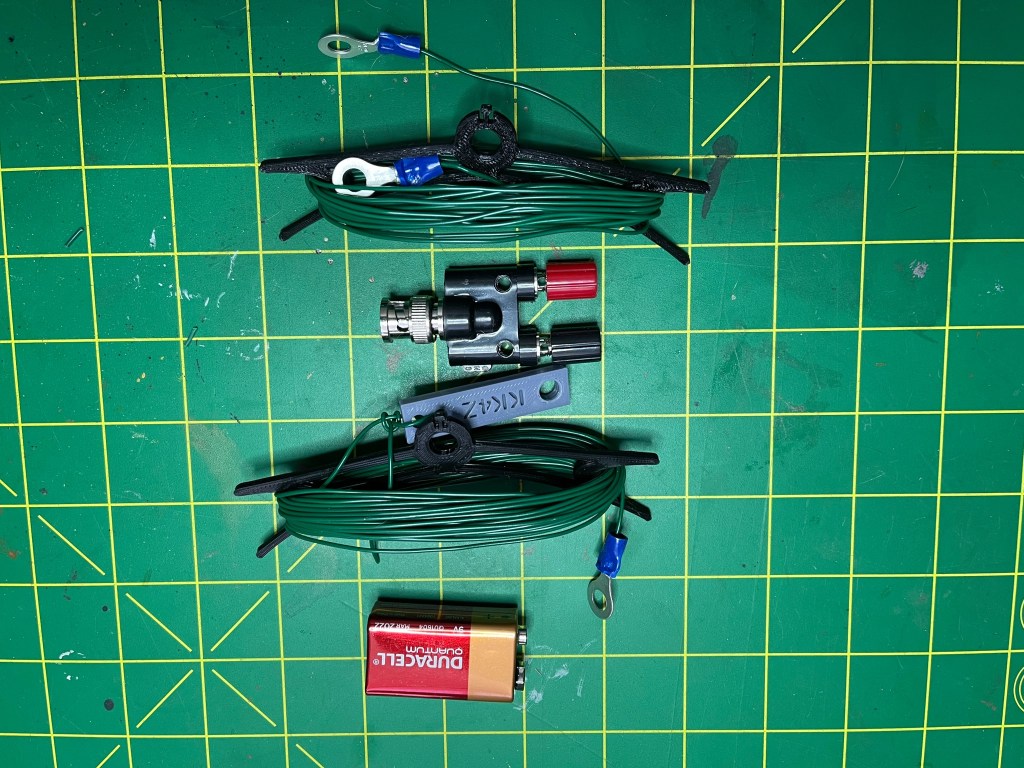
The end insulator and the wire winders were 3D printed by my son. The battery is for scale. The antenna length is approximately 28-29 feet and the counterpoise is approximately 17 feet. Putting it together was straight forward with the end result looking like this. It weighs 3 oz.

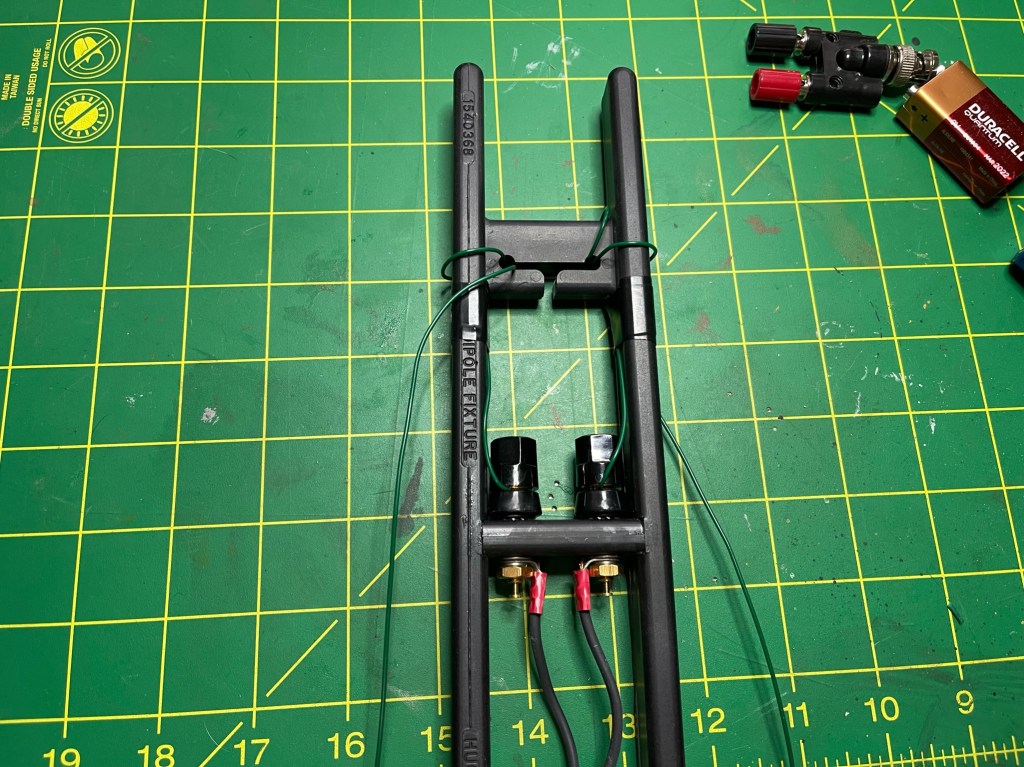
I have discovered that I like working the low bands while on a POTA activation. It takes a little more doing as the antennas get more complex and heavier. My Frankentenna can reach 160 meters but it is a pretty heavy antenna. Again, taking a clue from K4SWL, I acquired a piece of military surplus radio gear. I found an antenna winder for a dipole that is fed with 30 feet of twinlead. I got excited! A doublet is one of my favorite wire antennas as the vertical element can also radiate giving you some DX capability. It will also tune a broader range of frequencies than a dipole. Here is what I started out with.

Note that it is made by the Hughes Aircraft company. I cut the wire at 67 feet per side which should give me an approximately 132 foot dipole. I should be good to go down into the CW portion of 80 meters. While it won’t be efficient, I am thinking I can get an impedance match on 160 meters with my Elecraft T-1 or AH-705 tuner. A half wave dipole for 160 meters is about 270 feet and would be too unwieldy for the field. Getting things hooked up was straightforward.

Everything wraps on the winder. I added a balanced to BNC adapter and two 25 foot lengths of reflective cord I picked up at Tractor Supply. It all weighs 1 lb 3 oz and it all fits in a gallon size freezer bag.

There will be somewhere in the neighborhood of 5 operators at our site, so I don’t know if I will have the room to get the big antenna up. I hope so.

In case you couldn’t tell, I am a big fan of Ziplock Freezer bags in the quart and gallon sizes. They are tough, waterproof and cheap. I buy them in bulk at Sam’s Club. When one wears out, I pull a new one from the box.

Low band POTA activations can be a challenge, but not impossible. My activation at Ft Mountain State Park in GA. proved that. I am one step closer to being ready for Winter Field Day. Should be a lot of fun. It’s supposed to be cold (cold for us southerners) Night time in the mid 20’s and daytime south of 50 degrees. I’ve lived in cold climates; but, what will get me is my hands. I get pretty fumble-fingered on the paddles when my hands get cold. Thank goodnes for propane heaters. We will be operating under the callsign W4D and hopefully be turning in a log to POTA as well. Hope to hear you out there.