I decided to take a look at the FTX-1 and see how it compares to the IC-705. I now have both (I own both) so I can take a good look at each in comparison. My intention is to treat this in a similar fashion as I did for the FT-710/IC-7300. My take is not an in depth technical review but how the radios are perceived through the eyes of a user/operator. First up is the physicality of the radios.
The screens are the same size on both radios. The FTX-1 is a little wider and the IC-705 is a little thicker.
Adding the batteries seems to equalize this as the Icom’s battery is set into the radio and the Yaesu’s sticks out.
One is wider, one is thicker, handling the two radios, I would say it’s a wash.
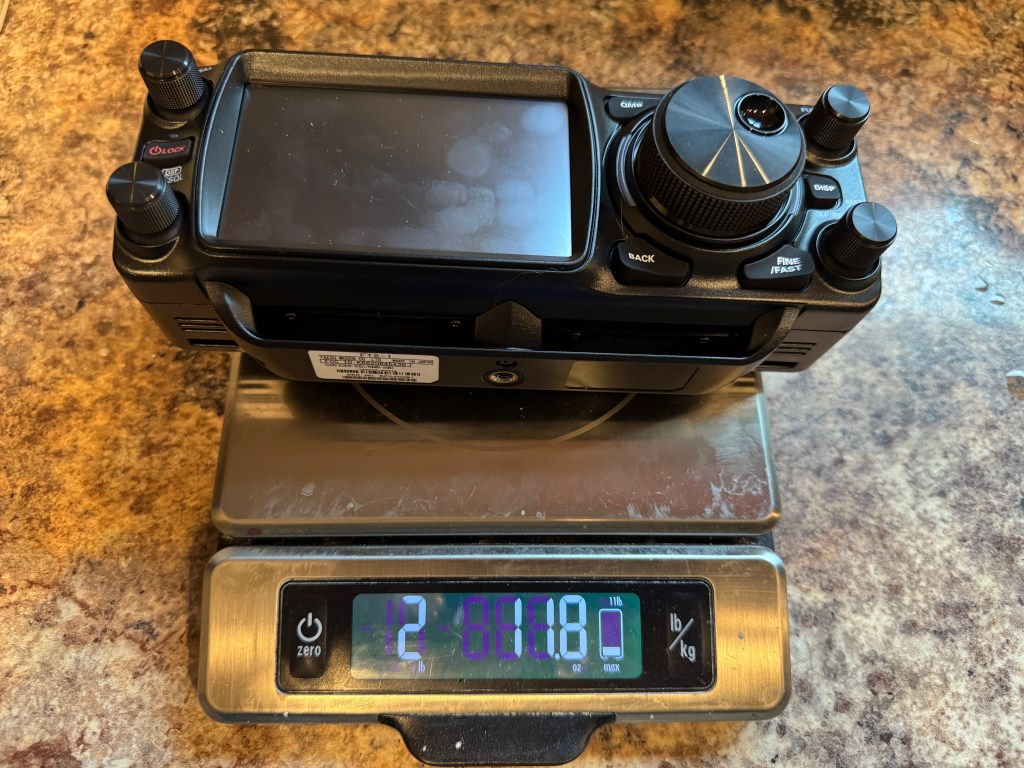
Weight Here there is a difference. The Yaesu weighs more. Handling the radios, the Yaesu feels heavier than it actually is. It feels like a brick.
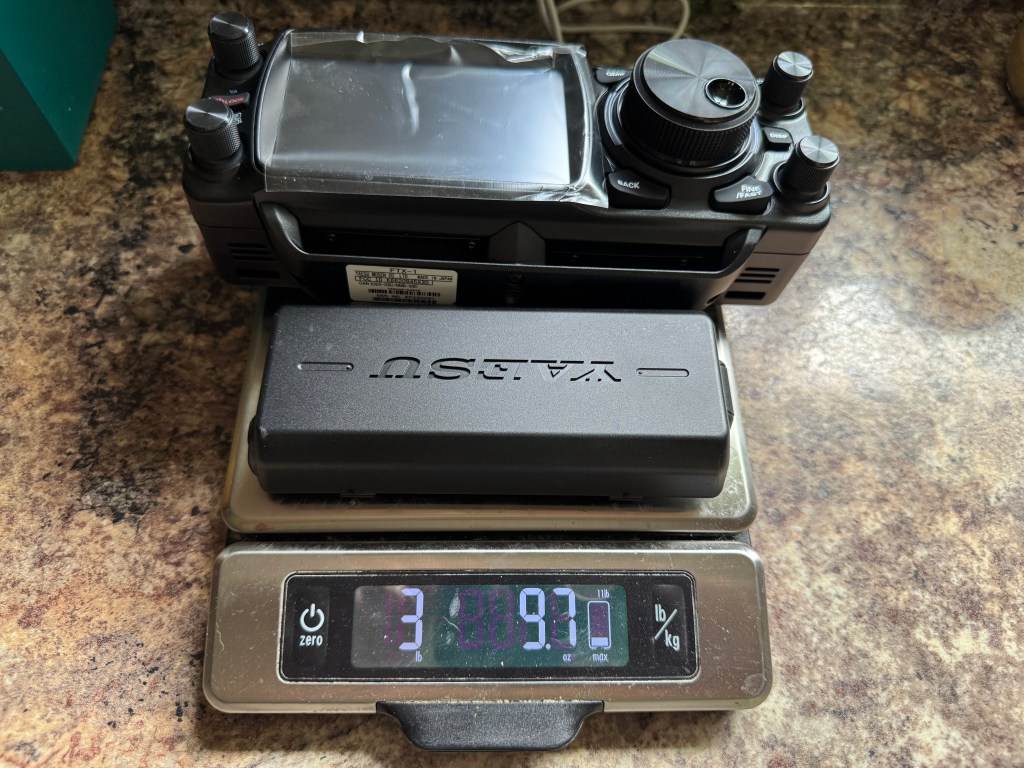
The FTX-1 is 6.3 ounces or 17% heavier than the IC-705. with out the batteries. Adding in the batteries.
For the Icom, I added to additional batteries to bring the total storage up to 6.3 Ah similar to the Yaesu’s 6.1 Ah battery. Even so, the IC-705 weighs less than the FTX-1 by 9.4 ounces or 16.34%. Note: The Icom with a 3.3 Ah battery weighs about 1 pound less than the FTX-1 with a 6.1 Ah battery (see the next post about power).
Size wise, I feel the radios are comparable, they would both fit in a pack or box interchangeably. Weight could be an issue for some. For those doing a POTA activation carrying their radio from the car to a park bench 50 yds away, weigh will probably not be an issue. For those who like to pack it in or do SOTA, weight would be a more critical concern. For me, my days of over hill and dale are pretty much done. If I had to travel light I would turn to my Elecraft KX2.
This month I ended up at Black Rock Mountain State Park. It is one of my favorite parks. I like it because it is located on the top of Black Rock Mountain. The views are fantastic and you couldn’t find a better park to operate a radio. This was a weekday trip. For the past couple of months I tried operating during the week instead of in the weekend. It was okay, I think I like the weekends better.
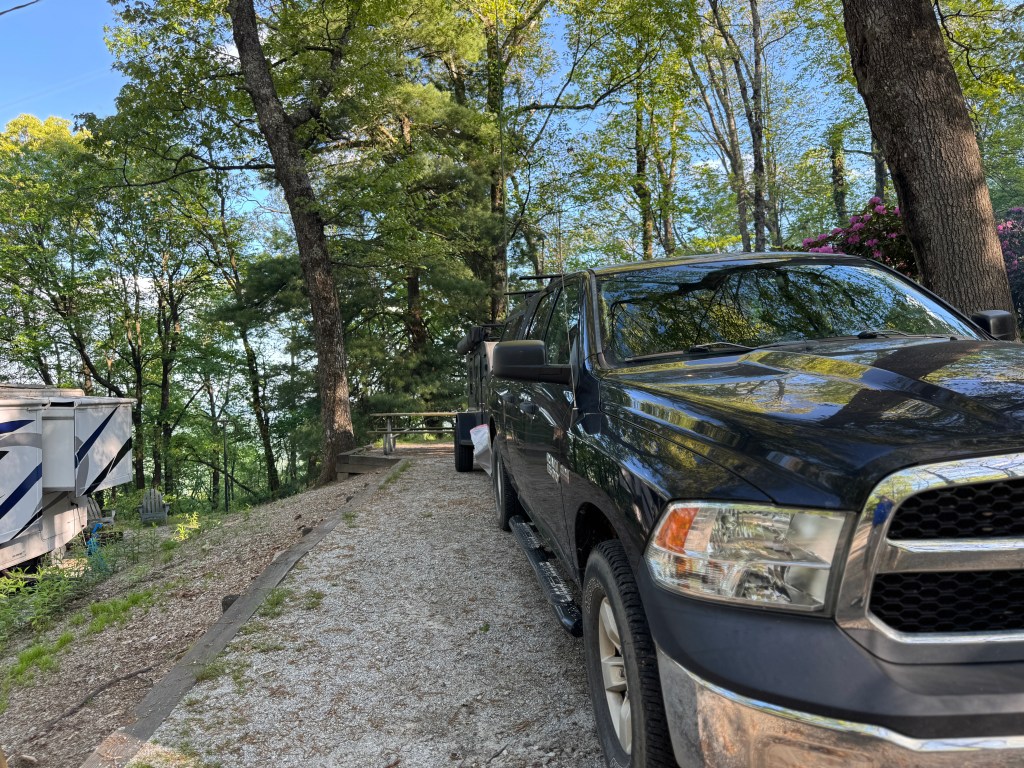
The weather was beautiful mostly cool with a spot of rain on the first night. I was surprised to see Slate Colored Juncos on the mountain. My mother called them snowbirds because they often proceeded a cold front and sometimes snow. I was near a comfort station and right next tot he camp host. No issues when I put up my 28.5′ random wire vertical.
Radio du jour was my FT-710. I also brought with me my IC-705 thinking I would switch over to QRP and CW on the second day. More about that later. I started out on FT8 and 25 watts. I went QRV on 20 meters around 1900 Z. The band was wide open! I stayed on 20 until about 0200 Z. The first day, I made over 200 QSO’s. Wednesday morning things started out well and then fizzled. In the end I made 453 QSO’s covering 46 states and 16 DX entities. The states I missed were AL, HI, ND, and WV. For DX I got as far north and west as Alaska, as far south as Uruguay, as far east as European Russia. I was hoping the band would stretch far enough west to pick up Hawaii, but it didn’t quite make it. A hop too far.
By Wednesday afternoon the bands were dead and I decided to head back to the house. It was a good run while it lasted and a lot of fun. The only issue I had were people asking for dupes. I only need to work you once and the way band conditions were many stations I needed were a one shot deal. Heard them once and then they were gone. I lost some of those because of people asking for dupes. That means two of us lost. Most logging software will show you if you worked a station before. It’s what I use. As an activator, I try to get as many stations as I can in the log.
Once the bands died and I realized that QRP and CW were not viable, I decided to pack it up and head home. I left the park early Wednesday evening and was home before dark. All in all a nice trip. Here is a QSO map of the activation.
End of an Era. This will be my last year on WordPress. It cost me between $100-$200 a year to maintain and being retired I need to cut a few corners. What will happen, is I will move back to Blogger which is free. I own the domain name and I will bring that with me. My WordPress subscription, ends March of next year and in the mean time, I will move some of my posts over to Blogger. Mainly the technical stuff. I will also be taking fewer overnight trips and combining some trips with the wife doing more than amateur radio.
Retirement is grand, I wouldn’t trade it anything. With it comes a little more responsibility. If I think I want something on the pricey side, I ask myself if I am willing to go back to work for it. So far the answer is no. Stay safe and 73 de Scott
I decided to travel a little further this time and head toward the Okefenokee swamp. this time I tried the Laura S Walker State Park. It was a five hour drive and about 320 miles but fortunately I was able to stay off the interstates for all but about 30 miles of the trip. The park is near Waycross, GA which recently suffered from severe weather. Even though it has been a while there it still plenty of evidence to attest to natures fury. The park itself was in good shape and I had a nice campsite.
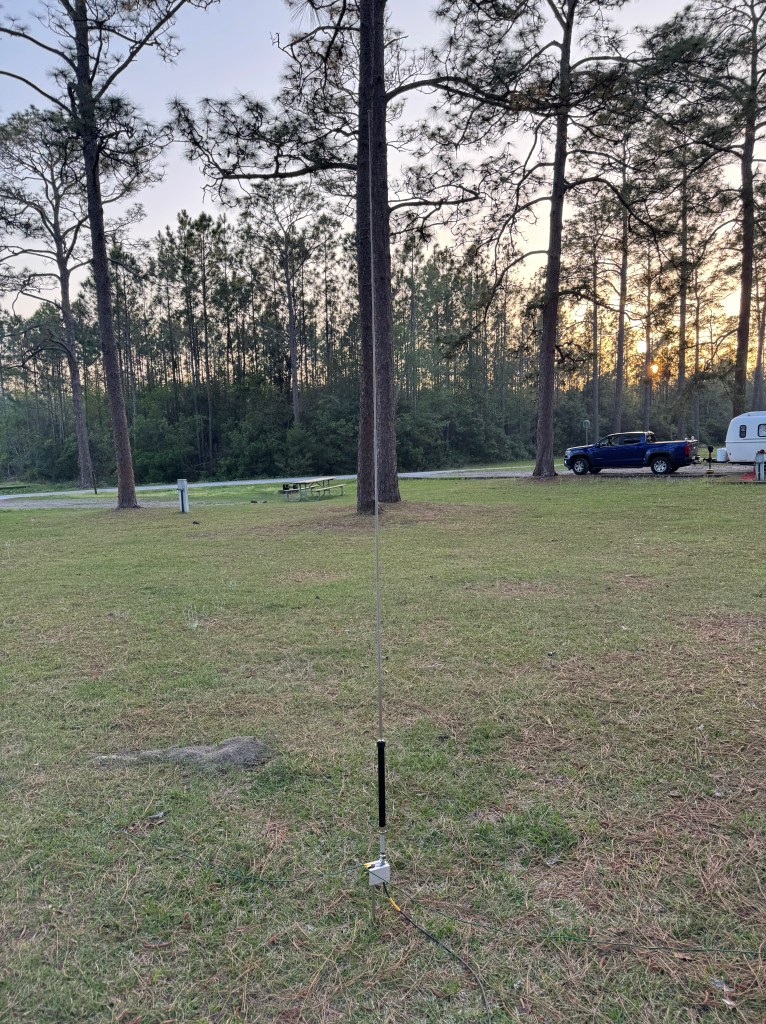
I would normally use my 28.5′ vertical antenna but I had a power line that passed almost directly over my truck and camper. I could have requested a better campsite but in the spirit of FunComm I decided to work with what I had. Instead of my usual antennas I deployed a new antenna. A Diamond RHM-12. This is a manual screw drive type antenna that is only about 7 feet tall and covers 40 meters to 440 MHz. With additional coils it also covers 80 and 160 meters. I set it up away from the power lines and used a Chameleon Spike to set it into the ground. I also had 2 counterpoises about 20-25′.
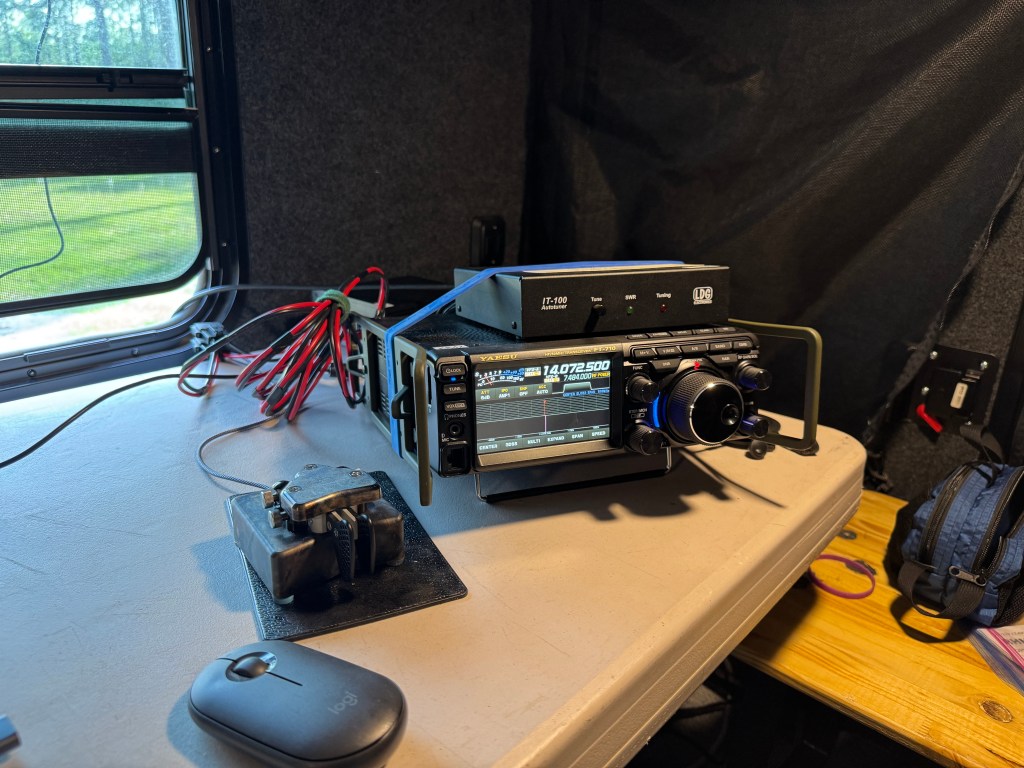
I was a little concerned about its performance. Inside the camper I had My Lenovo Laptop and Yaesu FT-710 with an LDG tuner.
I had a Rig Expert Pro Stick antenna analyzer with me and I was able to get the SWR down below 2:1. I guess I could have monkeyed with to get it lower but since I had the tuner…
I have really taken a liking to the FT-710. It has been performing well and since the last firmware updates, it has become a little champ. It is winning my heart. The radio, tuner, and computer all worked well together. I only ran 25 watts of power as that is about the limit on the antenna using FT-8. I was going to work some CW but the days I was at the park the temps were up around 90 degrees, far from the 43 degrees the morning I left my home QTH. I ran the air conditioning and when it is on I have trouble copying CW. Years in Army Aviation and other loud occupations have affected my hearing.
How did I do? Surprisingly well. In a 24 hour period which included sleep time, I made 400 contacts (7 dupes). I made contacts in 46 states (Not AK, HI, MT or RI) and 34 DX entities! I think that’s a new record for me during a POTA Activation. I got as far west as Australia and American Samoa, and as far east as Turkey, Bulgaria, and European Russia. The bands were up and down and I had to make a few trips out to the antenna to adjust it when I changed bands.
I never expected that little antenna to perform so well. The RHM-12 antenna has been assigned to permanent duty in my antenna kit.
It’s important to take your gear out and use it. Understand how it operates under various conditions. Know what your gear can and cannot do. This is good to know having fun but becomes critical when more is at stake.
This past weekend I made a trip down to Orlando Florida to experience Hamcation. It was a lot fun. I got to meet some cool people and of course came home with some radio related goodies. The Region 4 U.S. Army MARS group had a dinner Friday night and I got to connect faces to voices. It was a good time.
This was also a time for some refection. On my way down and back I traveled on Interstate 75. This was the same route I used during the 2004-2005 hurricane seasons. I provided HF radio communication for the convoy bringing relief supplies right after a hurricane. I did this 4 times in 2004 and once in 2005. Back then, communications was not as well developed as it is today.
During those trips I would check into the South CARS net or the South Coast Amateur Radio Service net. According to South CARS: “The purpose of the net is to assist those seeking to contact other amateur radio stations, or areas; to provide weather and travel information; to assist in emergencies when needed.” They operate on 7.251 MHz from 0800 to 1300 hrs Eastern. I used the net to check my radios and listen for any travel information that might have affected the mission. I joined back then (#3773)and still occasionally check in from time to time.
On this trip I was traveling solo so I dialed up 7.251 and checked into the net. While the net was operational, they kept me company and I enjoyed listening to the net. At times, it brought me back to those disaster relief days. Good memories; I felt the sense of purpose I had back then. I appreciate South CARS today as much as I did back then. I know that if I was ever called up again to provide EmComm in Region 4, South CARS would be there for me.
Other good news is I may have a trade for my amplifier. I found a TS-890s and hopefully the trade will go though by the end of the week. I am not young anymore as I have retired twice now. I know that my days of deploying are numbered as the body starts to wear out. Currently I still go camping and therefore could deploy if needed. However, as time marches on I will become more home centered. The good news is ham radio offers opportunities both home and abroad. I have a pretty good home station and I am a pretty good Net Control Station. I plan to use the TS-890s for CW and other fun things.
I’ve had a good run. I’ve got to do some exciting things in my life. In retirement, I am still busy, I still have lots to do. My focus is changing. A fixed income doesn’t mean eating Alpo, it means careful planning. If I want something, I can have it, if I plan for it. The other option would be to go back to work and that ain’t going to happen. Life is good — de 73 Scott
I woke up this morning to fresh snow on the ground. I had the same excitement as I did as a kid. I got dressed and went on my daily 4 mile walk—in the snow while it was snowing. It was glorious, I remembered playing in the snow as a child and backpacking in it as a young adult. I also remember the grueling Army Field Training Exercises (FTX) in German winters. I have seen cold winters, my coldest was somewhere between -20 to -30 degrees F. Winters can be fun, and they can be dangerous. The most dangerous winter is like what we are seeing today on NW Georgia. Snow with freezing rain and temps hovering around freezing. For driving, this means ice on the roads and sometimes ice covered with snow. Drivers unaware that they are driving on ice lose traction and control of the vehicle. Often they are unaware they have lost control until it’s too late. I have driven cars, trucks, military vehicles, and 18 wheelers on snow and ice covered roads. Only through training and experience did I survive those encounters.
These conditions are also conducive to personal physical injuries such as immersion foot, frost nip, frost bite and hypothermia. Being cold and wet by itself may not kill you, but cold and wet, coupled with inexperience will. This blog post is not necessarily about amateur radio, but about operating amateur radio outside in these conditions. Using my 4 mile walk today, I will lay out what I wore and why.
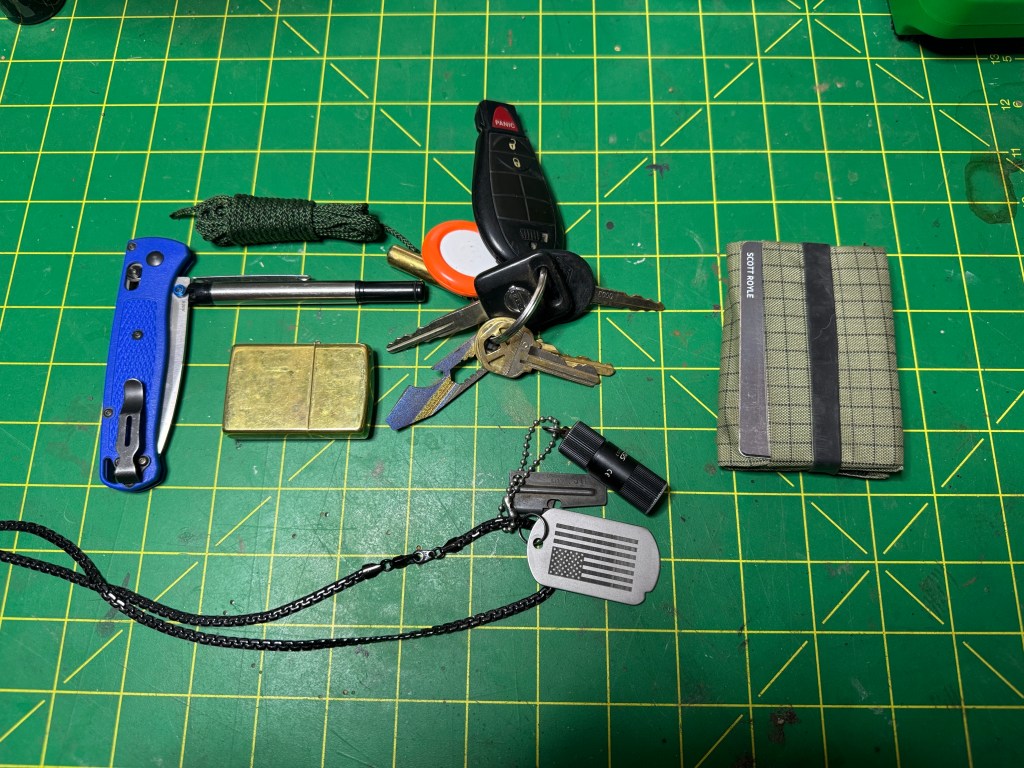
Let’s start with EDC. EDC is Every Day Carry which for me is every time I leave the house I have these items on my. Here is what I carry Every Day.
Knife – Benchmade Bugout. I love this knife. It is the perfect size and weight. I resides in a pocket on my cell phone holster.
Bandanna
Pen
Lighter – Zippo with a butane insert. I used to carry a Bic Flic but because it is so light, it would fall out of my pocket when I retrieved other items. I do not have this issue with the Zippo
Cord – 10-12 feet of 1/16” 100 lb test cord.
Car keys with a bottle opener
Cell Phone
Necklace with: P38 can opener (from my army days) Olight i1Reos flashlight. This is an amazing little light. Dog tag with emergency contact info and medical insurance info
Wallet with: Cash, Credit Cards and ID Signal Mirror Fresnel lens – for reading and fire starting A couple of bandaids Victorinox Swiss Card.
Other items may be added as necessary such as self-defense items or electronics to support blogging/vlogging and radio gear.
Clothing. Starting from the inside out. My undergarments are a mesh top with a bottoms made from 60% cotton and 40% polyester. The next layer was a Carhartt Force Cotton Tee shirt 65% cotton/35% polyester, and Levi blue jeans. I wore Darn Tough wool socks (I wear these year round) and Solomon XA Goretex trail shoes.
My next layer was an Eddie Bauer fleece pullover I got cheap from Sam’s Wholesale. It is 100% polyester. On top of that I wore a cheap Amazon Basics lightweight fleece vest again 100% polyester.
My outer layer was a Carhartt stocking cap 100% acrylic. A TurtleFur neck tube (polyester). Cotton Jersey Gloves and a British SAS Windproof Smock (50-50% Cotton Polyester (unlined and uninsulated). Through the rain/Sleet/Snow I remained warm and dry. My Smock got quite damp but the hydrophobic nature of my under layers and the heat I generated kept the moisture to the outside. If I wore one of my Goretex jackets, I would have been soaked in sweat as Goretex is not as breathable as the smock is.
While walking, I was warm enough to have to unzip my smock and my vest. My gear would have kept me warm down into the teens. I tend to dress one layer warmer than I need. In this case I added the vest. There is a myth that “cotton kills” It’s not the cotton, it’s the operator. Most military uniforms are about 50% cotton. My days in the Army go back to the BDU which is made from Nyco or 50% cotton/50% nylon. I wore that uniform from very hot to very cold and I lived to tell about it. Know your gear, know how it works in different conditions. How does it perform when wet. What I wore today was perfect. My smock got damp, my gloves got damp, but inside I was warm and dry. I walk year round and I walk in most weather conditions. I know how my clothes work. I made myself a promise when I got out of the Army, and that was I would only be cold and wet when I wanted to be. To date, that has not happened. Get outside, try your gear, know what to wear for different conditions. Be safe. Be especially safe when your community needs you. 73 de Scott










 KK4Z
KK4Z 