Black Rock Mtn State Park – Aug 2025

Last weekend I finished up a 3-day, 1,800 mile, 7-state POTA Rove that included a radio trade. Out with the FTX1 and in with a TS-590sg. After setting up the 590, I brought it with me to Black Rock Mountain State Park to try some FT8 and if the band conditions permit, a little CW.

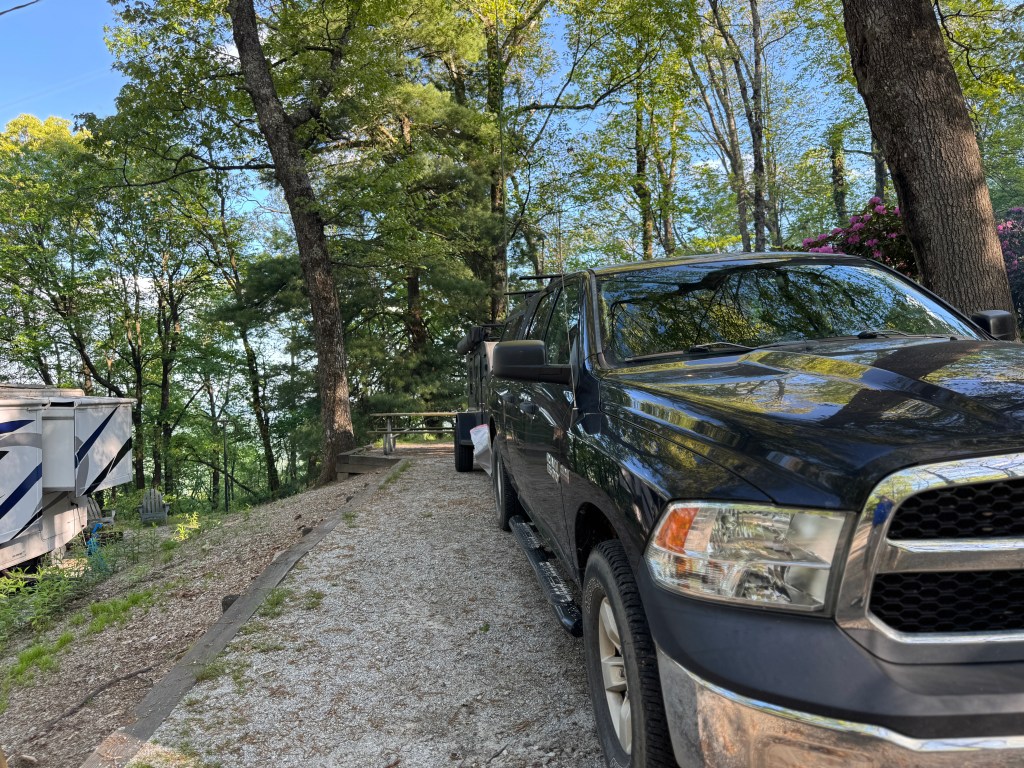
I arrived at the Park Friday afternoon. I have done this enough times that I am setup and ready to go within 30 minutes.  This campsite had some challenges.It was the smallest campsite I ever used.  I had space for the trailer and I had to park my truck in the picnic area.  I also had overhead power lines so I had to use a shorter antenna. The weather was cool for a change and I didn’t have to run my A/C.

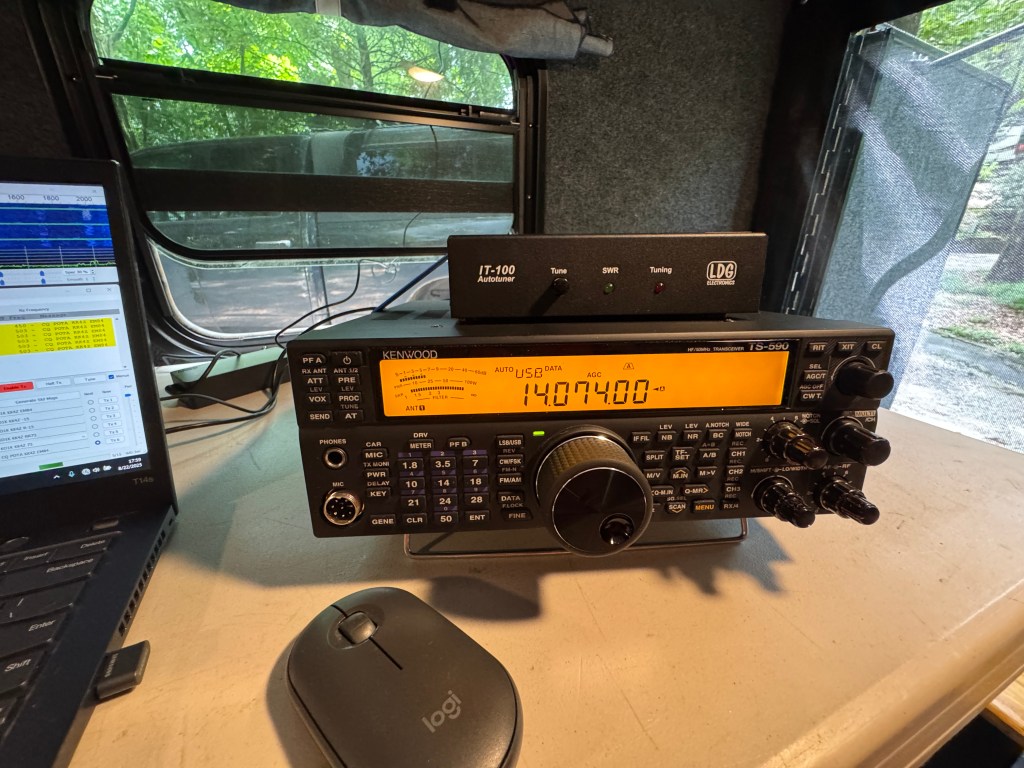
Setup was a Chameleon Micro Hybrid transformer with a 12’ whip and about a 20’ counterpoise.  The radio was my new-to-me Kenwood TS-590sg.  This was the radio’s maiden voyage and I really liked it. It performed well.  One of the main reasons I like running big radios at low power is more of the controls are readily available. Most everything in the TS-590sg is either a push button or a twist of a knob away.  Having a high performance receiver isn’t any good if you can’t get to the controls.

Band conditions were poor. The first night I only made 88 FT-8 contacts and they were a struggle.  At times the band would “white-out”, high noise and only white snow on the waterfall. At the better times QSB or fading was a constant up and down.  I would watch S7-9 signals drop to nothing during a QSO.  Saturday afternoon brought a power failure at the park. Yep, right during mid QSO.  The power was still out at 1800 hrs, so I had a decision to make – should I stay, or should I go.  As you get older one of the things that goes, is your night vision.  If I was going to leave it had to be soon, so I could still do most of my driving during daylight/evening hours.  I decided to go.  Since I have a lot of practice setting up and tearing down.  I was packed up in less than 30 minutes. As I was pulling out of the park, the power returned.  Better safe than sorry.

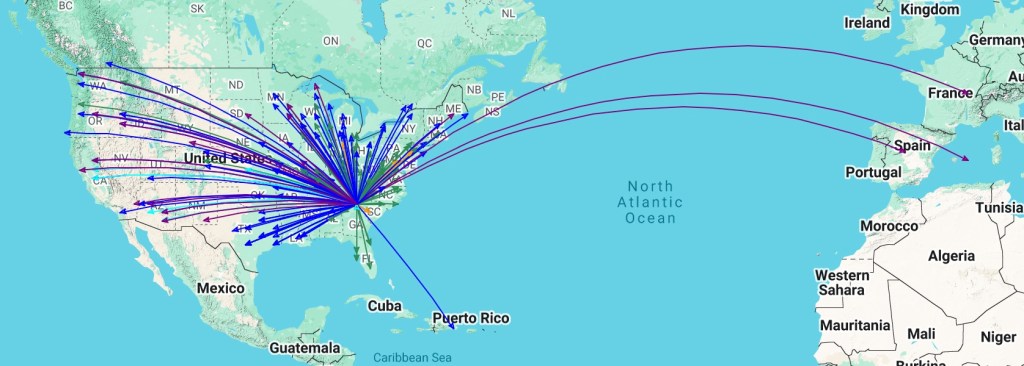
I ended up with 233 contacts, 88 short of my kilo for that park.  I will plan another trip in the fall to finish.  I am real happy with the TS-590sg.  I opened it up and found the MARS mod already done and the TXCO installed.  The radio performed well and I ran it mostly at 20 watts.  As you can see in the QSO map, Most of my contacts were CONUS. Kenwoods and Icoms have the best ergonomics. I feel the layouts were designed by people who use their radios; that ergonomics were a primary concern and not an afterthought. 
Screenshot

I also decided to trade off the FT-710 and ended up with a pristine IC-7200.  I always wanted one but the stars never aligned — until now.  I no longer have any Yaesu radios in the stable and probably won’t have any more.  Why? A couple of reasons. I prefer the ergonomics of the Icoms and the Kenwoods.  Everything I need is right there on the front panel. Easy, to see — Easy to use. I have owned a FTDX10, FT-710, and a FTX1, along with an Icom IC-7610, IC-7300, and a Kenwood TS-890s. I can tell you that whatever I hear on one radio, I can hear on the other.  There’s two reasons for this.  One is knowing where the controls are and two is knowing how to use them. There is a third factor the CSP unit, that’s Cerebral Signal Processing Unit. Half of the battle is using the CSP to process faint signals.  After 30 years, mine is pretty good.

The Yaesu radios, are not bad radios, they are not my cup of tea. I can squeeze more horsepower out of the Icoms and the Kenwoods.  I am sure there are those who can say the same about Yaesus.  I at least crossed the fence and tried them but in the end my preference is not Yaesu. YMMV.

Other happenings. I rearranged my Go Box.  My TS-590sg will not fit in it like my other radios so I got an Apache case for it from Harbor Freight and moved some antenna stuff into the Go Box. So now all my radios travel in a separate case and my Go Box has become universal.  Everything I need to run any of my field radios is in the Go Box.  These days I do more FunComm than EmComm, but I am always prepared to do either. I load the same stuff and off I go. I’ve had a busy summer and the honey-do list is growing, there is lots to do around the ranch so this may be one of the last trips for a while. I do most of my outdoor work from Fall to Spring to avoid working in the southeast hot, humid summers and the accompanying chiggers and ticks. That’s all for now,  take care and 73 de Scott
US-2167 Black Rock Mountain State Park and the End of an Era

This month I ended up at Black Rock Mountain State Park. It is one of my favorite parks. I like it because it is located on the top of Black Rock Mountain. The views are fantastic and you couldn’t find a better park to operate a radio. This was a weekday trip. For the past couple of months I tried operating during the week instead of in the weekend. It was okay, I think I like the weekends better.

The weather was beautiful mostly cool with a spot of rain on the first night. I was surprised to see Slate Colored Juncos on the mountain. My mother called them snowbirds because they often proceeded a cold front and sometimes snow. I was near a comfort station and right next tot he camp host. No issues when I put up my 28.5′ random wire vertical.

Radio du jour was my FT-710. I also brought with me my IC-705 thinking I would switch over to QRP and CW on the second day. More about that later. I started out on FT8 and 25 watts. I went QRV on 20 meters around 1900 Z. The band was wide open! I stayed on 20 until about 0200 Z. The first day, I made over 200 QSO’s. Wednesday morning things started out well and then fizzled. In the end I made 453 QSO’s covering 46 states and 16 DX entities. The states I missed were AL, HI, ND, and WV. For DX I got as far north and west as Alaska, as far south as Uruguay, as far east as European Russia. I was hoping the band would stretch far enough west to pick up Hawaii, but it didn’t quite make it. A hop too far.

By Wednesday afternoon the bands were dead and I decided to head back to the house. It was a good run while it lasted and a lot of fun. The only issue I had were people asking for dupes. I only need to work you once and the way band conditions were many stations I needed were a one shot deal. Heard them once and then they were gone. I lost some of those because of people asking for dupes. That means two of us lost. Most logging software will show you if you worked a station before. It’s what I use. As an activator, I try to get as many stations as I can in the log.

Once the bands died and I realized that QRP and CW were not viable, I decided to pack it up and head home. I left the park early Wednesday evening and was home before dark. All in all a nice trip. Here is a QSO map of the activation.

End of an Era. This will be my last year on WordPress. It cost me between $100-$200 a year to maintain and being retired I need to cut a few corners. What will happen, is I will move back to Blogger which is free. I own the domain name and I will bring that with me. My WordPress subscription, ends March of next year and in the mean time, I will move some of my posts over to Blogger. Mainly the technical stuff. I will also be taking fewer overnight trips and combining some trips with the wife doing more than amateur radio.

Retirement is grand, I wouldn’t trade it anything. With it comes a little more responsibility. If I think I want something on the pricey side, I ask myself if I am willing to go back to work for it. So far the answer is no. Stay safe and 73 de Scott

POTA Activation K-2939 Cumberland Mountain State Park

I try to get out camping about once a month. It’s good for the soul. While out I am often activating the park. Also fun and relaxing. I book my campsites 3-4 months in advance to ensure I have a place to go. Campgrounds in the southeast fill up fast. This trip was up into Tennessee to the Cumberland Mountain State Park. It was a lovely 4-hour trip with only 44 miles being on an Interstate Highway. The park is located in the Cumberland Plateau Region of Tennessee and my drive included driving through Sequatchie Valley. The valley is rather narrow and you can see the walls of the valley on both sides. I couldn’t ask for better weather. Highs in the 70’s and lows in the ’50s. After a hot summer, it’s was a welcome relief.

The campsite was cozy. This park had a higher density than I normally like, but there was lots of foliage and greenery around to set my karma right.

Band conditions were not that good and I operated FT8 on this trip. I am working on my N1CC award which is working 10 different bands from 10 different parks. Because the park was so far away (200 miles) with gas prices what they are, I wanted a one-and-done which is why I stuck to FT8. My setup was what I have been using on the past couple of trips.

The radio was my IC-7300 and the tuner was an old LDG Z-11 Pro. Since I had shore power, I used a Powerwerx Switching power supply. The computer is a Lenovo Thinkpad T14 which I bought refurbished from Lenovo. It’s a really nice computer. The mouse is a Logitech Pebble which is Bluetooth. For FT8 I also use a GPS dongle to keep the clocks on my computer and radio synced. On FT8 the further you drift from the actual time, the probability to connect to another station goes down. Even at home I sync my computer every day that I use FT8. I also keep a flash drive plugged into the computer. I use ACLog and I have it set up that it makes a backup copy to the flash drive every time the program shuts down.

The antenna is my homebrew random wire. It’s a 29-foot wire setup as a vertical using an MFJ-1910 pushup pole attached to my truck’s trailer hitch. I use one 17-foot counterpoise with a homemade 9:1 UnUn and a 1:1 current balun for a choke. I highly recommend a choke on any portable operation. Keeping RF at the antenna prevents all sorts of things on the radio. I really like this antenna. It has become my go-to antenna. I have probably made over 1,000 contacts with it from all over the world. Since there are no holes in the ground or wires in the trees, the park staff remains happy. On this trip, my campsite was next to the campground host. I can’t say enough about the antenna, it just works, it goes up and down in a couple of minutes, and didn’t cost that much to make. You do need a good tuner though. With this antenna I managed to get my 10 bands. 6-meters was dead the whole weekend so I had to to the other end — 160 meters. On digital modes, my antenna can tolerate about 65 watts max before toroids get saturated. On 160, it’s more like 35 watts. 160 was looking a little sketchy, however, I managed 2 contacts, here is one. I have used this antenna from 6-160 meters.

The IC-7300 has become one of my favorite field radios. Compact, lightweight, and full of features. It has never let me down. I bought mine back in 2017. The only protection I use on it is a set of Portable Zero rails. When I transport it, it rides in a Dewalt Tough System box with no additional padding. Every time I pull it out and plug it in, it works. I have had other brands of radios, but I always seem to head back to Icom at least for HF.

I operated from Friday afternoon until Saturday night. I made 350 QSO’s from 43 States and 18 countries. I worked them from 10 meters to 160 meters. It was a blast. I now have 8 parks with 10 different bands. I have one with 9 and one with 7. I should be able to wrap those up in the next couple of weeks. Then I think I’ll go back to low power (less than 10 watts) and get my CW mojo back in order. See you out there — Scott