Shack Shakeup Continues

I have a stable of radios. I like radios. I have spent the past couple of years going through radios and finding the ones I like to use. I think I am getting close. In the shack, I like my IC-7610 and TS-890. They are big and all the controls I use are easy to get to. There performance is top notch. I am content.

QRP radios. This has been my greatest controversy. When I retired, I thought I was going to do a lot of QRP with little radios and maybe even do some SOTA. It didn’t turn out that way. I found myself using big radios at low power. They are easy to use and because of their heatsinks, they never overheat at low power. I did keep one little radio the IC-705, of all the little radios I had, the 705 was the one I grabbed the most.

Field radios. I went through a bunch of radios here too. I kept my IC-7300 which I bought new and has stayed with me over the years. I may sell it off for the new IC-7300MK2. I recently acquired a TS-590sg which went with me on my recent POTA activation at Black Rock Mountain State Park.

It was definitely a fun radio and I look forward to using it more in the future. Yesterday, an IC-7200 was delivered by UPS. The was a trade I had in the works. I always wanted an IC-7200. It’s a basic radio that has a military vibe to it. Being a Veteran, it appealed to me. The radio came with the rails and the MARS mod was already done. The radio is pristine. Power draw at idle is about 1 amp and at 20 watts it draws about 8 amps. Lowering the power level does not overly change the amp draw. Above 20 watts and the amp draw increases. Twenty watts is the happy medium. Here in the shack I had it turned on and was able to work N0SA. I have a set of his SOTA paddles from his last run before he retired. They are fun to use. I plan on taking the 7200 on my next POTA adventure.

During the past couple of years after making many POTA activations, Field Days (winter and summer), Army MARS, and SHARES I was able to shape how I operate. Some of it was a surprise as I was led in a different direction than when I started. I guess when it comes to radios, I may march to the beat of a different drummer. I prefer big radios (IC-7300 size) over little radios. I like that the controls are easier to get to and they don’t overheat. In the field I usually run around 20-35 watts. Most of the time I am in my micro-camper so I am not carrying the radios very far. I may have to lug them 50 feet to a picnic table. I recently bought one of those folding wagons so weight is no problem.

Another surprise was my use of FT8. Band conditions on many of my outings was poor. If it wasn’t for FT8, I may not have had a valid activation. Plus, I discovered I could work a lot of DX while in a park using FT8.

Yaesu’s. I don’t have any Yaesu’s. I have tried to like them, but they are just not for me. I had an FTDX10 for about 18 months, a FT-710 for about a year total, and a FTX1 for a couple of months. To me they are kind of quirky. The Icom’s and the Kenwood’s are solid performers and the ergonomics are superior. I know how to make them dance and sing. I know there are those who love Yaesu and I get it. To each his own. Find the radios that suit you best and enjoy them as I have. The journey is half the fun. 73 de Scott

A New Widget/Gizmo

I picked this up during Hamcation last year. I thought was interesting. It allows me to quickly hook up a set of power wires to Anderson Power Poles. I recently found it useful when my FTX1 arrived and I wanted to hook it up to my power supply. Ten seconds later and I was good to go. I found over the past couple of months I used these quite a few times.

My quandary was I bought it from a booth at the hamfest from a vendor whose name I couldn’t remember, how much it cost, and even what it was called. So I thought I would try to recreate it. An Amazon seach found these.

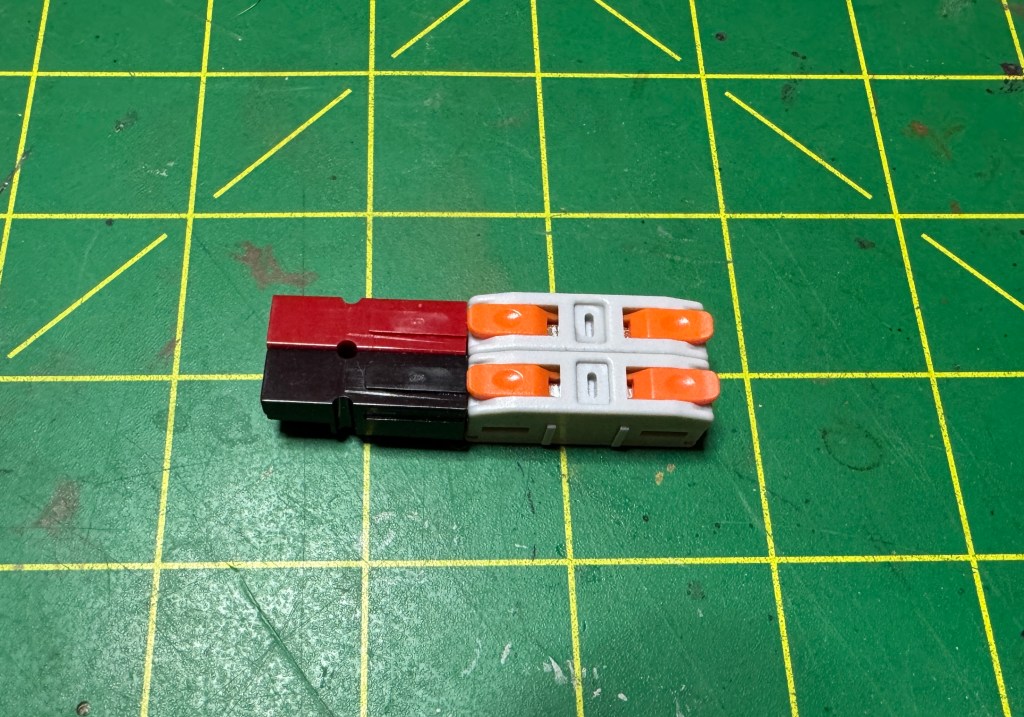
Wire Connectors Putting it together I used 1″ 12 ga. solid copper wire and standard Anderson Power Poles. These connectors will handle wire from 24 to 12 ga. Putting everything together they look like this.

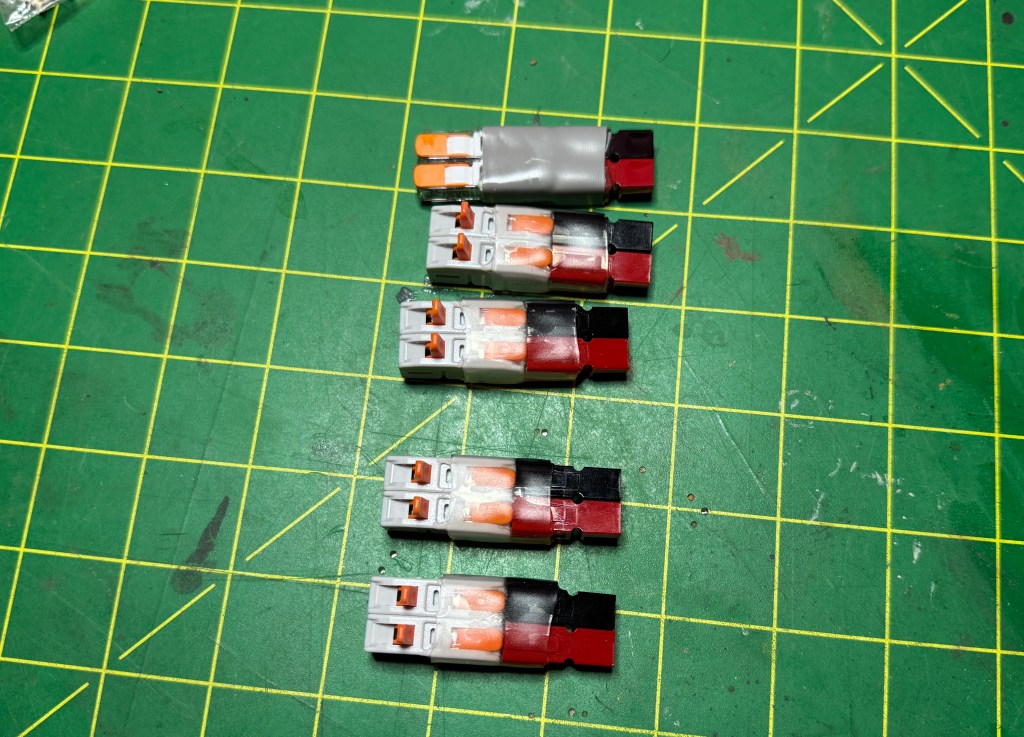
From here I dabbled some Clear Gorilla Glue to hold everything together and I used some clear heat shrink from a prior project. The fnished product looks like this.

I made enough to put with my various radios. I started using Anderson Power Poles about 20 years ago when they first showed up in the EmComm community. I know folks have a love-hate relationship with them. I love them because they can prevent cross wiring an expensive radio to a power supply. Today’s pricing they are about $1.25 a set, cheap insurance.

Now if I have a friend that does not use Anderson Power Poles, I can hook him up (literally). I think I spent about 30 minutes making these. A little something to make life easier when everything around you may falling apart. 73 de Scott

Yeah, I might be a little fickle

I’m not afraid to tell on myself, I can own up to it. Last night I decided to go ahead and order a Yaesu FTX-1 Field. Not without reason though. I watched a few YouTube videos from hamvention with John from Yaesu talking about the FTX-1. He mentioned that the performance of the FTX-1 would be similar to the FT-710. That could be impressive. I just finished up a review on my FT-710 so I have a feel for the radio.

Another cause and effect was yesterday, I pulled my IC-705 out getting it ready for some POTA activations. I had been remiss doing QRP CW activations focusing instead on low power digital with full size radios. I have been feeling the urge to brush up on my CW skills. Back to the 705, I like the radio a lot. It does indeed push all of the buttons. I was holding it in my hand thinking it’s not so bad for a portable radio and the FTX-1 is only a little bigger…I thought I might do another comparison series this time between the 705 an the FTX-1. I have a couple of big trips planned for the fall and winter and these radios will do nicely.

Another reason that pushed me toward the FTX-1 was the price of used radios, they are over the top right now. I was looking at a KX3 and it was the same price as the FTX-1. Even some of the other used radios were more than I cared to spend for them. One thing I forgot to mention, is I have grown used to waterfall radios. I have learned to use them to help me find places in the band to operate and to do a real time check on propagation. It’s amazing what you can glean from those screens.

Hopefully, over the next couple of months I’ll put the IC-705 and the FTX-1 through their paces. Up front I will say that I have a preference for Icom radios, but the FT-710, KX2, and TS-890s have found places here at the ranch. I am not adverse to using different brand radios, I use whatever fits me best.

The new radio should be here in a couple of days and then the games begin. This should be fun. 72 de Scott

Hurricane Season 2025

NOAA has released their 2025 hurricane season (01 June to 30 November) prediction. they are calling for an above average season with 13-19 named storms and 6-10 to reach hurricane strength. Of those hurricanes, 3-5 are predicted to become major hurricanes.

As we learned last year, coastal states are not the only ones vulnerable to the havoc a hurricane can bring. Now might be a good time to break out the portable gear and give it a shakedown. Turn on those go-boxes and feed those portable antennas. Make sure everything is in working order. Take your gear out and go at least 20 miles from home. Why 20 miles? It’s a distance that is too far to go back home and retrieve a forgotten part or replace a broken piece of kit. Field Day (winter and summer) are good events to try your gear. Only if you use the same gear you would bring for EmComm and use the same power levels. The lesson here is don’t wait to get ready, get ready now. I try to keep myself prepared to deploy in 4 hours or less.

You can’t plan for everything that may go wrong. You can however, minimize the chance of failure by ensuring your gear is in the best possible condition. Remember Proper Planing and Preparation Prevents Piss Poor Performance (7P’s). Be THE guy, not THAT guy. 73 de Scott

Yaesu FT710 final Review and Where to Go From Here

I’ve had the Yaesu FT710 for a while now and used it mainly in the field. That was and is my intent for this radio.  In general, I feel if I am doing an activity like Field Day or a multi-day POTA activation, and I am not carrying my gear more than a few feet, why not bring a full sized but compact radio.  These radios have more operating options and the controls are generally easier to use.  In addition, running a 100 watt radio at low power (20 watts or less), the radio doesn’t even get warm.  The radio works well with digital modes.  It wasn’t that long ago that Yaesu’s were a real pain to run digital.  Icom’s have had an easy interface since the IC-7100.  Today, the FTDX10 and the FT710 both are on par with the Icom’s when it comes to digital modes.  With CW, both brands are about equal.  In general, I feel both radios are interchangeable and it would be the matter of personal preference which would determine which is best for you. In the next couple of paragraphs I will describe the pluses and minus’ of the FT710 and the IC-7300. John WD8LQT provided input from his use of my radio during the WGARS Spring Fling.

Attenuation.  The IC-7300 only gives you 18dB of attenuation while the FT710 give you 3: 6dB, 12dB, and 18db.  Your more expensive radios typically have 3 like the FT710.  In an SDR radio, attenuation is your friend.  Preamp should almost never be used.  The nod goes to the FT710.

CW Tune.  Both radios have autotune but the FT710 has a CW tuning indicator right below the S-meter. I find myself using it quit a bit.  Some CW ops crank their filters way down and if you are a little off frequency, they won’t hear you.  My buddy John WD8LQT, also liked this feature. Nod goes to the FT710.

Sound quality.  The FT710 sounds a little better, but the IC-7300 has a lower noise floor.  I do not find either one objectionable. YMMV.  Draw

Waterfall.  The IC-7300 has an averaging waterfall and the FT710 does not.  That means that the FT710’s waterfall has to be manually adjusted every time band conditions change.  John noticed that when sending CW the waterfall would flash rather brightly, enough to be a little distracting. This may have been due to the waterfall level not being adjusted properly, but it is not an issue with the Icom.  Nod to the Icom.

Ergonomics.  Here the IC-7300 is the clear winner.  It has more of the right buttons on the control panel and it is easier to get to the most needed controls. The 7300 gives you 3 adjustable filters and the Yaesu gives you 2.  To adjust the Icom, grab a knob and give it a twist.  On the Yaesu, push a knob, twist the knob, push the knob, twist the knob.

Power consumption.  The FT710 uses about 1.2 to 1.3 amps at idle with normal volume.  The IC-7300 uses about 0.85 amps.  This doesn’t matter if mains power or generator power is available but when working off of batteries this can become an issue.

Sensitivity and Selectivity. The Icom has a lower noise floor, -133 vs -127 dBm for the Yaesu. Before I get into selectivity let me explain a little about Rob Sherwoods numbers.  Most people quote the 2 KHz blocking number, that comes with a couple of caveats. First, for the most part Rob measures 2 KHz blocking with a 500 Hz filter. That’s a CW filter.  Sideband filters usually run 2.4 KHz plus.  Unless you’re a CW op, this number is irrelevant. Here is what Rod Sherwood says, “I decided to sort the table on my website by close-in dynamic range at 2-kHz spacing. This was the “acid test” for CW contest / DX pile up operation.” He further quantifies his research with the following numbers. “What do you need in the way of close-in dynamic range? You want a number of at least 70 dB for SSB, and at least 80 dB for CW. A 10 dB safety factor would be nice, so that means you would prefer 80 dB for SSB and 90 dB for CW.” In the past I have compared the IC-7300 with the FTDX10 and the FT710 during a CW contest. What ever I could hear with one, I could hear with the other. The Yaesu’s had a little less ringing but I had no problem copying the signal from any of the radios.  

What this means is either radio will serve the vast majority of operators well.  Whatever your personal preference is, go for it.  There are things I love about the FT710 and there are things I love about the IC-7300. I never feel at a disadvantage with either radio.  I plan on keeping both.

Where do I go from here? That’s a good question. I don’t have anything in line to review. I have decided to take a step back from EmComm for a while.  I’ve been doing a lot of digital lately and need to get back to the joys of CW. I also have a couple of QRP radios that need to be taken out and used.  I still enjoy the smaller radios.  I’ll take a big radio on a camping trips/Field Days and may take a little radio for a quick activation. Sometimes it’s nice to grab a small box or bag and go. I have some antennas I haven’t used in a while, I need to get them out.  

Thanks for hanging with me.  I appreciate your company.  73 de Scott

WGARS Spring Fling 2025

Today was the club’s semi-annual outing and this spring it was one of our old haunts, Cheaha State Park US-1037 in the fine state of Alabama. There are 3 things we as a club like to do, we like to eat, we like to socialize, and once in a while we talk on the radio.

As usual, food was in abundance.

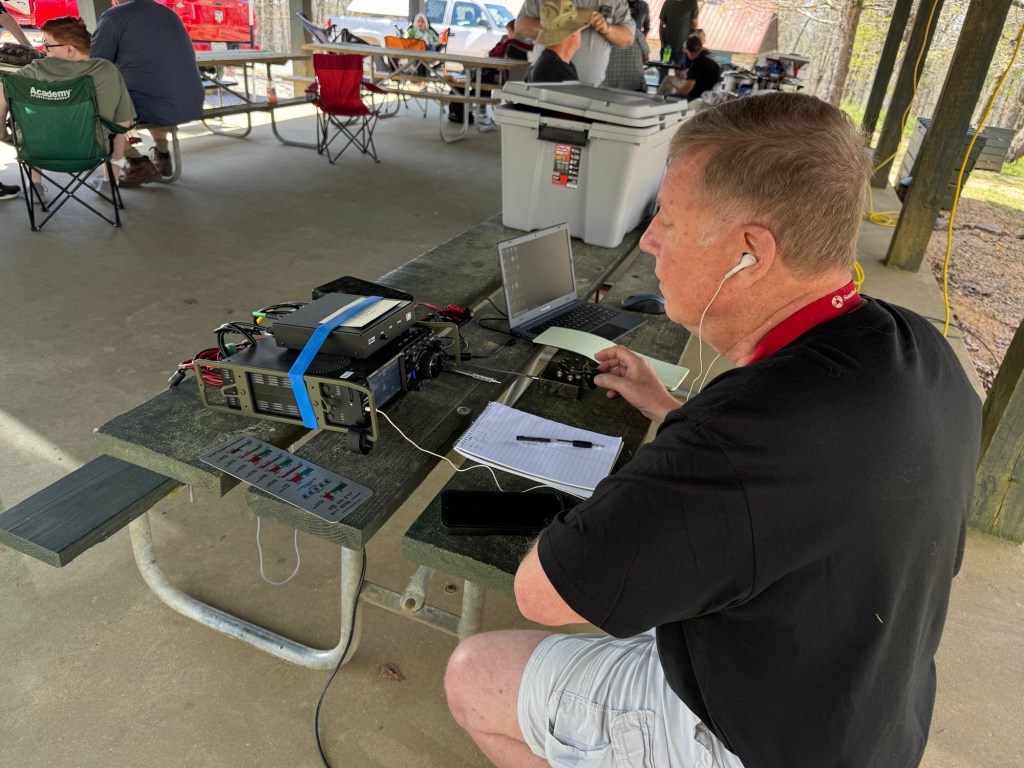
We had several stations set up under the pavilion. QRM was held to a minimum. We had Xeigu G90’s, Tru-SDR, Icom IC-705, and my Yaesu FT-710. I set the radio up and turned it over to the club President John WD8LQT. John, like me is a CW op and I wanted his opinion of the FT-710. I didn’t have to twist his arm too hard. The setup was the radio feeding a Chameleon micro transformer with a 12’ whip and about a 20’ counterpoise. The radio was powered by a 20 amp-hour Bioenno battery and the paddles were a Begali Expedition.

Band conditions were poor and it took John most of the time at the park to get his 10 contacts. There were stops for eating and chatting. Early in the activation, I decided to change antennas to be sure we had an atmospheric issue and not an equipment one. I had my Diamond RHM-12 which recently proved itself to be a good performer. Once the switch was made and some searching through the bands, John started making contacts on 20 meters. I believe it was atmospherics and not the equipment. John got his 10 contacts and we called it good.

John’s comments about the FT-710 were quite favorable. Like any radio, there are pluses and minuses. In general he thought it was a very good radio for CW. There is more commentary from John on the YouTube video posted below. John did have one epic fail. The ear buds he was using which looked rather ancient finally gave up the ghost. I took it upon myself to intervene and unceremoniously threw them in the trash. John will thank me.

My review of the FT-710 is drawling to a close. I find that I like the radio. It performs well for its price point and has some features found on more expensive radios. It has its quirks as all radios do, but none that I find overly objectionable. I plan on keeping the radio and it has found a place among my field radios. I imagine the radio may make an appearance during this year’s Field Day.

FTDX10 or FT710

Yaesu came out with too fairly closely spec’d radios at different price points. The FTDX10 currently sells for ~$1,500 and if you add in the 300 Hz filter, another ~$175. The FT710 Field sells for ~$1,075. Roughly $500 less.

The FTDX10 is a hybrid radio with a down conversion receiver feeding into a Direct Digital Synthesizer (DDS). The FT710 is a SDR radio similar to the IC-7300. I owned an FTDX10 for about 18 months and I am on my second FT710, total ownership time is approximately 10 months. I had the first FT710 a couple of months after the initial release. It wasn’t working the way I expected it to so I traded. About 6 months ago, after reading some of the update material, I thought I would give it another go. My second FT710, this time the field version, is much improved. It is my current go to field radio. I plan on keeping this one. Having used both radios if I had to do it again which one would I pick?

I would pick the FT710. The FT710 has 90-95% of the performance of the FTDX10 for $500 less. In fact, I do not think one could tell the difference between the two in a side by side blind test. There is a caveat, the receiver architecture is different between the two radios and it requires a slightly different skill set. SDR radios like the FT710 basically run wide open all of the time. Keeping that in mind, in most cases it is better to run IPO or attenuation rather than preamp. I almost never run preamp on my FT710. What is nice about the FT710 is it gives you 3 levels of attenuation: 6dB, 12dB, and 18dB; a feature usually only found on higher end radios. In contrast, the IC-7300 only gives you one, 18dB.

The other control you should become familiar with is the RF gain. On a Yaesu, RF gain starts in the fully clockwise position. When there is a lot of noise, slowly turn the RF gain counter-clockwise until only the desired signal is heard. Coming from analog radios years ago, my brain is still a very good filter. I use digital noise reduction sparingly. I often keep it at level 2 or 3, enough to take the edge off.

Perhaps the most compelling reason to chose the FT710 over the FTDX10 besides the cost, is the ergonomics. I have large hands and fat fingers. The FTDX10 clustered its controls close together so I had to be careful when pushing a button or twisting a knob. Even so, I would bump the frequency dial and throw it off frequency. I have remarked that the controls on the FTDX10 were more suited for the lefthand. In fact when it was a part of my home station, it sat to the left side. With the FT710, the controls spaced further apart and are easy to get to even with my big mitts. This is a real benefit for a field radio. The position of the radio or the lighting conditions may not be optimal so ergonomics are important. I find the FT710 a joy to use in the field.

If you are a dyed-in-the-wool FTDX10 owner, this post is not for you. I wrote this for the amateur radio operator looking for their first HF radio, or maybe a seasoned operator looking to venture into the Yaesu family. This is also for those who have limited funds and are agonizing over which radio to get and should they sacrifice funds for the more expensive radio over something else they may need for the shack. The FTDX10 is a fine radio. Its Achilles’ Heel is its ergonomics. The FT710 is a fine radio in its own right. I believe it is 90-95% of what the FTDX10 is but for much less money. Of all the Yaesu radios I have owned over the past almost 30 years, the FT710 is the one I have been most happy with. YMMV de Scott

Memories past and Present

This past weekend I made a trip down to Orlando Florida to experience Hamcation. It was a lot fun. I got to meet some cool people and of course came home with some radio related goodies. The Region 4 U.S. Army MARS group had a dinner Friday night and I got to connect faces to voices. It was a good time.

This was also a time for some refection. On my way down and back I traveled on Interstate 75. This was the same route I used during the 2004-2005 hurricane seasons. I provided HF radio communication for the convoy bringing relief supplies right after a hurricane. I did this 4 times in 2004 and once in 2005. Back then, communications was not as well developed as it is today.

During those trips I would check into the South CARS net or the South Coast Amateur Radio Service net. According to South CARS: “The purpose of the net is to assist those seeking to contact other amateur radio stations, or areas; to provide weather and travel information; to assist in emergencies when needed.” They operate on 7.251 MHz from 0800 to 1300 hrs Eastern. I used the net to check my radios and listen for any travel information that might have affected the mission. I joined back then (#3773)and still occasionally check in from time to time.

On this trip I was traveling solo so I dialed up 7.251 and checked into the net. While the net was operational, they kept me company and I enjoyed listening to the net. At times, it brought me back to those disaster relief days. Good memories; I felt the sense of purpose I had back then. I appreciate South CARS today as much as I did back then. I know that if I was ever called up again to provide EmComm in Region 4, South CARS would be there for me.

Other good news is I may have a trade for my amplifier. I found a TS-890s and hopefully the trade will go though by the end of the week. I am not young anymore as I have retired twice now. I know that my days of deploying are numbered as the body starts to wear out. Currently I still go camping and therefore could deploy if needed. However, as time marches on I will become more home centered. The good news is ham radio offers opportunities both home and abroad. I have a pretty good home station and I am a pretty good Net Control Station. I plan to use the TS-890s for CW and other fun things.

I’ve had a good run. I’ve got to do some exciting things in my life. In retirement, I am still busy, I still have lots to do. My focus is changing. A fixed income doesn’t mean eating Alpo, it means careful planning. If I want something, I can have it, if I plan for it. The other option would be to go back to work and that ain’t going to happen. Life is good — de 73 Scott

Hamcation 2025

This was my first Hamcation and it was a lot of fun. Lots of people, lots of food and lots of ham gear. I only spent one day there, but it was a fun-filled, packed. day.

One of the highlights of my day was the Begali Booth. Up until this point, I had 4 Begali paddles in my collection. Each one purchased directly from Begali and each one through Bruna. Buying a Begali key/paddle is like being adopted into a family. That’s how Begali treats their customers. I finally got to meet Bruna in person.

They had many of their paddles there — so many to choose from. I like to dabble with straight keys and my preference being a cootie key since they have the same back and forth motion as a paddle. Bruna had a Sculpture Swing and after sending a couple of characters, I was smitten, and I was lucky to get the last one, the display model. I also got to meet Bruna’s husband Roberto who packaged up my prize for me.

I hope to get a review done on the Sculpture Swing in the near future.

Diamond Antennas, one of my favorite brands for mobile/portable VHF/UHF antennas has a new portable HF antenna for the US market. I have seen this antenna on European website but this was the first time I have seen it in the U.S. It is a portable HF/UHF/VHF antenna that covers 7-440 MHz. With optional coils, it also covers the 3.5 and 1.8 bands.

The screwdriver portion of the antenna is 15″ long and the 1.8 MHz coil is 17″. For comparison the yellow packaging is 21″. This will be a great antenna for POTA/SOTA. I can’t wait to get this on the air.

Kenwood had a teaser for their new VHF/UHF mobile. Looks like it might be out by the end of the year. Here is a shot of a non-working model.

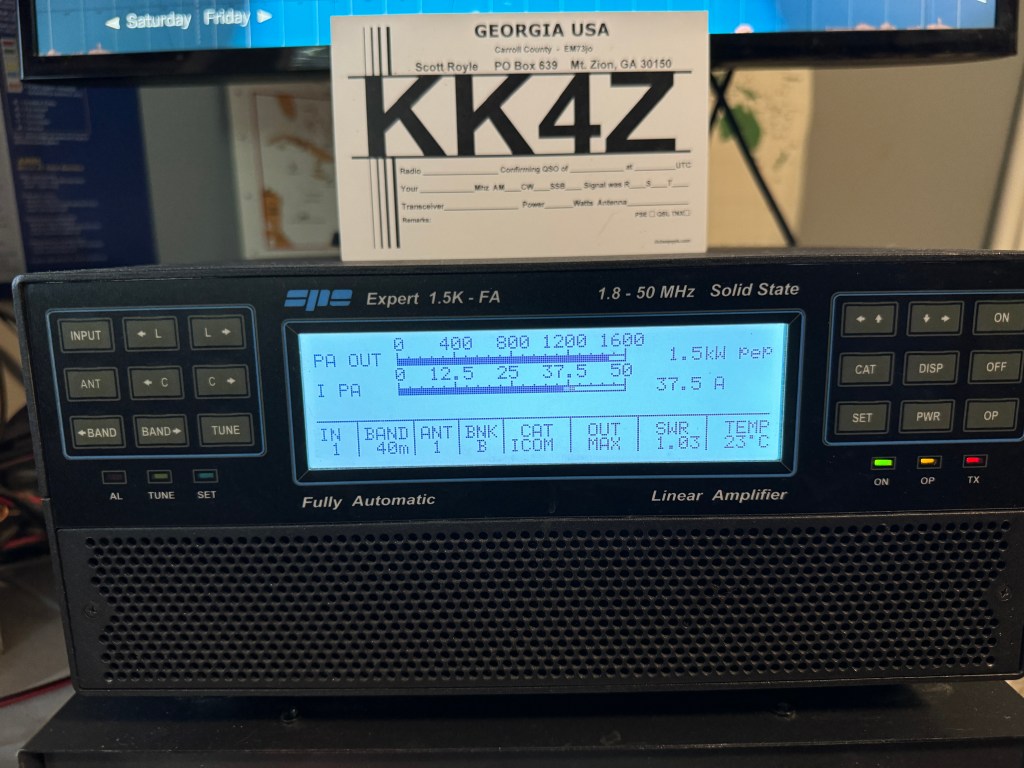
It looks pretty cool. I am mainly an HF guy and I stopped there to look at the TS-890. That is my current dream radio. I brought one of my amps down there to trade but the stars were not aligned. I have a nice lightly used SPE 1.5K FA up for sale or trade. I would like to get a TS-890 and may consider a FTDX101MP. I would also consider an Elecraft KPA/KAT500. It’s a great amp but it doesn’t do MARS so I had to get another amp that would (SPE 2.0K FA).

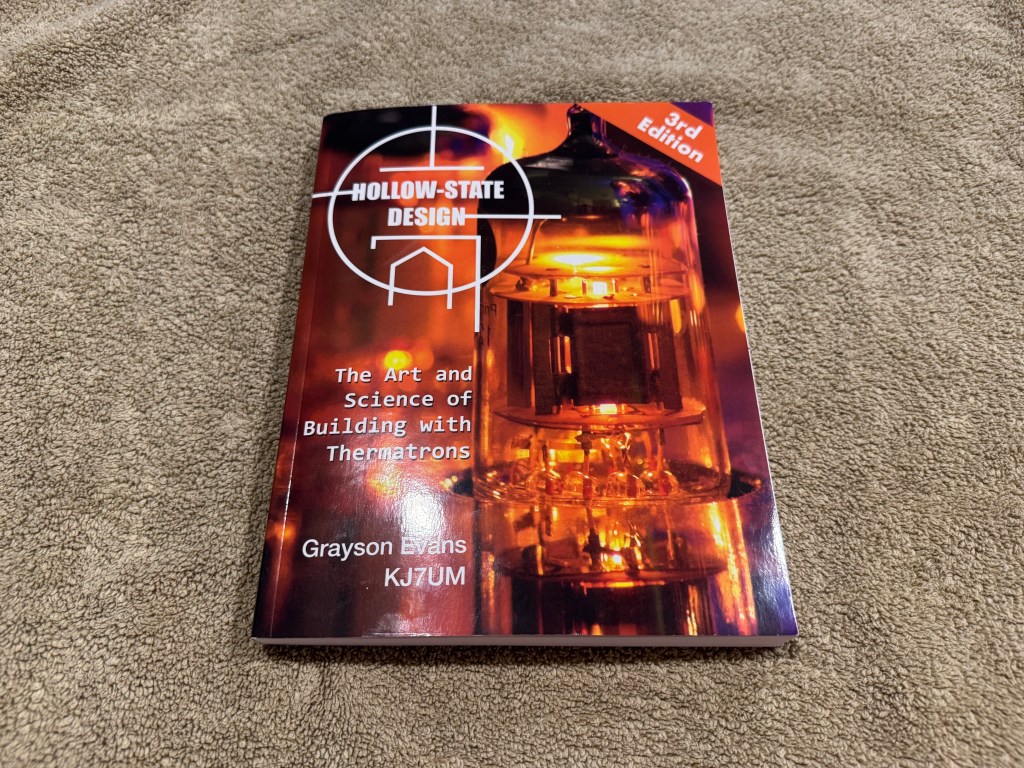
While cruisng the swap building, I came across this book:

I bought on a whim and Grayson autographed the book for me. I may never build anything out of tubes, but I thought the book would be a fun read.

I got to talk to a lot of people while I was there. I talked to one guy there that was looking to get a radio after being absent from amateur radio for many years. He was thinking about getting an IC-705. I asked him if he had any other radios and he said no. I suggested he look into getting an IC-7300 first. The 7300 is still my “if i could only have one HF radio” radio. Many times new or returning hams opt for the QRP route, not knowing how frustrating QRP can be for the less experienced. For a first or only radio I recommend a 100 watt radio. You can always turn a 100 watt radio down to 5 watts but a 5 watt radio is already at its max. A lot of times when camping, I am running CW at 20 watts.

It was fun seeing all the stuff, meeting people, and bringing home a few things. Hope to see you at the next one. 73- de Scott

Winter Field Day 2025

It was another fun Winter Field Day. Our club, we like to do 3 things: 1) we like to talk, 2) we like to eat, and 3) every once in a while we like to talk on the radio. This year was no different. We had a lot of fun, ate good food, and played on the radios. I think it’s the non-competitive spirit that helps us brave the cold weather. And it was cold this year with temps in the 20’s and 30’s. Not only does this tax our physical comfort, it also taxes our equipment.

Coax cables and extension cords were stiff and fingers went numb but we managed to get 4 stations on the air. I operated separate from the group to try to Get multipliers on JS8Call. I also copied the WFD bulletin and used Winlink to send and receive email. We had one member attempt to make a satellite contact and while he could hear other stations, it appeared no one was connecting. This year we ran QRP. Which was fun. Let me run through the gear and tell you how things worked.

The antenna this year was a 73’ inverted L with the vertical leg at 20 feet. This had a 60’ counterpoise connected to 1.5 KW Palomar Engineering 9:1 UnUn. I use the bigger UnUn because times when I run higher power (up to 40 watts) using digital, smaller UnUns get warm and saturated. This antenna works well down to 160 meters. I made contacts on different bands out to the west coast. A fail I had was I used a Chameleon RF choke next to the UnUn. It blocked all of the signal to the radio. Once I removed it, things were fine.

The radio was my new Yaesu FT-710. The radio worked well with no real issues. A quirk of the radio is the AF cuts the volume off louder than other radios. Sometimes when I am operating digital, I like to turn the audio volume real low so I can just barely hear it to keep tabs on what is going on. With the FT-710, it cuts off the volume while it is still louder than I like. Not a deal breaker. One of the benefits of operating a big radio QRP is the controls are easier to get to. While I prefer the ergonomics of Icom radios, the FT-710 is still pretty good. Another quirk with the FT-710 is the waterfall. It is not averaging like other radios, you have to adjust it manually. Overall, the radio performed well and compares favorably with the IC-7300. Either radio will equally get the job done. This radio feels more refined than my first one. It will be going on several more trips I have planned.

FT-710 accessories. I got the tuner issue worked out and my LDG tuner is playing well with the 710. I added Portable Zero rails which not only protects the sticky-outy things, but gives extra finger holds. I consider the rails a must have for portable big radios. Heil Proset Elite. I had to buy another headset for the FT-710 and the Elite was on sale at HRO. My Icoms use an electret mic which requires power. I already had an adapter from when I owned an FTDX10. I’ve been using Heil products for 25+ years and they are my goto. Mouse. I bought a Logitech M310 mouse to go the FT-710 thinking it might be easier to navigate through the menus. However, once I got the radio setup I was only changing a few things and found I didn’t use the mouse at all. I will probably not use a mouse with the 710 and I already found another use for it.

Maestro Evolve III laptop. I think I paid $122 for it. It works okay. It’s not zippy fast but all the software I used worked. It does appear to be RF sensitive though. During transmit, the mouse would freeze and sometimes the app window would close and open. What do you expect for a hundred bucks! One thing I did find annoying was the track pad. It was overly sensitive and would often treat a light touch as an “execute” function doing something I didn’t want it to do. My solution is to take the Logitech M310 mouse and use it with the Evolve III. A cool feature is I can run the Evolve off of my radio power supply or battery. Less “stuff” to deal with. The power plug for the Evolve also fits older Icom and Kenwood HT’s. The Evolve worked with my GPS receiver and I was able to easily sync the time for JS8Call. I will be taking this little laptop out again.

JS8Call. I think this will be the last time I use JS8Call. I was never fond of it and running a contest with it is almost a nightmare. For WFD, it doesn’t sync well with ACLog. People would send their Class and section info out without attaching a call sign to it so you would get something like 1O OH… and nothing else. That would be okay if only one person does it but when 2 or 3 others do it at the same time, you don’t know who is who. That and there wasn’t really enough JS8Call stations on the air to make it worthwhile. CW was the same for WFD. There were other contests going on. It appears the money maker for WFD is SSB. Which is interesting because the EmComm community relies heavily on digital modes.

As a group, we had a lot of fun. We always enjoy getting together. I had fun and I got to test my equipment. It is reassuring to have the knowledge that your equipment is ready. Even when I go on one of my FunComm trips, I load things up and go. I don’t have to check them because I already did. Final thoughts? Listening to the CW contests over the weekend reinvigorated my love for CW. I have been away from it while getting up to speed with MARS and SHARES, but there is still something to be said for the simplicity of me and the key. Hopefully, this will be a better year than last year, and I can get back into the swing of things. Stay safe, stay warm es 72 de Scott