Over the past couple of years, I have spent a lot of time taking what I call big radios to the field. These are 100 watt radios that I run at reduced power usually between 20 and 35 watts. I can run digital modes all day long on a big radio at this power and it won’t even get warm. I usually take them out for a weekend camping trip.
That has gotten a little stale, I feel I have a good understanding of how those radios and antennas work and I have made 1000’s of contacts all over the world. It’s time to do something different. I have 2 wonderful QRP radios, a KX2 and an IC-705, that haven’t seen a lot of use. I have also let my CW skills slip a little. Change is in the wind. I am planning some trips using my little (QRP) radios. in addition, I may spend a few nights in a motel rather than camp. Each day I am out, I can mini rove and do a couple of parks instead of just one. I feel the change will be refreshing, kind of going back to my POTA roots.
This fall, I am planning another multi-state rove. This will be a multi-day rove hitting a park in a state and moving on. It will be a nice drive and a lot of fun. I want to try my hand at quick set-ups and tear downs. The beauty of amateur radio is the diversity of things you can do. Sometimes, you gotta due a few things for fun. 73 de Scott
As information started coming out about Yaesu’s new QRP radio I was tempted to get one. However, the more I learned the less I liked about it. I have an Icom IC-705 and an Elecraft KX2 for QRP radios. My big field radios are an Icom IC-7300 and Yaesu FT-710F. I am looking for another QRP radio to do a long term review. I considered the FTX1 but gave it a pass for the following reasons.
Price. An IC-705 cost $1349.95 at HRO. The FTX1 cost $1499.95 but to be truly compatible with the IC-705, you have to add Bluetooth ($54.95) and GPS ($69.95). this brings the total to $1624.85. A spare battery for the FTX1 is $199.95. The Icom battery (BP-307) is $135.95; however, knockoffs on Amazon can be had for 2 for $59.95. I use them and they seem to work just fine. Another point are the antenna tuners. The AH-705 sells for $359.95 and can tune long wire and coax fed antennas. Yaesu chose a different path they have one tuner for coax fed antennas and one for long wire each costing $319.95 or $639.90 for both.
The optima package. It cost $1899.95 to give you a 100 watt option. To put this in perspective, you can buy a FT-710 Field for $884.95 and a FTM-510 for $499.95 for a total of $1384.90. Plus you get an antenna tuner included with the FT-710 and the 710 probably has better performance than the FTX1 on HF. As a side note, the FT-991A sells for $1229.95.
Performance. Yaesu was pretty mum about the performance of the FTX1. With the FTDX101, FTDX10, and FT-710, they touted the Rob Sherwood numbers long and loud. The only thing they said about the FTX1 was it had the same Analog to Digital Converter (ADC) as the FTDX10. ADC’s are all pretty similar in all of the SDR radios. So where does the FTX1 fall? Is it like the FT-710 or is it more like the FT-991A or the FT-891? For POTA and SOTA using SSB this is probably fine Rob Sherwood recommends a Dynamic Range Narrow Spaced number of 80 dB for contesting. For CW that number increases to 90dB. The FT-891 and the FT-991 are in the 70’s range.
My friend Thomas K4SWL who is attending Hamvention put his hands on a live FTX1. His first impression was it was much bigger than he imagined. He decided to cancel his reservation for a FTX1. Looking at how things attached to the radio, I had the same thoughts. If I am going that large, I’ll bring my IC-7300 or my FT-710F. I am curious about the current draw of the FTX1 at idle.
As folks get their hands on the radio, more details will come out. Hopefully Yaesu will be more forthcoming with information, we shall see. It seems to me that Yaesu did not listen to the QRP/POTA/SOTA community when building this radio. For sure the pricing and size seem out of whack. As for me, I am still looking for another radio to review, but at this time I will give the FTX1 a pass. 73 de Scott
I had good intentions today. When I went for my morning walk it was 8 degrees F and with the windchill, somewhere around zero. This was one of the coldest days I have ever experienced in Georgia. I have been colder, but not here. To celebrate a how low can you go day, I decided on a park activation. During my CW Innovations (CWI) Class I wished to try to make a day activation each week of the class.
Today, it was back to JL Lester Wildlife Management Area. It’s still the closest and I had pretty good luck there last time. I wanted to go over my random wire antenna since I wrote about it in my last blog. Everything was going along swimmingly until I tried to remove the trailer hitch from the receiver — it was frozen in place. Which meant I couldn’t use my K4SWL+ Antenna. Luckily, I had my Frankentenna in the back and broke it out. I ran it in stealth mode :Frankentenna Stealth Mode I hooked everything and away I went, or I didn’t.
I’m not sure what was happening, but I was not making any POTA contact. I don’t think I was making into the RBN either. I did get one hit on HamAlert from the Cayman Islands. I didn’t know if I wasn’t getting out or that there were not a lot of POTA hunters operating today. The bands did sound quiet. So thinking POTA today was a bust, I spun the dial and a guy calling CW on 20 meters. I gave a shout and he came right back to me. We had a nice QSO for about 10 minutes until QRM kicked in. We were both operating QRP from a park and we both had a KX2. Obviously, the radio worked and I was getting out. The thrill of victory is that I made an actual CW QSO and not just an exchange. First time in many years. It is this sort of activity that CWI encourages. So, I broke the ice and did it, usually it gets easier after the first one. One of my goals this year is to get more conversational with CW. I have taken the first step.
This morning I started waxing philsophically about kits and kitting. Some folks prefer to build a separate kit for each radio or each adventure. That can be a fun past time itself. I have tried that and it doesn’t work well for me (YMMV your milage may vary). When I do an activation or for that matter when I am hunting from home, I like to be familiar with my equipment. I like to know what it can and can’t do. One negative about multiple kits is you don’t put your hands on them as much which means they don’t get inspected or checked for damage, dead batteries etc. as much. I’ve seen many times where someone brought one of these kits to the field and something was missing, broken or dead, and they couldn’t get on the air.
This probably goes back to my Army days. We were issued one set of gear and that’s what we used. You knew how every thing worked and your kit was inspected frequently . A good example is my pocket knife of choice. While in the Army, I always carried a Swiss Army knife (SAK). It was used daily for a multitude of tasks. I developed a close relationship with SAKs. Forward to today, even though I can afford fancier knives and I have a few, my Every Day Carry (EDC) is still mostly a SAK. Why? Because I know the knife. I know the steel, how they are built and how to various blades work. For a while I was a UH-60A Blackhawk Crew-chief and the SAK was routinely used to work on the aircraft. Today, a SAK Small Tinker resides in my pocket. I have carried SAKs for over 50 years.
Back to radio stuff, I feel the same way. Even though I have quite a few antennas, I stick to a few that really work for me. I like going on an activation, knowing how my gear is going to work. Today, I was musing that I had my KX2 in its bag that came with the radio. It’s a nice bag but it’s a little tight fitting in my back pack. I decided to put some of the gear in a separate smaller bag. I have a 3D printed face cover and BNC connector cover to protect the radio bits so I can place the radio in my bag by itself. I also thought that my little QRP radios (KX2, IC-705, and QMX) use much of the same gear so I made one bag that all 3 radios can use. Then, when I go an activation, I can just swap out the radio and not worry about leaving something behind. Here is my new radio bag and list. For the rest of the pack contents see my blog post AAR on Bald Mountain: https://kk4z.com/2023/11/23/aar-bald-mountain/
The bag is a Condor Belt pouch. Nothin fancy, but sturdy enough and mashable enough to fit nicely in my backpack. Both my IC-705 and KX2 have a Begali Adventure mount and the Adventure paddle can be hand held. One thing not shown is an anti-slip pad that I use when operating from inside the truck. Here is the rest of the kit: 3’ RG-316 jumper 15” RG-316 with choke Throw line and weight Extra Bank Line Begali Adventure Paddle 28.5 Random Wire Antenna with 17’ Counterpoise Wire to BNC Adapter BNC to SO-239 adapter BNC to BNC adapter 3’ 3.5 mm Stereo Cable Earbuds Power Cable for there IC-705 Power Cable for the KX2 and QMX
My backpack stays packed and ready to go complete with a radio. Because it gets used often, I do not worry if the gear is ready, I just grab and go. Part of my Army training that has stuck with me, is I go through my gear when I come back from the field and get it ready for next time. As I said earlier, I plan on doing a one day activation a week along with one weekend activation a month. 72 — Scott
Going with my goal to improve my CW skills I set out this morning to a nearby WMA for a POTA activation. It is the closest one to my house but it is still 30 miles away. CW is a participation sport, and like many things, in order to get better, you must practice. One of the things I have done was to sign up for a CW class in this case CW Innovations. One of the things CWI stresses is getting on the air and making contacts. I believe in that, and part of me joining CWI was forcing me to practice what I preach. The course is 10 weeks long starting next Monday. It is my plan to try to get out and make one day activation a week along with practicing from home. I like to activate but sometimes I get distracted at home and other things take precedence. By setting a schedule, I hope to break the pattern.
The JL Lester is a small WMA and I chose the less populated parking area. It’s a quiet place. My antenna was my 28.5’ random wire. It’s the easiest antenna I have to set up. It takes a few minutes and puts no wires in the trees nor holes in the ground. A win-win for everyone. The antenna is a permanent resident of my truck. The radio for this trip was my Elecraft KX2. It is a perfect radio for a short duration activity. Hook up the antenna and plug the paddle into the radio; I’m in business.
I was set up by mid-morning and thought I would start on 40 meters. Forty was already dead so I moved up to 20 meters and jackpot! I had quite a flurry of activity. I kept my speed at 18 wpm. Slow enough for those still around 15-16 wpm but fast enough for zippy guys. It can get hard to adjust your speed. I often falter when going from 16 wpm to 22 wpm. The band was in okay shape. There was a bit of QSB which made hearing some of the stations a little difficult. There was also some pile-up QRM. I really prefer it if everyone would send their call once and let me grab one. Sending a call 2-3 times slows down the whole process. I have to wait for everyone to stop sending before I can respond. Like today, most times, I stay on long enough to work everyone in the pile-up. Today I stayed on until no one was calling and then went QRT.
It was a pretty fast run, I made 32 contacts in less than 50 minutes. Could have made a few more if…
Below is a QSO map and a short video describing the activation. Thanks to all for your patience. I had some trouble with a few call signs due to QSB and a short between the ear cups. Hope to see hear you out there next week. 72 — Scott
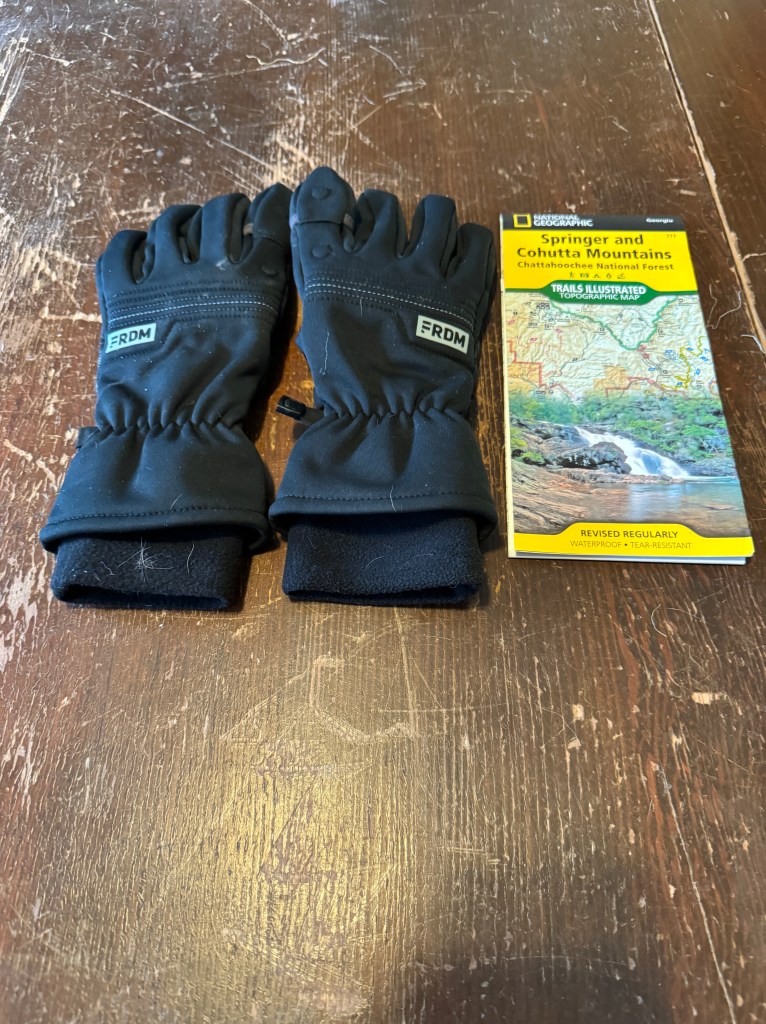
My training from the military compels me to perform an after-action report of sorts. I have found it beneficial to review an adventure as quickly as possible while the triumphs and foibles are still fresh in memory. This becomes more important as we age. Today (Thursday) is a few days after my SOTA activation on Bald Mountain. In general, things went well even though the weather was not as nice as was expected. The climb was as expected, I had to huff and puff a bit which at my age was expected. Two things that came to mind were: 1) the pack could be a little lighter (it was 15 pounds with water and my Goretex jacket) and my hands were cold enough to hinder my CW sending. For my hands, I bought a pair of warm gloves that can expose the fingertips of my thumb and index finger. Because I was warmed up from the hike, the Goretex jacket was enough to keep me warm.
I decided to lighten my load a little bit. When climbing, a lighter is better. Here is a list of my new slimmed-down version of my SOTA pack. I got the pack down to 10 lbs without water or a jacket. I probably saved about 2 pounds, but hey! two pounds is two pounds.
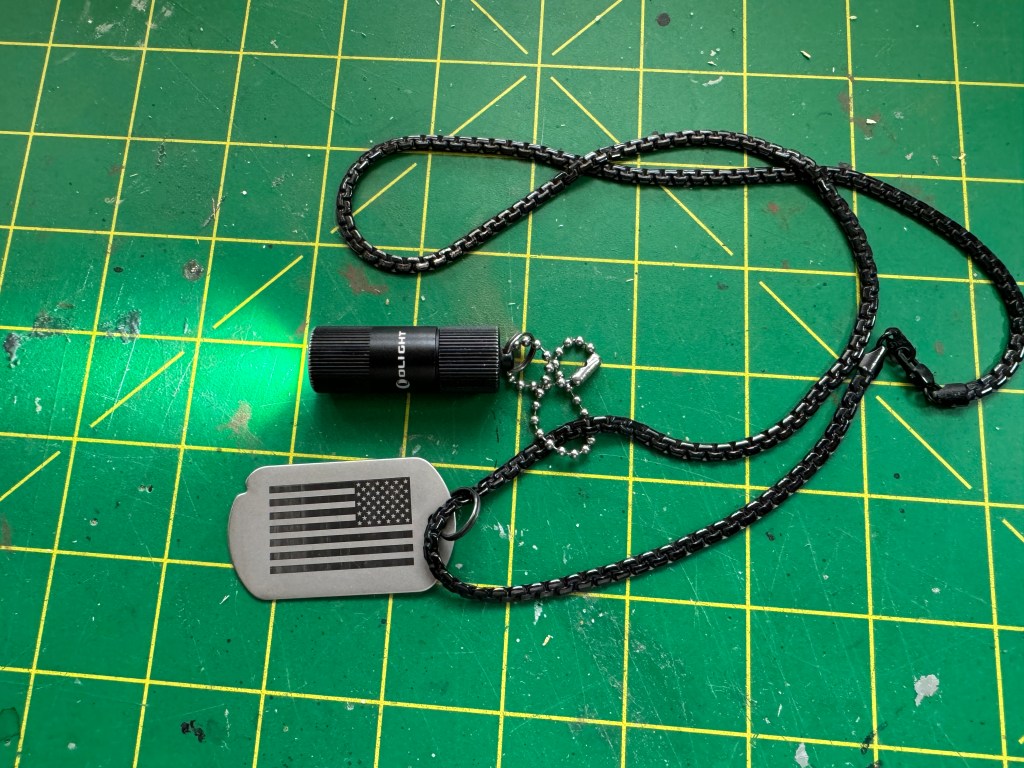
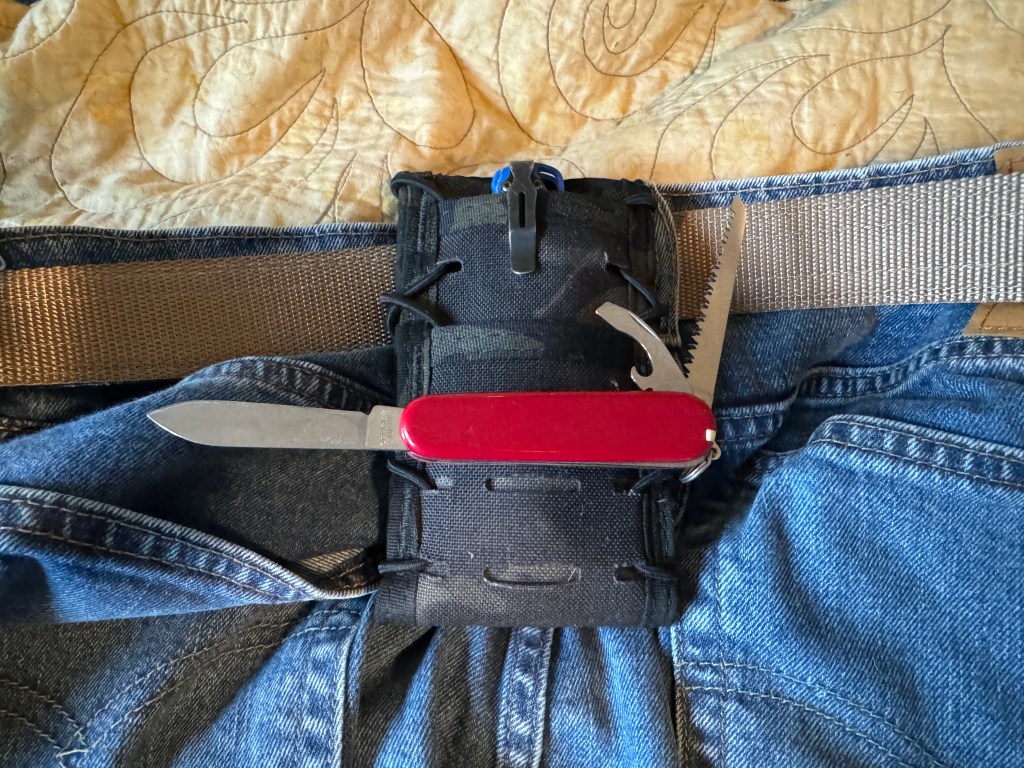
Starting with my person, this is what I carry: Wallet – minimalist Bic Mini-lighter Fischer Space Bullet Pen Swiss Army Knife Hiker iPhone Benchmade Bugout Knife Notebook 3×5 Dogtag with emergency contact info on a neck chain Olight i1r2eos flashlight on the chain with the dog tag
The Bugout rides in the same pouch as my iPhone in its own pocket. The pack I use is a Camelbak Military HAWG. It’s the old style. I’ve had it for quite a while and when I need a smallish pack, it’s the one I grab. The orange strip is highly reflective.
Attached to the left shoulder strap of the pack is a Garmin InReach Messenger. Some of the places I activate have little or no cell service so I use the Garmin to spot myself and keep the wife updated.
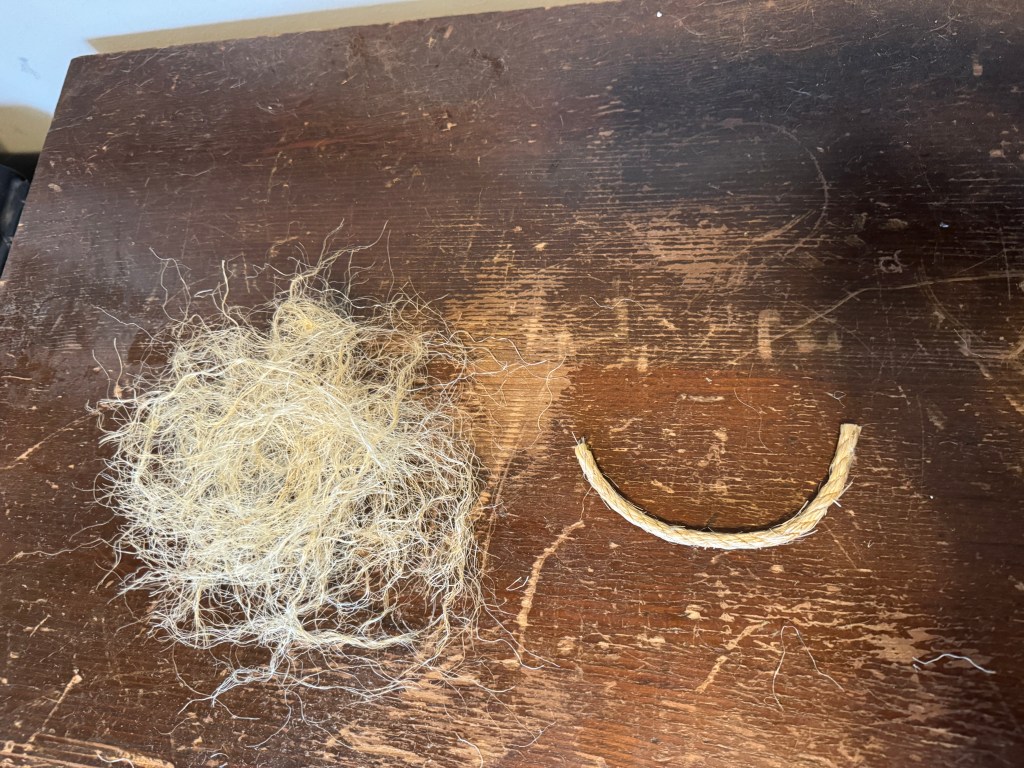
E&E Pouch In the Army, we often made Escape and Evasion pouches. A small pouch with just enough stuff to get by. This one fits in a 6 x 9″ Alocsak Pouch and weighs 10oz. Ferro Rod with carbide striker Magnesium Rod 2 – 3/8 by 8″ Sisal Rope Tropical matches (from MRE) Tinder Lighter Pine iFAK Whistle Compass Space Blanket Signal Mirror 2 – Bic Lighters
The sisal rope is great for fire starting. You take it apart and it makes a nice nest for your fire.
Considering my whereabouts will be generally known, I do have a preference for fire and signaling. Most likely, any survival situation will be short-term, and I want to be found.
The Elecraft Bag This is the bulk of my radio gear. The Elecraft bag that came with my radio does a great job of keeping things organized. KX2 with a 3D printed cover Begali KX2 Adventure Paddle adapter 28.5′ Random Wire Antenna 17′ Counterpoise 30′ Bank Line 12 VDC power cable with Anderson Power Pole connector N0SA SOTA Paddles (swap with Begali Adventure Duo) 15′ RG-316 with choke (Chameleon) Skull Candy earbuds 8 oz Arbor weight with line
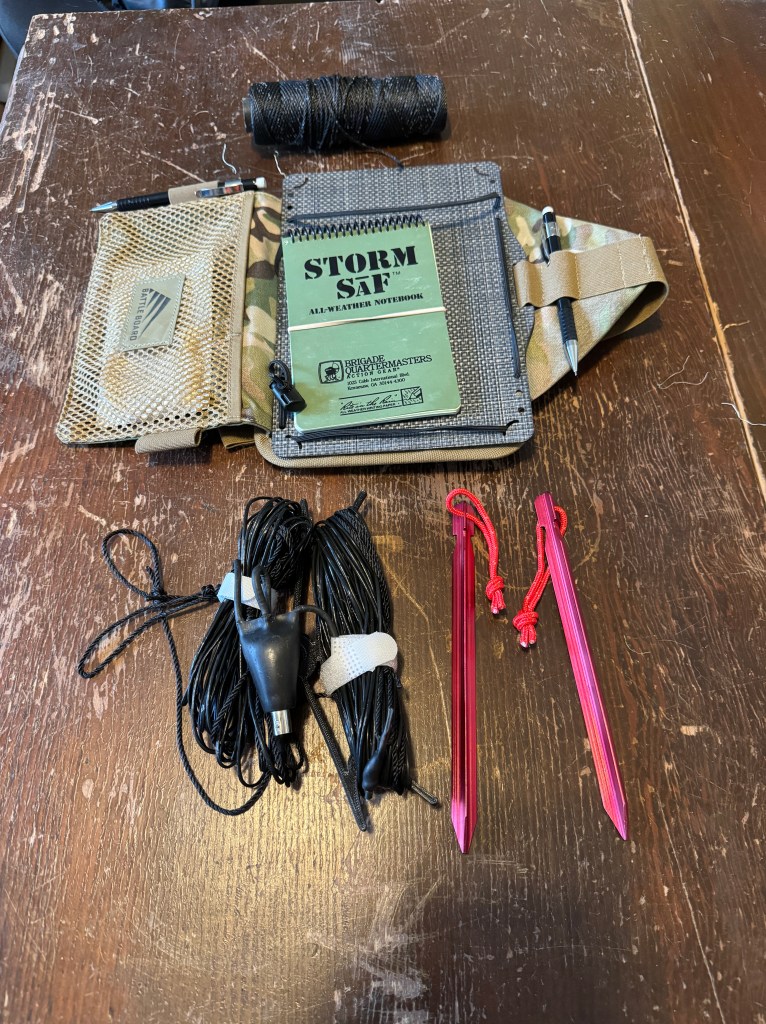
The rest of the items are dispersed within the pack 1 Liter Canteen with Cup and Spoon HeadlampSeat Cushion Contractor Trash Bag Knee Board Rite-In-The-Rain 4×6 Notepad 2 Mechanical Pencils Spool of Bank Line 2 Tent Stake Chameleon 40-meter OCF Dipole
Finally, there are some seasonal/ad hoc items such as gloves, jackets, food, and localized maps. I have plenty of room in the pack to make adjustments for conditions.
My pack contents will probably evolve over time as I use it. Right now I think there is a good balance in the pack between fun and safety. Some of the places I go are pretty remote. I always tell my wife where I am going and a general itinerary. You should do the same.
How did the KX2 do? This was the maiden voyage of the KX2. Right off the bat, I got to use it in some trying conditions. The weather was deteriorating as I walked into a cloud at the summit. It was windy and I wasn’t really sure what the weather was going to do. I figured I had enough time to make a quick activation and get down off of the mountain before the rains came. I climbed until I got well within the activation zone and set up. I strung the OCF dipole about 10 feet up and set my station right below it using the same tree as a backrest. I was going to use a Flight Deck but I didn’t want to fiddle with so I set the radio on top of the pack. Because the radio is self-contained all I had to do was plug in the antenna, paddles, and earbuds, and I was in business. I made 19 contacts logging on my notepad resting on my thigh. What helped to make the activation a success was the ease with which I got the radio working. Bing-Bam-Boom and I was on the air. As quick as I set it up, I took it down. The KX2 made it easy. I made it back to the truck to beat the drizzle. Since the activation, I added the kneeboard shown. I set it up at home and it should be easier to use than the one I had. I am still learning my way around the radio, but it is indeed going to be my main SOTA radio. Until next time 73 –de Scott
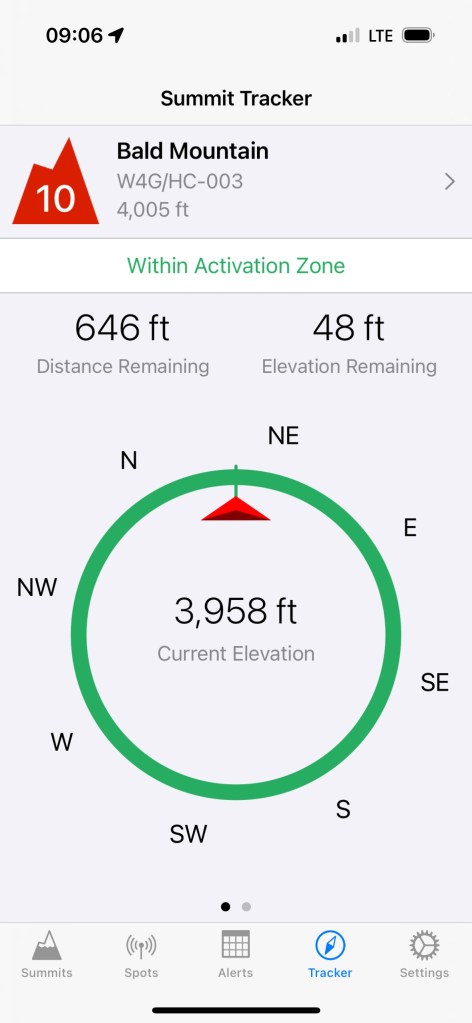
It’s official, I am retired. Fifty-three years in the making. Being on the north side of 66 does not mean you are wheelchair-bound. Maybe a little slower, but with patience and skill almost anything can be done. One of my first acts as KK4Z (ret.) was to do a SOTA activation. I chose Bald Mountain, a 10-pointer in northwest Georgia.
One of the reasons I chose a 10-pointer is I wish to get involved with a group called Southern Appalachian Summit QRPers or SASQ (SASQuatches). The group combines SOTA with a moderate level of Bushcraft. What’s not to like. There are skill-based membership requirements and one is a 10 pt SOTA activation within the past year. I wanted to get my 10-pointer in before the Park Service closes the roads to the summits during the winter.
I was originally planning on Tuesday for the trip, but the weather was going to be harsh that day. Lots of wind and rain. This is what I call the first winter storm of the season. Between the wind and the rain, it usually finishes knocking all the leaves off of the tree. So, I backed the trip up to Monday and checked the weather (Wx) – all systems go. Preflight check of the Wx 0600 hrs Monday showed VFR (good). The 10-point mountains are at least a 3-hour drive for me. Two hours on highway/improved roads and one hour on unimproved/gravel roads. That last hour covers approx. 20 miles. Along the way, I was confronted by a 6-8 pt deer who thought he was up to the challenge by a 5,000 lb Ram truck. After a few snorts, he thought better of it and scampered into the wood. Shortly after this, I heard Mussorgsky’s Night on Bald Mountain, an omen I didn’t recognize at the time. When I reached the parking lot below the summit, things weren’t so VFR. I checked the Wx again and now it showed rain on the way. The sky had closed in and the summit was in a cloud. I figured I had just enough time to reach the summit, make the required contacts, and retreat without getting too wet. When I started the trek, it was 60 degrees. By the time I reached the activation zone, the temps dropped, and the wind picked up. When I got back to the truck the thermometer registered 50 degrees. I estimated that the wind chill put temps in the low 40’s to high 30’s. Whenever I venture out, I always bring an extra layer, in this case, a Gore-Tex jacket. I forgot gloves and my CW suffered for it.
I climbed just high enough to get safely into the activation zone. My setup was quick and simple. I used a Chameleon 40-meter OCF QRP dipole. I like OCF dipoles. They do not have to get very high off the ground (10-12 feet is enough) and they are good performers. I prefer them over EFHWs. I sit on a cushion on the ground, so I use the supporting tree as a backrest. Coax is 15’ of RG-316 with a choke on one end. The radio was my new Elecraft KX2. I waited quite a while to get the radio. I did set it up at home and made one contact before taking it out. Since I was in a hurry, I set the radio on my pack and the notebook log on my thigh. The paddles were N0SA’s SOTA paddles. I got lucky and got one from his last run. I held it in my left hand. I sent a spot out and a few minutes later I sent QRL? On 7.057 MHz. I got a NO, they were waiting for me, I’ve never had that before. The wind was picking up and I had some difficulty hearing. As my hands got colder, my CW and handwriting suffered. I had a pretty good pile-up going and after 19 contacts I called QRT. There were still some calling, but Wx was not on my side.
I packed it up and headed down the mountain. By the time I got to the truck, it was starting to drizzle. I really didn’t mind the weather, I need to keep my hands warmer though.
The KX2. It was everything I had hoped it would be. I ran it 5 watts and it purred like a kitten. The quality of the received signal was great. I ran with the filter set to 1K Hz and it was fine, no overloading even with a pile-up. For SOTA, the radio is hard to beat. I like that I only have 3 cables to the radio, paddles, earbuds, and coax. Simple and easy.
Next time I will be sure to add some gloves to my pack. It was fun and I can’t wait to do the next one. If I knew retirement was going to be this much fun, I’d have done it a long time ago. 72 de Scott








 KK4Z
KK4Z 