Well My Bags Are Packed, I’m ready to Go

The 2024 Hurricane Season started of slow but boy did it pick up steam. Right now, the country has been rocked by the devastation left by Hurricane Helene and now Florida is bracing for Major Hurricane Milton. There are lots of good people doing lots of good things out there. I want to give a shoutout to AmRRon and Grindstone Ministeries for all the work they are doing in the Tennessee/North Carolina areas. You can find out more about these organizations at https://amrron.com and https://grindstoneministries.com.

I have been blessed in that both of these powerful hurricanes missed me. Helene about 40 miles to my east and Milton several hundred miles to my south. Just because I got lucky doesn’t mean I should sit back and rest upon my laurels. Contrary to popular belief, ham radio operators in the affected area are typically not able to operate after a hurricane passes through. Their number one concern is the safety of their family and the protection of their property. Many have left the area and are holed up in a motel somewhere or are with friends/family. This is the time and the place for those not affected by the storm to lend a hand. With families and property safe and secure, amateur radio operators can travel to, set up and operate their portable stations, relaying valuable information to public safety and/or nervous families wanting to know that their kith and kin are safe.

For those able to deploy, preparations should start long before you leave hearth and home. Radios and coax need to be checked for proper operation, antennas checked for damage? Are all of your batteries charged, generators serviced, and solar panels operating properly? Is your vehicle ready: tires checked, engine serviced, lights work? Do you have enough fuel for your vehicle and your generators? Do you have a place to sleep and something to sleep on? Do you have water and do you have food? Always bring food and always bring water, regardless of what someone promises you.

And what about you? Are you in shape? When was the last time you were to the doctors? Do you have any conditions that may affect you and are they serious enough that not being near an emergency room might kill you?

I’m not young anymore and my days of traveling to a disaster areas are coming to a close. However, I am ready; I keep a running talley on my gear. How? I practice with my gear almost everytime I go to park or a campground. The same gear I use in a park is the same gear I use for a disaster. I know how it works and I know I have what I need. I call this FunComm, which to me, is practice for EmComm. My field radio stays packed and ready to go. My basic kit looks like this.

The top box contains my radio and associated gear.

The bottom box, contains my batteries, power stations and a couple of solar panels. I also have 2 larger solar panels that I would also bring. I do not always bring batteries with me for FunComm but I see that they are charged up several times a year. Two notes. 1) Check your gear. Out in a disaster, you probably won’t be able to get whatever it is you left behind. I recommend that when practicing FunComm, you go at least 20 miles away from home. That is about the distance too far to drive back home again — either make do or call it a bust. 2) Solar power generation is iffy. On a good day, a 100 watt solar panel puts out about 6 amps. Your radio at 100 watts output consumes about 18 amps. That means for every hour of transmitting, it requires 3 hours of solar power generation at max efficiency. Don’t forget, you will have to feed you laptop, lights, cell phone etc. Yes, a cell phone has other uses besides a phone. My battery box looks like this.

You EmComm types may chuff at Parks on the Air (POTA), but they know their gear, because they use it often. Take the time now. Check your gear, get it ready, get yourself ready, sometimes, when they need you, they need you now. My prayers are for those in the paths of Hurricanes Helene and Milton, and also for those souls who when the call came were ready. When the call comes, can you cry out “Here am I” 73 and God Bless de Scott

POTA FunComm with EmComm Practice

This past weekend I spent some time at Florence Marina State Park US-2174. It had been a while since I had a chance to get out and I felt the need for a shakedown cruise. Peak hurricane season is just a couple of weeks away and I wanted to make sure I was ready. While most people connect hurricanes with the summer season, September is acutally the busiest month.

I usually work FT8 as a digital mode when doing a POTA activation but I wanted to test out my other modes making sure my radio system (radio, computer, antenna, etc) was in good working order.

I have been busy the past couple of months working on some projects on the EmComm side of the house and I haven’t had the opportunity to test my portable gear. In particular, I haven’t had the chance to use my Elecraft K3 with digital modes. It is a great radio so I took it and the manual with me. For EmComm, always bring the manual. My antenna was my 28.5′ random wire vertical with a 17′ counterpoise. This is a good antenna for parks as it does not put wires in the trees nor holes in the ground. Being a vetical, it does tend to be more Dx than local. If I need more local operation, I have other antennas I can use. Attached to the antenna is a homemade 9:1 UnUn and a 1:1 current BalUn. Coax was RG-8x fed into the back of the K3. The auto-tuner on the K3 is fairly wide ranging so an external tuner is not needed. This configuration allowed me to work 40-10 meters easily. My spare radio was an Elecraft KX2.

I used mains power at the campsite however, my two Honda generators will power the camper and the radios.

Band conditions were poor, you can’t pick the conditions when responding to a disaster. I booked this campsite a couple of months in advance. When I deployed to Hurricane Katrina, I had similar band conditions. You work with what you got.

I spent some time setting up the radio to run on digital, it took me about 10 minutes to get it sorted. I worked through my apps starting with Winlink. I didn’t update my propagation chart, so I had to download it via radio. I had to hunt around to find a node to connect to. Band conditions again made things difficult. I did manage to connect to a node in TX on 20 meters. I was able to get the report and send an email. Next up was VarAC. It started right up and I sent a few beacons and checked it on PSKReporter.

I had 1 bar on my cell phone and was able to get the map copied before it winked out again. Vara is a great mode and has weak signal propagation very close to JS8Call. From my experince, it is less than 1 S-unit difference.

Later that evening, I checked into one of my EmComm nets using FLdigi. Along with FLdigi, I use FLrig, FLmsg and FLamp. All worked well except that the band condtions prevented 100% copy. The rest of the time I was on FT8. the bands were up and down and the only band producing anything was 20 meters. I only made 161 contacts. On a weekend with normal band conditions I would get between 400-600 contacts. I decided to call it quits late Saturday afternoon and head home. Besides the poor band conditions, it was oppressively hot and humid. There is only so much you can do inside a small camper. Here is the QSO map for the trip.

As you can see, really strange propagation. It was almost like someone built a wall SW to NE. My antenna is normally omni-directional.

It was a good trip and I managed to check all the boxes I needed to check. if you are involved in EmComm or if you live in an area prone to hurricanes, now is the time to check your gear. For those living in a hurricane prone area, make sure you have a spare antenna, tucked away somewhere. Take it out check it and run it with your radio on the bands you think you will be using. Hurricanes can and will take out you antenna farm. Don’t forget to check out the video. Stay safe and stay ready de Scott

Shack Shake up and a New Cootie Box

I’m still a little land-locked but as my wife continues to improve after her surgery, I will be able to get a away. That hasn’t stopped me from tinkering in the shack and playing radio. Today I graduated from CWI and I am now an Alumni. For those wishing to improve their CW Skills, I recommend attending CW Innvations https://cwinnovations.net

One of the things I did today was shake up the shack a little. I had the Elecraft K3 installed at the home QTH. As I looked at the radio, I realized that it looked and felt out of place. In reality it is the best field radio I have and with that in mind I pulled it off of the desk and put it in a travel box. I like to take this radio out for my local club events like Field Day, Winter Field Day and the Support Your Parks on the Air Weekends. In its place I moved one of my IC-7300’s to the desk. The 7300 is a very versatile radio capable at home or abroad. The 7300 compliments the IC-7610 as they operate in a similar fashion.

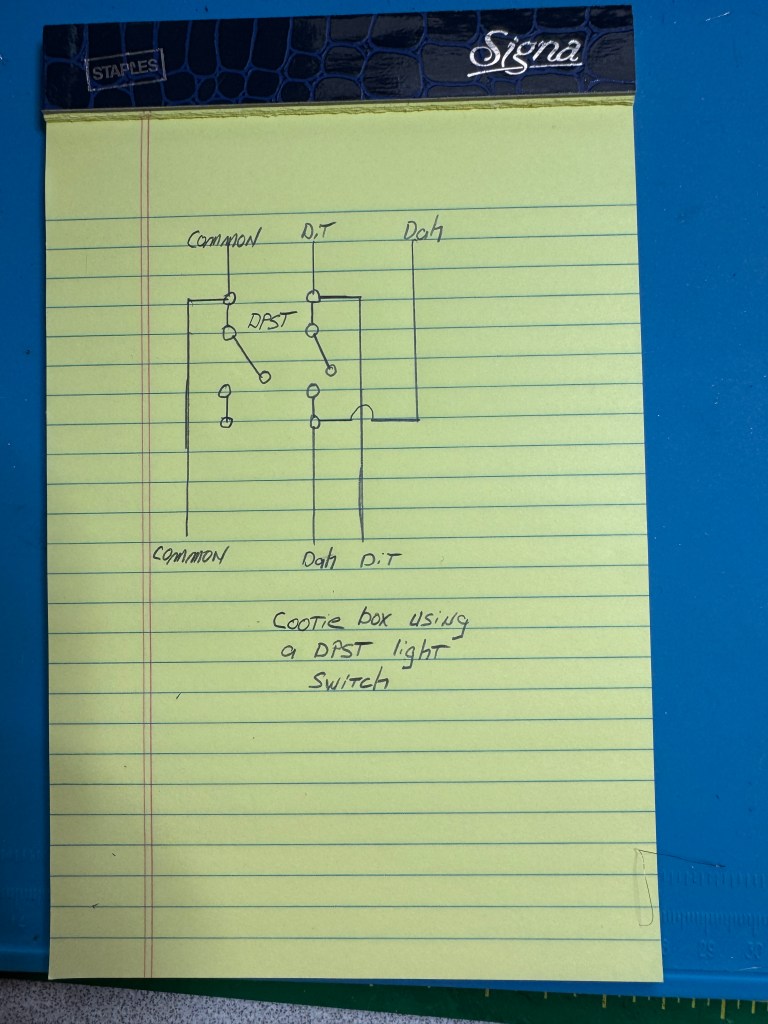
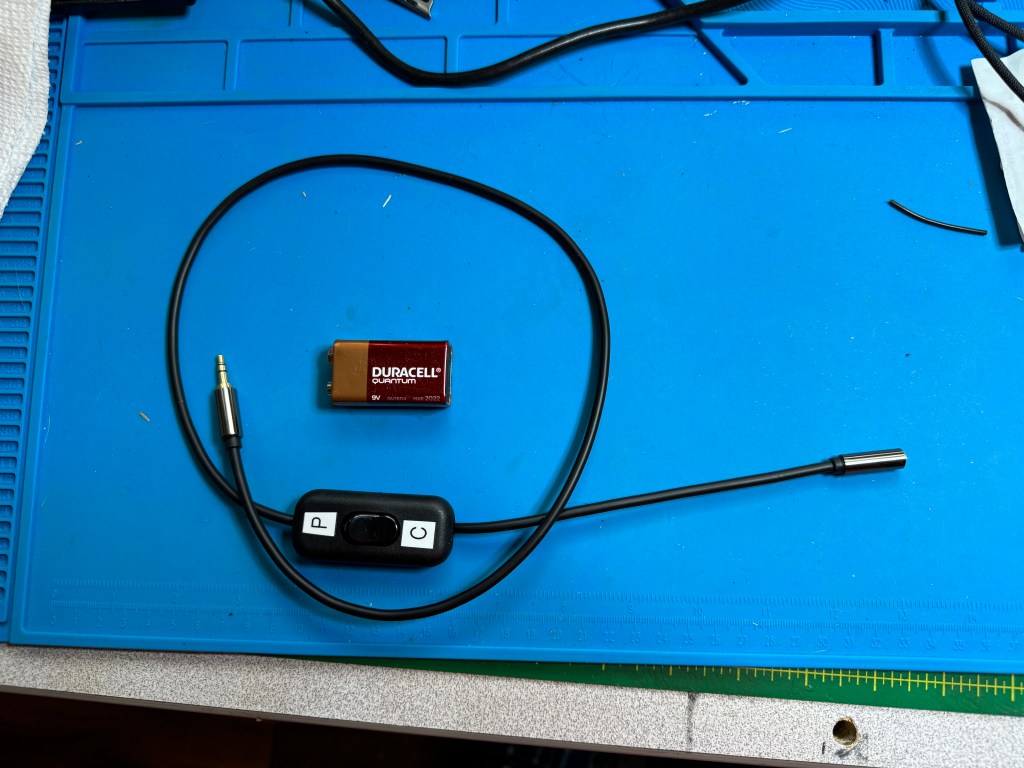
I also made another version of my Cootie Box using a DPST light switch and a 1/8″ TRS plug cable. It cost about $15 and 30 minutes of time. Parts are from amazon:
Stereo Cable
DPST Light Switch
No soldering required as the switch has screw down terminals. Here is a shematic:

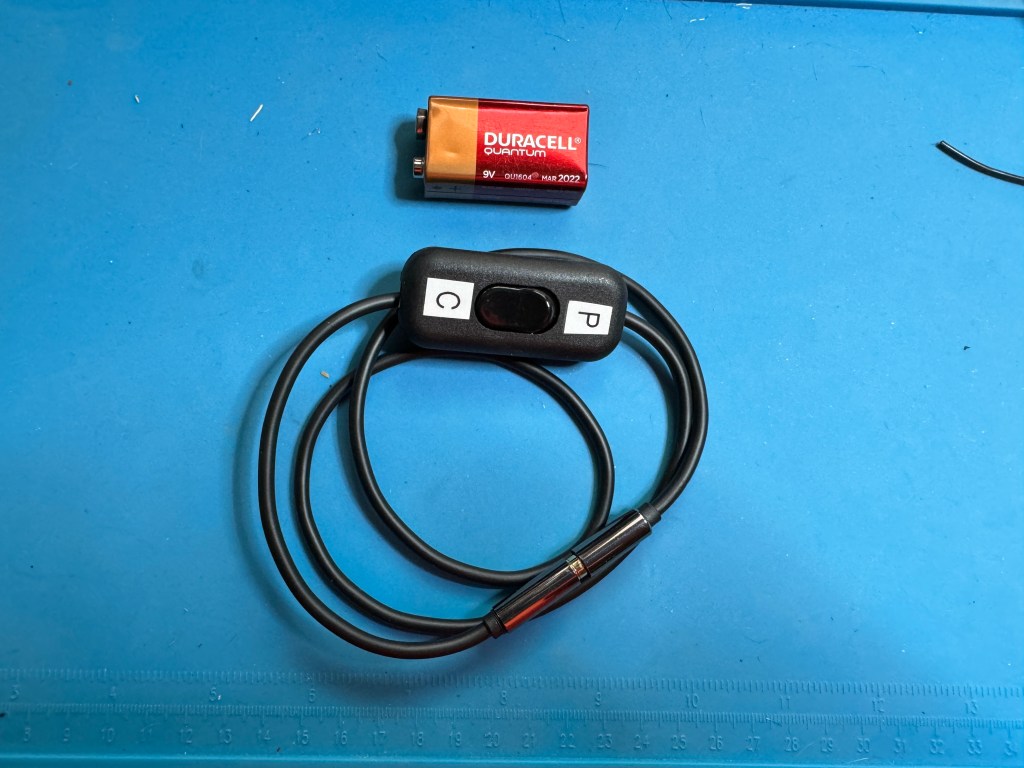
I have a male end on one side and a female end on the other. I have some paddles with the cable attached so having the female end is for convenience. The cootie box is not much bigger than the cables I normally use.

Having a male/female end allows me to coil it up.

This Cootie Box is small enough to take anywhere and allows me to work straight key events without having to bring an extra key with me. The switches I bought come in two’s so I may make another one. 73 — Scott

Carlos Goes Under the Knife

Carlos is my Elecraft K3…”cause he’s so smooth”. I’ve had Carlos since June, 2023. He came to me as a basic 10 watt K3. He had the 144 MHz K144XV, the KXV3 interface option and 2, 5-pole filters. I got the radio in a trade. Owning a K3 always lingered in the back of my mind, so I took the trade. That started my journey.

Carlos has gone through several iterations since I got him. First I swapped out the 2, 5-pole filters for 5, 8-pole filters (2.8 KHz, 2.1 KHz, 1.0 KHz, 400 Hz, and 250 Hz). Second, I added the KAT3 autotuner. I wanted the internal tuner so I would have less stuff to fool with when using antennas like my random wire. My next upgrade was to add the KSYN3A synthesizer and KIO3B interface. This brought my radio up to a K3S. Finally, I added the KPA3 – 100 watt internal amplifier. I wanted the amp for a couple of reasons. I enjoy Winter Field Day and ARRL Field Day with my club, the West Georgia Amateur Radio Society. I am currently one of 2 CW ops in the club so I usually run CW to help with multipliers. The QSK, the filters, and the ability to run near other radios makes it a no brainer. Also, when I operate portable while camping, I like to run a little more power than QRP; usually in the 20-35 watt range. That is more than enough power for CW. I did all the mods myself and found them pretty straight forward. Elecraft did an excellent job kitting and making the instructions. The couple times I had an issue and they were mine, Elecraft did an excellent job helping me work through it. I did have to send it in last year because of a goof I made, but while it was in the shop, they completely went over the radio and brought it up to spec.

Carlos does scratch a couple of itches. To me, it is like owning a vintage car. It has a nostalgic look and feel about it. The radio was produced from 2008 until about 2015 when the K3S came out. Mine is a later edition with the serial number 8640. The radio is a generation or more older than the current flock of radios. Like a vintage car, I may have more money into it than I should have, but if only accounting for the enjoyment factor, it is money well spent.

I was first licensed in 1995 and my first radio was an old TenTec Omni D. The K3 has a similar look and feel as the old TenTec allowing me to reminisce about all the fun I had as a Tech+ making my first HF contacts using CW. During that time I worked second shift. When I came home from work at night I was able to slip on a pair of headphones and make contacts wihtout disturbing the family until I was sleepy enough to go to bed. My first DX contacts happened then. The K3 gives me the form factor of the older radios with the performance of the newer radios. One other difference is the ergonomics of the K3, which is best in class.

I was considering acquiring an older radio for fun and the K3 fell into my lap. It has become one of my favorite radios. I use it portable for things like POTA and Field Day. Because of its QSK, it is my favorite CW radio. When not in the field, it resides on my desk as a part of the home team. I have a set of paddles and a sideswiper hooked up to it. Hopefully I will get some time today to have some CW fun. 73 — Scott

The King is Dead, Long Live the King

Yesterday, I decided to list my Yaesu FTDX10 on QTH.com. Surprising to me, it sold in a couple of hours. I got my asking price and the guy I sold it to has been helpful and communicative. The radio ships out Monday morning. 

I am going to take the money and get the KPA3A 100 watt amp kit for my K3(s). It is currently a 10 watt radio. I put the 3 in parenthesis becuase my radio is a converted K3 to the S. I plan to use the radio in the shack and for field days. I mainly do CW these days and the QSK on the K3(s) is sublime.

Speaking of CW, I recently received 2 keys from KN4YB. He is a one man shop that makes Bugs and keys. I was intrigued by his designs and bought a couple to try out.

The first one is a bug, model DL-151RA. It is unique in that it is a dual lever. It has one paddle for the dits and one paddle for the dahs. By moving the dit weights, you can adjust the dit speed from about 13 wpm up to 40 wpm. Mine is set around 16.

As you can see, the bug is rather compact. I have it sitting on a silicone pad on my desk and it does not move.

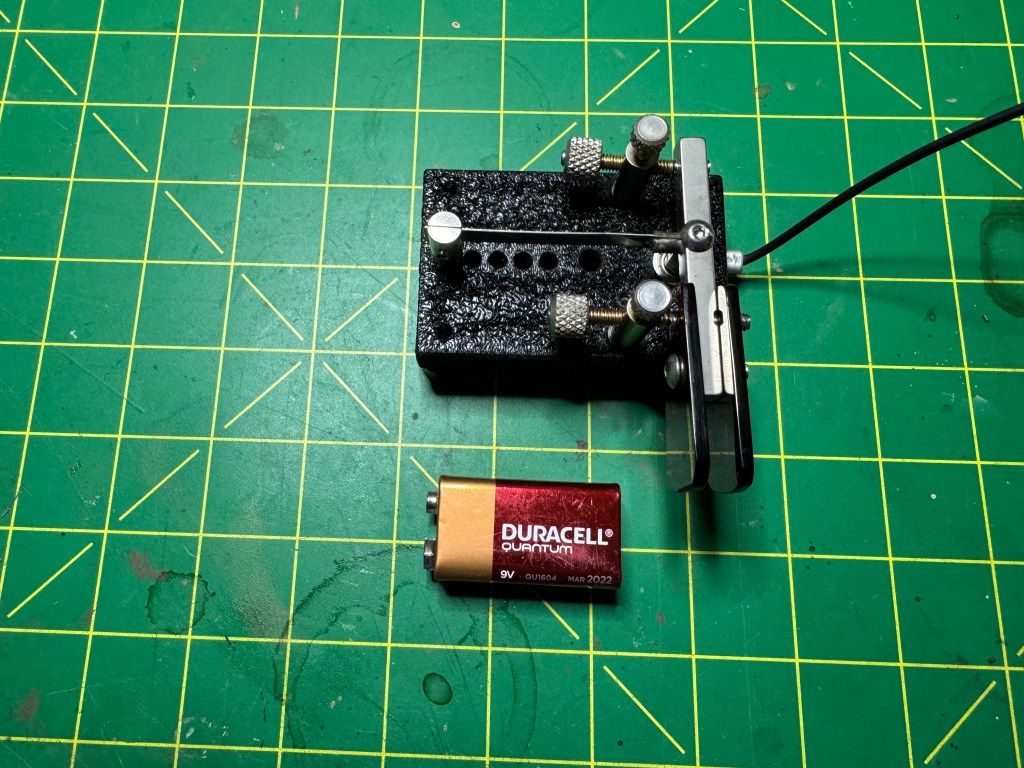
The other paddle I got is a Single Lever Paddle/Sideswiper. The difference between a single lever and a sideswiper (also called a Cootie Key), is a single lever paddle is used with an electronic keyer where the keyer generates the dits and dahs automatically. Note: I use the term paddle to designate a key that uses an electronic keyer and a key to designate a straight key. A sideswiper is more like a straight key where the dits and dahs are generated by hand movement. This model, the SL85 has a shorting bar which allows you to set it up as either a single lever or a sideswiper.

It is also a compact key. The workmanship is excellent and the prices are reasonable.

I started my journey into mechanical keys as the civilty on POTA seems to have taken a turn for the worse. Not as bad as SSB but not like it used to be. I decided to give the Straight Key Century Club (SKCC) a try. They only allow straight keys, sideswipers, and bugs, keys where the dits and dah are formed by hand or mechanically. My fascination for CW goes back to the 60’s. I thought bugs were very cool and wanted a Vibroplex. I wasn’t licensed until the mid 90’s and then chose an electronic keyer. My first set of paddles were Benchers. This is my first experience with straight keys.

I spent time with both keys to see which one I was most comfortable with. I went with keys that had a side-to-side motion as that was my experience. I was curious to see how well I could transition from paddles to straight keys. The answer is, not to bad. I think my years of using paddles has helped me with dit and dah ratios. The ratio is already ingrained in my head. Right now, between the two keys, I am doing better with the bug, which surprised me. However, I think over time and practice, I can gain some level of mastery over both.

What about my paddles? They are not going away. I can still send faster with the paddles and will probably use them for Field Days and some contests. It will take me a while to be proficient with keys. Setting up the bug is an art all by itself. So I am off to a new adventure. My code buddies will now have a new challenge as I try to improve my key skills. 73 — Scott

The long and the short of it

My first campout for 2024 was at Vogel State Park located at the base of Blood Mountain in the Chattahoochee National Forest. It is Georgia’s second oldest state park having been established in 1931. The park contains 233 acres and includes a 22 acre lake. The park has camping, picnicking, hiking, and is known for its spectacular fall foliage. Nearby, the alpine village of Helen provides various attractions and good food. Be sure to check out the German Bakery/guesthouse.

One of my New Year’s resolutions is to improve my CW skills.
This weekend, it was going to be a me and the key weekend. I am going to spend the weekend only doing CW (or so I thought). Over the past year, I used a lot of FT8 mainly because the bands were in poor shape during my camping trips. I still plan to use FT8 some but for the most part it will be CW. In addition, to help me improve my skill, I signed up for a class with CW Innovations. It is a 10 week intensive CW course. My hope is to get my speed up to where I can do the occasional contest. Those contest boys are pretty zippy.

The weather for the trip was iffy. Friday night, the park was under a winter weather advisory with freezing rain predicted. I try not to let weather stop me from an activity. When I was in the Army, they never called off a field problem due to weather. Today , while I err on the side of safety, I still go regardless of the weather. It teaches the limits of my equipment and me.

I decided to bring the Elecraft Brothers. My K3(S)/10 and my KX2. In addition to running CW, I also plan on operating at QRP levels. This is not much less than I usually run while camping which is about 25-35 watts. My antenna ended up being my 28.5 Foot random wire antenna with a 17 foot counterpoise. I also brought my EmComm II which has better NVIS capability. Often my campsite dictates which antenna I use (I ended up using the random wire due to space constraints and the chance for freezing rain). I will be using a notepad and my Lenovo T14 for logging.

It all started out innocently enough. I was finishing up a bout with the Flu which was probably Covid, and thought I was well enough to make the trip. I reserved the campsite months ago and I figured I could give it a go and if things went south, I could come home the next day.

As soon as the sun went down and the winds picked up I was not feeling well. I ended up with a scratchy throat and associated coughing along with a good case of the chills. No matter how I tried, I could not get warm. My camper has two good heaters, my small ceramic heater which is usually more than enough and the built-in overhead heater/AC unit which will bring the camper up over 90 degrees. Even with both running, I still felt chilled. It was already starting to rain so I had to wait until morning to pack things up. It was not a fun night.

The second big thing to happen was me not making any CW contacts. I called and called Friday night and only made one contact. Cell service was sketchy so it was difficult to check if I was being picked up by the RBN network. I was running 10 watts which usually is enough to at least make the required number of contacts. I was stumped. By the way, on Saturday morning, I made contact with the NCS of the EmComm net I check into on CW and LSB. Hmmm! Back to Friday night. I had about an hour and a half to make the other 9 contacts for a valid activation.

I didn’t want to do it, but I switched over to FT8. I did it to see what was going on out there and to make enough for a valid activation. My FT8 app lit up like a Christmas tree. I had contacts from the west coast and Europe with points in-between to include Canada. What a head scratcher. I’ll include a a QSO map below.

The only thing I can think of is the propagation was not falling on the ears of the hunters and with spotty cell service I could see I wasn’t making it into the RBN. The park sets down in the mountains a bit but it has had 137 valid activations so the signal does get out. It is funny that I could check into my EmComm net with the NCS in SC and not work more than one hunter.

Saturday morning, I packed up after the rain stopped and headed for the house. Back home and under the care of my good wife I began to recover. I still have some gear to dry out and a few things to fix, but that can wait a day. You can’t always have a great activation. While I planned to have a “me and the key” weekend, I was glad to have the ability to operate FT8 which saved the day. Sometimes, a little extra planning makes the difference. I enjoyed the weekend, even though I wasn’t feeling well. A little adversity does add spice to life. Till next time 72 — Scott

West Georgia Amateur Radio Society at Cheaha State Park

The West Georgia Amateur Radio Society (WGARS) is a great group. We like to do three things: 1) talk on the radio, 2) get together, and 3) eat. We did all three this past weekend during the Fall Support Support Your Parks on the Air weekend (POTA). We like to do about 4 gatherings a year namely Field Day, Winter Field Day, and the Spring and Fall Support Your Parks on the Air Weekends.

This fall we went a little uptown and rented one of the pavilions at Cheaha State Park (K-1037). This gave us shelter from the elements, power for the slow cookers, and plenty of benches to set up on. There were restrooms nearby with running water. Cheaha Mountain is the tallest point in Alabama and our pavilion was just a little down from the summit.

The weather was perfect. In the morning it was in the upper 40’s rising to the mid 70’s by afternoon. As I said earlier, we like to eat. There was an abundance of food, we had Chicken and Sausage Gumbo, BBQ, baked beans, buns, garlic bread, dunkin’ donuts, coffee, soda, and I am sure I missed a few. The bottom line is we could have fed half again as many and still had leftovers. There were over a dozen of us there.

We set up three radio stations. We had a Yaesu FT-991A and an Icom IC-7300. They were running FT8, CW, and SSB. I was running an Elecraft K3(s)/10 on FT8. My original plan was to run FT8 until it got warmer out and then switch to CW. However, we had a group gather around my station and we were doing what we like to do, kibitz and socialize. With FT8 I can run the radio and join in the conversation. We had a lot of fun chatting with one another. By the end of the day, I worked 40 states and 4 countries for a total of 120 contacts. The DX were Argentina, Canada, Ecuador, and Spain. States covered all 4 corners and in between. Not bad for 10 watts!

I had the pleasure of meeting Ward W4RE. Ward is a Vietnam Veteran and what made our meeting special is that we both served with the 101st Airborne Division. We were a generation apart with me serving between wars, but anyone who has served with the 101st understands that it is not a cakewalk; we had an immediate bond. Like me, Ward is a CW op albeit, much better than I. I am hoping that during one of our future meets, Ward and I can run a CW station together.

This was the trial run for my K3(s). I upgraded my K3 to a K3S. It is a QRP radio with a max power of 12 watts. The difference between 10 watts and 100 watts is about 1.7 S-units, a small change for CW. I operated the radio pretty much the whole time I was out there and it performed flawlessly.

While my K3 was in the shop for a repair and a going over, I put my name on the list for a KX2. There is about a 3-4 month wait for them and if things didn’t work out I could always cancel the order. When I received the invoice for the KX2, I asked my wife Mary K4SEZ about it, thinking it was worth a shot and as I was getting ready to cancel the order; she got on the computer and checked the books (she’s an accountant) and said “Happy Retirement”. I was ecstatic. I retire in 54 days and I have already made plans for that little radio. It was a great weekend that was full of surprises. Winter Field Day is right around the corner — can’t wait. 72 de Scott