Yeah, I might be a little fickle

I’m not afraid to tell on myself, I can own up to it. Last night I decided to go ahead and order a Yaesu FTX-1 Field. Not without reason though. I watched a few YouTube videos from hamvention with John from Yaesu talking about the FTX-1. He mentioned that the performance of the FTX-1 would be similar to the FT-710. That could be impressive. I just finished up a review on my FT-710 so I have a feel for the radio.

Another cause and effect was yesterday, I pulled my IC-705 out getting it ready for some POTA activations. I had been remiss doing QRP CW activations focusing instead on low power digital with full size radios. I have been feeling the urge to brush up on my CW skills. Back to the 705, I like the radio a lot. It does indeed push all of the buttons. I was holding it in my hand thinking it’s not so bad for a portable radio and the FTX-1 is only a little bigger…I thought I might do another comparison series this time between the 705 an the FTX-1. I have a couple of big trips planned for the fall and winter and these radios will do nicely.

Another reason that pushed me toward the FTX-1 was the price of used radios, they are over the top right now. I was looking at a KX3 and it was the same price as the FTX-1. Even some of the other used radios were more than I cared to spend for them. One thing I forgot to mention, is I have grown used to waterfall radios. I have learned to use them to help me find places in the band to operate and to do a real time check on propagation. It’s amazing what you can glean from those screens.

Hopefully, over the next couple of months I’ll put the IC-705 and the FTX-1 through their paces. Up front I will say that I have a preference for Icom radios, but the FT-710, KX2, and TS-890s have found places here at the ranch. I am not adverse to using different brand radios, I use whatever fits me best.

The new radio should be here in a couple of days and then the games begin. This should be fun. 72 de Scott

Why I didn’t Preorder the Yaesu FTX1

As information started coming out about Yaesu’s new QRP radio I was tempted to get one. However, the more I learned the less I liked about it. I have an Icom IC-705 and an Elecraft KX2 for QRP radios. My big field radios are an Icom IC-7300 and Yaesu FT-710F. I am looking for another QRP radio to do a long term review. I considered the FTX1 but gave it a pass for the following reasons.

Price. An IC-705 cost $1349.95 at HRO. The FTX1 cost $1499.95 but to be truly compatible with the IC-705, you have to add Bluetooth ($54.95) and GPS ($69.95). this brings the total to $1624.85. A spare battery for the FTX1 is $199.95. The Icom battery (BP-307) is $135.95; however, knockoffs on Amazon can be had for 2 for $59.95. I use them and they seem to work just fine. Another point are the antenna tuners. The AH-705 sells for $359.95 and can tune long wire and coax fed antennas. Yaesu chose a different path they have one tuner for coax fed antennas and one for long wire each costing $319.95 or $639.90 for both.

The optima package. It cost $1899.95 to give you a 100 watt option. To put this in perspective, you can buy a FT-710 Field for $884.95 and a FTM-510 for $499.95 for a total of $1384.90. Plus you get an antenna tuner included with the FT-710 and the 710 probably has better performance than the FTX1 on HF. As a side note, the FT-991A sells for $1229.95.

Performance. Yaesu was pretty mum about the performance of the FTX1. With the FTDX101, FTDX10, and FT-710, they touted the Rob Sherwood numbers long and loud. The only thing they said about the FTX1 was it had the same Analog to Digital Converter (ADC) as the FTDX10. ADC’s are all pretty similar in all of the SDR radios. So where does the FTX1 fall? Is it like the FT-710 or is it more like the FT-991A or the FT-891? For POTA and SOTA using SSB this is probably fine Rob Sherwood recommends a Dynamic Range Narrow Spaced number of 80 dB for contesting. For CW that number increases to 90dB. The FT-891 and the FT-991 are in the 70’s range.

My friend Thomas K4SWL who is attending Hamvention put his hands on a live FTX1. His first impression was it was much bigger than he imagined. He decided to cancel his reservation for a FTX1. Looking at how things attached to the radio, I had the same thoughts. If I am going that large, I’ll bring my IC-7300 or my FT-710F. I am curious about the current draw of the FTX1 at idle.

As folks get their hands on the radio, more details will come out. Hopefully Yaesu will be more forthcoming with information, we shall see. It seems to me that Yaesu did not listen to the QRP/POTA/SOTA community when building this radio. For sure the pricing and size seem out of whack. As for me, I am still looking for another radio to review, but at this time I will give the FTX1 a pass. 73 de Scott

Yaesu FT710 final Review and Where to Go From Here

I’ve had the Yaesu FT710 for a while now and used it mainly in the field. That was and is my intent for this radio.  In general, I feel if I am doing an activity like Field Day or a multi-day POTA activation, and I am not carrying my gear more than a few feet, why not bring a full sized but compact radio.  These radios have more operating options and the controls are generally easier to use.  In addition, running a 100 watt radio at low power (20 watts or less), the radio doesn’t even get warm.  The radio works well with digital modes.  It wasn’t that long ago that Yaesu’s were a real pain to run digital.  Icom’s have had an easy interface since the IC-7100.  Today, the FTDX10 and the FT710 both are on par with the Icom’s when it comes to digital modes.  With CW, both brands are about equal.  In general, I feel both radios are interchangeable and it would be the matter of personal preference which would determine which is best for you. In the next couple of paragraphs I will describe the pluses and minus’ of the FT710 and the IC-7300. John WD8LQT provided input from his use of my radio during the WGARS Spring Fling.

Attenuation.  The IC-7300 only gives you 18dB of attenuation while the FT710 give you 3: 6dB, 12dB, and 18db.  Your more expensive radios typically have 3 like the FT710.  In an SDR radio, attenuation is your friend.  Preamp should almost never be used.  The nod goes to the FT710.

CW Tune.  Both radios have autotune but the FT710 has a CW tuning indicator right below the S-meter. I find myself using it quit a bit.  Some CW ops crank their filters way down and if you are a little off frequency, they won’t hear you.  My buddy John WD8LQT, also liked this feature. Nod goes to the FT710.

Sound quality.  The FT710 sounds a little better, but the IC-7300 has a lower noise floor.  I do not find either one objectionable. YMMV.  Draw

Waterfall.  The IC-7300 has an averaging waterfall and the FT710 does not.  That means that the FT710’s waterfall has to be manually adjusted every time band conditions change.  John noticed that when sending CW the waterfall would flash rather brightly, enough to be a little distracting. This may have been due to the waterfall level not being adjusted properly, but it is not an issue with the Icom.  Nod to the Icom.

Ergonomics.  Here the IC-7300 is the clear winner.  It has more of the right buttons on the control panel and it is easier to get to the most needed controls. The 7300 gives you 3 adjustable filters and the Yaesu gives you 2.  To adjust the Icom, grab a knob and give it a twist.  On the Yaesu, push a knob, twist the knob, push the knob, twist the knob.

Power consumption.  The FT710 uses about 1.2 to 1.3 amps at idle with normal volume.  The IC-7300 uses about 0.85 amps.  This doesn’t matter if mains power or generator power is available but when working off of batteries this can become an issue.

Sensitivity and Selectivity. The Icom has a lower noise floor, -133 vs -127 dBm for the Yaesu. Before I get into selectivity let me explain a little about Rob Sherwoods numbers.  Most people quote the 2 KHz blocking number, that comes with a couple of caveats. First, for the most part Rob measures 2 KHz blocking with a 500 Hz filter. That’s a CW filter.  Sideband filters usually run 2.4 KHz plus.  Unless you’re a CW op, this number is irrelevant. Here is what Rod Sherwood says, “I decided to sort the table on my website by close-in dynamic range at 2-kHz spacing. This was the “acid test” for CW contest / DX pile up operation.” He further quantifies his research with the following numbers. “What do you need in the way of close-in dynamic range? You want a number of at least 70 dB for SSB, and at least 80 dB for CW. A 10 dB safety factor would be nice, so that means you would prefer 80 dB for SSB and 90 dB for CW.” In the past I have compared the IC-7300 with the FTDX10 and the FT710 during a CW contest. What ever I could hear with one, I could hear with the other. The Yaesu’s had a little less ringing but I had no problem copying the signal from any of the radios.  

What this means is either radio will serve the vast majority of operators well.  Whatever your personal preference is, go for it.  There are things I love about the FT710 and there are things I love about the IC-7300. I never feel at a disadvantage with either radio.  I plan on keeping both.

Where do I go from here? That’s a good question. I don’t have anything in line to review. I have decided to take a step back from EmComm for a while.  I’ve been doing a lot of digital lately and need to get back to the joys of CW. I also have a couple of QRP radios that need to be taken out and used.  I still enjoy the smaller radios.  I’ll take a big radio on a camping trips/Field Days and may take a little radio for a quick activation. Sometimes it’s nice to grab a small box or bag and go. I have some antennas I haven’t used in a while, I need to get them out.  

Thanks for hanging with me.  I appreciate your company.  73 de Scott

WGARS Spring Fling 2025

Today was the club’s semi-annual outing and this spring it was one of our old haunts, Cheaha State Park US-1037 in the fine state of Alabama. There are 3 things we as a club like to do, we like to eat, we like to socialize, and once in a while we talk on the radio.

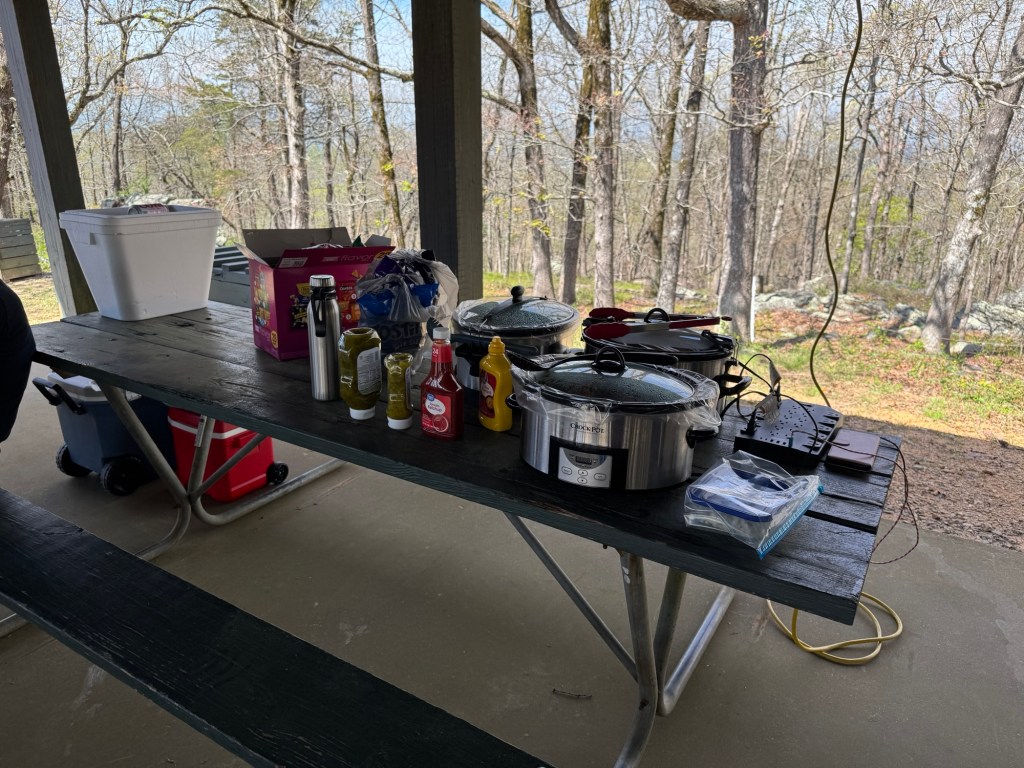
As usual, food was in abundance.

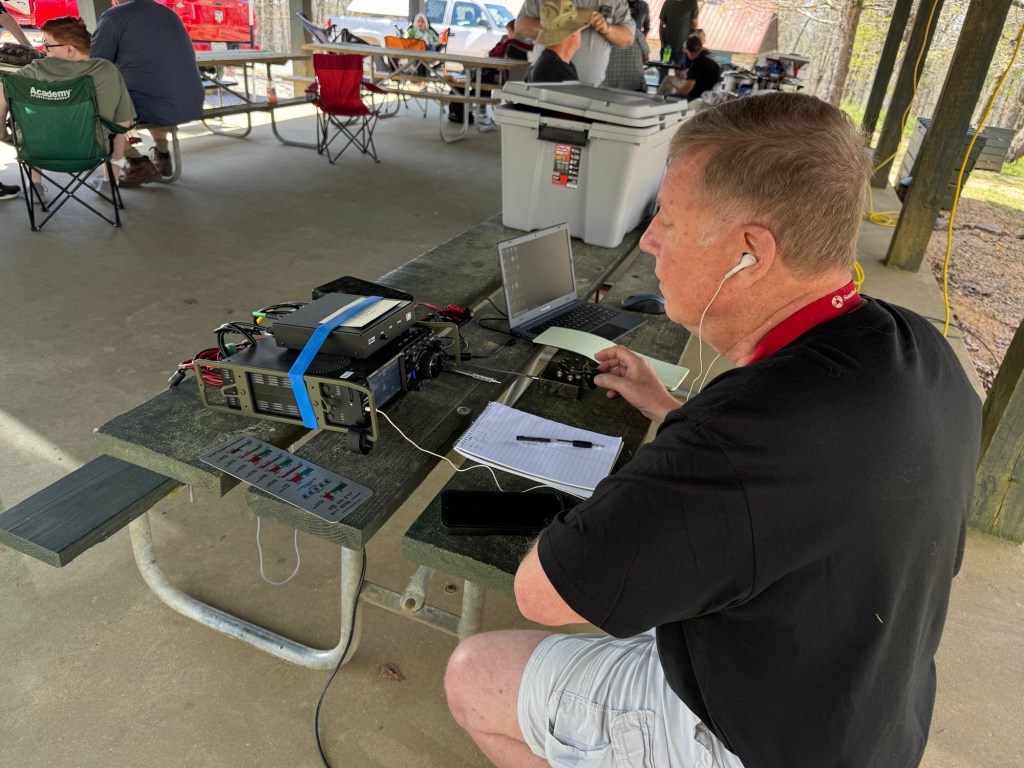
We had several stations set up under the pavilion. QRM was held to a minimum. We had Xeigu G90’s, Tru-SDR, Icom IC-705, and my Yaesu FT-710. I set the radio up and turned it over to the club President John WD8LQT. John, like me is a CW op and I wanted his opinion of the FT-710. I didn’t have to twist his arm too hard. The setup was the radio feeding a Chameleon micro transformer with a 12’ whip and about a 20’ counterpoise. The radio was powered by a 20 amp-hour Bioenno battery and the paddles were a Begali Expedition.

Band conditions were poor and it took John most of the time at the park to get his 10 contacts. There were stops for eating and chatting. Early in the activation, I decided to change antennas to be sure we had an atmospheric issue and not an equipment one. I had my Diamond RHM-12 which recently proved itself to be a good performer. Once the switch was made and some searching through the bands, John started making contacts on 20 meters. I believe it was atmospherics and not the equipment. John got his 10 contacts and we called it good.

John’s comments about the FT-710 were quite favorable. Like any radio, there are pluses and minuses. In general he thought it was a very good radio for CW. There is more commentary from John on the YouTube video posted below. John did have one epic fail. The ear buds he was using which looked rather ancient finally gave up the ghost. I took it upon myself to intervene and unceremoniously threw them in the trash. John will thank me.

My review of the FT-710 is drawling to a close. I find that I like the radio. It performs well for its price point and has some features found on more expensive radios. It has its quirks as all radios do, but none that I find overly objectionable. I plan on keeping the radio and it has found a place among my field radios. I imagine the radio may make an appearance during this year’s Field Day.

FTDX10 or FT710

Yaesu came out with too fairly closely spec’d radios at different price points. The FTDX10 currently sells for ~$1,500 and if you add in the 300 Hz filter, another ~$175. The FT710 Field sells for ~$1,075. Roughly $500 less.

The FTDX10 is a hybrid radio with a down conversion receiver feeding into a Direct Digital Synthesizer (DDS). The FT710 is a SDR radio similar to the IC-7300. I owned an FTDX10 for about 18 months and I am on my second FT710, total ownership time is approximately 10 months. I had the first FT710 a couple of months after the initial release. It wasn’t working the way I expected it to so I traded. About 6 months ago, after reading some of the update material, I thought I would give it another go. My second FT710, this time the field version, is much improved. It is my current go to field radio. I plan on keeping this one. Having used both radios if I had to do it again which one would I pick?

I would pick the FT710. The FT710 has 90-95% of the performance of the FTDX10 for $500 less. In fact, I do not think one could tell the difference between the two in a side by side blind test. There is a caveat, the receiver architecture is different between the two radios and it requires a slightly different skill set. SDR radios like the FT710 basically run wide open all of the time. Keeping that in mind, in most cases it is better to run IPO or attenuation rather than preamp. I almost never run preamp on my FT710. What is nice about the FT710 is it gives you 3 levels of attenuation: 6dB, 12dB, and 18dB; a feature usually only found on higher end radios. In contrast, the IC-7300 only gives you one, 18dB.

The other control you should become familiar with is the RF gain. On a Yaesu, RF gain starts in the fully clockwise position. When there is a lot of noise, slowly turn the RF gain counter-clockwise until only the desired signal is heard. Coming from analog radios years ago, my brain is still a very good filter. I use digital noise reduction sparingly. I often keep it at level 2 or 3, enough to take the edge off.

Perhaps the most compelling reason to chose the FT710 over the FTDX10 besides the cost, is the ergonomics. I have large hands and fat fingers. The FTDX10 clustered its controls close together so I had to be careful when pushing a button or twisting a knob. Even so, I would bump the frequency dial and throw it off frequency. I have remarked that the controls on the FTDX10 were more suited for the lefthand. In fact when it was a part of my home station, it sat to the left side. With the FT710, the controls spaced further apart and are easy to get to even with my big mitts. This is a real benefit for a field radio. The position of the radio or the lighting conditions may not be optimal so ergonomics are important. I find the FT710 a joy to use in the field.

If you are a dyed-in-the-wool FTDX10 owner, this post is not for you. I wrote this for the amateur radio operator looking for their first HF radio, or maybe a seasoned operator looking to venture into the Yaesu family. This is also for those who have limited funds and are agonizing over which radio to get and should they sacrifice funds for the more expensive radio over something else they may need for the shack. The FTDX10 is a fine radio. Its Achilles’ Heel is its ergonomics. The FT710 is a fine radio in its own right. I believe it is 90-95% of what the FTDX10 is but for much less money. Of all the Yaesu radios I have owned over the past almost 30 years, the FT710 is the one I have been most happy with. YMMV de Scott

Night on Bald Mountain

This trip was to Cloudland Canyon State Park located in NW Georgia. It is a very nice campground about a 2 hour drive from the home QTH. I got at the campground Tuesday, around 2000Z and quickly set up. Radio du jour was the Yaesu FT710 Field which is currently under review. The antenna was my 28.5’ random wire vertical. I am also trying out my Maestro Evolve III laptop along with HAMRS Pro software.

Band conditions were a little off so I started on FT8. It was slow going but I made 15 contacts before the new day. After supper, I went back to FT8 to try to get 15 more contacts before the storms hit.

The whole time I had moderate winds and some pretty good gusts. Right before the storms I lowered the antenna and put a garbage bag over it to keep it dry. The antenna is weather sealed, but the push up pole when it gets wet, is a real pain to dry out.

How about the FT710? In general, I like the radio. I think it’s a keeper. It is fun to use and performs well. It has a few niggles that I camp about but I like it. I talk more about the issues on my YouTube video. I will say that this radio is very different than the first one I got. The first radio was probably released too early and still had growing pains. This radio just feels better. In general I feel this radio and the IC-7300 are about equal. Either one will work well.

Evolve III. This is a pleasant surprise. I paid about $122 for it and for a field laptop it does well. Last night I ran WSJT (FT8) and AcLog without any issues. I was also running. BktTimeSync with a GPS receiver in the background. It is a little slow to start up but once it’s running, it does fine. I run it with a Logitech M310 mouse.

I am also trying out HAMRS Pro. I have it on Windows, Mac, IOS (iPhone, iPad) and they all sync up. I will talk more about HAMRS in a follow up article.

This is Wednesday morning and I am going to try to do some CW before I pack up and go home. Bands conditions are so-so at the moment. I will break my normal procedure are hunt a while to try out some of HAMRS features.

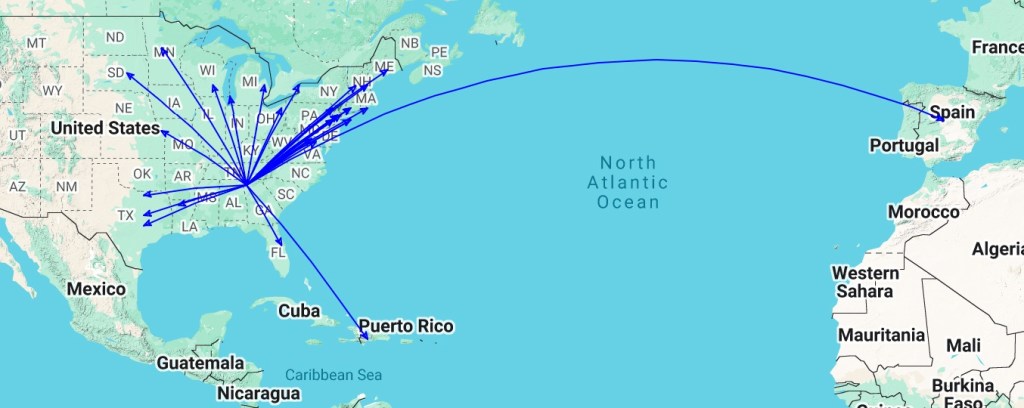
I only managed to make one CW contact hunting and activating. I could tell I was getting out as I showed up on HamAlert. Here is a QSO map of the activation.

Screenshot

If I remember correctly, I had issues last time I was at Cloudland. The important thing was I got out for a while and I had fun. It isn’t always about the numbers. Below is a video about the activation and my thoughts on the FT710. Stay tuned es 73 Scott

Mobile Mount Upgrade IC-7100

There is always a better way to build a mousetrap

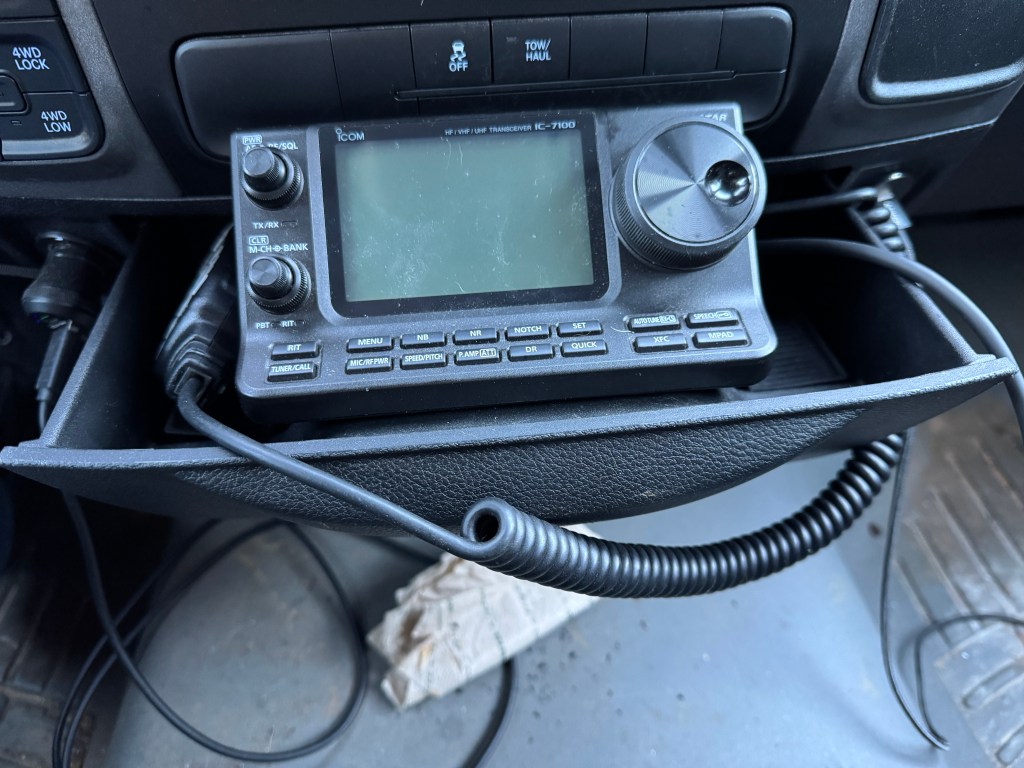
Last year I installed an IC-7100 in my truck. You can see the installation details here IC-7100 Install. The installation went pretty smoothly and I have used the radio on VHF and HF. The only fault I could find with the installation was how I mounted the control head. I used one of those Lido cup holder mounts. No matter how hard I tightened everything down, they still worked loose leaving the control head to wobble around.

Yesterday, I decided to fix this. It was simple. Using a 3 1/2” 1/4-20 bolt, some nylon bushings, washers lock washers and rubber grommets, I mounted the control head to the pull out drawer In my center dash.

I drilled one 5/16” hole in the bottom of the drawer. I put a lock washer and a washer on the bolt and pushed it through the bottom of the drawer. I then added 2-3 washers, a 1” nylon bushing (1/4” ID) a 1/4” rubber grommet, and another nylon bushing. The bushings, and washers acted like shims to keep the control head level and allow me to tighten the bolt without damaging the control head. The rubber grommet added a little extra “squeeze” so the lock washer would engage the bottom of the drawer.

It took me about an hour including driving to Tractor Supply for the hardware. It cost me about $6.

The control head is now firmly mounted to the truck and there is even a space for the microphone. The only thing I have left to do is reroute the control cable under the mat. This installation is more secure and looks nicer. I even get a cup holder back! 73-de Scott

Naming Radios

Men in general, have a habit of naming things. All sorts of things, cars, body parts, you name it, we will cast our own nickname on it. I thought I would share some of the names I have given my radios. Typically, I don’t just throw a name on something. I am around it for a while, before I decide what I am going to call it. My poor dogs, when I first get them, I go through a plethora of names until I find one that fits. My latest dog, a boxer mix from the pound was named Hawkeye by them. I got him home. I had to get to know him.

He ended up being Andy but likes to be called pup-pup. Maybe his last owners called him that. He’s still very much a pup but is going to be a great dog.

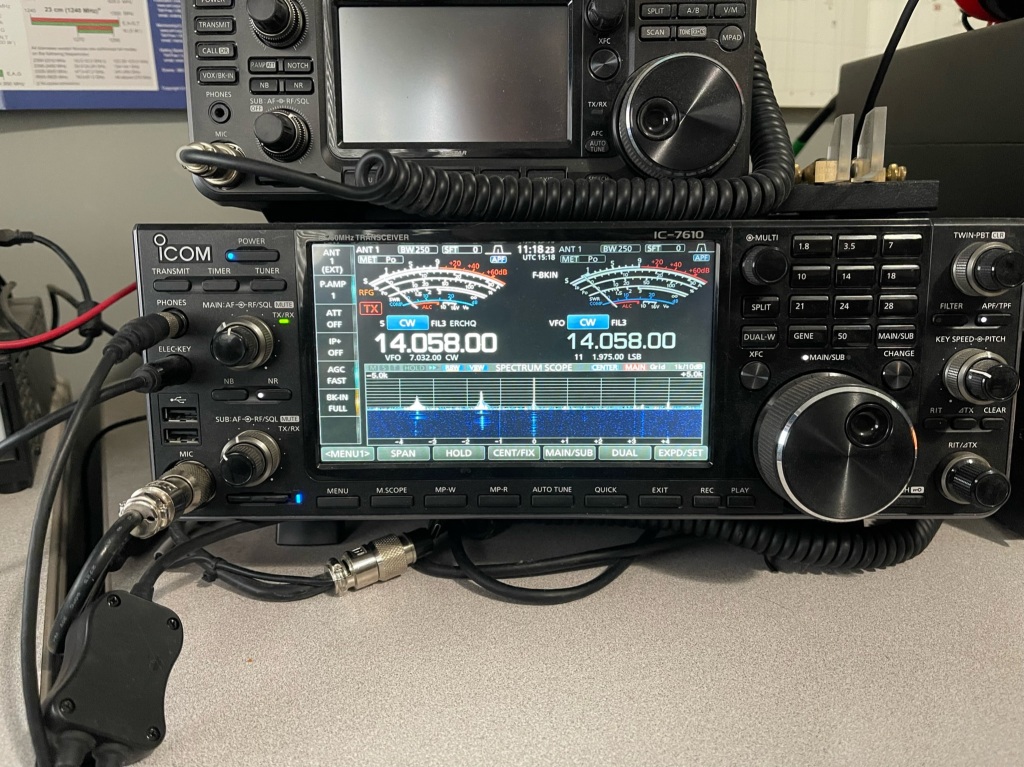
I will start with my main radio which is an Icom IC-7610. It is my workhorse radio. It is probably the best radio I have ever owned. I have worked the world on it and it does everything I need it to do. I call it Zeus, the king of all my other radios. I believe there is not a radio out there that can do anything that Zeus cannot do. Any improvements over Zeus would be marginal.

Next up is another Icom, the IC-7300. I’ve had this radio the longest. It is simply called Peter, after the Apostle Peter. This radio is my rock. It can do everything my other radios can do. Not as well, but if I could only have one radio, the IC-7300 would be it. I’ve used it as a base, I take it to the field, run it off of batteries, voice, digital, CW, it does it all.

The last Icom in my stable is my IC-705 whom I call Jack. Jack with the AH-705 can do it all. Jack is short for Jack-of-all-trades. It does everything quite well. Because the user interface is similar to my other Icoms, it is easy to use. I think Icom has some of the best ergonomics out there for modern radios.

The next radio on the list is my Lab599, TX-500. This is a fun radio with a simple interface in a small package. What sets this radio apart is it is weatherproof. I have taken out on cold rainy days without issue. Its name is Baal (pronounced bale) which is the Canaanite god of weather. This one doesn’t see as much use as the others, but when bad weather is in the forecast…

The last radio in my current quiver is the FTDX10. My most recent radio and one I wanted to try over a long period to see how I like it and how it compares to my other radios. I named it Sheldon after the main character on The Big Bang Theory. Like Sheldon, the radio has its moments of brilliance, but along with that an awkwardness that can’t be ignored. I will continue to use the radio and try to keep the firmware updated. Yaesu could easily fix some of the issues so we shall see. One thing that I do like about the radio is the roofing filters including the 300hz one.

The last radio on my list is a Penntek TR-45L This radio was due to be delivered last Thursday but has now been postponed until Monday (thank you USPS). This radio is already named Apollo, after the Apollo moon missions back in the 1960’s. I was fortunate enough to be alive then and watched the actual landing on TV. This radio has a 1960’s vibe to it so Apollo it is. More about the TR-45L once I get my hands on it.

These are my radios. I like them all and I try to rotate them as I go to the field. The past couple of months though has had horrible band conditions during my trips so I tended to bring the bigger radios for more horsepower. That and I was working on my POTA N1CC award. When I was at a faraway park I wanted a little insurance working 10 different bands. Gas prices were killer back then so I wasn’t sure about a return trip. Upcoming trips should see a more normal rotation. 73 — Scott

Split Operation Up 2, Up 2

On HF radios operating split means you are transmitting on one frequency and receiving on another. This is beneficial when pileups become large and unruly. Often, hunters or people wanting to work a station (activator or DX) will step over themselves so much that the activator can no longer pick out call signs and the hunters are transmitting so much that no one can hear the activator. Running split keeps the activator’s transmit frequency clear and the activator can vary their receive frequency up and down a little to pick out individual calls.

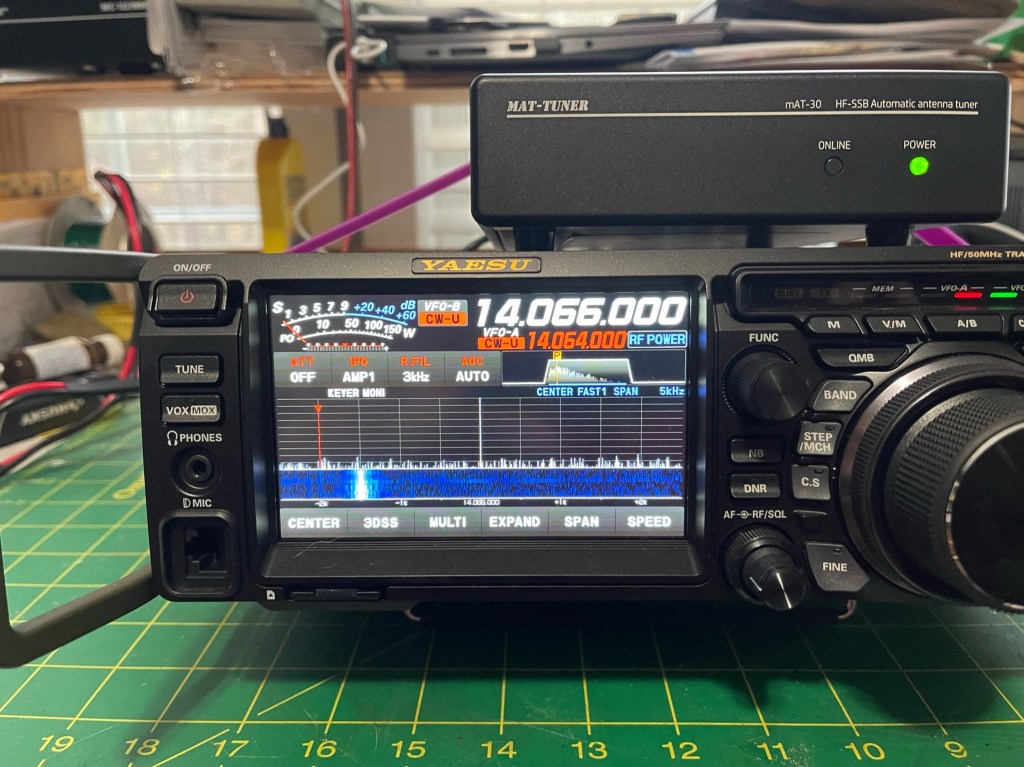
When an activator decides to operate split they add something like “up 2” to their CQ or QRZ. What that means is they are transmitting on one frequency and receiving on another. Typically CW split is 2 kHz and SSB is 5 kHz. For example, if an activator is transmitting on 14.064 mHz and calls “up 2”, they are receiving on14.066 mHz. The activator can now vary his receive frequency a little to pick out call signs while all the hunters can listen to the one frequency the activator is transmitting on. The hunt is finding the frequency the activator is listening on. Smart activators will move up and down a little to reduce the pileup.

For activators, the split setup is a little different than for hunters. Activators may start out on simplex and then decide the pileup is more chaotic than they can handle. When an activator decides to split he is starting out with the transmit frequency. Hunters on the other hand start with the receive frequency which will be discussed later. For activators, I suggest the following for the FTDX10. Push the A/B button until VFO B is the same as VFO A. Press the split button and then use the Main tuning dial to set the receive frequency.

This will give you the “up 2”. The radio sets VFO B as the transmit frequency and VFO A as the receive frequency. This allows the main tuning dial to change the frequency of VFO A.

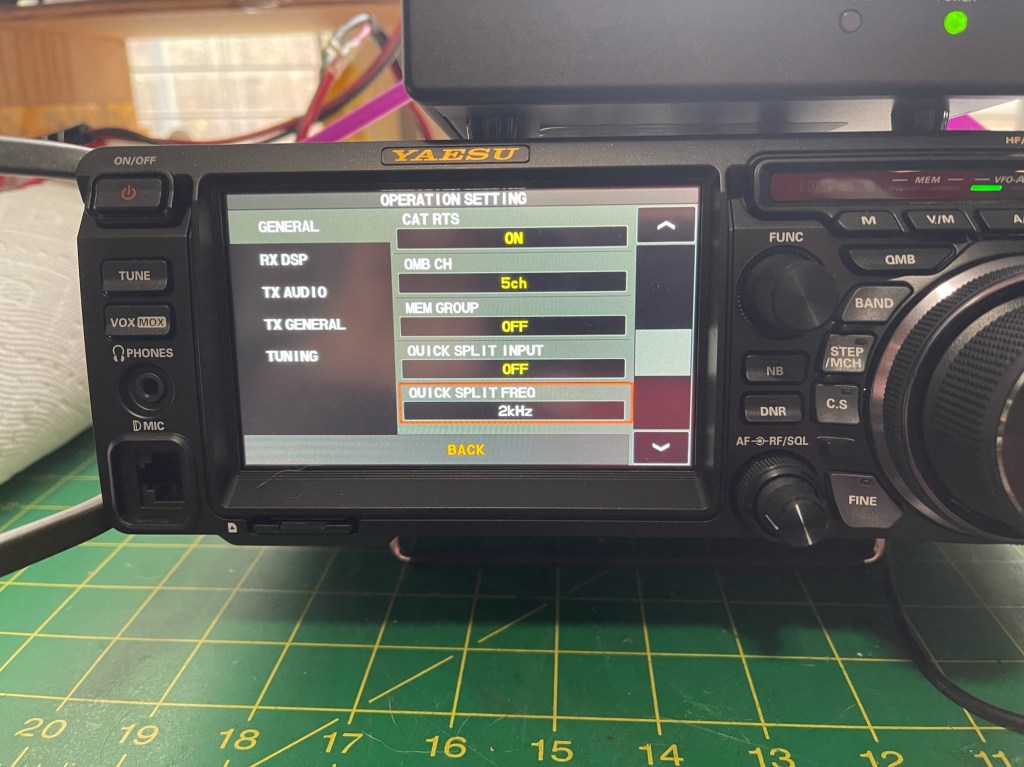
For hunters, it’s a little different. Hunters start out on the receive frequency. A hunter hears an activator on 14.064 calling for “2 up”. The easiest way is to dial in the receive frequency, touch the A/B button to equalize the VFOs, and then briefly press the Split button. Use the MPVD (outer) tuning ring to adjust the transmit frequency. Be careful not to hit or bump the main tuning dial. You can also use the Quick Split Option. To use it, set the receive frequency in VFO A and press and hold the Split Button. This will add (or subtract) the offset programmed in the radio. To change the offset, press the function button and go to the Operation Setting menu and then to the General Tab. Scroll down to the Quick Split Freq. Typical offsets are 2 kHz for CW and 5kHz for SSB. The offset can still be adjusted by the MPVD.

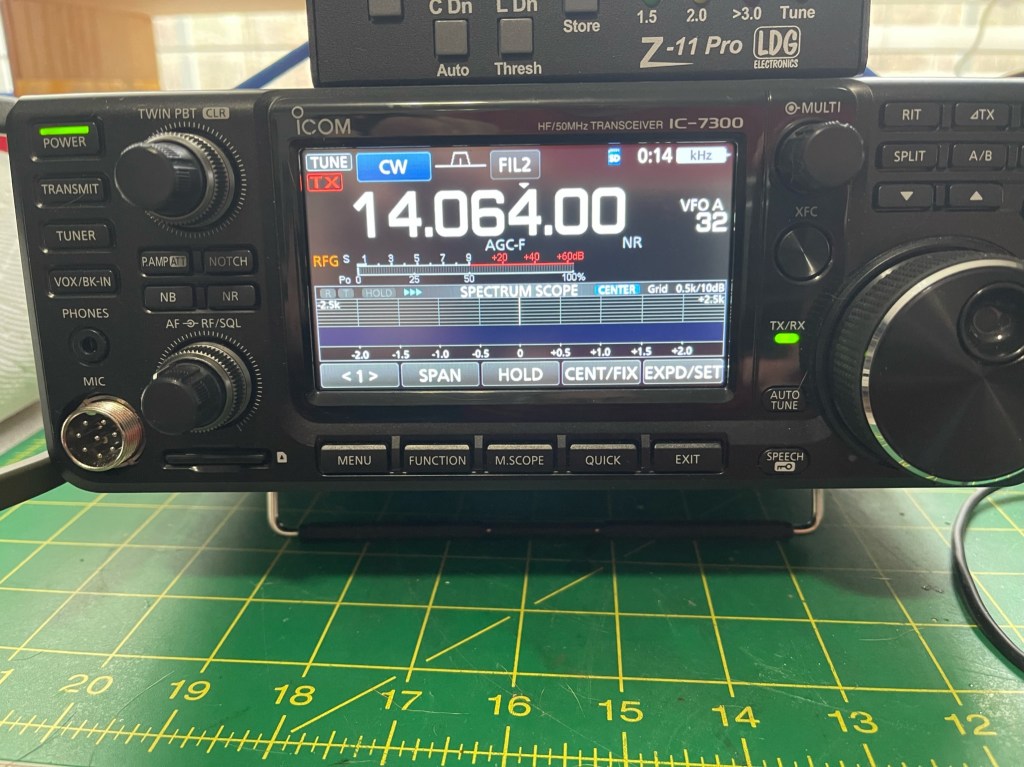
Now let’s talk about Icom and in this case the IC-7300. The Icom does not offer a built-in split offset like the Yaesu. As an activator, you start your activation on one frequency 14.064. When it is time to go to split operation.

Press and hold the Split button until VFO B equalizes with VFO A.

This sets up VFO B as the transmitting frequency. Turning the main tuning dial will change the frequency for VFO A, the receive frequency.

For hunters. Set the receive frequency 14.064 and then Push and hold the Split button until the VFO’s equalize. To set the transmit frequency (up 2) push and hold the XFC button under the Multi-Function Knob and using the main tuning dial, set the transmit Frequency. Every time you wish to alter the transmit frequency you have to push the XFC button.

Icom does have a Split Lock function which locks the receive frequency. To enable it, go to menu > Funtion > Split > Split Lock and turn it on.

While in Split Mode if you push and hold the Speech/Lock for one second, you will lock the main tuning dial so you cannot change the receive frequency. You can still alter the transmit frequency by pushing the XFC button and turning the main tuning dial. You will see a little key by the hertz numbers

That’s the basic how-to for split operation. It can be a little confusing. Shown here are the FTDX10 and the Icom IC-7300. Different models from each manufacturer should be similar. Which one is better, that depends. I think in general, when it comes to split operation, it’s a toss-up. I like things from both manufacturers. In general, I find the ergonomics of the IC-7300 better than the FTDX10 however, for split operation, the FTDX10 may be a little easier.

Why I’m keeping my IC-7300

I know there’s been a lot of hoopla over the new Yaesu Radios. I am sure they are fine radios and do a great job. These will be fine radios for those invested in the Yaesu environment.

I have owned Yaesus in the past, the last being the FTDX-3000. However, I always seem to gravitate back to Icom. I am not necessarily an Icom fan boy, just that currently, Icom suits me better.

I was tempted to buy the new FT-710. I looked at it long and hard. I schemed about how I was going to buy one. Part of my justification was looking at the specs where I discovered something…

The IC-7300 hears better. The noise floor for the IC-7300 is -133 dBm vs -127 dBm for the FT-710. Rob Sherwood defines noise floor as “Noise floor measures how weak a signal one can hear.” I can work signals on my IC-7300 and IC-7610 with an S0 (zero) on the meter. I’m working a station and the meter is not moving when receiving.

I hear comments about the FT-710 being quieter. It could be possible that Yaesu has a 6 dBm high pass filter creating an artificial noise floor above the actual one? This is just my opinion based on what I see in the specs. That may be why the Icom hears better and the Yaesu is quieter. Ah, but the FT-710 has better close in dynamic range. This is true. The FT-710 has about a 10 db better close in dynamic range then the IC-7300. The question becomes, do you really need it? From Rob Sherwood “What do you need in the way of close-in dynamic range? You want a number of at least 70 dB for SSB, and at least 80 dB for CW. A 10 dB safety factor would be nice, so that means you would prefer 80 dB for SSB and 90 dB for CW.” Unless you’re a hard core contester or chasing DX, the answer might be maybe not. Rob Sherwood put an IC-7300 through its paces during an ARRL 160 meter CW contest. His comment was “I have zero complaints about using it in a CW contest.” This contest would be a good test for any receiver. Like Rob I have no issues with my Icom the way I use it.

Am I telling you not to get a FT-710? Of course not. It’s a fine radio in its own right. Like I said, I was tempted. But, if you already own an IC-7300, the extra expense of buying a FT-710 and/or selling your IC-7300 may not be worth the effort. I’ve owned my IC-7300 since 2017 and can make it dance and sing. I would have to relearn the Yaesu menu architecture and it may take me a while to get the same results as the Icom. I have 4 Icoms with the same/simular menu system so for me it’s a no brainer to keep the Icom. I believe either radio is well suited for the task it was designed to do. I am not really saying the Icom is better than the Yaesu, what I am saying is that the Icom is better suited to me. YMMV. 73 Scott.