By the Hand of God at US-2173

I book my campsites often months in advance to ensure I get a good campsite. This particular trip was postponed twice due to typical life events that take precedence over having a little fun. Even this trip was not without its own issues. My wife and I forgot that this weekend was also Mother’s Day and unknown to us at the time of the booking was that there was going to be a 4 major Coronal Mass Ejections (CME) making an earth strike during the trip.

The last time I witnessed solar storms of this magnatude, I was in Gulfport MS doing EmComm for my Church in the aftermath of Hurricane Katrina. It was a humbling experience and it shaped my EmComm Philosophy.

I use the same gear for EmComm and FunComm. The equipment gets tested and exercised, and I remain proficient in its use. I also have an understanding of its strengths and weaknesses.

Most trips I take my go box.

It stays packed and contains everthing except a battery or generator to operate. I do keep a small switching power supply for mains power when it is available. Here is a look at the inside.

I have built rack mount or shelf type go boxes and in general, I do not like them. I have deployed to real disasters and found what I have here works the best for me. I do this enough that I am up and running in minutes. One thing I like is the versatility of being able to adapt my radio to the space I have to set up in. Your Milage May Vary, but for me and my 26 years in EmComm; this works best for me.

This weekend was spent at F.D. Roosevelt State Park (US-2173) near Warm Springs GA. The park was named after Franklin Delano Roosevelt. He suffered from Polio and often would travel to Warm Springs GA for hydrotherapy. He built a residence there often referred to as “The Little White Hose”. During his presidency, he established the Civilain Conservation Core (CCC) during the Great Depression. This provided jobs to young single men to help families who had difficulty finding jobs. The CCC built much of the park.

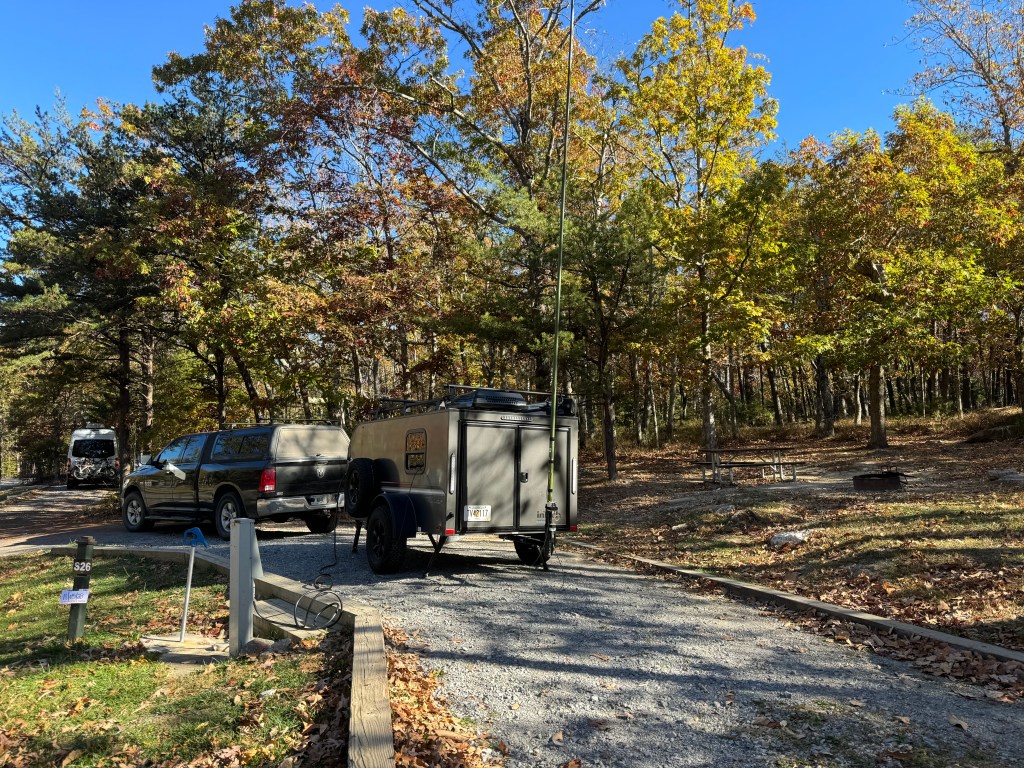
The park contains 9,049 acres (largest in GA) and is built along the Pine Mountain Ridge. It is the southern most moutain range east of the Mississippi River. The highest point is Dowdell’s Knob at 1,395 ft and is a popular POTA and SOTA (W4G/CE-004) site. I took the Radio Flyer and stayed at the campgrounds near Lake Delano.

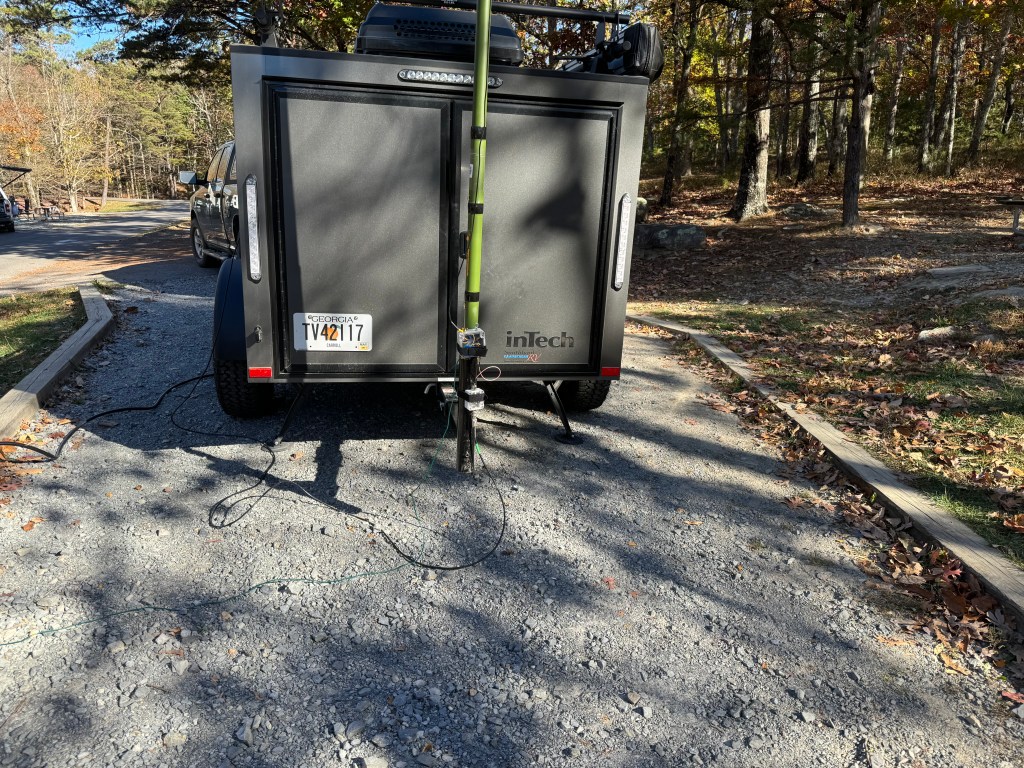
I arrived there right at 1300 hrs eastern (check-in time) and quickly got myself settled and ready to go. I knew the solar storms were coming and that my time maybe short. I wanted to finish my kilo here (#6) and needed 310 QSO’s. I had already postponed this trip twice so I was a little edgy. My gear for the trip was my 28.5′ Random Wire Antenna with the Peter my IC-7300. I had my Lenovo Thinkpad T-14 laptop and used mains power. The nice part about the antenna besides it performance, is I get zero complaints from park employees. No wires in the trees nor holes in the ground.

Friday’s band conditions were okay. There was lots pof QSB and I stuck with FT8 (35 watts). CW in these more rural parks can be iffy and this go I needed quantity. I started at 1430 hrs eastern and by oooo hrs Saturday (Friday Night) I had 134 QSO’s and when I quit at 2315 hrs I had a total of 230.

Saturday morning, after a quick breakfast I started up again at 0730 hrs. I operated until 1140 hrs when the bottom dropped. Luckily, I ended up with 338 QSO’s including 3 that were mader after the CME hit.

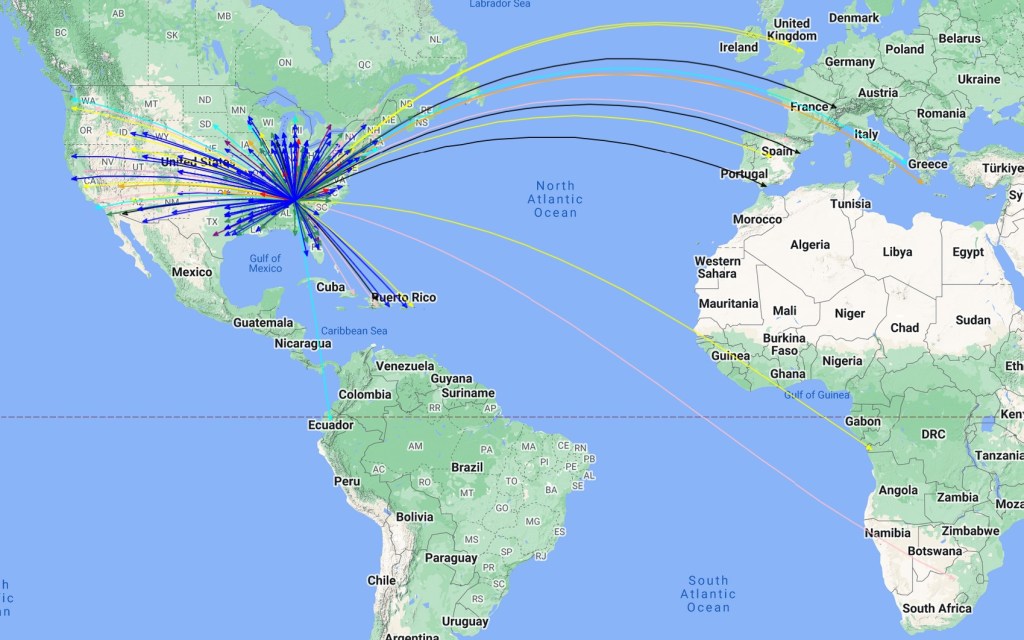
I decided my time would be best spent at home to spend Mother’s Day with my Lovely Bride so I packed up and headed for the house. My stats refelected band conditions and even though I made quite a few contacts, I only had three DX entities: Alaska, Canada and Mexico. I made contacts in 40 of the 5o states.
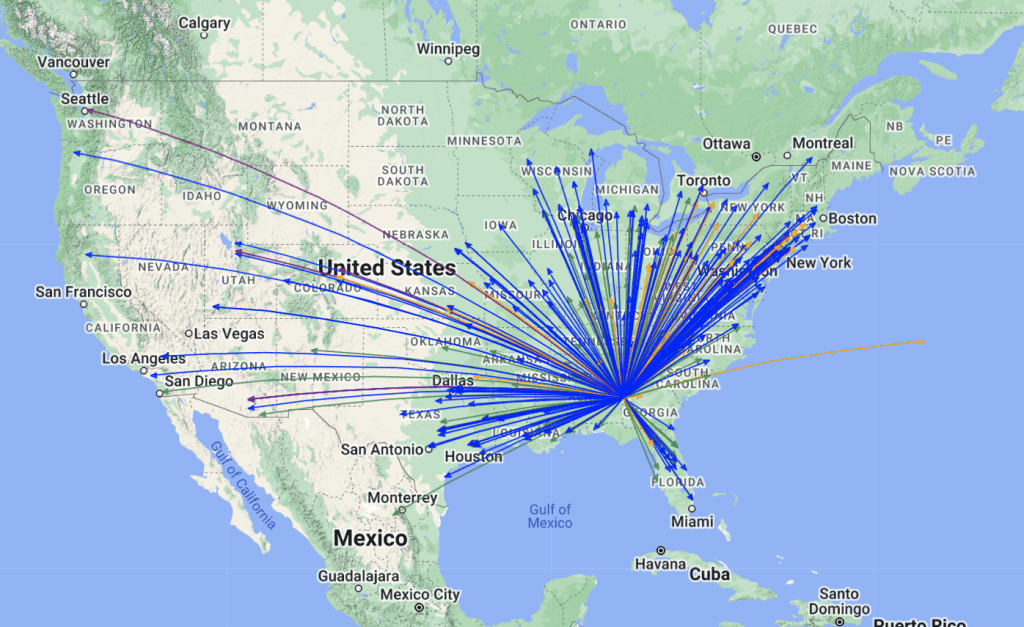
Operating this weekend reminded me that as reliable as HF commnications can be, it does have its Achilles Heel. For those in EmComm, never stop practicing, refining your techniques, or keeping your gear in order. For everyone else, it’s just another day in paradise. 73 de Scott

Shack Shake up and a New Cootie Box

I’m still a little land-locked but as my wife continues to improve after her surgery, I will be able to get a away. That hasn’t stopped me from tinkering in the shack and playing radio. Today I graduated from CWI and I am now an Alumni. For those wishing to improve their CW Skills, I recommend attending CW Innvations https://cwinnovations.net

One of the things I did today was shake up the shack a little. I had the Elecraft K3 installed at the home QTH. As I looked at the radio, I realized that it looked and felt out of place. In reality it is the best field radio I have and with that in mind I pulled it off of the desk and put it in a travel box. I like to take this radio out for my local club events like Field Day, Winter Field Day and the Support Your Parks on the Air Weekends. In its place I moved one of my IC-7300’s to the desk. The 7300 is a very versatile radio capable at home or abroad. The 7300 compliments the IC-7610 as they operate in a similar fashion.

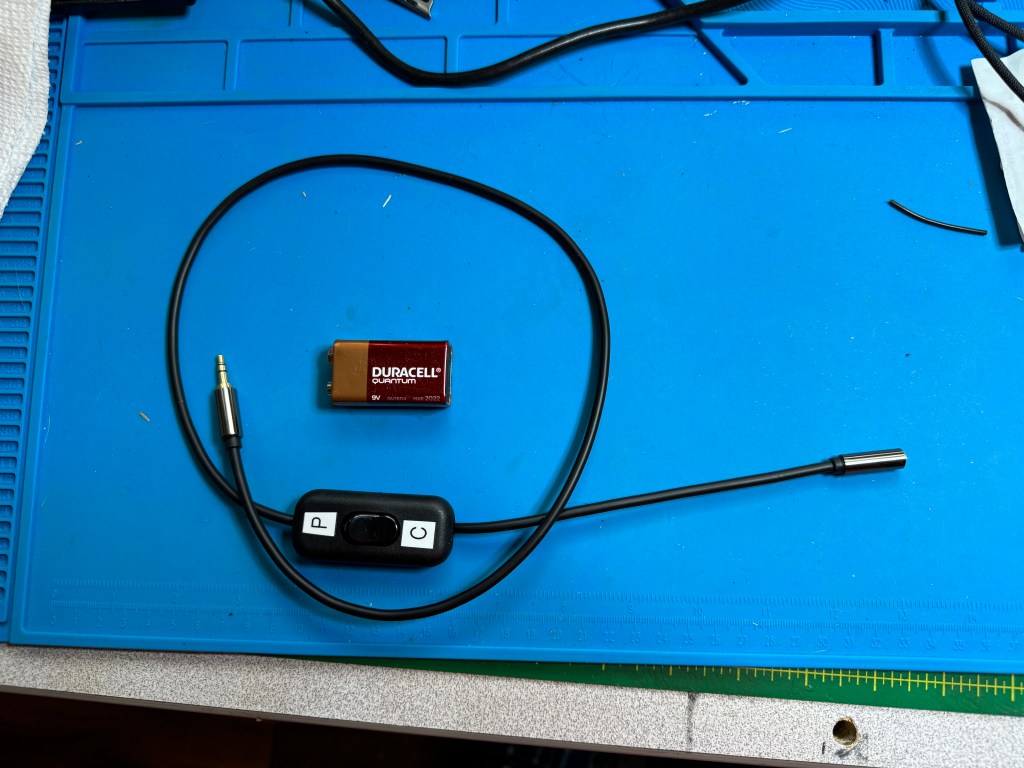
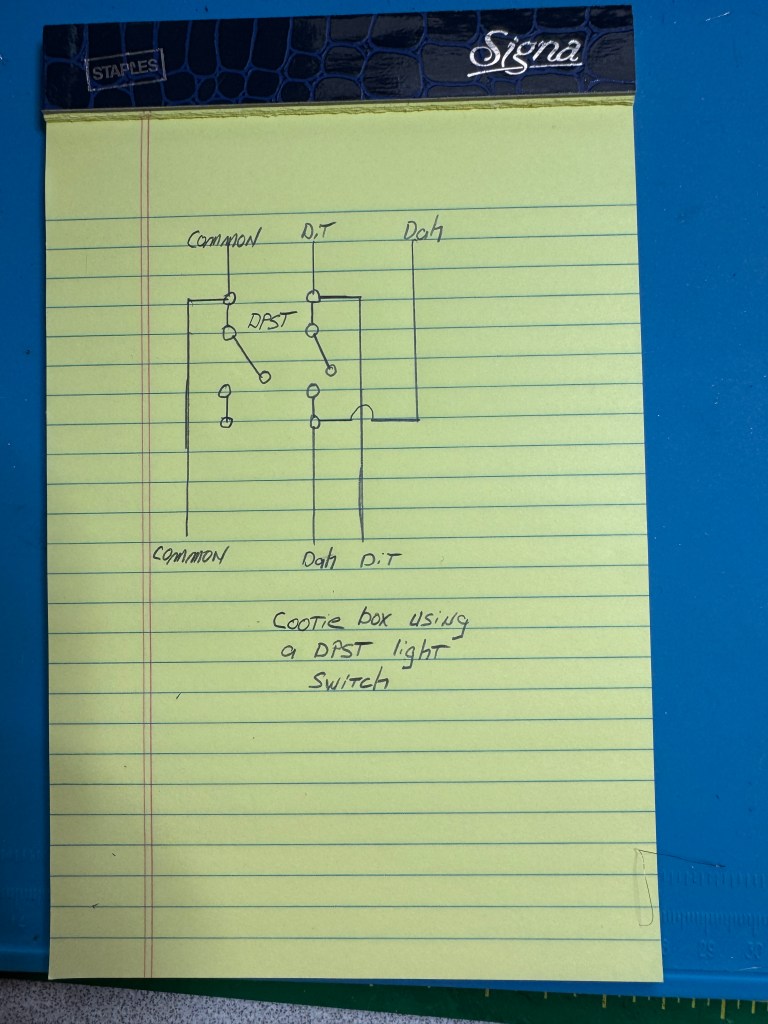
I also made another version of my Cootie Box using a DPST light switch and a 1/8″ TRS plug cable. It cost about $15 and 30 minutes of time. Parts are from amazon:
Stereo Cable
DPST Light Switch
No soldering required as the switch has screw down terminals. Here is a shematic:

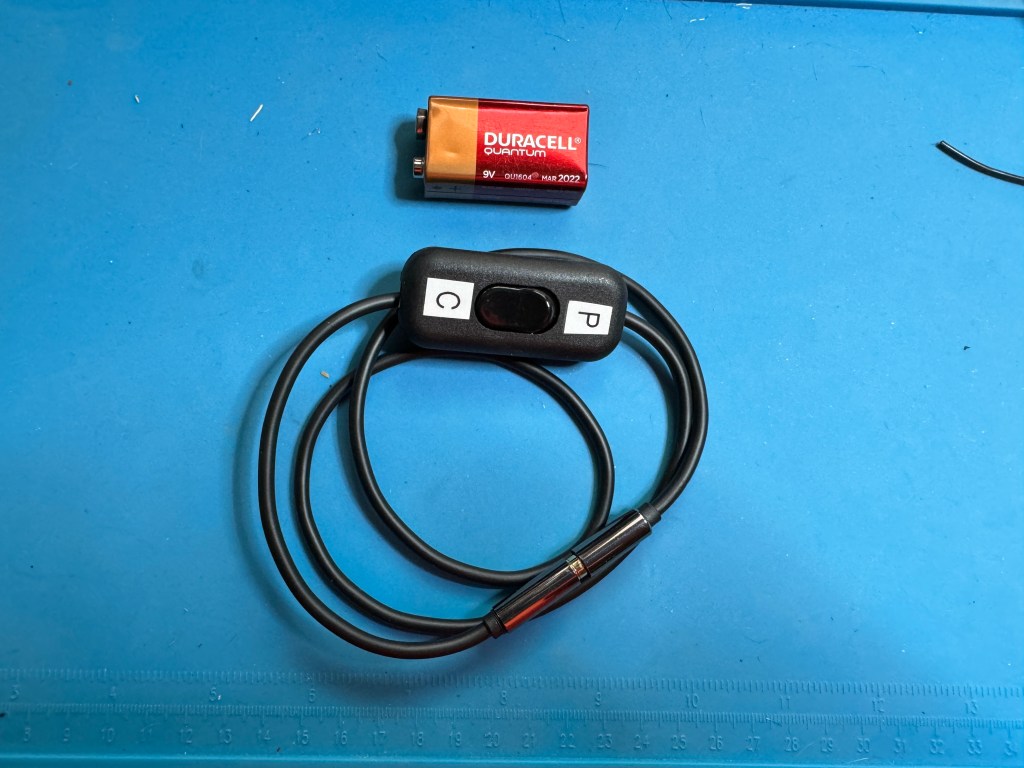
I have a male end on one side and a female end on the other. I have some paddles with the cable attached so having the female end is for convenience. The cootie box is not much bigger than the cables I normally use.

Having a male/female end allows me to coil it up.

This Cootie Box is small enough to take anywhere and allows me to work straight key events without having to bring an extra key with me. The switches I bought come in two’s so I may make another one. 73 — Scott

Winter Field Day 2024

This Winter Field Day (WFD) I operated with the West Georgia Amateur Radio Society. I am one of two CW ops so I got to play CW. We operated under W4F. I typically operate away from the main group so I won’t QRM them. This gives me the latitude to switch bands at will. My purpose is to get multipilers. You get a multpier from working each band. I managed 5 bands. Six meters never came up and I had no takers on 160 meters. Friday night and Saturday morning, prior to WFD, I made a few POTA contacts, had two CW QSO’s and managed to get France on 10 meters. So the antenna was working. 

About the club, in general, we are not hard core contesters. We like to do these events for three reasons, we like to socialize, eat, and play on the radio, often in that order. Saturday, John WD8LQT made chili. Along with the chili, we had hotdogs, coleslaw, and various condimets and snacks. My wife Mary K4SEZ, made Graham Cracker Cookies, a club favorite.

I went QRV at 1400 hrs. eastern on saturday. CW during WFD can be a challenge. There are some really good ops that can zip along at 25-30 wpm. I am not one of them. I can usually get the exchnge if I listen to them call a few times. I can send between 16-22 wpm. Sometimes I felt like I was standing still at 22 wpm with these ops at high speed. A lot of times CW ops are operating portable and QRP or low power. I made many contacts with the S-meter not budging off of zero. We also had a lot of QSB and some QRN. You could see the QSB come and go on the waterfall. It was a bit of a challenge, but I felt WFD helped me realize how my CW Innovations class has already helped me. I was able to copy the QRQ stations better than I have in the past. I eneded up making 45+ contacts mainly by search and pounce. I didn’t think I would do well running a frequency — yet. I went QRT about 2200 hrs. eastern Saturday night. I had to leave early Sunday morning so my wife could get to church on time.

Equipment: My antenna was my Chameleon EmComm II ver.1. I ran a 60′ wire in an inverted L withe a 20′ vertical section using my push-up pole and tying off the other end to a pine tree. I had a 50′ counterpoise underneath the antenna. The antenna played well. I have no complaints, it did what it was supposed to do. I think it will be my WFD/FD antenna if I have the space to set it up. The radio was 2nd Peter, my IC-7300. I was running between 35-50 watts. The radio purred along and never missed a beat. I love my 7300’s. I always say that if I could only have one radio, the IC-7300 would be it. For paddles, I used my Begali Expedition. It’s a nice heavy paddle that doesn’t move and is silky smooth. Logging was handled by ACLog WFD edition on my Lenovo Thinkpad.

Everything worked as advertised, so no real changes need to be made to the radios and related gear. We did talk about getting a MESH network between me and the base camp so we can network my computer with theirs. All in all, it was a good time. I got to see folks I don’t see very often, ate good food and ran some CW on the radio. The QSO map is my contacts only. The club is still operating as I write this. 73 – de Scott

POTA Activation K-2169, Me, VaraC, 160 meters and more

This weekend I had the opportunity to activate Cloudland Canyon State Park in NW Georgia. It was a digi weekend with me running FT8 and experimenting with VaraC. I also tried a new antenna combination to see how it would work on 160 meters.

The weather. I book my campsites 4-6 months in advance so I take what I get when I go. This weekend called for rain Friday and was supposed to clear up Saturday PM. It didn’t. It drizzled/rained from the time I got there until 0200 hrs Sunday morning. Since I mingle FunComm with EmComm, this was another test of my gear. The only issue I had was I needed to better seal the window where my coax goes into the camper. You shouldn’t let the weather stop you from going as long as it’s safe. I go year round and because of that, I have a good understanding of my gear and my clothing under varying conditions.

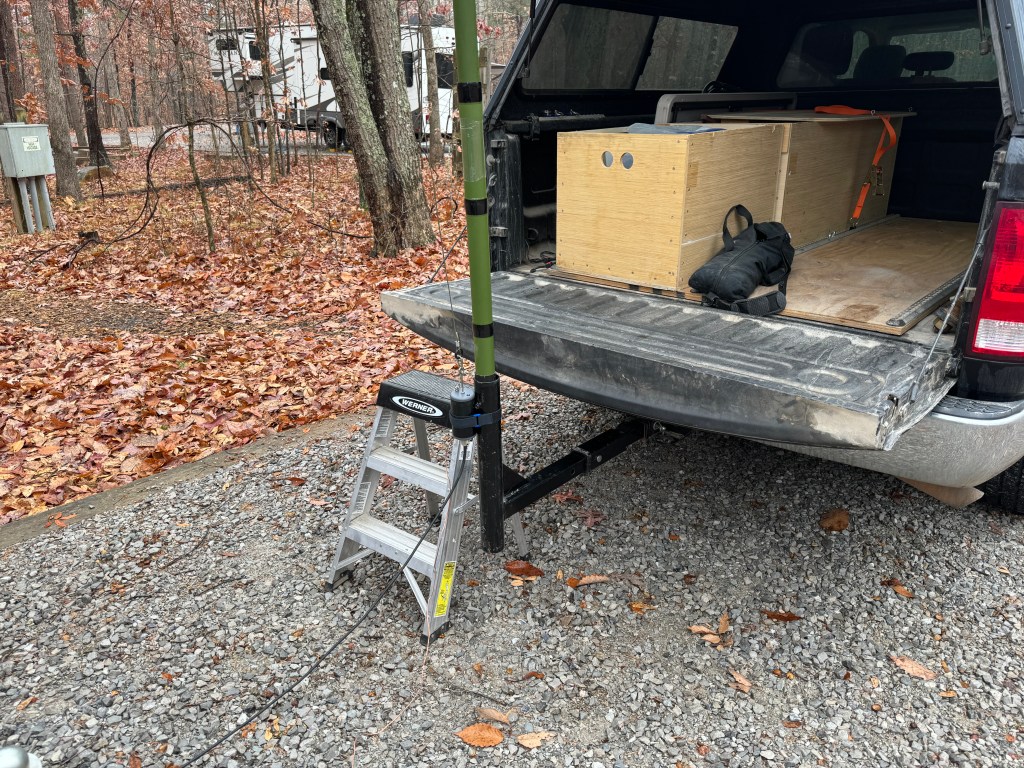
The gear. The antenna was a Chameleon EmComm II ver. 1. This version had a clunky antenna wire and insulator that is more from permanent/semi-permanent installation so I didn’t use it much. This year, Chameleon had a Black Friday Sale of 25% off. I decided to upgrade the wire to a 60′ Kevlar with a winder. I also ordered their new 40-meter OCF dipole which will be used on SOTA activations. I had some 14 gauge Flexweave wire that I cut to 50′ for a counterpoise. My intention was to use this antenna down to 160 meters. I ran the antenna as an inverted “L” ish. The vertical portion went about 25′ up my mast and the horizontal portion was more of a slope and facing north. The nice part was that the entire antenna fit within my campsite. I used the lantern hook on the site to secure the antenna. For rope, I used #36 tarred bank line. The rope is a little sticky so it holds knots well and does not absorb water like para-cord does. I used a clove hitch to secure the antenna ring to the mast and it held fast. The Bank line has replaced all of my para-cord.

The radio was First Peter, my IC-7300 that I bought new in 2016. I use an LDG Z-11 Pro that I have had for 15+ years to keep everything matched up. I was running 25-35 watts. My other IC-7300 is Second Peter. My backup radio was my new KX2. I keep it in a backpack so it is easy to toss in the truck.

Propagation. It was different, not bad, but different. There was a lot of solar activity and I believe it pushed the MUF up above 20 MHz. I had a lot of success on the higher bands which is typically not the case in the winter. My antenna easily tuned 160 meters and I made about half a dozen contacts using FT8. How did I do? I started at about 2030 hrs UTC Friday and finished up at about 2200 hrs UTC Saturday afternoon. I made a total of 325 contacts covering 42 states and 12 countries. Some of the interesting (to me) DX was Angola and South Africa. Both of those stations called me. Angola was on 10 meters and South Africa was on 12. No DX on 40 meters. I had a Facebook request to work 40 meters for local contacts. I did my best but 40 was rather flat this time around. It had the second-highest count of contacts. Breakdown by band was: 10 meters – 18, 12 meters – 18, 15 meters – 13, 17 meters – 7, 20 meters – 136, 30 meters – 19, 40 meters – 90, 60 meters – 12, 80 meters – 6, and 160 meters – 6. One of the surprises other than the lack of low band activity was that 17 meters was fairly dead. Typically on an activation, my money bands are 17, 20, 30, and 40. This time only 20 and 40 panned out. I manage 10 bands at this park in case I want to go for another N1CC award.

VaraC. For the past week, I have been evaluating VaraC mainly for EmComm. There is a lot to like about it. For one thing, it uses the same modem as Winlink. If you have it set up for Winlink, you are good to go for VaraC. VaraC can upload files and low-res pictures. PSKReporter showed favorable propagation on 20 and 40 meters. I made a few contacts with it and did some beaconing. I haven’t tried it yet, but it looks like I can create a document in FLMsg, save it, send it via VaraC, and reverse the process at the other end. pretty nifty. I think pairing Winlink with VaraC just might be the ticket.

Recap. Neither snow, nor rain, nor heat, nor gloom of night stays this operator from completing his park activation… I had a lot of fun. I try not to let the elements stop me from doing what I like to do. 73 – Scott

Wild Times at Cheaha State Park K-1037

It all started innocently enough. A nice fall weekend at Cheaha State Park to camp and operate my radios. While there I was planning on finishing up my POTA Kilo Award for this park.

Things started happening right at the time I got to the park. My reservation got messed up and I had to to take another campsite. This campsite was further from the comfort station bu at a higher elevation. Even at the higher elevation, cell service was very spotty which added to the wild weekend.

Getting setup, I put up my 28.5′ random wire antenna with a 17’counterpoise. I used a homemade 9:1 UnUn with a 1:1 current balun to feed my IC-7300 (Peter II). In between was my trusty LDG Z-11 Pro. I ran FT8 at 35 watts.

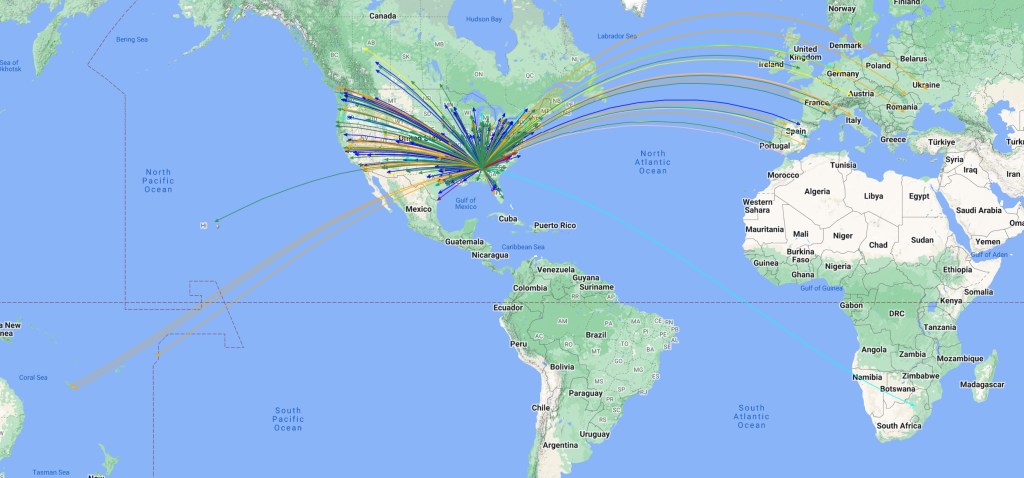
As soon as I started operating, things began to get squirrelly. I normally start on 20 meters in the afternoon and then drop down the bands as night falls often going back to 20 in the late evening. That didn’t happen. I only stayed on 20 for a little while before jumping down to 40, for most of the rest of the evening. This was not going to be a typical campout/POTA Activation. The next day I spent time on 20 but the MUF appeared to be much higher as I crept up the bands all the way to 10 meters. Typically, during an activation, 20 meters is my money band but this time 40 meters was the winner. Of the 465 contacts I made, 197 were on 40m meters and 157 were on 20 meters. I worked 46 states (except AK,CT,ND, and NH) and 15 dx entities. I had some interesting DX. I worked Germany, Portugal, Spain and Canada on 10 meters; Spain, Italy, and France on 12 meters; Samoa, New Caledonia, Ukraine, and Romania on 30 meters; and Hawaii on 40 meters. See the QSO Map.

On my home, when I got back to full service, I started receiving emails from the prior day from the SWPC with a bunch of Geomagnetic Storm Alerts. That explained the wild times on the bands. It was fun trying to figure out were to go to catch the propagation. I did manage to complete 3 Kilo awards before I left the park. The moral of the story is bad solar conditions can bring some surprising DX results. 73 de Scott

POTA Activation K-2176 Ft. Mountain State Park

I spent part of the Fourth of July weekend at Ft. Mountain State Park. I really like this park. It’s where my wife and I spent our honeymoon many years ago. This time I had a nice drive through campsite. The campsites are located down from the mountain top but I am usually able to get my signal out. Driving up there, the temps were in the upper 80’s but by the time I got to Ft Mountain, the temperature dropped by about 18 degrees. Seems a cold front passed over but then on Saturday afternoon, it made its way back in the form of a squall line. The wind picked up and we had thunderstorms overhead for about an hour or so. I had to lower the antenna and hunker down in the Radio Flyer.

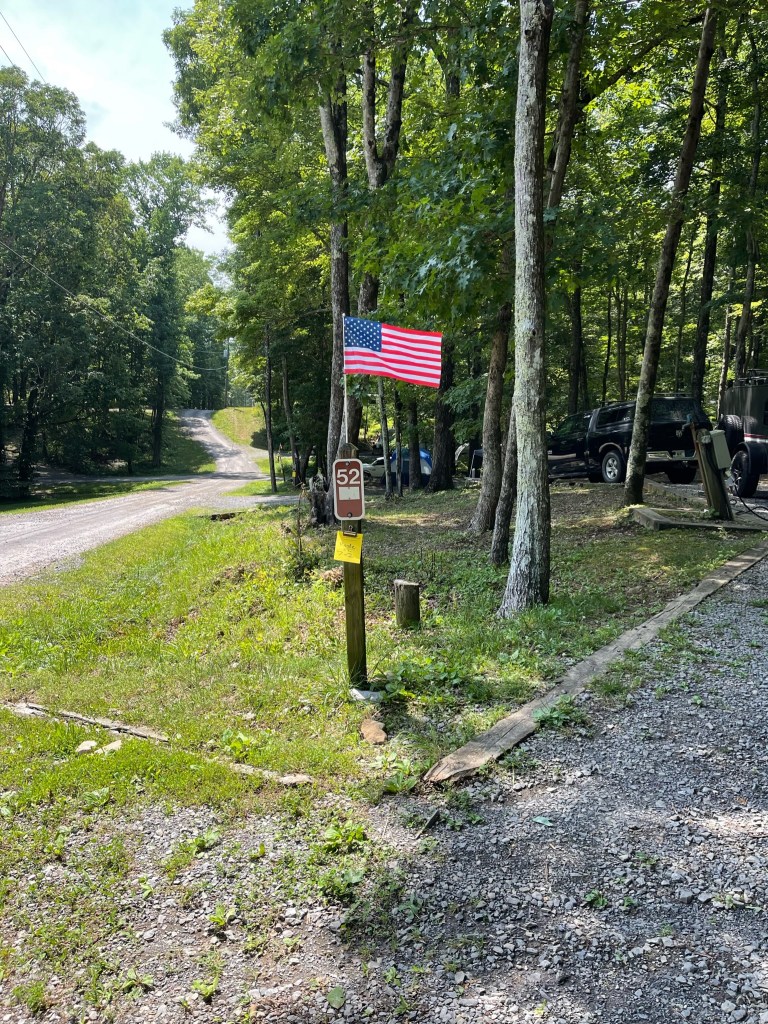
Prior to the storm, the man came around and placed American Flags on the campsite markers. I love seeing our flag especially when the wind stands it up.

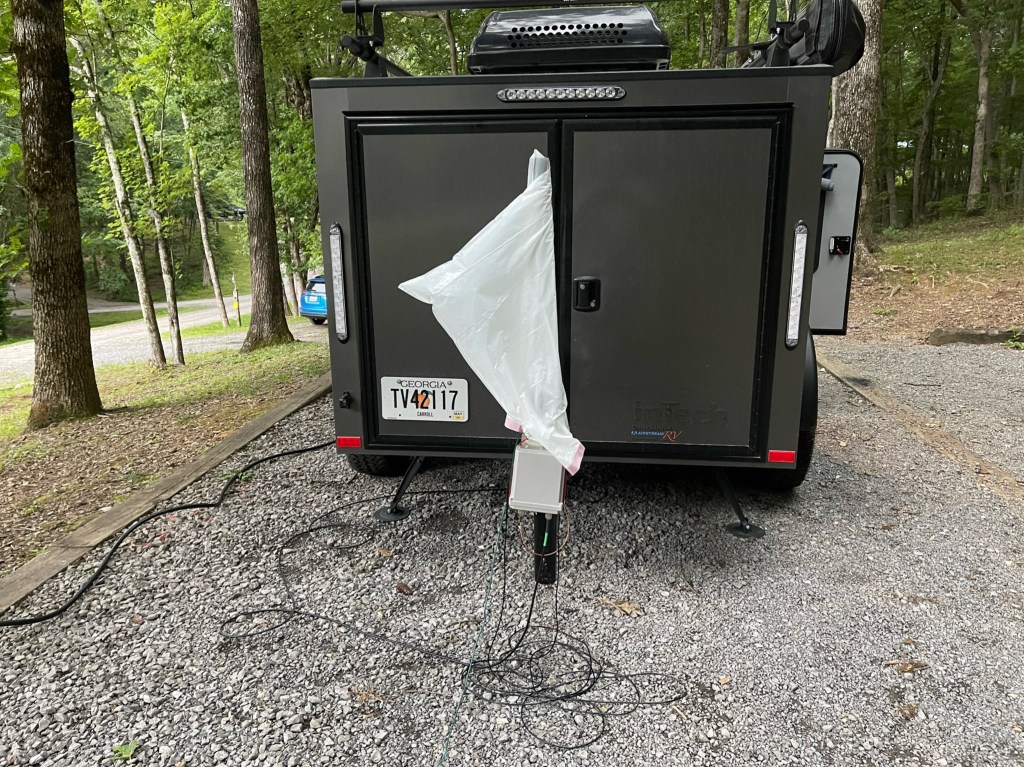
I placed a garbage bag over the lowered antenna to prevent water from filling up the fiberglass antenna pole. My antenna goes up and down in less than a minute.

The setup was typical. My homemade 28.5′ Random Wire Vertical with a 17′ counterpoise. The radio this time is my new (to me) IC-7300. I traded the FT-710 for it. Nothing really wrong with the Yaesu, I prefer Icoms. I now have two IC-7300 for EmComm and FunComm. One thing I can do with the Icom that I cannot do with the Yaesu is show all of the meters.

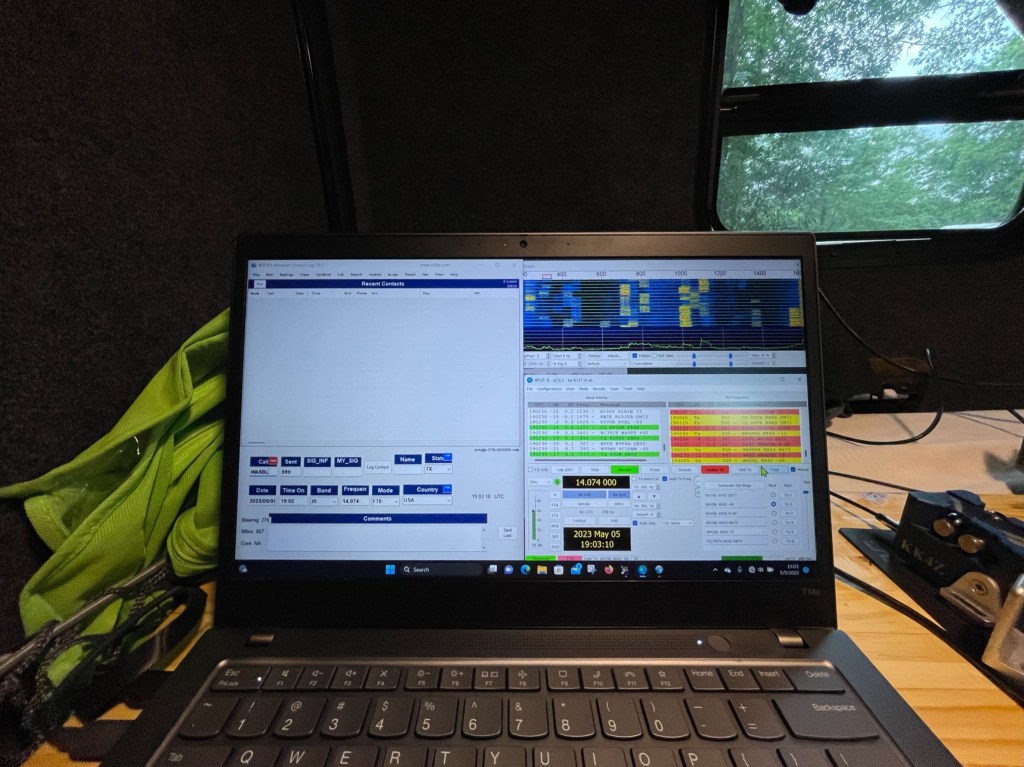
Where this really matters is during digital operation. I can watch Power, ALC, and SWR all at once. With a mode like FT8, the waterfall isn’t important on the radio.

Band conditions were poor with sporadic good moments. I book campsites months in advance so I have to work with what I got. The mode this time was FT8 and the power was in the 40-45 watt range. The IC-7300 doesn’t even get warm. I went QRV at about 1500 hrs local and operated until about 0100 hrs. I get early the next morning and checked into my EmComm net and then back to FT8. Like to check into the EmComm net from a park to give net members the opportunity to work a field station. I operated all day until about midnight local Saturday night. Sunday I packed up and came home.

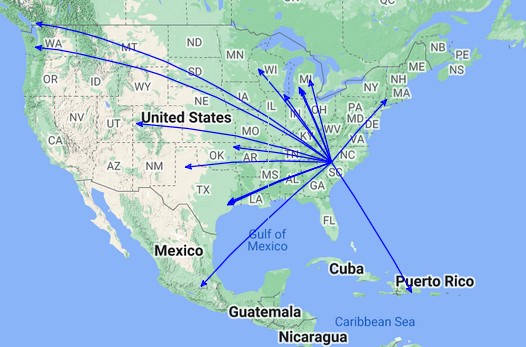
Overall, I did pretty well. I worked 510 stations (500 for POTA) including 46 States and 11 DX entities. That puts me pretty close to a kilo maybe next time there. here is a QSO Map of the activation. The money bands were 40, 30, and 20 this time around.

Everything worked as advertised and only a few minor glitches. Below is a short YouTube of the activation. 73 — Scott

What the Heck is going on at KK4Z!

Over the past week or so I have had a bit of a shake-up. I decided to sell some of my stuff so the line-up is changing. Yesterday, I drove to a friend’s house for a visit. While there I traded my FT-710 for an IC-7300. Yes, I now have two IC-7300s. They are a part of my EmComm package so now my primary and backup field radios are the same. One of the problems I had with the 710, is a needed extra stuff to make it work with my field gear. That and the IC-7300 is easier to use.

I think I said it earlier but the TX-500 is gone and the TR-45L should be leaving soon. The TR-45 wasn’t getting much use because of the IC-705. In their places, I have a QRP Labs QMX and an FX-4CR on order. When I don’t have to pack something like on a SOTA Summit I prefer bigger radios because they are easier to use. To that end, I am currently working on a deal for a QRP K3. It’s kind of a dream radio for me. I am looking forward to getting it.

My friend lives in SC so while I was there I did a quick activation at Chester State Park K-2889. I never did a POTA activation in SC so I wanted to check that box. I didn’t have much time as I drove up and back in one day so the activation was short, just 16 contacts on FT8. I stuck to 20 meters, and I made some decent contacts riding the crest of the QSB. here is a map.

The park is small and a little out of the way. My kind of park. It’s a fairly popular park with POTA enthusiasts, and I can see why. I enjoyed the short time I was there and maybe in the future, I can go back and spend more time. Below is an equally short video on the activation.

POTA Activation K-3726 Kolomoki Mounds State Park

This past weekend, I got the opportunity to visit Kolomoki Mounds State Park in SW Georgia. It’s about 180 miles away and I can get there and back on one tank of gas. I like this park, it is a little out of the way and it is nice and quiet. Cell service/Internet is almost non-existent. What not to like, right!. This time I got a drive-thru campsite that was well-shaded.

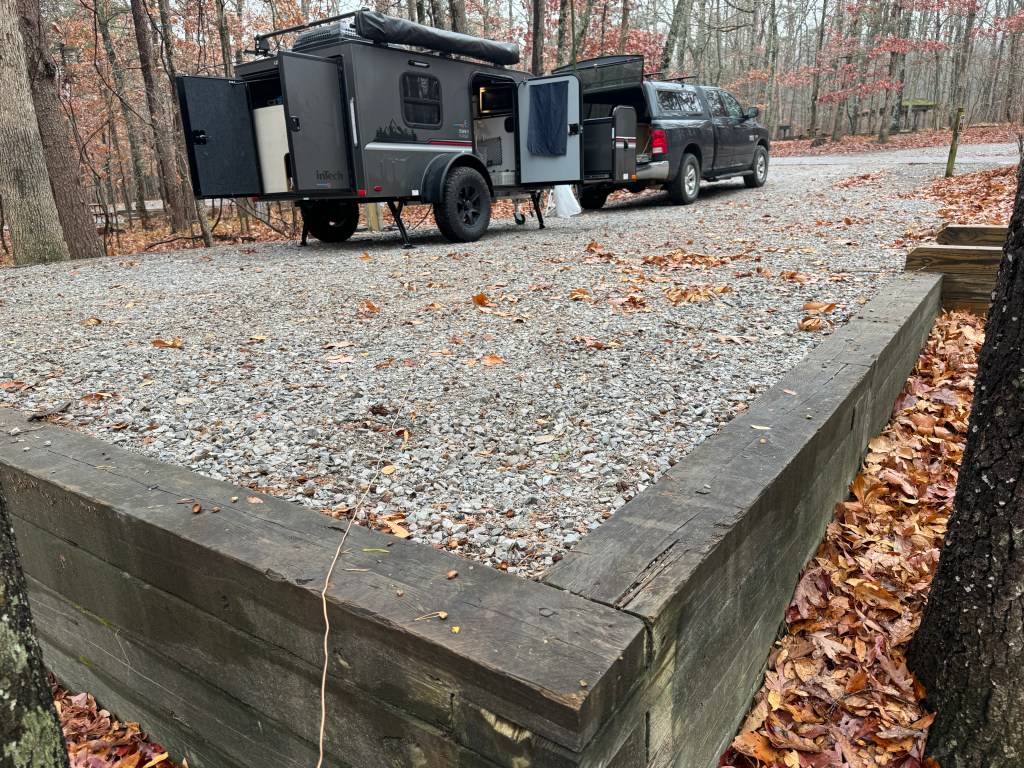
Because of the trees, I had to mount my antenna to the truck instead of the camper. However, the shaded provided kept the camper cool and I only had to use the A/C intermittently. This was the first time I had to use the A/C and it will quickly freeze you out if turned up too high.

The setup was pretty normal, I used my K4SWL antenna which is a 28′ random wire with a 17′ counterpoise. It has a homemade 9:1 UnUn and a 1:1 current balun. The tuner is an LDG RT-100. I love this antenna. It is easy to put up and take down, and it performs very well. I include the stats a little later.

Inside everything is pretty much the same except this time the radio is my new Yaesu FT-710. This will be its first real workout. I plan on using FT8 with a little CW if the bands’ permit. As it turns out, the bands were not in that good of shape. I ended up running the FT-710 at 45 watts. On Saturday a G2 magnetic storm hit and wiped out the bands. Saturday during the day was rather slow. Here is a look at 20 and 30 meters. Normally the whole waterfall from east to west is orange.

The radio got a good workout. I went QRV on Friday at 1400 hrs eastern and ran until 0200 hrs eastern Saturday morning, then again at 0730 hrs Saturday morning until about 2330 hrs eastern Saturday night. Operation was a pretty steady diet of FT-8 at 45 watts. The FT710 didn’t even get warm. It’s one of the reasons I like to bring a big radio — I can run them pretty hard without them skipping a beat.

First impression of the FT-710? I like it. I feel it compares favorably with the IC-7300. Each one has its pluses and minuses but in the end, either one will work for my intended uses for them. What are my intended uses? These radios are my field radios. I use them mainly when I am doing outdoor/portable activities such as camping or public service. I look at amateur radio from two different perspectives. First, is amateur radio for fun doing things like POTA, SOTA, or the like as well as some public service events like bike rides, parades, etc. My second perspective is from Emergency Communications. I am quite involved with EmComm at the local/state/region/national level and participate regularly in training events as well as provide training. I have in the past deployed to several disasters as an EmComm Specialist. So, when I look at radios, it is from the point of view of whether can I use them for both of my endeavors. Radios like the FT-710 or the IC-7300 fill that bill nicely. EmComm is one of the reasons I like POTA and camping, It gives me a fun way to practice my craft and ensure my equipment is in good working order. The only way to get to know your gear is to get out and use it.

How’d I do? Not too bad, over the weekend I made 571 FT-8 contacts 46 States, and 19 countries. My best operating times were at night after the earth turned my location away from the sun. You can see that in the map below where I don’t have any contacts from the Pacific which were still sunlit. I had intended to operate a little QRP CW, but the propagation gods had different plans. I was glad to have a big radio with more power. Every time I go out, I learn something new, either about my gear or about myself. Each trip is a nice weekend in a park but also a training exercise to prepare me to deploy if need be.

Here is a video of the activation.

POTA Activation K-1037 Cheaha State Park

Yesterday (04/29/23), I was able to get away and do a day POTA activation. It’s a little harder for me as the nearest POTA parks are 45-60 minutes distant and none are in my normal paths of travel. Cheaha State Park in Alabama is one of the closest and I consider it my home park. Being the highest point in Alabama, it does have some spectacular views. I often set up just below the summit to get away from all the communications towers there.

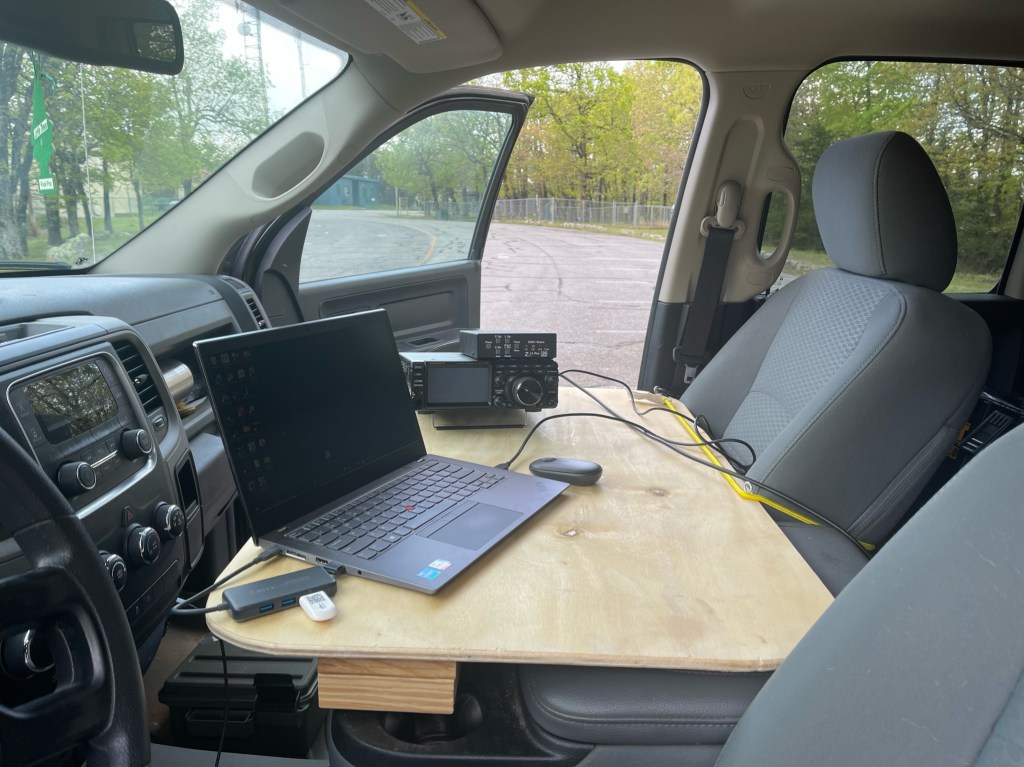
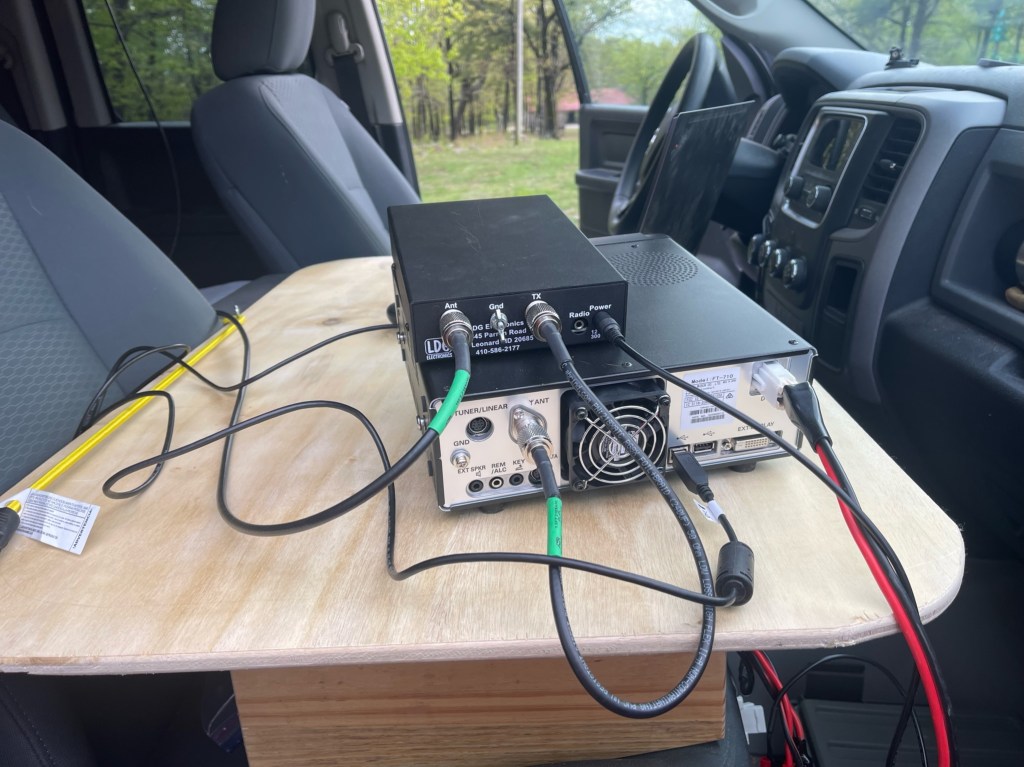
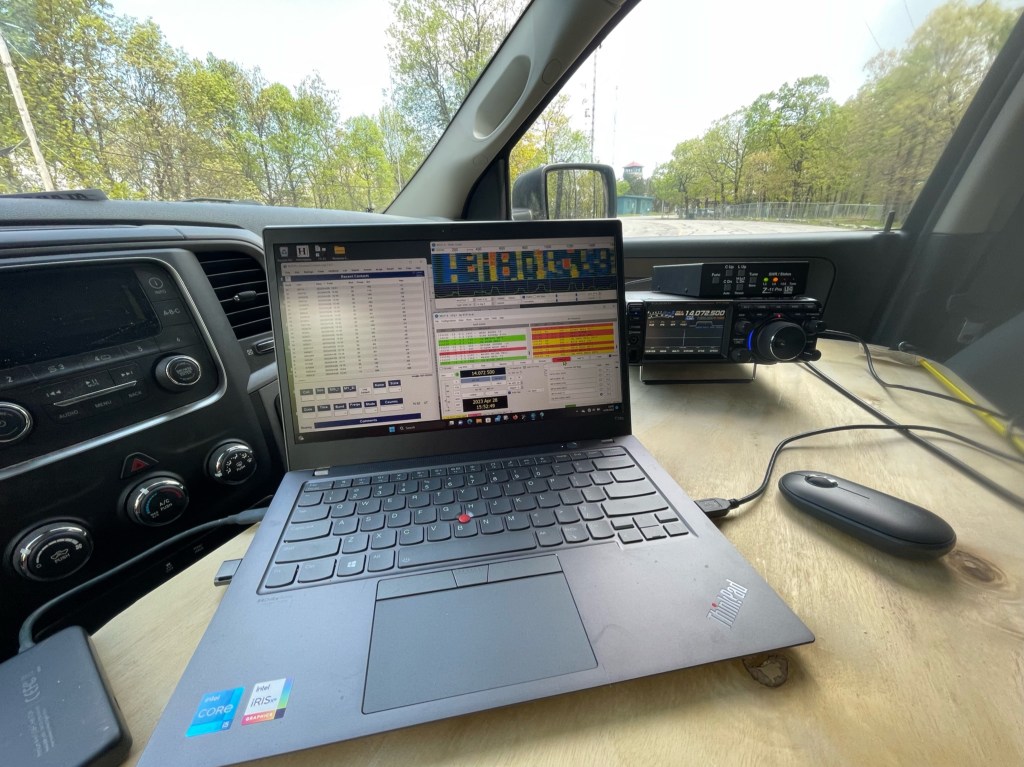
Normally for a day activation, I bring one of my smaller low-power radios such as my IC-705. However, I recently added the FT-710 to the stable and I wanted to get it outdoors. Along with the radio, I built a new antenna configuration using my Frankentenna and a desk for the truck. Info about the antenna can be found here https://kk4z.com/2023/04/07/frankentenna-stealth-mode/ and the desk info can be found here https://kk4z.com/2023/04/07/necessity-is-the-mother-of-invention/ The setup looks like this:

As you can see the battery fits nicely under the seat. For this activation, I ran FT-8. I wanted to give the FT-710 a good workout similar to the workouts I give the IC-7300. Next weekend will be the FT-710’s first camping trip and that will also be FT-8. Working from inside the truck, all screens were easy to read. I had plenty of room for the radios, computer, etc.

Running the GPS for time sync and running FT-8 on the computer gave me about 2 hours of operating time. I do have batteries to extend the computer operating time but my time at the park was limited. During that time I made 64 contacts from 23 states and Canada. I usually get a couple from Europe, but band conditions were so-so and Europe didn’t happen. Here is a QSO map of teh activation.

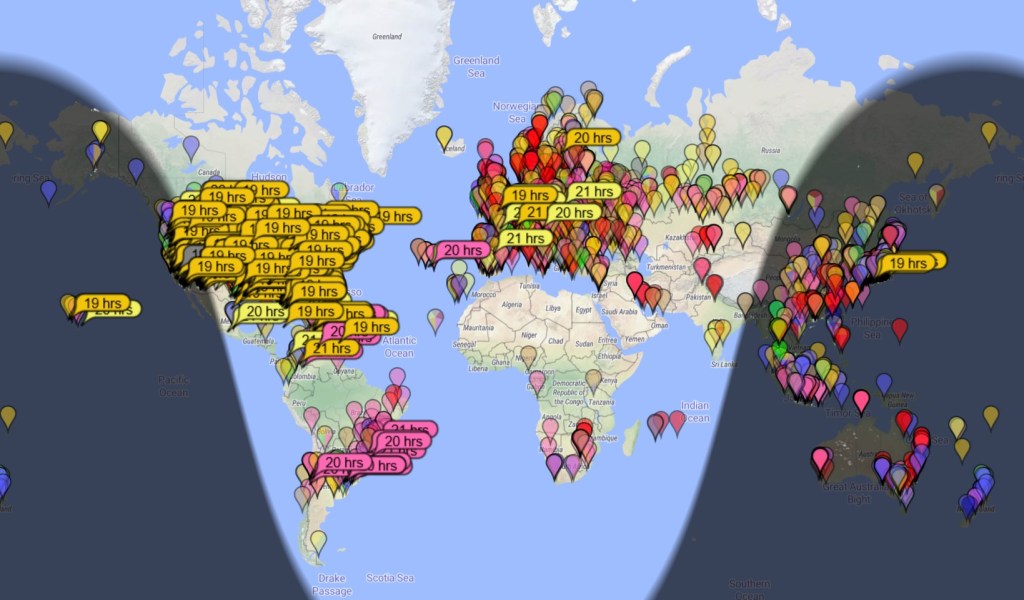
Since this was a new antenna configuration, I included a PSKReporter map. As you can see the antenna did fairly well.

How about the FT-710? It is a likable radio. I feel it is on par with eh IC-7300. They both exhibit many of the same qualities. I would have no qualms about taking either to the field. In the next couple of months, the FT-710 will be used more to firm up what I like and dislike about it. Right now, I feel it is a keeper but, if I had to choose between the FT-710 and the IC-7300; in other words, if I could only have one, it would be the IC-7300. That would be more for personal preference rather than performance. Some of my preferences I have outlined in prior videos. As I said, if you are a Yaesu man or woman, get the FT-710. If you are an Icom man or woman, get the IC-7300. I don’t think you can go wrong with either one.

Here is a short video of the activation. 73 — Scott

A Foot in Both Camps

I like to keep a foot in both camps. The Icom and Yaesu Camps. When you blog or YouTube and voice an opinion, You should be as straightforward as possible. It’s hard to be objective when you use one radio (or brand) for years, and the other for a couple of weeks. On many levels, it does no one justice. That’s where I found myself a while back.

To be fair, I have used radios from both brands over the years. From the Yaesu camp, I had an FT-817, FT-950, and FTDX3000. From Icom I had an IC-706MKIIG, IC-7000, and IC-746 Pro. Over the last 7 years until now, I have an IC-7300 and an IC-7610. I found myself making comments about the FTDX10 while not actually having one. I decided right then, that to be fair, I needed to own one and not just for a couple of weeks. In October of last year, I bought my FTDX10 and put it to work. First as a field radio and then as a home shack radio. I make sure it gets regular exercise along with my IC-7610. I recently purchased a Yaesu FT-710. I want to try it as a field radio. My initial impressions are pretty good but time will tell. Over the next couple of months, I will be taking it to the field as my primary radio.

How do they stack up? In my opinion, the FT-710 competes and compares with the IC-7300. I would go so far as to say that they are fairly even in actual use. In other words, if you are married to the Yaesu system, then get the FT-710, if you are married to the Icom system, get the IC-7300.

While it is not fair to compare the IC-7300 with the FTDX10, it is also not fair to compare the FTDX10 with the IC-7610. Me, I use the IC-7610 for all my heavy lifting. It is my main shack radio. The FTDX10 I like to use for causal CW and for things like POTA. Each has its pluses and minuses. A while back, I did a comparison between the FTDX10 and the IC-7300, during the CQWW CW contest. Using the same antenna, every signal I heard with the FTDX10, I heard with the IC-7300.

Where does everybody fit in? Like I said earlier, I feel the FT-710 and the IC-7300 are rather comparable. Time will tell as I get more acquainted with the FT-710. The FTDX10, in my opinion, is better than the IC-7300 but not as good as the IC-7610 when looking at the whole picture. The IC-7610 is probably more in line with the FTDX101D.

So far, I like all 4 radios. I don’t plan on selling any of them soon. I like that I can speak from experience when talking about the differences or similarities of the radios. Over the next couple of months, the FT-710 is going to get a workout. I will probably have two trips in May and one trip in June and I plan on using it for Field Day.