Hurricane Prep and a Little Project

About this time of year, I get a little antsy. This is the peak of the hurricane season. At this time, I tend to go over my gear and see of I can improve it. I practice Kaizen. It is the Japanese process of small continuous improvement. I learned this from my days in manufacturing. Each year I look at my gear and see what I can do to make it better.

My first improvement is with antennas. I have been a Chameleon Antenna user for years and I have been collecting bits and bobs as needed to make the antennas I think will do me the most good. This year I built their Tactical Delta Loop (CHA TDL). I already had their Micro Transformer and 1 – 17′ Stainless Steel Whip. All I needed was another 17′ Stainless Steel Whip and their Hub Kit. Sometimes when you deploy or even do a POTA activation, there my not be enough clearance (horizontal or vertical) to put the best antenna. The TDL gives me a good sized, free standing antenna that does not take up a lot of space. It is slightly directional giving me a little gain when operating at low power.

My next project was building a desk to fit in the back of my truck. I often activate parks for POTA alone and when nature calls, I do not like to leave my expensive radios on a park bench. I sketched a plan on a piece of paper and went to the shed to see what wood I had. I had enough scraps to build what I wanted to include a desktop I used in the cab of the truck. Part of the project was to try a new to me technology – pocket hole joinery. I stopped at my local Home Depot and picked up a Kreg jig. My first step was to cut the pieces to length and then assemble it.

I let it sit for a couple of hours and then took it out for the paint job. Bcause of the dissimilar woods I went with paint instead of stain.
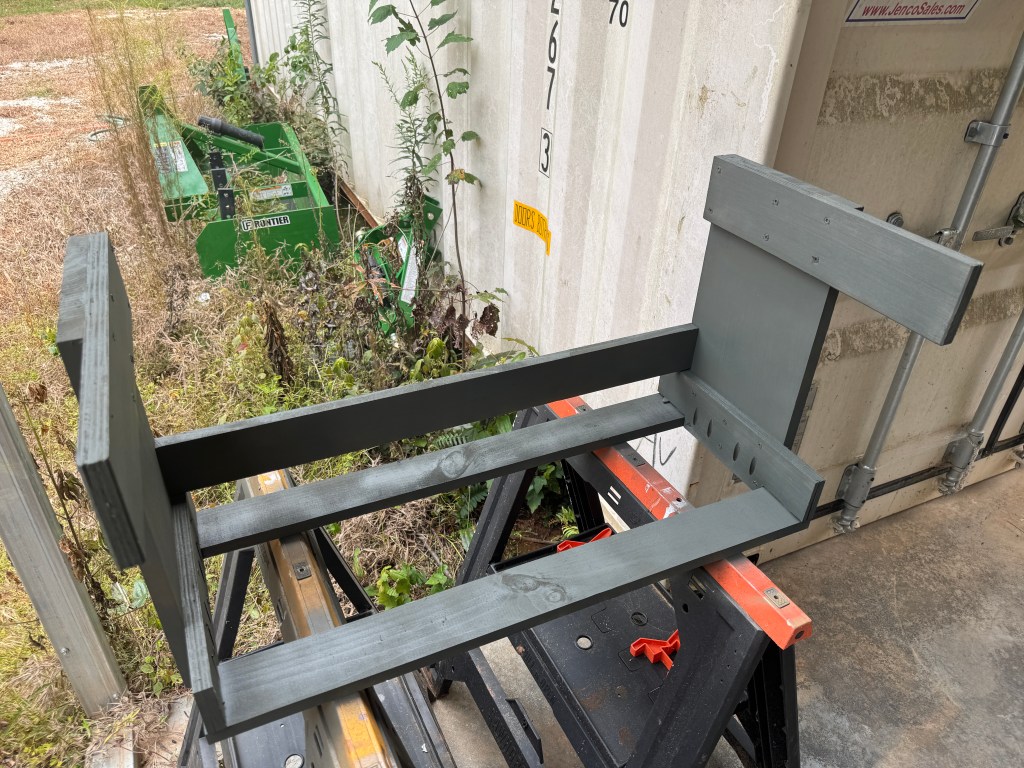
I got creative and decided to camouflage it a little. After I let the paint dry I attached the top.
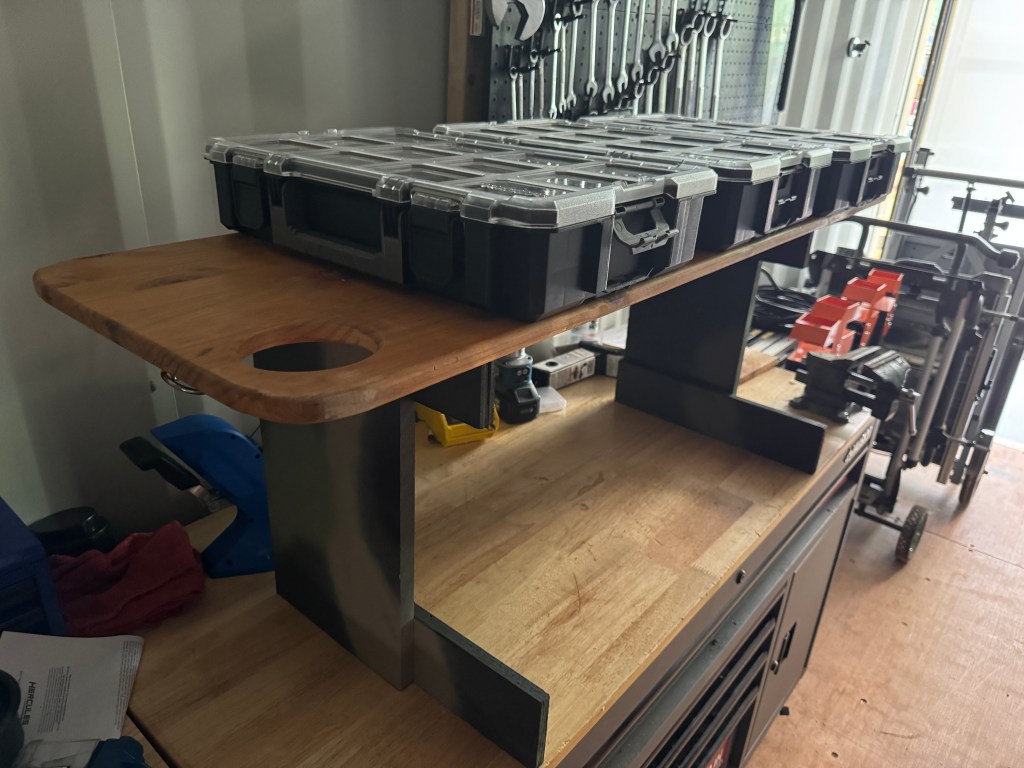
The hole in the foreground is for a coffee cup holder. I didn’t like the plastic ones I had so a quick look on Amazon netted me a stainless steel one. When operating portable it is very easy to knock over your drink onto your log, computer, or radio. Ask me how I know.

One last little bit is I added L-track connectors to the bottom of the desktop on each end.
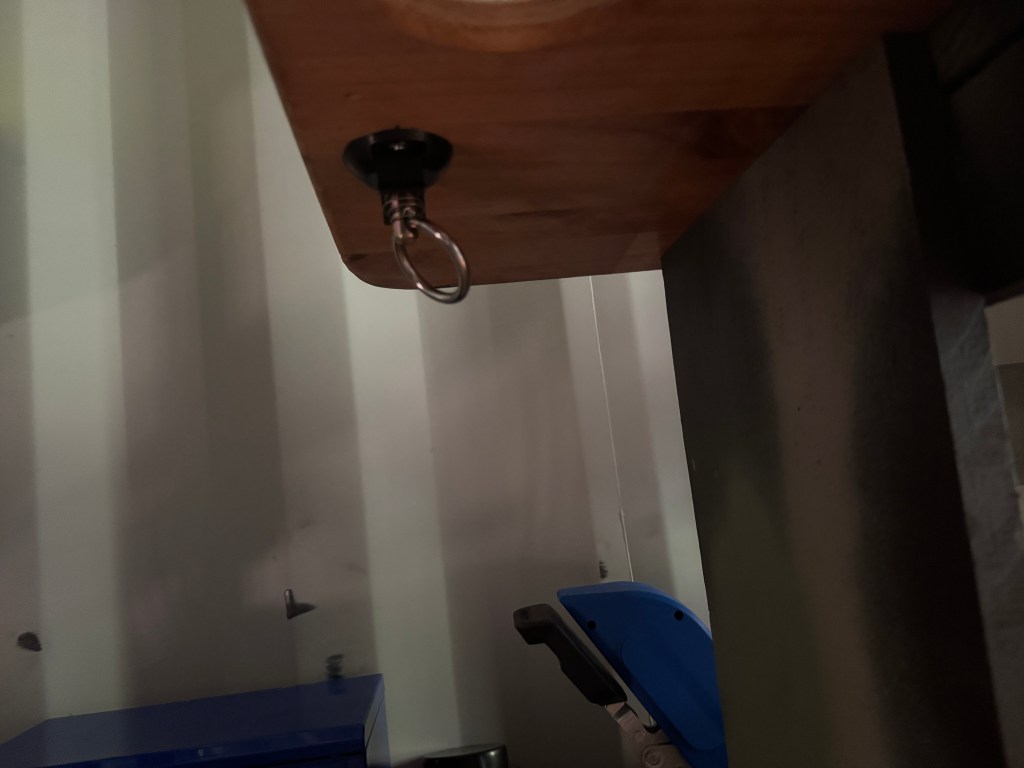
I have L-track on my truck bed and using cargo straps with L-track connectors, it is easy for me to cinch the desk down to keep it from moving in the bed.
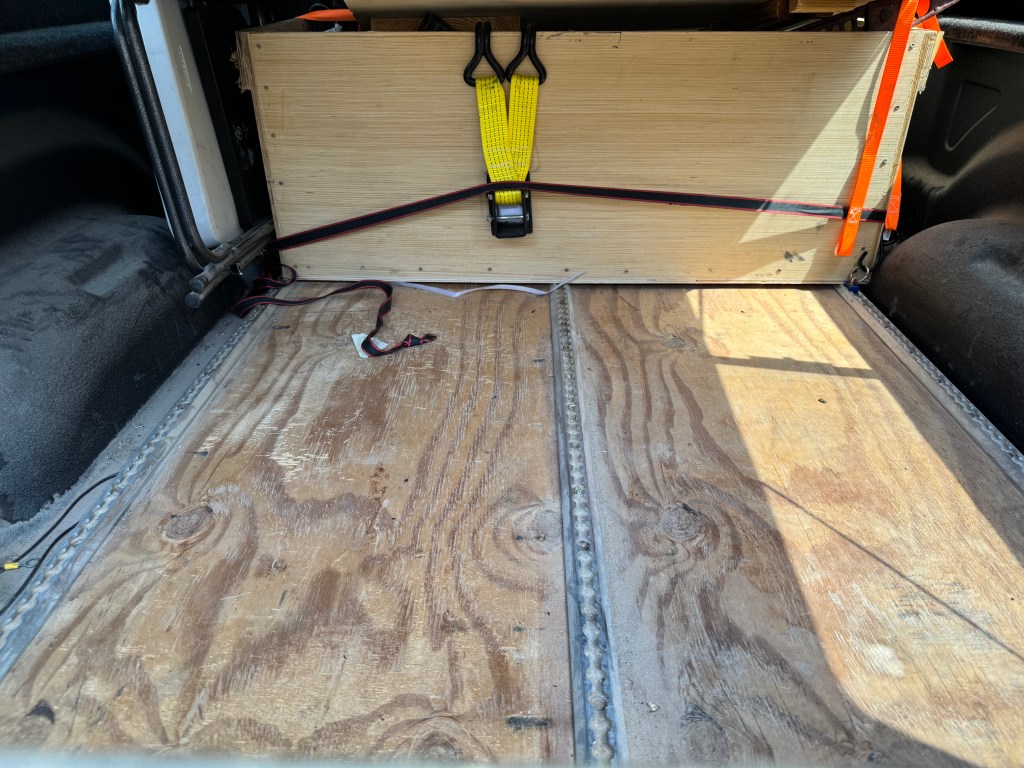
I have a low camping seat that easily allows me to slide under the table. The bottom of the desk top is approx. 17″ off of the ground. There is plenty of room for my legs. Now I can go to a park and all I need to do to secure my radios is flip up the tailgate and lock the camper top. The windows on the top slide open and have bug screens. I just have to add a small fan for the hot days, but for now, fall is approaching and cooler days are ahead. 73- de Scott

Hurricane Season 2025

NOAA has released their 2025 hurricane season (01 June to 30 November) prediction. they are calling for an above average season with 13-19 named storms and 6-10 to reach hurricane strength. Of those hurricanes, 3-5 are predicted to become major hurricanes.

As we learned last year, coastal states are not the only ones vulnerable to the havoc a hurricane can bring. Now might be a good time to break out the portable gear and give it a shakedown. Turn on those go-boxes and feed those portable antennas. Make sure everything is in working order. Take your gear out and go at least 20 miles from home. Why 20 miles? It’s a distance that is too far to go back home and retrieve a forgotten part or replace a broken piece of kit. Field Day (winter and summer) are good events to try your gear. Only if you use the same gear you would bring for EmComm and use the same power levels. The lesson here is don’t wait to get ready, get ready now. I try to keep myself prepared to deploy in 4 hours or less.

You can’t plan for everything that may go wrong. You can however, minimize the chance of failure by ensuring your gear is in the best possible condition. Remember Proper Planing and Preparation Prevents Piss Poor Performance (7P’s). Be THE guy, not THAT guy. 73 de Scott

Memories past and Present

This past weekend I made a trip down to Orlando Florida to experience Hamcation. It was a lot fun. I got to meet some cool people and of course came home with some radio related goodies. The Region 4 U.S. Army MARS group had a dinner Friday night and I got to connect faces to voices. It was a good time.

This was also a time for some refection. On my way down and back I traveled on Interstate 75. This was the same route I used during the 2004-2005 hurricane seasons. I provided HF radio communication for the convoy bringing relief supplies right after a hurricane. I did this 4 times in 2004 and once in 2005. Back then, communications was not as well developed as it is today.

During those trips I would check into the South CARS net or the South Coast Amateur Radio Service net. According to South CARS: “The purpose of the net is to assist those seeking to contact other amateur radio stations, or areas; to provide weather and travel information; to assist in emergencies when needed.” They operate on 7.251 MHz from 0800 to 1300 hrs Eastern. I used the net to check my radios and listen for any travel information that might have affected the mission. I joined back then (#3773)and still occasionally check in from time to time.

On this trip I was traveling solo so I dialed up 7.251 and checked into the net. While the net was operational, they kept me company and I enjoyed listening to the net. At times, it brought me back to those disaster relief days. Good memories; I felt the sense of purpose I had back then. I appreciate South CARS today as much as I did back then. I know that if I was ever called up again to provide EmComm in Region 4, South CARS would be there for me.

Other good news is I may have a trade for my amplifier. I found a TS-890s and hopefully the trade will go though by the end of the week. I am not young anymore as I have retired twice now. I know that my days of deploying are numbered as the body starts to wear out. Currently I still go camping and therefore could deploy if needed. However, as time marches on I will become more home centered. The good news is ham radio offers opportunities both home and abroad. I have a pretty good home station and I am a pretty good Net Control Station. I plan to use the TS-890s for CW and other fun things.

I’ve had a good run. I’ve got to do some exciting things in my life. In retirement, I am still busy, I still have lots to do. My focus is changing. A fixed income doesn’t mean eating Alpo, it means careful planning. If I want something, I can have it, if I plan for it. The other option would be to go back to work and that ain’t going to happen. Life is good — de 73 Scott

Well My Bags Are Packed, I’m ready to Go

The 2024 Hurricane Season started of slow but boy did it pick up steam. Right now, the country has been rocked by the devastation left by Hurricane Helene and now Florida is bracing for Major Hurricane Milton. There are lots of good people doing lots of good things out there. I want to give a shoutout to AmRRon and Grindstone Ministeries for all the work they are doing in the Tennessee/North Carolina areas. You can find out more about these organizations at https://amrron.com and https://grindstoneministries.com.

I have been blessed in that both of these powerful hurricanes missed me. Helene about 40 miles to my east and Milton several hundred miles to my south. Just because I got lucky doesn’t mean I should sit back and rest upon my laurels. Contrary to popular belief, ham radio operators in the affected area are typically not able to operate after a hurricane passes through. Their number one concern is the safety of their family and the protection of their property. Many have left the area and are holed up in a motel somewhere or are with friends/family. This is the time and the place for those not affected by the storm to lend a hand. With families and property safe and secure, amateur radio operators can travel to, set up and operate their portable stations, relaying valuable information to public safety and/or nervous families wanting to know that their kith and kin are safe.

For those able to deploy, preparations should start long before you leave hearth and home. Radios and coax need to be checked for proper operation, antennas checked for damage? Are all of your batteries charged, generators serviced, and solar panels operating properly? Is your vehicle ready: tires checked, engine serviced, lights work? Do you have enough fuel for your vehicle and your generators? Do you have a place to sleep and something to sleep on? Do you have water and do you have food? Always bring food and always bring water, regardless of what someone promises you.

And what about you? Are you in shape? When was the last time you were to the doctors? Do you have any conditions that may affect you and are they serious enough that not being near an emergency room might kill you?

I’m not young anymore and my days of traveling to a disaster areas are coming to a close. However, I am ready; I keep a running talley on my gear. How? I practice with my gear almost everytime I go to park or a campground. The same gear I use in a park is the same gear I use for a disaster. I know how it works and I know I have what I need. I call this FunComm, which to me, is practice for EmComm. My field radio stays packed and ready to go. My basic kit looks like this.

The top box contains my radio and associated gear.

The bottom box, contains my batteries, power stations and a couple of solar panels. I also have 2 larger solar panels that I would also bring. I do not always bring batteries with me for FunComm but I see that they are charged up several times a year. Two notes. 1) Check your gear. Out in a disaster, you probably won’t be able to get whatever it is you left behind. I recommend that when practicing FunComm, you go at least 20 miles away from home. That is about the distance too far to drive back home again — either make do or call it a bust. 2) Solar power generation is iffy. On a good day, a 100 watt solar panel puts out about 6 amps. Your radio at 100 watts output consumes about 18 amps. That means for every hour of transmitting, it requires 3 hours of solar power generation at max efficiency. Don’t forget, you will have to feed you laptop, lights, cell phone etc. Yes, a cell phone has other uses besides a phone. My battery box looks like this.

You EmComm types may chuff at Parks on the Air (POTA), but they know their gear, because they use it often. Take the time now. Check your gear, get it ready, get yourself ready, sometimes, when they need you, they need you now. My prayers are for those in the paths of Hurricanes Helene and Milton, and also for those souls who when the call came were ready. When the call comes, can you cry out “Here am I” 73 and God Bless de Scott

I’ve Been Busy

Today is the second day of hurricane season for the United States. According to Colorado State University, this may be a busy season. For most of CONUS (CONtinental United States), hurricanes have little effect. For those of us on the eastern seaboard and gulf coast, it is time to keep a weather eye out.

It should be a time of preparation. Procuring materials to stormproof homes, purchase/maintain generators and check on fuel supplies, check the pantries for food and water storage, and ensure there are adequate medication and first aid supplies. In addition to this, is there enough cash on hand as with no power, there is no credit; cash is king. There is always the question of; should I stay or should I go? This is often a tough decision and the wrong choice could be fatal. If you are going, do you have a place to go? During Hurricane Michael, I was returning to Georgia from Virginia the weekend before the storm, there was storm related traffic up in Tennessee, people looking for a place to stay.

Even though I live in northwest Georgia, I can still be affected by a storm. High winds, heavy rains, tornadoes, flooding and power outages occur as a hurricane winds down as it travels inland.

Part of my preps, besides food, and water, etc., is making sure my communications gear is in order. Most of my gear gets used at least weekly with some of my portable gear getting use monthly. As I have said in past posts, my FunComm gear is mostly the same as my EmComm gear. I check to see that my radios are working and that my portable antennas are in good working order. I pull out my laptop and make sure all of my radio apps and OS are up to date and working. I especially check to make sure I can send/receive on my main digital modes. For EmComm I rely mainly on Winlink, PSK31, Contestia, and CW. I get on the air and send emails, check into nets, etc. I am also a Net Control Station for Phone and Digital, and I run those nets on a monthly basis. During a disaster is the wrong time to find out something doesn’t work. Been there, done that. And yes, sometimes, even though you checked, checked, and double checked, things can still go wrong, but at least you can reduce the probability.

My vehicles get serviced regularly, and I go over my little camper before each trip. My generators are checked and run on a regular basis. I also go through my Flee bag. I check to make sure everything in it is in working order, that there are no expired, expiration dates, and the clothes I have tucked in there still fit. Too big is okay, too small is not.

With all my gear squared away, I turn to me. Have I had a check-up recently? Are my meds current to my needs?, is there anything I need to get fixed before I deploy somewhere? From here I move to my skill sets. Can I use the apps/radios I need? Sometimes a big update happens that changes the app enough I may have to relearn it. Can I still copy CW? CW is not widely used, but it makes a pretty good backup when everything else is going to pot.

How is my fieldcraft? Can I cook and eat in the field, can I purify water, start a fire, clean myself, apply first aid, make repairs, navigate; can I improvise, adapt, and overcome?

Some of this is annual and some of it is on going. I should never let my skills and gear degrade to a point where they are no longer usable. It is bad voodoo to try to learn/relearn a skill during or on the way to a disaster.

How about you? Don’t wait until the last minute. It’s no fun waiting in a long line to get something you could have gotten a few months ago for half the price. And then to add insult to injury, the guy in front of you buys the last one. Be ready, do it now! Embrace the coming storm with a cup of coffee and the knowledge you have done everything you could to be ready. Or, you could be driving around white-knuckled in a panic trying to buy the same things everything else who has waited is trying to buy. I’ve done both and I like the first option much better. Think straight and stay safe. 73 de Scott

Turning FunComm to EmComm

In less than a month, Hurricane Season starts. For most parts of the country, this is nothing more than a news item. For us in the southeastern United States, it becomes a time of preparation.

Hurricanes, are an extreme force of nature. Unlike tornadoes, whose path of destruction may be a mile or two wide, a hurricane can leave a path of desolation 100 or more miles wide. Because it it so immense, it is almost impossible to describe; you have to be there to appreciate the god-like destruction.

Last month Colorado State University’s Department of Atmospheric Science, released it’s 2024 hurricane season forecast. Their prediction is for an “extremely active” season with an “above-average” probability for major hurricanes making landfall along the continental United States (CONUS)and the Caribbean.

This year they are predicting 23 named storms (aver. 14.4) with 5 major hurricanes (aver. 3.2). The probability of a major hurricane striking the east coast is 34% (aver. 21%) and for the gulf coast 42% (aver. 27%). In the tropical Pacific there will be La Nina conditions which can increase hurricane activity in the Atlantic. In addition, eastern and tropical Atlantic surface sea temperatures are warmer than normal making conditions conducive to hurricane development. The complete report can be found here: 2024 Hurricane Season Prediction

FunComm is a great way in keeping your emergency and portable comms ready. Field Day, Winter Field Day, POTA and SOTA are good ways to maintain your emergency gear. The same gear I take to the parks is what I would use during a disaster. I have been to disasters where a guy walks up to me with a handi-talkie in 3 pieces and telling me if I can help him fix his radio, he could help me. Don’t be that guy.

Do your radios work? Do your field antennas work? Have you tested them and checked their performance? Have you tested your batteries and do they work with your radio? Do you have enough capacity? How about generators? Do you have the right kind of generator? Some of these Home Depot generators will destroy a radio. Can you bring fuel to power your vehicle and generators? If there is no power in a disaster area, there is typically no power to pump gas. Make sure you have enough gas to get back out of the disaster area.

Don’t forget about your laptop. Do you have the apps you need installed on the laptop? Are they up to date? Did you sync the time before you left? Do you have a plan to power your laptop?

Where are you going to sleep? Are you going to bring enough food? Water? What about sanitation? Again, no power, no public sanitation. Do you have a list of things you need to bring? What about cash? In a disaster, cash is often king as the credit card machines run off of electricity and the Internet. Remember, if there is no cell service, those cell phone credit card swipers won’t work either. Make sure you bring small bills, as stores will probably not have the means to make change.

The way I am set up now, I could leave my QTH in about 4 hours with a stop at a gas station and grocery store. Part of the reason is I practice my EmComm using FunComm. I have been to several wide area disasters and I made plenty of mistakes, I learned the hard way. 73 de Scott