Black Rock Mtn State Park – Aug 2025

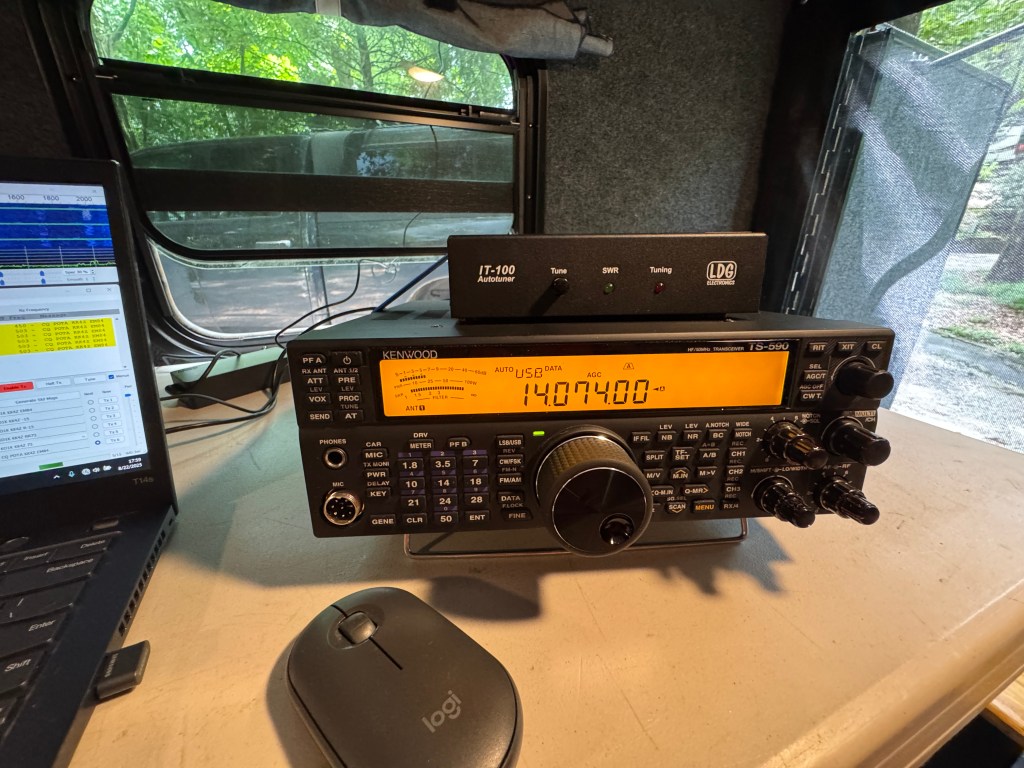
Last weekend I finished up a 3-day, 1,800 mile, 7-state POTA Rove that included a radio trade. Out with the FTX1 and in with a TS-590sg. After setting up the 590, I brought it with me to Black Rock Mountain State Park to try some FT8 and if the band conditions permit, a little CW.

I arrived at the Park Friday afternoon. I have done this enough times that I am setup and ready to go within 30 minutes.  This campsite had some challenges.It was the smallest campsite I ever used.  I had space for the trailer and I had to park my truck in the picnic area.  I also had overhead power lines so I had to use a shorter antenna. The weather was cool for a change and I didn’t have to run my A/C.

Setup was a Chameleon Micro Hybrid transformer with a 12’ whip and about a 20’ counterpoise.  The radio was my new-to-me Kenwood TS-590sg.  This was the radio’s maiden voyage and I really liked it. It performed well.  One of the main reasons I like running big radios at low power is more of the controls are readily available. Most everything in the TS-590sg is either a push button or a twist of a knob away.  Having a high performance receiver isn’t any good if you can’t get to the controls.

Band conditions were poor. The first night I only made 88 FT-8 contacts and they were a struggle.  At times the band would “white-out”, high noise and only white snow on the waterfall. At the better times QSB or fading was a constant up and down.  I would watch S7-9 signals drop to nothing during a QSO.  Saturday afternoon brought a power failure at the park. Yep, right during mid QSO.  The power was still out at 1800 hrs, so I had a decision to make – should I stay, or should I go.  As you get older one of the things that goes, is your night vision.  If I was going to leave it had to be soon, so I could still do most of my driving during daylight/evening hours.  I decided to go.  Since I have a lot of practice setting up and tearing down.  I was packed up in less than 30 minutes. As I was pulling out of the park, the power returned.  Better safe than sorry.

I ended up with 233 contacts, 88 short of my kilo for that park.  I will plan another trip in the fall to finish.  I am real happy with the TS-590sg.  I opened it up and found the MARS mod already done and the TXCO installed.  The radio performed well and I ran it mostly at 20 watts.  As you can see in the QSO map, Most of my contacts were CONUS. Kenwoods and Icoms have the best ergonomics. I feel the layouts were designed by people who use their radios; that ergonomics were a primary concern and not an afterthought. 
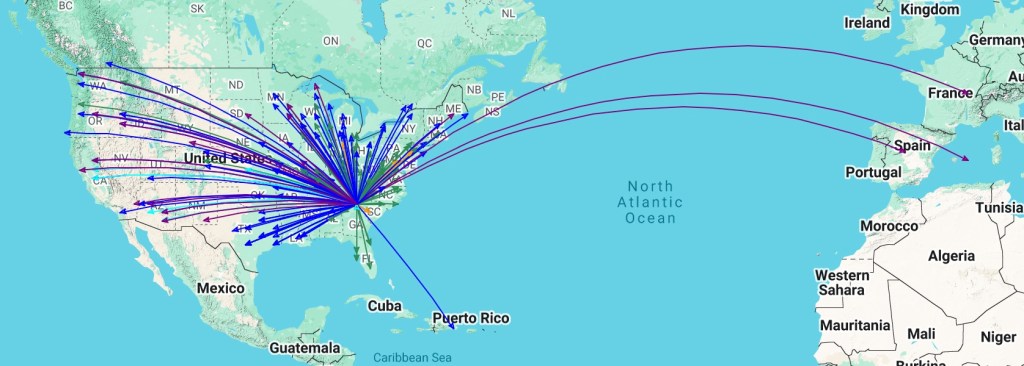
Screenshot

I also decided to trade off the FT-710 and ended up with a pristine IC-7200.  I always wanted one but the stars never aligned — until now.  I no longer have any Yaesu radios in the stable and probably won’t have any more.  Why? A couple of reasons. I prefer the ergonomics of the Icoms and the Kenwoods.  Everything I need is right there on the front panel. Easy, to see — Easy to use. I have owned a FTDX10, FT-710, and a FTX1, along with an Icom IC-7610, IC-7300, and a Kenwood TS-890s. I can tell you that whatever I hear on one radio, I can hear on the other.  There’s two reasons for this.  One is knowing where the controls are and two is knowing how to use them. There is a third factor the CSP unit, that’s Cerebral Signal Processing Unit. Half of the battle is using the CSP to process faint signals.  After 30 years, mine is pretty good.

The Yaesu radios, are not bad radios, they are not my cup of tea. I can squeeze more horsepower out of the Icoms and the Kenwoods.  I am sure there are those who can say the same about Yaesus.  I at least crossed the fence and tried them but in the end my preference is not Yaesu. YMMV.

Other happenings. I rearranged my Go Box.  My TS-590sg will not fit in it like my other radios so I got an Apache case for it from Harbor Freight and moved some antenna stuff into the Go Box. So now all my radios travel in a separate case and my Go Box has become universal.  Everything I need to run any of my field radios is in the Go Box.  These days I do more FunComm than EmComm, but I am always prepared to do either. I load the same stuff and off I go. I’ve had a busy summer and the honey-do list is growing, there is lots to do around the ranch so this may be one of the last trips for a while. I do most of my outdoor work from Fall to Spring to avoid working in the southeast hot, humid summers and the accompanying chiggers and ticks. That’s all for now,  take care and 73 de Scott

FTDX10 or FT710

Yaesu came out with too fairly closely spec’d radios at different price points. The FTDX10 currently sells for ~$1,500 and if you add in the 300 Hz filter, another ~$175. The FT710 Field sells for ~$1,075. Roughly $500 less.

The FTDX10 is a hybrid radio with a down conversion receiver feeding into a Direct Digital Synthesizer (DDS). The FT710 is a SDR radio similar to the IC-7300. I owned an FTDX10 for about 18 months and I am on my second FT710, total ownership time is approximately 10 months. I had the first FT710 a couple of months after the initial release. It wasn’t working the way I expected it to so I traded. About 6 months ago, after reading some of the update material, I thought I would give it another go. My second FT710, this time the field version, is much improved. It is my current go to field radio. I plan on keeping this one. Having used both radios if I had to do it again which one would I pick?

I would pick the FT710. The FT710 has 90-95% of the performance of the FTDX10 for $500 less. In fact, I do not think one could tell the difference between the two in a side by side blind test. There is a caveat, the receiver architecture is different between the two radios and it requires a slightly different skill set. SDR radios like the FT710 basically run wide open all of the time. Keeping that in mind, in most cases it is better to run IPO or attenuation rather than preamp. I almost never run preamp on my FT710. What is nice about the FT710 is it gives you 3 levels of attenuation: 6dB, 12dB, and 18dB; a feature usually only found on higher end radios. In contrast, the IC-7300 only gives you one, 18dB.

The other control you should become familiar with is the RF gain. On a Yaesu, RF gain starts in the fully clockwise position. When there is a lot of noise, slowly turn the RF gain counter-clockwise until only the desired signal is heard. Coming from analog radios years ago, my brain is still a very good filter. I use digital noise reduction sparingly. I often keep it at level 2 or 3, enough to take the edge off.

Perhaps the most compelling reason to chose the FT710 over the FTDX10 besides the cost, is the ergonomics. I have large hands and fat fingers. The FTDX10 clustered its controls close together so I had to be careful when pushing a button or twisting a knob. Even so, I would bump the frequency dial and throw it off frequency. I have remarked that the controls on the FTDX10 were more suited for the lefthand. In fact when it was a part of my home station, it sat to the left side. With the FT710, the controls spaced further apart and are easy to get to even with my big mitts. This is a real benefit for a field radio. The position of the radio or the lighting conditions may not be optimal so ergonomics are important. I find the FT710 a joy to use in the field.

If you are a dyed-in-the-wool FTDX10 owner, this post is not for you. I wrote this for the amateur radio operator looking for their first HF radio, or maybe a seasoned operator looking to venture into the Yaesu family. This is also for those who have limited funds and are agonizing over which radio to get and should they sacrifice funds for the more expensive radio over something else they may need for the shack. The FTDX10 is a fine radio. Its Achilles’ Heel is its ergonomics. The FT710 is a fine radio in its own right. I believe it is 90-95% of what the FTDX10 is but for much less money. Of all the Yaesu radios I have owned over the past almost 30 years, the FT710 is the one I have been most happy with. YMMV de Scott

Yaesu FT710 – Second Impression

Here is my first look at my second FT710. I will start with the settings I changed and then go over the list of issues I had with the first one. The first FT710 had the original firmware as it was new at the time. This one has several updates under its belt.

Settings/Changes

  1. T710,Taped Power Cables every couple of inches to reduce tangles.
  2. Added Anderson Power Poles to the power cable
  3. Turned off 3DSS
  4. Set waterfall span to 5K
  5. Set waterfall speed to slow2
  6. Set color to 6
  7. Set level to +3.5 dB, peak to level 2 and contrast to level 14
  8. Set tuner type to EXT
  9. Set Tuner/Lin Port to Linear
  10. Set keyer to Elekey B, repeat interval to 3 seconds, Weight to 2.7 and Pitch to 700Hz
  11. QSK – on
  12. Set MyCall to KK4Z and call time to 3 seconds
  13. Set Mic gain to 60 and Processor level to 65
  14. CW mode on
  15. Meter Detector to Peak
  16. Receive Audio SSB – Treble +3 Middle +5 Bass -2
  17. Receive Audio CW Treble +3 Middle +1 Bass -3
  18. Parametric Equalizer (processor on/off the same)
    1. E1 – Freq 300 Bandwidth 10 level -3
    2. E2 – Freq 1300 Bandwidth 2 level 10
    3. E3 – Freq 2400 Bandwidth 1 level 10
  19. Needs a 32gb (no larger) SD card. Scandisk Ultra SDHC UHS-I 32 GB works
  20. Mouse. Seems the only wireless mouse you can use with the radio is a Logitech M310. It does not appear to be in production anymore. I had to buy a renewed one. I got the mouse working and I think it is a good addition to the radio. It does make changing parameters easier and if you click on a signal in the waterfall, the radio will QSY to that frequency. I wasn’t sure how I was going to like using a mouse, but I think I like it.

Here are the issues from the first radio:

  1. Could not use LDG tuner with the radio — it was a surreptitious route to get a tuner to work. I started out with a different tuner, an LDG IT-100 which uses a different cable. I coupled the tuner with an LDG IC-108 cable. The cable is not listed as usable on the FT710. The other twist was setting the Tuner/Lin Port “Linear” instead of Ext Tuner. This little tidbit is not shared by Yaesu, I had to find it on an internet forum. To tune the antenna you push the tune button on the tuner (not on the radio) to get things going. This is where Icom shines. They have been using the same interface at least as far back as the IC-718 and the IC-706. A tuner I bought for my IC-706 MKIIG still works on my IC-7300 with the same cable and I can use the tune button on the radio. The other downside is you cannot use the FH-2 Remote pad when using the auto tuner as it uses the same port at the back of the radio. In addition, you cannot run an amplifier and an auto tuner at the same time. Icom has separate ports for the tuner and amplifier.
  2. No Portable Zero Rails – I use rails on all of my portable radios. Portable Zero now makes rails for the FT710.
  3. Could not use RT systems software – it took Yaesu until July 2023 to get the info to RT Systems. I have RT Systems software for almost all of my radios. RT systems software works fine now.
  4. Auto Notch — I don’t remember auto notch working on the first radio I had. It works now.
  5. Cannot edit/see QMB – another place where Icom shines. I can go into the memo pad (Icom’s QMB) and edit the entries.
  6. RJ45 mic connecter instead of Foster (Icom)- Foster connectors are more durable than the RJ45.
  7. Key clicks in the headphones using CW – They are still there but less pronounced. The CW is harsh sounding and can be fatiguing to listen to over long periods.
  8. WSJT software would change modes when switching bands
  9. Waterfall is not averaging like Kenwood’s or Icom’s. It has to be adjusted manually (and sometimes frequently)
  10. Filter only has 2 selections vs 3 for the Icom. Narrow which only has predefined values and wide which is adjustable. The Icoms have 3 selections each fully adjustable. Icoms can also adjust the filter shape (soft or sharp. The FT710 has contour and APF. Contour is like a soft notch filter and APF boosts the center frequency like a CW signal. Icoms have dedicated controls on the front panel while the Yaesu has a mix of front panel controls and menu items.

Even with all of its quirks, I like the little radio. Yaesu appears to have fixed most of its problems, at least enough to make the radio fun. I still believe this radio compares well with the IC-7300 and either will serve you well. If I could only have one, I would still go with the Icom. The Icom has a lower noise floor, the settings (ergonomics) are better, and it hears as well as the Yaesu (at least in my side by side test). For CW again, the edge goes to Icom. However, the Yaesu has its pluses. The FT710 has a slightly better audio quality let’s say more fidelity but in CW the tone is more harsh than the Icom. The Yaesu has a better attenuator with 3-steps instead of one. With the Yaesu, you can transmit CW while in SSB mode. I like the filter window on the FT710. I can see how changing the filter affects the signal.

Later this week I have Portable Zero rails coming. They are pricy, but I find them very useful on my field radios. I also have a Maestro Evolve III coming which I will setup software for the FT710 on it. I hope to have everything ready for Winter Field Day.

I think a major difference between the IC-7300 and the FT710 is settings. Yaesu gives you settings on top of settings, while the Icom gives you what you need. If you like to tinker and tweak, the FT710 is your radio. If you want to get down and operate, then Icom is the way to go. Out of the box, I had to do far less setting up with the Icoms.

Compared to the FTDX10. I owned an FTDX10 for about 18 months. If I bought one today, the cost would be about $600 more than the FT710. I’m not sure the FTDX10 is that much better than the 710. My primary use for this radio is for the field. More to follow es 73 de Scott

The King is Dead, Long Live the King

Yesterday, I decided to list my Yaesu FTDX10 on QTH.com. Surprising to me, it sold in a couple of hours. I got my asking price and the guy I sold it to has been helpful and communicative. The radio ships out Monday morning. 

I am going to take the money and get the KPA3A 100 watt amp kit for my K3(s). It is currently a 10 watt radio. I put the 3 in parenthesis becuase my radio is a converted K3 to the S. I plan to use the radio in the shack and for field days. I mainly do CW these days and the QSK on the K3(s) is sublime.

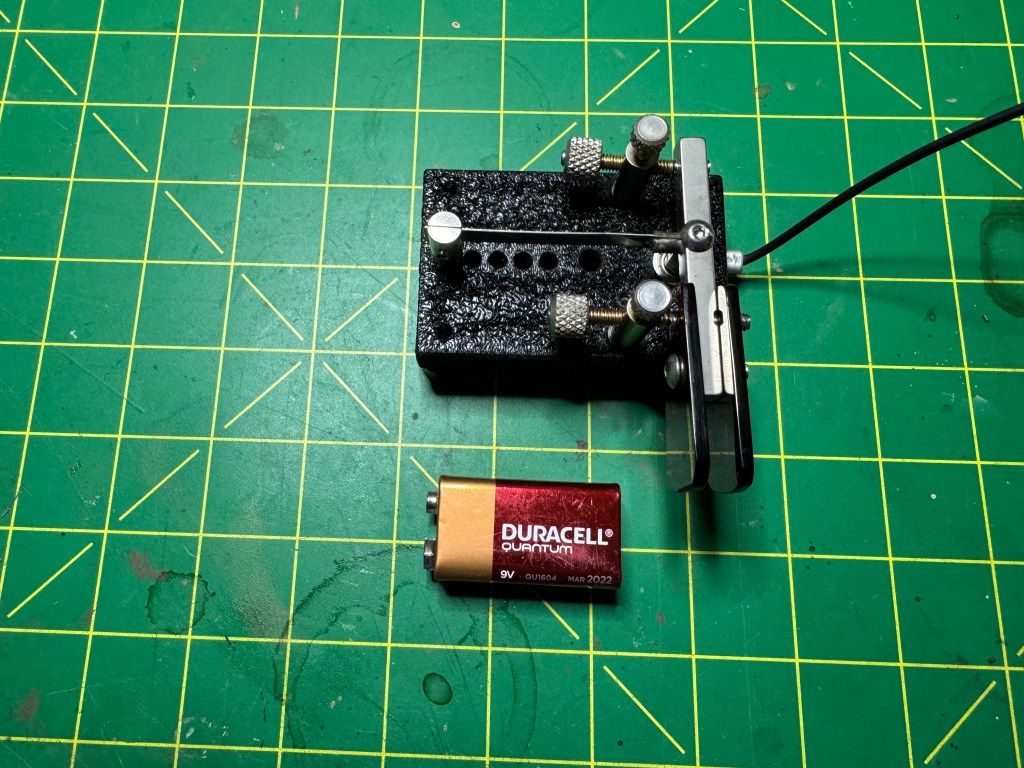
Speaking of CW, I recently received 2 keys from KN4YB. He is a one man shop that makes Bugs and keys. I was intrigued by his designs and bought a couple to try out.

The first one is a bug, model DL-151RA. It is unique in that it is a dual lever. It has one paddle for the dits and one paddle for the dahs. By moving the dit weights, you can adjust the dit speed from about 13 wpm up to 40 wpm. Mine is set around 16.

As you can see, the bug is rather compact. I have it sitting on a silicone pad on my desk and it does not move.

The other paddle I got is a Single Lever Paddle/Sideswiper. The difference between a single lever and a sideswiper (also called a Cootie Key), is a single lever paddle is used with an electronic keyer where the keyer generates the dits and dahs automatically. Note: I use the term paddle to designate a key that uses an electronic keyer and a key to designate a straight key. A sideswiper is more like a straight key where the dits and dahs are generated by hand movement. This model, the SL85 has a shorting bar which allows you to set it up as either a single lever or a sideswiper.

It is also a compact key. The workmanship is excellent and the prices are reasonable.

I started my journey into mechanical keys as the civilty on POTA seems to have taken a turn for the worse. Not as bad as SSB but not like it used to be. I decided to give the Straight Key Century Club (SKCC) a try. They only allow straight keys, sideswipers, and bugs, keys where the dits and dah are formed by hand or mechanically. My fascination for CW goes back to the 60’s. I thought bugs were very cool and wanted a Vibroplex. I wasn’t licensed until the mid 90’s and then chose an electronic keyer. My first set of paddles were Benchers. This is my first experience with straight keys.

I spent time with both keys to see which one I was most comfortable with. I went with keys that had a side-to-side motion as that was my experience. I was curious to see how well I could transition from paddles to straight keys. The answer is, not to bad. I think my years of using paddles has helped me with dit and dah ratios. The ratio is already ingrained in my head. Right now, between the two keys, I am doing better with the bug, which surprised me. However, I think over time and practice, I can gain some level of mastery over both.

What about my paddles? They are not going away. I can still send faster with the paddles and will probably use them for Field Days and some contests. It will take me a while to be proficient with keys. Setting up the bug is an art all by itself. So I am off to a new adventure. My code buddies will now have a new challenge as I try to improve my key skills. 73 — Scott

Culling the Herd

I feel I have too many radios. It’s better than having too few, but I have more than I need. The radios I have are not getting enough use even in a round robin. In the past, when I let radios sit too long something happens. Usually it’s corrosion somewhere and once discovered, a simple cleaning is in order. But I have had cheaper radios go dead on me. I like to use my radios enough to keep them healthy. I didn’t plan on all these radios; they were acquired through deals and trades I didn’t expect. But the bottom line is at least one has to go.

The radio I chose is my Yaesu FTDX10, Sheldon. I’ve owned the FTDX10 for about a year and a half. I’ve had a love/hate relationship with it. It is a good performing radio and I enjoy using it for casual CW like hunting POTA and for the past year or so and has been my back-up radio in the shack. I used it every other month switching between it and my IC-7610. While it’s a nice radio, Most of my gear is Icom centric and I feel that the ergonomics are better on the Icoms. Obliously, I like the radio enough to have kept it for a year and a half but, something has to go and I chose it. The radio was used mostly for CW and was run at 50 watts or below in a non-smoking environment.

I will probably replace it at the QTH with my K3(s)/10. This radio was a surprise trade and I have upgraded it from a K3 to a K3S. This is a radio that deserves more use than it has been getting. I was using it as a field radio, but it really belongs in the shack.

The FTDX10 is for sale, I will post an ad on QTH.com. It comes with the microphone, power cable, 300 Hz crystal filter, Portable Zero Rails, an SPE linear Amplifier Cable, and manual. I am asking $900. I prefer a local pickup/delivery. If shipped buyer pays shipping either USPS or FedEx. You can email me a sroyle@live.com. Low ball offers will be ignored.

Thanks to all who visit this website and associated YouTube Channel.

A Foot in Both Camps

I like to keep a foot in both camps. The Icom and Yaesu Camps. When you blog or YouTube and voice an opinion, You should be as straightforward as possible. It’s hard to be objective when you use one radio (or brand) for years, and the other for a couple of weeks. On many levels, it does no one justice. That’s where I found myself a while back.

To be fair, I have used radios from both brands over the years. From the Yaesu camp, I had an FT-817, FT-950, and FTDX3000. From Icom I had an IC-706MKIIG, IC-7000, and IC-746 Pro. Over the last 7 years until now, I have an IC-7300 and an IC-7610. I found myself making comments about the FTDX10 while not actually having one. I decided right then, that to be fair, I needed to own one and not just for a couple of weeks. In October of last year, I bought my FTDX10 and put it to work. First as a field radio and then as a home shack radio. I make sure it gets regular exercise along with my IC-7610. I recently purchased a Yaesu FT-710. I want to try it as a field radio. My initial impressions are pretty good but time will tell. Over the next couple of months, I will be taking it to the field as my primary radio.

How do they stack up? In my opinion, the FT-710 competes and compares with the IC-7300. I would go so far as to say that they are fairly even in actual use. In other words, if you are married to the Yaesu system, then get the FT-710, if you are married to the Icom system, get the IC-7300.

While it is not fair to compare the IC-7300 with the FTDX10, it is also not fair to compare the FTDX10 with the IC-7610. Me, I use the IC-7610 for all my heavy lifting. It is my main shack radio. The FTDX10 I like to use for causal CW and for things like POTA. Each has its pluses and minuses. A while back, I did a comparison between the FTDX10 and the IC-7300, during the CQWW CW contest. Using the same antenna, every signal I heard with the FTDX10, I heard with the IC-7300.

Where does everybody fit in? Like I said earlier, I feel the FT-710 and the IC-7300 are rather comparable. Time will tell as I get more acquainted with the FT-710. The FTDX10, in my opinion, is better than the IC-7300 but not as good as the IC-7610 when looking at the whole picture. The IC-7610 is probably more in line with the FTDX101D.

So far, I like all 4 radios. I don’t plan on selling any of them soon. I like that I can speak from experience when talking about the differences or similarities of the radios. Over the next couple of months, the FT-710 is going to get a workout. I will probably have two trips in May and one trip in June and I plan on using it for Field Day.

Ramblings

This weekend is the Georgia Parks on the Air Contest. I will be at a park operating CW and FT8 depending on band conditions. I will not be contesting. I have participated in contests in the past, but now I look at contesting like I look at a job. Neither is really fun to me. If you see my signal, give me a call I will be uploading it into POTA and LOTW.

Radios. This weekend I will be bringing my Icom IC-7300. It is still one of my favorite radios. If I could only have one, the 7300 would be it. I still have the FTDX10 and it has become part of the home shack. It shares space with the IC-7610. The 7610 is still my workhorse and it is hooked up to the amp. It does everything well. That doesn’t mean that the FTDX10 isn’t used. I think I use them about 50/50. I like to use the FTDX10 for casual CW like hunting for POTA activators. I rarely go above 50 watts and the built-in tuner will tune my antenna well.

A side benefit of moving the FTDX10 to inside the shack, is I use it more and I am more apt to dig into the manual. There are things I like about the radio. One is the roofing filters. The filters, along with DNR do a pretty good job taming QRN and QRM. The radio is more pleasant to listen to. Another thing I like is the way split operation works. Once you set up the split, the main dial controls the receive frequency, and the outer ring controls the transmit frequency. As a chaser, I need to be able to move my transmit frequency around while keeping the receive frequency steady.

Another nice feature is the ability to transmit CW in SSB mode. The Icoms do not do this. I check into a net that also allows CW check-ins. With the 7610 I use the Memo Pad to switch between SSB and CW (with a -600 Hz transmit offset). I also use the second receiver set to the SSB freq. Once set up, when they ask for check-ins, I hit the memo pad read button, send CW and then hit the memo pad read button again to return to SSB. With the FTDX10 I set the TX Clarifier to -600 Hz and turn it on to send CW and off to send voice. Easy Peasy. The benefit with the FTDX10 is if the net moves due to QRM I am instantly ready, whereas with the 7610 I would have to reset the memo pad.

I find that I like the FTDX10 more in its role as a shack radio. It was okay in the field, but it is better at home. It sits on the left side of my desk which is ergonomically better. As I said in the past, it is a left-handed radio.

The FTDX10 is a keeper, the more I use it, the more it endears itself to me. The IC-7610 is not going anywhere. It still runs with the best of them. Is there an FTDX101 in my future? Maybe. If I get one, I would probably sell the 10 and still keep the 7610. If I make my desk just a little bit bigger…

73–Scott

Where’s Sheldon?

Sheldon is the name I gave my FTDX10. Like Sheldon Cooper from the comedy series “Big Bang Theory”, the radio is smart but at times awkward. I bought the radio back in October 2022 to compare it with the the IC-7300 as a field radio. I used the radio at home and in the field for the past 6 months. It gave me a pretty good opportunity to put it through its paces and here are some conclusions about my overall feelings for the radio.

I wish to start by saying, I do kind of like the radio. Even though there are a lot of things I don’t like about the radio, at the end of the day, well, I kind of like it. When evaluating the radio, at times I felt like I was trying to pound a square peg in a round hole. Once I realized that, I felt I was being unfair to the radio so, in the next couple of paragraphs, I will try to right a wrong.

What the radio is not. The radio is not a field radio. It draws too much power, it is awkward to use, it is too heavy and a little too big. The ergonomics leave a little bit to be desired. My QRO field radio remains the IC-7300 and it is still the radio I recommend to people just getting started in amateur radio. After 6 months, the FTDX10 will go to the field no more.

What the radio is. I recently redid my radio desk and decided to fit the FTDX10 in the mix. At home, it is a different radio. I have it set to the left side of my desk and that improved the ergonomics. I guess I am saying that the FTDX10 is a left handed radio. I am using it as a backup radio for my IC-7610. However, I find myself drawn to it when operating CW. I have the 300 Hz roofing filter installed and on CW, it is a joy to use. One of the things I didn’t like was the Mat-30 tuner I bought for it. At home, I have a 270′ OCF dipole that tunes rather easily, so I use the radio’s internal tuner. I’ve never had much luck using external tuners with Yaesu radios, in this instance, Icoms are so much better.

Conclusion. I had originally thought I was going to sell the FTDX10. But since putting it in its proper place, in the home shack, on the left side, I believe I am going to keep it. I really enjoy using it for CW and It does make a great backup radio. I do not have it hooked up to the amplifier, so it is a 100 watt radio. The Sheldon experiment was a success. It showed some of the radio’s shortcomings, but it also showed its strong points. 73’s Scott

Winter Field Day

This year the West Georgia Amateur Radio Society (WGARS) decided to hold winter field day at Little Tallapoosa Park in Carroll County, GA. I would call the event semi-serious. I don’t think any of us are real hard-core contesters, but some of us watch the numbers. The majority of our members operate using SSB and I was the only one operating CW. The plan was for me to get as many bands as I could for multipliers. That meant I had to be able to swap bands fairly quickly in order to advantage of changing band conditions. We had five stations set up, 4 of which had bandpass filters. Because I didn’t have any bandpass filters I was located about 100 yards away from the main group.

Gear. I brought the FTDX10 with me to see how it would do in a semi-contest environment. It fed a Mat Tuner, Mat-30 tuner, and then to my 29-foot random wire antenna. This has become my favorite antenna. I logged with N3FJP WFD software and used a K1EL keyer. The computer and radio were powered by a Honda EU-2200 generator (we ran alternate power). This generator is very quiet and is very fuel efficient. The rest of my camper was fed with shore power at the campsite. I kept warm with a little ceramic heater.

Operation. This year I tried something new. Not only did I use the N3FJP software for logging but I also used it to send CW, in other words, I did everything from the keyboard. I was a little apprehensive, aren’t we all when it comes to something new? But I found it worked quite well. Band conditions, on the other hand, were not that good. They were up and down with a lot of fade. By being able to jump around I was able to work 100 contacts on 5 different bands. I was hoping for more, but there weren’t a whole lot of stations out there to work. I thought it might have been my station, but looking at the QSO Map, I was getting out okay.

Cold weather may have kept some CW ops at home. It gets harder to work a key or paddle when your hands are cold.

FTDX10. Part of my ongoing review of this radio. You really can’t get a feel for a radio or any piece of kit unless you use it over a period of time. My other radios are feeling the pain of neglect. How did it do? Not bad really. I made an effort to try the CW decoder. There were times were I really needed it due to QSB (fading). Sometimes the band would drop as I was getting the exchange. The decoder often picked up what I missed. It is not a replacement for your ears and mind. But it did help and made me a little more efficient. My hearing is not that good. The decoder is sensitive to CW speed. It does best when it is close to the sender’s speed. I set the outer dial (MVLP) to CW speed for this purpose. While I normally set the function knob to RF power, because band conditions were so variable, I set it to level (waterfall level) which allowed me to adjust the waterfall as needed. The radio performed well and I appreciate the roofing filters. I had one issue and that was I would tune across the band and about every 10 KC the waterfall would go dark and I would have to retune the antenna system. That became rather annoying. There is an example of what was going on in the activation video below. Very quickly, I got a response from one of my subscribers stating that it was the tuner and not the radio. This morning, I broke out the radio and tested it with the Mat-30 to make sure I still had the problem here at home (I did). I then swapped the Mat-30 for my old LDG Z-11 Pro and viola! The problem disappeared. You can see the results in the second video.

I think my club as a whole had a good time. It is fun to get and socialize, plus throw in a little operating. When testing a radio, or any piece of kit, You can’t really do it justice over a couple of days. I’ve had the radio for a couple of months, and as I work through the issues, I find that sometimes we don’t know each other that well yet. It’s still early in the dance. I will say that I am warming up to the radio more than I thought but I still say that if I had to choose between it and the 7300, the 7300 would still be my choice. However, that gap is getting narrower. If Yaesu would make a few software upgrades…

The Maiden Voyage of the Radio Flyer

Radio Flyer Logo (PRNewsFoto/Radio Flyer, Inc.)

When I was young, it was a simpler time. All you needed was a pen knife, cap gun, your dog, and a Radio Flyer red wagon to put your stuff in. The world was your oyster and adventure was right around the corner. Even though I am much older now, and my horizons have expanded; adventure is still right around the corner. It was fitting that my new camper is also a Flyer. I thought it fitting to name my camper the Radio Flyer, big boy’s red wagon.

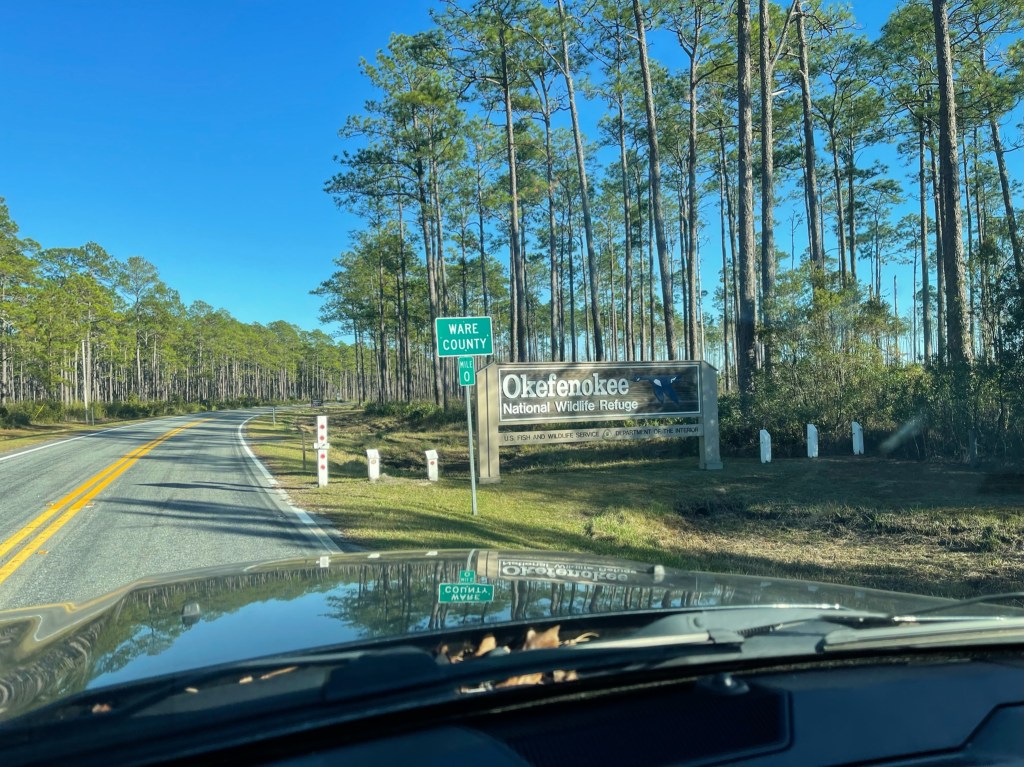
For my first adventure, I chose to go to the Stephen C. Foster State Park located within the Okefenokee Swamp. It’s about a 6-hour drive from my home QTH. Getting off of the interstate at Valdosta; it’s about a 45-mile drive down a highway that is largely uninhabited. For a man who likes his solitude, I felt alone. I pulled into Fargo, GA for gas, and then it was another 18 miles of desolation to the park. The first gate was entering the refuge. Then another lonely stretch to the park entrance.

The park was quiet with several different species of Owl providing commentary. The park never got noisy while I was there. I liked it. The campsite was rustic and nice. In short order I was set up and ready to go.

One of the things I like about the camper is its simplicity. The interior is open and spacious. there is enough room for me and my gear plus I can sit comfortably. The AC and heater work well. The galley is all I need. I added a microwave that fits on the storage shelf.

My intentions were to operate CW and FT8 while out. However, the propagation gods were not with me and band conditions were rather poor. Often only one or two of the bands were open and even then they suffered from heavy QSB or fading. You could see it on the WSJT waterfall. Now you see it, now you don’t. I tried CW a couple of times but to no avail, so FT8 it was. Here is a shot of my screen at 40 meters. Normally, it would be wall-to-wall signals at the time the image was taken.

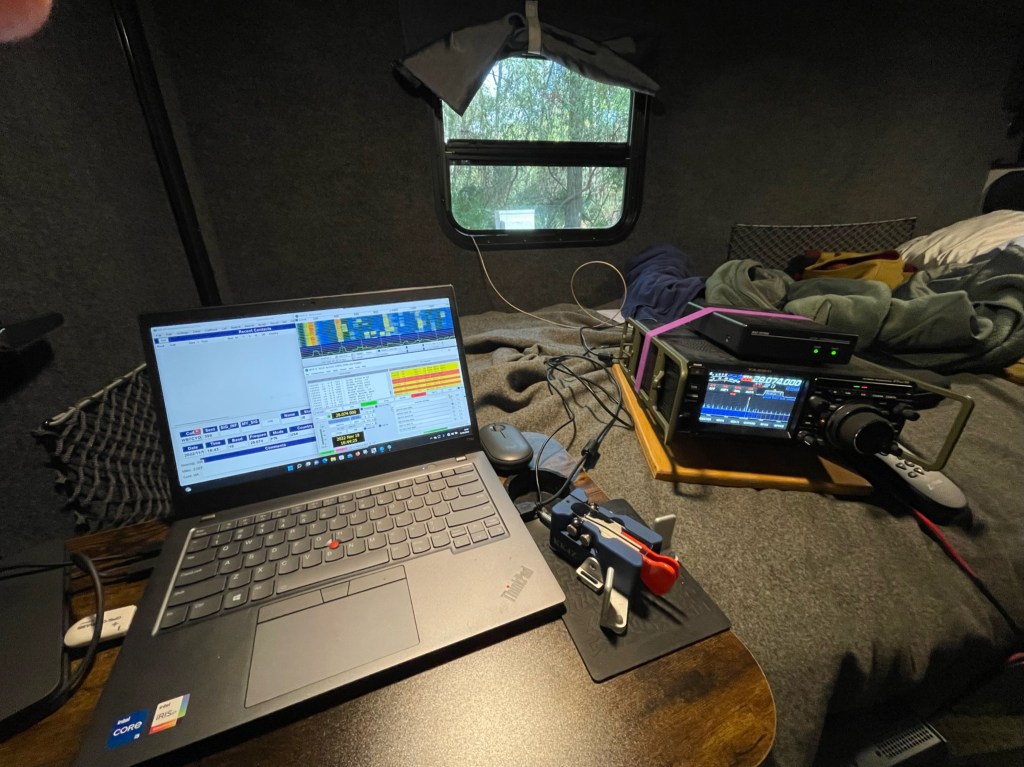
I tried a couple of different radio configurations inside the camper and the one that had the most promise was this:

I set up at the rear of the camper facing sideways. I was using a lap desk, leftover from my last camper. I was sitting in a canoe chair and balancing the desk on my legs. Not the best setup, but it gave me some ideas for next time. I was much more comfortable in this camper operating.

Station Setup. The antenna was my 29′ random wire antenna and 17′ counterpoise. It is fed with a homemade 9:1 UnUn and a 1:1 current balun. Here’s what the outside looked like.

Coax is RG-316. The radio was my Yaesu FTDX10 with a Mat-30 antenna tuner. I will comment more about the radio in a separate paragraph.

How did I do? I was on the radio pretty steady from 1800 hrs lcl Friday night, unitl about 2200 hrs lcl Saturday night. I would have worked a little later on Saturday, but the bands made it a struggle. I came out okay. I made 353 contacts from 45 states and 11 countries. Band break down as follows: 10m – 5, 12m – 2, 15m – 4, 20m – 130, 30m – 48, 40m – 151, 80m -13, and 160m – 6. I should have had more contacts on all of the bands, but conditions were not that good. I think the only reason I got the 6 on 160m, is people were trying to find propagation — any propagation.

FTDX Woes. I continue to find things I do not like about this radio. I plan on keeping this radio for a while to really give it a shakedown. You really can’t give a radio a good review if you only use it for a short while. I am keeping my IC-7300. On this trip, the biggest niggle I had was the main dial lock. It also locks the MPVD (outer ring) dial. Why is this bad? To use the clarifier, you have to use the MPVD. I recently wrote about split operation and some of you asked why not use the clarifier. The answer is you can but. The Yaesu main dial is large, too large in my opinion, and it is easy to bump it off frequency. This is important if the other station is running split. if you bump the main dial, you no longer hear the other station. You may not notice right away if something is wrong and you can miss your opportunity. If you are the station being worked and you bump your transmit frequency, no one can hear you. With the IC-7300, you can lock the main dial and still operate the RIT/DeltaTX (clarifier) with the multi-function knob.
Woe #2. You cannot easily operate FT8 on 60 meters. Yaesu programmed the 10 channels into memory and to get it to operate on 60 meters, you have to jump through some hoops, more than you should for a modern radio. The Icom will run 60 meters right from the WSJT app.
Woe #3. Using the Mat-30 tuner, the FTDX10 refuses to tune my antenna on 17 meters. I have 3 other portable tuners that work just fine on 17 meters including my 15-year-old LDG Z-11 Pro.
I don’t know, Yaesu, just misses the mark. I still kind of like the Yaesu, there seems to be a lot of almost, but not quite there. The reality is, whatever I can work on the Yaesu, I can work on the Icom. The Yaesu has a more refined receiver, but the Icom has a lower noise floor. For now, I am keeping the Yaesu, and I will continue to take it to the field and use it. I want to have a good feel for it before I decide which one to keep. Like I said, you really can’t do a good review over a short period of time. I really want to give the radio a good workout on CW, which I think will be its niche, if only the propagation gods will favor me. If one of you has an in with Yaesu, send them the link to my blog.

Below is a link to the accompanying YouTube video.