By the Hand of God at US-2173

I book my campsites often months in advance to ensure I get a good campsite. This particular trip was postponed twice due to typical life events that take precedence over having a little fun. Even this trip was not without its own issues. My wife and I forgot that this weekend was also Mother’s Day and unknown to us at the time of the booking was that there was going to be a 4 major Coronal Mass Ejections (CME) making an earth strike during the trip.

The last time I witnessed solar storms of this magnatude, I was in Gulfport MS doing EmComm for my Church in the aftermath of Hurricane Katrina. It was a humbling experience and it shaped my EmComm Philosophy.

I use the same gear for EmComm and FunComm. The equipment gets tested and exercised, and I remain proficient in its use. I also have an understanding of its strengths and weaknesses.

Most trips I take my go box.

It stays packed and contains everthing except a battery or generator to operate. I do keep a small switching power supply for mains power when it is available. Here is a look at the inside.

I have built rack mount or shelf type go boxes and in general, I do not like them. I have deployed to real disasters and found what I have here works the best for me. I do this enough that I am up and running in minutes. One thing I like is the versatility of being able to adapt my radio to the space I have to set up in. Your Milage May Vary, but for me and my 26 years in EmComm; this works best for me.

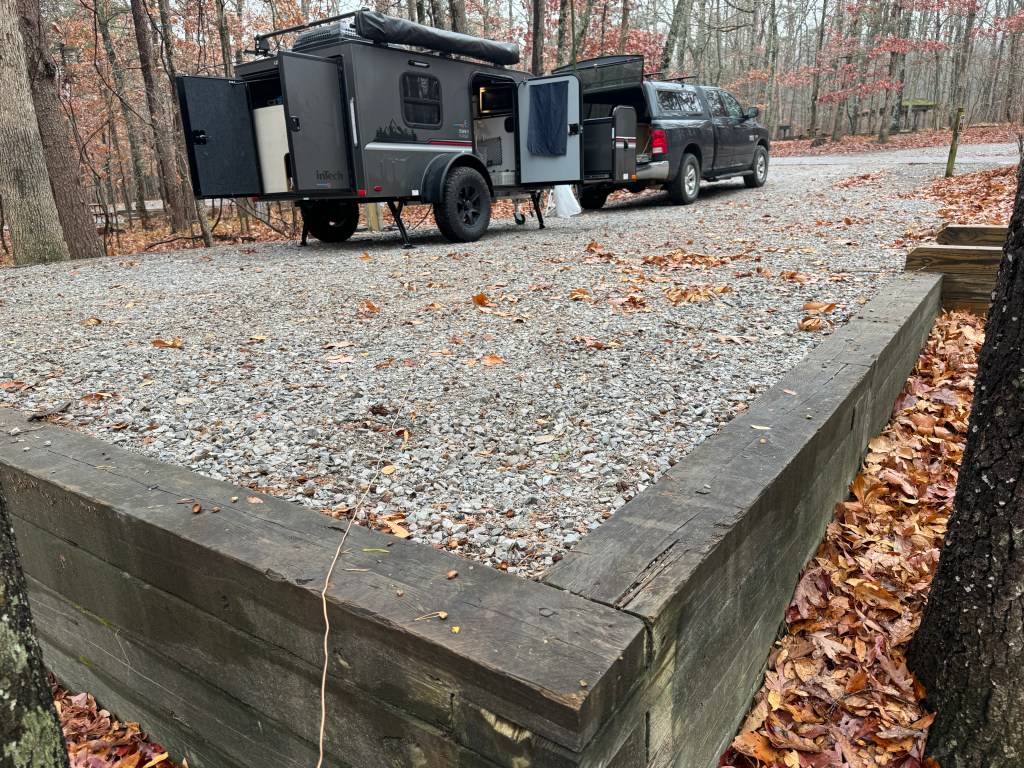
This weekend was spent at F.D. Roosevelt State Park (US-2173) near Warm Springs GA. The park was named after Franklin Delano Roosevelt. He suffered from Polio and often would travel to Warm Springs GA for hydrotherapy. He built a residence there often referred to as “The Little White Hose”. During his presidency, he established the Civilain Conservation Core (CCC) during the Great Depression. This provided jobs to young single men to help families who had difficulty finding jobs. The CCC built much of the park.

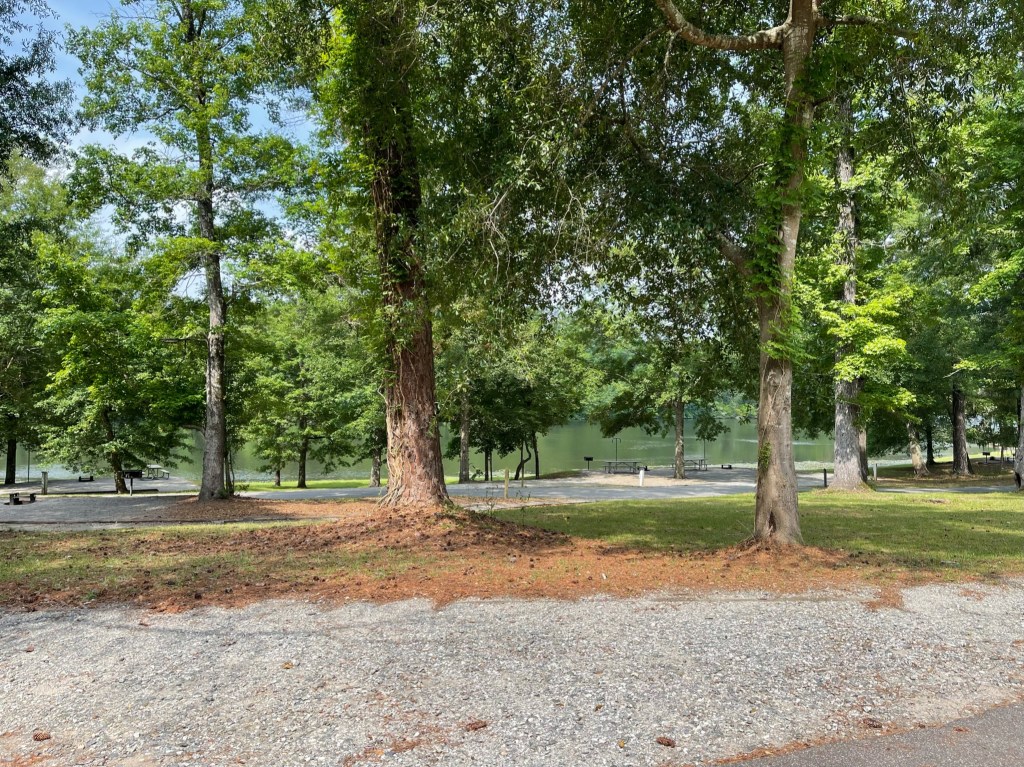
The park contains 9,049 acres (largest in GA) and is built along the Pine Mountain Ridge. It is the southern most moutain range east of the Mississippi River. The highest point is Dowdell’s Knob at 1,395 ft and is a popular POTA and SOTA (W4G/CE-004) site. I took the Radio Flyer and stayed at the campgrounds near Lake Delano.

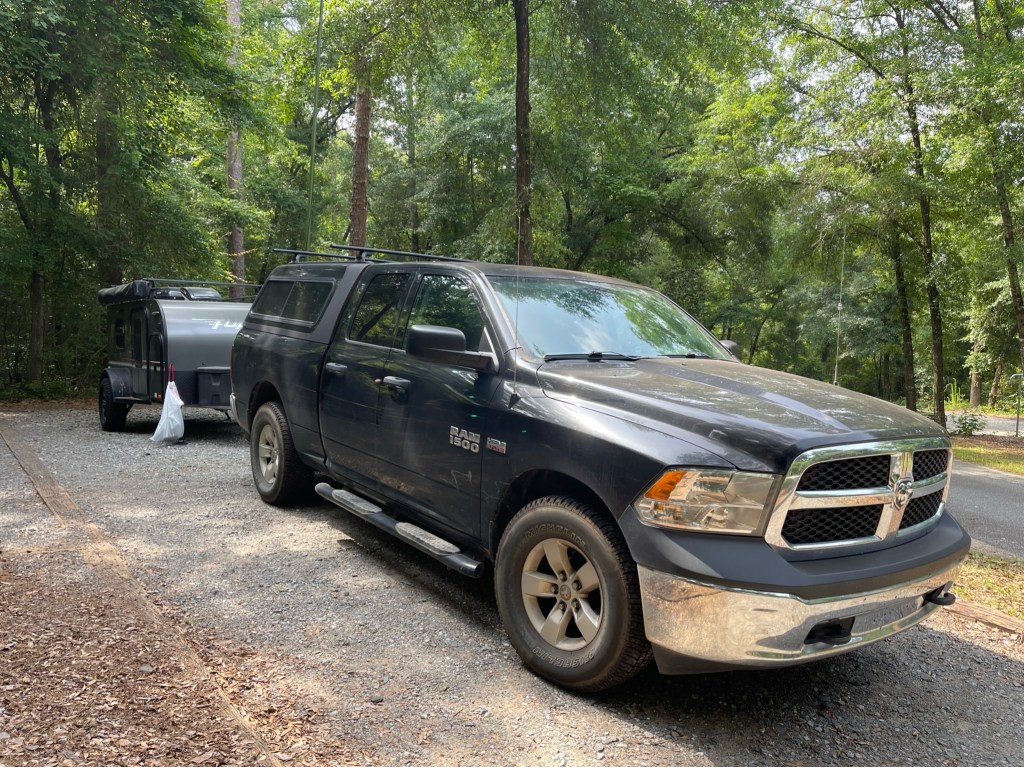
I arrived there right at 1300 hrs eastern (check-in time) and quickly got myself settled and ready to go. I knew the solar storms were coming and that my time maybe short. I wanted to finish my kilo here (#6) and needed 310 QSO’s. I had already postponed this trip twice so I was a little edgy. My gear for the trip was my 28.5′ Random Wire Antenna with the Peter my IC-7300. I had my Lenovo Thinkpad T-14 laptop and used mains power. The nice part about the antenna besides it performance, is I get zero complaints from park employees. No wires in the trees nor holes in the ground.

Friday’s band conditions were okay. There was lots pof QSB and I stuck with FT8 (35 watts). CW in these more rural parks can be iffy and this go I needed quantity. I started at 1430 hrs eastern and by oooo hrs Saturday (Friday Night) I had 134 QSO’s and when I quit at 2315 hrs I had a total of 230.

Saturday morning, after a quick breakfast I started up again at 0730 hrs. I operated until 1140 hrs when the bottom dropped. Luckily, I ended up with 338 QSO’s including 3 that were mader after the CME hit.

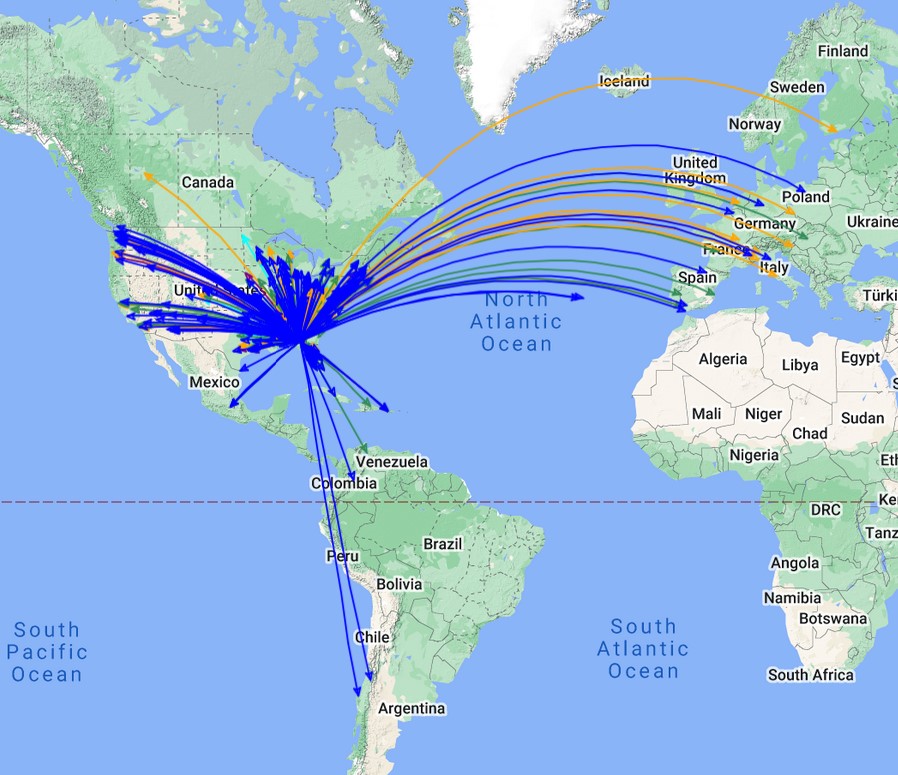
I decided my time would be best spent at home to spend Mother’s Day with my Lovely Bride so I packed up and headed for the house. My stats refelected band conditions and even though I made quite a few contacts, I only had three DX entities: Alaska, Canada and Mexico. I made contacts in 40 of the 5o states.
Operating this weekend reminded me that as reliable as HF commnications can be, it does have its Achilles Heel. For those in EmComm, never stop practicing, refining your techniques, or keeping your gear in order. For everyone else, it’s just another day in paradise. 73 de Scott

West Georgia Amateur Radio Society Spring Fling

Saturday, the West Georgia Amateur Radio Society (WGARS) took to the field for the Spring Support Your Parks Weekend sponsored by Parks on the Air (POTA). WGARS is a pretty active club and one of the best I have belonged to. Besides local events like fox hunts and balloon launches (APRS), we take to the roads 4 times a year to a park. In the spring and fall we make the POTA Support Your Parks Weekend usually on a Saturday. For the winter and summer, we participate in Field Day and Winter Field Day.

Weather was cold, with fog. Temps were in the 50’s and not the mid 70’s predicted by the weather service. I was in shorts and a tee shirt. Luckily, I had a goretex windbreaker in the truck. Others had blankets wrapped around them.

These events are casual events for us. We normally do 3 things while out. We eat, we socialize, and we throw in a little radio along the way. This was no different. We had a picnic table full of food with hamburgers and hot dogs cooked on site by our President John WD8LQT.

Due to a lot of recent solar activity band conditions were interesting. John WD8LQT was runnning CW/SSB and I was running FT8 to reduce interference between the 2 stations. When I switched to 10 meters, I was working into Europe and South America and when I switched to 20 meters, I couldn’t get out of the Continental United States (CONUS). We each made a handful of contacts and spent a lot of time enjoying each others company.

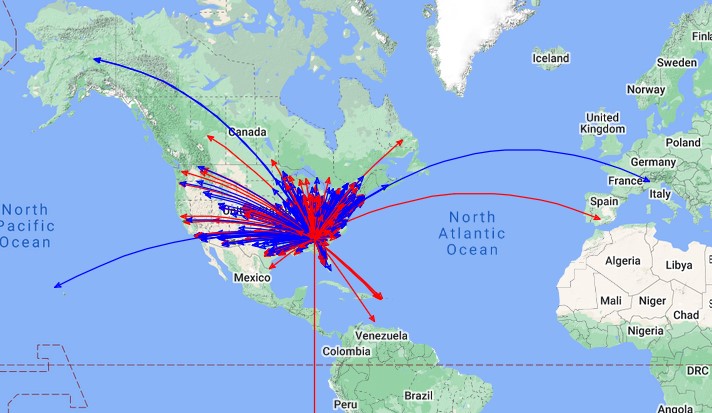
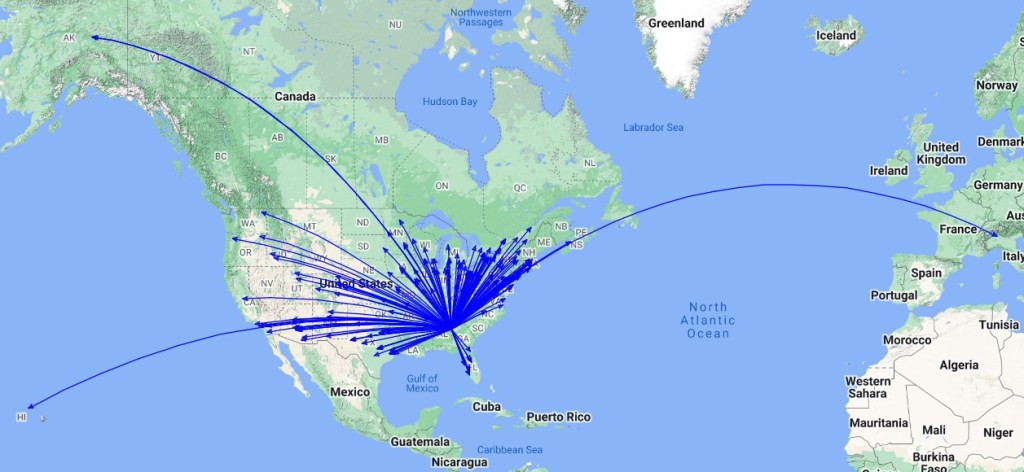
For radios, John was runnning his Xeigu G90 at 15 watts into a EFHW antenna. I was running my IC-705 at 5 watts into my 28.5′ Random Wire antenna. Towards the end my radio developed a glitch and refused to transmit. I was using my iPad via WiFi to make the FT8 contacts and I think that connection caused a setting to change. When I got home and warm, it took me about 3 minutes to figure it out. I still had a pretty good day. Here is a QSO map from my station.

The goal of these event for our club is not how many contacts we make, but how much fun we have and a large part of that is enjoying each others company. Field Day is only a couple of months away — can’t wait.

Below is a short video. It is a little jittery as I had navigate around people and chairs etc. If you’re prone to vertigo, you may wish to skip this one.

POTA Activation K-2169, Me, VaraC, 160 meters and more

This weekend I had the opportunity to activate Cloudland Canyon State Park in NW Georgia. It was a digi weekend with me running FT8 and experimenting with VaraC. I also tried a new antenna combination to see how it would work on 160 meters.

The weather. I book my campsites 4-6 months in advance so I take what I get when I go. This weekend called for rain Friday and was supposed to clear up Saturday PM. It didn’t. It drizzled/rained from the time I got there until 0200 hrs Sunday morning. Since I mingle FunComm with EmComm, this was another test of my gear. The only issue I had was I needed to better seal the window where my coax goes into the camper. You shouldn’t let the weather stop you from going as long as it’s safe. I go year round and because of that, I have a good understanding of my gear and my clothing under varying conditions.

The gear. The antenna was a Chameleon EmComm II ver. 1. This version had a clunky antenna wire and insulator that is more from permanent/semi-permanent installation so I didn’t use it much. This year, Chameleon had a Black Friday Sale of 25% off. I decided to upgrade the wire to a 60′ Kevlar with a winder. I also ordered their new 40-meter OCF dipole which will be used on SOTA activations. I had some 14 gauge Flexweave wire that I cut to 50′ for a counterpoise. My intention was to use this antenna down to 160 meters. I ran the antenna as an inverted “L” ish. The vertical portion went about 25′ up my mast and the horizontal portion was more of a slope and facing north. The nice part was that the entire antenna fit within my campsite. I used the lantern hook on the site to secure the antenna. For rope, I used #36 tarred bank line. The rope is a little sticky so it holds knots well and does not absorb water like para-cord does. I used a clove hitch to secure the antenna ring to the mast and it held fast. The Bank line has replaced all of my para-cord.

The radio was First Peter, my IC-7300 that I bought new in 2016. I use an LDG Z-11 Pro that I have had for 15+ years to keep everything matched up. I was running 25-35 watts. My other IC-7300 is Second Peter. My backup radio was my new KX2. I keep it in a backpack so it is easy to toss in the truck.

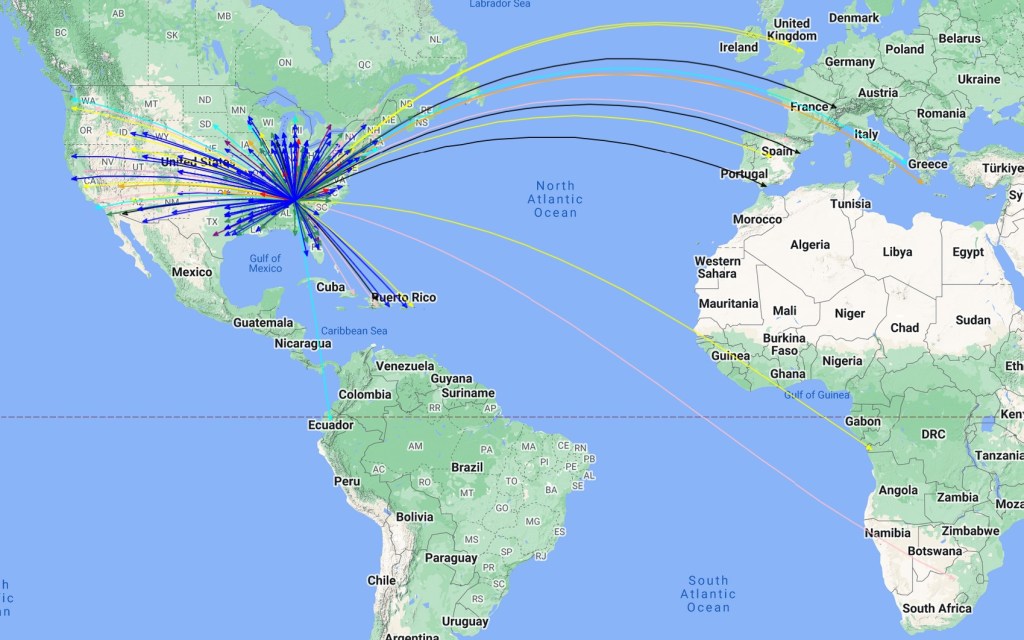
Propagation. It was different, not bad, but different. There was a lot of solar activity and I believe it pushed the MUF up above 20 MHz. I had a lot of success on the higher bands which is typically not the case in the winter. My antenna easily tuned 160 meters and I made about half a dozen contacts using FT8. How did I do? I started at about 2030 hrs UTC Friday and finished up at about 2200 hrs UTC Saturday afternoon. I made a total of 325 contacts covering 42 states and 12 countries. Some of the interesting (to me) DX was Angola and South Africa. Both of those stations called me. Angola was on 10 meters and South Africa was on 12. No DX on 40 meters. I had a Facebook request to work 40 meters for local contacts. I did my best but 40 was rather flat this time around. It had the second-highest count of contacts. Breakdown by band was: 10 meters – 18, 12 meters – 18, 15 meters – 13, 17 meters – 7, 20 meters – 136, 30 meters – 19, 40 meters – 90, 60 meters – 12, 80 meters – 6, and 160 meters – 6. One of the surprises other than the lack of low band activity was that 17 meters was fairly dead. Typically on an activation, my money bands are 17, 20, 30, and 40. This time only 20 and 40 panned out. I manage 10 bands at this park in case I want to go for another N1CC award.

VaraC. For the past week, I have been evaluating VaraC mainly for EmComm. There is a lot to like about it. For one thing, it uses the same modem as Winlink. If you have it set up for Winlink, you are good to go for VaraC. VaraC can upload files and low-res pictures. PSKReporter showed favorable propagation on 20 and 40 meters. I made a few contacts with it and did some beaconing. I haven’t tried it yet, but it looks like I can create a document in FLMsg, save it, send it via VaraC, and reverse the process at the other end. pretty nifty. I think pairing Winlink with VaraC just might be the ticket.

Recap. Neither snow, nor rain, nor heat, nor gloom of night stays this operator from completing his park activation… I had a lot of fun. I try not to let the elements stop me from doing what I like to do. 73 – Scott

Ft Mountain State Park – A Family Affair

This past weekend, my wife and I went camping at Ft Mountain State Park near Chatsworth, GA.  The park holds a special place in our hearts because we spent our honeymoon there some 32 years ago.  Believe it or not, she still loves me.

Ft Mountain is also a favored place for POTA activations. Going into the weekend I needed a little over 200 contacts to earn a kilo award for that park. This weekend was special.  We were having a family campout with my two sons and their families.  We rented 3 campsites close together and spent a great weekend enjoying each other’s company.

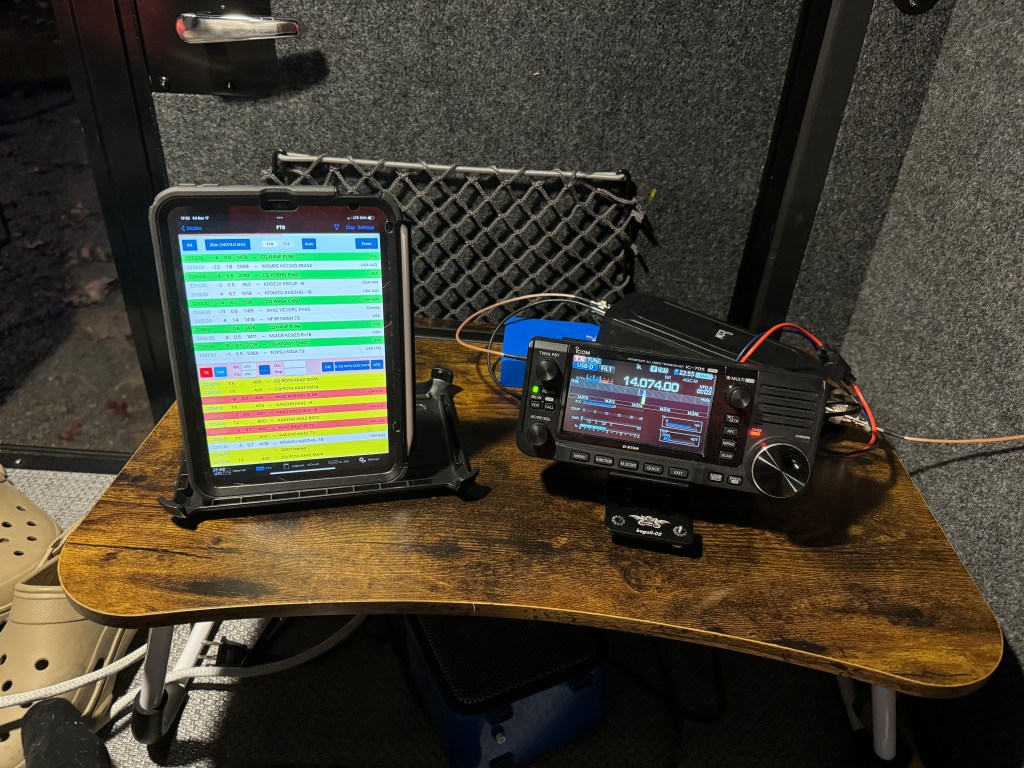
As you can guess, amateur radio took a back seat to the other activities.  Since my wife was with me, my little camper got a little crowded.  I had to scale back my radio gear.  I took the radio desk out of the camper and used a lap desk instead for the radio.  The radio du jour was my IC-705 with the AH-705 tuner.  The radio was battery powered and I used an external Bioenno 3 ah battery.  My mode of choice was FT-8 and I used my iPad mini to run SDR Control.  My antenna was my trusty 28.5 Random Wire.  When I first started, I hooked the antenna right up to the AH-705.  It worked flawlessly.  The AH-705 acts much like an SG-237.  It is a very versatile tuner.  As the temps dropped, I moved inside and had to change the antenna to its normal configuration with a 9:1 UnUn and a 1:1 current Balun.  I ran coax to the inside the camper to the AH-705. I did not have a long enough control cable to keep the AH-705 outside.

I knew my kids and their families wouldn’t arrive until Friday night which meant family activities wouldn’t start until sometime Saturday morning.  I got on the air Friday afternoon and stayed on until about midnight.  I took a couple hours of sleep and then got back into it.  The nice part about FT-8 is you can turn the volume down so as not to disturb the significant other.  I finished up before 10 AM, about the time everyone else was starting to stir.

I ended up with over 230 contacts covering 40 states and 7 countries with 7 watts of power.  This was enough for the Kilo. 

The rest of the weekend was with family.  When my boys were young (I call my boys, boys and my dogs boyz), I used to take them to Magic (The Gathering) tournaments.  While we were there I would run booster drafts which was an ad hoc game using new never never-opened card packs.  I did this to give myself something to do, and I got a Magic tee shirt that had “Staff”.  Street cred baby! I arranged a game while we were camping and of course, introduced the grandsons to the game.  It looks like we may do this again next year.

With careful planning, you can enjoy your family and radio at the same time.  In fact, one of my grandsons is interested in learning more about CW or Morse Code.  Yes, sir, next year’s campout is looking up.  72 de Scott

Field Day 2023

This weekend I got to participate with my local amateur radio club, the West Georgia Amateur Radio Society (WGARS) for Field Day. This is a great club and every event is fun. It covers a wide variety of activities, including Parks on the Air, Fox Hunts, Balloon releases, Field Day, and Winter Field Day. This year, Field Day was held at the Little Tallapoosa Park located in Carroll County Georgia. We operated as W4F, 5A GA. We did not operate 5 stations all of the time, we padded the number to allow members to bring their own rigs and operate for a short time if they desire.

I decided to make a night of it and brought my micro camper. Because I was in a group setting I set my radio up outside as there were plenty of folks to keep an eye on each other’s equipment. My original intent was to operate FT8 and CW. I have a newly acquired Elecraft K3/10 I wanted to try. However, band conditions were poor, so I relied on my IC-7300 and FT8. The club president tried CW and only made 2 contacts.

Everything worked well. The only glitch was a software one. We networked our computers together with N3FJP’s AcLog for Field Day. The glitch was with the CQ message. I set mine up for CQ FD W4F EM73. It would stay that way until I clicked on an incoming message (red). The FD would change to PACC on its own. I would have to change it back to FD before calling CQ.

I know this wasn’t isolated as I saw other stations from other groups calling CQ PACC. I had to keep an eye on it the whole time I was operating.

How did we do? I think we did okay. Our group is a little more casual than others but, by the time I left by mid-morning Sunday, we were north of 500 contacts. Here is a club QSO map.

I had a good run. I mainly ran FT8 on 20 meters. I ended up with 200 contacts from 38 states and 4 DX entities. The most fun came in the wee hours of the morning when there are DX openings to the west. I was able to make two contacts with Alaska and one with Hawaii. also about the same time I managed a contact to Italy. I didn’t hit the sack until 0400 hrs Eastern.

I was up at 0700 hrs to make the last few contacts. I wanted to pack up a little early before the heat of the day. I had a breakfast of eggs, bacon, OJ, and a pancake in a cup before heading home.

It was a lot of fun. I enjoy field operating and seeing how well my equipment does. What better way to spend a weekend than with friends and fellow amateur radio operators. Below is a short video about the event. 73 – Scott

POTA Activation Kolomoki Mound State Park and First Kilo

This past week I got to spend a few extra days at a park. My Church Youth Group was camping at this park and I offered to set up an amateur radio station to showcase what it can do.

The park is one of my favorites. It has a small campground and it is always peaceful and quiet.

There are a couple of and lakes fishing is one of the activities available here. You can also rent kayaks for a bit of a paddle. My campsite this go around was nestled back in the trees, and while there was a campsite right next door, the campers were quiet.

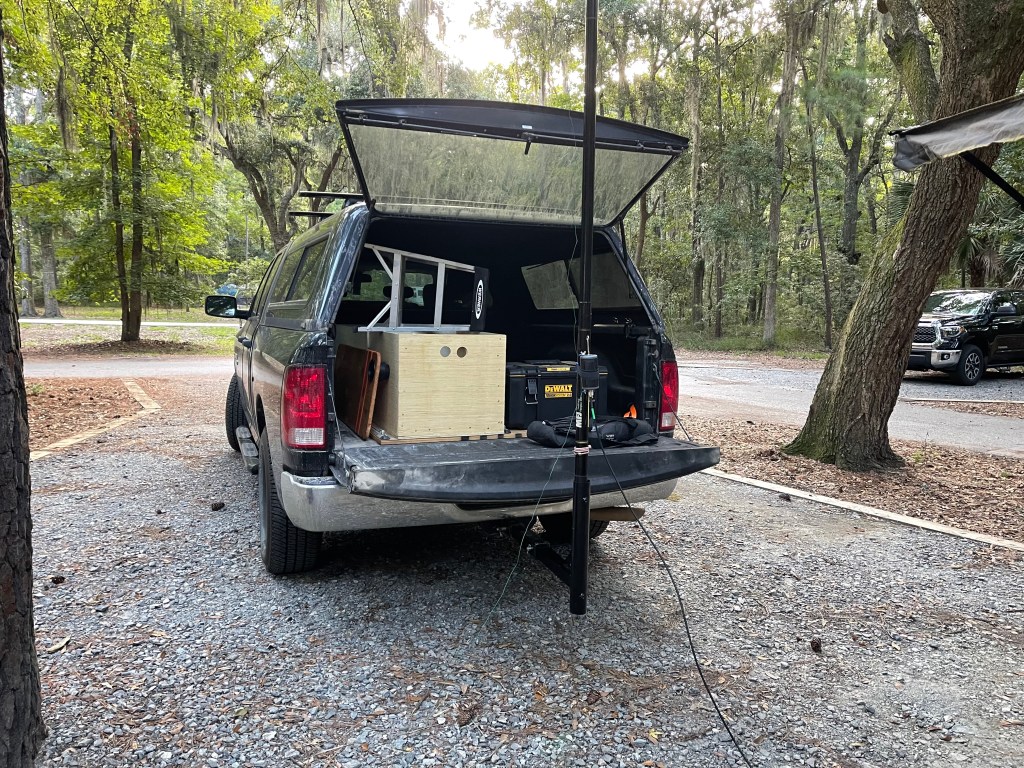
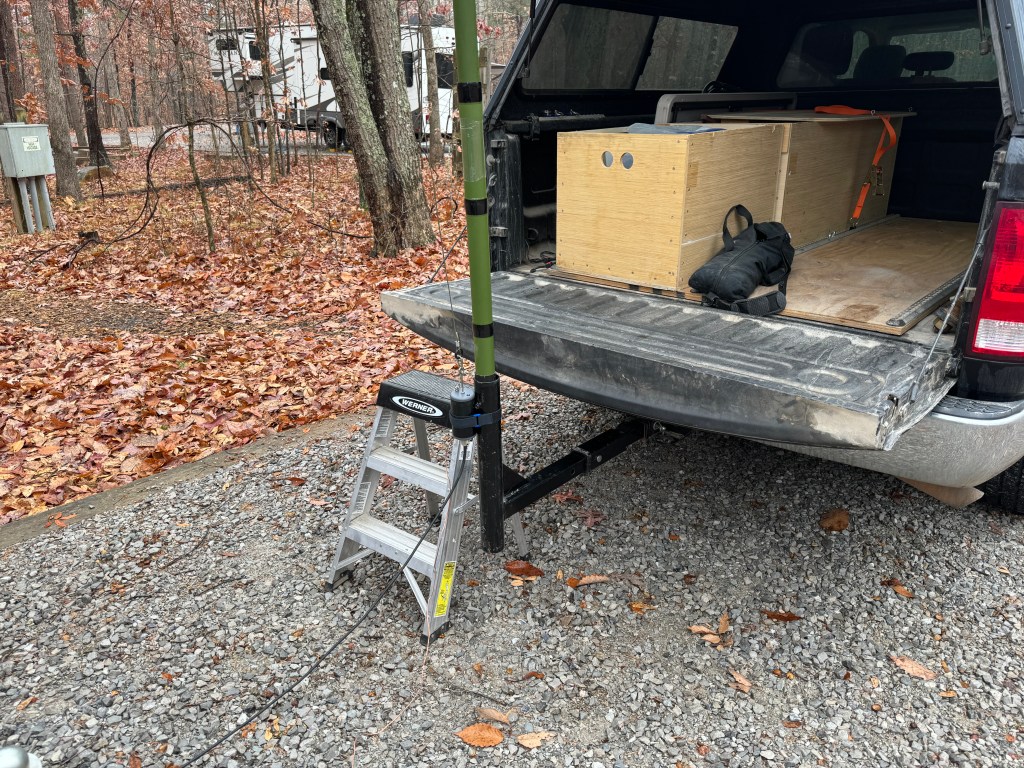
The antenna I used was my 28.5′ random wire antenna up a 31′ Jackite push-up pole. I got the green one and as you can see above, it almost disappears against the foliage.

Like last time, I had to mount the antenna to the truck due to trees over the camper.

Two new additions to the camper were screens and a radio desk. The screens were a kit designed for the camper. Installation was simple. You attached metal disks in the appropriate places and the screens attach by magnets. I mainly used the screens on the back door. It gave me a more open feeling and with the roof fan or A/C, I was able to keep the camper quite cool even in 85-degree heat. By keeping the side door closed, I had a nice breeze at the back. The desk was covered in a previous post but this was the first real workout it got. Here is a picture of the setup I used this weekend.

This would be a typical setup. There is room for a key (paddles) and everything is within easy reach. On the top shelf is a switching power supply, a Yaesu FT-710, LDG RC-100, and a Garmin InReach Messenger. This was another good workout for the FT-710. band conditions were good on Tues and only fair on Wednesday. My mode of choice was FT8. I was within 330 contacts of a Kilo and knew I could get it done. I ran the FT-710 pretty steady at 45 watts for almost 12 hours. The radio did not get warm and no hiccups were noticed. The screen is easy to read and most of the controls are in the right place. I find that in the field, the 710’s main menu, is a little too busy. Sometimes I have trouble finding the option I wish to change. Overall, the FT-710 is a likable radio. I am going to do some CW POTA Activations with the radio in the near future. I still feel that the FT-710 is very comparable to the IC-7300 and whichever brand you are married to, get that radio. If you are a new op or have no brand loyalty, I would still recommend the IC-7300 over the FT-710, because I feel the ergonomics are better. I still plan on keeping both radios.

Garmin InReach Messanger. This trip was the first time I took the InReach Messenger to the field. Cell service at Kolomoki is very spotty. A nice feature of Messenger is it uses an app on my iPhone. The app is very similar to other SMS apps. Once I got there, I was able to send a quick text home along with my location, downloaded the current weather, and spot myself on POTA. Messenger is so much faster than my old InReach (the first clunky big one). It is now a regular part of my kit and will be a boon to EmComm and FunComm.

FunComm. I have used this term a few times lately and probably need to explain it a little. Among other things radio, I am deeply involved in EmComm or emergency communications. I practice EmComm at home and in the field. Most of the time, the gear you see me take to the field, is the same gear I would take to an emergency. Enter Fun Comm, FunComm is using your EmComm gear for fun doing something like POTA. Each time I go out, I learn more about my gear and its capabilities. Everything is used, tested, repaired, or replaced. I know my gear. I have been to real-world emergencies, and I have had operators come up to me and tell me if I can help them fix their radio, they could be of help. Don’t be that guy. I have had my share of oops and blunders, but I take each experience and build upon it. Now, once a month me and my gear are tested, in a fun way of course. And if something fails, I lose a few contacts, and no harm is done.

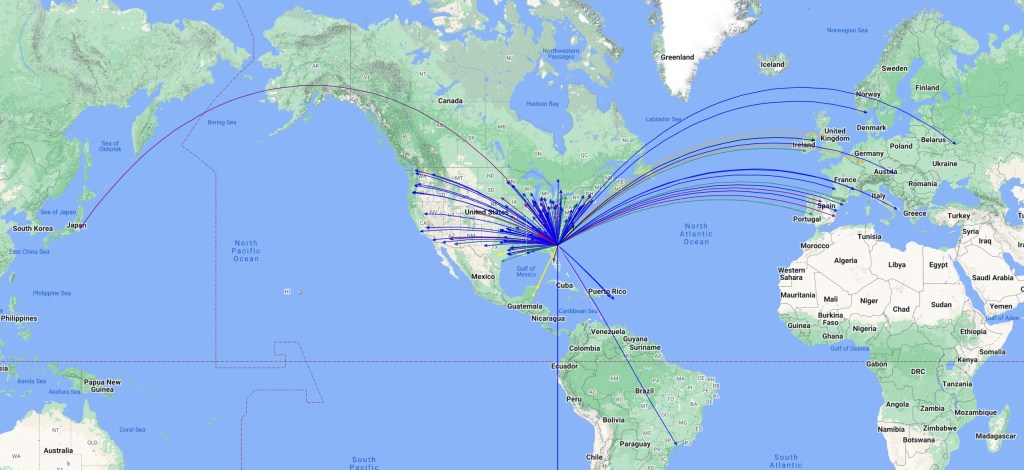
How did I do? Not bad really. I made over 400 contacts using FT-8 from 41 States and 20 Countries. Here is a QSO Map.

Here is a video of the activation.

The Maiden Voyage of the Radio Flyer

Radio Flyer Logo (PRNewsFoto/Radio Flyer, Inc.)

When I was young, it was a simpler time. All you needed was a pen knife, cap gun, your dog, and a Radio Flyer red wagon to put your stuff in. The world was your oyster and adventure was right around the corner. Even though I am much older now, and my horizons have expanded; adventure is still right around the corner. It was fitting that my new camper is also a Flyer. I thought it fitting to name my camper the Radio Flyer, big boy’s red wagon.

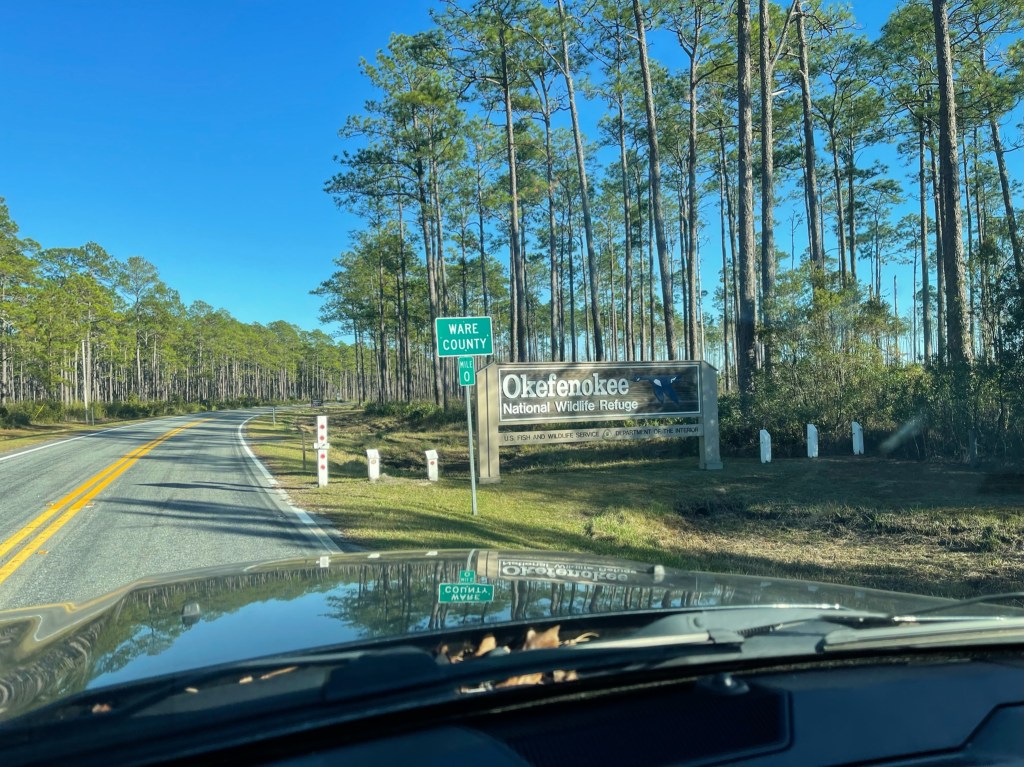
For my first adventure, I chose to go to the Stephen C. Foster State Park located within the Okefenokee Swamp. It’s about a 6-hour drive from my home QTH. Getting off of the interstate at Valdosta; it’s about a 45-mile drive down a highway that is largely uninhabited. For a man who likes his solitude, I felt alone. I pulled into Fargo, GA for gas, and then it was another 18 miles of desolation to the park. The first gate was entering the refuge. Then another lonely stretch to the park entrance.

The park was quiet with several different species of Owl providing commentary. The park never got noisy while I was there. I liked it. The campsite was rustic and nice. In short order I was set up and ready to go.

One of the things I like about the camper is its simplicity. The interior is open and spacious. there is enough room for me and my gear plus I can sit comfortably. The AC and heater work well. The galley is all I need. I added a microwave that fits on the storage shelf.

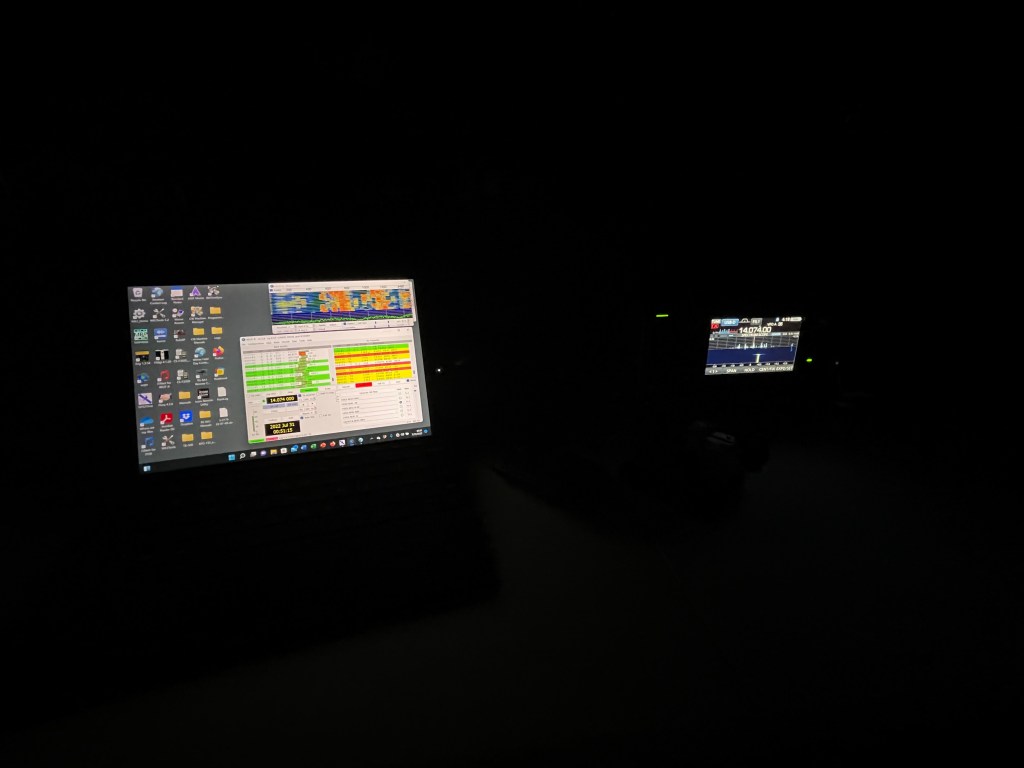
My intentions were to operate CW and FT8 while out. However, the propagation gods were not with me and band conditions were rather poor. Often only one or two of the bands were open and even then they suffered from heavy QSB or fading. You could see it on the WSJT waterfall. Now you see it, now you don’t. I tried CW a couple of times but to no avail, so FT8 it was. Here is a shot of my screen at 40 meters. Normally, it would be wall-to-wall signals at the time the image was taken.

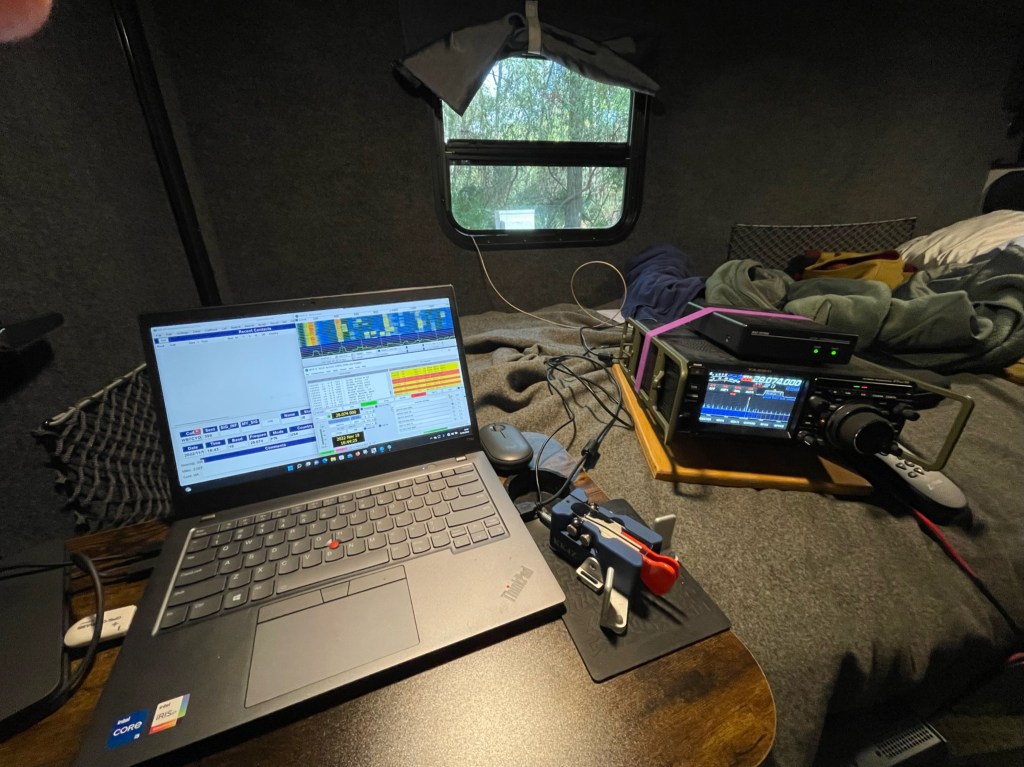
I tried a couple of different radio configurations inside the camper and the one that had the most promise was this:

I set up at the rear of the camper facing sideways. I was using a lap desk, leftover from my last camper. I was sitting in a canoe chair and balancing the desk on my legs. Not the best setup, but it gave me some ideas for next time. I was much more comfortable in this camper operating.

Station Setup. The antenna was my 29′ random wire antenna and 17′ counterpoise. It is fed with a homemade 9:1 UnUn and a 1:1 current balun. Here’s what the outside looked like.

Coax is RG-316. The radio was my Yaesu FTDX10 with a Mat-30 antenna tuner. I will comment more about the radio in a separate paragraph.

How did I do? I was on the radio pretty steady from 1800 hrs lcl Friday night, unitl about 2200 hrs lcl Saturday night. I would have worked a little later on Saturday, but the bands made it a struggle. I came out okay. I made 353 contacts from 45 states and 11 countries. Band break down as follows: 10m – 5, 12m – 2, 15m – 4, 20m – 130, 30m – 48, 40m – 151, 80m -13, and 160m – 6. I should have had more contacts on all of the bands, but conditions were not that good. I think the only reason I got the 6 on 160m, is people were trying to find propagation — any propagation.

FTDX Woes. I continue to find things I do not like about this radio. I plan on keeping this radio for a while to really give it a shakedown. You really can’t give a radio a good review if you only use it for a short while. I am keeping my IC-7300. On this trip, the biggest niggle I had was the main dial lock. It also locks the MPVD (outer ring) dial. Why is this bad? To use the clarifier, you have to use the MPVD. I recently wrote about split operation and some of you asked why not use the clarifier. The answer is you can but. The Yaesu main dial is large, too large in my opinion, and it is easy to bump it off frequency. This is important if the other station is running split. if you bump the main dial, you no longer hear the other station. You may not notice right away if something is wrong and you can miss your opportunity. If you are the station being worked and you bump your transmit frequency, no one can hear you. With the IC-7300, you can lock the main dial and still operate the RIT/DeltaTX (clarifier) with the multi-function knob.
Woe #2. You cannot easily operate FT8 on 60 meters. Yaesu programmed the 10 channels into memory and to get it to operate on 60 meters, you have to jump through some hoops, more than you should for a modern radio. The Icom will run 60 meters right from the WSJT app.
Woe #3. Using the Mat-30 tuner, the FTDX10 refuses to tune my antenna on 17 meters. I have 3 other portable tuners that work just fine on 17 meters including my 15-year-old LDG Z-11 Pro.
I don’t know, Yaesu, just misses the mark. I still kind of like the Yaesu, there seems to be a lot of almost, but not quite there. The reality is, whatever I can work on the Yaesu, I can work on the Icom. The Yaesu has a more refined receiver, but the Icom has a lower noise floor. For now, I am keeping the Yaesu, and I will continue to take it to the field and use it. I want to have a good feel for it before I decide which one to keep. Like I said, you really can’t do a good review over a short period of time. I really want to give the radio a good workout on CW, which I think will be its niche, if only the propagation gods will favor me. If one of you has an in with Yaesu, send them the link to my blog.

Below is a link to the accompanying YouTube video.

POTA Activation Skidaway Island State Park K-2198

Skidaway Island State Park is a beautiful park. Located southeast of Savannah, GA, With Spanish Moss, along the typical summer heat and humidity, it is a prime example of coastal Georgia. This trip came about because my wife needed a package delivered to South Carolina; I volunteered as long as I could camp one night an play radio. It’s about a 5 hour drive from NW Georgia to SE Georgia. After delivering the package I arrived at the park somewhere around 1600 hrs Local. It took a couple of minutes to get the camper setup and a little longer for the radio. Because it might be a while before I can make it back here (gas is still over $4 a gallon). I tried to get 10 bands for my N1CC award. I mostly worked FT8.

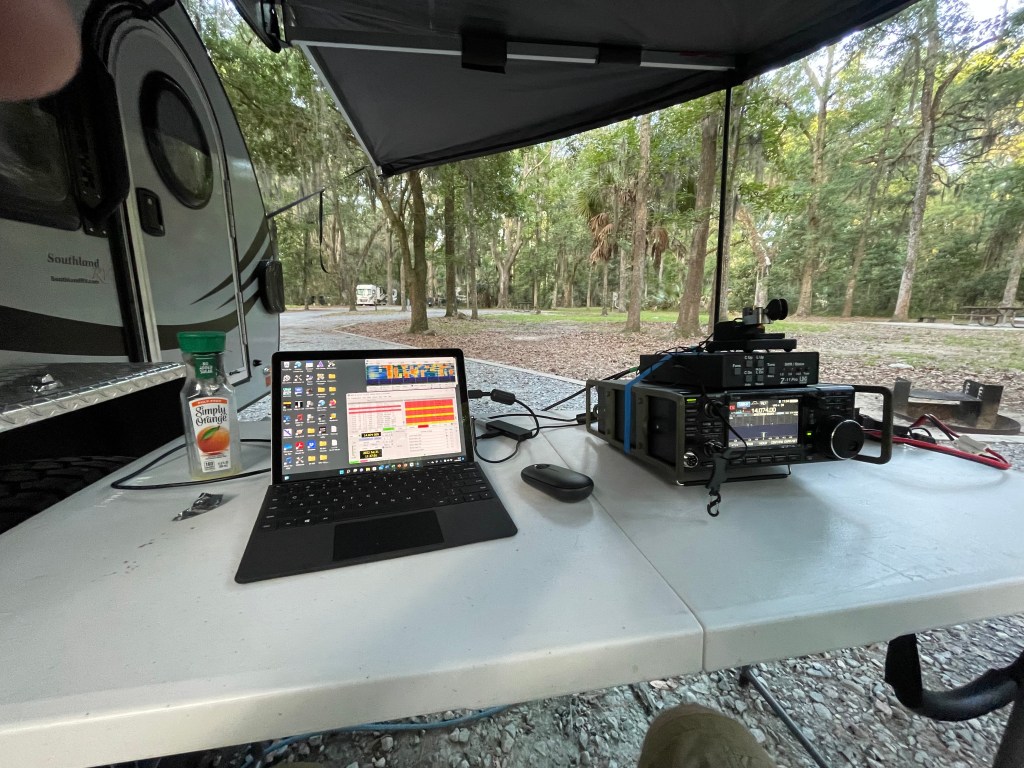
Setup. Setup was my usual for this type of activation. The radio was my IC-7300 and LDG Z-11 Pro tuner. The computer was a Microsoft Surface Go2.

The antenna was my K4SWL antenna which is a 29.5′ random wire antenna with one 17′ counterpoise. I used my Chameleon EmComm II transformer to even things out. The antenna is hoisted into the air with a MFJ-1910 33′ pushup pole. No plants or animals were harmed during this activation.

Being a former Nightstaker, working in the dark is routine to me. I stayed outside well after sunset until I finally had enough of the heat.

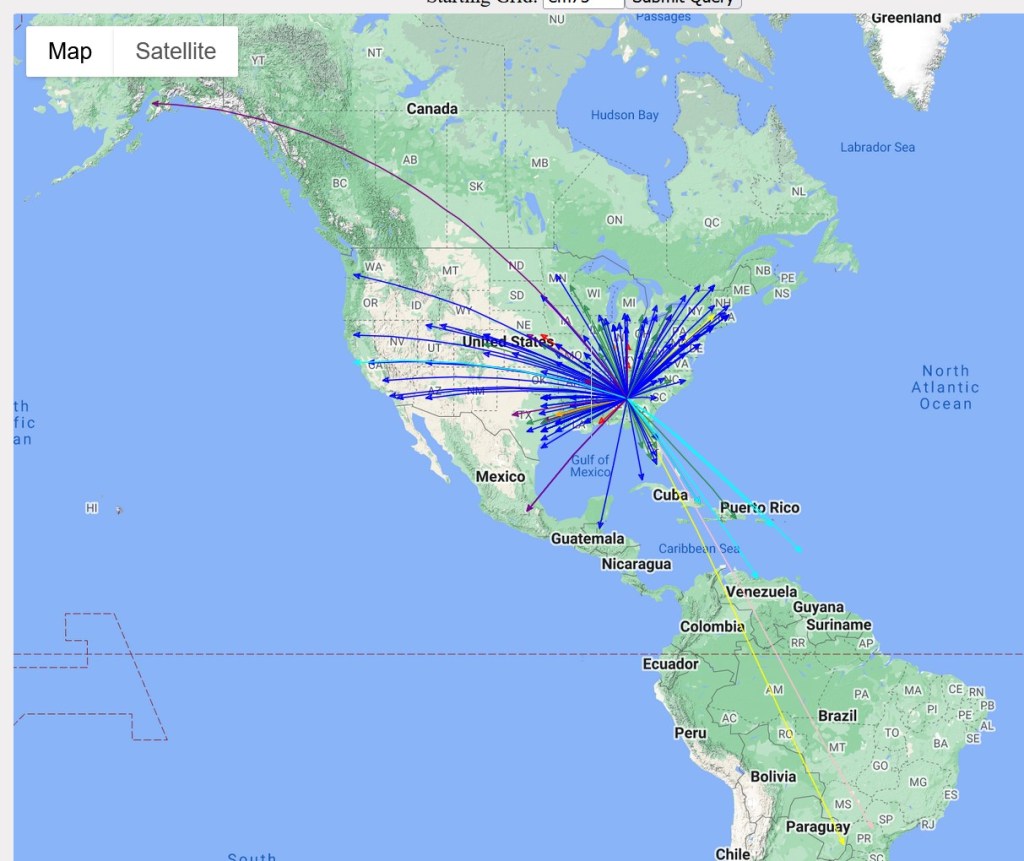
Band conditions were so-so, and I earned my keep making contacts. Working about 20 hours total I ended up with 174 contacts on 10 different bands. I had quite a few FT8 pileups which was fun and let me know that my antenna is working as it should. Here is a QSO map of the activation.

What was new? I recently acquired a Begali Adventure Duo with their metal base. The base is a little on the light side but there are magnets on the bottom. I had a fairly heavy base made for a AME Potra-Paddle. I set the the the begali base on the Porta-Paddle base and Viola! It works like a champ.

I also have the 705 mount coming to use with my IC-705. I really like these paddles. I only used them a little while trying to make contact with K7K. Alas, I didn’t have enough horsepower to make the trip to Alaska. My new paddles will definitely be my choice when camping.

Issues? I only had 2 and neither was catastrophic. The first was with the antenna. It seems when I increase power somewhere above 20 watts, I start getting some RF feedback through the coax on some bands. It was more of a nuisance than anything and I have since added a RF choke to the antenna bag. This antenna is one of my favorites if not my favorite antenna. It always performs well for me. The second issue has to do with the IC-7300. When I am working from inside of the camper, I set the radio down on the mattress. The tilt stand sinks nicely down in the 4″ of memory foam making the radio face plate difficult to see. I set my QRP radios on the lap desk with my computer and paddles. I banged around in my workshop and found a scrap piece of 3/4″ plywood. I cut it to 11″ x 12″ and now my radio floats on top of the mattress. The board also fits in the box I carry the big radio in.

Every time I go out, I learn something new. With gas prices the way they are, I may not be making these long trips for a while. However, there are plenty of great parks closer to home. Thanks to all of the hunters who took the time to work me. Sometimes making that contact can become a little tedious. I appreciate you all and 73’s until next time.

Improvise, Adapt, and Overcome

The Marines got this right. When planning for a POTA/SOTA trip. It pays to plan for contingencies. I am not talking about going overboard with this. You should still try to carry only what you need. This past weekend I did a POTA camp-out at Ft. Mountain State Park in northwestern Georgia. I usually reserve campsites several months in advance, so everything may not be perfect by trip time. Part of my planning was considering band conditions. The week prior, propagation was unstable. In addition, I was not sure about the geography of the campsite. My planning was to bring two radios; my IC-7300 (QRO) and my IC-705 (QRP). I brought my Frankentenna with an extra EmComm II transformer to handle more power.

The planning paid off. My campsite was down in a hole and the bands were not good. The site was great for camping and only so-so for radio.

One of the POTA awards I am working on is the N1CC award which is operating on ten different bands at 10 different parks. I needed 2 more bands at this park to check this park off. I chose to use the IC-7300 for more power. Since I had shore power available, I wasn’t worried about running out of juice. Station setup looked like this.

Band conditions were less than optimal, so for this trip I decided to use FT8. There were times when the waterfall on the 7300 went completely black, even on the FT8 frequency. Normally I run about 25 watts, but this time I had to go as high as 50 watts. QRP would have been a tough row to hoe. The antenna was my Frankentenna and I ran the Chameleon EmComm II transformer instead of the Hybrid Micro so I could run a little more power.

I operated from Friday afternoon until somewhere around 0100 hrs Lcl, with a couple hour break due to a thunderstorm. The next day was beautiful, much cooler than the day before when we were under a heat advisory. I operated most of Saturday until early evening when I pulled the plug with another round of thunderstorms inbound.

I made 161 Q’s including DX from Alaska and South America.

I was trying for 200 Q’s, However, the propagation Gods were not with me, but I was satisfied with the results. I have a couple of YouTube videos.

I am former US Army, so a tip of my hat to all those who serve(d). God Bless, God Speed, and 73 de Scott KK4Z

POTA Activation Kolomoki Mounds State Park K-3726

I decided to try a park in SW Georgia and Kolomoki Mounds State Park looked interesting. It was about a 3 hour drive traveling back highways and byways. I spent two nights there with my wife and it was a very nice experience. The campground was quiet and the restrooms were clean.

Hot! it was hot and very humid while we were there. My little camper has AC but everything got damp in that kind of humidity. Ambient temperature was in the low 90’s and the high humidity made it feel hotter. I plan on going back there but maybe in the fall or winter.

The propagation gods were angry. While there, I suffered from R1 radio blackouts mainly due to flare activity. The bands were mighty quiet; however, I was still able to make 100 contacts over the weekend.

Testing! Test,test. I brought a couple of antenna projects with me to do some field testing with. These included some of the 9:1 transformers I wound. I will report on the results in a separate post.

Setup. This weekend, I brought my IC-7300. I brought it for a couple of reasons. I hadn’t used it in a while so it deserved an outing. Plus, I had foreknowledge of the possibility of poor propagation so I brought it to run FT8 and have a little more power. I ran it in the 25-35 watt range and the 7300 can run like that all day long. However, the antenna I used is happiest when the power stays 25 watts or less on digital. This was fortuitous, CW, my preferred mode, was non existent at my location. I made one CW contact on 60 meters. The antenna I used was my POTA standby, my Frankentenna.

I ran one 50 foot counterpoise off into the woods. In the photo, you can see the lower 2 Buddipole extensions, the blue is pretty easy to see. I ordered 2 black ones to better allow the antenna to blend in. The antenna was fed with about 31 feet of RG-316. The shack looked like this.

I used a LDG Z-11 Pro to match the antenna. To sync time for FT8 I use a GPS dongle I got from Amazon https://tinyurl.com/2p9595sz. I sync the time to WSJT using GPS2Time. I used N3FJP for logging. The set up worked well. Since my little camper has an awning, I stayed in the shade all day and drank plenty of fluids. I lost a pound of weight over the weekend. A side note. When I operate in a campground, I wear ear buds and run either CW or FT8. I do not make “radio” noise. Out of sight, out of mind.

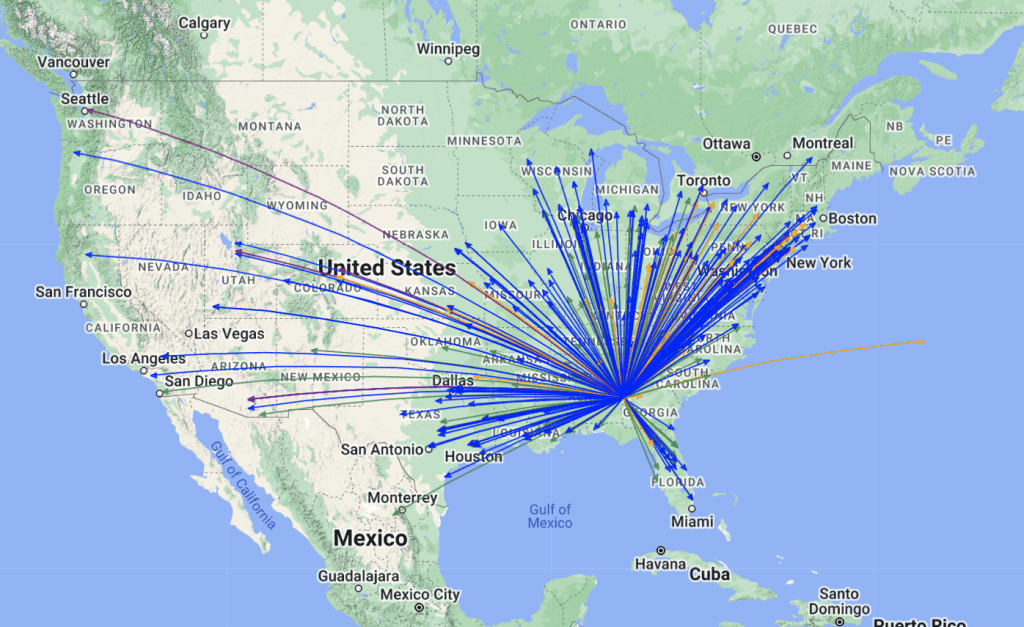
How did I do? Pretty good actually considering the poor band conditions. I am attempting a N1CC award so I was trying to work 10 bands while at the park. Here is a QSO Map from the activation.

It was work. Sometimes I was just banging away and no one responding. The few pileups I had were never more than 3 or 4. QSB would rear its ugly head and I lost a few contacts as they faded away. In the end I made 100 QSO with 20 minutes to spare on my last Zulu Day. I managed 10 bands with my one CW contact on 60 meters which does not have FT8. What was interesting was I worked a couple of stations in Brazil and one in Europe on 10 meters. It was fun while being a challenge. It’s always good to have a plan B. FT8 was my backup, but quickly became my primary mode. In upcoming post, I will spend time going over my antenna results, and a few other kinks I am working on. That’s all for now. 73 Scott.