Black Rock Mtn State Park – Aug 2025

Last weekend I finished up a 3-day, 1,800 mile, 7-state POTA Rove that included a radio trade. Out with the FTX1 and in with a TS-590sg. After setting up the 590, I brought it with me to Black Rock Mountain State Park to try some FT8 and if the band conditions permit, a little CW.

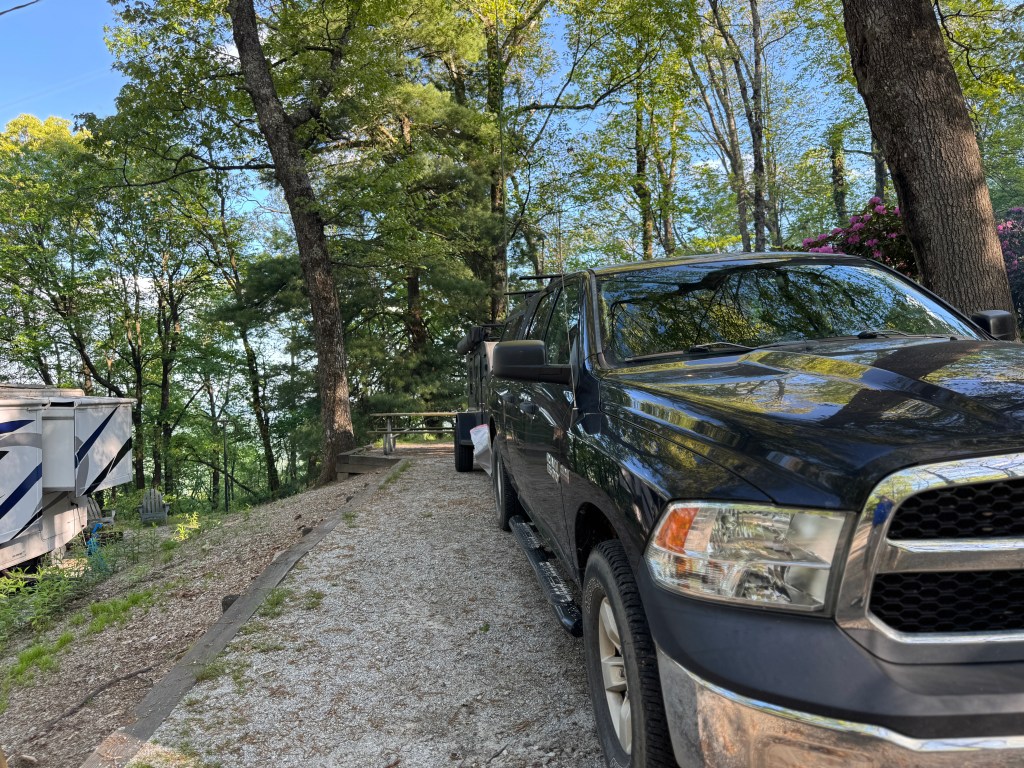
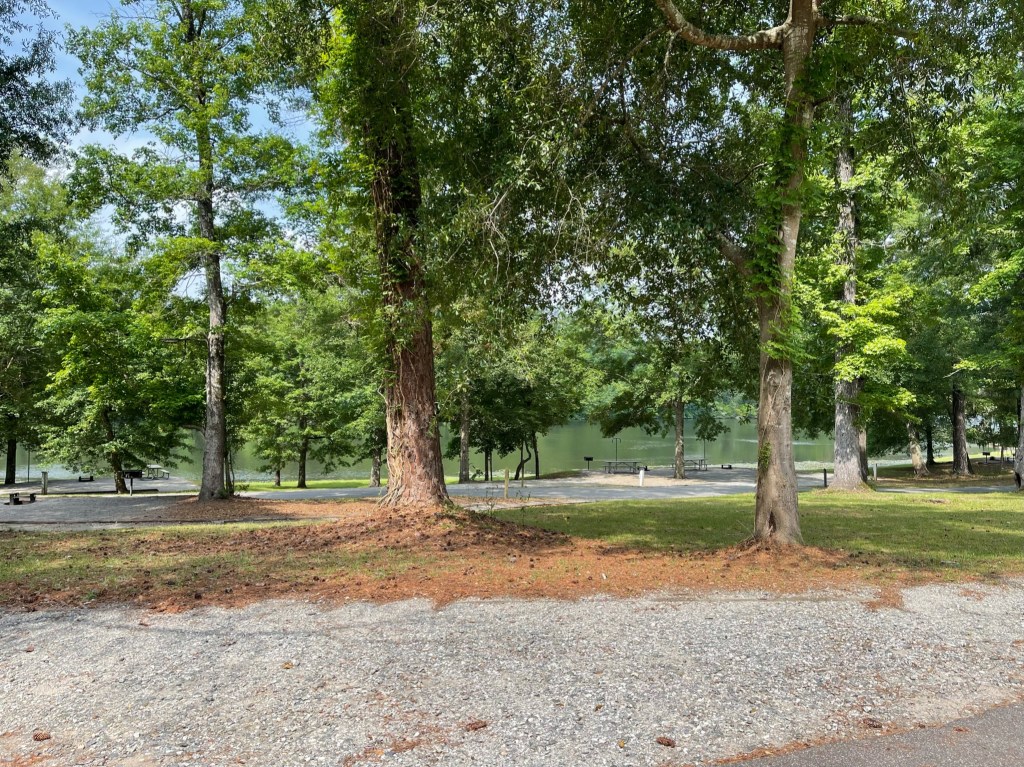
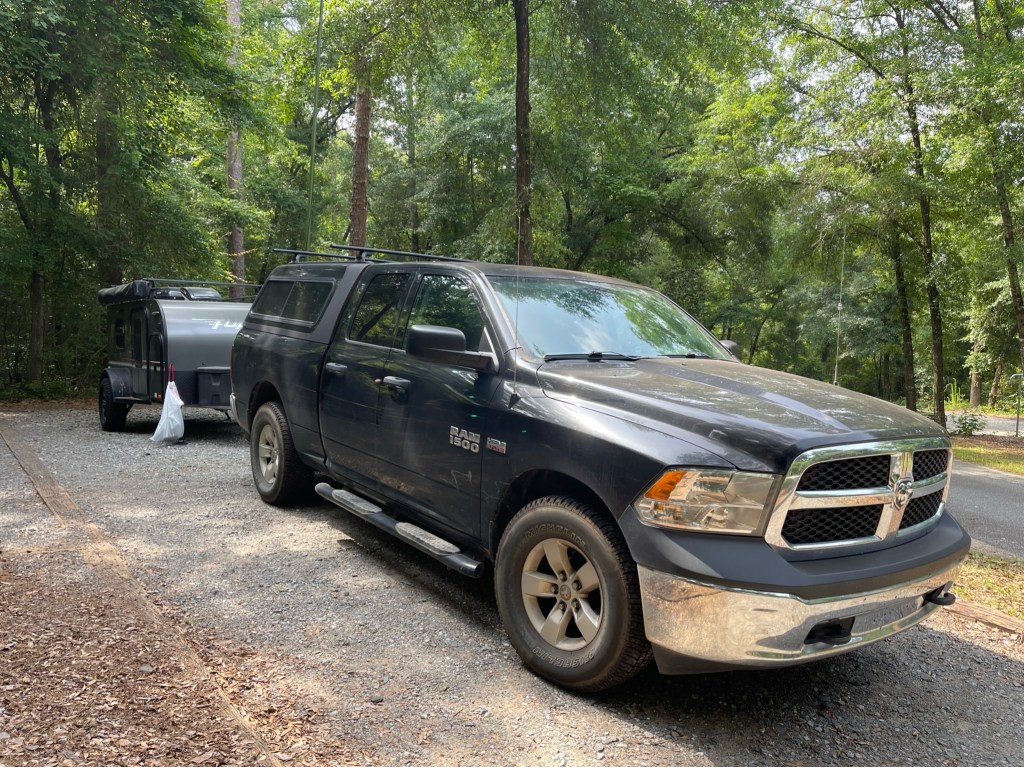
I arrived at the Park Friday afternoon. I have done this enough times that I am setup and ready to go within 30 minutes.  This campsite had some challenges.It was the smallest campsite I ever used.  I had space for the trailer and I had to park my truck in the picnic area.  I also had overhead power lines so I had to use a shorter antenna. The weather was cool for a change and I didn’t have to run my A/C.

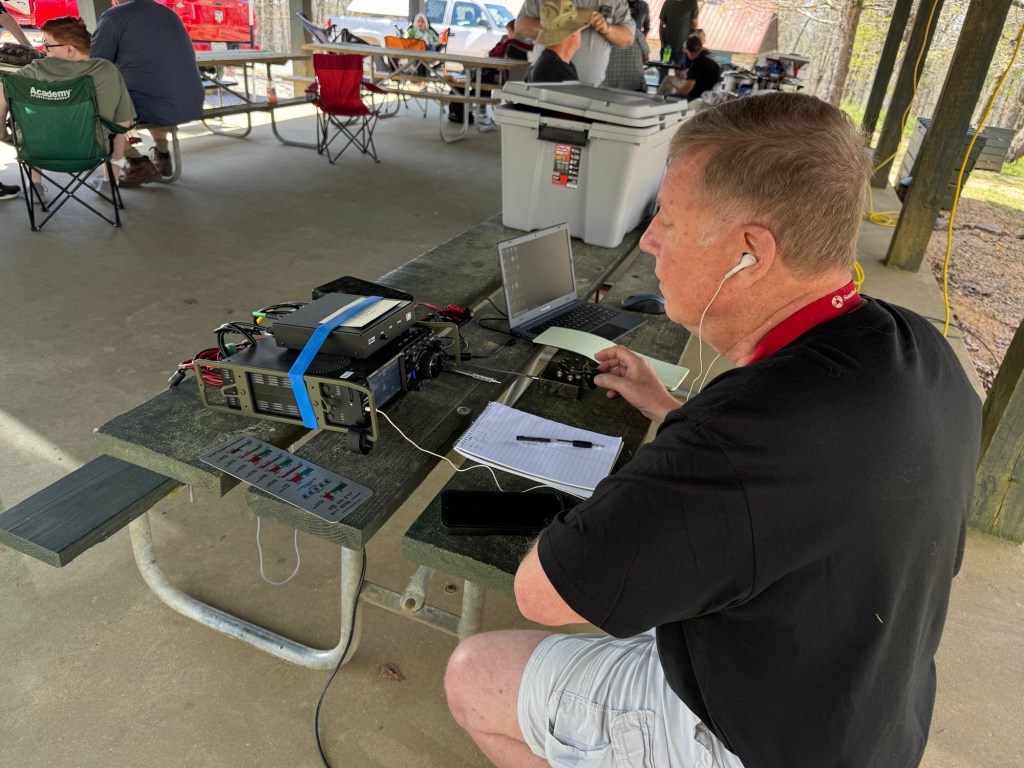
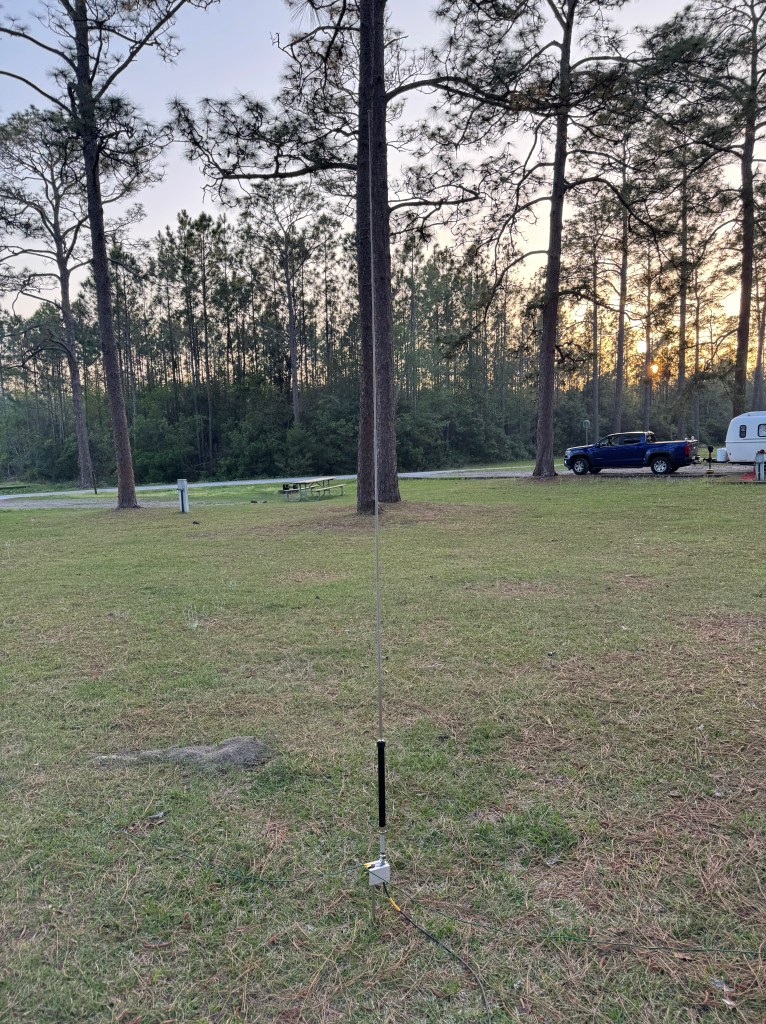
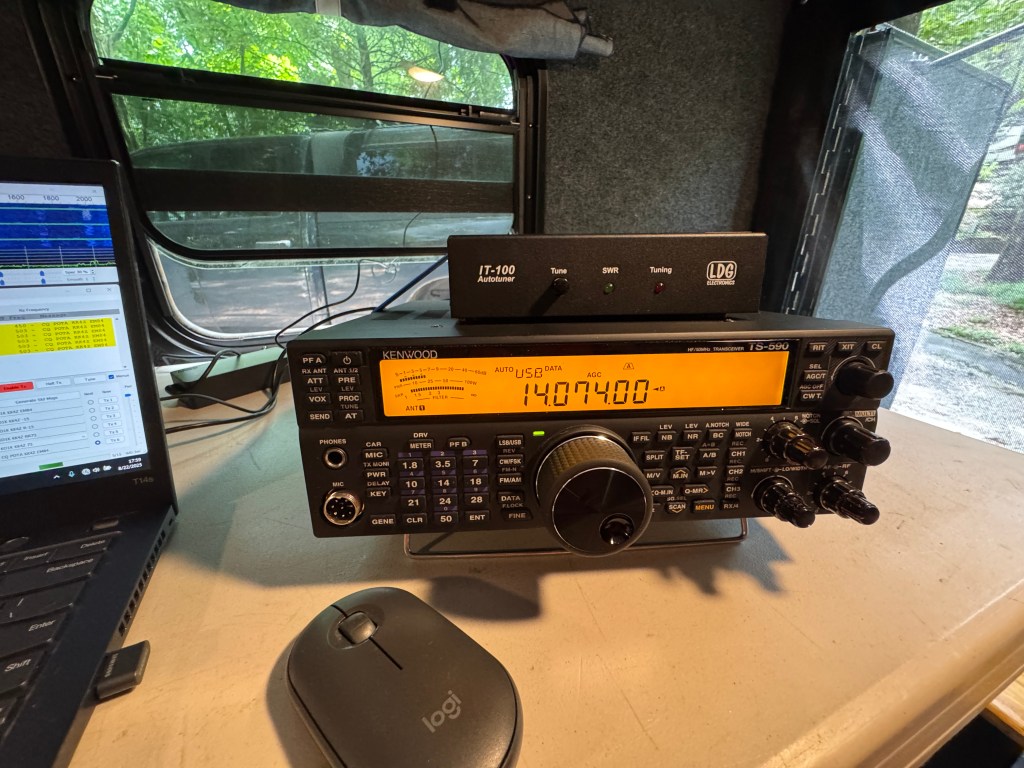
Setup was a Chameleon Micro Hybrid transformer with a 12’ whip and about a 20’ counterpoise.  The radio was my new-to-me Kenwood TS-590sg.  This was the radio’s maiden voyage and I really liked it. It performed well.  One of the main reasons I like running big radios at low power is more of the controls are readily available. Most everything in the TS-590sg is either a push button or a twist of a knob away.  Having a high performance receiver isn’t any good if you can’t get to the controls.

Band conditions were poor. The first night I only made 88 FT-8 contacts and they were a struggle.  At times the band would “white-out”, high noise and only white snow on the waterfall. At the better times QSB or fading was a constant up and down.  I would watch S7-9 signals drop to nothing during a QSO.  Saturday afternoon brought a power failure at the park. Yep, right during mid QSO.  The power was still out at 1800 hrs, so I had a decision to make – should I stay, or should I go.  As you get older one of the things that goes, is your night vision.  If I was going to leave it had to be soon, so I could still do most of my driving during daylight/evening hours.  I decided to go.  Since I have a lot of practice setting up and tearing down.  I was packed up in less than 30 minutes. As I was pulling out of the park, the power returned.  Better safe than sorry.

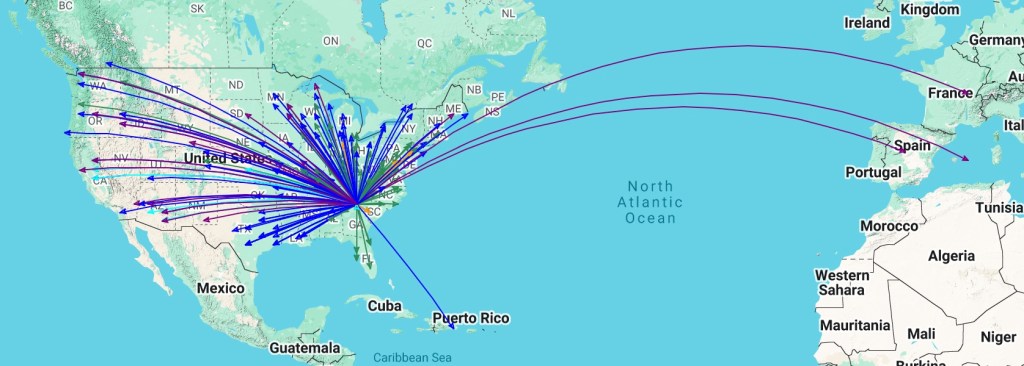
I ended up with 233 contacts, 88 short of my kilo for that park.  I will plan another trip in the fall to finish.  I am real happy with the TS-590sg.  I opened it up and found the MARS mod already done and the TXCO installed.  The radio performed well and I ran it mostly at 20 watts.  As you can see in the QSO map, Most of my contacts were CONUS. Kenwoods and Icoms have the best ergonomics. I feel the layouts were designed by people who use their radios; that ergonomics were a primary concern and not an afterthought. 
Screenshot

I also decided to trade off the FT-710 and ended up with a pristine IC-7200.  I always wanted one but the stars never aligned — until now.  I no longer have any Yaesu radios in the stable and probably won’t have any more.  Why? A couple of reasons. I prefer the ergonomics of the Icoms and the Kenwoods.  Everything I need is right there on the front panel. Easy, to see — Easy to use. I have owned a FTDX10, FT-710, and a FTX1, along with an Icom IC-7610, IC-7300, and a Kenwood TS-890s. I can tell you that whatever I hear on one radio, I can hear on the other.  There’s two reasons for this.  One is knowing where the controls are and two is knowing how to use them. There is a third factor the CSP unit, that’s Cerebral Signal Processing Unit. Half of the battle is using the CSP to process faint signals.  After 30 years, mine is pretty good.

The Yaesu radios, are not bad radios, they are not my cup of tea. I can squeeze more horsepower out of the Icoms and the Kenwoods.  I am sure there are those who can say the same about Yaesus.  I at least crossed the fence and tried them but in the end my preference is not Yaesu. YMMV.

Other happenings. I rearranged my Go Box.  My TS-590sg will not fit in it like my other radios so I got an Apache case for it from Harbor Freight and moved some antenna stuff into the Go Box. So now all my radios travel in a separate case and my Go Box has become universal.  Everything I need to run any of my field radios is in the Go Box.  These days I do more FunComm than EmComm, but I am always prepared to do either. I load the same stuff and off I go. I’ve had a busy summer and the honey-do list is growing, there is lots to do around the ranch so this may be one of the last trips for a while. I do most of my outdoor work from Fall to Spring to avoid working in the southeast hot, humid summers and the accompanying chiggers and ticks. That’s all for now,  take care and 73 de Scott

The FTX1 Cover Up

One of the things I was concerned about the FTX1 was how to protect its face while in transit. The Yaesu side rails which are not yet available are too large. They make the radio too bulky. Icom, when they made the IC-705 available also released a STL file so we could make our own covers which I did. Actually, I modified the file and my son printed it on his 3D printer.

The other day, I decided to check to see if someone had made a STL file for a FTX1 cover. They did! I downloaded the file and sent it to my son who printed it out for me (19 hours). The file was unmodified and fit the FTX1 to a tee. The file can be found here: Yaesu FTX1 3D Cover

I will wrap a silicone rubber band around it to keep the radio secure in the cover. The cover weighs 6.5 oz and the whole weighs just over 4 lbs without the rubber band. For comparison, My IC-705 with cover weighs in at just under 3 lbs.

Another annoyance or at least a distraction is during CW transmit. On the FTX1 the frequency readout flashes in time to CW along with the xmit light above the main dial. It is rather bright. I shot a YouTube video showing the difference between the FTX1 and the IC-705.

Where does this leave me. Well, for one thing wondering what Yaesu was thinking. I’m not giving up on the radio, hopefully as time goes by, Yaesu will work out some of the kinks. I am a bit annoyed that Yaesu is using us as beta testers. I would expect that from a company like Xeigu which sells their radios for less than half the price of the FTX1. The FTX1 is supposed to be a premium radio at a premium price. Come on Yaesu, you can do better. I think Yaesu had an opportunity and missed the mark. As I said in a prior post, I have been very busy this summer. Hopefully soon, I will get the FTX1 out in the field. So far, as of today if I had to choose between the FTX1 and the IC-705, I would still choose the IC-705 for a QRP radio. For a full size radio, I would take the IC-7300 or the FT-710 over the FTX1 Optima. Of course, your mileage may vary. Thanks for stopping by. 72 de Scott

Dear Yaesu, New Paddles, and Life on the Farm

Dear Yaesu,
What has happened? Have you forgotten us? I don’t understand your thinking when it comes to the FTX1. The FT-817 and its variants sold well for over 20 years. It is still a cherished radio and has a strong following. The FTX1 is an okay radio. It would appear to compete with the IC-705 and as I have said, it doesn’t really compare. In the realm of QRP radios the IC-705 is still better then the FTX1.

I think many of us were hoping for an improved FT-817/FT-818. The FT-817 had a nice form factor and only weighed ~2.5 lbs with a battery and antenna. The FTX1 is clunky and weighs ~4 pounds without an antenna. I still haven’t figured out the best way to carry it.

What would be a nice QRP radio? My suggestion is taking the form factor of the FT-891 and making it a 10 watt radio (20 might even be better). Replace the the 100 watt finals with a battery or a decent antenna tuner (10:1 matching?). You could even go so far as make it an SDR radio. Make a nice pouch with a shoulder strap to carry it. Most people who run QRP don’t have a need for a waterfall. Instead use the USB port to send the signal to a a tablet/cell phone/laptop to view the waterfall there. You can also allow connectivity to a tablet/cell phone/laptop for digital modes and logging. That might put you on top again.

I don’t understand the Optima option. ~$1,900. Right now, I can get a FT-710 for $955. That would leave almost $1,000 for another radio or two. The FT-710 is a better radio. I have an FT-710 and I think it is one of your better efforts. I recently used it for Field day and it did very well. I have an FTX1 and I’m keeping it for a while to see what you do with it.

Yes, I have a preference for Icom radios, they work better for me. I have had other Yaesu radios namely FTDX10, FTDX3000, FT-950 and years ago an FT-817. I also run a Kenwood. I use what works best for me. I am not necessarily bashing you, I am offering my opinion for your consideration.

Sincerely,
Scott KK4Z

Note: right now I am not sure how the FTX1 fits into my lineup. As I said earlier, I think the IC-705 is better (at least for me YMMV). If I need something lighter I have a KX2. For Field Days and bigger events I can bring either an FT-710 or IC-7300. When I purchased this radio I was also looking at a KX3 with KXAT3 and KXFL3. Maybe if the right trade comes along…

Working on the farm.
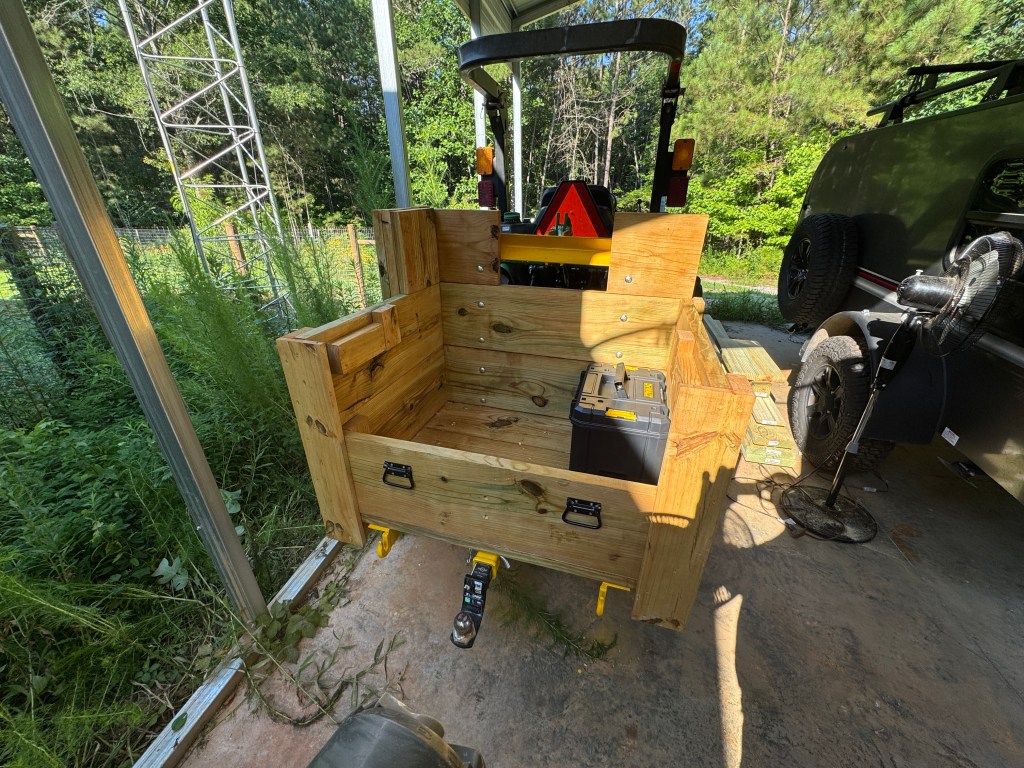
I have been busy on my property. I have 6 acres to take care of and there is always something to do. Right now I have to start getting firewood ready for winter. That means dragging downed trees to the process area, bucking, splitting and stacking. I have a John Deere 3025 tractor to help me out. A problem I was running into was how do I get my gear out to where I am working. The front end loader is okay to carry things until you need it for something else. Besides the steel of the bucket is not good for a chainsaw blade. In the past I would sometimes use my wife’s UTV. That has it’s own set of problems namely, she uses it for her stuff and it stays full. So I decided to build a cargo box for the 3 point hitch on my tractor. I got a carry-all from King Cutter which allows me to use my iMatch quick hitch.

I stopped by my local welder and had a 2″ receiver welded on along with some grab hooks. The finished project looks like this.

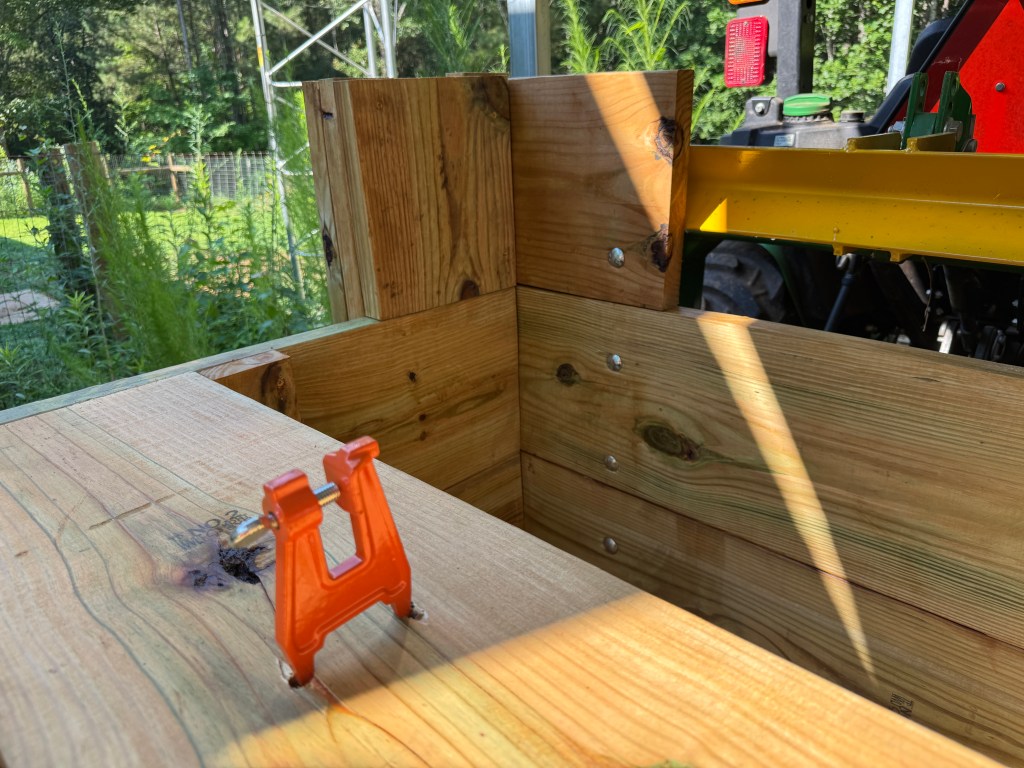
I can flip the tailgate up and turn it into a workbench.

I drilled a few holes so I can mount a chainsaw vise to sharpen my chainsaw in the field.

You can see the chainsaw sheath behind the vise. It will hold my 68cc chainsaw with a 27″ bar safely.

I use a 20′ shipping container for my maintenance shed. It’s hasn’t been reorganized since we initially filled it up almost 6 years ago. Another project is to get things in the shop sorted and non-essential stuff moved to one of our other outbuildings. I need to make it more of a workshop and less of a storage shed. There are always projects to work on.

New Paddles
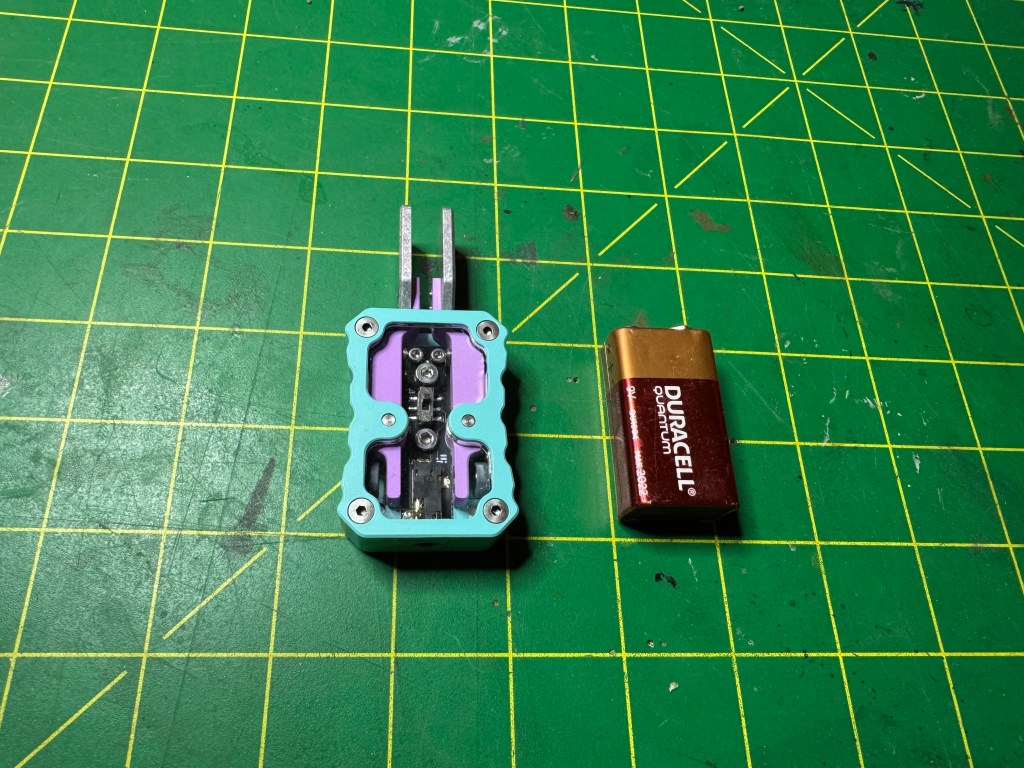
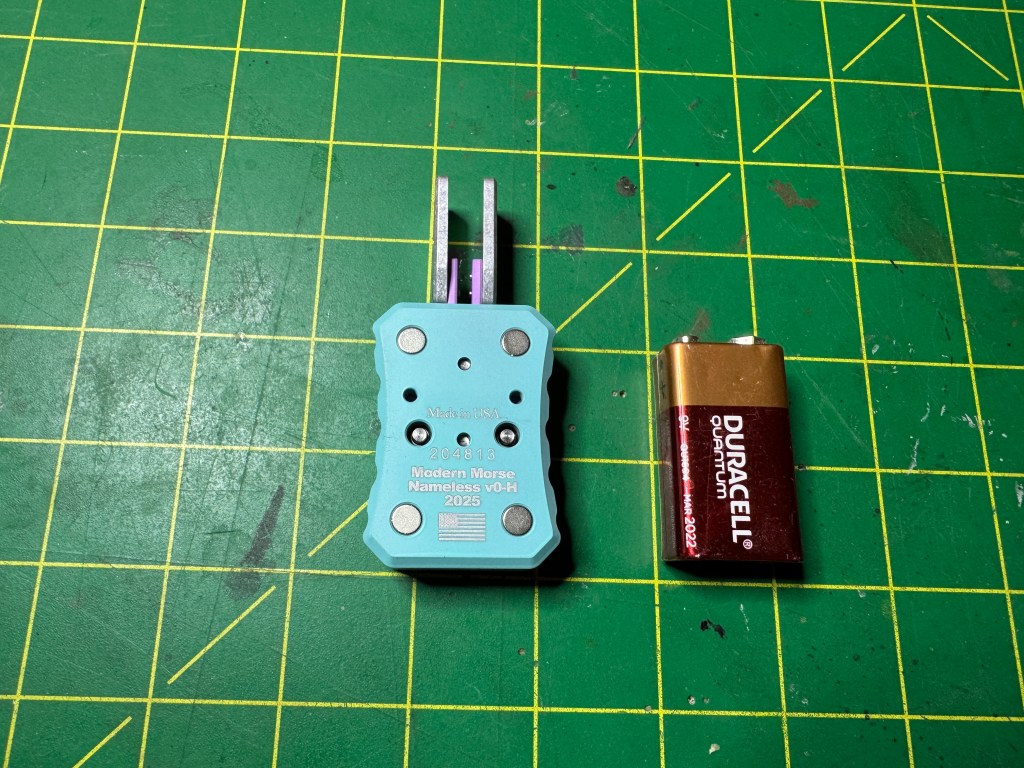
I just received a new set of paddles from Modern Morse. I haven’t taken them out to the field yet, but in house testing shows them to be very promising. They are asy to grip, comfortable in the hand and have a very smooth touch. Workmanship is superb. The paddle body and the arms are Ceracoated and the finger pieces appear to be passivated. The arms pivot on 4 small ball bearings and tension is magnetic. There is a switch inside the paddle to switch dit-dah polarity. This is nice for left handers or “booby-footed” right handers. You can now plug and play with any radio. The paddles come in a nice metal case and two hex keys. The smaller key adjusts the tension and contact spacing and the larger one is for the 4 crews that holds the top of the case to the bottom. The paddle mechanism is sealed with a plastic lid. to get to the switch, you have to loosen the four bolts and carefully lift the top off. Be careful as there are tiny washers on the paddle arm pivots. Another nice feature is the paddles come with 4 magnets on the bottom.

The colors have a nice retro feel and are pleasant to look at. They will certainly be easy to find in a pack or on the ground if dropped. The paddles fit nicely in my hand and I have no trouble sending. These are rugged paddles designed for field use. They are made in the USA by a Veteran. The first run is sold out and there will be a pause before the next run is available. You can check the status here https://www.modernmorse.com. These paddles are pricey but if you appreciate the feel of fine workmanship, they are worth it. I am happy with mine.

Final
Summer got busy and hot. Hopefully as fall approaches I will have more time to get my radios out in the field. I did manage to make it to Field Day with my club and my FT-710. I thought retirement was for leisure but I have never been busier. So much to do, so little time. 73 de Scott

US-2167 Black Rock Mountain State Park and the End of an Era

This month I ended up at Black Rock Mountain State Park. It is one of my favorite parks. I like it because it is located on the top of Black Rock Mountain. The views are fantastic and you couldn’t find a better park to operate a radio. This was a weekday trip. For the past couple of months I tried operating during the week instead of in the weekend. It was okay, I think I like the weekends better.

The weather was beautiful mostly cool with a spot of rain on the first night. I was surprised to see Slate Colored Juncos on the mountain. My mother called them snowbirds because they often proceeded a cold front and sometimes snow. I was near a comfort station and right next tot he camp host. No issues when I put up my 28.5′ random wire vertical.

Radio du jour was my FT-710. I also brought with me my IC-705 thinking I would switch over to QRP and CW on the second day. More about that later. I started out on FT8 and 25 watts. I went QRV on 20 meters around 1900 Z. The band was wide open! I stayed on 20 until about 0200 Z. The first day, I made over 200 QSO’s. Wednesday morning things started out well and then fizzled. In the end I made 453 QSO’s covering 46 states and 16 DX entities. The states I missed were AL, HI, ND, and WV. For DX I got as far north and west as Alaska, as far south as Uruguay, as far east as European Russia. I was hoping the band would stretch far enough west to pick up Hawaii, but it didn’t quite make it. A hop too far.

By Wednesday afternoon the bands were dead and I decided to head back to the house. It was a good run while it lasted and a lot of fun. The only issue I had were people asking for dupes. I only need to work you once and the way band conditions were many stations I needed were a one shot deal. Heard them once and then they were gone. I lost some of those because of people asking for dupes. That means two of us lost. Most logging software will show you if you worked a station before. It’s what I use. As an activator, I try to get as many stations as I can in the log.

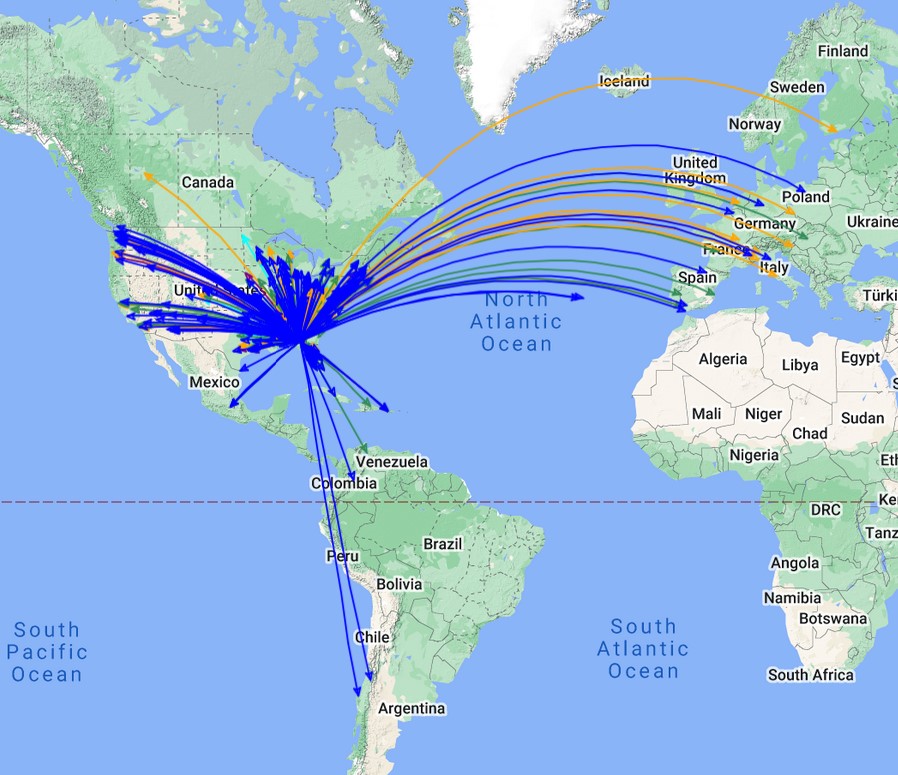
Once the bands died and I realized that QRP and CW were not viable, I decided to pack it up and head home. I left the park early Wednesday evening and was home before dark. All in all a nice trip. Here is a QSO map of the activation.

End of an Era. This will be my last year on WordPress. It cost me between $100-$200 a year to maintain and being retired I need to cut a few corners. What will happen, is I will move back to Blogger which is free. I own the domain name and I will bring that with me. My WordPress subscription, ends March of next year and in the mean time, I will move some of my posts over to Blogger. Mainly the technical stuff. I will also be taking fewer overnight trips and combining some trips with the wife doing more than amateur radio.

Retirement is grand, I wouldn’t trade it anything. With it comes a little more responsibility. If I think I want something on the pricey side, I ask myself if I am willing to go back to work for it. So far the answer is no. Stay safe and 73 de Scott
WGARS Spring Fling 2025

Today was the club’s semi-annual outing and this spring it was one of our old haunts, Cheaha State Park US-1037 in the fine state of Alabama. There are 3 things we as a club like to do, we like to eat, we like to socialize, and once in a while we talk on the radio.

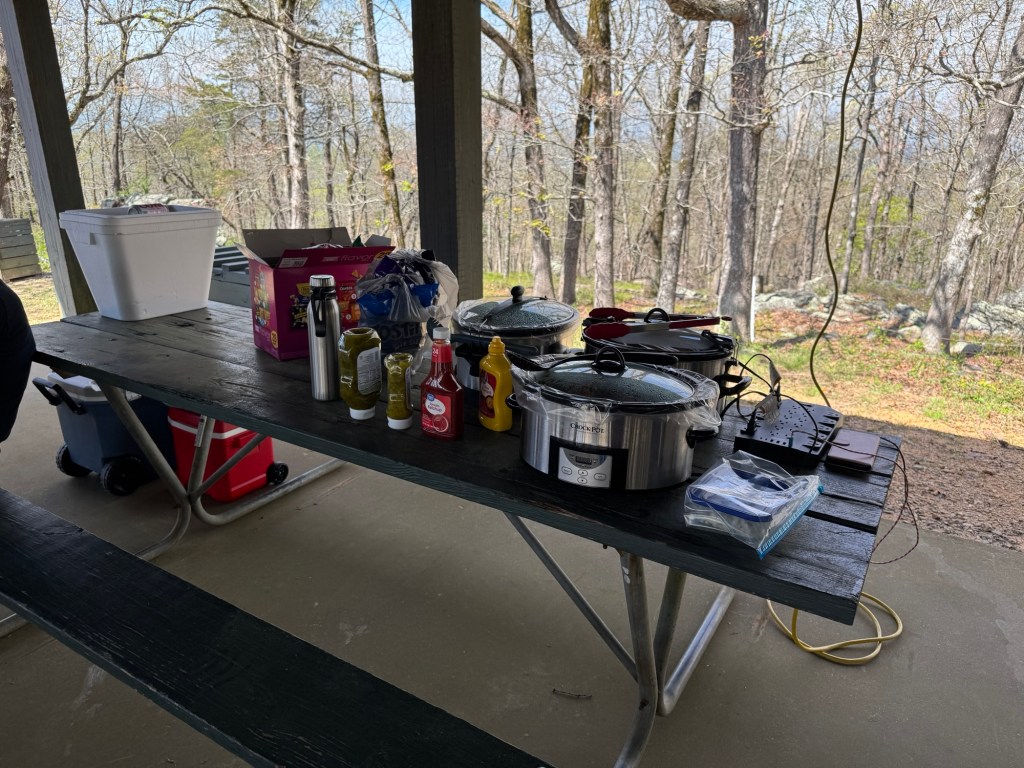
As usual, food was in abundance.

We had several stations set up under the pavilion. QRM was held to a minimum. We had Xeigu G90’s, Tru-SDR, Icom IC-705, and my Yaesu FT-710. I set the radio up and turned it over to the club President John WD8LQT. John, like me is a CW op and I wanted his opinion of the FT-710. I didn’t have to twist his arm too hard. The setup was the radio feeding a Chameleon micro transformer with a 12’ whip and about a 20’ counterpoise. The radio was powered by a 20 amp-hour Bioenno battery and the paddles were a Begali Expedition.

Band conditions were poor and it took John most of the time at the park to get his 10 contacts. There were stops for eating and chatting. Early in the activation, I decided to change antennas to be sure we had an atmospheric issue and not an equipment one. I had my Diamond RHM-12 which recently proved itself to be a good performer. Once the switch was made and some searching through the bands, John started making contacts on 20 meters. I believe it was atmospherics and not the equipment. John got his 10 contacts and we called it good.

John’s comments about the FT-710 were quite favorable. Like any radio, there are pluses and minuses. In general he thought it was a very good radio for CW. There is more commentary from John on the YouTube video posted below. John did have one epic fail. The ear buds he was using which looked rather ancient finally gave up the ghost. I took it upon myself to intervene and unceremoniously threw them in the trash. John will thank me.

My review of the FT-710 is drawling to a close. I find that I like the radio. It performs well for its price point and has some features found on more expensive radios. It has its quirks as all radios do, but none that I find overly objectionable. I plan on keeping the radio and it has found a place among my field radios. I imagine the radio may make an appearance during this year’s Field Day.

Surprises at Laura S Walker State Park

I decided to travel a little further this time and head toward the Okefenokee swamp. this time I tried the Laura S Walker State Park. It was a five hour drive and about 320 miles but fortunately I was able to stay off the interstates for all but about 30 miles of the trip. The park is near Waycross, GA which recently suffered from severe weather. Even though it has been a while there it still plenty of evidence to attest to natures fury. The park itself was in good shape and I had a nice campsite.

I would normally use my 28.5′ vertical antenna but I had a power line that passed almost directly over my truck and camper. I could have requested a better campsite but in the spirit of FunComm I decided to work with what I had. Instead of my usual antennas I deployed a new antenna. A Diamond RHM-12. This is a manual screw drive type antenna that is only about 7 feet tall and covers 40 meters to 440 MHz. With additional coils it also covers 80 and 160 meters. I set it up away from the power lines and used a Chameleon Spike to set it into the ground. I also had 2 counterpoises about 20-25′.

I was a little concerned about its performance. Inside the camper I had My Lenovo Laptop and Yaesu FT-710 with an LDG tuner.

I had a Rig Expert Pro Stick antenna analyzer with me and I was able to get the SWR down below 2:1. I guess I could have monkeyed with to get it lower but since I had the tuner…

I have really taken a liking to the FT-710. It has been performing well and since the last firmware updates, it has become a little champ. It is winning my heart. The radio, tuner, and computer all worked well together. I only ran 25 watts of power as that is about the limit on the antenna using FT-8. I was going to work some CW but the days I was at the park the temps were up around 90 degrees, far from the 43 degrees the morning I left my home QTH. I ran the air conditioning and when it is on I have trouble copying CW. Years in Army Aviation and other loud occupations have affected my hearing.

How did I do? Surprisingly well. In a 24 hour period which included sleep time, I made 400 contacts (7 dupes). I made contacts in 46 states (Not AK, HI, MT or RI) and 34 DX entities! I think that’s a new record for me during a POTA Activation. I got as far west as Australia and American Samoa, and as far east as Turkey, Bulgaria, and European Russia. The bands were up and down and I had to make a few trips out to the antenna to adjust it when I changed bands.

I never expected that little antenna to perform so well. The RHM-12 antenna has been assigned to permanent duty in my antenna kit.

It’s important to take your gear out and use it. Understand how it operates under various conditions. Know what your gear can and cannot do. This is good to know having fun but becomes critical when more is at stake.

Night on Bald Mountain

This trip was to Cloudland Canyon State Park located in NW Georgia. It is a very nice campground about a 2 hour drive from the home QTH. I got at the campground Tuesday, around 2000Z and quickly set up. Radio du jour was the Yaesu FT710 Field which is currently under review. The antenna was my 28.5’ random wire vertical. I am also trying out my Maestro Evolve III laptop along with HAMRS Pro software.

Band conditions were a little off so I started on FT8. It was slow going but I made 15 contacts before the new day. After supper, I went back to FT8 to try to get 15 more contacts before the storms hit.

The whole time I had moderate winds and some pretty good gusts. Right before the storms I lowered the antenna and put a garbage bag over it to keep it dry. The antenna is weather sealed, but the push up pole when it gets wet, is a real pain to dry out.

How about the FT710? In general, I like the radio. I think it’s a keeper. It is fun to use and performs well. It has a few niggles that I camp about but I like it. I talk more about the issues on my YouTube video. I will say that this radio is very different than the first one I got. The first radio was probably released too early and still had growing pains. This radio just feels better. In general I feel this radio and the IC-7300 are about equal. Either one will work well.

Evolve III. This is a pleasant surprise. I paid about $122 for it and for a field laptop it does well. Last night I ran WSJT (FT8) and AcLog without any issues. I was also running. BktTimeSync with a GPS receiver in the background. It is a little slow to start up but once it’s running, it does fine. I run it with a Logitech M310 mouse.

I am also trying out HAMRS Pro. I have it on Windows, Mac, IOS (iPhone, iPad) and they all sync up. I will talk more about HAMRS in a follow up article.

This is Wednesday morning and I am going to try to do some CW before I pack up and go home. Bands conditions are so-so at the moment. I will break my normal procedure are hunt a while to try out some of HAMRS features.

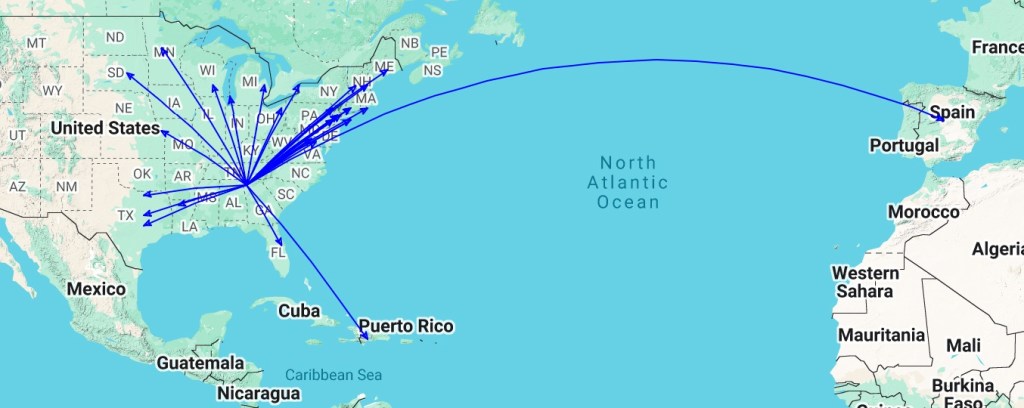
I only managed to make one CW contact hunting and activating. I could tell I was getting out as I showed up on HamAlert. Here is a QSO map of the activation.

Screenshot

If I remember correctly, I had issues last time I was at Cloudland. The important thing was I got out for a while and I had fun. It isn’t always about the numbers. Below is a video about the activation and my thoughts on the FT710. Stay tuned es 73 Scott

Winter Field Day 2025

It was another fun Winter Field Day. Our club, we like to do 3 things: 1) we like to talk, 2) we like to eat, and 3) every once in a while we like to talk on the radio. This year was no different. We had a lot of fun, ate good food, and played on the radios. I think it’s the non-competitive spirit that helps us brave the cold weather. And it was cold this year with temps in the 20’s and 30’s. Not only does this tax our physical comfort, it also taxes our equipment.

Coax cables and extension cords were stiff and fingers went numb but we managed to get 4 stations on the air. I operated separate from the group to try to Get multipliers on JS8Call. I also copied the WFD bulletin and used Winlink to send and receive email. We had one member attempt to make a satellite contact and while he could hear other stations, it appeared no one was connecting. This year we ran QRP. Which was fun. Let me run through the gear and tell you how things worked.

The antenna this year was a 73’ inverted L with the vertical leg at 20 feet. This had a 60’ counterpoise connected to 1.5 KW Palomar Engineering 9:1 UnUn. I use the bigger UnUn because times when I run higher power (up to 40 watts) using digital, smaller UnUns get warm and saturated. This antenna works well down to 160 meters. I made contacts on different bands out to the west coast. A fail I had was I used a Chameleon RF choke next to the UnUn. It blocked all of the signal to the radio. Once I removed it, things were fine.

The radio was my new Yaesu FT-710. The radio worked well with no real issues. A quirk of the radio is the AF cuts the volume off louder than other radios. Sometimes when I am operating digital, I like to turn the audio volume real low so I can just barely hear it to keep tabs on what is going on. With the FT-710, it cuts off the volume while it is still louder than I like. Not a deal breaker. One of the benefits of operating a big radio QRP is the controls are easier to get to. While I prefer the ergonomics of Icom radios, the FT-710 is still pretty good. Another quirk with the FT-710 is the waterfall. It is not averaging like other radios, you have to adjust it manually. Overall, the radio performed well and compares favorably with the IC-7300. Either radio will equally get the job done. This radio feels more refined than my first one. It will be going on several more trips I have planned.

FT-710 accessories. I got the tuner issue worked out and my LDG tuner is playing well with the 710. I added Portable Zero rails which not only protects the sticky-outy things, but gives extra finger holds. I consider the rails a must have for portable big radios. Heil Proset Elite. I had to buy another headset for the FT-710 and the Elite was on sale at HRO. My Icoms use an electret mic which requires power. I already had an adapter from when I owned an FTDX10. I’ve been using Heil products for 25+ years and they are my goto. Mouse. I bought a Logitech M310 mouse to go the FT-710 thinking it might be easier to navigate through the menus. However, once I got the radio setup I was only changing a few things and found I didn’t use the mouse at all. I will probably not use a mouse with the 710 and I already found another use for it.

Maestro Evolve III laptop. I think I paid $122 for it. It works okay. It’s not zippy fast but all the software I used worked. It does appear to be RF sensitive though. During transmit, the mouse would freeze and sometimes the app window would close and open. What do you expect for a hundred bucks! One thing I did find annoying was the track pad. It was overly sensitive and would often treat a light touch as an “execute” function doing something I didn’t want it to do. My solution is to take the Logitech M310 mouse and use it with the Evolve III. A cool feature is I can run the Evolve off of my radio power supply or battery. Less “stuff” to deal with. The power plug for the Evolve also fits older Icom and Kenwood HT’s. The Evolve worked with my GPS receiver and I was able to easily sync the time for JS8Call. I will be taking this little laptop out again.

JS8Call. I think this will be the last time I use JS8Call. I was never fond of it and running a contest with it is almost a nightmare. For WFD, it doesn’t sync well with ACLog. People would send their Class and section info out without attaching a call sign to it so you would get something like 1O OH… and nothing else. That would be okay if only one person does it but when 2 or 3 others do it at the same time, you don’t know who is who. That and there wasn’t really enough JS8Call stations on the air to make it worthwhile. CW was the same for WFD. There were other contests going on. It appears the money maker for WFD is SSB. Which is interesting because the EmComm community relies heavily on digital modes.

As a group, we had a lot of fun. We always enjoy getting together. I had fun and I got to test my equipment. It is reassuring to have the knowledge that your equipment is ready. Even when I go on one of my FunComm trips, I load things up and go. I don’t have to check them because I already did. Final thoughts? Listening to the CW contests over the weekend reinvigorated my love for CW. I have been away from it while getting up to speed with MARS and SHARES, but there is still something to be said for the simplicity of me and the key. Hopefully, this will be a better year than last year, and I can get back into the swing of things. Stay safe, stay warm es 72 de Scott

POTA Activation K-2187 with the Yaesu FT-710

This weekend, I tried a new park, The James H. (Sloppy)Floyd State Park. With a name like that, what’s not to like. It’s a beautiful quiet park that is not too far from the home QTH. How convenient I thought.

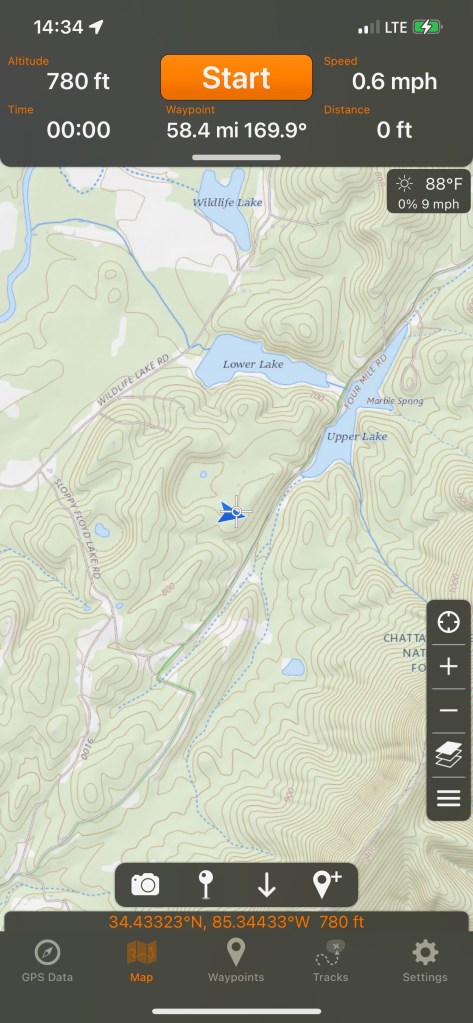
The Trouble I discovered was the park is located in a river valley. My campsite was well below the ridge and hilltops. It wasn’t until later that I checked my topo map. In addition, the bands were not in good shape but hey, I’m up for a challenge.

It is a beautiful park with lots of peace and quiet. The setup was my usual, my 28.5′ Random Wire antenna with the Yaesu FT-710. In hindsight, I should have rigged the antenna in a horizontal orientation rather than a vertical one to take advantage of NVIS or Near Vertical Incidence Skywave propagation. I have been reviewing the FT-710 and I thought I would finish up with the POTA Plaque weekend using CW. I even left the laptop at home to avoid temptation. I used HAMRS for logging and kept a notepad handy for scratch paper. Another thing I wanted to try was going paperless.

I started by calling CQ POTA but that wasn’t really getting me anywhere, I made a few contacts, but the deck was stacked against me. I switched over to Search and Pounce (S&P). I was going to do S&P but not right away. I wanted to S&P so I would be working with other activators. Making contact with someone who has a tribander and 1,500 watts is no challenge. Working other activators really gave the 710 a workout. I had to twist knobs and turn dials for a lot of the contacts. Many were S0 signal strength and often down in the static. It was a good test of the receiver. When I finally went QRT sometime around 1845 UTC and had 52 contacts. Not a lot, but each one a challenge. You will notice in the photo above, I have a weight on the paddles. To operate one-handed I need the extra weight to hold the paddles still. The weight is 500 grams or about 1.1 lbs.

How did the FT-710 do? Quite well. I was pleased with its performance. I was able to work stations I could hardly hear. The filtering worked very well. The DNR does get a little watery sounding as you increase its presence. I usually kept it between 2 and 6. With this radio and any SDR radio, RF gain is your friend and Preamp is not. Sometimes dialing in (actually taking out) a little RF gain is just enough to make that signal pop.

Issues? A few but none earth-shattering. When using headphones sending CW, there is clicking as the code is being sent. It happens at all volumes. It’s a little annoying, but not irritating. Another niggle is using the clarifier. When the clarifier is engaged, it uses the main tuning dial to adjust it. You have to turn off the clarifier to change the frequency. Yes, you can use the Step/Mch knob, but the lowest step is 1 KHz. The 7300 does not use the main tuning dial to set the clarifier.

One thing the 710 has that the 7300 doesn’t is the ability to send CW while in SSB mode. I really like that feature and I use it. The 710 is a likable radio and compares favorably with the 7300. Each has its pluses and minuses and I feel in the end, they equal out. I own both and unless you have a specific need for a specific feature that one or the other has, I think either one will serve you well.

This go around I used the HAMRS app on my phone to log contacts. I have the iPhone Max so I have a bigger screen and it wasn’t that difficult to keep up. Things did get a little dicey when signals were down in the noise but with a little more practice, it (and I) will be fine.

Even though my activation didn’t turn out as well as I expected (through no fault of the radio), it was a beautiful weekend to be out and about. I may not try another activation here, but it is a nice place for some peace and quiet. Until next time, 73 — Scott

POTA Activation Kolomoki Mound State Park and First Kilo

This past week I got to spend a few extra days at a park. My Church Youth Group was camping at this park and I offered to set up an amateur radio station to showcase what it can do.

The park is one of my favorites. It has a small campground and it is always peaceful and quiet.

There are a couple of and lakes fishing is one of the activities available here. You can also rent kayaks for a bit of a paddle. My campsite this go around was nestled back in the trees, and while there was a campsite right next door, the campers were quiet.

The antenna I used was my 28.5′ random wire antenna up a 31′ Jackite push-up pole. I got the green one and as you can see above, it almost disappears against the foliage.

Like last time, I had to mount the antenna to the truck due to trees over the camper.

Two new additions to the camper were screens and a radio desk. The screens were a kit designed for the camper. Installation was simple. You attached metal disks in the appropriate places and the screens attach by magnets. I mainly used the screens on the back door. It gave me a more open feeling and with the roof fan or A/C, I was able to keep the camper quite cool even in 85-degree heat. By keeping the side door closed, I had a nice breeze at the back. The desk was covered in a previous post but this was the first real workout it got. Here is a picture of the setup I used this weekend.

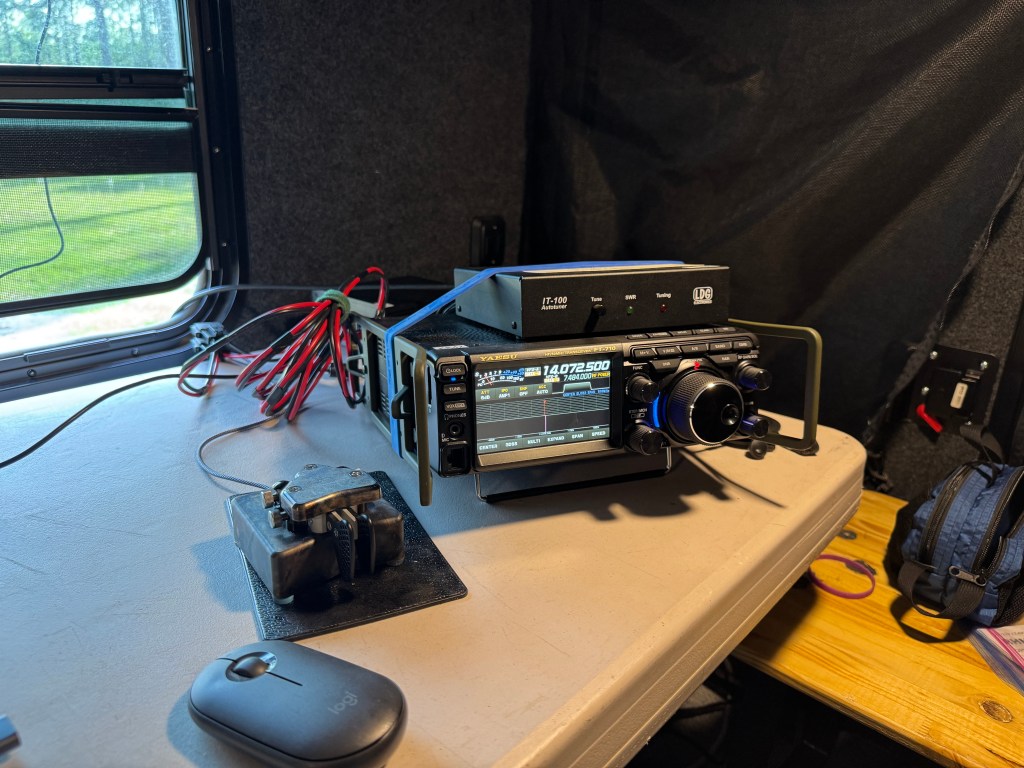
This would be a typical setup. There is room for a key (paddles) and everything is within easy reach. On the top shelf is a switching power supply, a Yaesu FT-710, LDG RC-100, and a Garmin InReach Messenger. This was another good workout for the FT-710. band conditions were good on Tues and only fair on Wednesday. My mode of choice was FT8. I was within 330 contacts of a Kilo and knew I could get it done. I ran the FT-710 pretty steady at 45 watts for almost 12 hours. The radio did not get warm and no hiccups were noticed. The screen is easy to read and most of the controls are in the right place. I find that in the field, the 710’s main menu, is a little too busy. Sometimes I have trouble finding the option I wish to change. Overall, the FT-710 is a likable radio. I am going to do some CW POTA Activations with the radio in the near future. I still feel that the FT-710 is very comparable to the IC-7300 and whichever brand you are married to, get that radio. If you are a new op or have no brand loyalty, I would still recommend the IC-7300 over the FT-710, because I feel the ergonomics are better. I still plan on keeping both radios.

Garmin InReach Messanger. This trip was the first time I took the InReach Messenger to the field. Cell service at Kolomoki is very spotty. A nice feature of Messenger is it uses an app on my iPhone. The app is very similar to other SMS apps. Once I got there, I was able to send a quick text home along with my location, downloaded the current weather, and spot myself on POTA. Messenger is so much faster than my old InReach (the first clunky big one). It is now a regular part of my kit and will be a boon to EmComm and FunComm.

FunComm. I have used this term a few times lately and probably need to explain it a little. Among other things radio, I am deeply involved in EmComm or emergency communications. I practice EmComm at home and in the field. Most of the time, the gear you see me take to the field, is the same gear I would take to an emergency. Enter Fun Comm, FunComm is using your EmComm gear for fun doing something like POTA. Each time I go out, I learn more about my gear and its capabilities. Everything is used, tested, repaired, or replaced. I know my gear. I have been to real-world emergencies, and I have had operators come up to me and tell me if I can help them fix their radio, they could be of help. Don’t be that guy. I have had my share of oops and blunders, but I take each experience and build upon it. Now, once a month me and my gear are tested, in a fun way of course. And if something fails, I lose a few contacts, and no harm is done.

How did I do? Not bad really. I made over 400 contacts using FT-8 from 41 States and 20 Countries. Here is a QSO Map.

Here is a video of the activation.