Happy Birthday to me and FT-710 Day 2

For my birthday, my wife bought me a JackTite 31′ pushup pole. I’ve had my Mfj-1910 pole for about 15 years and bought it used for $25. On my last outing, the joints were starting to slip. This time I went with JackTite. It’s a 31′ pole instead of a 33′ but it has a sturdier tip.

The MFJ is above and the JackTite is below. Overall they are about the same size.

The only mod I did was add some Gorilla Tape where the pole rubbed against my trailer hitch flagpole holder. Hoisting up a 12ga insulated antenna wire the tip does have a little sag but not near as much as the MFJ.

I normally tape the wire to the pole at the top three sections using a little electrical tape. 3M Super 88 is my go-to. The joints are tight and secure and the JackTite has a sturdier construction than the MFJ. I will take it out on my next camping trip. I’ll keep the MFJ as a spare.

Update on the FT-710. Yesterday, I spent the day setting up the radio. I’m not much of a tweaker once I get things set up, I get on the radio to operate and make contacts. If you look at military or commercial HF rigs, there is very little to tweak. I think I am close to where I like it. One very frustrating issue was getting the radio to operate FT8. I got everything to work except the audio on transmit. The software would key the radio, but no sound. I turned on the monitor and could hear it through the speakers, but the radio would not transmit it. so zero watts out. I worked on this for a couple of hours. Finally, I checked to see if there was a firmware update and there was. Duh, I know! The update fixed the issue, but really! The radio should have never left the factory like that. With the popularity of digital modes, that should have been a priority. Come on Yaesu!

On a good note, my first contact on FT8 was Turkey. First (or second) impressions. My intended use for this radio is a field radio and as such, it will work fine. My other radio is my trusted IC-7300. I’ve had the Icom for 7 years now and know it quite well. My field box is set up in such a way that to swap the radios out for a trip, all I have to do is swap the radio and the microphone and I am good to go. I pretty much bring the same things every time I go out. I am involved in EmComm and it pays to know your gear.

Where does the FT-710 fit in? I always thought that comparing the IC-7300 to the FTDX10 was unfair, but a lot of people did, and that should tell you how people think about the radio. I don’t think anybody will be comparing the FT-710 to the IC-7610. Today, I would place the FT-710 slightly behind the IC-7300. They are both good radios and if you are married to one manufacturer, then by all means stick with that brand. I have 2 Icoms and now I have 2 Yaesu’s, The FT-710 and IC-7300 will be my field radios. Currently, I do not have any intention of selling either one. Like the FTDX10, the FT-710 will be a long-term review. I wouldn’t worry about the Rob Sherwood numbers too much; it would be rare that the FT-710 would need that kind of filtering horsepower. The IC-7300 will hear everything the FT-710 will hear. I am looking forward to bringing the FT-710 on my next trip. 73 — Scott
Syncing Computer Time

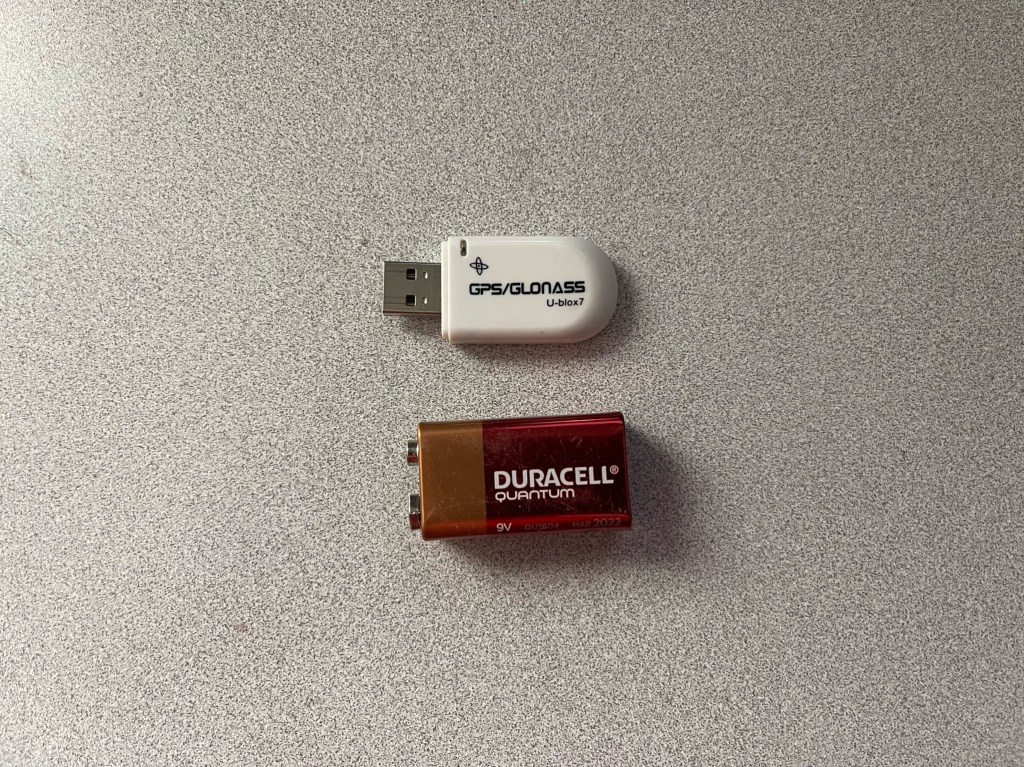
Digital modes have become a mainstay for Amateur Radio. Digital modes are used for conversations, chasing DX, POTA and SOTA, and for EmComm. Indeed we have come a long way even from the turn of the century. Some of these new modes require accurate time synchronization between the receiving and transmitting radios. Off by more than a second or two and the machines will fail to communicate. While operating from home or anywhere else where the internet is available, syncing time is easy-peasy. But what about those times when the internet and even cell service are not available? The easiest way I have discovered is to use the time signal from GPS satellites. It’s pretty easy and the cost is minimal. All you need is a USB GPS dongle like this one:

These can be found on Amazon for about $13. https://tinyurl.com/2p9enmsv.
Next, you’ll need a piece of software that will take the GPS signal, and adjust the computer clock. The one that works the best for me is BKT Time: https://www.maniaradio.it/en/bkttimesync.html


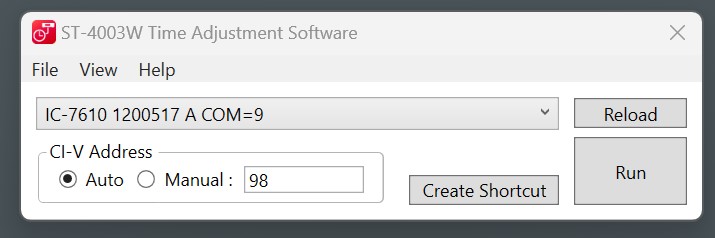
For those that have Icom radios, You can also sync your radios date and time to your computer using an app called ST-4003W which can be found here: https://www.icomjapan.com/support/firmware_driver/3428/

The whole process is pretty easy. I’ve included a short YouTube Video to help you along the way.

Just remember, I am not a great videographer, but the video will give the nuts and bolts on how to sync time. 73 – Scott

My Field Radios

Taking a little break from activations and hunting, I thought I would showcase my field radios as it stands today. I recently culled the herd and this is what I ended up with. The power draw was measured using a Watts Up inline meter, something like this: https://tinyurl.com/yc6yfvsd. Not lab quality, but certainly enough for this article.

Most of my recent activations have either been camping with my little teardrop camper or in my truck for a day trip. The desire to trek to a destination is not as romantic as it used to be. Often my radio time is fitted in with my other responsibilities.

Before I go down my list of radios, I want mention that my modes of choice are CW and Digital with CW generally being my preferred mode. When band conditions are poor as they have been these past few months I use FT8. Some might say that FT8 is easy or point and click, but to be a successful FT8 operator does take some skill.

My first radio is my IC-7300. Because of band conditions these past few months, it was my radio of choice because it is a 100 watt radio. In the field, I normally operate in the 5-10 watt range, but when the bands are bad I am in the 25-35 watt (and sometimes more) range. I also want to note that over the past few months I was working on my N1CC award which is working 10 bands at 10 different parks. Most parks are a couple of hours drive away from me so I try to get my 10 bands over the course of a weekend. Because gas prices are elevated, returning to some parks may not be an option.

I’ve had this IC-7300 since 2017. It’s a great radio and a great field radio. I have 4 radios that share much of the same menu system so I do not have to relearn the radio everytime I take it out. The filtering is excellent. The noise floor is lower than many other radios by a factor of 4. I have worked stations were the meter is not moving indicating a less than S1 reading.

With Icoms, antenna tuner integration is a simple cable connection and will also power the tuner. The only mod to the radio is I added a set of Portable Zero 7300 Escort guards https://portablezero.com/icom706.html. The radio rides in a Dewalt Tough Sytem medium case with no additional padding https://tinyurl.com/2sw8u9ub. The guards protect the knobs from bumping into the sides of the case. They also make great handles. Power consumption for this radio at idle with nothing connected to it is 0.81 amps or 810 mAh. For a 100 watt radio, that’s pretty darn good. The paddle I use with this radio is a Begali Traveler Lite. I am a fan of Begali paddles.

The next radio is my current favorite QRP radio, the IC-705. This radio is brillant. Icom packed a bunch of goodness into a samll package with an idle amp draw of 220 mAh with the charger off and 360 mAh with the charger on. That’s right down there with many other QRP rigs.

My 705 travels with a 3D printed cover for the face inside a MTM Ammo Crate https://tinyurl.com/y4j6t4nu. These are great cases for small radios and their accessories. A nice feature for this radio is it and be linked/controlled via Bluetooth. I have run FT8 and logged on my iPad using an app called SDR Control https://roskosch.de/sdr-control/. Another brillant feature of the IC-705 is it can be recharged via USB. That means both my iPad and the IC-705 can use the same charger. Some complain that the IC-705 is too heavy. When you realize that you do not need an HT for VHF/UHF (plus you get 10 watts of power), no cabling needed to hook the radio up to a laptop and as a bonus can use an iPad, and, can be charged via USB, you may have an actual savings of weight. No, it doesn’t have a built-in tuner and that has never bothered me. I have the AH-705 tuner and it is amazing. I use it to tune random wire antennas and can tune them without a UnUn or Balun. I would say the AH-705 tuner is on par with an AH-4 or even an SG-237 albeit at lower power.

The paddles for the 705 are Begali Adventure Dual. Big performance in a small package. Like all Begali products, they must be tried to be appreciated. I also use the Begali stand for the 705, it does a good job preventing the paddle from moving without adding a lot of weight. The screwdriver is a Nite-ize KMT-11-R3 that I modified by narrowing the screwdriver blade. I also have the begali base so I can use the paddle with other radios.

The paddles are stored in a little 3D printed box which holds the paddles, the base and the screwdriver. To the left of the box is another steel base from American Morse Equipment. The Begali base is a little light but has magnets on the bottom to attach to the AME base. Together, they work perfectly.

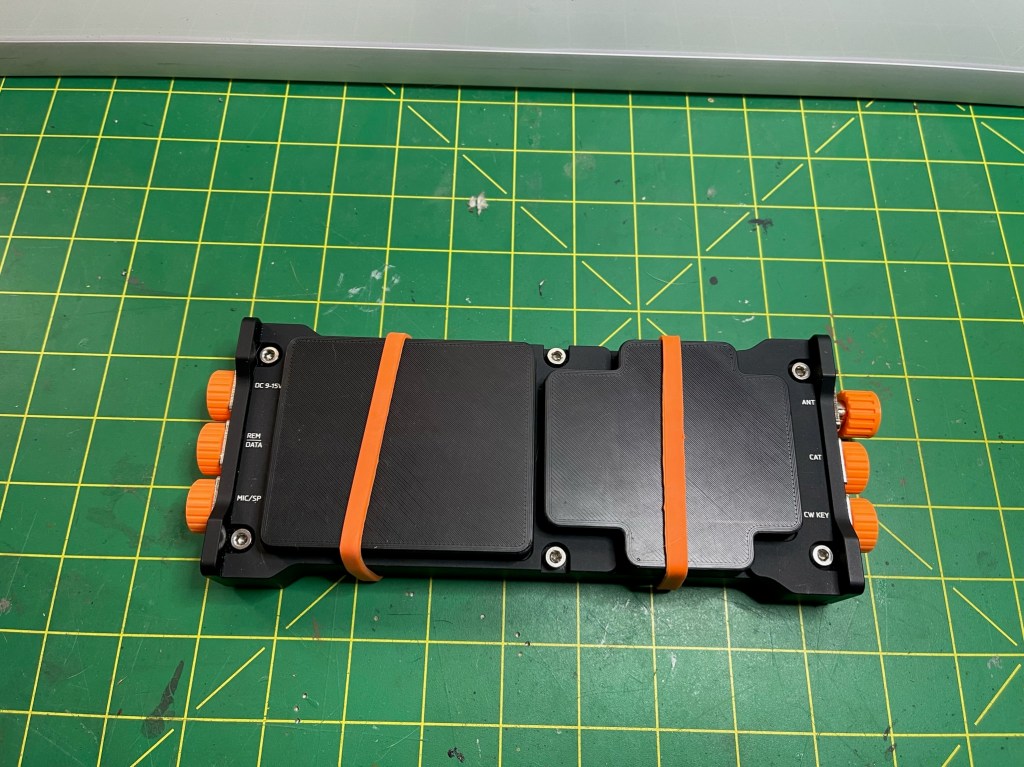
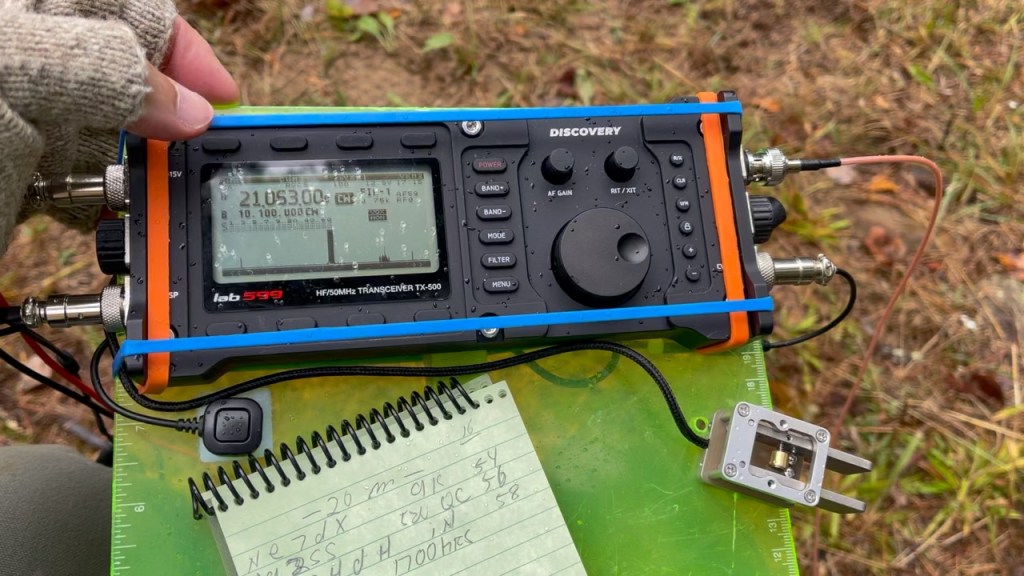
Last but not least is my Lab599 TX-500. This is a great rig for many reasons. Lightweight, simple to use, weather resistant and draws less than 100 mAh idle. It includes a waterfall on the easy to read LCD display. The receiver specs are pretty decent and I have not had any issues using it. I normally pair it with Elecraft T-1 tuner and Bioenno 3Ah battery. For travel I use 3D printed covers.

The paddles I use for this radio are Larry’s N0SA SOTA paddles. These are great paddles but last I heard he is no longer making them.

What is nice about these paddles is they are easy to hold in the hand and can be mounted to a flight deck.

These are my current radios and the paddles I use with them. Is this list set in stone? Of course not, you never know what you might find just around the corner. However, I could be quite happy with these. They are all good perfromers that give me a lot of latitude when operating in the field. Now that my N1CC is complete, I can worry a little less about quantity and a little more about quality. Hope to hear you out there — 73 Scott.