Shack Shakeup Continues

I have a stable of radios. I like radios. I have spent the past couple of years going through radios and finding the ones I like to use. I think I am getting close. In the shack, I like my IC-7610 and TS-890. They are big and all the controls I use are easy to get to. There performance is top notch. I am content.

QRP radios. This has been my greatest controversy. When I retired, I thought I was going to do a lot of QRP with little radios and maybe even do some SOTA. It didn’t turn out that way. I found myself using big radios at low power. They are easy to use and because of their heatsinks, they never overheat at low power. I did keep one little radio the IC-705, of all the little radios I had, the 705 was the one I grabbed the most.

Field radios. I went through a bunch of radios here too. I kept my IC-7300 which I bought new and has stayed with me over the years. I may sell it off for the new IC-7300MK2. I recently acquired a TS-590sg which went with me on my recent POTA activation at Black Rock Mountain State Park.

It was definitely a fun radio and I look forward to using it more in the future. Yesterday, an IC-7200 was delivered by UPS. The was a trade I had in the works. I always wanted an IC-7200. It’s a basic radio that has a military vibe to it. Being a Veteran, it appealed to me. The radio came with the rails and the MARS mod was already done. The radio is pristine. Power draw at idle is about 1 amp and at 20 watts it draws about 8 amps. Lowering the power level does not overly change the amp draw. Above 20 watts and the amp draw increases. Twenty watts is the happy medium. Here in the shack I had it turned on and was able to work N0SA. I have a set of his SOTA paddles from his last run before he retired. They are fun to use. I plan on taking the 7200 on my next POTA adventure.

During the past couple of years after making many POTA activations, Field Days (winter and summer), Army MARS, and SHARES I was able to shape how I operate. Some of it was a surprise as I was led in a different direction than when I started. I guess when it comes to radios, I may march to the beat of a different drummer. I prefer big radios (IC-7300 size) over little radios. I like that the controls are easier to get to and they don’t overheat. In the field I usually run around 20-35 watts. Most of the time I am in my micro-camper so I am not carrying the radios very far. I may have to lug them 50 feet to a picnic table. I recently bought one of those folding wagons so weight is no problem.

Another surprise was my use of FT8. Band conditions on many of my outings was poor. If it wasn’t for FT8, I may not have had a valid activation. Plus, I discovered I could work a lot of DX while in a park using FT8.

Yaesu’s. I don’t have any Yaesu’s. I have tried to like them, but they are just not for me. I had an FTDX10 for about 18 months, a FT-710 for about a year total, and a FTX1 for a couple of months. To me they are kind of quirky. The Icom’s and the Kenwood’s are solid performers and the ergonomics are superior. I know how to make them dance and sing. I know there are those who love Yaesu and I get it. To each his own. Find the radios that suit you best and enjoy them as I have. The journey is half the fun. 73 de Scott

Dear Yaesu, New Paddles, and Life on the Farm

Dear Yaesu,
What has happened? Have you forgotten us? I don’t understand your thinking when it comes to the FTX1. The FT-817 and its variants sold well for over 20 years. It is still a cherished radio and has a strong following. The FTX1 is an okay radio. It would appear to compete with the IC-705 and as I have said, it doesn’t really compare. In the realm of QRP radios the IC-705 is still better then the FTX1.

I think many of us were hoping for an improved FT-817/FT-818. The FT-817 had a nice form factor and only weighed ~2.5 lbs with a battery and antenna. The FTX1 is clunky and weighs ~4 pounds without an antenna. I still haven’t figured out the best way to carry it.

What would be a nice QRP radio? My suggestion is taking the form factor of the FT-891 and making it a 10 watt radio (20 might even be better). Replace the the 100 watt finals with a battery or a decent antenna tuner (10:1 matching?). You could even go so far as make it an SDR radio. Make a nice pouch with a shoulder strap to carry it. Most people who run QRP don’t have a need for a waterfall. Instead use the USB port to send the signal to a a tablet/cell phone/laptop to view the waterfall there. You can also allow connectivity to a tablet/cell phone/laptop for digital modes and logging. That might put you on top again.

I don’t understand the Optima option. ~$1,900. Right now, I can get a FT-710 for $955. That would leave almost $1,000 for another radio or two. The FT-710 is a better radio. I have an FT-710 and I think it is one of your better efforts. I recently used it for Field day and it did very well. I have an FTX1 and I’m keeping it for a while to see what you do with it.

Yes, I have a preference for Icom radios, they work better for me. I have had other Yaesu radios namely FTDX10, FTDX3000, FT-950 and years ago an FT-817. I also run a Kenwood. I use what works best for me. I am not necessarily bashing you, I am offering my opinion for your consideration.

Sincerely,
Scott KK4Z

Note: right now I am not sure how the FTX1 fits into my lineup. As I said earlier, I think the IC-705 is better (at least for me YMMV). If I need something lighter I have a KX2. For Field Days and bigger events I can bring either an FT-710 or IC-7300. When I purchased this radio I was also looking at a KX3 with KXAT3 and KXFL3. Maybe if the right trade comes along…

Working on the farm.
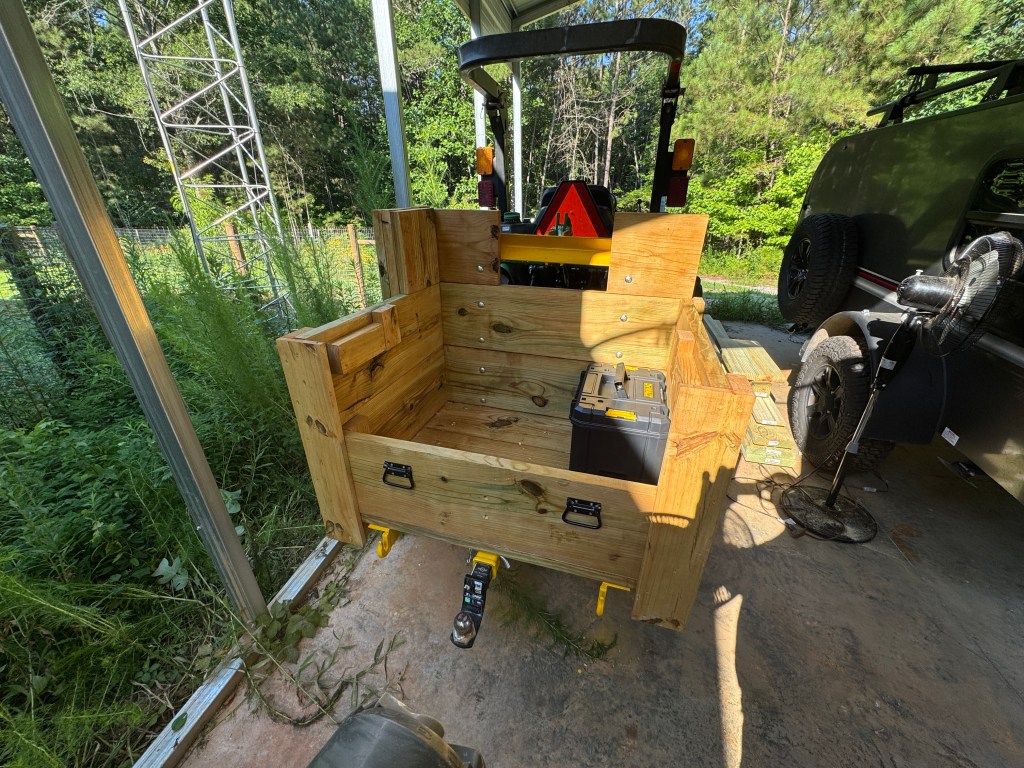
I have been busy on my property. I have 6 acres to take care of and there is always something to do. Right now I have to start getting firewood ready for winter. That means dragging downed trees to the process area, bucking, splitting and stacking. I have a John Deere 3025 tractor to help me out. A problem I was running into was how do I get my gear out to where I am working. The front end loader is okay to carry things until you need it for something else. Besides the steel of the bucket is not good for a chainsaw blade. In the past I would sometimes use my wife’s UTV. That has it’s own set of problems namely, she uses it for her stuff and it stays full. So I decided to build a cargo box for the 3 point hitch on my tractor. I got a carry-all from King Cutter which allows me to use my iMatch quick hitch.

I stopped by my local welder and had a 2″ receiver welded on along with some grab hooks. The finished project looks like this.

I can flip the tailgate up and turn it into a workbench.

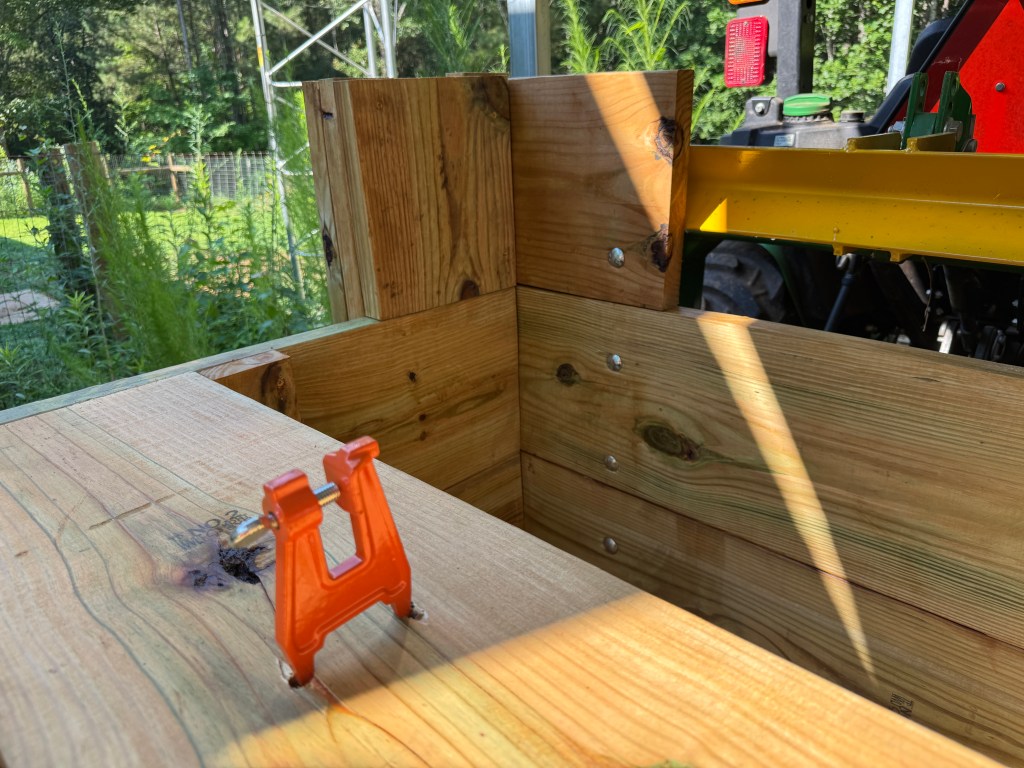
I drilled a few holes so I can mount a chainsaw vise to sharpen my chainsaw in the field.

You can see the chainsaw sheath behind the vise. It will hold my 68cc chainsaw with a 27″ bar safely.

I use a 20′ shipping container for my maintenance shed. It’s hasn’t been reorganized since we initially filled it up almost 6 years ago. Another project is to get things in the shop sorted and non-essential stuff moved to one of our other outbuildings. I need to make it more of a workshop and less of a storage shed. There are always projects to work on.

New Paddles
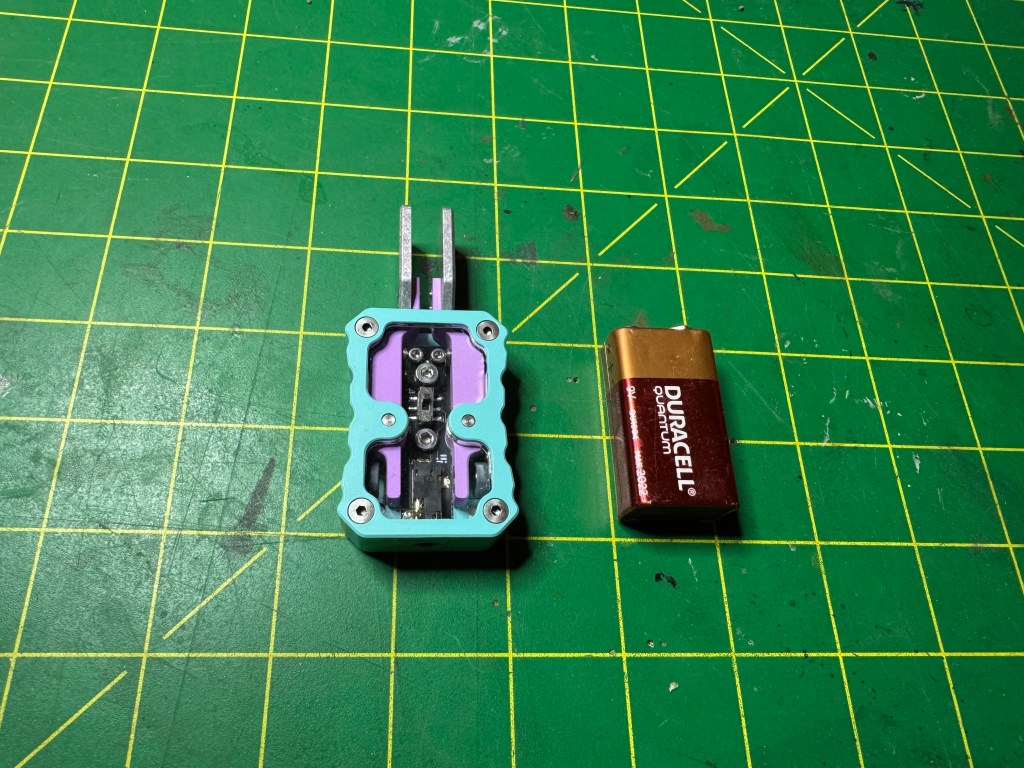
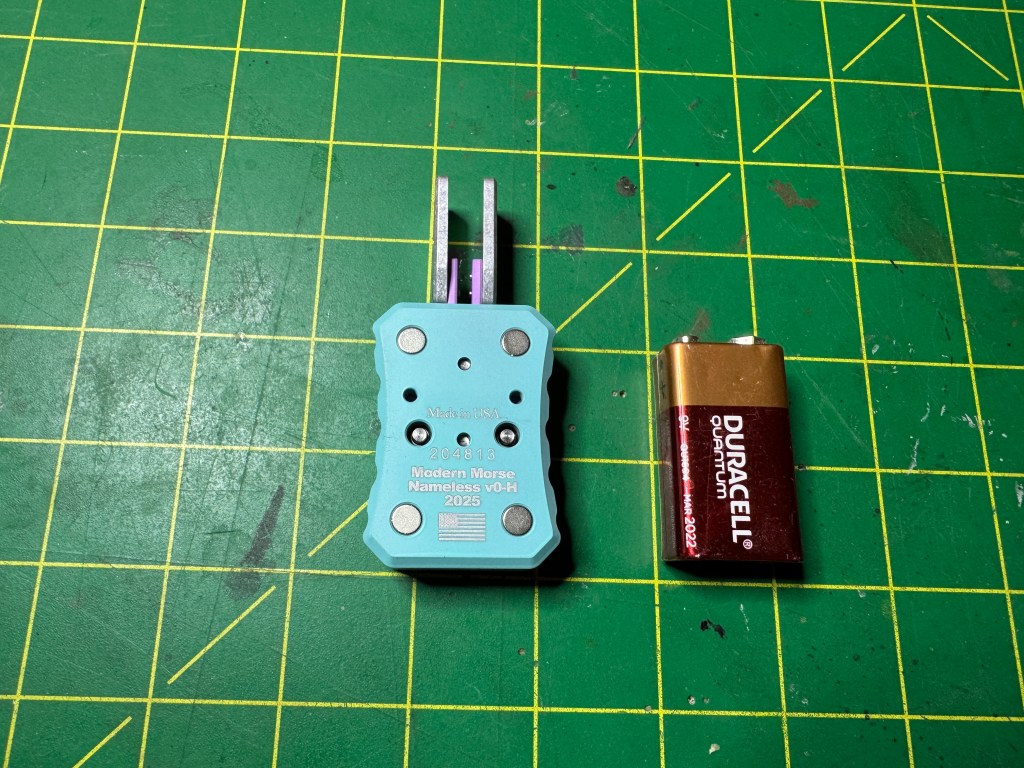
I just received a new set of paddles from Modern Morse. I haven’t taken them out to the field yet, but in house testing shows them to be very promising. They are asy to grip, comfortable in the hand and have a very smooth touch. Workmanship is superb. The paddle body and the arms are Ceracoated and the finger pieces appear to be passivated. The arms pivot on 4 small ball bearings and tension is magnetic. There is a switch inside the paddle to switch dit-dah polarity. This is nice for left handers or “booby-footed” right handers. You can now plug and play with any radio. The paddles come in a nice metal case and two hex keys. The smaller key adjusts the tension and contact spacing and the larger one is for the 4 crews that holds the top of the case to the bottom. The paddle mechanism is sealed with a plastic lid. to get to the switch, you have to loosen the four bolts and carefully lift the top off. Be careful as there are tiny washers on the paddle arm pivots. Another nice feature is the paddles come with 4 magnets on the bottom.

The colors have a nice retro feel and are pleasant to look at. They will certainly be easy to find in a pack or on the ground if dropped. The paddles fit nicely in my hand and I have no trouble sending. These are rugged paddles designed for field use. They are made in the USA by a Veteran. The first run is sold out and there will be a pause before the next run is available. You can check the status here https://www.modernmorse.com. These paddles are pricey but if you appreciate the feel of fine workmanship, they are worth it. I am happy with mine.

Final
Summer got busy and hot. Hopefully as fall approaches I will have more time to get my radios out in the field. I did manage to make it to Field Day with my club and my FT-710. I thought retirement was for leisure but I have never been busier. So much to do, so little time. 73 de Scott

WGARS Spring Fling 2025

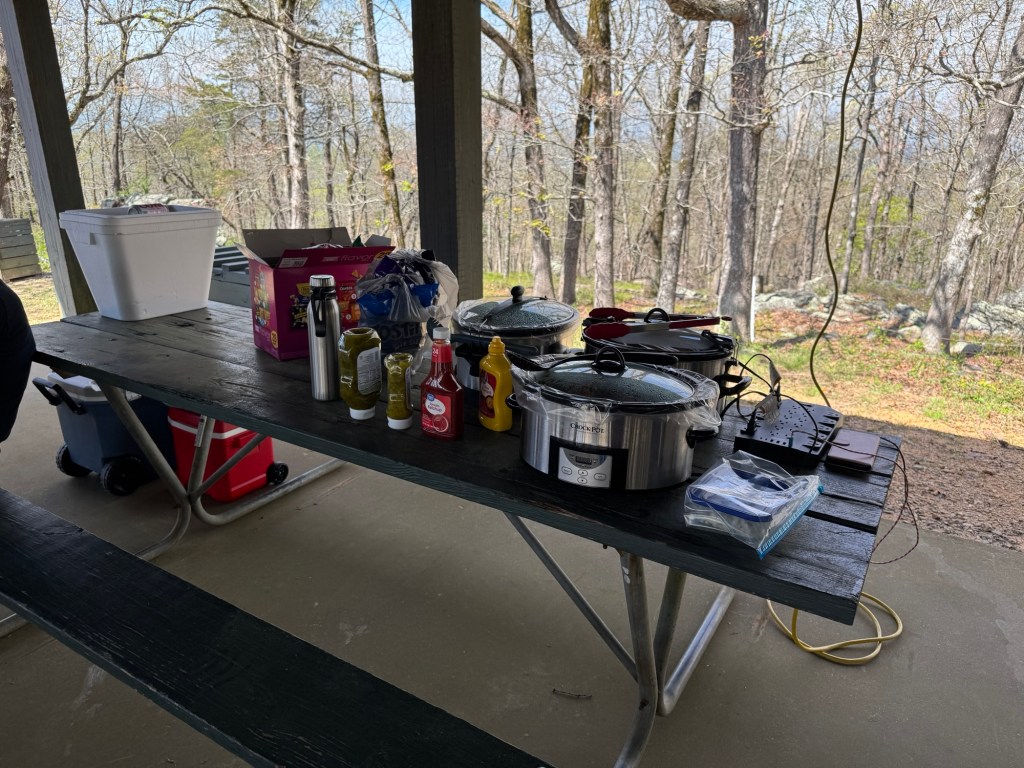
Today was the club’s semi-annual outing and this spring it was one of our old haunts, Cheaha State Park US-1037 in the fine state of Alabama. There are 3 things we as a club like to do, we like to eat, we like to socialize, and once in a while we talk on the radio.

As usual, food was in abundance.

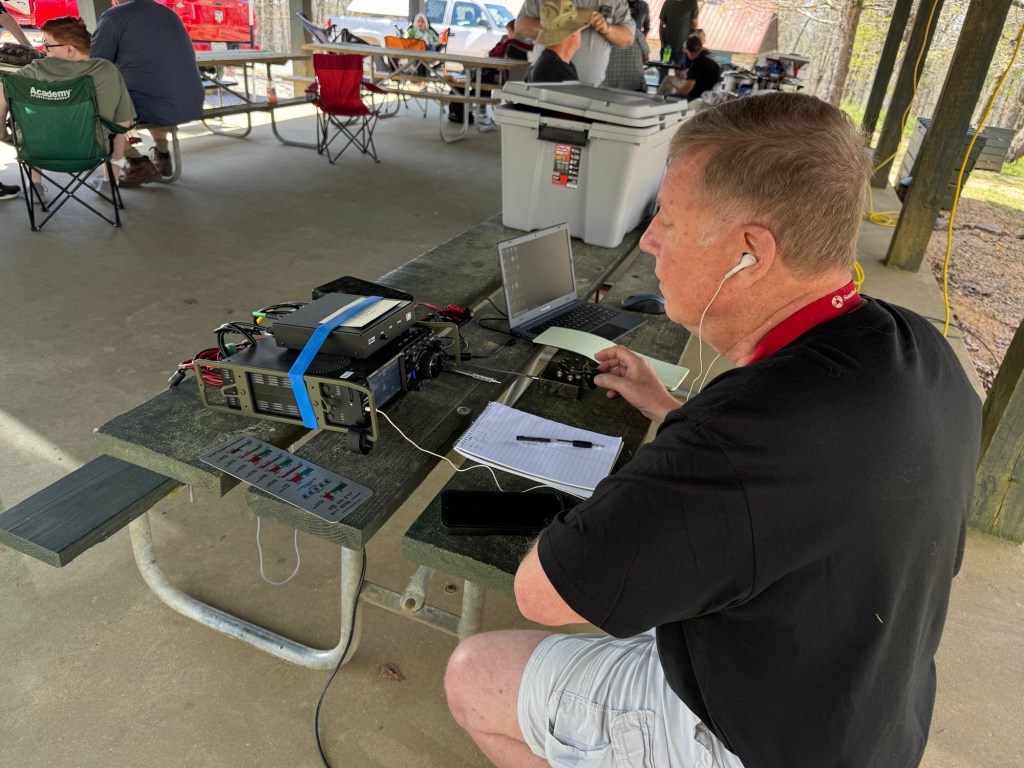
We had several stations set up under the pavilion. QRM was held to a minimum. We had Xeigu G90’s, Tru-SDR, Icom IC-705, and my Yaesu FT-710. I set the radio up and turned it over to the club President John WD8LQT. John, like me is a CW op and I wanted his opinion of the FT-710. I didn’t have to twist his arm too hard. The setup was the radio feeding a Chameleon micro transformer with a 12’ whip and about a 20’ counterpoise. The radio was powered by a 20 amp-hour Bioenno battery and the paddles were a Begali Expedition.

Band conditions were poor and it took John most of the time at the park to get his 10 contacts. There were stops for eating and chatting. Early in the activation, I decided to change antennas to be sure we had an atmospheric issue and not an equipment one. I had my Diamond RHM-12 which recently proved itself to be a good performer. Once the switch was made and some searching through the bands, John started making contacts on 20 meters. I believe it was atmospherics and not the equipment. John got his 10 contacts and we called it good.

John’s comments about the FT-710 were quite favorable. Like any radio, there are pluses and minuses. In general he thought it was a very good radio for CW. There is more commentary from John on the YouTube video posted below. John did have one epic fail. The ear buds he was using which looked rather ancient finally gave up the ghost. I took it upon myself to intervene and unceremoniously threw them in the trash. John will thank me.

My review of the FT-710 is drawling to a close. I find that I like the radio. It performs well for its price point and has some features found on more expensive radios. It has its quirks as all radios do, but none that I find overly objectionable. I plan on keeping the radio and it has found a place among my field radios. I imagine the radio may make an appearance during this year’s Field Day.

FTDX10 or FT710

Yaesu came out with too fairly closely spec’d radios at different price points. The FTDX10 currently sells for ~$1,500 and if you add in the 300 Hz filter, another ~$175. The FT710 Field sells for ~$1,075. Roughly $500 less.

The FTDX10 is a hybrid radio with a down conversion receiver feeding into a Direct Digital Synthesizer (DDS). The FT710 is a SDR radio similar to the IC-7300. I owned an FTDX10 for about 18 months and I am on my second FT710, total ownership time is approximately 10 months. I had the first FT710 a couple of months after the initial release. It wasn’t working the way I expected it to so I traded. About 6 months ago, after reading some of the update material, I thought I would give it another go. My second FT710, this time the field version, is much improved. It is my current go to field radio. I plan on keeping this one. Having used both radios if I had to do it again which one would I pick?

I would pick the FT710. The FT710 has 90-95% of the performance of the FTDX10 for $500 less. In fact, I do not think one could tell the difference between the two in a side by side blind test. There is a caveat, the receiver architecture is different between the two radios and it requires a slightly different skill set. SDR radios like the FT710 basically run wide open all of the time. Keeping that in mind, in most cases it is better to run IPO or attenuation rather than preamp. I almost never run preamp on my FT710. What is nice about the FT710 is it gives you 3 levels of attenuation: 6dB, 12dB, and 18dB; a feature usually only found on higher end radios. In contrast, the IC-7300 only gives you one, 18dB.

The other control you should become familiar with is the RF gain. On a Yaesu, RF gain starts in the fully clockwise position. When there is a lot of noise, slowly turn the RF gain counter-clockwise until only the desired signal is heard. Coming from analog radios years ago, my brain is still a very good filter. I use digital noise reduction sparingly. I often keep it at level 2 or 3, enough to take the edge off.

Perhaps the most compelling reason to chose the FT710 over the FTDX10 besides the cost, is the ergonomics. I have large hands and fat fingers. The FTDX10 clustered its controls close together so I had to be careful when pushing a button or twisting a knob. Even so, I would bump the frequency dial and throw it off frequency. I have remarked that the controls on the FTDX10 were more suited for the lefthand. In fact when it was a part of my home station, it sat to the left side. With the FT710, the controls spaced further apart and are easy to get to even with my big mitts. This is a real benefit for a field radio. The position of the radio or the lighting conditions may not be optimal so ergonomics are important. I find the FT710 a joy to use in the field.

If you are a dyed-in-the-wool FTDX10 owner, this post is not for you. I wrote this for the amateur radio operator looking for their first HF radio, or maybe a seasoned operator looking to venture into the Yaesu family. This is also for those who have limited funds and are agonizing over which radio to get and should they sacrifice funds for the more expensive radio over something else they may need for the shack. The FTDX10 is a fine radio. Its Achilles’ Heel is its ergonomics. The FT710 is a fine radio in its own right. I believe it is 90-95% of what the FTDX10 is but for much less money. Of all the Yaesu radios I have owned over the past almost 30 years, the FT710 is the one I have been most happy with. YMMV de Scott

Night on Bald Mountain

This trip was to Cloudland Canyon State Park located in NW Georgia. It is a very nice campground about a 2 hour drive from the home QTH. I got at the campground Tuesday, around 2000Z and quickly set up. Radio du jour was the Yaesu FT710 Field which is currently under review. The antenna was my 28.5’ random wire vertical. I am also trying out my Maestro Evolve III laptop along with HAMRS Pro software.

Band conditions were a little off so I started on FT8. It was slow going but I made 15 contacts before the new day. After supper, I went back to FT8 to try to get 15 more contacts before the storms hit.

The whole time I had moderate winds and some pretty good gusts. Right before the storms I lowered the antenna and put a garbage bag over it to keep it dry. The antenna is weather sealed, but the push up pole when it gets wet, is a real pain to dry out.

How about the FT710? In general, I like the radio. I think it’s a keeper. It is fun to use and performs well. It has a few niggles that I camp about but I like it. I talk more about the issues on my YouTube video. I will say that this radio is very different than the first one I got. The first radio was probably released too early and still had growing pains. This radio just feels better. In general I feel this radio and the IC-7300 are about equal. Either one will work well.

Evolve III. This is a pleasant surprise. I paid about $122 for it and for a field laptop it does well. Last night I ran WSJT (FT8) and AcLog without any issues. I was also running. BktTimeSync with a GPS receiver in the background. It is a little slow to start up but once it’s running, it does fine. I run it with a Logitech M310 mouse.

I am also trying out HAMRS Pro. I have it on Windows, Mac, IOS (iPhone, iPad) and they all sync up. I will talk more about HAMRS in a follow up article.

This is Wednesday morning and I am going to try to do some CW before I pack up and go home. Bands conditions are so-so at the moment. I will break my normal procedure are hunt a while to try out some of HAMRS features.

I only managed to make one CW contact hunting and activating. I could tell I was getting out as I showed up on HamAlert. Here is a QSO map of the activation.

Screenshot

If I remember correctly, I had issues last time I was at Cloudland. The important thing was I got out for a while and I had fun. It isn’t always about the numbers. Below is a video about the activation and my thoughts on the FT710. Stay tuned es 73 Scott

Yaesu FT710 – Second Impression

Here is my first look at my second FT710. I will start with the settings I changed and then go over the list of issues I had with the first one. The first FT710 had the original firmware as it was new at the time. This one has several updates under its belt.

Settings/Changes

  1. T710,Taped Power Cables every couple of inches to reduce tangles.
  2. Added Anderson Power Poles to the power cable
  3. Turned off 3DSS
  4. Set waterfall span to 5K
  5. Set waterfall speed to slow2
  6. Set color to 6
  7. Set level to +3.5 dB, peak to level 2 and contrast to level 14
  8. Set tuner type to EXT
  9. Set Tuner/Lin Port to Linear
  10. Set keyer to Elekey B, repeat interval to 3 seconds, Weight to 2.7 and Pitch to 700Hz
  11. QSK – on
  12. Set MyCall to KK4Z and call time to 3 seconds
  13. Set Mic gain to 60 and Processor level to 65
  14. CW mode on
  15. Meter Detector to Peak
  16. Receive Audio SSB – Treble +3 Middle +5 Bass -2
  17. Receive Audio CW Treble +3 Middle +1 Bass -3
  18. Parametric Equalizer (processor on/off the same)
    1. E1 – Freq 300 Bandwidth 10 level -3
    2. E2 – Freq 1300 Bandwidth 2 level 10
    3. E3 – Freq 2400 Bandwidth 1 level 10
  19. Needs a 32gb (no larger) SD card. Scandisk Ultra SDHC UHS-I 32 GB works
  20. Mouse. Seems the only wireless mouse you can use with the radio is a Logitech M310. It does not appear to be in production anymore. I had to buy a renewed one. I got the mouse working and I think it is a good addition to the radio. It does make changing parameters easier and if you click on a signal in the waterfall, the radio will QSY to that frequency. I wasn’t sure how I was going to like using a mouse, but I think I like it.

Here are the issues from the first radio:

  1. Could not use LDG tuner with the radio — it was a surreptitious route to get a tuner to work. I started out with a different tuner, an LDG IT-100 which uses a different cable. I coupled the tuner with an LDG IC-108 cable. The cable is not listed as usable on the FT710. The other twist was setting the Tuner/Lin Port “Linear” instead of Ext Tuner. This little tidbit is not shared by Yaesu, I had to find it on an internet forum. To tune the antenna you push the tune button on the tuner (not on the radio) to get things going. This is where Icom shines. They have been using the same interface at least as far back as the IC-718 and the IC-706. A tuner I bought for my IC-706 MKIIG still works on my IC-7300 with the same cable and I can use the tune button on the radio. The other downside is you cannot use the FH-2 Remote pad when using the auto tuner as it uses the same port at the back of the radio. In addition, you cannot run an amplifier and an auto tuner at the same time. Icom has separate ports for the tuner and amplifier.
  2. No Portable Zero Rails – I use rails on all of my portable radios. Portable Zero now makes rails for the FT710.
  3. Could not use RT systems software – it took Yaesu until July 2023 to get the info to RT Systems. I have RT Systems software for almost all of my radios. RT systems software works fine now.
  4. Auto Notch — I don’t remember auto notch working on the first radio I had. It works now.
  5. Cannot edit/see QMB – another place where Icom shines. I can go into the memo pad (Icom’s QMB) and edit the entries.
  6. RJ45 mic connecter instead of Foster (Icom)- Foster connectors are more durable than the RJ45.
  7. Key clicks in the headphones using CW – They are still there but less pronounced. The CW is harsh sounding and can be fatiguing to listen to over long periods.
  8. WSJT software would change modes when switching bands
  9. Waterfall is not averaging like Kenwood’s or Icom’s. It has to be adjusted manually (and sometimes frequently)
  10. Filter only has 2 selections vs 3 for the Icom. Narrow which only has predefined values and wide which is adjustable. The Icoms have 3 selections each fully adjustable. Icoms can also adjust the filter shape (soft or sharp. The FT710 has contour and APF. Contour is like a soft notch filter and APF boosts the center frequency like a CW signal. Icoms have dedicated controls on the front panel while the Yaesu has a mix of front panel controls and menu items.

Even with all of its quirks, I like the little radio. Yaesu appears to have fixed most of its problems, at least enough to make the radio fun. I still believe this radio compares well with the IC-7300 and either will serve you well. If I could only have one, I would still go with the Icom. The Icom has a lower noise floor, the settings (ergonomics) are better, and it hears as well as the Yaesu (at least in my side by side test). For CW again, the edge goes to Icom. However, the Yaesu has its pluses. The FT710 has a slightly better audio quality let’s say more fidelity but in CW the tone is more harsh than the Icom. The Yaesu has a better attenuator with 3-steps instead of one. With the Yaesu, you can transmit CW while in SSB mode. I like the filter window on the FT710. I can see how changing the filter affects the signal.

Later this week I have Portable Zero rails coming. They are pricy, but I find them very useful on my field radios. I also have a Maestro Evolve III coming which I will setup software for the FT710 on it. I hope to have everything ready for Winter Field Day.

I think a major difference between the IC-7300 and the FT710 is settings. Yaesu gives you settings on top of settings, while the Icom gives you what you need. If you like to tinker and tweak, the FT710 is your radio. If you want to get down and operate, then Icom is the way to go. Out of the box, I had to do far less setting up with the Icoms.

Compared to the FTDX10. I owned an FTDX10 for about 18 months. If I bought one today, the cost would be about $600 more than the FT710. I’m not sure the FTDX10 is that much better than the 710. My primary use for this radio is for the field. More to follow es 73 de Scott

Deja Vu all over again

The 2025 promises to be a better year. I am looking forward to being more radio-active. I am also looking forward to more blogging and more vlogging. I am hoping to undertake some long term reviews. I have two in mind. One is going to be a Maestro Evolve III laptop computer. I know a lot of hams use them so I thought I would give one a whirl. My other project is going to be another Yaesu FT710, this time the field version. I last owned one about a year and a half ago, I traded it off after a few months of use. The radio was going through some growing pains and was probably not ready for prime time. My general thoughts back then was the radio was a likable and fun radio and compared favorably to my IC-7300. I thought I would give it another look and a fair shake since it’s been through a few firmware updates since its release in 2022.

I am hoping this FT-710 is more polished than my first one. I can see at least two firmware updates since my last 710 and the manual has been updated. Hopefully Yaesu cured those early issues. I picked up the radio yesterday. I plan on using it as a field radio for POTA activations as well as for Winter Field Day and Field day with my club. In general the IC-7300 and the FT-710 are comparable, each with their pluses and minuses. Whichever brand you are married to, either radio will probably serve you equally well. One reason I got this radio is there are many members in my club that use Yaesu radios. Having familiarity with the Yaesu system allows me to help them with their radio problems.

My initial thoughts are similar to the ones I had a year and a half ago. It is a likable radio and it has a certain fun factor. I am going through my past blog posts and YouTube videos to make list of things I found with my first FT710 and see if they have been corrected. I will also post the settings I changed on the new radio to suit me.

I like big radios when I go camping or even on POTA day trips. I like having the controls I use handy and if band conditions get ugly, I can turn up the power. I normally run 20-25 watts for CW and digital. The rare times I am on SSB, I may go as high as 50 watts. Another plus with a big radio is I can run digital modes all day long and it will not overheat the radio. I do have a couple of QRP radios and I do take them out for a spin every now and again; but I can just as easily turn my big radio down to 5 watts. I am looking forward to using it in the upcoming Winter Field Day. 73 de Scott

Turning FunComm to EmComm

In less than a month, Hurricane Season starts. For most parts of the country, this is nothing more than a news item. For us in the southeastern United States, it becomes a time of preparation.

Hurricanes, are an extreme force of nature. Unlike tornadoes, whose path of destruction may be a mile or two wide, a hurricane can leave a path of desolation 100 or more miles wide. Because it it so immense, it is almost impossible to describe; you have to be there to appreciate the god-like destruction.

Last month Colorado State University’s Department of Atmospheric Science, released it’s 2024 hurricane season forecast. Their prediction is for an “extremely active” season with an “above-average” probability for major hurricanes making landfall along the continental United States (CONUS)and the Caribbean.

This year they are predicting 23 named storms (aver. 14.4) with 5 major hurricanes (aver. 3.2). The probability of a major hurricane striking the east coast is 34% (aver. 21%) and for the gulf coast 42% (aver. 27%). In the tropical Pacific there will be La Nina conditions which can increase hurricane activity in the Atlantic. In addition, eastern and tropical Atlantic surface sea temperatures are warmer than normal making conditions conducive to hurricane development. The complete report can be found here: 2024 Hurricane Season Prediction

FunComm is a great way in keeping your emergency and portable comms ready. Field Day, Winter Field Day, POTA and SOTA are good ways to maintain your emergency gear. The same gear I take to the parks is what I would use during a disaster. I have been to disasters where a guy walks up to me with a handi-talkie in 3 pieces and telling me if I can help him fix his radio, he could help me. Don’t be that guy.

Do your radios work? Do your field antennas work? Have you tested them and checked their performance? Have you tested your batteries and do they work with your radio? Do you have enough capacity? How about generators? Do you have the right kind of generator? Some of these Home Depot generators will destroy a radio. Can you bring fuel to power your vehicle and generators? If there is no power in a disaster area, there is typically no power to pump gas. Make sure you have enough gas to get back out of the disaster area.

Don’t forget about your laptop. Do you have the apps you need installed on the laptop? Are they up to date? Did you sync the time before you left? Do you have a plan to power your laptop?

Where are you going to sleep? Are you going to bring enough food? Water? What about sanitation? Again, no power, no public sanitation. Do you have a list of things you need to bring? What about cash? In a disaster, cash is often king as the credit card machines run off of electricity and the Internet. Remember, if there is no cell service, those cell phone credit card swipers won’t work either. Make sure you bring small bills, as stores will probably not have the means to make change.

The way I am set up now, I could leave my QTH in about 4 hours with a stop at a gas station and grocery store. Part of the reason is I practice my EmComm using FunComm. I have been to several wide area disasters and I made plenty of mistakes, I learned the hard way. 73 de Scott

QRP at Home and SOTA Setup

I posted earlier that I was in a radio doldrum. Today I am slowly drifting back to fair skies and wind at my stern. My friend Thomas K4SWL recently posted on his blog a Field Kit Gallery showcasing operators’ various field kits: https://qrper.com/resources/field-radio-kits/ I thought I would post mine.

This is what I typically bring for a SOTA activation. I also have some general outdoor essentials like an iFAK, bug repellent, a compass, water, and of course snacks. For POTA, I am usually in my camper and bring a full-sized radio like my Elecraft K3/10. I also have an IC-705 which I like for those one-day POTA activations. The kit is pretty simple and gets the job done. Here is a list of components.

Garmin In-reach Messenger https://www.garmin.com/en-US/p/793265

Elecraft T1 Antenna Tuner in a homemade 3D printed case https://elecraft.com/products/t1-miniature-stand-alone-atu-and-accessories

WA3RNC TR-35 4 band QRP radio https://www.wa3rnc.com/store/tr-35-cw-transceiver-kit.html

N0SA SOTA Paddle

Staples Clip Board

Rite in the Rain 4×6 Notebookhttps://www.amazon.com/Rite-Rain-Weatherproof-Top-Spiral-946-3/dp/B01MQFDNSH

Pentel Forte 0.5mm Pencil – no longer made

Grifiti Band Joes Silicone Rubber bands https://www.amazon.com/Assorted-Standard-Wrapping-Exercise-Silicone/dp/B018WPZCSO/ref=sr_1_8?crid=2EOBSH8X6QR0V&keywords=joe+band+silicone&qid=1696349174&sprefix=joe+band+silicone%2Caps%2C282&sr=8-8

Stretch Velcro Strap (leg strap)https://www.amazon.com/gp/product/B09VY5H5JT/ref=ppx_yo_dt_b_search_asin_title?ie=UTF8&th=1

Homemade Random Wire antenna (41′)

Throw weight and line

3 AH Bioenno Battery https://www.bioennopower.com/collections/12v-series-lifepo4-batteries/products/copy-of-12v-3ah-lfp-battery-pvc-blf-1203a

6 Foot RG-316

Chameleon 15′ RG-316 with Choke https://chameleonantenna.com/shop-here/ols/products/cha-50-coax-with-integrated-rfi-choke-cha-50-cx-wth/v/CHA-RG-316-15-RFI

MM0OPX Balun w/61′ of wire and a 17′ counterpoise

A couple of generic tent stakes

Not shown – a spool of 35# bank line.

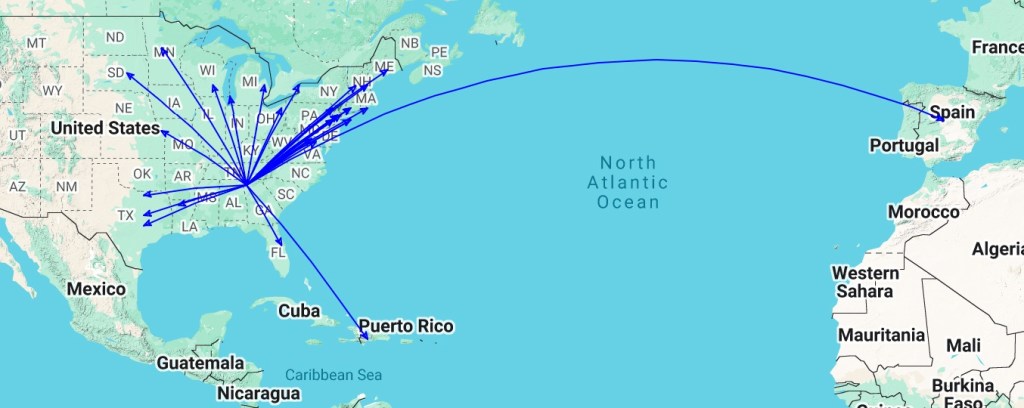
Also, I decided to take a break from everything else I have been doing and get on the air. I recently got my K3/10 back from the shop and thought I would give it a good workout at home so I wouldn’t have another calamity like I did a few months ago https://kk4z.com/2023/08/06/calamity-on-black-rock-mountain/. I set the radio up in the shack and started to make contacts. I had forgotten how far 10-watts CW can get you with a good antenna. At the home QTH, I run a 270′ OCF dipole with the apex up about 35′. I was hunting POTA activators and found I could work almost everyone I heard. I got as far north as Ontario, Canada, and as far west as TX, MO, and IA. This was still the morning and there weren’t many activators out yet. The K3/10 worked like a champ and purred like a kitten. Not hearing relays click during QSK CW is sublime. With the K3/10 cleared for field use, I have a couple of outings planned for it.

It feels good to be back in the saddle again. Absence makes the heart grow fonder, and after being away from amateur radio, even for a short while, I appreciate it all the more. 72 de Scott

I Got Bit By The SOTA Bug

Meeting with the SASQ group at Cheaha State Park this past weekend renewed my interest in SOTA. Over the past year, I have gotten myself in pretty good shape making SOTA more doable. I started putting together a bag for hiking to SOTA Summits. I have hiked and backpacked at different parts of my life so I have an idea of what I need (and want) for a kit. Since I’m an old guy, I do not want to be carrying the kitchen sink with me. I have a QRP radio coming, but that’s another post. Here is the list of my current load out.

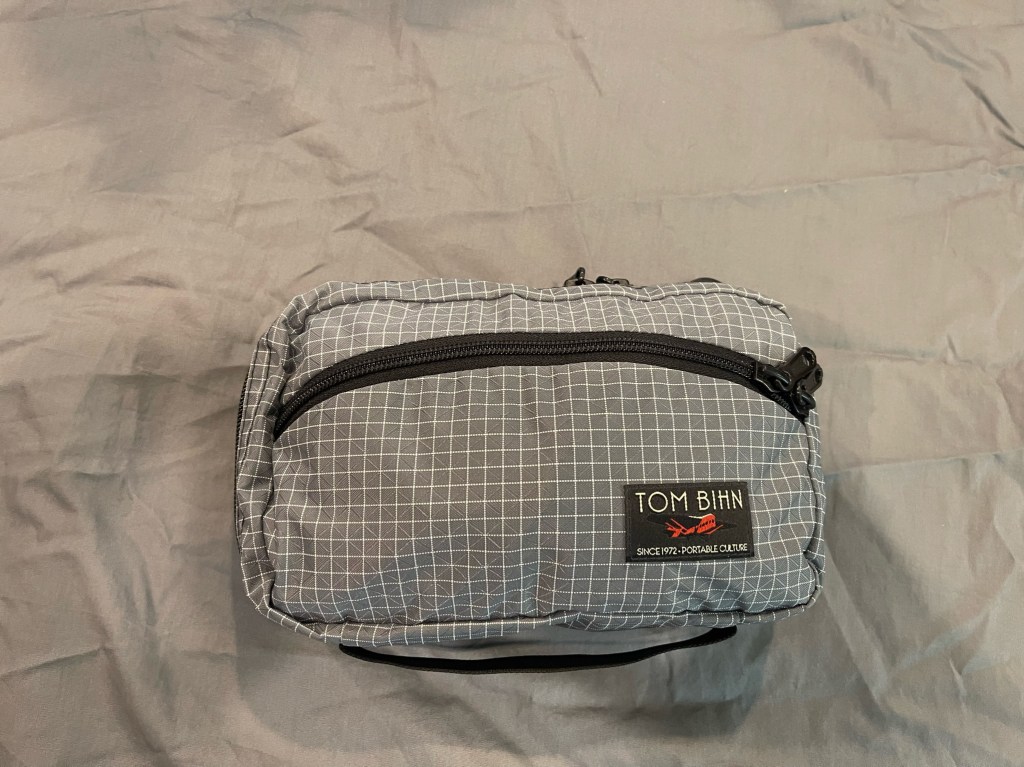
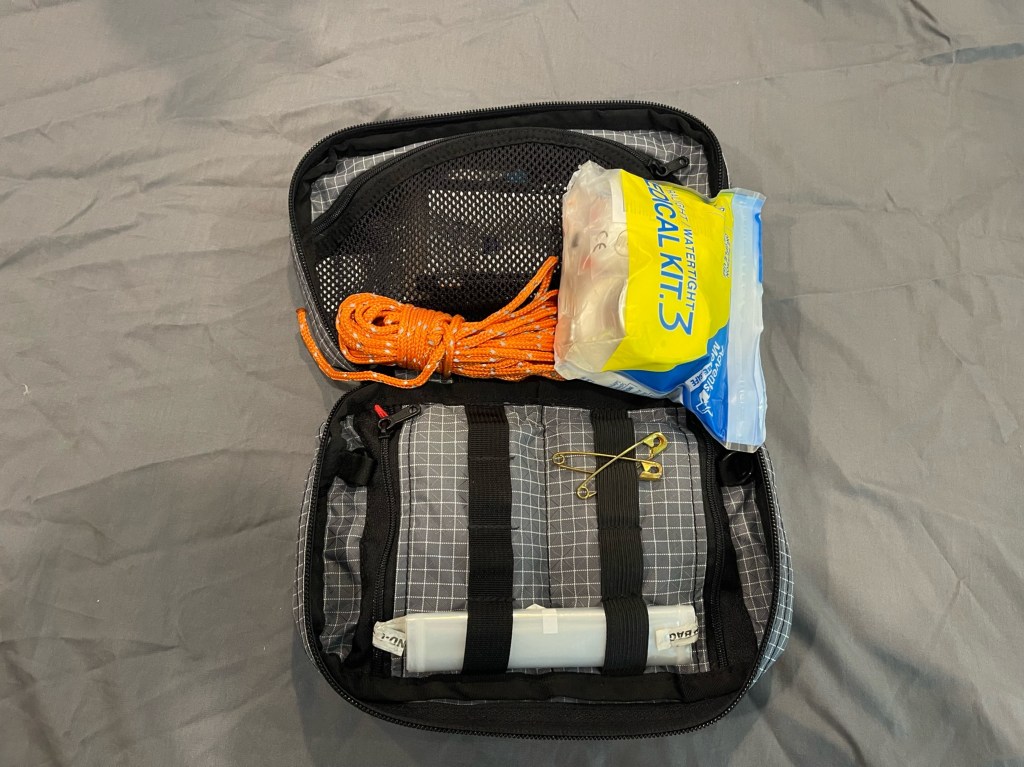
I’ll start with my E&E bag short for Escape and Evasion. Typically an E&E bag has the bare minimum of gear. This bag travels with me when I leave my home area. I move it from bag to bag as needed. The bag is a Tom Bihn Handy Little Thing (HLT) size 2. Loaded, it weighs 24 oz (1.5 lbs).

Here is a list of the contents:
Mechanical Pencil
Bullet (Space) Pen
Rite in the Rain Notebook
Mylar Rescue Blanket
2 – Eye Glass Cleaners
2 – Dude Wipes
Rope
First Aid Kit
2 – Safety Pins
1 – 1 Liter Water Bag
Compass w/signal mirror
Whistle
Survival Guide
Dental Floss
Ferro Rod, Striker, and Magnesium
Fire Tinder
Matches
Duct Tape
P-38
Mini Screwdriver
Flash Drive
Evidence Card
Large Magnifying Glass
Small Magnifying Glass

To carry the radio and associated gear, along with food, water, etc., I decided to use my Camelbak HAWG. It is the older style. I like it because it prevents me from overpacking. The bag and gear without the E&E bag weigh an even 6 lbs., 7.5 lbs with the E&E. With adding food, water, and radios, I am hoping to keep the weight below 15 lbs. I’ve done some Go Rucking with 40 lbs so this should be a breeze.

Here is the list:
Canteen, Cup, and Cover (canteen is Nalgene)
Potable Aqua
MRE Spoon
Poncho
Garbage Bag – Contractor
Rope Kit w/Duct Tape
Triangular Bandanna
Insect Repellent
Tincture of Iodine
Sit Cushion
Tent Stakes – 6

There you have it. enough to cover most events that may happen on an excursion into the wilds, but not too much where you feel like a pack mule. Next work on the radios. 73 – Scott