Oh Boy Oh Boy Oh Boy!

Yesterday, I got a phone call from HRO in Atlanta. I cashed in my reservation and placed an order for an Icom IC-7300 MK2. The MK2 has recently beed FCC certified so it will not be too much longer until they start shipping.

Many of you know, I have been a long proponent for the IC-7300. I had one since 2016 and only recently sold it to get the new MK2. I still believe it is one of the best bang for the buck radios out there. It is still the one radio I recommend to folks looking for their first HF radio. In fact in my region Army MARS, it is by far the most popular radio. The MK2 is an improved version of the original. Some of the features are USB-C connectivity with dual usb (+audio) ports, HDMI, lower power consumption, reduced heat generation, CW decode, and better receive performance. All for $1499 USD. That’s a very reasonable price.

I have been busy. I have shifted my radio focus to Army MARS and SHARES so that is where I am spending a lot of my time. Besides radio, I enjoy shooting sports and I delve into emergency preparedness. I would not call myself a doomsday prepper, more of a concerned citizen for my family, friends, and neighbors. I am in the process of setting up a GMRS repeater on my property for my neighbors to use. I still like to get out and take my radios to the field. Even though the things I do now, are mostly base related activities, I am an NCS on several nets, I still maintain skills and equipment for field operations. I have been there and done that; I have seen what a lack of preparation and experience does during an actual field operation. It is not pretty.

If any of you are interested in emergency prep, let me know. I can do some articles on it and maybe even some YouTube videos. I am retired and not young so that will reflect how I do things. One of the hardest adaptations I have had to make is convincing my mind which still thinks like its 30, that it is living in a late 60’s body. Let me know what you think, leave a comment and until then 73 de Scott

Hurricane Prep Update

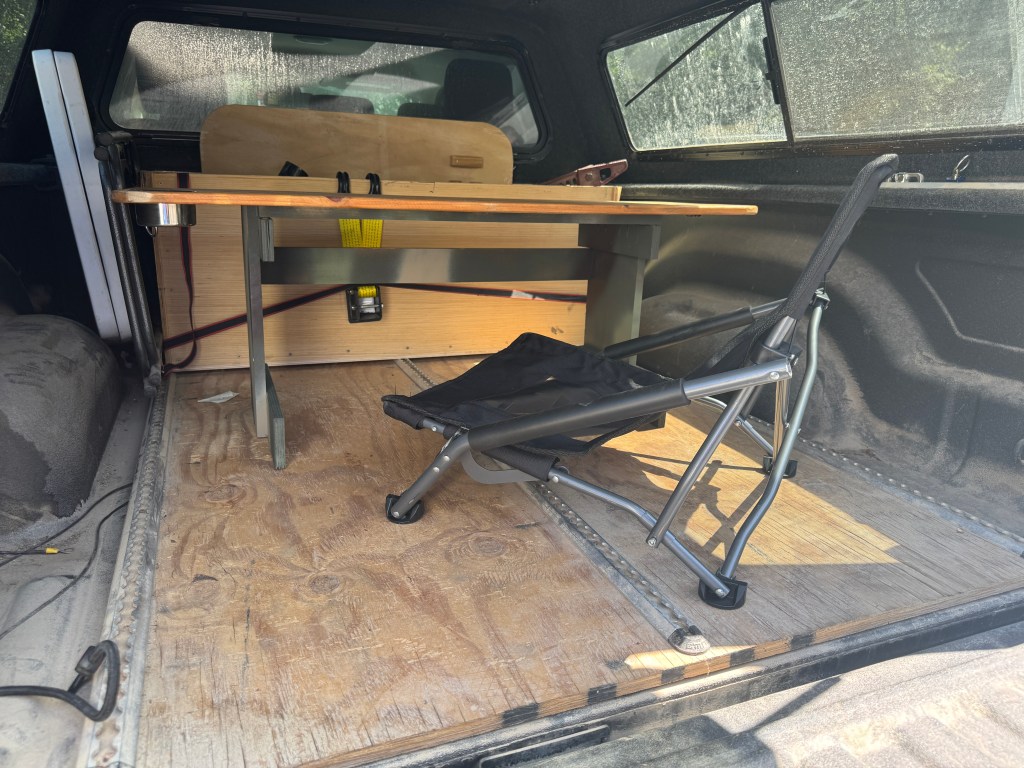
Update. I got the cupholder for the desk. It’s important to have because I often use tall coffee cups or soda bottles in the field. They can tip over easily and make a mess. The cup holder prevents that. Here is a view of the table and chair inside the truck bed.

I have a couple of L-track cargo straps on order that will tie the desk to the bed floor. This is a pretty comfortable setup when I am not in the camper.

Speaking of the camper, the table fits nicely in there too. I will be taking the folding table I was using out and replacing it with this. The other table was too large. You will see the table in action on my next camping trip.

I received all of the pieces for the Chameleon TDL (Tactical Delta Loop). I plan on using it my next trip. What is nice about the TDL is it has a lower vertical height and will be safe to use around power lines.

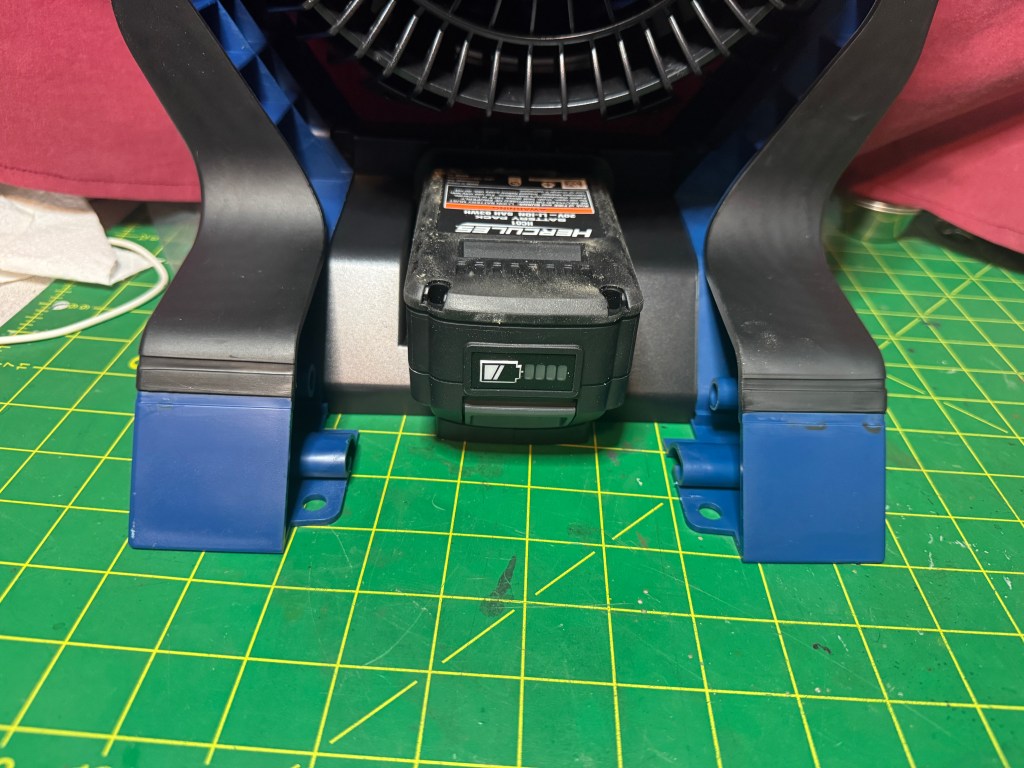
Here in Georgia it can get pretty warm. At the time of this writing Fall is approaching and temperatures are moderating. I added a battery operated fan to my kit. I recently discovered Harbor Freight Hercules brand battery power tools. I needed a small trim router and decided to try Hercules. The router was $69 vs $219 (Dewalt at Home Depot). Since I no longer work out of a tool box, I felt the Hercules brand would have me covered. I really like that little router. I decided to try their fan at $25.

It runs off of 120 VAC and 20V Hercules batteries.

The Dewalt version runs about $125. I can buy 5 of these for one of Dewalt. The fan comes with a 5 year warranty and the batteries – 3 year. From what the folks at the store tell me, it’s no questions asked, any Harbor Freight Store, anywhere. I turned the fan on and it moves air pretty good. Certainly enough for inside the camper or the truck bed.

So far this year, the hurricane season has been quiet and we have only had glancing blows. I check my gear on a regular basis. I have been doing this enough that my annual improvements are incremental. I use my camping trips to check gear and my skill set. I feel that if a call came, I could be ready to go in about 4 hrs give or take.

For those that practice FunComm, good on you and for those that practice Fun, have more of it. Let’s hope for a quiet remainder of the season and that FunComm was only for fun this year. 73 de Scott

Working on the IC-7100

My Ic-7100 rides with me in the truck. I have it hooked up to an AH-730 and a 102″ whip. I also have a 60′ wire with insulators and an alligator clip on one end. I can attach this to the whip and make a very effective NVIS/medium range antenna.

I really like the 7100 except that I was having RFI problems. I read where the cable between the control head and the radio was not shielded well so I tried some CAT8 ethernet cable. It worked great once and I couldn’t get it to work again. so I switched to plan B. I added some ferrite cores to both ends of the cable and that solved it up to 75 watts. I still get a little RFI interference at 100 watts but I rarely operate above 50 watts mobile/portable so I am good to go.

The other thing I wanted to do was make the radio easier to detach from its tray. I have some desks that I can put over the center console for laptops, notebooks, etc, but they cover up the radio. So off to TSC for some hardware. This is what I came up with.

The knob fits under the tray and makes it easier to unscrew the control head from the tray. I have about 5′ of cable to move the head around, enough for what I want to do. Installed, it looks like this.

I am glad I got the RFI problem sorted and made the head easier to remove. I also have another cable so I can now get the control head outside of the truck and on a folding table if that’s what I want to do.

Marching to the beat of a different drummer.

I know I do a few things differently. Many POTA activators use small QRP radios or compact radios like the FT-891 when they activate. That’s not me. I have always had a foot in the EmComm world and I enjoy working weak signals. There’s an art to catching the weak ones and it takes a good ear. It also takes skill in operating your radio. I like to have the controls I use most easy to get at like I find on radios like the IC-7300, and TS-590sg. I also like to operate low power, not QRP. I mostly find myself in the 20-35 watt range. Even at home, I am usually at 50 watts. Low power gives me enough oomph to make the contact and still makes it a challenge. Through most of my amateur radio career, I have been involved in EmComm. I use FunComm events like POTA to keep my EmComm skills sharp and my radios and antennas in good working order. Not using your EmComm gear until the “Big One” hits often brings unwelcome surprises. I know I am getting a little long in the tooth for some EmComm but old habits die hard. 73 de Scott

Hurricane Season 2025

NOAA has released their 2025 hurricane season (01 June to 30 November) prediction. they are calling for an above average season with 13-19 named storms and 6-10 to reach hurricane strength. Of those hurricanes, 3-5 are predicted to become major hurricanes.

As we learned last year, coastal states are not the only ones vulnerable to the havoc a hurricane can bring. Now might be a good time to break out the portable gear and give it a shakedown. Turn on those go-boxes and feed those portable antennas. Make sure everything is in working order. Take your gear out and go at least 20 miles from home. Why 20 miles? It’s a distance that is too far to go back home and retrieve a forgotten part or replace a broken piece of kit. Field Day (winter and summer) are good events to try your gear. Only if you use the same gear you would bring for EmComm and use the same power levels. The lesson here is don’t wait to get ready, get ready now. I try to keep myself prepared to deploy in 4 hours or less.

You can’t plan for everything that may go wrong. You can however, minimize the chance of failure by ensuring your gear is in the best possible condition. Remember Proper Planing and Preparation Prevents Piss Poor Performance (7P’s). Be THE guy, not THAT guy. 73 de Scott

EmComm

This past weekend we had a major storm event across the southeast. There were as many as 40 deaths reported as well damage from strong winds and tornados. there were 56 tornados reported across 10 states to include 2 EF-4, and several EF-3’s, I started watching the storm system as it crossed the Mississippi/Louisiana border. I paid particular attention to the system as it approached Birmingham, AL. I live just east of the Georgia/Alabama border.

My local EmComm group started a net on the local 2 meter repeater at 2130 hrs EDT. By that time I was already within the outer fringes of the storm. Lightning was everywhere. When lightning gets within about 20 miles of my QTH, I shut down and disconnect all my radios. In my 30 years of amateur radio, I suffered from 2 lightning strikes. Both came up through the mains (commercial) ground system. the first time about 20 years ago cost me about $3,000 and the last time in 2019 cost me about $7,000.

I broke out my HT and tried to check into the net. I could break squelch on the repeater and that was about it. I am a good ways away from the repeater. Radio comms was out of the question so I sent a text message to the NCS — no reply. I also sent him an email — no reply. Because of the intensity of the lightning, I also shut down and disconnected my computers, I was on my iPhone and iPad to monitor the storms progress.

Fortunately, the storm dissipated somewhat before reaching my QTH but there was still a lot of lightning and a lot of rain. When considering EmComm for any event, the best methods should always be used. In my case, it was not radio, but my cell phone. It was safer. Often in amateur radio EmComm we get fixated on using the radio when other means that may be more efficient and safer are available. In my case sending a text message and/or an email was the best bet. I remember an exercise a long time ago when I watched an operator try to send a message on his HT from inside the EMA. He had trouble hitting the repeater and the end user had trouble copying him. All the while he was sitting next to an operational FAX machine.

When we develop a communications plan, we should always consider the best means/mode available. If the cell phone works, use it, plan for it. When it stops working, then use the next best and so on and so on. It’s never a good idea to start with a 3rd tier system and work down from there. Here in the southeast, except for a major hurricane, cell service is usually working during and after a storm/disaster.

In my case, when the net started, I was surrounded by lightning and using a radio with a tower mounted antenna was not safe. While I had other means to communicate, there was nobody on the other end. It was a sobering experience. If you don’t have a plan, make one. If you have a plan, review it. Make sure you are using the best means/methods/modes available. Have a tiered approach, first A, then B, then C and so on. Relying only on one method is a recipe for failure. Remember the 7-P’s: Proper Planning and Preparation Prevents Piss Poor Performance.

Food for Thought

For those old enough to remember Popeye the movie with Robin Williams, there is a song called Everything is Food. When we talk about EmComm, we spend a lot of time talking about radios, antennas, batteries and so forth; but rarely does food come up. When deploying to an EmComm event, you often do not know if there is any food available (or available to you). I have been deployed to places where there was an active kitchen preparing meals, to living off of peanut butter and jelly sandwiches. I will tell that as much as I like. good PB&J sandwich, after a few days it gets old. On that trip, on the way home we stopped at the first burger joint we found open and a cheese burger never tasted so good.

During the aftermath of Hurricane Katrina, I spent 3 weeks in gulfport MS providing local and area comms. I was living off of 2 MRE’s a day donated by FEMA. MRE’s lose their flavor after about the first week. I’ve learned that you always bring food. ALWAYS! You never know what will or will not be there. When I am camping or on a deplyment, I want easy meals. I am usually busy doing other things to overly fuss about what to eat.

Back in my youth, I was an avid backpacker. Freeze dried foods were just coming out and they were expensive. I would mix and match them with store bought foods. I would eat instant oatmeal for breakfast along with a cup of instant coffee and maybe some Tang, lunch might be some granola bars and GORP (Good Ole Raisins and Peanuts), and supper might be one of those freeze dried meals. I only used my stove to heat water.

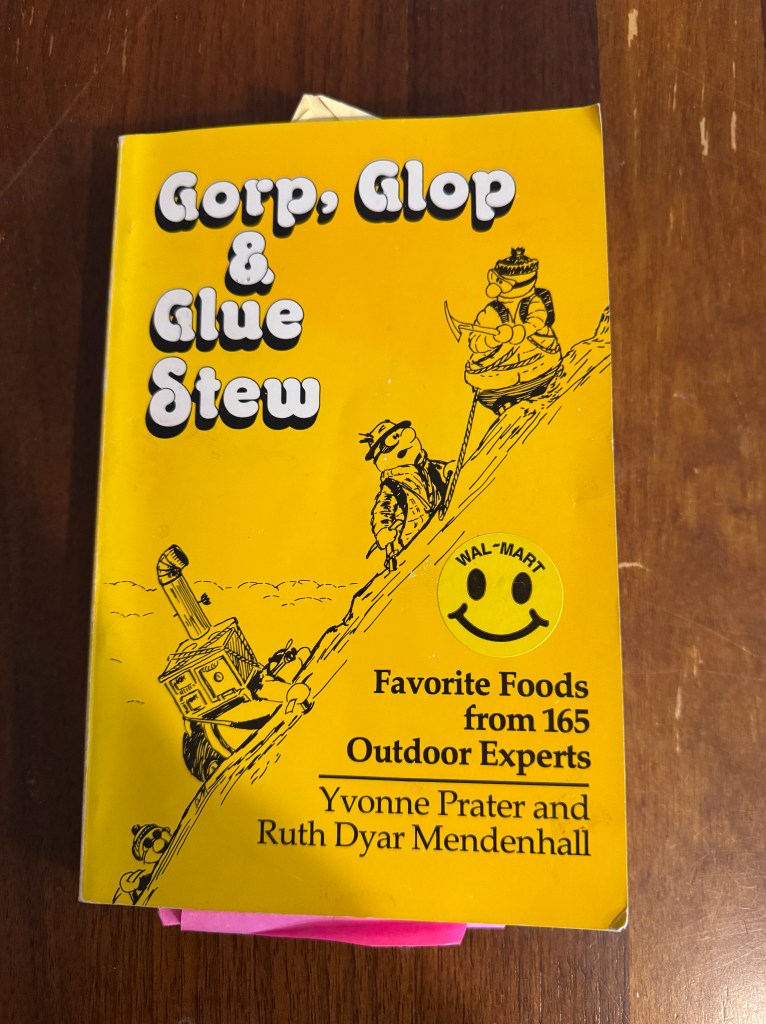
Today, I rarely buy MRE’s or Freeze dried foods. I bought a book Gorp, Glop and Glue Strew about 30 years ago. It’s a book about mountaineering foods that date back to pre dehydrated/freeze dried foods. These are the foods that conquered mountains. The foods are hardy, sturdy, and provide lots of calories. They are also quite filling. I like to make some of the mountain breads and fruit/energy bars. A little bit goes a long way and they do not require refrigeration. I can couple mountain bread with summer Sausage and cheese for the main course and then have some GORP for dessert. Drinks are usually coffee, tea, or some instant fruit mix.

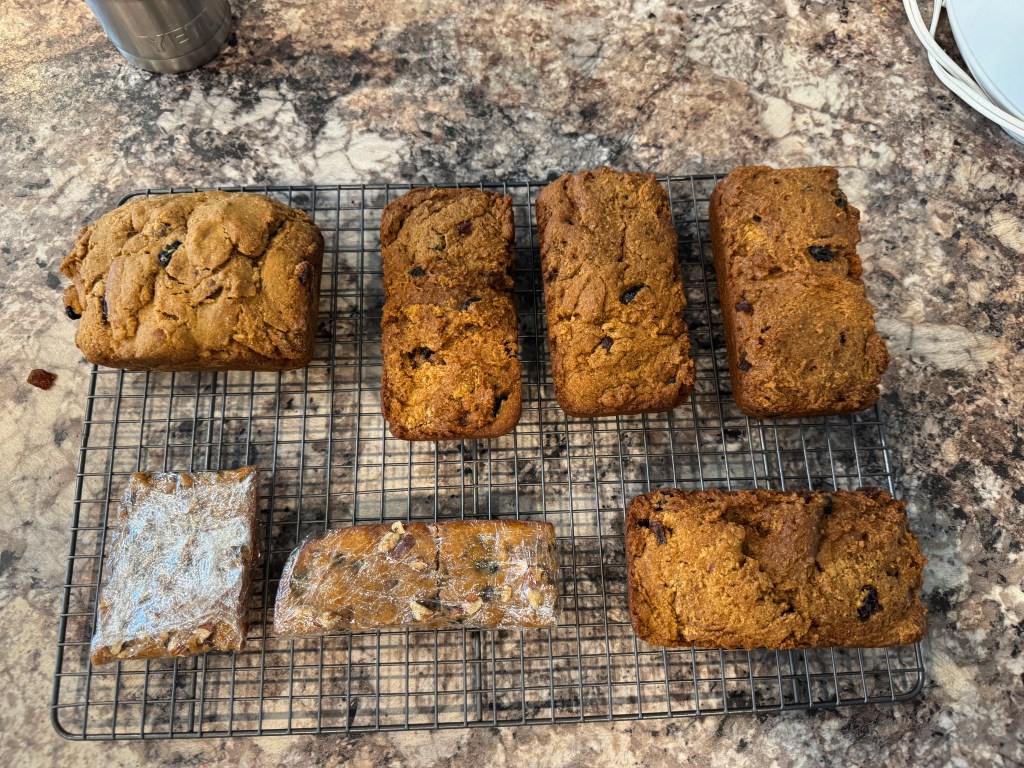
The loaves are Apple Logan Bread and the wrapped bars are Mince Meat Cookies. I will get them all wrapped and then freeze them. They last almost indefinitely. Some deployments may require a conservation of energy because those resources may be limited. Having foods that require no on site preparation is a bonus that allows you to operate longer. Sometimes, the Calvary doesn’t arrive just in time. Along with these foods, you can add Summer Sausage, Beef Jerky, Beef Sticks or canned meats. In addition to meats, cheeses keep pretty well and Ghee does not require refrigeration. Crackers or Pilot Bread are a good addition, try to find crackers that won’t crumble from the rigors of the road.

An old Army trick was to mix a little cold water with Hot Chocolate mix to make a pudding and doing the same to coffee creamer makes a field expedient whipped cream. It may not taste good at home but in the field… In the field I eat to live. These foods taste good to me especially out in the great beyond. One piece of advice; whatever food you plan to use on a deployment, start eating it now. Eat it during a POTA activation, an ARES event, or anytime you may be away from home. Now is the time to make sure your system can handle the foods you plan to eat. Having your bowels in an uproar away from home and nice “facilities” can be a very miserable experience. Stay safe es 73 de Scott

Night on Bald Mountain

This trip was to Cloudland Canyon State Park located in NW Georgia. It is a very nice campground about a 2 hour drive from the home QTH. I got at the campground Tuesday, around 2000Z and quickly set up. Radio du jour was the Yaesu FT710 Field which is currently under review. The antenna was my 28.5’ random wire vertical. I am also trying out my Maestro Evolve III laptop along with HAMRS Pro software.

Band conditions were a little off so I started on FT8. It was slow going but I made 15 contacts before the new day. After supper, I went back to FT8 to try to get 15 more contacts before the storms hit.

The whole time I had moderate winds and some pretty good gusts. Right before the storms I lowered the antenna and put a garbage bag over it to keep it dry. The antenna is weather sealed, but the push up pole when it gets wet, is a real pain to dry out.

How about the FT710? In general, I like the radio. I think it’s a keeper. It is fun to use and performs well. It has a few niggles that I camp about but I like it. I talk more about the issues on my YouTube video. I will say that this radio is very different than the first one I got. The first radio was probably released too early and still had growing pains. This radio just feels better. In general I feel this radio and the IC-7300 are about equal. Either one will work well.

Evolve III. This is a pleasant surprise. I paid about $122 for it and for a field laptop it does well. Last night I ran WSJT (FT8) and AcLog without any issues. I was also running. BktTimeSync with a GPS receiver in the background. It is a little slow to start up but once it’s running, it does fine. I run it with a Logitech M310 mouse.

I am also trying out HAMRS Pro. I have it on Windows, Mac, IOS (iPhone, iPad) and they all sync up. I will talk more about HAMRS in a follow up article.

This is Wednesday morning and I am going to try to do some CW before I pack up and go home. Bands conditions are so-so at the moment. I will break my normal procedure are hunt a while to try out some of HAMRS features.

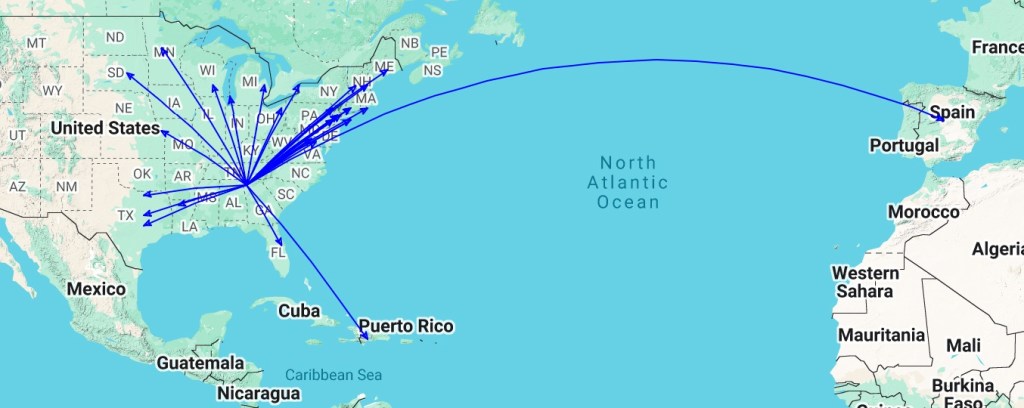
I only managed to make one CW contact hunting and activating. I could tell I was getting out as I showed up on HamAlert. Here is a QSO map of the activation.

Screenshot

If I remember correctly, I had issues last time I was at Cloudland. The important thing was I got out for a while and I had fun. It isn’t always about the numbers. Below is a video about the activation and my thoughts on the FT710. Stay tuned es 73 Scott

Memories past and Present

This past weekend I made a trip down to Orlando Florida to experience Hamcation. It was a lot fun. I got to meet some cool people and of course came home with some radio related goodies. The Region 4 U.S. Army MARS group had a dinner Friday night and I got to connect faces to voices. It was a good time.

This was also a time for some refection. On my way down and back I traveled on Interstate 75. This was the same route I used during the 2004-2005 hurricane seasons. I provided HF radio communication for the convoy bringing relief supplies right after a hurricane. I did this 4 times in 2004 and once in 2005. Back then, communications was not as well developed as it is today.

During those trips I would check into the South CARS net or the South Coast Amateur Radio Service net. According to South CARS: “The purpose of the net is to assist those seeking to contact other amateur radio stations, or areas; to provide weather and travel information; to assist in emergencies when needed.” They operate on 7.251 MHz from 0800 to 1300 hrs Eastern. I used the net to check my radios and listen for any travel information that might have affected the mission. I joined back then (#3773)and still occasionally check in from time to time.

On this trip I was traveling solo so I dialed up 7.251 and checked into the net. While the net was operational, they kept me company and I enjoyed listening to the net. At times, it brought me back to those disaster relief days. Good memories; I felt the sense of purpose I had back then. I appreciate South CARS today as much as I did back then. I know that if I was ever called up again to provide EmComm in Region 4, South CARS would be there for me.

Other good news is I may have a trade for my amplifier. I found a TS-890s and hopefully the trade will go though by the end of the week. I am not young anymore as I have retired twice now. I know that my days of deploying are numbered as the body starts to wear out. Currently I still go camping and therefore could deploy if needed. However, as time marches on I will become more home centered. The good news is ham radio offers opportunities both home and abroad. I have a pretty good home station and I am a pretty good Net Control Station. I plan to use the TS-890s for CW and other fun things.

I’ve had a good run. I’ve got to do some exciting things in my life. In retirement, I am still busy, I still have lots to do. My focus is changing. A fixed income doesn’t mean eating Alpo, it means careful planning. If I want something, I can have it, if I plan for it. The other option would be to go back to work and that ain’t going to happen. Life is good — de 73 Scott

Winter Wonderland

I woke up this morning to fresh snow on the ground. I had the same excitement as I did as a kid. I got dressed and went on my daily 4 mile walk—in the snow while it was snowing. It was glorious, I remembered playing in the snow as a child and backpacking in it as a young adult. I also remember the grueling Army Field Training Exercises (FTX) in German winters. I have seen cold winters, my coldest was somewhere between -20 to -30 degrees F. Winters can be fun, and they can be dangerous. The most dangerous winter is like what we are seeing today on NW Georgia. Snow with freezing rain and temps hovering around freezing. For driving, this means ice on the roads and sometimes ice covered with snow. Drivers unaware that they are driving on ice lose traction and control of the vehicle. Often they are unaware they have lost control until it’s too late. I have driven cars, trucks, military vehicles, and 18 wheelers on snow and ice covered roads. Only through training and experience did I survive those encounters.

These conditions are also conducive to personal physical injuries such as immersion foot, frost nip, frost bite and hypothermia. Being cold and wet by itself may not kill you, but cold and wet, coupled with inexperience will. This blog post is not necessarily about amateur radio, but about operating amateur radio outside in these conditions. Using my 4 mile walk today, I will lay out what I wore and why.

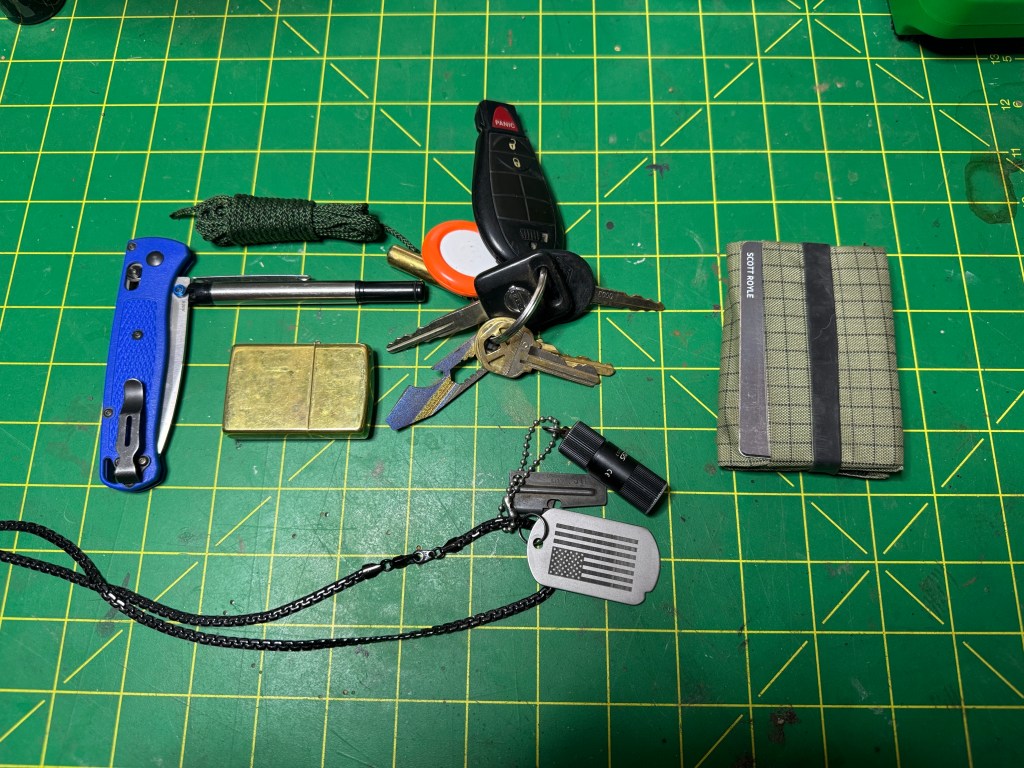
Let’s start with EDC. EDC is Every Day Carry which for me is every time I leave the house I have these items on my. Here is what I carry Every Day.

Knife – Benchmade Bugout. I love this knife. It is the perfect size and
weight. I resides in a pocket on my cell phone holster.

Bandanna

Pen


Lighter – Zippo with a butane insert. I used to carry a Bic Flic but because it is so light, it would fall out of my pocket when I retrieved other items. I do not have this issue with the Zippo

Cord – 10-12 feet of 1/16” 100 lb test cord.

Car keys with a bottle opener

Cell Phone

Necklace with:
P38 can opener (from my army days)
Olight i1Reos flashlight. This is an amazing little light.
Dog tag with emergency contact info and medical insurance info

Wallet with:
Cash, Credit Cards and ID
Signal Mirror
Fresnel lens – for reading and fire starting
A couple of bandaids
Victorinox Swiss Card.

Other items may be added as necessary such as self-defense items or electronics to support blogging/vlogging and radio gear.

Clothing. Starting from the inside out. My undergarments are a mesh top with a bottoms made from 60% cotton and 40% polyester. The next layer was a Carhartt Force Cotton Tee shirt 65% cotton/35% polyester, and Levi blue jeans. I wore Darn Tough wool socks (I wear these year round) and Solomon XA Goretex trail shoes.

My next layer was an Eddie Bauer fleece pullover I got cheap from Sam’s Wholesale. It is 100% polyester. On top of that I wore a cheap Amazon Basics lightweight fleece vest again 100% polyester.

My outer layer was a Carhartt stocking cap 100% acrylic. A TurtleFur neck tube (polyester). Cotton Jersey Gloves and a British SAS Windproof Smock (50-50% Cotton Polyester (unlined and uninsulated). Through the rain/Sleet/Snow I remained warm and dry. My Smock got quite damp but the hydrophobic nature of my under layers and the heat I generated kept the moisture to the outside. If I wore one of my Goretex jackets, I would have been soaked in sweat as Goretex is not as breathable as the smock is.

While walking, I was warm enough to have to unzip my smock and my vest. My gear would have kept me warm down into the teens. I tend to dress one layer warmer than I need. In this case I added the vest. There is a myth that “cotton kills” It’s not the cotton, it’s the operator. Most military uniforms are about 50% cotton. My days in the Army go back to the BDU which is made from Nyco or 50% cotton/50% nylon. I wore that uniform from very hot to very cold and I lived to tell about it. Know your gear, know how it works in different conditions. How does it perform when wet. What I wore today was perfect. My smock got damp, my gloves got damp, but inside I was warm and dry. I walk year round and I walk in most weather conditions. I know how my clothes work. I made myself a promise when I got out of the Army, and that was I would only be cold and wet when I wanted to be. To date, that has not happened. Get outside, try your gear, know what to wear for different conditions. Be safe. Be especially safe when your community needs you. 73 de Scott

Roger, Wilco, Over and Out

Welcome to KK4Z.com of 2025. I am hoping for a smoother year and the opportunity to write more. Part of my plans for this blog are to include more posts about EmComm and more technical articles. I am also planning to up my game on my YouTube channel. I know I said this last year, but last year was well, wonky.

My first article of the year will be about the aforementioned Prowords used in voice nets. They are often used and often abused. I have been running nets for 25+ years at the local, state, regional, and national levels. Besides amateur radio (EmComm), I have run nets for Civil Air Patrol, and US Army Mars. I also participate in nets with SHARES. The best run nets in my opinion are MARS and SHARES with MARS being a little stricter on protocol.

These Prowords: Roger, wilco, over, and out, are the cornerstone Prowords for efficient net operations. These words have specific meanings and when used properly, provide the brevity needed to quickly handle information passed within and through the net. Let’s start with Over and Out.

First, over and out are never used together as their meanings are diametrically opposed. The Proword over means I am done talking, and I need a response from you An example would be:

ID1OT this is KK4Z How Copy over

This is ID1OT Loud Clear over

The conversation would continue back and forth using over at the end of each statement. To conclude the conversation the word out would be used. Out means the conversation with you is over and I do not expect a response. To finish the above conversation:

This is KK4Z Loud Clear out

Another way to use out is out to you This is used when finishing one conversation and starting another. For Example:

This is KK4Z Loud Clear out to you

N0OB this is KK4Z How Copy over

Out to you is an option and just saying out is fine to.

Roger means I acknowledge Example:

ID1OT this is KK4Z did you copy the traffic over

This is ID1OT roger out

Wilco means I understand and I will comply. Roger is generally not used with wilco. Example:

N0OB this is KK4Z QSY to channel Bravo over

This is N0OB wilco out

Other words/phrases used. As noted above some Q-signals are used. The ones I hear the most are QSY, QSL, and QRU. The word repeat is never used. As a Proword it means to repeat the last artillery barrage. Instead use I say again. The Proword break means to pause and is not used that much. Instead wait is used.

Phonetic Alphabet. Only use the ITU or NATO phonetic alphabet. The reason for this is during poor band conditions, having a reduced vocabulary makes it easier to transfer information. With the ITU Phonetic Alphabet I have 36 sounds for letters and numbers to listen for instead of several hundred because operators are making something up. The reduced vocabulary with distinct sounds makes it easier to pull the correct letter or number out of the static. Remember, voice becomes unintelligible at the noise level and not below it. Learning the ITU Phonetic Alphabet is a worthwhile investment of your time. It is used by governments, military, and the EmComm communities. If you are a DXer, it is also good to know. Besides, it makes you sound like you know what you are doing.

All of this is usable anywhere and anytime you are on the radio. EmComm nets are usually more tightly run so these Prowords and phonetic alphabet are important. For ragchew or roundtable nets, not so much; they are informal and if you miss a piece of information, it’s not life or death. 73 de Scott