Oh Boy Oh Boy Oh Boy!

Yesterday, I got a phone call from HRO in Atlanta. I cashed in my reservation and placed an order for an Icom IC-7300 MK2. The MK2 has recently beed FCC certified so it will not be too much longer until they start shipping.

Many of you know, I have been a long proponent for the IC-7300. I had one since 2016 and only recently sold it to get the new MK2. I still believe it is one of the best bang for the buck radios out there. It is still the one radio I recommend to folks looking for their first HF radio. In fact in my region Army MARS, it is by far the most popular radio. The MK2 is an improved version of the original. Some of the features are USB-C connectivity with dual usb (+audio) ports, HDMI, lower power consumption, reduced heat generation, CW decode, and better receive performance. All for $1499 USD. That’s a very reasonable price.

I have been busy. I have shifted my radio focus to Army MARS and SHARES so that is where I am spending a lot of my time. Besides radio, I enjoy shooting sports and I delve into emergency preparedness. I would not call myself a doomsday prepper, more of a concerned citizen for my family, friends, and neighbors. I am in the process of setting up a GMRS repeater on my property for my neighbors to use. I still like to get out and take my radios to the field. Even though the things I do now, are mostly base related activities, I am an NCS on several nets, I still maintain skills and equipment for field operations. I have been there and done that; I have seen what a lack of preparation and experience does during an actual field operation. It is not pretty.

If any of you are interested in emergency prep, let me know. I can do some articles on it and maybe even some YouTube videos. I am retired and not young so that will reflect how I do things. One of the hardest adaptations I have had to make is convincing my mind which still thinks like its 30, that it is living in a late 60’s body. Let me know what you think, leave a comment and until then 73 de Scott

WGARS Spring Fling 2025

Today was the club’s semi-annual outing and this spring it was one of our old haunts, Cheaha State Park US-1037 in the fine state of Alabama. There are 3 things we as a club like to do, we like to eat, we like to socialize, and once in a while we talk on the radio.

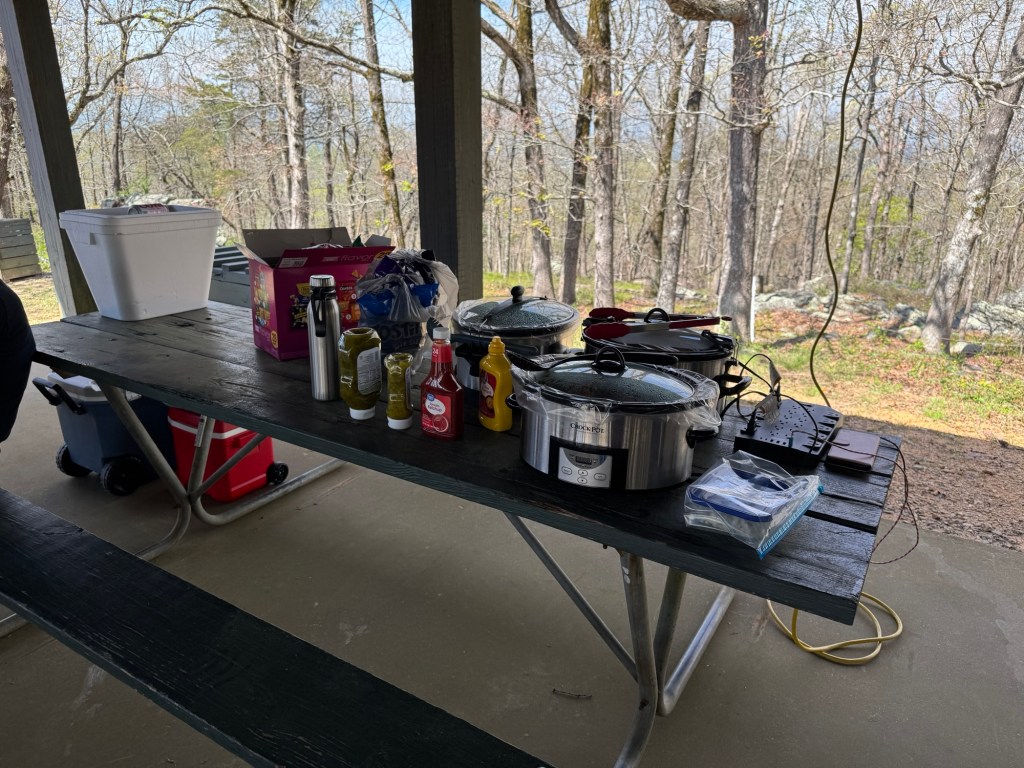
As usual, food was in abundance.

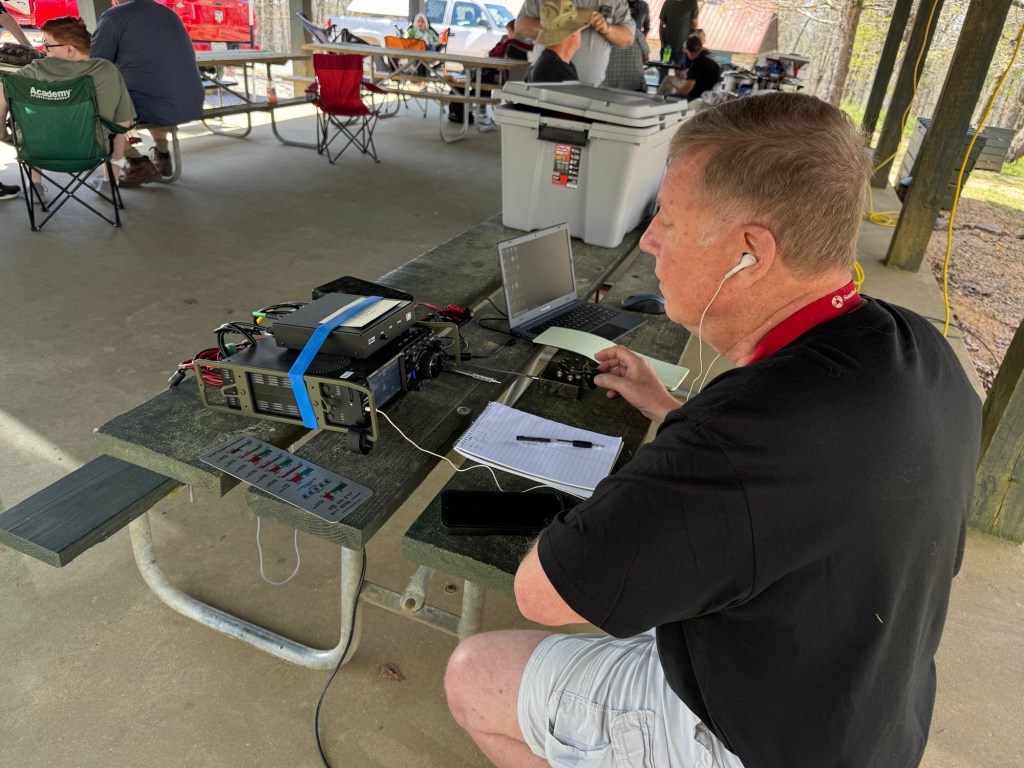
We had several stations set up under the pavilion. QRM was held to a minimum. We had Xeigu G90’s, Tru-SDR, Icom IC-705, and my Yaesu FT-710. I set the radio up and turned it over to the club President John WD8LQT. John, like me is a CW op and I wanted his opinion of the FT-710. I didn’t have to twist his arm too hard. The setup was the radio feeding a Chameleon micro transformer with a 12’ whip and about a 20’ counterpoise. The radio was powered by a 20 amp-hour Bioenno battery and the paddles were a Begali Expedition.

Band conditions were poor and it took John most of the time at the park to get his 10 contacts. There were stops for eating and chatting. Early in the activation, I decided to change antennas to be sure we had an atmospheric issue and not an equipment one. I had my Diamond RHM-12 which recently proved itself to be a good performer. Once the switch was made and some searching through the bands, John started making contacts on 20 meters. I believe it was atmospherics and not the equipment. John got his 10 contacts and we called it good.

John’s comments about the FT-710 were quite favorable. Like any radio, there are pluses and minuses. In general he thought it was a very good radio for CW. There is more commentary from John on the YouTube video posted below. John did have one epic fail. The ear buds he was using which looked rather ancient finally gave up the ghost. I took it upon myself to intervene and unceremoniously threw them in the trash. John will thank me.

My review of the FT-710 is drawling to a close. I find that I like the radio. It performs well for its price point and has some features found on more expensive radios. It has its quirks as all radios do, but none that I find overly objectionable. I plan on keeping the radio and it has found a place among my field radios. I imagine the radio may make an appearance during this year’s Field Day.

EmComm

This past weekend we had a major storm event across the southeast. There were as many as 40 deaths reported as well damage from strong winds and tornados. there were 56 tornados reported across 10 states to include 2 EF-4, and several EF-3’s, I started watching the storm system as it crossed the Mississippi/Louisiana border. I paid particular attention to the system as it approached Birmingham, AL. I live just east of the Georgia/Alabama border.

My local EmComm group started a net on the local 2 meter repeater at 2130 hrs EDT. By that time I was already within the outer fringes of the storm. Lightning was everywhere. When lightning gets within about 20 miles of my QTH, I shut down and disconnect all my radios. In my 30 years of amateur radio, I suffered from 2 lightning strikes. Both came up through the mains (commercial) ground system. the first time about 20 years ago cost me about $3,000 and the last time in 2019 cost me about $7,000.

I broke out my HT and tried to check into the net. I could break squelch on the repeater and that was about it. I am a good ways away from the repeater. Radio comms was out of the question so I sent a text message to the NCS — no reply. I also sent him an email — no reply. Because of the intensity of the lightning, I also shut down and disconnected my computers, I was on my iPhone and iPad to monitor the storms progress.

Fortunately, the storm dissipated somewhat before reaching my QTH but there was still a lot of lightning and a lot of rain. When considering EmComm for any event, the best methods should always be used. In my case, it was not radio, but my cell phone. It was safer. Often in amateur radio EmComm we get fixated on using the radio when other means that may be more efficient and safer are available. In my case sending a text message and/or an email was the best bet. I remember an exercise a long time ago when I watched an operator try to send a message on his HT from inside the EMA. He had trouble hitting the repeater and the end user had trouble copying him. All the while he was sitting next to an operational FAX machine.

When we develop a communications plan, we should always consider the best means/mode available. If the cell phone works, use it, plan for it. When it stops working, then use the next best and so on and so on. It’s never a good idea to start with a 3rd tier system and work down from there. Here in the southeast, except for a major hurricane, cell service is usually working during and after a storm/disaster.

In my case, when the net started, I was surrounded by lightning and using a radio with a tower mounted antenna was not safe. While I had other means to communicate, there was nobody on the other end. It was a sobering experience. If you don’t have a plan, make one. If you have a plan, review it. Make sure you are using the best means/methods/modes available. Have a tiered approach, first A, then B, then C and so on. Relying only on one method is a recipe for failure. Remember the 7-P’s: Proper Planning and Preparation Prevents Piss Poor Performance.

I’ve Been Busy

Today is the second day of hurricane season for the United States. According to Colorado State University, this may be a busy season. For most of CONUS (CONtinental United States), hurricanes have little effect. For those of us on the eastern seaboard and gulf coast, it is time to keep a weather eye out.

It should be a time of preparation. Procuring materials to stormproof homes, purchase/maintain generators and check on fuel supplies, check the pantries for food and water storage, and ensure there are adequate medication and first aid supplies. In addition to this, is there enough cash on hand as with no power, there is no credit; cash is king. There is always the question of; should I stay or should I go? This is often a tough decision and the wrong choice could be fatal. If you are going, do you have a place to go? During Hurricane Michael, I was returning to Georgia from Virginia the weekend before the storm, there was storm related traffic up in Tennessee, people looking for a place to stay.

Even though I live in northwest Georgia, I can still be affected by a storm. High winds, heavy rains, tornadoes, flooding and power outages occur as a hurricane winds down as it travels inland.

Part of my preps, besides food, and water, etc., is making sure my communications gear is in order. Most of my gear gets used at least weekly with some of my portable gear getting use monthly. As I have said in past posts, my FunComm gear is mostly the same as my EmComm gear. I check to see that my radios are working and that my portable antennas are in good working order. I pull out my laptop and make sure all of my radio apps and OS are up to date and working. I especially check to make sure I can send/receive on my main digital modes. For EmComm I rely mainly on Winlink, PSK31, Contestia, and CW. I get on the air and send emails, check into nets, etc. I am also a Net Control Station for Phone and Digital, and I run those nets on a monthly basis. During a disaster is the wrong time to find out something doesn’t work. Been there, done that. And yes, sometimes, even though you checked, checked, and double checked, things can still go wrong, but at least you can reduce the probability.

My vehicles get serviced regularly, and I go over my little camper before each trip. My generators are checked and run on a regular basis. I also go through my Flee bag. I check to make sure everything in it is in working order, that there are no expired, expiration dates, and the clothes I have tucked in there still fit. Too big is okay, too small is not.

With all my gear squared away, I turn to me. Have I had a check-up recently? Are my meds current to my needs?, is there anything I need to get fixed before I deploy somewhere? From here I move to my skill sets. Can I use the apps/radios I need? Sometimes a big update happens that changes the app enough I may have to relearn it. Can I still copy CW? CW is not widely used, but it makes a pretty good backup when everything else is going to pot.

How is my fieldcraft? Can I cook and eat in the field, can I purify water, start a fire, clean myself, apply first aid, make repairs, navigate; can I improvise, adapt, and overcome?

Some of this is annual and some of it is on going. I should never let my skills and gear degrade to a point where they are no longer usable. It is bad voodoo to try to learn/relearn a skill during or on the way to a disaster.

How about you? Don’t wait until the last minute. It’s no fun waiting in a long line to get something you could have gotten a few months ago for half the price. And then to add insult to injury, the guy in front of you buys the last one. Be ready, do it now! Embrace the coming storm with a cup of coffee and the knowledge you have done everything you could to be ready. Or, you could be driving around white-knuckled in a panic trying to buy the same things everything else who has waited is trying to buy. I’ve done both and I like the first option much better. Think straight and stay safe. 73 de Scott

Methods Modes and Madness

Before I take my leave from EmComm and revert to FunComm, I thought I would share some of my meditations on digital modes.

My use of digital modes goes back to the mid-2,000’s. I was an early adopter of Winlink and ran a regional digital PSK31 net. I have had the pleasure of working with many fine amateur radio operators with many different skill sets.  Recently, I have had the opportunity to run a national digital PSK31 net for a few months.  Again, the experience of working with amateur radio operators was a fun and fulfilling endeavor. I have used most of the modes for Winlink with VARA being the current favorite.  Other modes I have used include PSK31, PSK125, QPSK125, Contestia, MT63, and Olivia.  They all work as intended, however, when it comes to the less experienced digital operators, PSK31 is the easiest to master.  I have run nets where we started on PSK31 and then moved to another mode and then back to PSK31.  Many ops do fine on PSK31; however, once we move to a different mode, they get lost. When considering EmComm we should always play to the least common denominator.

My favorite modes for EmComm are:

1) Winkink/Vara.  If I had to choose one, this would be it.  With nodes all over the world, the probability of getting into a node is greater than if you had to depend on a single point. Because messages are stored until they are retrieved, Radios do not have to be left on to forward and retrieve messages.  This can be done at any time and there is no need for a schedule.  An operator can wait until favorable propagation exists. I have not tried VARAC yet, but it is on my to-do list.

2) PSK 31 and 125.  I like PSK31.  I have run a national net using it.  Typically, I take check-ins on 31, send a message using FLMsg on 125, and then go back to 31.  I have a much higher percentage of people getting the message using PSK31 than with other modes.  On most modern radios, PSK31 can be decoded and sent without the use of a computer.  While those at home with mains power see that as frivolous, a computer or laptop can be a serious drain on a battery when mains power is not available when operating under potable/emergency conditions.  Because PSK31 has a narrow bandwidth (60 Hz) compared to MT63-1000s (1000 HZ), it enjoys a 2 S-unit advantage.  Roughly that means a PSK31 message transmitting at 5 watts is equivalent to an MT63-1000s message transmitting at 100 watts (5 watts to 100 is about 2.2 S-unit gain and PKS 31 to MT63-100 is about 2.03). My point of view here is someone operating in the field, using portable equipment.  In addition, we do not always get to choose who is in the field and who is at home.  Throughput on PSK31 is about 50 wpm and MT63-1000 is about 100 wpm.  If we bump up to PSK125 (which is about 1 S-unit better than MT63-1000) we get about 200 wpm.

3) My third mode would be CW and this would be used when nothing else is working.  It requires the least amount of equipment and what can be used is not complicated.  This would be an emergency mode.  Any communications plan should include CW and any EmComm group should try to maintain a few CW ops on their rosters.

What would I do if I was in charge? I would try to keep the communications plan as simple as possible and play to the least common denominator.  I would use the U.S. Army acronym PACE which stands for Primary, Alternate, Contingency, and Emergency. My plan would look something like:

a) Primary – normal infrastructure/internet-based communication.  When it’s working, it’s the best. I have seen operators try to use their radios when there is a working FAX machine next to them.

b) Alternate – This could be a combination of Voice/SSB and Winlink.  Establish a voice net because that is where most of the operators operate and provide an email address where to send Winlink Messages.

c) Contingency – This could be a Peer-to-Peer digital mode such as MT63-1000, or VARAC.  I like the idea of VARAC because VARA is used by Winlink but I have to try it out before I can recommend it.  Down at this level, the more experienced ops may not be prevalent, and it might be the less informed ops on the scene. 

d) Emergency – This is no man’s land in the EmComm community.  The probability of us getting to Emergency is quite low, maybe 1%.  Here you might find an operator with a radio and antenna while a geomagnetic storm is raging overhead.  I have been deployed to a disaster area while a storm was raging, and we have had a couple of SETs with poor band conditions.  Here might be the realm of PSK31 and/or CW.

What I am saying is to keep your comm plan simple.  You don’t have a legion of professional-level operators on hand that can tackle all the modes available.  What you do have are operators with widely varied skill levels, with amateur radio either a secondary or tertiary interest.  Pick the fewest modes that use the fewest different types of software and stick with them.  Don’t forget to train, train, train.  Additionally, have exercises that get operators out in the field.  Field ops are hugely different than operating from home.  Try to get them at least 20 miles from their home, this reduces the run home for something I forgot.  Many times, during a deployment/exercise there were ops who could not complete the tasking. I like to go camping at least once a month and bring my radios with me.  I usually do a POTA activation; it gives my radio system a good shakedown and helps me understand its performance. Get out, get on, and go do!  73 de Scott