Hurricane Prep and a Little Project

About this time of year, I get a little antsy. This is the peak of the hurricane season. At this time, I tend to go over my gear and see of I can improve it. I practice Kaizen. It is the Japanese process of small continuous improvement. I learned this from my days in manufacturing. Each year I look at my gear and see what I can do to make it better.

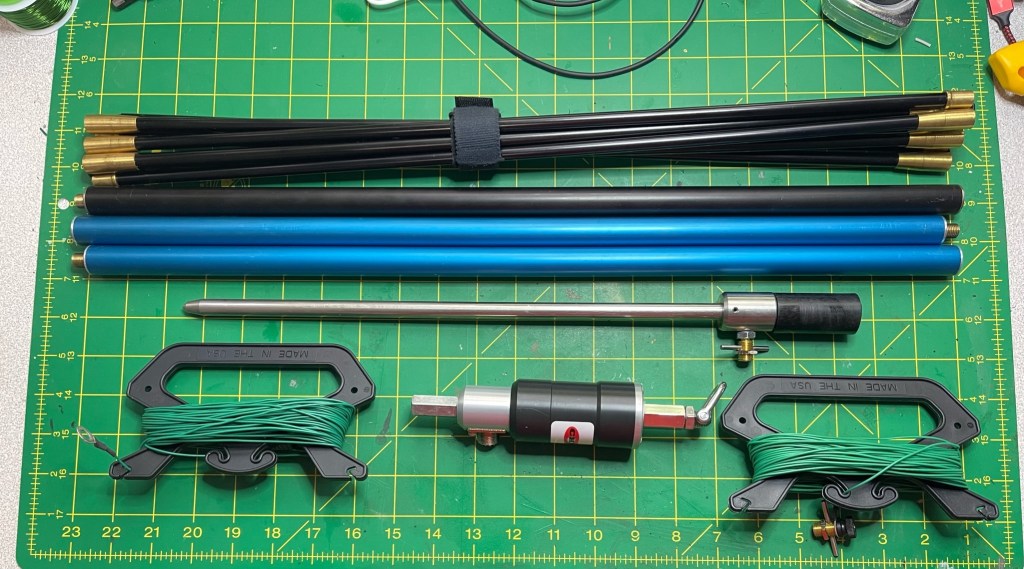
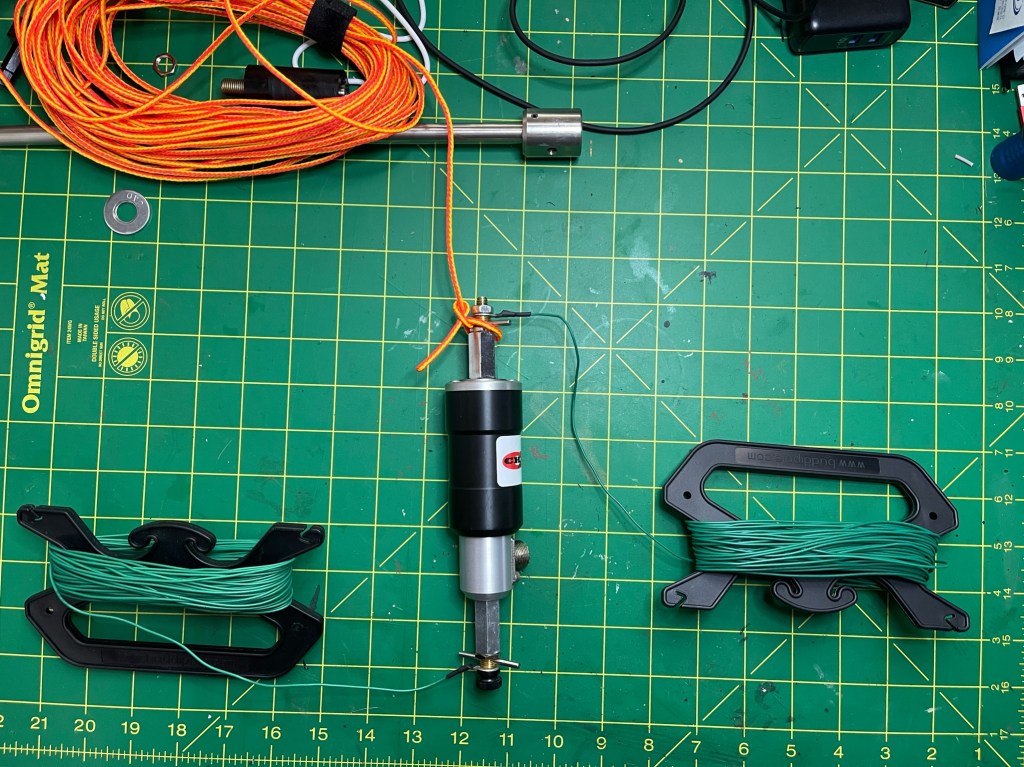
My first improvement is with antennas. I have been a Chameleon Antenna user for years and I have been collecting bits and bobs as needed to make the antennas I think will do me the most good. This year I built their Tactical Delta Loop (CHA TDL). I already had their Micro Transformer and 1 – 17′ Stainless Steel Whip. All I needed was another 17′ Stainless Steel Whip and their Hub Kit. Sometimes when you deploy or even do a POTA activation, there my not be enough clearance (horizontal or vertical) to put the best antenna. The TDL gives me a good sized, free standing antenna that does not take up a lot of space. It is slightly directional giving me a little gain when operating at low power.

My next project was building a desk to fit in the back of my truck. I often activate parks for POTA alone and when nature calls, I do not like to leave my expensive radios on a park bench. I sketched a plan on a piece of paper and went to the shed to see what wood I had. I had enough scraps to build what I wanted to include a desktop I used in the cab of the truck. Part of the project was to try a new to me technology – pocket hole joinery. I stopped at my local Home Depot and picked up a Kreg jig. My first step was to cut the pieces to length and then assemble it.

I let it sit for a couple of hours and then took it out for the paint job. Bcause of the dissimilar woods I went with paint instead of stain.
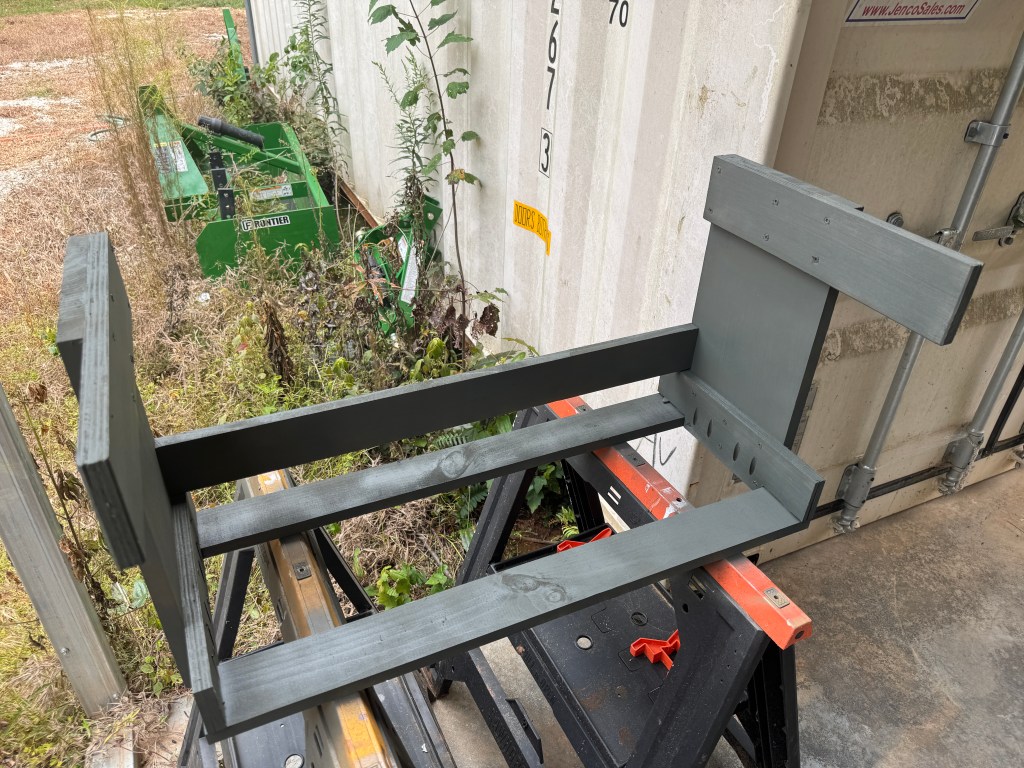
I got creative and decided to camouflage it a little. After I let the paint dry I attached the top.
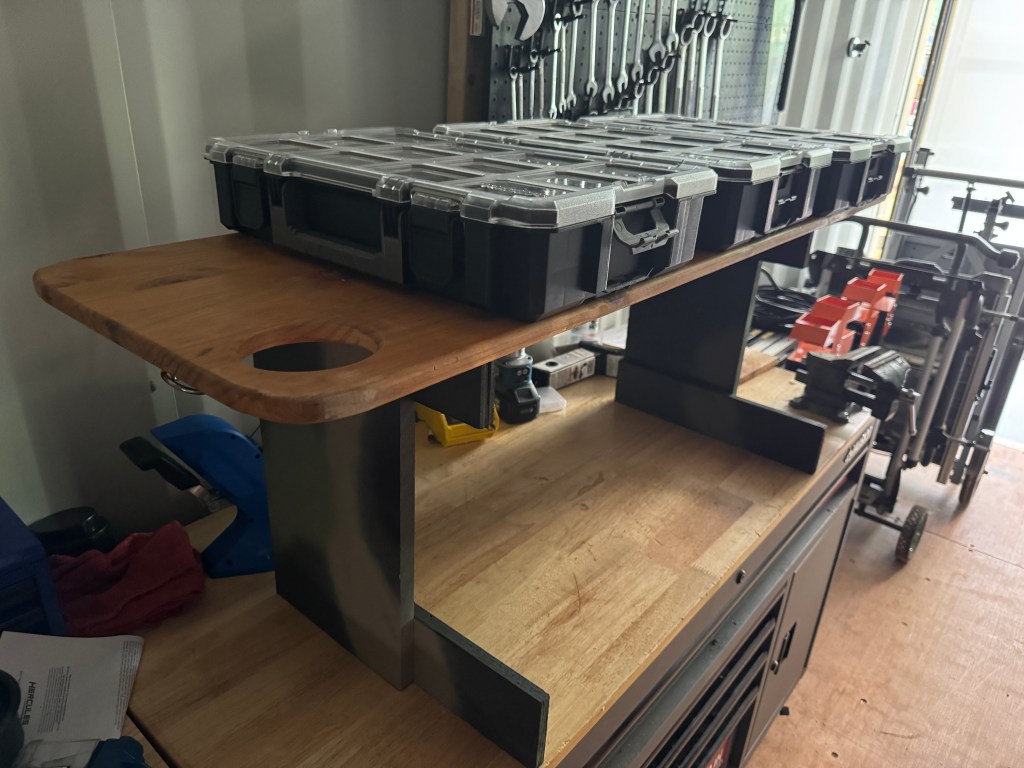
The hole in the foreground is for a coffee cup holder. I didn’t like the plastic ones I had so a quick look on Amazon netted me a stainless steel one. When operating portable it is very easy to knock over your drink onto your log, computer, or radio. Ask me how I know.

One last little bit is I added L-track connectors to the bottom of the desktop on each end.
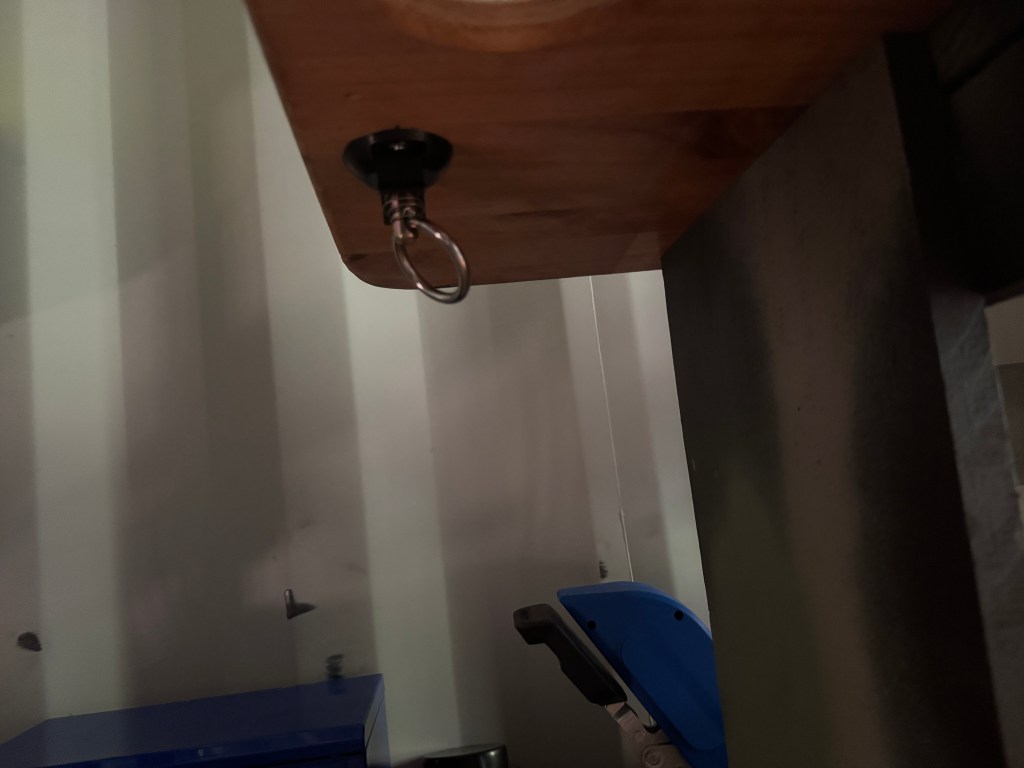
I have L-track on my truck bed and using cargo straps with L-track connectors, it is easy for me to cinch the desk down to keep it from moving in the bed.
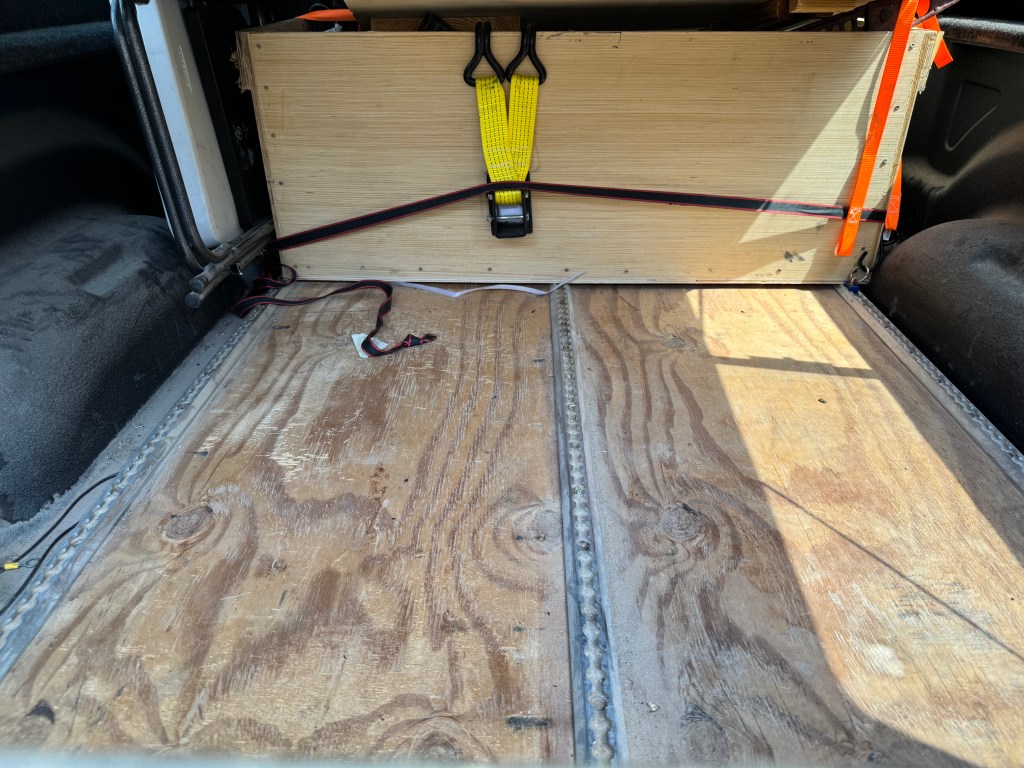
I have a low camping seat that easily allows me to slide under the table. The bottom of the desk top is approx. 17″ off of the ground. There is plenty of room for my legs. Now I can go to a park and all I need to do to secure my radios is flip up the tailgate and lock the camper top. The windows on the top slide open and have bug screens. I just have to add a small fan for the hot days, but for now, fall is approaching and cooler days are ahead. 73- de Scott
Black Rock Mtn State Park – Aug 2025

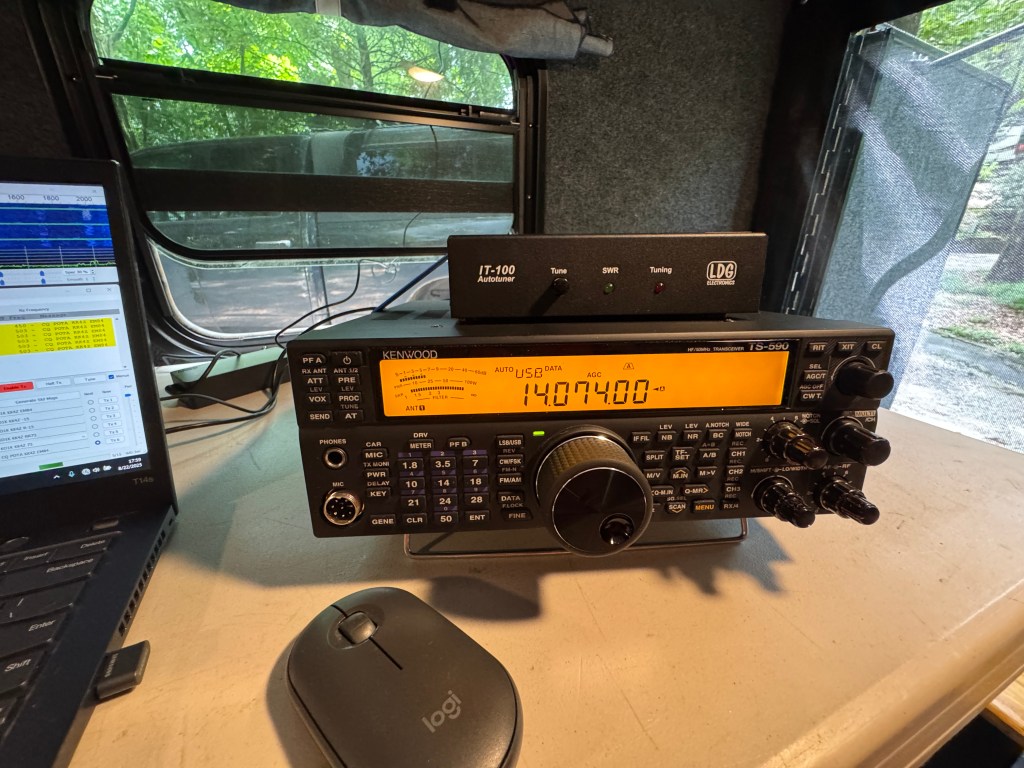
Last weekend I finished up a 3-day, 1,800 mile, 7-state POTA Rove that included a radio trade. Out with the FTX1 and in with a TS-590sg. After setting up the 590, I brought it with me to Black Rock Mountain State Park to try some FT8 and if the band conditions permit, a little CW.

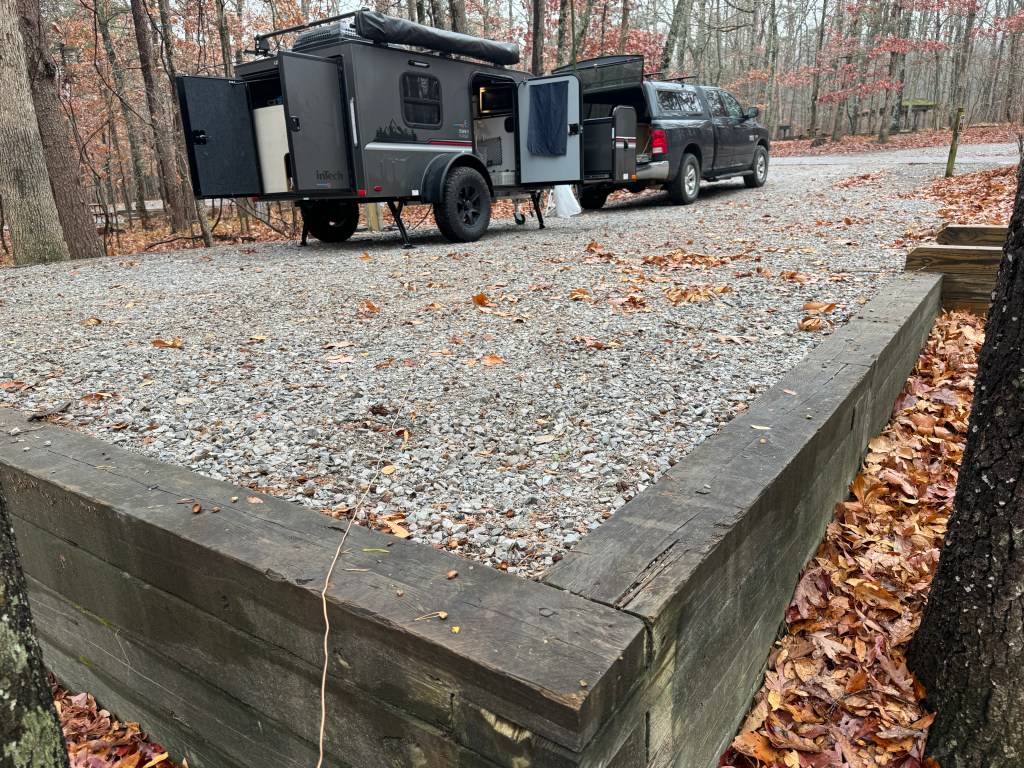
I arrived at the Park Friday afternoon. I have done this enough times that I am setup and ready to go within 30 minutes.  This campsite had some challenges.It was the smallest campsite I ever used.  I had space for the trailer and I had to park my truck in the picnic area.  I also had overhead power lines so I had to use a shorter antenna. The weather was cool for a change and I didn’t have to run my A/C.

Setup was a Chameleon Micro Hybrid transformer with a 12’ whip and about a 20’ counterpoise.  The radio was my new-to-me Kenwood TS-590sg.  This was the radio’s maiden voyage and I really liked it. It performed well.  One of the main reasons I like running big radios at low power is more of the controls are readily available. Most everything in the TS-590sg is either a push button or a twist of a knob away.  Having a high performance receiver isn’t any good if you can’t get to the controls.

Band conditions were poor. The first night I only made 88 FT-8 contacts and they were a struggle.  At times the band would “white-out”, high noise and only white snow on the waterfall. At the better times QSB or fading was a constant up and down.  I would watch S7-9 signals drop to nothing during a QSO.  Saturday afternoon brought a power failure at the park. Yep, right during mid QSO.  The power was still out at 1800 hrs, so I had a decision to make – should I stay, or should I go.  As you get older one of the things that goes, is your night vision.  If I was going to leave it had to be soon, so I could still do most of my driving during daylight/evening hours.  I decided to go.  Since I have a lot of practice setting up and tearing down.  I was packed up in less than 30 minutes. As I was pulling out of the park, the power returned.  Better safe than sorry.

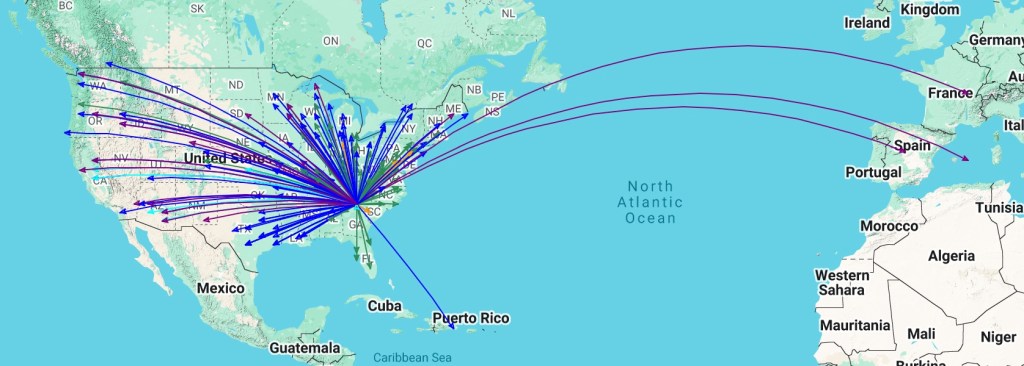
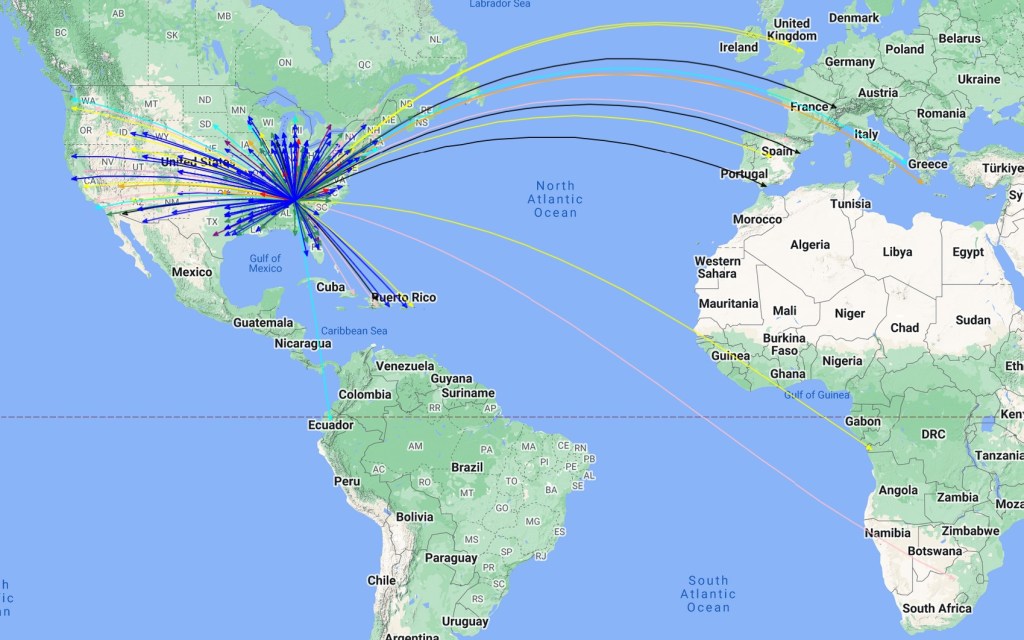
I ended up with 233 contacts, 88 short of my kilo for that park.  I will plan another trip in the fall to finish.  I am real happy with the TS-590sg.  I opened it up and found the MARS mod already done and the TXCO installed.  The radio performed well and I ran it mostly at 20 watts.  As you can see in the QSO map, Most of my contacts were CONUS. Kenwoods and Icoms have the best ergonomics. I feel the layouts were designed by people who use their radios; that ergonomics were a primary concern and not an afterthought. 

Screenshot

I also decided to trade off the FT-710 and ended up with a pristine IC-7200.  I always wanted one but the stars never aligned — until now.  I no longer have any Yaesu radios in the stable and probably won’t have any more.  Why? A couple of reasons. I prefer the ergonomics of the Icoms and the Kenwoods.  Everything I need is right there on the front panel. Easy, to see — Easy to use. I have owned a FTDX10, FT-710, and a FTX1, along with an Icom IC-7610, IC-7300, and a Kenwood TS-890s. I can tell you that whatever I hear on one radio, I can hear on the other.  There’s two reasons for this.  One is knowing where the controls are and two is knowing how to use them. There is a third factor the CSP unit, that’s Cerebral Signal Processing Unit. Half of the battle is using the CSP to process faint signals.  After 30 years, mine is pretty good.

The Yaesu radios, are not bad radios, they are not my cup of tea. I can squeeze more horsepower out of the Icoms and the Kenwoods.  I am sure there are those who can say the same about Yaesus.  I at least crossed the fence and tried them but in the end my preference is not Yaesu. YMMV.

Other happenings. I rearranged my Go Box.  My TS-590sg will not fit in it like my other radios so I got an Apache case for it from Harbor Freight and moved some antenna stuff into the Go Box. So now all my radios travel in a separate case and my Go Box has become universal.  Everything I need to run any of my field radios is in the Go Box.  These days I do more FunComm than EmComm, but I am always prepared to do either. I load the same stuff and off I go. I’ve had a busy summer and the honey-do list is growing, there is lots to do around the ranch so this may be one of the last trips for a while. I do most of my outdoor work from Fall to Spring to avoid working in the southeast hot, humid summers and the accompanying chiggers and ticks. That’s all for now,  take care and 73 de Scott

A Road Trip and a New Radio

Road Trip! I love the sound of that.  I am taking an impromptu road trip north and turning it into a POTA Rove.  I put my FTX1 up for trade on QTH.com and very quickly got a good trade offer for a Kenwood TS-590sg.  I have always wanted one of those.  A nice simple radio that is robust and easy to operate.  I am going to add it to my field radio collection.

Some of you know I have a penchant for operating big radios at low power. I don’t have to worry about overheating and I like that the controls I use most are easy to get to.  Most of the time my field work is either in my micro camper or at a nearby park picnic table.  Weight is not an issue.  I normally operate at about 20 watts. Sometimes as high as 30-35 depending on band conditions.  I don’t need more than that.

My adventure starts Friday afternoon as I head towards Indiana.  I’ll stop somewhere for the night around dark and then pick it up the next day.  I plan on stopping at a park in Ohio and then a park in Indiana to add those two to my activation list. Michigan, another needed State is nearby and I hope to add that one to the list.  From there I will generally head east and see what mischief I can get into.

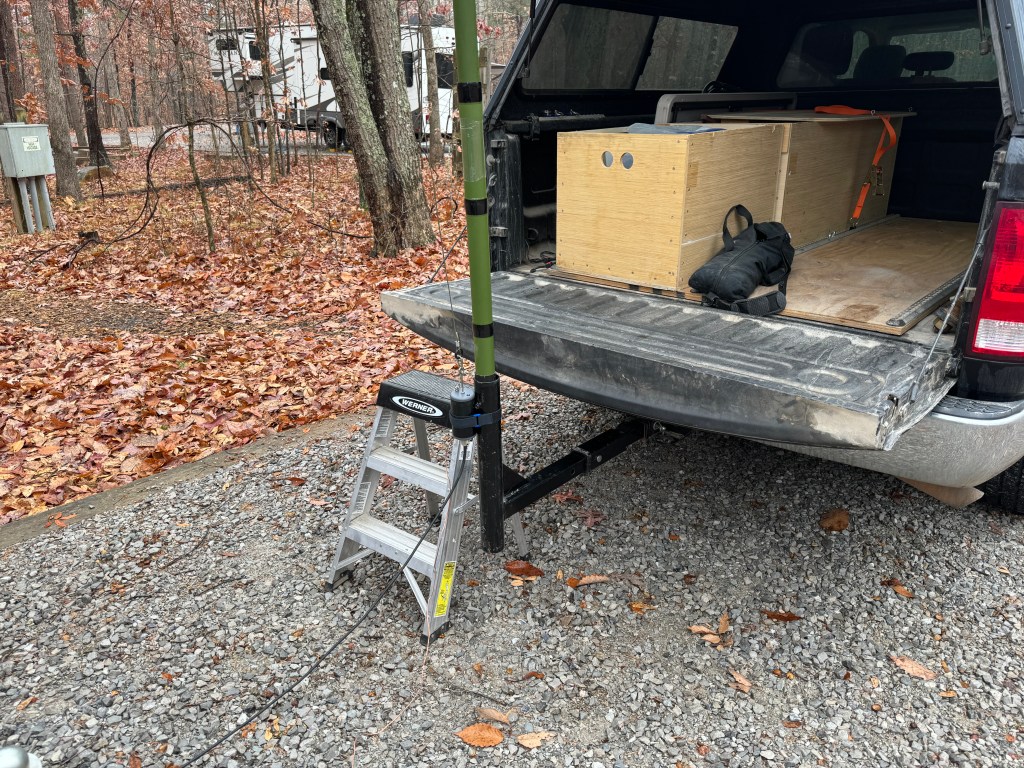
Gear for the trip was my IC-7300 and LDG tuner.  The antenna was a Chameleon 17’ stainless steel whip and a Chameleon  CHA Hybrid Micro Balun sitting on top of a carbon fiber tripod.  Counterpoise was a Chameleon wire with about 20-22’ used. Since this was a shoot and scoot trip I used FT8 with my Lenovo T14 Thinkpad.  I brought a 100 amp/hr LiPo battery for the radio with a Bioenno BPP-160 for the laptop. I ran the radio from the backseat and the laptop on the center console from the drivers seat.  Setup and teardown only took a few minutes.  I collapsed the antenna and stuck it in the back seat when I was done.  Slam, Bam, Thankyou Ma’am. 

Friday night I stopped in Lexington KY, for the night and I was on the road by 6 AM the next morning.  My fist stop was Lake Laramie State Park in Minster, OH.  The GPS put me at the back of the park and I had a nice clearing by the lake to myself.  It took a while to get my 15 contacts ( I always get spares).  Band conditions were up and down like a roller coaster. After working out a few kinks to my setup, I packed up and headed toward Indiana.  The trip was mostly county roads and highways.  The scenery was beautiful passed through farmland with corn as far as the eye can see.  I also passed through some Amish communities and was treated to traditional horse and buggies on the road.

My next Park was Ouabache State Park in Bluffton, IN. I found a little spot in a picnic area and set up shop.  Again, the band conditions were not that good and I was glad I was running FT8. After completing my contacts, I packed up and headed for New Haven, IN were my trade was to take place. I arrived on time and after chatting with my trading partner we were both satisfied with the trade and once again I was on the road heading toward Michigan.

Coldwater State Park is a hunting preserve.  When I got there, there was no infrastructure. Just a parking area and bulletin board.  I was alone and in about an hour I was on the road again.

This was leg of the trip was a long one.  I spent the night in Zanesville, OH and the next morning found me heading for southwestern Pennsylvania. The park I chose was Ryerson Station State Park.  This park was nestled in the Allegheny Mountains with twisty-turney, uppy-downy roads both into and out of the area.  There was no cell service for miles.  It took me a little longer to get my contacts but I succeeded. From there is was a short hop to Picketts Fort State Park in Fairmont, West Virginia. This was a nice park and I found a shaded spot in a picnic area.  This was a hot weekend and at some of the parks, I operated with the A/C running. At Picketts, I rolled down the windows. 

Leaving Picketts, it was a long haul to Hungry Mother State Park in Marion Virginia.  This park while still being in the mountains was more open and the contacts came easier.  From there I drove to Statesville, North Carolina and spent the night.  The next morning I was up early and drove 8 miles to Lake Norman State Park, my shortest hop.  I found a spot down by the lake and made my contacts fairly quickly.  Back on the road for the last 5 hour drive back to the home QTH.

I now have activated 17 States.  I was a fast and fun trip but while my mind was willing, the body not so much.  At 68 it’s probably time to start slowing down a bit. I am at the point where to activate a new state it is a one to two day drive just to get there. 

So why is the FTX1 leaving? To start off with, it is not a bad radio. I have two other small radios, an IC-705 and a KX2. Between the FTX1 and IC-705, my preference is for the 705.  It is more in line with the way I operate. Plus, as I have said earlier, I mostly use big radios so having 3 small radios is a bit superfluous. The FTX1 is off to a new home and I get another big radio for the field. 

When I got home, I did hook the TS-590sg up and played around for a few minutes.  The radio is easy to use and on CW the relays are super quiet.  The controls are fairly intuitive and easy to use.  I am going to bring this radio on my next outing.  Over the next couple of days, I will go over it and set it up to my liking.  Don’t forget to check out my video, and thanks for stopping by.  73 de Scott

WGARS Spring Fling 2025

Today was the club’s semi-annual outing and this spring it was one of our old haunts, Cheaha State Park US-1037 in the fine state of Alabama. There are 3 things we as a club like to do, we like to eat, we like to socialize, and once in a while we talk on the radio.

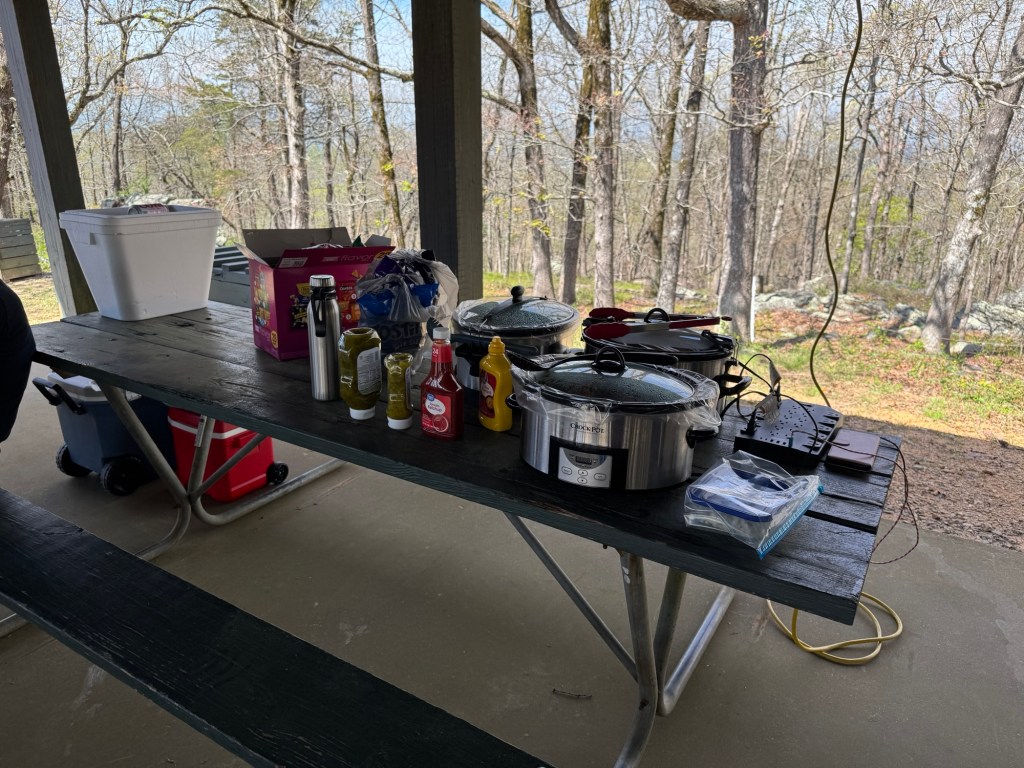
As usual, food was in abundance.

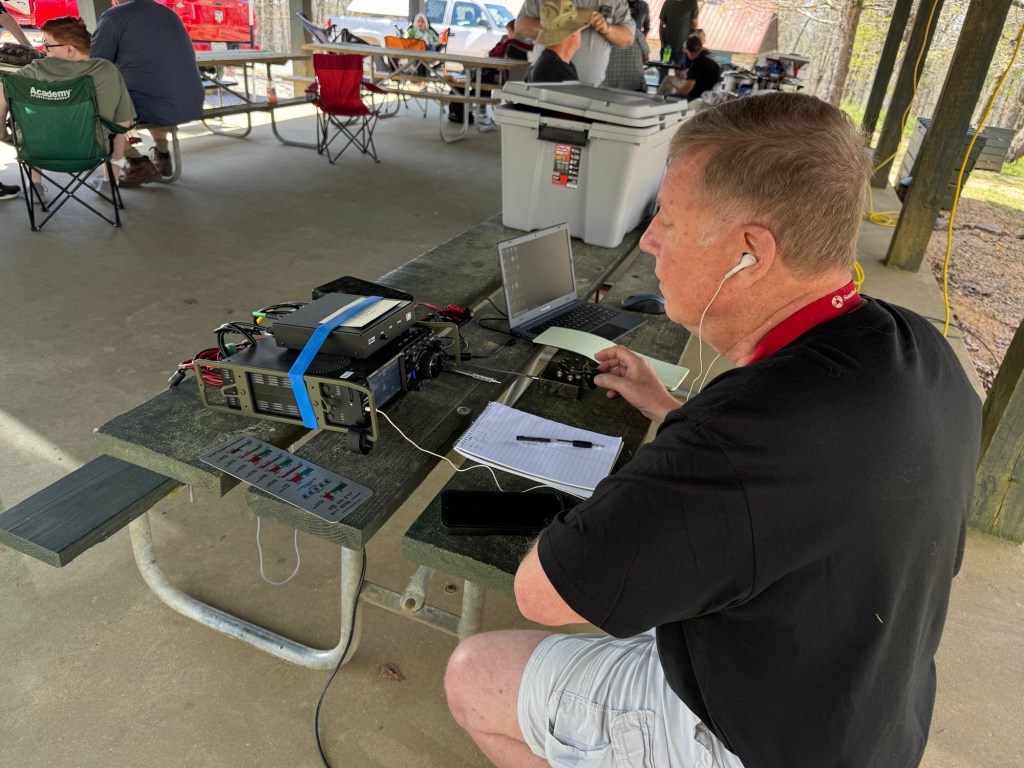
We had several stations set up under the pavilion. QRM was held to a minimum. We had Xeigu G90’s, Tru-SDR, Icom IC-705, and my Yaesu FT-710. I set the radio up and turned it over to the club President John WD8LQT. John, like me is a CW op and I wanted his opinion of the FT-710. I didn’t have to twist his arm too hard. The setup was the radio feeding a Chameleon micro transformer with a 12’ whip and about a 20’ counterpoise. The radio was powered by a 20 amp-hour Bioenno battery and the paddles were a Begali Expedition.

Band conditions were poor and it took John most of the time at the park to get his 10 contacts. There were stops for eating and chatting. Early in the activation, I decided to change antennas to be sure we had an atmospheric issue and not an equipment one. I had my Diamond RHM-12 which recently proved itself to be a good performer. Once the switch was made and some searching through the bands, John started making contacts on 20 meters. I believe it was atmospherics and not the equipment. John got his 10 contacts and we called it good.

John’s comments about the FT-710 were quite favorable. Like any radio, there are pluses and minuses. In general he thought it was a very good radio for CW. There is more commentary from John on the YouTube video posted below. John did have one epic fail. The ear buds he was using which looked rather ancient finally gave up the ghost. I took it upon myself to intervene and unceremoniously threw them in the trash. John will thank me.

My review of the FT-710 is drawling to a close. I find that I like the radio. It performs well for its price point and has some features found on more expensive radios. It has its quirks as all radios do, but none that I find overly objectionable. I plan on keeping the radio and it has found a place among my field radios. I imagine the radio may make an appearance during this year’s Field Day.

POTA Activation K-2169, Me, VaraC, 160 meters and more

This weekend I had the opportunity to activate Cloudland Canyon State Park in NW Georgia. It was a digi weekend with me running FT8 and experimenting with VaraC. I also tried a new antenna combination to see how it would work on 160 meters.

The weather. I book my campsites 4-6 months in advance so I take what I get when I go. This weekend called for rain Friday and was supposed to clear up Saturday PM. It didn’t. It drizzled/rained from the time I got there until 0200 hrs Sunday morning. Since I mingle FunComm with EmComm, this was another test of my gear. The only issue I had was I needed to better seal the window where my coax goes into the camper. You shouldn’t let the weather stop you from going as long as it’s safe. I go year round and because of that, I have a good understanding of my gear and my clothing under varying conditions.

The gear. The antenna was a Chameleon EmComm II ver. 1. This version had a clunky antenna wire and insulator that is more from permanent/semi-permanent installation so I didn’t use it much. This year, Chameleon had a Black Friday Sale of 25% off. I decided to upgrade the wire to a 60′ Kevlar with a winder. I also ordered their new 40-meter OCF dipole which will be used on SOTA activations. I had some 14 gauge Flexweave wire that I cut to 50′ for a counterpoise. My intention was to use this antenna down to 160 meters. I ran the antenna as an inverted “L” ish. The vertical portion went about 25′ up my mast and the horizontal portion was more of a slope and facing north. The nice part was that the entire antenna fit within my campsite. I used the lantern hook on the site to secure the antenna. For rope, I used #36 tarred bank line. The rope is a little sticky so it holds knots well and does not absorb water like para-cord does. I used a clove hitch to secure the antenna ring to the mast and it held fast. The Bank line has replaced all of my para-cord.

The radio was First Peter, my IC-7300 that I bought new in 2016. I use an LDG Z-11 Pro that I have had for 15+ years to keep everything matched up. I was running 25-35 watts. My other IC-7300 is Second Peter. My backup radio was my new KX2. I keep it in a backpack so it is easy to toss in the truck.

Propagation. It was different, not bad, but different. There was a lot of solar activity and I believe it pushed the MUF up above 20 MHz. I had a lot of success on the higher bands which is typically not the case in the winter. My antenna easily tuned 160 meters and I made about half a dozen contacts using FT8. How did I do? I started at about 2030 hrs UTC Friday and finished up at about 2200 hrs UTC Saturday afternoon. I made a total of 325 contacts covering 42 states and 12 countries. Some of the interesting (to me) DX was Angola and South Africa. Both of those stations called me. Angola was on 10 meters and South Africa was on 12. No DX on 40 meters. I had a Facebook request to work 40 meters for local contacts. I did my best but 40 was rather flat this time around. It had the second-highest count of contacts. Breakdown by band was: 10 meters – 18, 12 meters – 18, 15 meters – 13, 17 meters – 7, 20 meters – 136, 30 meters – 19, 40 meters – 90, 60 meters – 12, 80 meters – 6, and 160 meters – 6. One of the surprises other than the lack of low band activity was that 17 meters was fairly dead. Typically on an activation, my money bands are 17, 20, 30, and 40. This time only 20 and 40 panned out. I manage 10 bands at this park in case I want to go for another N1CC award.

VaraC. For the past week, I have been evaluating VaraC mainly for EmComm. There is a lot to like about it. For one thing, it uses the same modem as Winlink. If you have it set up for Winlink, you are good to go for VaraC. VaraC can upload files and low-res pictures. PSKReporter showed favorable propagation on 20 and 40 meters. I made a few contacts with it and did some beaconing. I haven’t tried it yet, but it looks like I can create a document in FLMsg, save it, send it via VaraC, and reverse the process at the other end. pretty nifty. I think pairing Winlink with VaraC just might be the ticket.

Recap. Neither snow, nor rain, nor heat, nor gloom of night stays this operator from completing his park activation… I had a lot of fun. I try not to let the elements stop me from doing what I like to do. 73 – Scott

Frankentenna

I have been playing with portable antennas for years. When operating portable, the antenna probably has the biggest effect on how well you portable station works. I have quite a few portable antennas. Some are specialty antennas and some are my “go to” antennas. When operating at a park for Parks on the Air (POTA). My Frankentenna is my go to. It has evolved over the years, but now I mostly tweak to get it how I like it. Here is the antenna and its parts:

What makes it a Frankentenna is it uses parts from different companies, mainly from Buddipole and Chameleon. Here is a list of the components and links to their websites:
(1) Buddipole 7 section Lightweight Shock Corded Whip Antenna https://www.buddipole.com/mistshwh.html
(3) Buddipole 22″ accessory antenna arms. I am swapping out the blue arms for black ones to better reduce the visibility of the antenna (out of sight, out of mind) https://www.buddipole.com/exanar.html
(1) Chameleon CHA Spike Mount – https://chameleonantenna.com/shop-here/ols/products/cha-spike-mount
(1) Chameleon CHA Hybrid Micro https://chameleonantenna.com/shop-here/ols/products/cha-hybrid-micro
92) Buddipole Wire Assembly Low Band (66′) https://www.buddipole.com/wireassembly.html

This is the basic kit. With it I can make a vertical antenna, and endfed with a counterpoise, and even a dipole. The kit is pretty lightweight and easily fits into a standard Buddipole bag. While at park campgrounds, I usually run it as a vertical. I keep an arborist throw line and weight in with my station equipment. I have some tweaks and mods I have done. Two that you see here are the phenolic insulator and a mod to the spike.

The spike mod is an improvement on the current ground screw. It was a red plastic knob with about an 8-32 screw thread.

I felt it was too small since most counterpoises have either 1/4″ OR 3/8″ eye on the end. I carefully drilled out the hole and tapped it for 1/4″-20 thread.

This now allows me to use a Buddipole Counterpoise Wire Adapter https://www.buddipole.com/noname2.html which is 1/4-20 on one end and 3/8-24 on the other. It gives a more secure connection between the spike and the counterpoise. These are the same adapters that come with the Buddipole Wire Assembly and you can buy them separately https://www.buddipole.com/noname2.html. finished, it looks like this.

One of the things I didn’t like about the Chameleon Micro was the shackle it comes with. The shackle is used to support the transformer when it is used as an end fed or a dipole since it is too heavy to be supported by the antenna wires. It was always kind of hincky getting the shackle setup right. Now I use the Buddipole Counterpoise Wire Adapters. So much easier and so much lighter.

The other mod is a phenolic (micarta) insulator. This allows me to use the vertical with something other than the Chameleon transformer. An example might be one of my homebrew 9:1 UnUn or a Buddipole coil. The insulator is threaded on one end and has an insert on the other, both 3/8-24.

How does it play? Quite Well. I tested 2 configurations I would most likely use during a POTA activation. The first is a 54′ end fed with a 50’ish counterpoise using the Chameleon Micro. Using my RigExpert Stick Pro I got the following. Format is Band — SWR
160m — 5.7
80m — 3.2
60m — 3.5
40m — 4.1
30m — 3.2
20m — 2.1
17m — 3.7
15m — 1.7
12m — 2.2
10m — 3.6
6m — 2.1
The second setup was using the Micro as a vertical. The antenna is approx 17′ (very close to the Chameleon) and running a 50’ish counterpoise.
160m — 6.7
80m — 3.7
60m — 3.5
40m — 2.4
30m — 1.5
20m — 1.3
17m — 1.3
15m — 1.9
12m — 2.8
10m — 3.1
6m — 1.8
During this last activation, I mainly used the vertical arrangement as that suited the space I had. The antenna performed well. I made 100 contacts here and abroad. To see a map check out my post about my activation at Kolomoki Mounds State Park.

What’s next for this antenna? I have two Black Accessory Arms and a Counterpoise Wire Adapter coming from Buddipole. The arms will make the antenna more stealthy and the extra adapter will reside on the spike. I may try the Buddipole coil to see how it plays and I just got some new toroids to see if they work any better. Overall, I really like this antenna. It’s light and compact and goes up anywhere. The SWR is low enough that almost any tuner, can tune it, even on the low bands.