I am still very new to bugs. This is my first one ever. I set it up by myself after watching a 5 minute video from Tom KN4YB. I am sure that with practice and experience I can tune the bug even more, but for a beginner, I was able to get the speeds from 13 to 30 wpm without much issue.
Because I can change speeds fairly quickly, it lends itself to activities like SKCC where there is a wide range of operator experience. I try to match the speed of the other party as best I can.
Here is a short video showing how I set up the bug for different speeds. This is by no means the only way to do it nor even the right way. However, It could be considered a good baseline for others like me just getting started. 73 — Scott
Over the past couple of days I have been trying my new keys. One is a bug and the other is a single lever/sideswiper. I kind of switch back and forth between then as well as use my paddles. I am the zippyest with my paddles so far. So here are some of my first impressions.
Single Lever/Sideswiper. It’s okay. Coming from years of paddle use, it seems it takes more effort to run a sideswiper. Between my paddles/keys, it is the slowest. I can run around 17 wpm. I also seem to be more error prone. In single lever mode, again it’s okay. I have trouble in my head switching from sideswiper to single lever. I could probably train out of it. I think the bottom line is, if I continue to use the key, it will be as a single lever.
Next up is the bug or semi-automatic key. A bit of history. Even though I wasn’t licensed until 1995. I built a Heathkit HW-8 in the early 80’s and was interested in amateur radio since the 60’s. Back then there weren’t electronic keyers or paddles. I was very enamored the Vibroplex key. I thought they were so cool. When I finally got licensed I started out with paddles. The philosophy I followed was start with the key/paddle type you intend to use from the beginning. I have been a paddle guy since 1995 until now. With my venture into SKCC, I needed a key. I was always a little intimadated by bugs. They were complex, had to be set-up and required additional skill to run one. I held off until now.
I was in for a pleasant surprise, I got one of Tom’s KN4YB’s bugs and after watching a YouTube video by him to help me set it up. I was off and running.
The conversion from paddle to bug was pretty easy. I was worried about my dah spacing after hearing some not-so-good bug operators, but what I discovered was my years of paddle use kind of ingrained my dit/dah spacing in my head.
After some practice and adjustment I tried the bug on my code-buddy. I did forewarn him I was using a bug for the first time. I set the bug for about 17 wpm. With my current setup,by moving the weights, I can go from 17 to about 21 wpm. By altering the setup, the bug has a range from 13 wpm up to about 40 wpm. I started the QSO, and afterwards, I called him on the phone for a critique. He said he wrote down my side of the QSO and only missed one letter. It was an “S” for an “I” in the word rain. That was also an SKCC contact (my first) and I passed my SKCC number to him. Besides being able to run the bug at the same speeds as my paddles; I am comfortable with the bug at 20 wpm, it also seems easier to transition from bug to paddles and back.
It appears I am bitten by the bug. My IC-7610 and my K3(s) have both a straight key and a paddle input so I can leave both hooked up at the same time ready to go. I am in a CW Innovations class and one of my goals is to get my copy speed above 25-27 wpm. Those speeds are very doable with the bug and the paddle. Because of the size and design of my bug (model DL-151RA) It is easily field portable. I am going to get a small padded case for it and take it to a park.
A new key, a new venue, and a new adventure awaits. Retirement is grand. I am having a blast. Stay safe, play nice and 73 — Scott
Yesterday, I decided to list my Yaesu FTDX10 on QTH.com. Surprising to me, it sold in a couple of hours. I got my asking price and the guy I sold it to has been helpful and communicative. The radio ships out Monday morning.
I am going to take the money and get the KPA3A 100 watt amp kit for my K3(s). It is currently a 10 watt radio. I put the 3 in parenthesis becuase my radio is a converted K3 to the S. I plan to use the radio in the shack and for field days. I mainly do CW these days and the QSK on the K3(s) is sublime.
Speaking of CW, I recently received 2 keys from KN4YB. He is a one man shop that makes Bugs and keys. I was intrigued by his designs and bought a couple to try out.
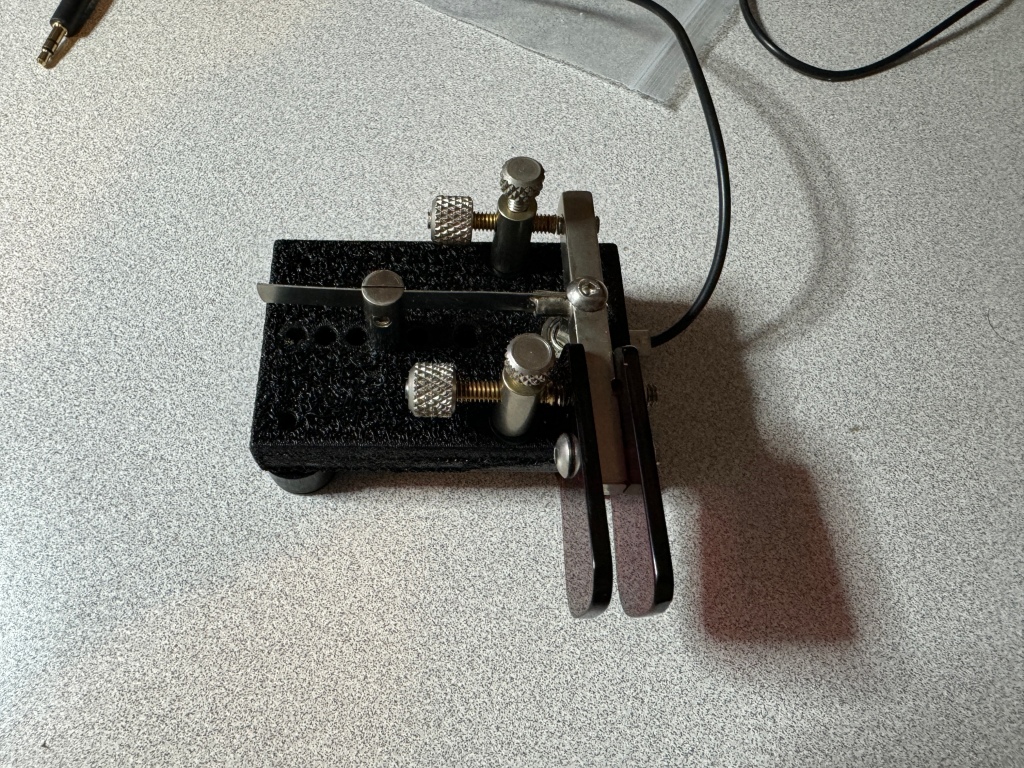
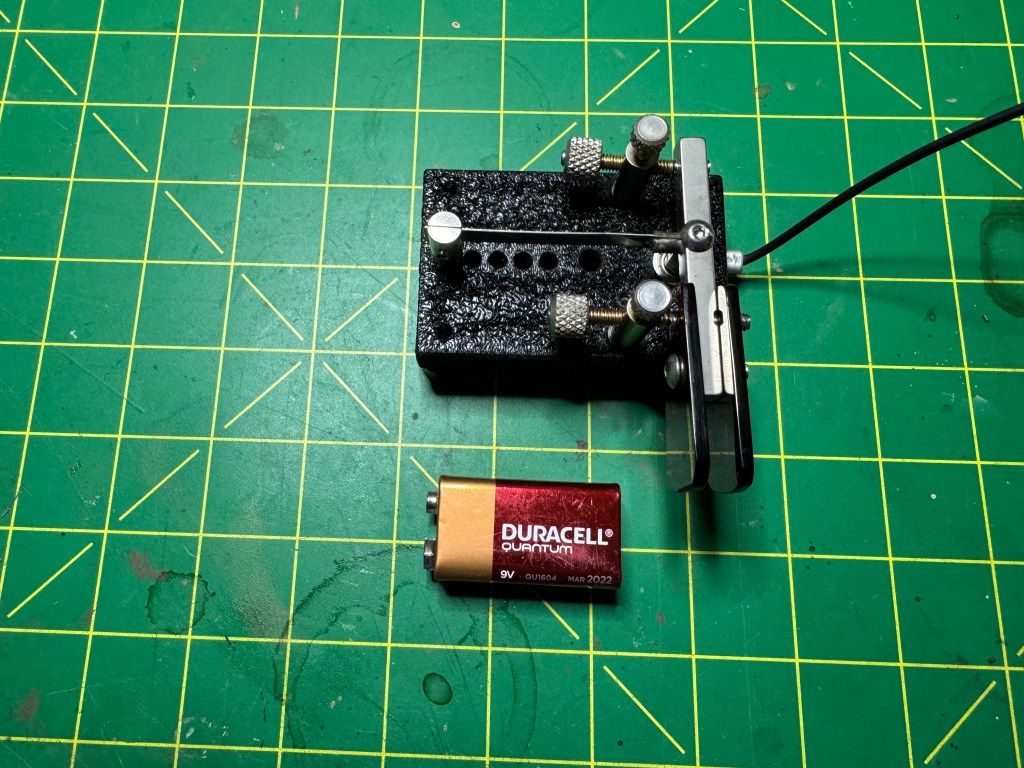
The first one is a bug, model DL-151RA. It is unique in that it is a dual lever. It has one paddle for the dits and one paddle for the dahs. By moving the dit weights, you can adjust the dit speed from about 13 wpm up to 40 wpm. Mine is set around 16.
As you can see, the bug is rather compact. I have it sitting on a silicone pad on my desk and it does not move.
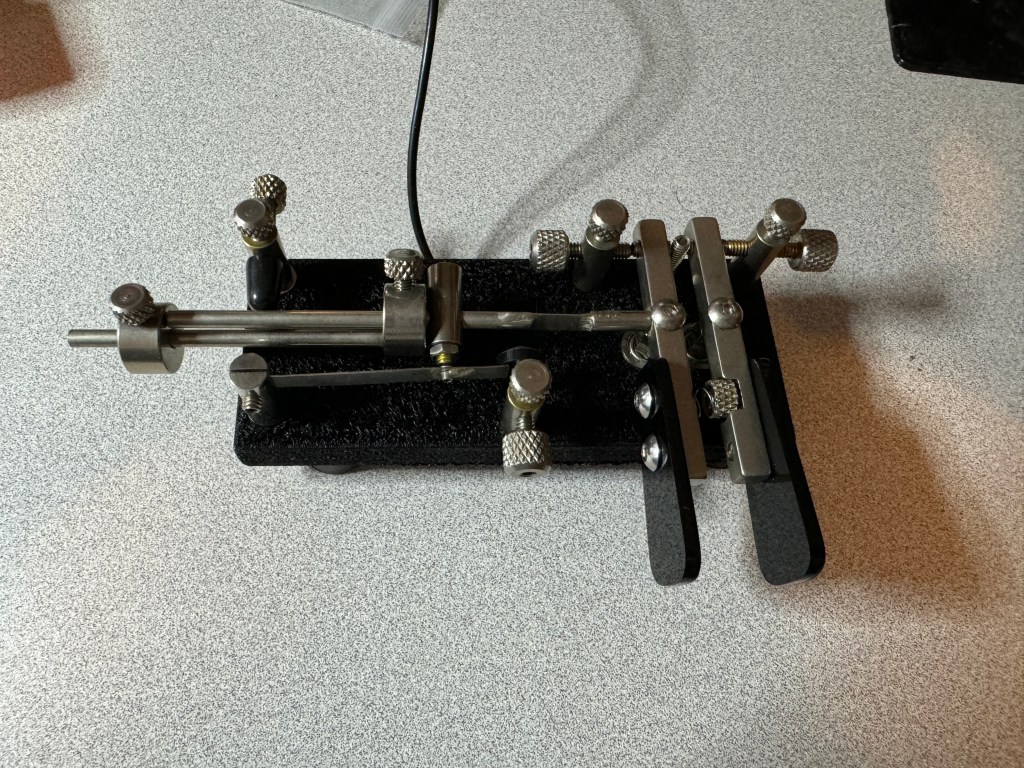
The other paddle I got is a Single Lever Paddle/Sideswiper. The difference between a single lever and a sideswiper (also called a Cootie Key), is a single lever paddle is used with an electronic keyer where the keyer generates the dits and dahs automatically. Note: I use the term paddle to designate a key that uses an electronic keyer and a key to designate a straight key. A sideswiper is more like a straight key where the dits and dahs are generated by hand movement. This model, the SL85 has a shorting bar which allows you to set it up as either a single lever or a sideswiper.
It is also a compact key. The workmanship is excellent and the prices are reasonable.
I started my journey into mechanical keys as the civilty on POTA seems to have taken a turn for the worse. Not as bad as SSB but not like it used to be. I decided to give the Straight Key Century Club (SKCC) a try. They only allow straight keys, sideswipers, and bugs, keys where the dits and dah are formed by hand or mechanically. My fascination for CW goes back to the 60’s. I thought bugs were very cool and wanted a Vibroplex. I wasn’t licensed until the mid 90’s and then chose an electronic keyer. My first set of paddles were Benchers. This is my first experience with straight keys.
I spent time with both keys to see which one I was most comfortable with. I went with keys that had a side-to-side motion as that was my experience. I was curious to see how well I could transition from paddles to straight keys. The answer is, not to bad. I think my years of using paddles has helped me with dit and dah ratios. The ratio is already ingrained in my head. Right now, between the two keys, I am doing better with the bug, which surprised me. However, I think over time and practice, I can gain some level of mastery over both.
What about my paddles? They are not going away. I can still send faster with the paddles and will probably use them for Field Days and some contests. It will take me a while to be proficient with keys. Setting up the bug is an art all by itself. So I am off to a new adventure. My code buddies will now have a new challenge as I try to improve my key skills. 73 — Scott
I feel a shift in the winds. Maybe it’s time to chart a new course. I feel if I continue on the current heading, I will end up in the doldrums. Not a good place. Parks on the Air (POTA) using CW has become stale. There is more to CW than a contest-like exchange. I have also noticed that the pile-ups in POTA have become a little more unruly. When this happens, it can extend the pileup time to double or triple what it used to be. CW pileups work well when each station sends their call once and not two or three times. Couple multiple calls with tail-ending, and a pileup could go on from close to a minute. These multiple calls often QRM the activator so no one can hear him, causing him to repeat the call they have chosen. While there aren’t any fast rules, there is an art to working a pileup from either end and, adapting to the ebb and flow of the pileup is key.
So where am I today? I think I need to try something different, not real different, just not what I’m doing now. After 1,000+ POTA CW contacts, I think I got it. Activations are still a bit of a challenge, but, it’s still just an exchange. I am currently enrolled in a CWI course to help break out of my stagnation. I want to become more conversational with CW, much like I was years ago. But insanity is defined as doing the same thing over and over again expecting a different result. This means I have to do something different than POTA, or SOTA for that matter.
My first step was to join the Straight Key Century Club (SKCC). SKCC does not allow any electronic means of sending CW. They allow 3 types of keys: straight key, sideswiper, and a bug. Yep, it takes a little more skill to run one of those babies. Twenty-eight plus years ago when I was a Tech+ I used Iambic Paddles and have used them since. I have another challenge, learn how to run a mechanical key. Couple that with learning to become more conversational should keep me busy for a while. I am also hoping that jumping backwards over the technological barrier, may be a place where things are a little less hectic.
I am looking at several different mechanical keys and when I get one (or more) they will show up here on the blog. Learning to use a mechanical key will be like learning a new musical instrument — how fun! I will still do POTA and SOTA, but I plan on opening new avenues to adventure. Hope to hear you out there. 73-Scott



 KK4Z
KK4Z 