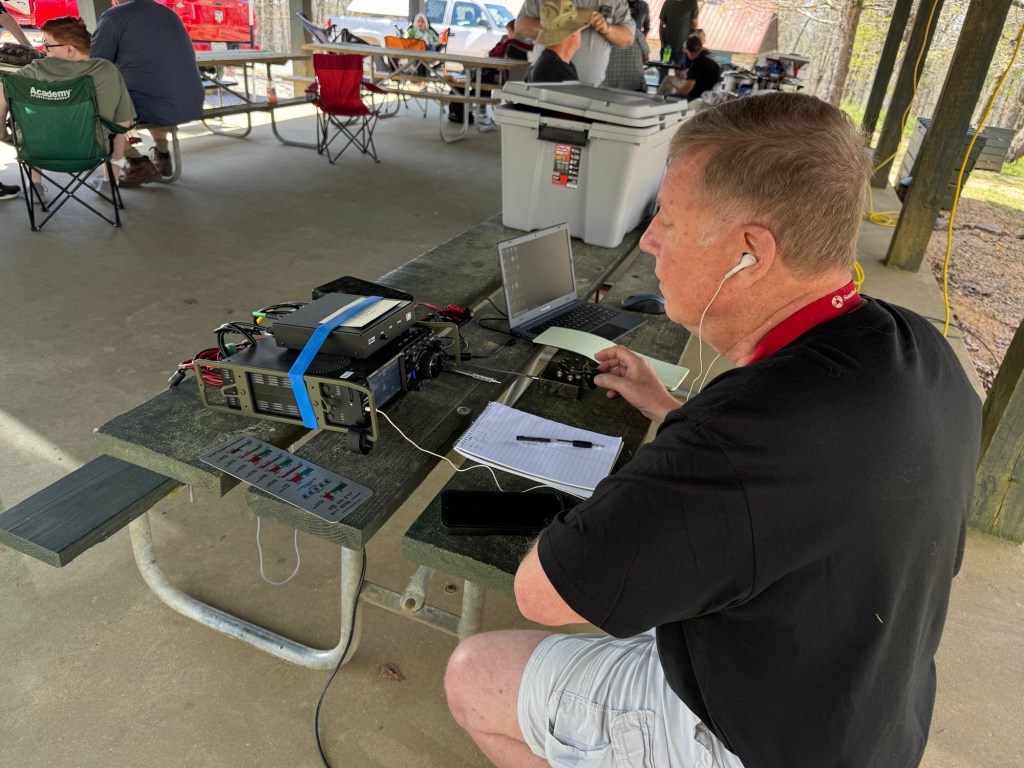
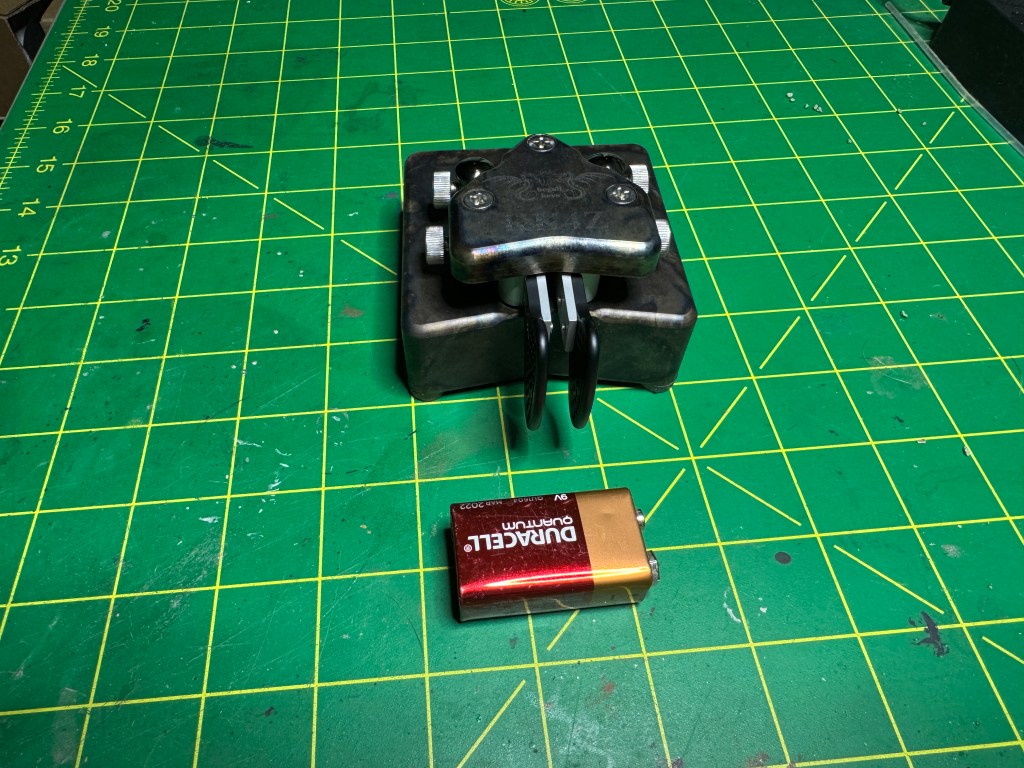
This past weekend was the Support Your Parks on the Air Weekend. My local radio club, the West Georgia Amateur Radio Society (WGARS – https://wgars.com) operated from Cheaha State Park which is the tallest point in Alabama. While there I spent some time with a new ham and we got on the subject of CW paddles. He asked for a recommendation and at the time I didn’t really have a good answer. On the way home from the event I thought about it and if I was to make a recommendation today, it would be a Begali Simplex Begali Simplex Paddle. Currently they cost about $163 USD and are built to last a lifetime. I am a fan of their paddles and own 5. Begali paddles are built like tanks with the precision of a Ferrari. Their customer service is bar none.
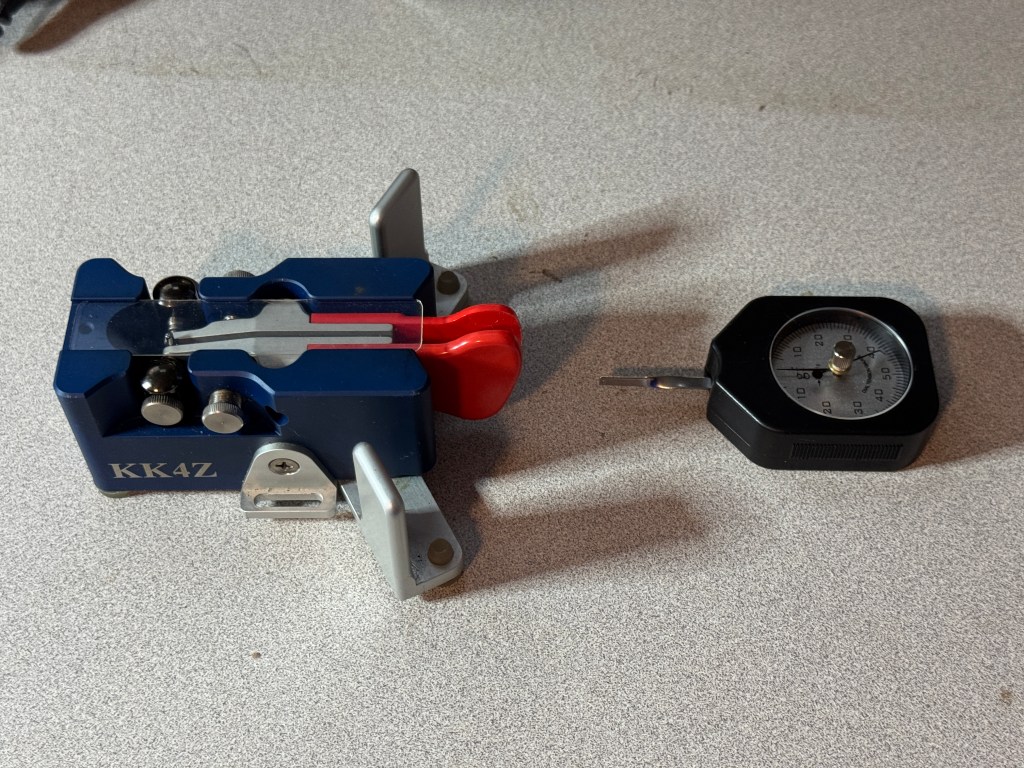
While at the park, I set up my IC-705/AH-705 with a Chameleon Delta Loop. The 705 is a fun and very capable radio. The paddles I used were made by Modern Morse. These are very nice paddles and well built. However, during the operation, I was having trouble adapting to them. I made a lot of mistakes. It just didn’t feel right. I decided to check the paddle force or the amount of pressure it took to depress the paddles. I had been holding off getting a dynamometer but pulled the plug and I am glad I did. I first measured a set of paddles that I use well which were my Begali Expedition. They measured about 25 grams of force. As I went through my other paddles I discovered a wide range of forces between them. Some as high as 50+ grams.
One by one, I got them all adjusted to 25 grams and switching between paddles has become much easier. Why didn’t I do this sooner? I got the gauge from amazon Amazon – Dynamometer.
QSK vs Semi-Break in. In CW, QSK means the the radio quickly switches between transmit and receive so you can hear dits and dahs from another station in between your characters and words you are sending. Some people love QSK, some people hate it. I like it because a good operator can send a dit at the right time to make you stop and listen for them. An example might be you calling CQ too fast and a well placed dit will get you to pause long enough to allow the other station to send their call and start a QSO or exchange. Some radios have noisy relays and QSK makes too much of a racket. Adding a little delay to make it semi-break in will cut down the chatter.
QSL. I no longer send out QSL cards. Life has gotten rather busy and I find myself not being able to keep up with QSL cards. I am usually very diligent about updating LOTW. Thanks to everyone who visits my blog and YouTube channel. I hope you are enjoying this fall weather as much as I am. 73 de Scott
I have a set of Begali Adventure Paddles. They are wonderful paddles. I have the mount for my IC-705, KX2, and desktop. Each mount works well. However, there are times when I do not have a stable platform for my radios or the paddles. At these times I usually hold the paddles in my hands. My go to handheld paddles are my N0SA SOTA paddles. I got mine from his last run. They are an excellent paddle.
I tried holding the Adventure paddles in my hand but I would cause errant dits and dahs. I first thought I would 3D print a box for the paddles–to much thought. I then thought about getting some square aluminum tubing. Too expensive. I scrouged around in my shop and found some 1″ angle aluminum. Perfect. Before I go on let me explain, that this was done with hand tools. A hacksaw, files, hand drill and drill bits. I also used a Dremel tool a little. This project is far from perfect. I never let perfection be the enemy of good enough.
Here is the piece roughed out.
The slot is where the finger guard mounts to the bottom of the paddler using a 4-40 screw. Mounted it looks something like this.
The guard extends past the end of the paddles to help protect the cable where it enters the paddle.
In use the paddle/guard combo looks like this.The guard keeps my index finger from touching the paddle lever and allows me to put my thumb below the paddle lever on the other side. It is very comfortable to use even with my large mitts.
A coat of primer, followed by paint and a clear coat and viola!, it is finished.
I will let it cure overnight and it will be ready for the next adventure. 73-de Scott
Today was the club’s semi-annual outing and this spring it was one of our old haunts, Cheaha State Park US-1037 in the fine state of Alabama. There are 3 things we as a club like to do, we like to eat, we like to socialize, and once in a while we talk on the radio.
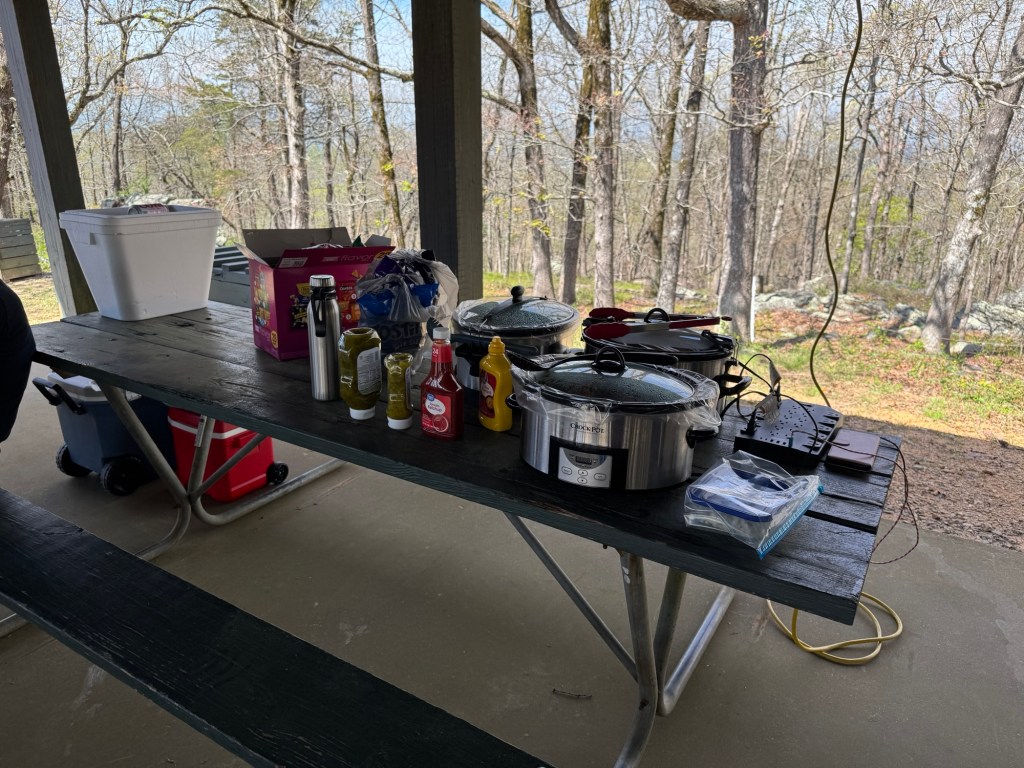
As usual, food was in abundance.
We had several stations set up under the pavilion. QRM was held to a minimum. We had Xeigu G90’s, Tru-SDR, Icom IC-705, and my Yaesu FT-710. I set the radio up and turned it over to the club President John WD8LQT. John, like me is a CW op and I wanted his opinion of the FT-710. I didn’t have to twist his arm too hard. The setup was the radio feeding a Chameleon micro transformer with a 12’ whip and about a 20’ counterpoise. The radio was powered by a 20 amp-hour Bioenno battery and the paddles were a Begali Expedition.
Band conditions were poor and it took John most of the time at the park to get his 10 contacts. There were stops for eating and chatting. Early in the activation, I decided to change antennas to be sure we had an atmospheric issue and not an equipment one. I had my Diamond RHM-12 which recently proved itself to be a good performer. Once the switch was made and some searching through the bands, John started making contacts on 20 meters. I believe it was atmospherics and not the equipment. John got his 10 contacts and we called it good.
John’s comments about the FT-710 were quite favorable. Like any radio, there are pluses and minuses. In general he thought it was a very good radio for CW. There is more commentary from John on the YouTube video posted below. John did have one epic fail. The ear buds he was using which looked rather ancient finally gave up the ghost. I took it upon myself to intervene and unceremoniously threw them in the trash. John will thank me.
My review of the FT-710 is drawling to a close. I find that I like the radio. It performs well for its price point and has some features found on more expensive radios. It has its quirks as all radios do, but none that I find overly objectionable. I plan on keeping the radio and it has found a place among my field radios. I imagine the radio may make an appearance during this year’s Field Day.
Life is full of changes. Some are expected and some are not. Over the past couple of weeks I have had some changes for the good. One is that 2025 is shaping up to be a better year than 2024. My wife and I had some trials and tribulations which hampered my radio-activity. We had deaths, surgeries, and a few other health issues that slowed us down. This year, things have appeared to clear up and I am already enjoying more amateur radio activity.
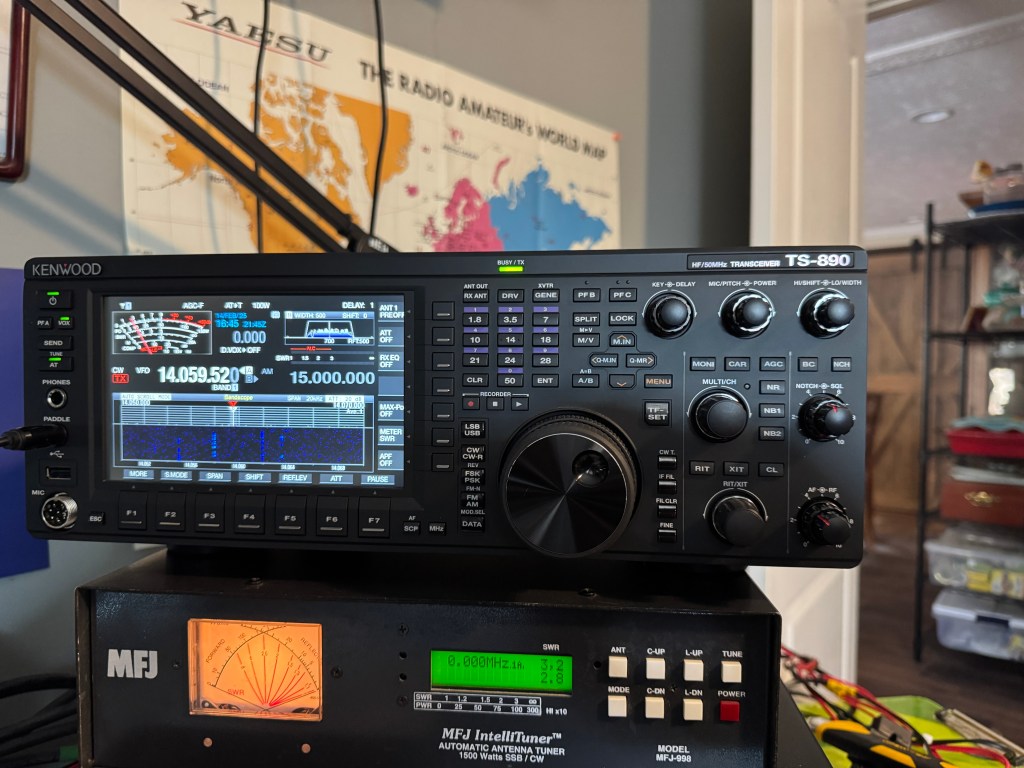
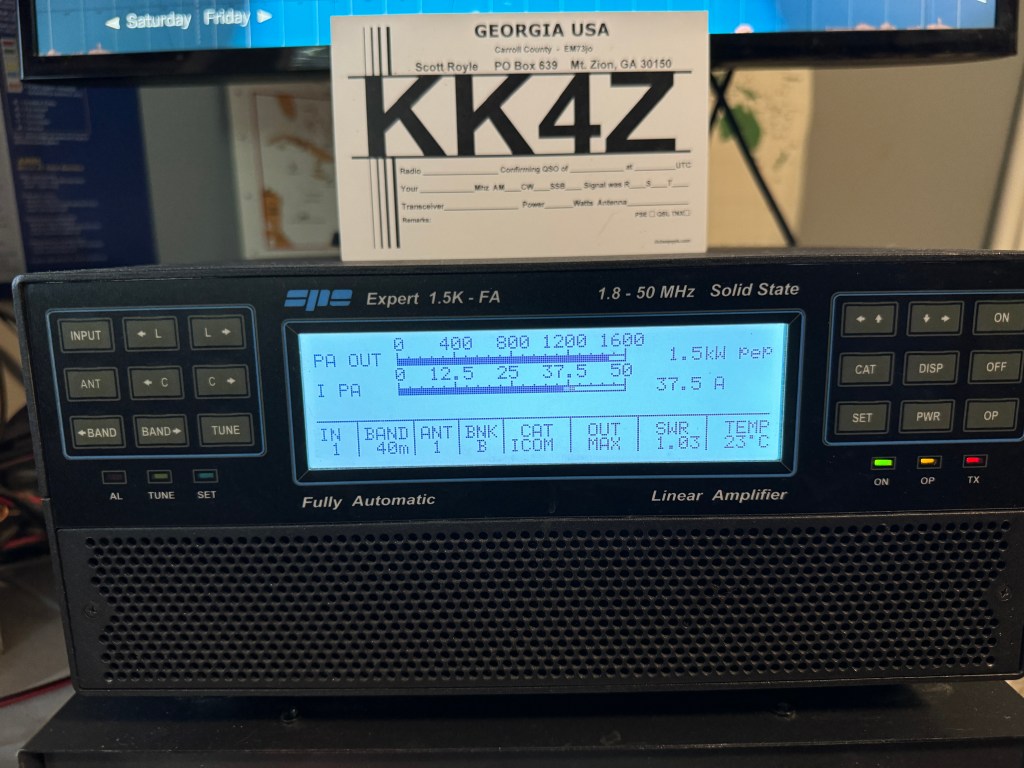
To start off, I have had another shack shake-up. In a prior post I had my SPE Expert 1.5K FA up for sale or trade. It is a great amp but I needed an amp that would do MARS and SHARES frequencies so I ended up with an SPE 2.0 K FA. When I get back from Hamcation, I had a trade offer. My amp for a TS-890s. I have never owned a Kenwood HF radio so I thought I would give it a go. The trade went smoothly.
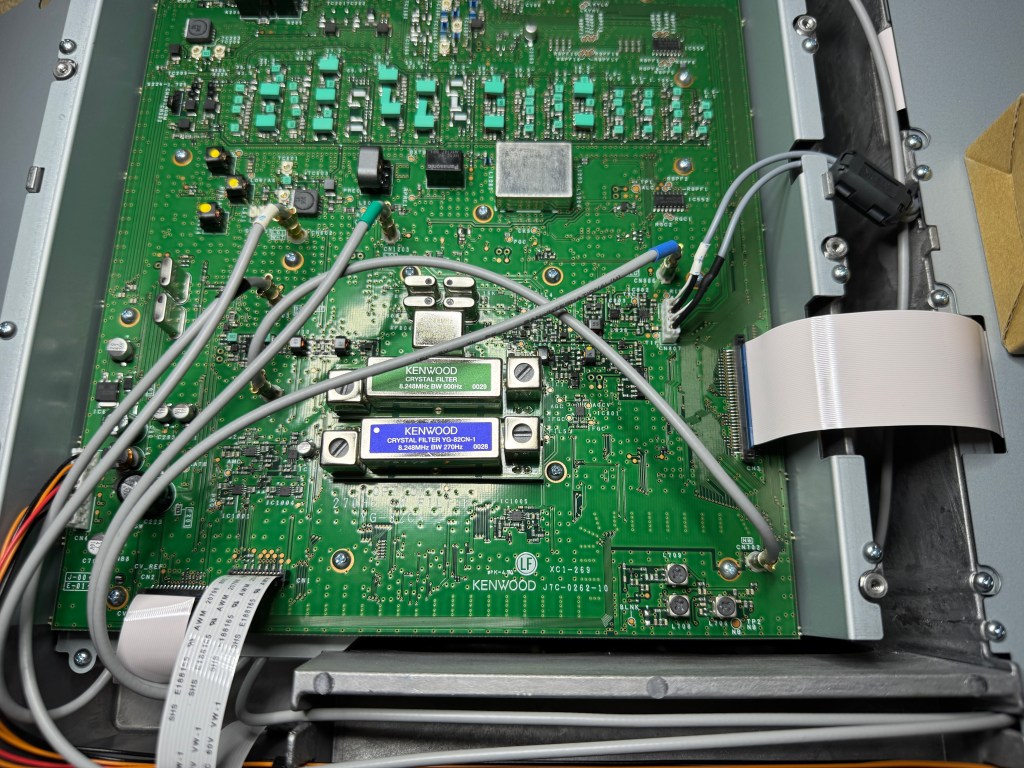
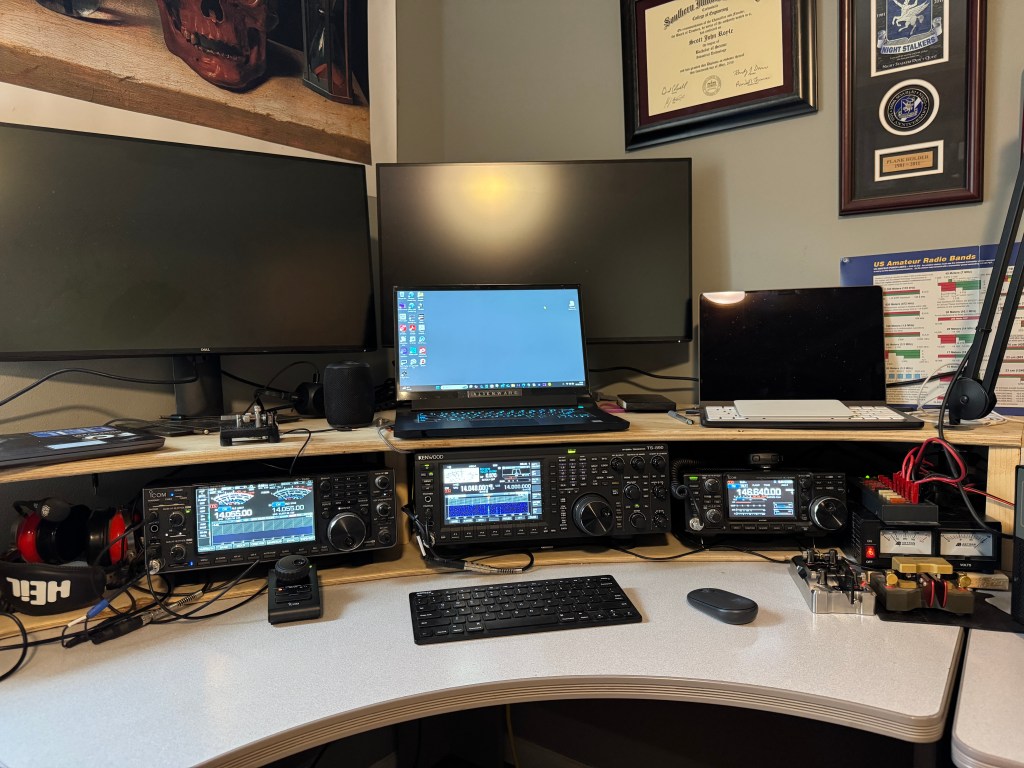
Before installing it in the shack I added the 270 Hz Roofing Filter and while I was inside, I did the MARS modification. I do not intend to use this radio for MARS, but in pinch, I am ready. My intention is to use the radio for fun and CW. I located it front and center on my desk. The IC-7610 was moved to the left which is where I set up for MARS operation. The 7610 plays very well for MARS.
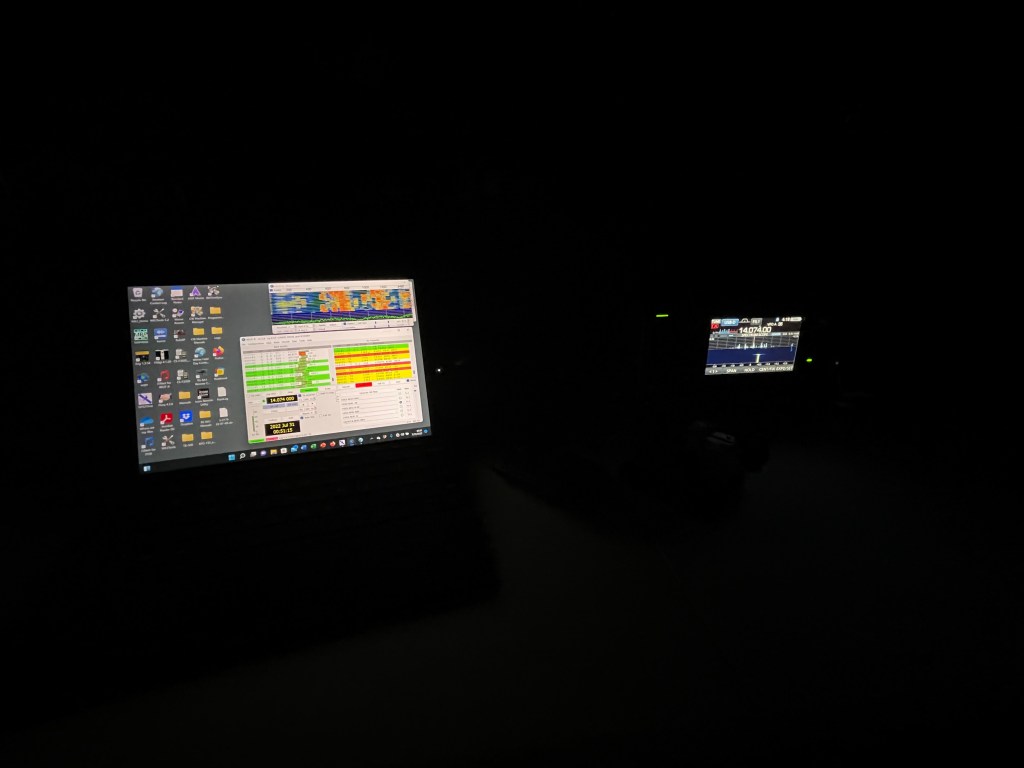
As you can see in the above photo, I am using a Windows machine for radio control and logging. I really enjoy my Mac for everything else but when it comes to things radio, Windows machines are easier.
This weekend was the ARRL DX contest and the CW bands were crowded. this gave me a good opportunity to test the TS-890s. It performed very well.
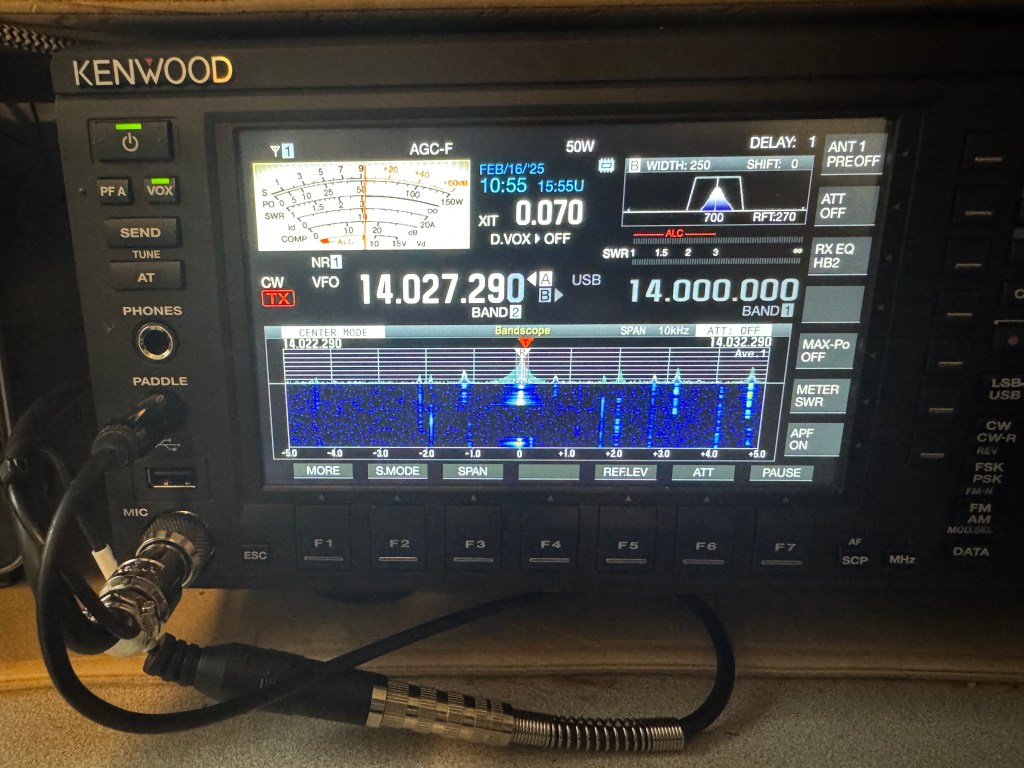
The scale on the waterfall is 5 KHz on either side of the frequency. I had the 270 Hz Roofing Filter and a filter bandwidth of 250 Hz. The TS-890 easily blocked an adjacent S9+10 signal less than 500 Hz away. Even at less than 200 Hz away I could easily copy the target signal though there was some ringing. That is pretty impressive.
I am hoping to get back into CW this year. I made about 10 POTA contacts this morning with the TS-890s. It is a very pleasant experience. The TS-890s has more buttons and controls than my IC-7610 and even though I think the 7610’s ergonomics are great, The TS-890s’ is better. The 890 is a big radio and it is heavy. It’s built like a brick…
Tools of the trade for CW are my Begali Magnetic Signature and Sculpture Swing.
I joined SKCC last year but didn’t do much because of stuff. I hope to do better this year. A lofty goal I have in mind is to get my CW above 25 wpm. I think I am close. I need to practice. Hopefully this year will allow that to happen.
I hope everybody else is doing well and I hope to hear you on the air. I have a couple of camping trips coming up which should be me and the key trips. The IC-7300? It has gone back to being a field radio. Which is one arena it really shines. 73 – de Scott
This was my first Hamcation and it was a lot of fun. Lots of people, lots of food and lots of ham gear. I only spent one day there, but it was a fun-filled, packed. day.
One of the highlights of my day was the Begali Booth. Up until this point, I had 4 Begali paddles in my collection. Each one purchased directly from Begali and each one through Bruna. Buying a Begali key/paddle is like being adopted into a family. That’s how Begali treats their customers. I finally got to meet Bruna in person.
They had many of their paddles there — so many to choose from. I like to dabble with straight keys and my preference being a cootie key since they have the same back and forth motion as a paddle. Bruna had a Sculpture Swing and after sending a couple of characters, I was smitten, and I was lucky to get the last one, the display model. I also got to meet Bruna’s husband Roberto who packaged up my prize for me.
I hope to get a review done on the Sculpture Swing in the near future.
Diamond Antennas, one of my favorite brands for mobile/portable VHF/UHF antennas has a new portable HF antenna for the US market. I have seen this antenna on European website but this was the first time I have seen it in the U.S. It is a portable HF/UHF/VHF antenna that covers 7-440 MHz. With optional coils, it also covers the 3.5 and 1.8 bands.
The screwdriver portion of the antenna is 15″ long and the 1.8 MHz coil is 17″. For comparison the yellow packaging is 21″. This will be a great antenna for POTA/SOTA. I can’t wait to get this on the air.
Kenwood had a teaser for their new VHF/UHF mobile. Looks like it might be out by the end of the year. Here is a shot of a non-working model.
It looks pretty cool. I am mainly an HF guy and I stopped there to look at the TS-890. That is my current dream radio. I brought one of my amps down there to trade but the stars were not aligned. I have a nice lightly used SPE 1.5K FA up for sale or trade. I would like to get a TS-890 and may consider a FTDX101MP. I would also consider an Elecraft KPA/KAT500. It’s a great amp but it doesn’t do MARS so I had to get another amp that would (SPE 2.0K FA).
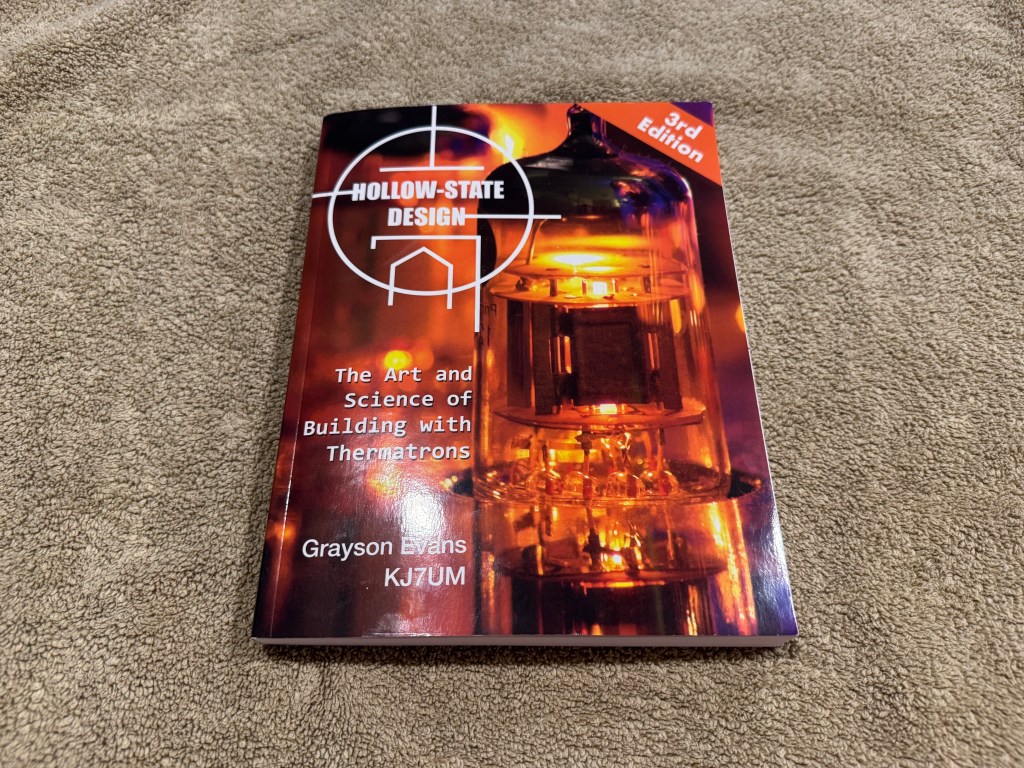
While cruisng the swap building, I came across this book:
I bought on a whim and Grayson autographed the book for me. I may never build anything out of tubes, but I thought the book would be a fun read.
I got to talk to a lot of people while I was there. I talked to one guy there that was looking to get a radio after being absent from amateur radio for many years. He was thinking about getting an IC-705. I asked him if he had any other radios and he said no. I suggested he look into getting an IC-7300 first. The 7300 is still my “if i could only have one HF radio” radio. Many times new or returning hams opt for the QRP route, not knowing how frustrating QRP can be for the less experienced. For a first or only radio I recommend a 100 watt radio. You can always turn a 100 watt radio down to 5 watts but a 5 watt radio is already at its max. A lot of times when camping, I am running CW at 20 watts.
It was fun seeing all the stuff, meeting people, and bringing home a few things. Hope to see you at the next one. 73- de Scott
I had good intentions today. When I went for my morning walk it was 8 degrees F and with the windchill, somewhere around zero. This was one of the coldest days I have ever experienced in Georgia. I have been colder, but not here. To celebrate a how low can you go day, I decided on a park activation. During my CW Innovations (CWI) Class I wished to try to make a day activation each week of the class.
Today, it was back to JL Lester Wildlife Management Area. It’s still the closest and I had pretty good luck there last time. I wanted to go over my random wire antenna since I wrote about it in my last blog. Everything was going along swimmingly until I tried to remove the trailer hitch from the receiver — it was frozen in place. Which meant I couldn’t use my K4SWL+ Antenna. Luckily, I had my Frankentenna in the back and broke it out. I ran it in stealth mode :Frankentenna Stealth Mode I hooked everything and away I went, or I didn’t.
I’m not sure what was happening, but I was not making any POTA contact. I don’t think I was making into the RBN either. I did get one hit on HamAlert from the Cayman Islands. I didn’t know if I wasn’t getting out or that there were not a lot of POTA hunters operating today. The bands did sound quiet. So thinking POTA today was a bust, I spun the dial and a guy calling CW on 20 meters. I gave a shout and he came right back to me. We had a nice QSO for about 10 minutes until QRM kicked in. We were both operating QRP from a park and we both had a KX2. Obviously, the radio worked and I was getting out. The thrill of victory is that I made an actual CW QSO and not just an exchange. First time in many years. It is this sort of activity that CWI encourages. So, I broke the ice and did it, usually it gets easier after the first one. One of my goals this year is to get more conversational with CW. I have taken the first step.
I hope everyone has had a very Merry Christmas and is looking forward to a Happy New Year. For those not celebrating Christmas, I wish you a joyous holiday season. Bah, Humbug! Is not in my volcabuary this year.
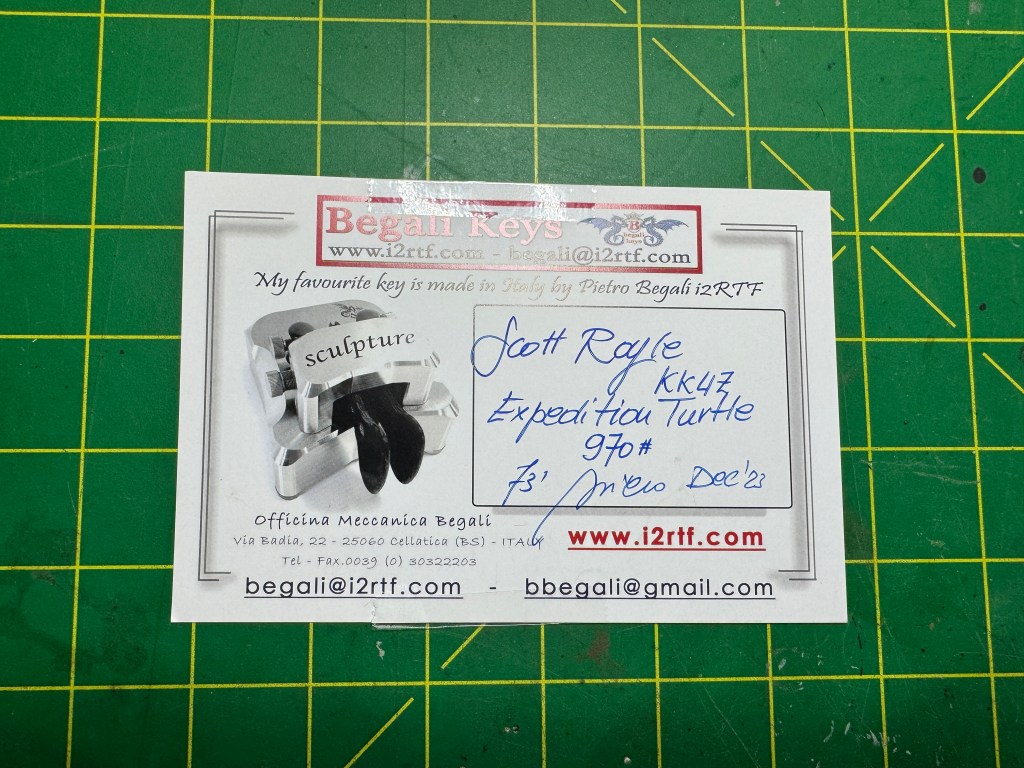
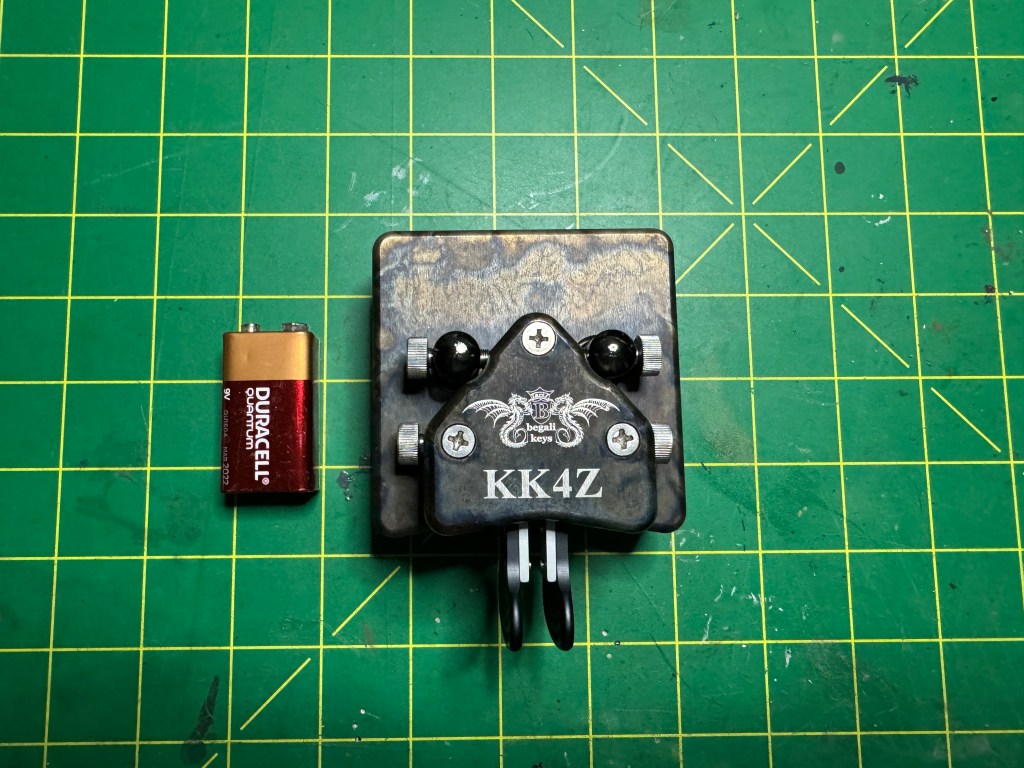
Back in early December, I ordered another Begali Paddle. This time I ordered an Expedition. As you can see in the photos, it was done in Turtle with my Callsign engraved. As a surprise Christmas Gift, my wife paid for them! She’s a keeper. I am planning on pairing the Paddles with my K3(s)/10 radio. I like to keep a set of paddles with each of my portable radios – all set and ready to go.
The Begali’s are a wonderful family. Whenever I order a set of paddles from Begali, Bruna always ensures that I get what I want and we often exchange multiple emails throughout the process. I now own 4 Begali paddles. Her last email was a request that I let her know I received the paddles. I will send her a link to this blog post.
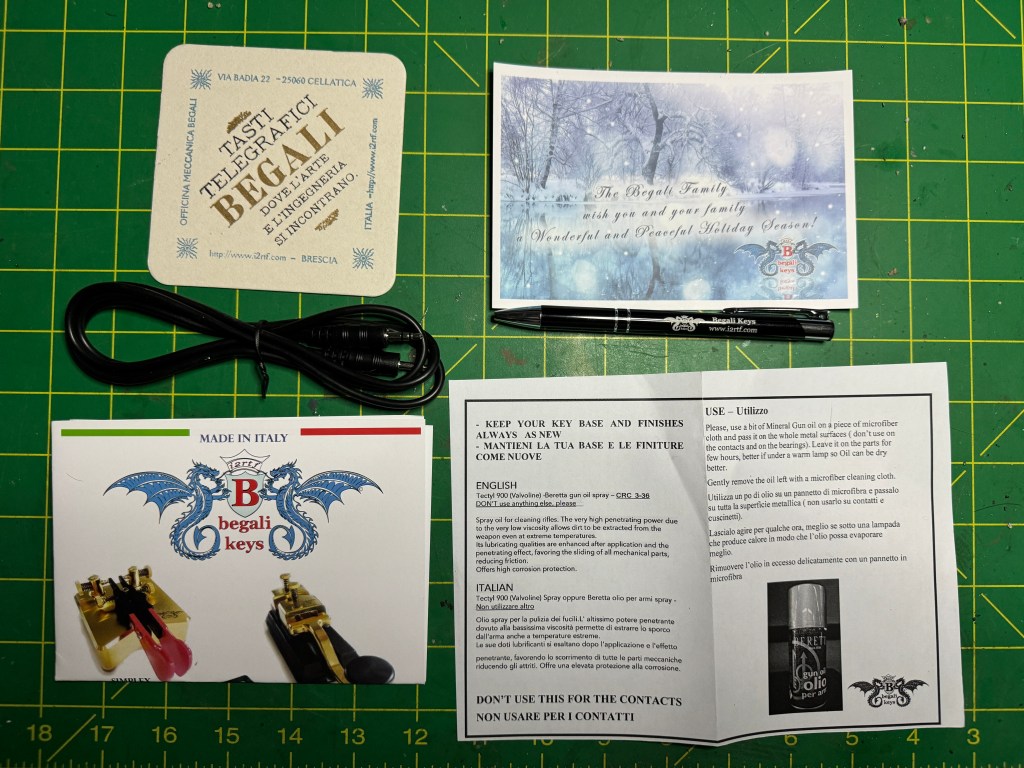
Why the Expedition? I wanted a set of heavy paddles to take with me on POTA activations and both of the Field Days. Weight is not an issue when carrying my kit a short distance. Having heavier paddles keeps them from moving around. I wanted a set of paddles that could take a little knocking around common to portable operations. According to the Begali website: The Expedition is a no-frills high-performance key. It is rugged enough, and not too expensive, to be tossed into the baggage for a DX expedition. Along with the paddles I received a nice Christmas card, care instructions, a microfiber cloth, a cable, and a pen. I ordered some CRC 3-36 oil for the paddles to keep them looking good. I wasn’t sure about the Turtle finish when I ordered them, but hey, you only live once. When I opened the box, I was amazed at how good they looked. The marbling effect has a nice patina and is somewhat subdued. Understated would be a good word to describe the finish. I am very pleased with the finish and the engraving.
How do they play? Very well thank you. The paddles come set up, ready to go, with the contacts closed during shipment to prevent damage. My adjustment is simple. From closed contacts, I back them off until I stop hearing the dits (or the dahs) and I am good to go. I nice feature about the Begali’s is they all have a similar feel. I have no issues going from one set to another. I received my paddles on the 23rd and as a part of my family tradition we open gifts on Christmas Eve. This dates back to my great-grandfather whose birthday was on the 24th. I did spend some time last night trying the paddles out and for portable rugged paddles, they are as smooth as silk.
I have been off the air these past few weeks, mainly due to the holidays, I am getting on the air today to reconnect with friends on the POTA-verse. One of my goals for 2024 is to get better on CW and the only way to do that is to get on the air.
I want to take a moment and thank everyone I have made contact with and especially those that visit this website. It’s you that keeps me going. Starting mid-January, I will be enrolled in a CW Innovations class to help with my new years resolution. I am looking forward to making new friends and new code buddies. 73 de Scott
Taking a little break from activations and hunting, I thought I would showcase my field radios as it stands today. I recently culled the herd and this is what I ended up with. The power draw was measured using a Watts Up inline meter, something like this: https://tinyurl.com/yc6yfvsd. Not lab quality, but certainly enough for this article.
Most of my recent activations have either been camping with my little teardrop camper or in my truck for a day trip. The desire to trek to a destination is not as romantic as it used to be. Often my radio time is fitted in with my other responsibilities.
Before I go down my list of radios, I want mention that my modes of choice are CW and Digital with CW generally being my preferred mode. When band conditions are poor as they have been these past few months I use FT8. Some might say that FT8 is easy or point and click, but to be a successful FT8 operator does take some skill.
My first radio is my IC-7300. Because of band conditions these past few months, it was my radio of choice because it is a 100 watt radio. In the field, I normally operate in the 5-10 watt range, but when the bands are bad I am in the 25-35 watt (and sometimes more) range. I also want to note that over the past few months I was working on my N1CC award which is working 10 bands at 10 different parks. Most parks are a couple of hours drive away from me so I try to get my 10 bands over the course of a weekend. Because gas prices are elevated, returning to some parks may not be an option.
I’ve had this IC-7300 since 2017. It’s a great radio and a great field radio. I have 4 radios that share much of the same menu system so I do not have to relearn the radio everytime I take it out. The filtering is excellent. The noise floor is lower than many other radios by a factor of 4. I have worked stations were the meter is not moving indicating a less than S1 reading.
With Icoms, antenna tuner integration is a simple cable connection and will also power the tuner. The only mod to the radio is I added a set of Portable Zero 7300 Escort guards https://portablezero.com/icom706.html. The radio rides in a Dewalt Tough Sytem medium case with no additional padding https://tinyurl.com/2sw8u9ub. The guards protect the knobs from bumping into the sides of the case. They also make great handles. Power consumption for this radio at idle with nothing connected to it is 0.81 amps or 810 mAh. For a 100 watt radio, that’s pretty darn good. The paddle I use with this radio is a Begali Traveler Lite. I am a fan of Begali paddles.
The next radio is my current favorite QRP radio, the IC-705. This radio is brillant. Icom packed a bunch of goodness into a samll package with an idle amp draw of 220 mAh with the charger off and 360 mAh with the charger on. That’s right down there with many other QRP rigs.
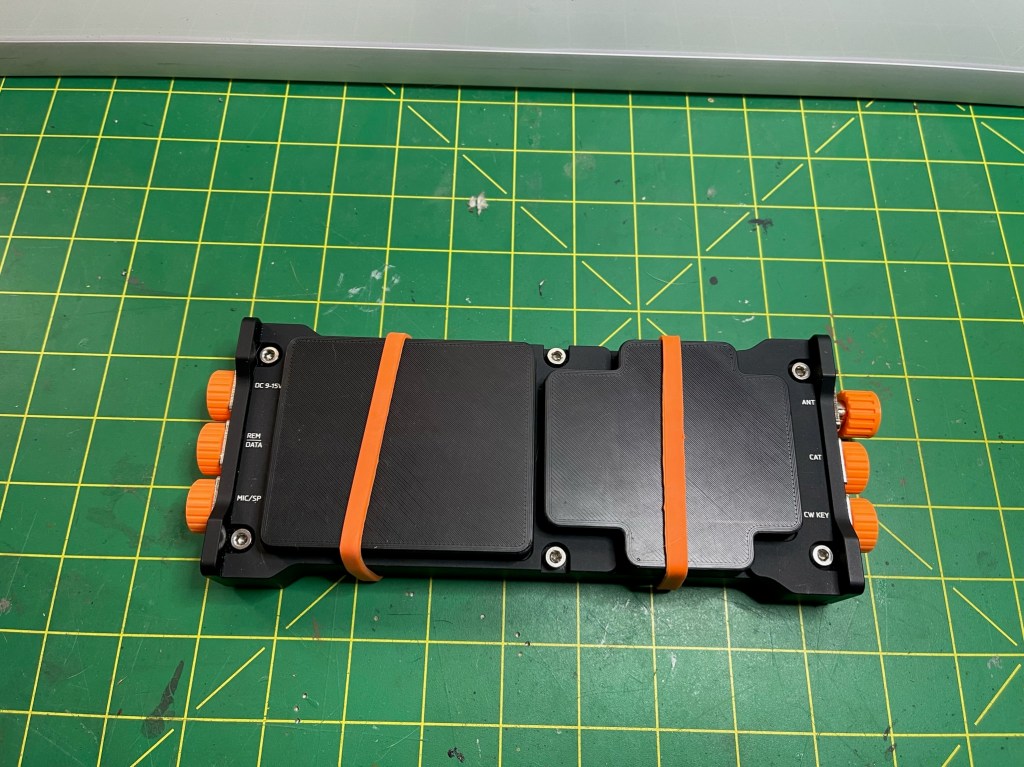
My 705 travels with a 3D printed cover for the face inside a MTM Ammo Crate https://tinyurl.com/y4j6t4nu. These are great cases for small radios and their accessories. A nice feature for this radio is it and be linked/controlled via Bluetooth. I have run FT8 and logged on my iPad using an app called SDR Control https://roskosch.de/sdr-control/. Another brillant feature of the IC-705 is it can be recharged via USB. That means both my iPad and the IC-705 can use the same charger. Some complain that the IC-705 is too heavy. When you realize that you do not need an HT for VHF/UHF (plus you get 10 watts of power), no cabling needed to hook the radio up to a laptop and as a bonus can use an iPad, and, can be charged via USB, you may have an actual savings of weight. No, it doesn’t have a built-in tuner and that has never bothered me. I have the AH-705 tuner and it is amazing. I use it to tune random wire antennas and can tune them without a UnUn or Balun. I would say the AH-705 tuner is on par with an AH-4 or even an SG-237 albeit at lower power.
The paddles for the 705 are Begali Adventure Dual. Big performance in a small package. Like all Begali products, they must be tried to be appreciated. I also use the Begali stand for the 705, it does a good job preventing the paddle from moving without adding a lot of weight. The screwdriver is a Nite-ize KMT-11-R3 that I modified by narrowing the screwdriver blade. I also have the begali base so I can use the paddle with other radios.
The paddles are stored in a little 3D printed box which holds the paddles, the base and the screwdriver. To the left of the box is another steel base from American Morse Equipment. The Begali base is a little light but has magnets on the bottom to attach to the AME base. Together, they work perfectly.
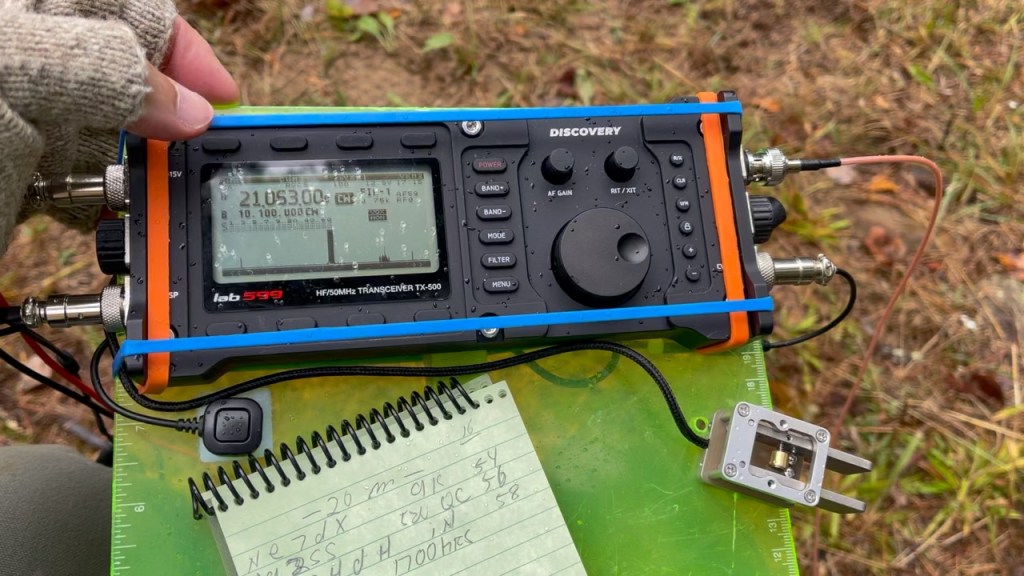
Last but not least is my Lab599 TX-500. This is a great rig for many reasons. Lightweight, simple to use, weather resistant and draws less than 100 mAh idle. It includes a waterfall on the easy to read LCD display. The receiver specs are pretty decent and I have not had any issues using it. I normally pair it with Elecraft T-1 tuner and Bioenno 3Ah battery. For travel I use 3D printed covers.
The paddles I use for this radio are Larry’s N0SA SOTA paddles. These are great paddles but last I heard he is no longer making them.
What is nice about these paddles is they are easy to hold in the hand and can be mounted to a flight deck.
These are my current radios and the paddles I use with them. Is this list set in stone? Of course not, you never know what you might find just around the corner. However, I could be quite happy with these. They are all good perfromers that give me a lot of latitude when operating in the field. Now that my N1CC is complete, I can worry a little less about quantity and a little more about quality. Hope to hear you out there — 73 Scott.
Skidaway Island State Park is a beautiful park. Located southeast of Savannah, GA, With Spanish Moss, along the typical summer heat and humidity, it is a prime example of coastal Georgia. This trip came about because my wife needed a package delivered to South Carolina; I volunteered as long as I could camp one night an play radio. It’s about a 5 hour drive from NW Georgia to SE Georgia. After delivering the package I arrived at the park somewhere around 1600 hrs Local. It took a couple of minutes to get the camper setup and a little longer for the radio. Because it might be a while before I can make it back here (gas is still over $4 a gallon). I tried to get 10 bands for my N1CC award. I mostly worked FT8.
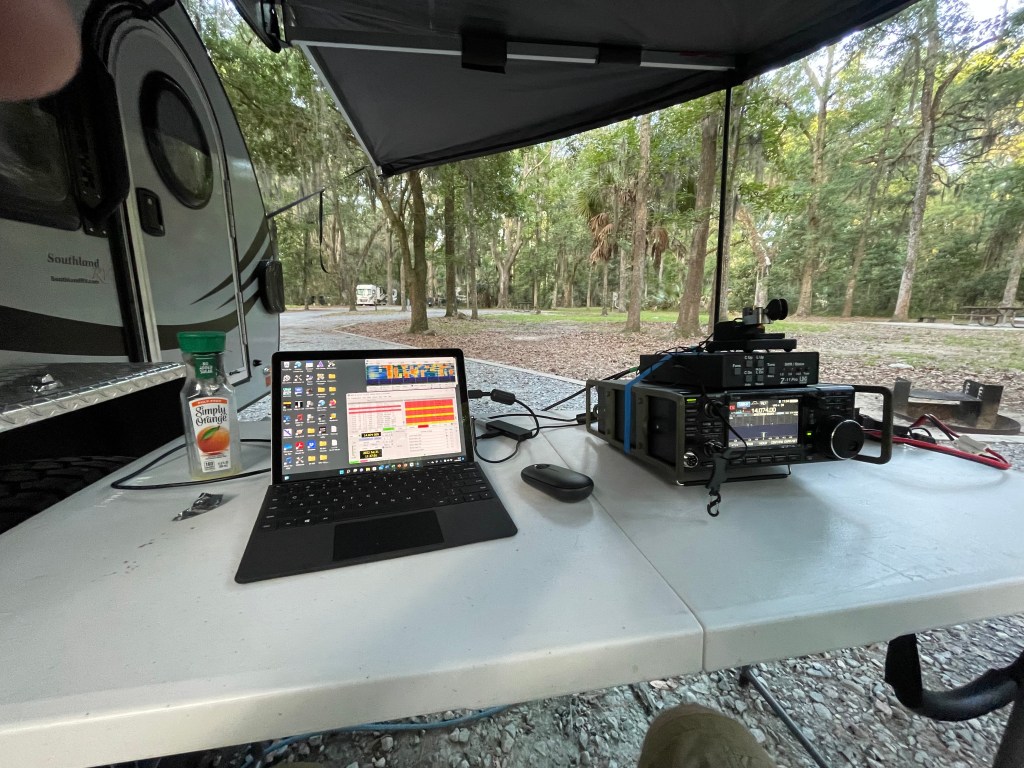
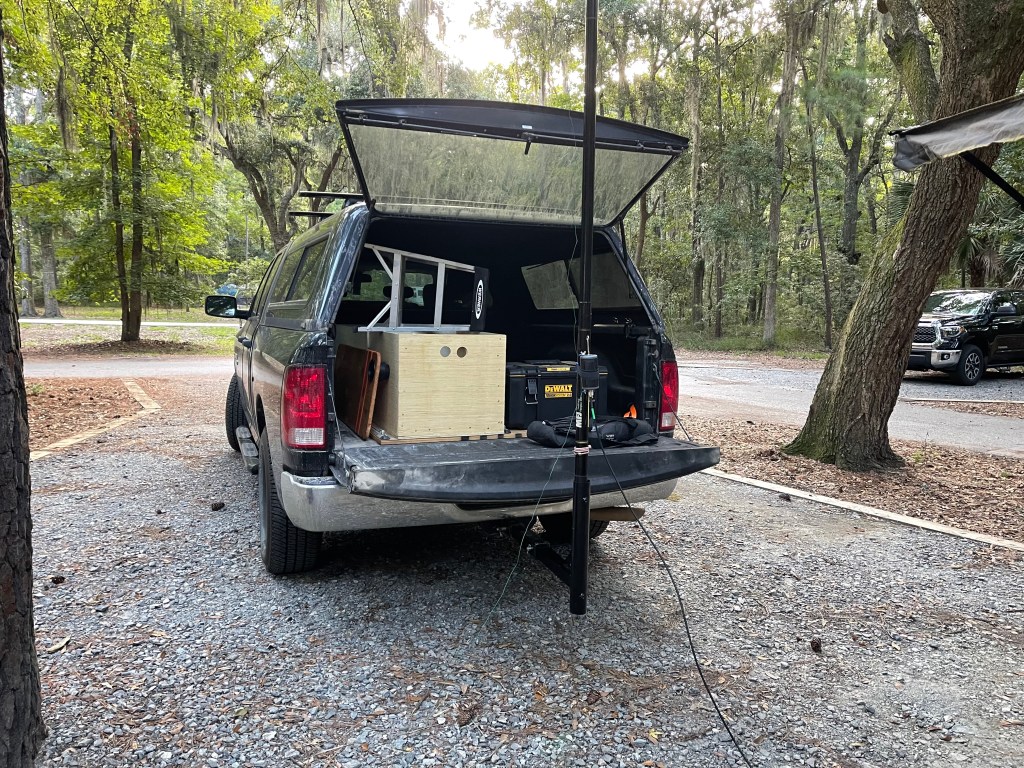
Setup. Setup was my usual for this type of activation. The radio was my IC-7300 and LDG Z-11 Pro tuner. The computer was a Microsoft Surface Go2.
The antenna was my K4SWL antenna which is a 29.5′ random wire antenna with one 17′ counterpoise. I used my Chameleon EmComm II transformer to even things out. The antenna is hoisted into the air with a MFJ-1910 33′ pushup pole. No plants or animals were harmed during this activation.
Being a former Nightstaker, working in the dark is routine to me. I stayed outside well after sunset until I finally had enough of the heat.
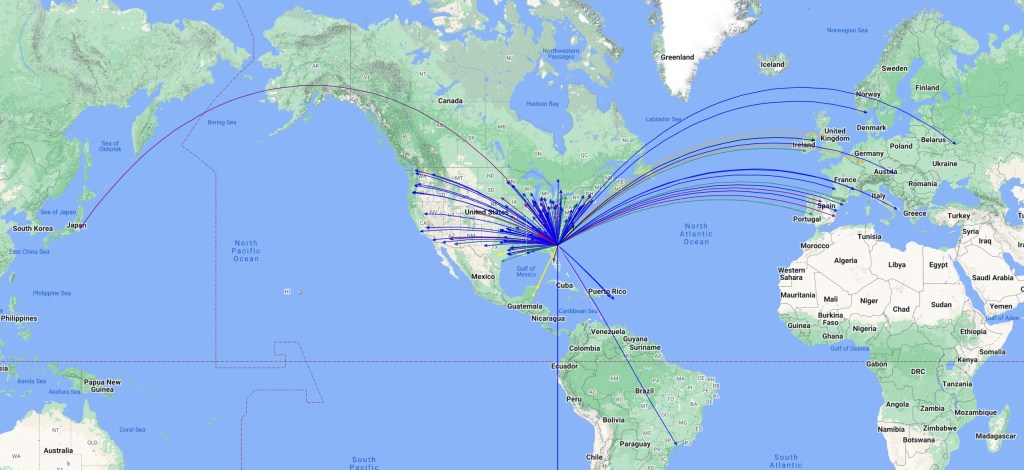
Band conditions were so-so, and I earned my keep making contacts. Working about 20 hours total I ended up with 174 contacts on 10 different bands. I had quite a few FT8 pileups which was fun and let me know that my antenna is working as it should. Here is a QSO map of the activation.
What was new? I recently acquired a Begali Adventure Duo with their metal base. The base is a little on the light side but there are magnets on the bottom. I had a fairly heavy base made for a AME Potra-Paddle. I set the the the begali base on the Porta-Paddle base and Viola! It works like a champ.
I also have the 705 mount coming to use with my IC-705. I really like these paddles. I only used them a little while trying to make contact with K7K. Alas, I didn’t have enough horsepower to make the trip to Alaska. My new paddles will definitely be my choice when camping.
Issues? I only had 2 and neither was catastrophic. The first was with the antenna. It seems when I increase power somewhere above 20 watts, I start getting some RF feedback through the coax on some bands. It was more of a nuisance than anything and I have since added a RF choke to the antenna bag. This antenna is one of my favorites if not my favorite antenna. It always performs well for me. The second issue has to do with the IC-7300. When I am working from inside of the camper, I set the radio down on the mattress. The tilt stand sinks nicely down in the 4″ of memory foam making the radio face plate difficult to see. I set my QRP radios on the lap desk with my computer and paddles. I banged around in my workshop and found a scrap piece of 3/4″ plywood. I cut it to 11″ x 12″ and now my radio floats on top of the mattress. The board also fits in the box I carry the big radio in.
Every time I go out, I learn something new. With gas prices the way they are, I may not be making these long trips for a while. However, there are plenty of great parks closer to home. Thanks to all of the hunters who took the time to work me. Sometimes making that contact can become a little tedious. I appreciate you all and 73’s until next time.
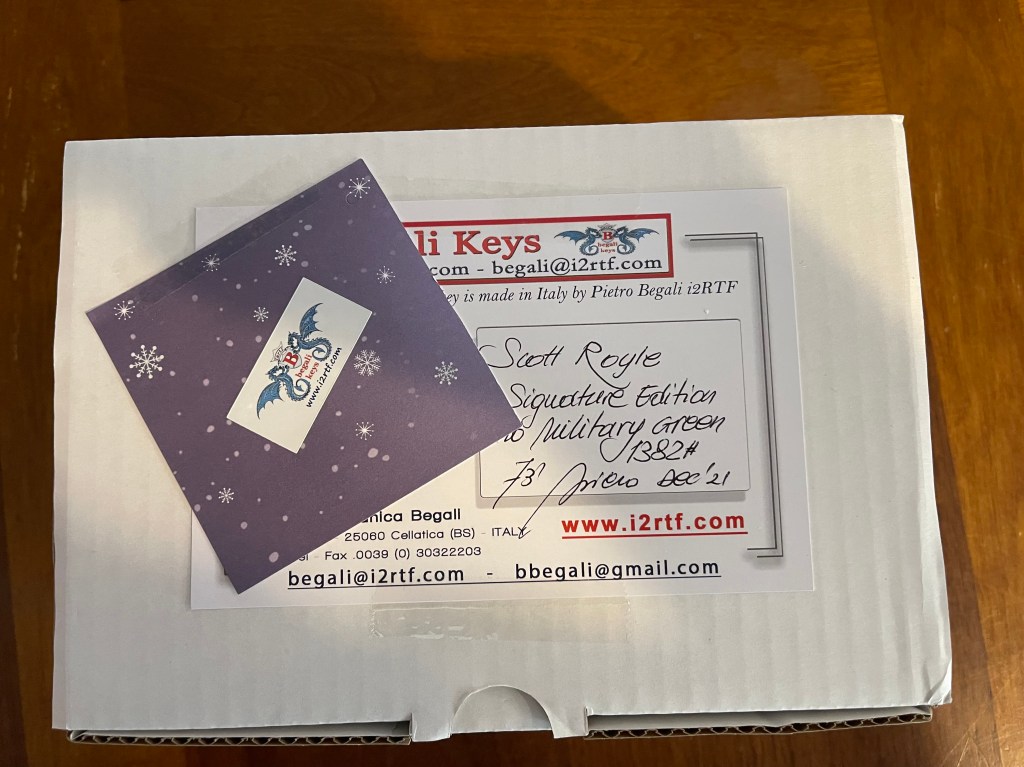
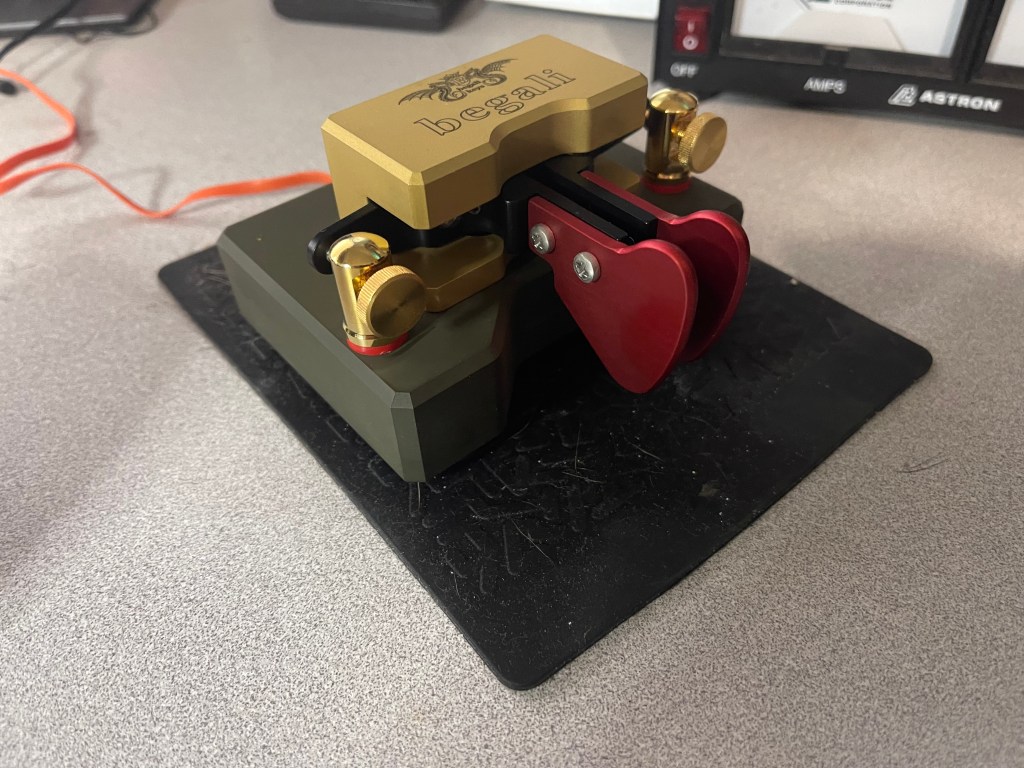
Today is a dreary day in northwest Georgia. It looks like rain and thunderstorms most of today so little or no Ham Radio. Yesterday I received a package from Italy. After waiting almost 3 weeks, my Begali Signature paddles arrived. This is no fault of Bruna at Begali, she shipped them out early so that I would have them for Christmas. However, Fedex had different ideas and the paddles sat in a Fedex facility for 10+ days before they moved. So here they are.
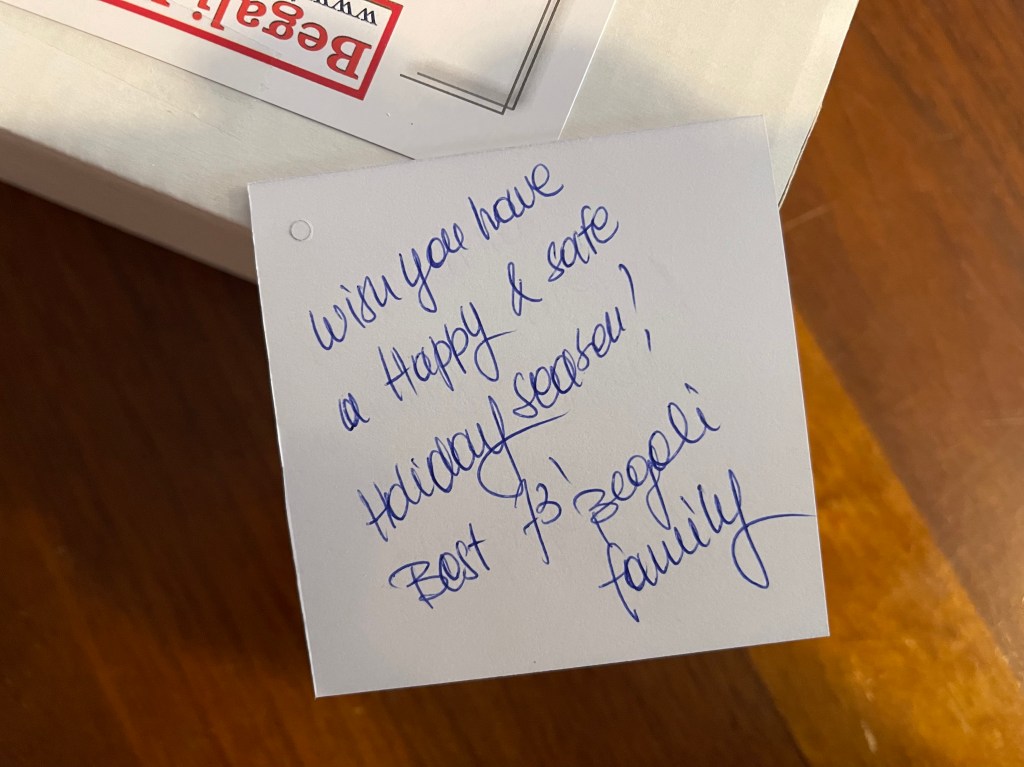
Even the packaging is a work of art with a note from the master himself.
His daughter Bruna added a little holiday cheer.
To be honest, this is my third set of paddles from Begali.
So why did I choose the Signature this time? My first set of paddles were Benchers. That set up is what I call right angle arms. The contacts are to the side of the paddles and not to the rear. In my opinion they have a slightly different feel. The paddles came with the longer plastic finger pieces and the contacts screwed closed to prevent damage. I swapped the finger pieces out with the included short aluminum ones.
Adjustment was easy. I loosened the contact screws, plugged the paddles into my radio, screwed the contacts in till I heard dits or dahs, and them back it out until they stopped. No other adjustment was necessary.
The fit and finish of the paddles are typical from Begali which is excellent. I have an engineering/quality background and have an appreciation for fine fitment and finish. Begali never lets me down. Even the work on the underside is perfection. The paddles make me think of Ferrari or Lamborghini.
For the finish, I wanted something a little different. I’m from the “chrome don’t get you home” crowd. The base of the paddle is military green and the top is their titanium finish. Both are more of a satin finish rather than shiny. I like the green as I am a former soldier. The finish creates an understated elegance that is a quiet statement of quality.
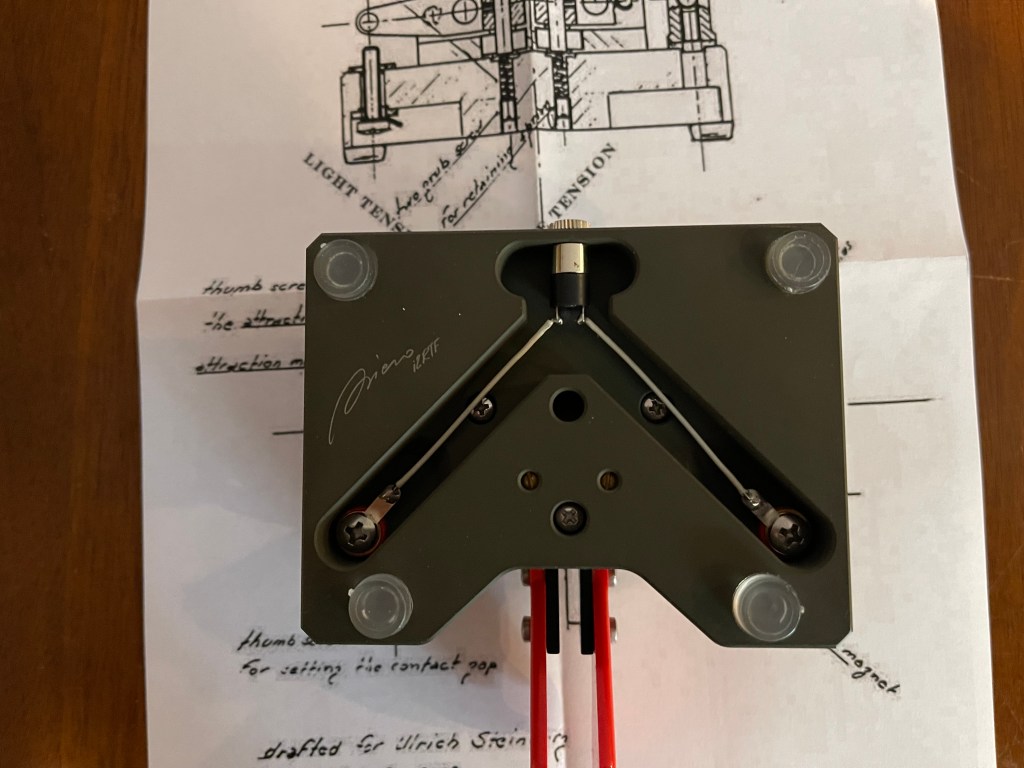
How do they play? First, they are different. The action feels a little different because of the different geometry of the arms. That being said, I do not think I have ever used a smoother set of paddles. Smooth as silk or purrs like a kitten come to mind. I am no speed demon with CW. I typically run in the neighborhood of 16-22 wpm. These paddles are smooth enough to go much higher. The arms are magnetically tensioned keeping the amount of force consistent through the swing. In short, they are a joy to use and to admire. The little time I have had them and used them, they have endeared themselves to me. The now reside on my desk top and are my go to home key.
Final thoughts. The whole Begali experience is something other companies should aspire to. From their customer service, packaging, and the product itself, is all top shelf. Their commitment to customer service leaves me feeling like they made this key especially for me. Is there another Begali set of paddles in my future? Probably, but not tomorrow.













 KK4Z
KK4Z 