Improvise, Adapt, and Overcome

The Marines got this right. When planning for a POTA/SOTA trip. It pays to plan for contingencies. I am not talking about going overboard with this. You should still try to carry only what you need. This past weekend I did a POTA camp-out at Ft. Mountain State Park in northwestern Georgia. I usually reserve campsites several months in advance, so everything may not be perfect by trip time. Part of my planning was considering band conditions. The week prior, propagation was unstable. In addition, I was not sure about the geography of the campsite. My planning was to bring two radios; my IC-7300 (QRO) and my IC-705 (QRP). I brought my Frankentenna with an extra EmComm II transformer to handle more power.

The planning paid off. My campsite was down in a hole and the bands were not good. The site was great for camping and only so-so for radio.

One of the POTA awards I am working on is the N1CC award which is operating on ten different bands at 10 different parks. I needed 2 more bands at this park to check this park off. I chose to use the IC-7300 for more power. Since I had shore power available, I wasn’t worried about running out of juice. Station setup looked like this.

Band conditions were less than optimal, so for this trip I decided to use FT8. There were times when the waterfall on the 7300 went completely black, even on the FT8 frequency. Normally I run about 25 watts, but this time I had to go as high as 50 watts. QRP would have been a tough row to hoe. The antenna was my Frankentenna and I ran the Chameleon EmComm II transformer instead of the Hybrid Micro so I could run a little more power.

I operated from Friday afternoon until somewhere around 0100 hrs Lcl, with a couple hour break due to a thunderstorm. The next day was beautiful, much cooler than the day before when we were under a heat advisory. I operated most of Saturday until early evening when I pulled the plug with another round of thunderstorms inbound.

I made 161 Q’s including DX from Alaska and South America.
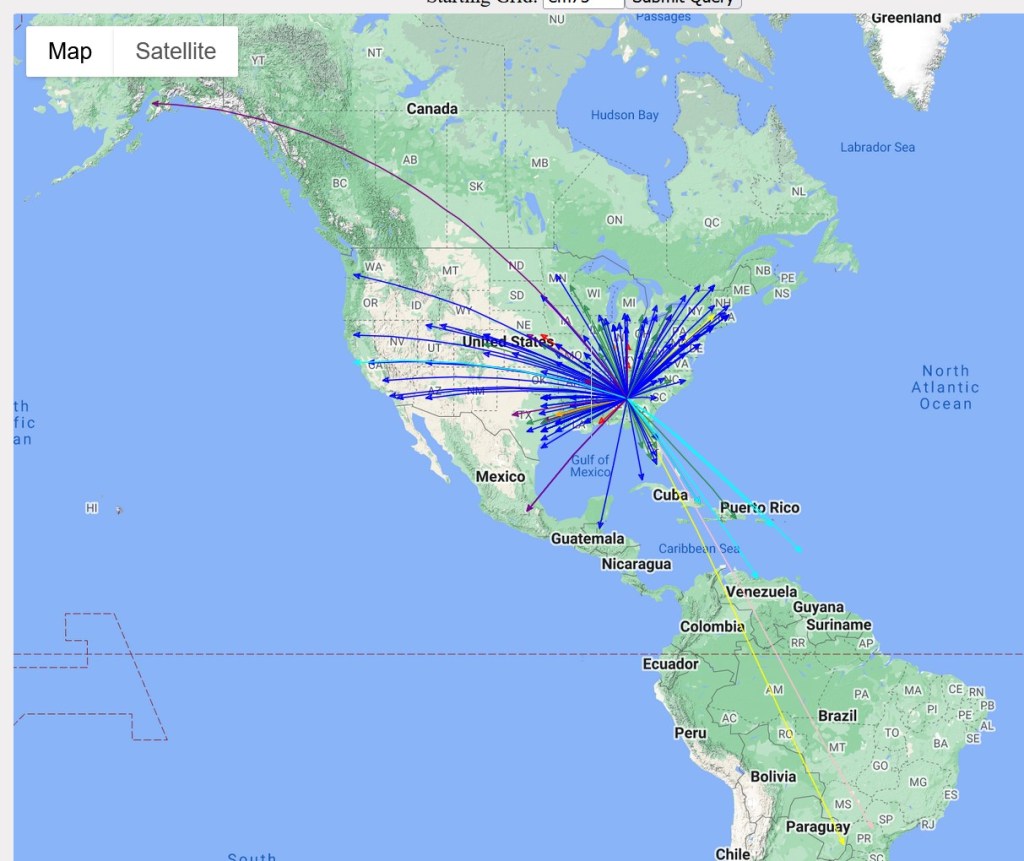
I was trying for 200 Q’s, However, the propagation Gods were not with me, but I was satisfied with the results. I have a couple of YouTube videos.

I am former US Army, so a tip of my hat to all those who serve(d). God Bless, God Speed, and 73 de Scott KK4Z

A Little More UnUn fun

This past week I wound a few more toroids using a 77 mix. The toroids are 0.5″ in diameter and wound with 22 awg insulated magnet wire. I wound one with a single core and one with a dual core. My goal was to try to get a little better low band performance. I get a kick out making a few contacts on 60-80-160 meters. The finished UnUns are 9:1.

We’ve been going through a heat wave this week with a heat advisory every day. I got up early and tried a couple different antennas. Using antenna wire from my Frankentenna, I built an end fed with a 65′ antenna and a 65′ counterpoise. I also tried the 65″ antenna with a 17′ counterpoise. The set up looked like this.

For this antenna, the best combination was a 65′ antenna wire, a 17′ counterpoise and the single core 77 mix 9:1 UnUn. I got the following readings from my Rig Expert Prostick with 6′ of RG316. As a control I also tested my Sparkplug transformer.
Band SWR (17′)—–SWR (65′)——Sparkplug 65′
160 – 2.4 ———— 4.2 ————– 5.6
80 – 5.4 ———— 1.1 ————–8.3
60 – 1.7 ———— 2.3 ————– 12
40 – 2.9 ———— 3.5 ————– 1.7
30 – 6.9 ———– 4.5 ————– 16
20 – 3.8 ———– 4.0 ————— 1.5
17 – 5.2 ———– 5.7 ————— 9.7
15 – 4.1 ———– 4.3 ————— 1.1
12 – 6.2 ———– 6.9 ————— 10
10 – 4.5 ———– 4.6 ————— 2.6
6 – 5.9 ———– 5.8 —————-14
Fiddling with the counterpoise length could make things a little better, but overall the SWR’s are low enough to match with a good tuner. I realize that running a short feed line would affect the Sparkplug so in another test I added a counterpoise and it did bring down the SWR on some bands. However, to me the winner is still the single core 77 mix 9:1 UnUn.

Another antenna that I like is a random wire antenna I call the K4SWL antenna https://kk4z.com/2022/06/05/k4swl-antenna-plus/. I call it that because it was Tom K4SWL who I got the basic design form. It’s a 29.5′ antenna with a 17′ counterpoise. I built an UnUn based upon a QRP Guys design but wanted to try to get a little better performance on the lower bands. In this case I used a two core 77 mix 9:1 UnUn and got the following results.
Band – SWR
160 —- 2.0
80 —- 1.7
60 —- 1.5
40 —- 1.5
30 — 1.5
20 — 1.4
17 — 1.3
15 —- 1.3
12 —– 1.2
10 —– 1.2
6 —— 1.2
Realize that this is a small antenna and will not be as efficient as a full half wave dipole (on 160 meters, that is 270′). However, it would be fun to see if you can make a contact on 160 or 80 meters in a park with a small antenna. So get out there and play radio! 73 Scott

Frankentenna

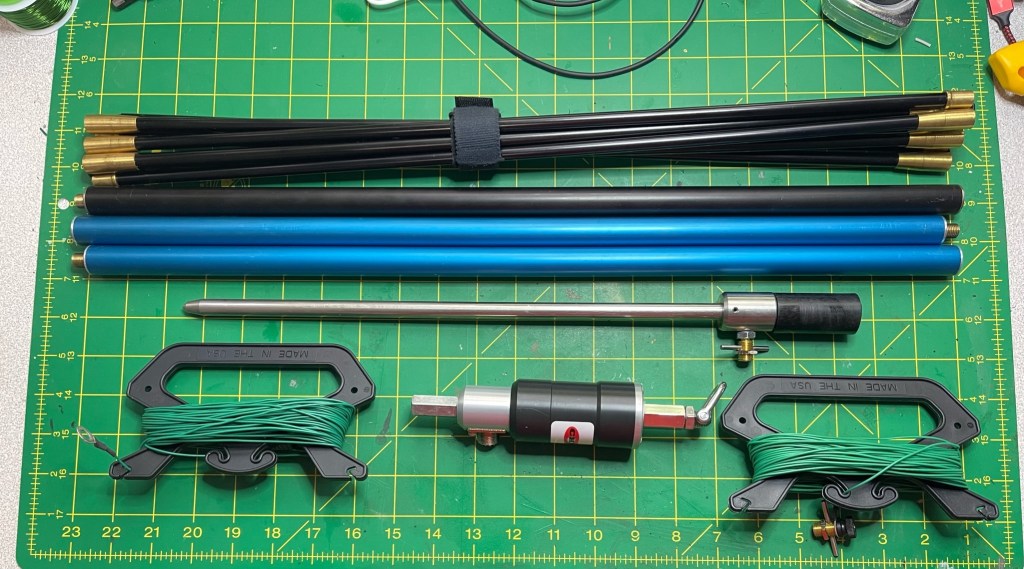
I have been playing with portable antennas for years. When operating portable, the antenna probably has the biggest effect on how well you portable station works. I have quite a few portable antennas. Some are specialty antennas and some are my “go to” antennas. When operating at a park for Parks on the Air (POTA). My Frankentenna is my go to. It has evolved over the years, but now I mostly tweak to get it how I like it. Here is the antenna and its parts:

What makes it a Frankentenna is it uses parts from different companies, mainly from Buddipole and Chameleon. Here is a list of the components and links to their websites:
(1) Buddipole 7 section Lightweight Shock Corded Whip Antenna https://www.buddipole.com/mistshwh.html
(3) Buddipole 22″ accessory antenna arms. I am swapping out the blue arms for black ones to better reduce the visibility of the antenna (out of sight, out of mind) https://www.buddipole.com/exanar.html
(1) Chameleon CHA Spike Mount – https://chameleonantenna.com/shop-here/ols/products/cha-spike-mount
(1) Chameleon CHA Hybrid Micro https://chameleonantenna.com/shop-here/ols/products/cha-hybrid-micro
92) Buddipole Wire Assembly Low Band (66′) https://www.buddipole.com/wireassembly.html

This is the basic kit. With it I can make a vertical antenna, and endfed with a counterpoise, and even a dipole. The kit is pretty lightweight and easily fits into a standard Buddipole bag. While at park campgrounds, I usually run it as a vertical. I keep an arborist throw line and weight in with my station equipment. I have some tweaks and mods I have done. Two that you see here are the phenolic insulator and a mod to the spike.

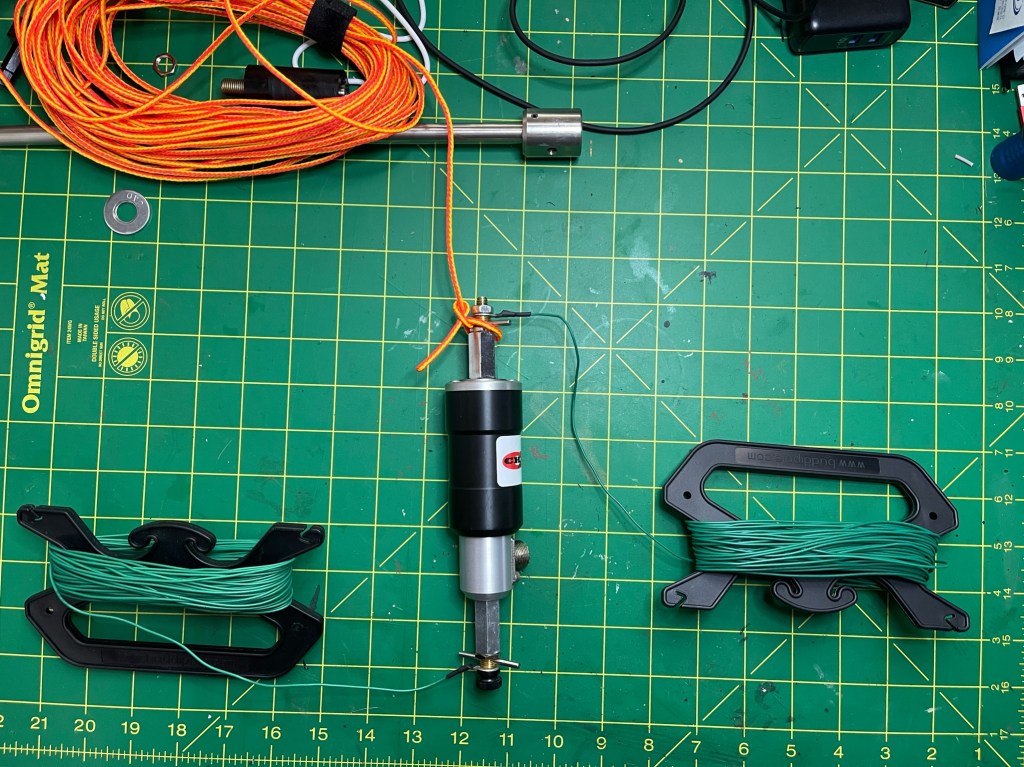
The spike mod is an improvement on the current ground screw. It was a red plastic knob with about an 8-32 screw thread.

I felt it was too small since most counterpoises have either 1/4″ OR 3/8″ eye on the end. I carefully drilled out the hole and tapped it for 1/4″-20 thread.

This now allows me to use a Buddipole Counterpoise Wire Adapter https://www.buddipole.com/noname2.html which is 1/4-20 on one end and 3/8-24 on the other. It gives a more secure connection between the spike and the counterpoise. These are the same adapters that come with the Buddipole Wire Assembly and you can buy them separately https://www.buddipole.com/noname2.html. finished, it looks like this.

One of the things I didn’t like about the Chameleon Micro was the shackle it comes with. The shackle is used to support the transformer when it is used as an end fed or a dipole since it is too heavy to be supported by the antenna wires. It was always kind of hincky getting the shackle setup right. Now I use the Buddipole Counterpoise Wire Adapters. So much easier and so much lighter.

The other mod is a phenolic (micarta) insulator. This allows me to use the vertical with something other than the Chameleon transformer. An example might be one of my homebrew 9:1 UnUn or a Buddipole coil. The insulator is threaded on one end and has an insert on the other, both 3/8-24.

How does it play? Quite Well. I tested 2 configurations I would most likely use during a POTA activation. The first is a 54′ end fed with a 50’ish counterpoise using the Chameleon Micro. Using my RigExpert Stick Pro I got the following. Format is Band — SWR
160m — 5.7
80m — 3.2
60m — 3.5
40m — 4.1
30m — 3.2
20m — 2.1
17m — 3.7
15m — 1.7
12m — 2.2
10m — 3.6
6m — 2.1
The second setup was using the Micro as a vertical. The antenna is approx 17′ (very close to the Chameleon) and running a 50’ish counterpoise.
160m — 6.7
80m — 3.7
60m — 3.5
40m — 2.4
30m — 1.5
20m — 1.3
17m — 1.3
15m — 1.9
12m — 2.8
10m — 3.1
6m — 1.8
During this last activation, I mainly used the vertical arrangement as that suited the space I had. The antenna performed well. I made 100 contacts here and abroad. To see a map check out my post about my activation at Kolomoki Mounds State Park.

What’s next for this antenna? I have two Black Accessory Arms and a Counterpoise Wire Adapter coming from Buddipole. The arms will make the antenna more stealthy and the extra adapter will reside on the spike. I may try the Buddipole coil to see how it plays and I just got some new toroids to see if they work any better. Overall, I really like this antenna. It’s light and compact and goes up anywhere. The SWR is low enough that almost any tuner, can tune it, even on the low bands.

Vertical Antenna Support

I like to tinker. Always have and probably, always will. This past weekend while I was activating K-2171, I swapped out antennas to see if one was any better than another. My first antenna was my Frankentenna set up as a vertical. Later in my activation, I switched to my random wire vertical. To use this antenna, I had to shoot a line up into a tree. Band conditions were not that good, and truth be told, I am not sure which antenna was better; however, for this activation, I gave a slight edge to the random wire.

For those that have operated within State Parks, rules and regulations sometimes seem to get a little blurry when it come to operating amateur radio within park boundaries. There is a general consensus that Park Rangers do not like things in their trees. I personally have not had this issue, but I was never approached by a ranger. I operate CW with earbuds on, so I do not really attract attention to myself.

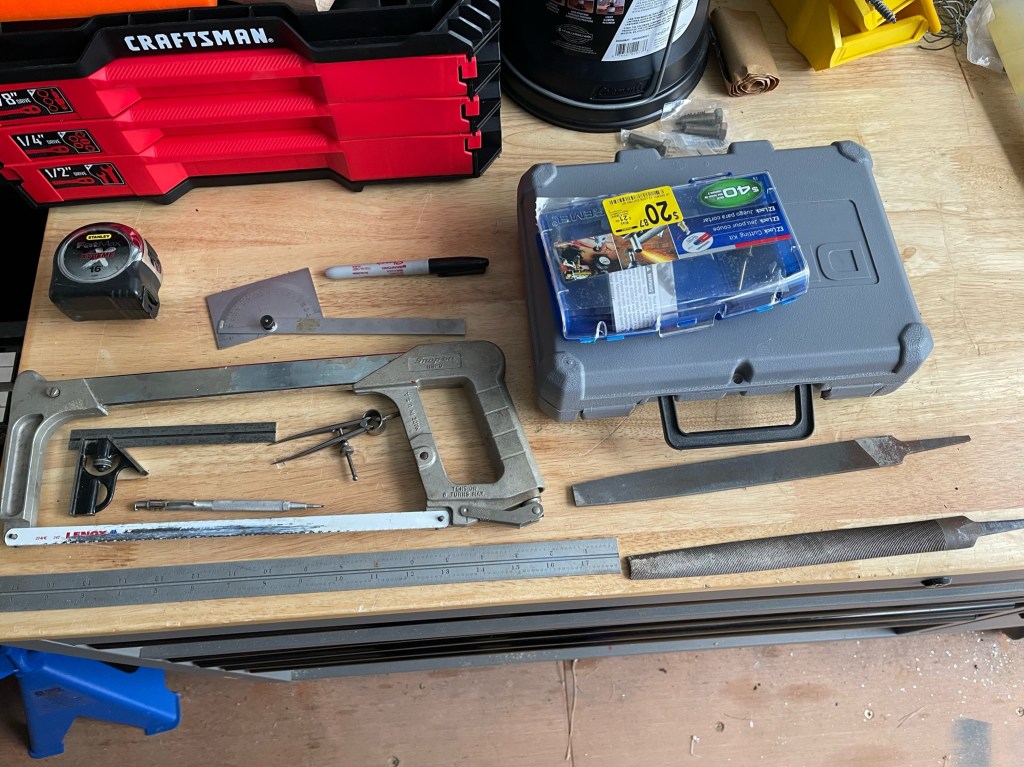
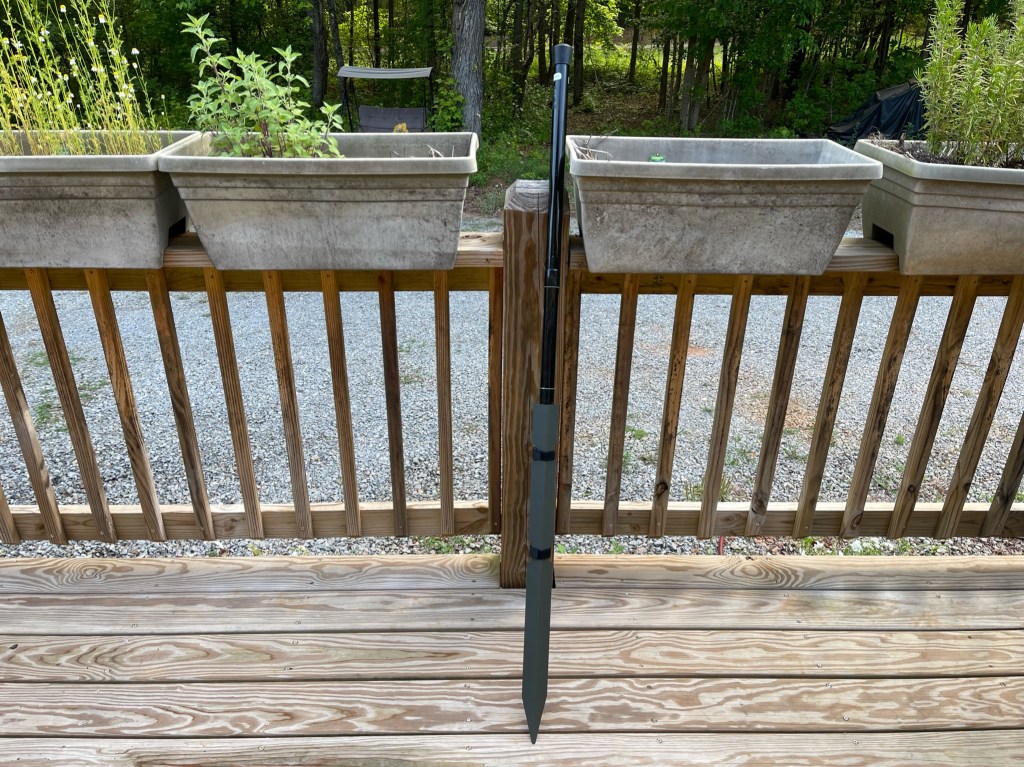
Recognizing, that it might be a matter of time before I get “caught” with something up in a tree, I thought I would look for a solution to solve a potential problem. I have a B&M Black Widow 20′ fishing pole that should work just fine for my random wire antenna. A trip to TSC got me a 4 foot piece of 1 1/2″ x 1 1/2″ Aluminum Angle Stock. Tools used were:

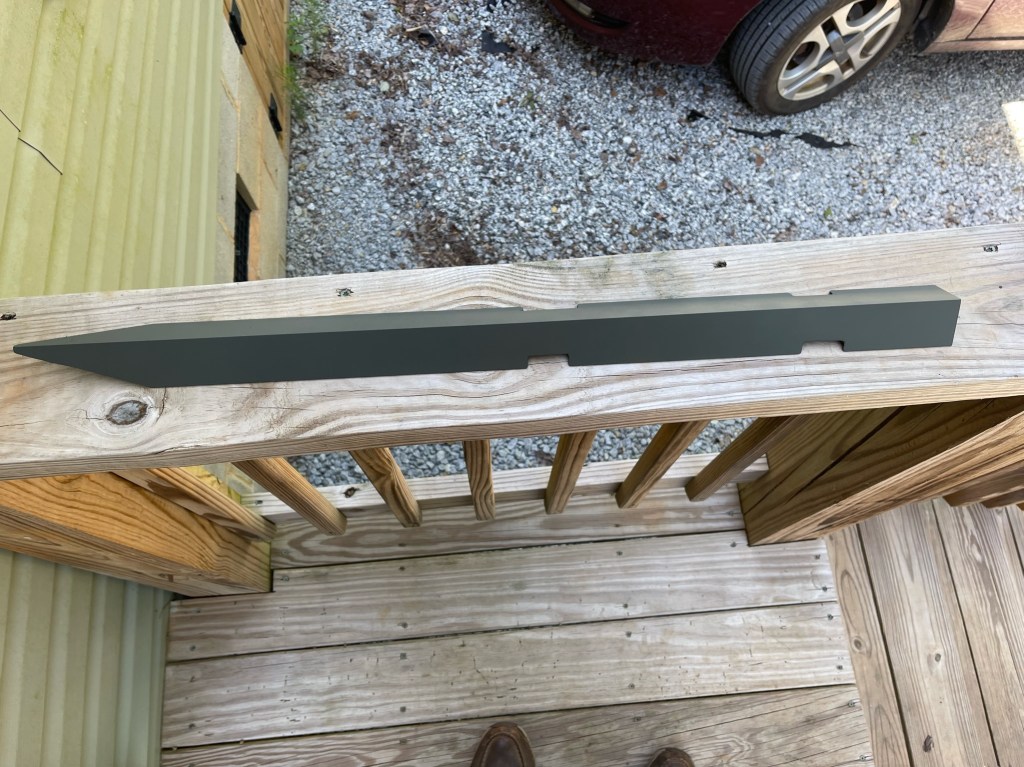
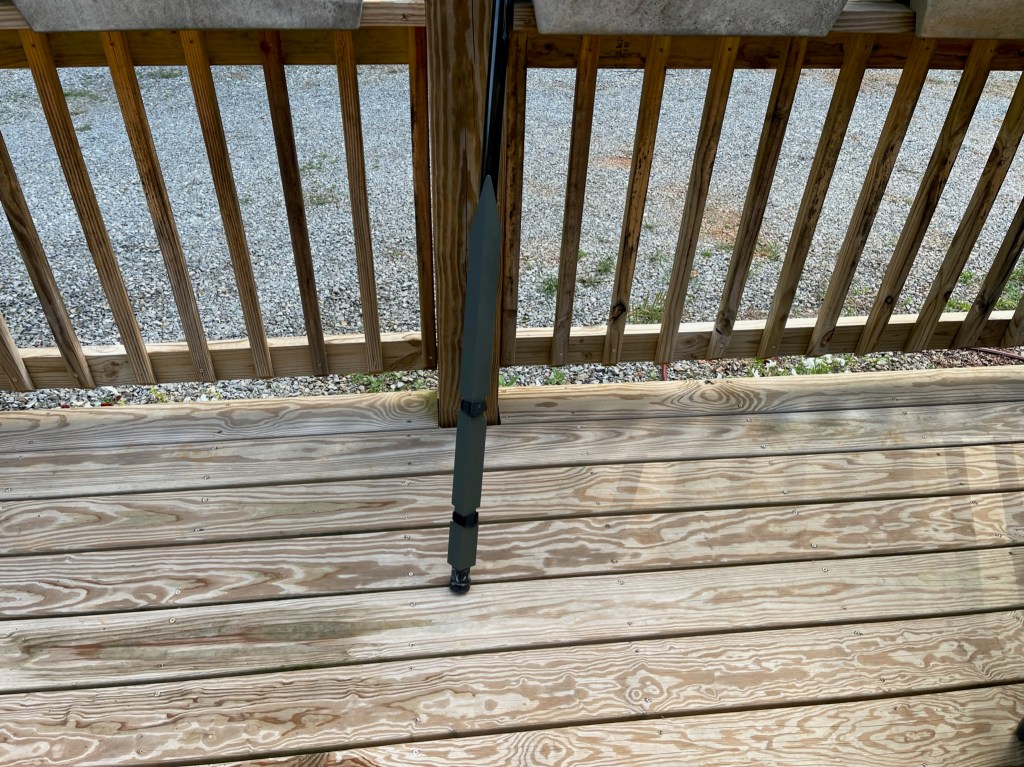
Layout was pretty simple. The angle for the pointy end was 20 degrees and the slots for the straps were 3/8″ by 1 1/4″ (approx). The total length of the stake is 28″

I got everything cut out and deburred. I added a coat of zinc chromate primer and a finish coat of flat olive paint.

I have two small Velcro straps that I had lying around that work perfectly,

Then by turning the stake around, it stores nicely on the fishing pole. Together the outfit weighs a touch over 1 1/2 pounds. This is easy to carry and by moving the stake more to the center, it would be better balanced for walking.

This gives you options. You should be able to use this anywhere you can drive a tent stake into the ground. With this setup, you can use many different antennas besides a vertical. I am going to try it with my 40m OCF dipole (I may have to mount it a little down from the tip).

When I do an activation, I like to carry a minimum amount of gear. Sometimes, I feel my Frankentenna is too big even though it fits in a small Buddipole bag. It is fun trying to operate with a small amount of gear. For my next activation, I will bring the pole with everything else fitting in an 8 liter Bucket Boss bag. Instead of the Bucket Boss Bag, I could use a small backpack. In fact, I am thinking about doing a couple of SOTA activations this year. I hope to hear you out there! de Scott KK4Z

POTA/SOTA Antennas and More

My amateur radio club, West Georgia Amateur Radio Society (WGARS) decided to participate in Winter Field Day. We are going to operate from Talladega National Forest in Alabama. It doesn’t take much to get me out in the woods with a radio. As a club, we will be operating QRP and I will be doing CW.

Since joining POTA, I have been more inclined to build things. I had forgotten how much fun this can be. So today, I thought I would build a couple of antennas for the outing. My first antenna will be a replacement for my speaker wire non-resonant vertical. The idea came from Thomas K4SWL using speaker wire. It was an okay antenna but it was bulky and heavier (12 oz.) than I wanted it to be.

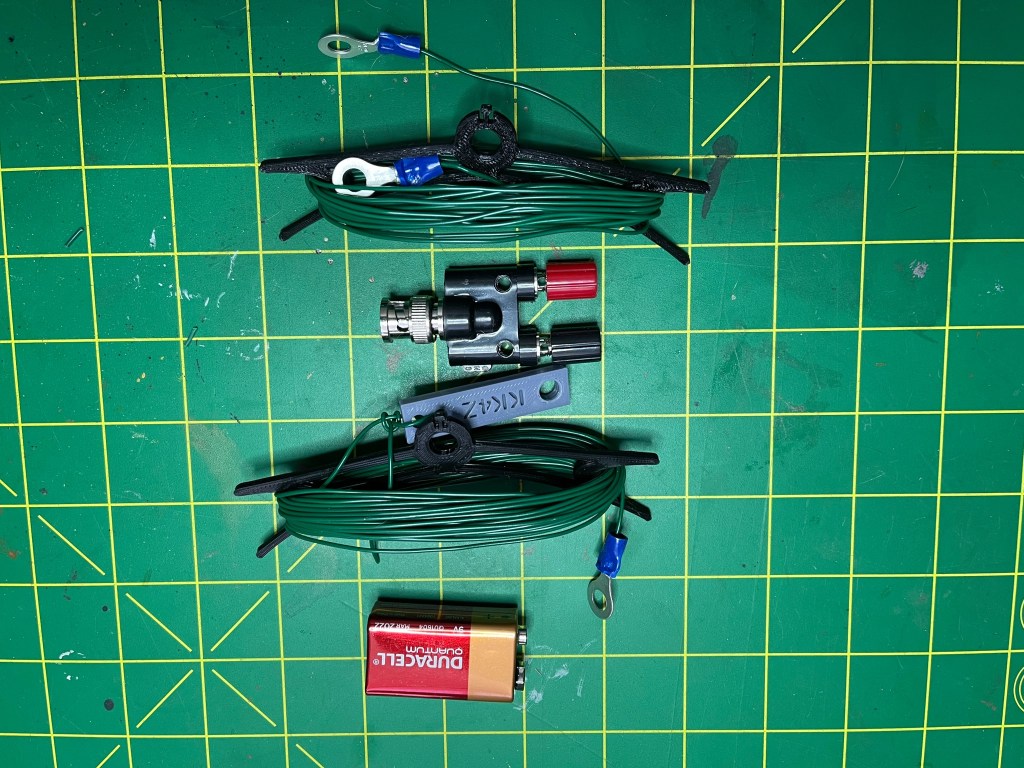
A British company, SOTA-Beams sells some remarkably thin antenna wire. It is insulated and approximately 24 AWG. The best part is they sell a 100 meters for $10.37 and their shipping rates are reasonable. You can find it here: https://www.sotabeams.co.uk/antenna-wire-lightweight-100m/.

A non-resonant antenna is an antenna that is not resonant on any of the frequencies you plan to use. In non- resonant antennas only forward waves exist. A non-resonant antenna radiates as well as a resonant one. Here is what I started out with.

The end insulator and the wire winders were 3D printed by my son. The battery is for scale. The antenna length is approximately 28-29 feet and the counterpoise is approximately 17 feet. Putting it together was straight forward with the end result looking like this. It weighs 3 oz.

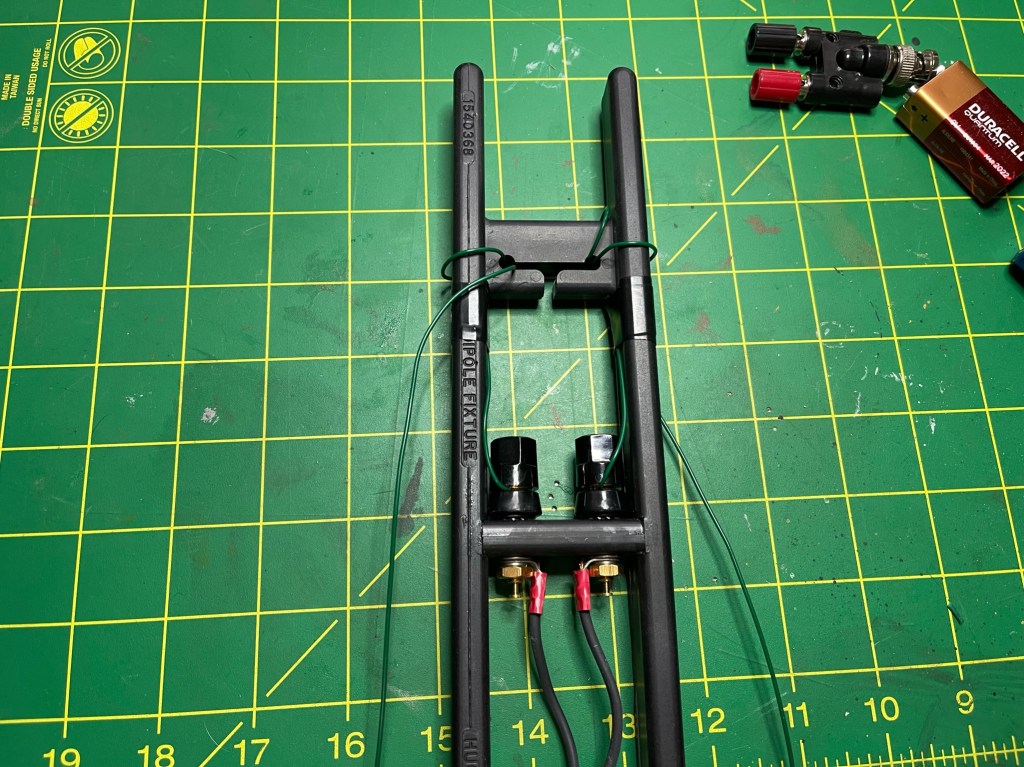
I have discovered that I like working the low bands while on a POTA activation. It takes a little more doing as the antennas get more complex and heavier. My Frankentenna can reach 160 meters but it is a pretty heavy antenna. Again, taking a clue from K4SWL, I acquired a piece of military surplus radio gear. I found an antenna winder for a dipole that is fed with 30 feet of twinlead. I got excited! A doublet is one of my favorite wire antennas as the vertical element can also radiate giving you some DX capability. It will also tune a broader range of frequencies than a dipole. Here is what I started out with.

Note that it is made by the Hughes Aircraft company. I cut the wire at 67 feet per side which should give me an approximately 132 foot dipole. I should be good to go down into the CW portion of 80 meters. While it won’t be efficient, I am thinking I can get an impedance match on 160 meters with my Elecraft T-1 or AH-705 tuner. A half wave dipole for 160 meters is about 270 feet and would be too unwieldy for the field. Getting things hooked up was straightforward.

Everything wraps on the winder. I added a balanced to BNC adapter and two 25 foot lengths of reflective cord I picked up at Tractor Supply. It all weighs 1 lb 3 oz and it all fits in a gallon size freezer bag.

There will be somewhere in the neighborhood of 5 operators at our site, so I don’t know if I will have the room to get the big antenna up. I hope so.

In case you couldn’t tell, I am a big fan of Ziplock Freezer bags in the quart and gallon sizes. They are tough, waterproof and cheap. I buy them in bulk at Sam’s Club. When one wears out, I pull a new one from the box.

Low band POTA activations can be a challenge, but not impossible. My activation at Ft Mountain State Park in GA. proved that. I am one step closer to being ready for Winter Field Day. Should be a lot of fun. It’s supposed to be cold (cold for us southerners) Night time in the mid 20’s and daytime south of 50 degrees. I’ve lived in cold climates; but, what will get me is my hands. I get pretty fumble-fingered on the paddles when my hands get cold. Thank goodnes for propane heaters. We will be operating under the callsign W4D and hopefully be turning in a log to POTA as well. Hope to hear you out there.