The Happenstance Rove

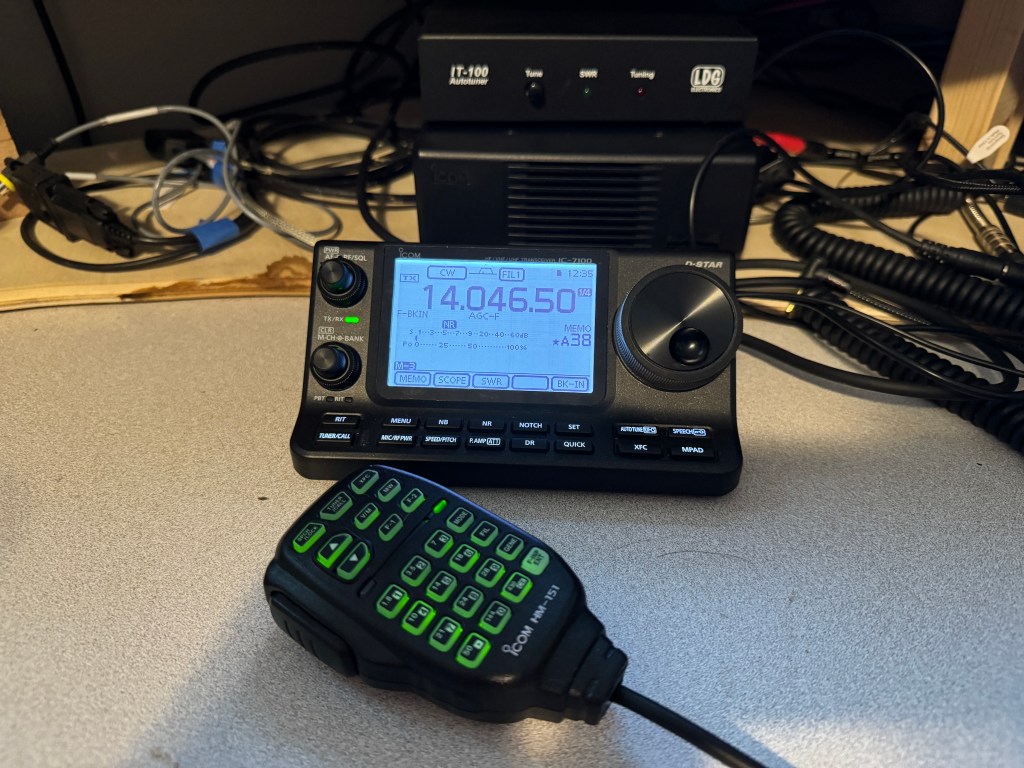
Happenstance: a chance circumstance. That is how it started out. I recently sold one of my radios and for giggles I thought I would check out QTH.com to see if there was anything I just had to have (Danger Will Robinson). I stumbled across a nice IC-7100 and thought I could install it in my truck to make quick POTA activations a little easier. The ad looked good and the call sign sounded familiar. I checked the seller out on QRZ.com. I do this with every ham radio transaction to reduce the opprtunity of being scammed. Low and behold! the seller John KX6F, is an old army buddy of mine. We served together in the 101st Airborne Division in C/158 TF 160. That was 40 years ago and I hadn’t seen him in at least 15 years. John is a good guy and was a major influence to me becoming a ham. I served with him from about 1980-1983 when I was transferred to Germany. Life and stuff took over and I was finally able to get licensed in 1995.

I sent John an email asking if I could pick up the radio in person and take him out to lunch. He told me that he suffered a severe stroke a couple of years ago and that dining in would be a better option. No problem. On Monday 04/22, I asked when would be a good time to come. He said Tuesday would be good. I had one night to plan a trip. He lives about 5 hours away from me so I thought I would turn this into a rove. I decided on two nights of camping and 5 parks in 5 states. The XYL had a hip replaced so I hadn’t been out in a while, it was time to stretch my legs. Here is a map showing the stops.

Blue is day one, red is day 2 and green is day 3 and the trip home.

#1 Clarskville TN. First stop was John’s. We had pizza for lunch and reminisced about old times. John looked good and was as jovial as ever. I was glad I made the trip. He and his wife were very gracious. After about an hour and half, I could tell it was time to go. The radio is in great shape and I am sure I will enjoy it.

KK4Z with KX6F
My new radio at the QTH

From John’s house I drove to Lake Barkley State Park (US-1284 and #2 on the map). I spent the night there in a very nice campsite. Right at dusk, a Barred Owl flew into my campsite. He was less than 20 feet away from me at eye level. Once we made eye contact, he flew off to another perch – silent as a ghost. All the states on this trip were new activation states for me so I made sure I had enough contacts for a valid activation. I was prepared to do either CW or FT8 but due to band conditions, it looked like FT8 was going to be the weapon of choice. I made 20 contacts and managed to work Australia, Canada and France.


Wednesday morning I broke camp and headed toward Ft Massac State Park (US-0993 and #3 on the map) just over the line from Kentucky. It was a nice park inside of the town of Metropolis. I found a spot with clean restrooms nearby and enough room for my truck and camper. There were a lot people using the park to exercise. I used FT8 to make 20 contacts on 30 and 10 meters and the only DX was Canada.

From Ft Massac State Park my next destination was Big Oak Tree State Park (US-1749 and #4 on the map) in MO about 1 1/2 hours away. Along the way near the town of Omstead, IL, I spotted a Bald Eagle having lunch with Vultures at the roadkill cafe. The park is located in rural MO. and surrounded by farms. There was no cell service here but the park and the views were great. I set up near the picnic area. Ten meters was hopping. DX stations included: Hawaii, Belize, Portugal, Puerto Rico, Sardinia, and Spain. I was running 25 watts. I made 20 contacts before packing it up and moving to my next park.
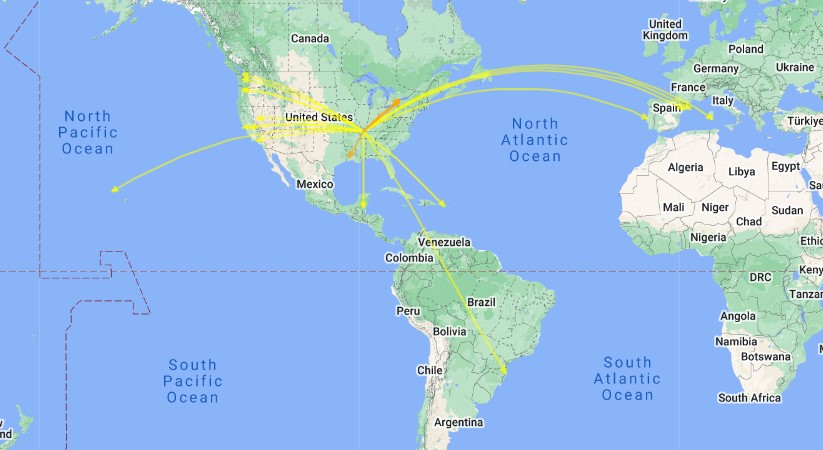
Stop #5 and my second overnight was Mississippi River State Park (US-1102). This was a very nice park and I managed to reserve a campsite on the water. It also had zero cell service, even my cell phone went SOS. My money band was 10 meters again making DX contacts with Argentina, Australia, Brazil, Canada, Chile, Japan, and New Zealand. Ten meters acted like 20 meters, and 20 meters acted like 40 meters. I ended up with 33 contacts total.

Thursday morning had me heading toward home with Georgia on my mind (I even heard the song on the radio). I made a stop at Trace State Park (US-2554 and stop #6) just outside of Tupelo, MS. I stayed long enough to make 20 contacts and one DX into Canada.

I got home about 1600 hrs eastern Thursday afternoon. I worked 5 parks in 5 states: Kentucky, Illinois, Missouri, Arkansas, and Mississippi, in 2 days. I crossed 4 major rivers: Cumberland, Tennessee, Ohio, and Mississippi (twice). I added 5 new states to my POTA activations. It was a good trip considering I only had about 2 hours to plan it. I learned some new things about my equipment and I have plans to make things better for next time.

My first rove proved to be a lot of fun. Usually I drive to a park, spend a couple of days and then drive home. I am hoping to try another rove before the year is out. See the YouTube video below. Until then — 73 de Scott

Winter Field Day 2024

This Winter Field Day (WFD) I operated with the West Georgia Amateur Radio Society. I am one of two CW ops so I got to play CW. We operated under W4F. I typically operate away from the main group so I won’t QRM them. This gives me the latitude to switch bands at will. My purpose is to get multipilers. You get a multpier from working each band. I managed 5 bands. Six meters never came up and I had no takers on 160 meters. Friday night and Saturday morning, prior to WFD, I made a few POTA contacts, had two CW QSO’s and managed to get France on 10 meters. So the antenna was working. 

About the club, in general, we are not hard core contesters. We like to do these events for three reasons, we like to socialize, eat, and play on the radio, often in that order. Saturday, John WD8LQT made chili. Along with the chili, we had hotdogs, coleslaw, and various condimets and snacks. My wife Mary K4SEZ, made Graham Cracker Cookies, a club favorite.

I went QRV at 1400 hrs. eastern on saturday. CW during WFD can be a challenge. There are some really good ops that can zip along at 25-30 wpm. I am not one of them. I can usually get the exchnge if I listen to them call a few times. I can send between 16-22 wpm. Sometimes I felt like I was standing still at 22 wpm with these ops at high speed. A lot of times CW ops are operating portable and QRP or low power. I made many contacts with the S-meter not budging off of zero. We also had a lot of QSB and some QRN. You could see the QSB come and go on the waterfall. It was a bit of a challenge, but I felt WFD helped me realize how my CW Innovations class has already helped me. I was able to copy the QRQ stations better than I have in the past. I eneded up making 45+ contacts mainly by search and pounce. I didn’t think I would do well running a frequency — yet. I went QRT about 2200 hrs. eastern Saturday night. I had to leave early Sunday morning so my wife could get to church on time.

Equipment: My antenna was my Chameleon EmComm II ver.1. I ran a 60′ wire in an inverted L withe a 20′ vertical section using my push-up pole and tying off the other end to a pine tree. I had a 50′ counterpoise underneath the antenna. The antenna played well. I have no complaints, it did what it was supposed to do. I think it will be my WFD/FD antenna if I have the space to set it up. The radio was 2nd Peter, my IC-7300. I was running between 35-50 watts. The radio purred along and never missed a beat. I love my 7300’s. I always say that if I could only have one radio, the IC-7300 would be it. For paddles, I used my Begali Expedition. It’s a nice heavy paddle that doesn’t move and is silky smooth. Logging was handled by ACLog WFD edition on my Lenovo Thinkpad.

Everything worked as advertised, so no real changes need to be made to the radios and related gear. We did talk about getting a MESH network between me and the base camp so we can network my computer with theirs. All in all, it was a good time. I got to see folks I don’t see very often, ate good food and ran some CW on the radio. The QSO map is my contacts only. The club is still operating as I write this. 73 – de Scott

The Thrill of Victory and the Agony of Defeat – or is it

I had good intentions today. When I went for my morning walk it was 8 degrees F and with the windchill, somewhere around zero. This was one of the coldest days I have ever experienced in Georgia. I have been colder, but not here. To celebrate a how low can you go day, I decided on a park activation. During my CW Innovations (CWI) Class I wished to try to make a day activation each week of the class.

Today, it was back to JL Lester Wildlife Management Area. It’s still the closest and I had pretty good luck there last time. I wanted to go over my random wire antenna since I wrote about it in my last blog. Everything was going along swimmingly until I tried to remove the trailer hitch from the receiver — it was frozen in place. Which meant I couldn’t use my K4SWL+ Antenna. Luckily, I had my Frankentenna in the back and broke it out. I ran it in stealth mode :Frankentenna Stealth Mode I hooked everything and away I went, or I didn’t.

I’m not sure what was happening, but I was not making any POTA contact. I don’t think I was making into the RBN either. I did get one hit on HamAlert from the Cayman Islands. I didn’t know if I wasn’t getting out or that there were not a lot of POTA hunters operating today. The bands did sound quiet. So thinking POTA today was a bust, I spun the dial and a guy calling CW on 20 meters. I gave a shout and he came right back to me. We had a nice QSO for about 10 minutes until QRM kicked in. We were both operating QRP from a park and we both had a KX2. Obviously, the radio worked and I was getting out. The thrill of victory is that I made an actual CW QSO and not just an exchange. First time in many years. It is this sort of activity that CWI encourages. So, I broke the ice and did it, usually it gets easier after the first one. One of my goals this year is to get more conversational with CW. I have taken the first step.

K4SWL+ Antenna

On a recent post on QRPER.com, Teri KO4WFP was at a park in Florida that did not allow wires (or anything else) in their trees. Many POTA activators use End Fed Half Wave antennas which usually require one end in a tree. While it doesn’t happen at all parks, not being able to hoist your antenna could bust an activation.

I realized this may happen to me even though Georgia appears to be pretty lenient when it comes to such matters, I decided to switch to a park friendly antenna. I have been a fan of QRPER.com for quite some time and occasionally Thomas will repost something from my humble blog. That being said, it was K4SWL that got me started using a random wire antenna. My basis for my antenna was his speaker wire antenna which was a 28.5’ vertical antenna with a 17’ counterpoise. I used it a few times in that configuration and then started to modify it. I call this antenna my K4SWL+.

Some of the differences are I use a push-up pole to get the antenna in the air and at the base I use a 9:1 UnUn and a 1:1 Choke to keep RF out of the radio. A random wire antenna can feed RF back into the coax.

The wire is 14 ga. coated flex weave from The Wireman. This was left over wire from some other antenna projects. When I started this project I was using 22-24 ga. coated wire from SOTABeams but realizing there was no need to save weight, used the heavier wire. This allows me to dual purpose the antenna both for FunComm and EmComm. The insulator at the top is 3D printed with my call-sign and the base is U-type lugs. I find these are the best as I do not have to take the nut off of the antenna studs and if pulled hard will come loose instead of damaging the UnUn. I connect the antenna to the top of the push-up pole with a small Nite-eze “S-biner” size 1.

The 9:1 UnUn comes from Palomar Engineering. I have already created a blog post about how to build it and it can be found here: http://[https://kk4z.com/2022/05/28/91-unun-qro/]

Part of this blog post was to bring the different components together into one blog post.

The 1:1 Choke can be found here: [https://kk4z.com/2022/08/15/lightweight-choke-balun/]

I made two different types but I found the second works much better.

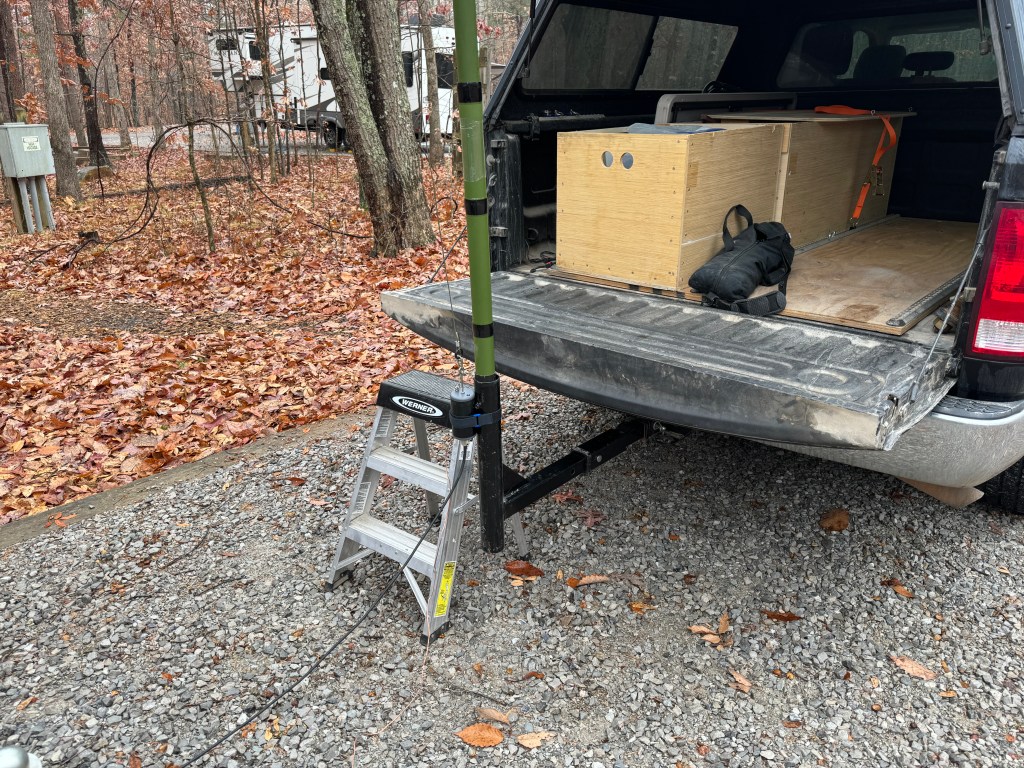
The project is pretty easy, the only caveat is to pay attention to what wire goes where. Putting it all together, you need a push-up pole, a Flag holder and maybe a trailer hitch extender. I will provide links below. The Flag Pole holder I used was not available so the link I used is a probable substitute. I have a trailer hitch on both my truck and my camper, When I pull into a campsite I have a choice of which hitch to use to keep my antenna clear from the trees. With the antenna up, I wrap the antenna wire around the push-up pole from tip to base, to prevent the wire from sagging near the tip. I attach the UnUn and choke to the mast with Stretch Velcro Straps. With my antenna up I have park employees drive by me all day along. Most of the time we exchange a friendly wave and occasionally one will stop by for a chat. I have had zero issues with this antenna at any of the parks I have visited.

How does it play? It has pretty much been a main antenna for just about all of my POTA activations. You can go back through my blog post and see what equipment I used with the antenna and the accompanying QSOMap. You do need an antenna tuner with this antenna and I typically use an LDG Z-11 Pro which I’ve had for 15+ years. The antenna tunes up from 80 to 6 meters and I have run the power as high as 65 watts. I normally run 10-35 watts depending on band conditions. I have tried it on 160 meters and while I can get a match, I don’t think much RF is leaving the antenna. I’ve made a few contact with it on 160. If you like to work 160 meters during a POTA activation, I suggest a Chameleon EmComm II with a 60’ antenna and a 50’ counterpoise. I run it as an inverted L with the apex about 20’ up my push-up pole and the end sloping down to something not a tree. Last time I tied it to the lantern stand at the campsite. It worked pretty well and I was able to make contacts on 160.

If you’re looking for an antenna that you can set up almost anywhere, with little or no hassles, take a look at this one. Don’t forget to check out the short video below. 73 — Scott

14 ga. Flexweave
Nite-Ize-Size-1-S-Biner
Jackite 31′ Pushup Pole
Flagpole Holder
Hitch Extender
Stretch Velcro Straps


Bits and Bobs

This morning I started waxing philsophically about kits and kitting. Some folks prefer to build a separate kit for each radio or each adventure. That can be a fun past time itself. I have tried that and it doesn’t work well for me (YMMV your milage may vary). When I do an activation or for that matter when I am hunting from home, I like to be familiar with my equipment. I like to know what it can and can’t do. One negative about multiple kits is you don’t put your hands on them as much which means they don’t get inspected or checked for damage, dead batteries etc. as much. I’ve seen many times where someone brought one of these kits to the field and something was missing, broken or dead, and they couldn’t get on the air.

This probably goes back to my Army days. We were issued one set of gear and that’s what we used. You knew how every thing worked and your kit was inspected frequently . A good example is my pocket knife of choice. While in the Army, I always carried a Swiss Army knife (SAK). It was used daily for a multitude of tasks. I developed a close relationship with SAKs. Forward to today, even though I can afford fancier knives and I have a few, my Every Day Carry (EDC) is still mostly a SAK. Why? Because I know the knife. I know the steel, how they are built and how to various blades work. For a while I was a UH-60A Blackhawk Crew-chief and the SAK was routinely used to work on the aircraft. Today, a SAK Small Tinker resides in my pocket. I have carried SAKs for over 50 years.

Back to radio stuff, I feel the same way. Even though I have quite a few antennas, I stick to a few that really work for me. I like going on an activation, knowing how my gear is going to work. Today, I was musing that I had my KX2 in its bag that came with the radio. It’s a nice bag but it’s a little tight fitting in my back pack. I decided to put some of the gear in a separate smaller bag. I have a 3D printed face cover and BNC connector cover to protect the radio bits so I can place the radio in my bag by itself. I also thought that my little QRP radios (KX2, IC-705, and QMX) use much of the same gear so I made one bag that all 3 radios can use. Then, when I go an activation, I can just swap out the radio and not worry about leaving something behind. Here is my new radio bag and list. For the rest of the pack contents see my blog post AAR on Bald Mountain: https://kk4z.com/2023/11/23/aar-bald-mountain/

The bag is a Condor Belt pouch. Nothin fancy, but sturdy enough and mashable enough to fit nicely in my backpack. Both my IC-705 and KX2 have a Begali Adventure mount and the Adventure paddle can be hand held. One thing not shown is an anti-slip pad that I use when operating from inside the truck. Here is the rest of the kit:
3’ RG-316 jumper
15” RG-316 with choke
Throw line and weight
Extra Bank Line
Begali Adventure Paddle
28.5 Random Wire Antenna with 17’ Counterpoise
Wire to BNC Adapter
BNC to SO-239 adapter
BNC to BNC adapter
3’ 3.5 mm Stereo Cable
Earbuds
Power Cable for there IC-705
Power Cable for the KX2 and QMX

My backpack stays packed and ready to go complete with a radio. Because it gets used often, I do not worry if the gear is ready, I just grab and go. Part of my Army training that has stuck with me, is I go through my gear when I come back from the field and get it ready for next time. As I said earlier, I plan on doing a one day activation a week along with one weekend activation a month. 72 — Scott

Day Activation at JL Lester WMA K-3756

Going with my goal to improve my CW skills I set out this morning to a nearby WMA for a POTA activation. It is the closest one to my house but it is still 30 miles away. CW is a participation sport, and like many things, in order to get better, you must practice. One of the things I have done was to sign up for a CW class in this case CW Innovations. One of the things CWI stresses is getting on the air and making contacts. I believe in that, and part of me joining CWI was forcing me to practice what I preach. The course is 10 weeks long starting next Monday. It is my plan to try to get out and make one day activation a week along with practicing from home. I like to activate but sometimes I get distracted at home and other things take precedence. By setting a schedule, I hope to break the pattern.

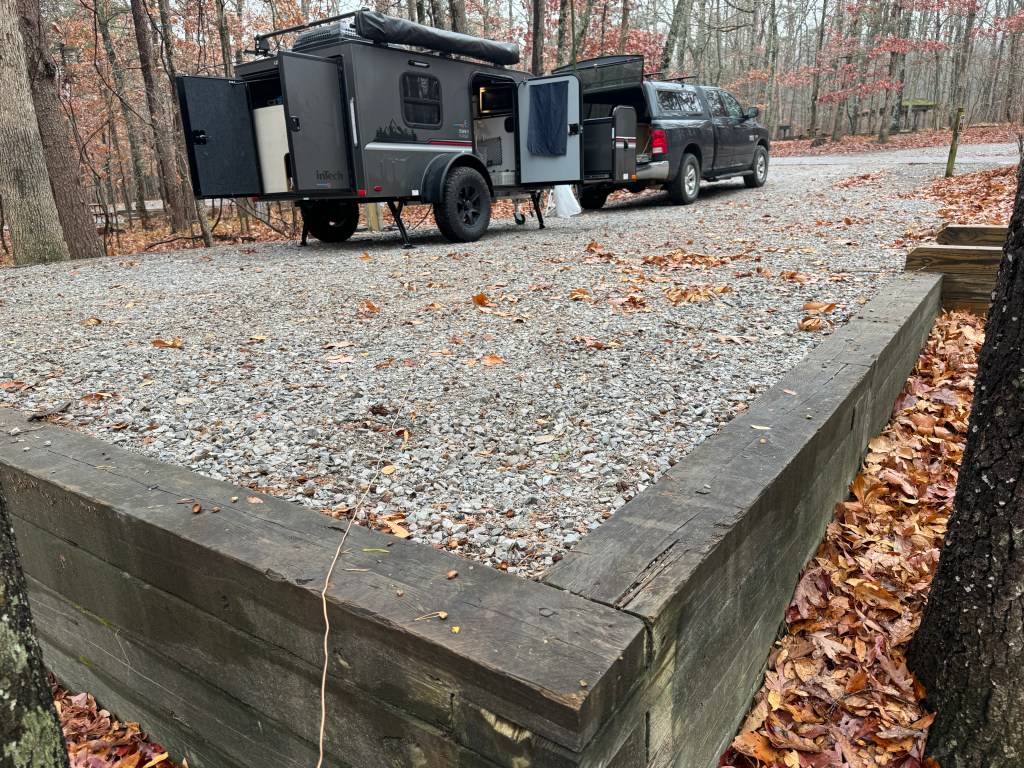
The JL Lester is a small WMA and I chose the less populated parking area. It’s a quiet place. My antenna was my 28.5’ random wire. It’s the easiest antenna I have to set up. It takes a few minutes and puts no wires in the trees nor holes in the ground. A win-win for everyone. The antenna is a permanent resident of my truck. The radio for this trip was my Elecraft KX2. It is a perfect radio for a short duration activity. Hook up the antenna and plug the paddle into the radio; I’m in business.

I was set up by mid-morning and thought I would start on 40 meters. Forty was already dead so I moved up to 20 meters and jackpot! I had quite a flurry of activity. I kept my speed at 18 wpm. Slow enough for those still around 15-16 wpm but fast enough for zippy guys. It can get hard to adjust your speed. I often falter when going from 16 wpm to 22 wpm. The band was in okay shape. There was a bit of QSB which made hearing some of the stations a little difficult. There was also some pile-up QRM. I really prefer it if everyone would send their call once and let me grab one. Sending a call 2-3 times slows down the whole process. I have to wait for everyone to stop sending before I can respond. Like today, most times, I stay on long enough to work everyone in the pile-up. Today I stayed on until no one was calling and then went QRT.

It was a pretty fast run, I made 32 contacts in less than 50 minutes. Could have made a few more if…

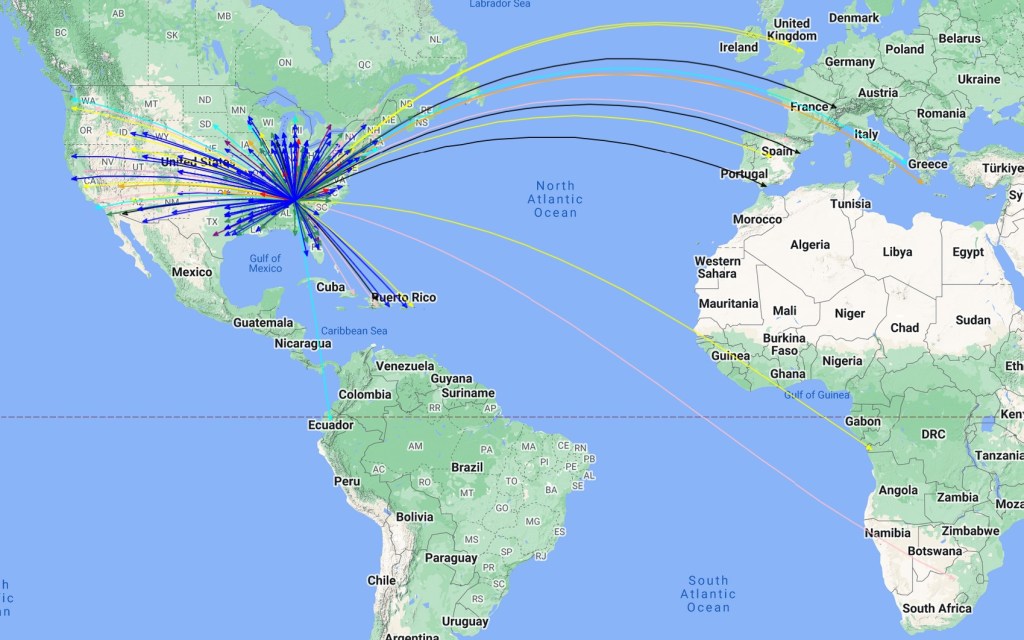
Below is a QSO map and a short video describing the activation. Thanks to all for your patience. I had some trouble with a few call signs due to QSB and a short between the ear cups. Hope to see hear you out there next week. 72 — Scott

POTA Activation K-2169, Me, VaraC, 160 meters and more

This weekend I had the opportunity to activate Cloudland Canyon State Park in NW Georgia. It was a digi weekend with me running FT8 and experimenting with VaraC. I also tried a new antenna combination to see how it would work on 160 meters.

The weather. I book my campsites 4-6 months in advance so I take what I get when I go. This weekend called for rain Friday and was supposed to clear up Saturday PM. It didn’t. It drizzled/rained from the time I got there until 0200 hrs Sunday morning. Since I mingle FunComm with EmComm, this was another test of my gear. The only issue I had was I needed to better seal the window where my coax goes into the camper. You shouldn’t let the weather stop you from going as long as it’s safe. I go year round and because of that, I have a good understanding of my gear and my clothing under varying conditions.

The gear. The antenna was a Chameleon EmComm II ver. 1. This version had a clunky antenna wire and insulator that is more from permanent/semi-permanent installation so I didn’t use it much. This year, Chameleon had a Black Friday Sale of 25% off. I decided to upgrade the wire to a 60′ Kevlar with a winder. I also ordered their new 40-meter OCF dipole which will be used on SOTA activations. I had some 14 gauge Flexweave wire that I cut to 50′ for a counterpoise. My intention was to use this antenna down to 160 meters. I ran the antenna as an inverted “L” ish. The vertical portion went about 25′ up my mast and the horizontal portion was more of a slope and facing north. The nice part was that the entire antenna fit within my campsite. I used the lantern hook on the site to secure the antenna. For rope, I used #36 tarred bank line. The rope is a little sticky so it holds knots well and does not absorb water like para-cord does. I used a clove hitch to secure the antenna ring to the mast and it held fast. The Bank line has replaced all of my para-cord.

The radio was First Peter, my IC-7300 that I bought new in 2016. I use an LDG Z-11 Pro that I have had for 15+ years to keep everything matched up. I was running 25-35 watts. My other IC-7300 is Second Peter. My backup radio was my new KX2. I keep it in a backpack so it is easy to toss in the truck.

Propagation. It was different, not bad, but different. There was a lot of solar activity and I believe it pushed the MUF up above 20 MHz. I had a lot of success on the higher bands which is typically not the case in the winter. My antenna easily tuned 160 meters and I made about half a dozen contacts using FT8. How did I do? I started at about 2030 hrs UTC Friday and finished up at about 2200 hrs UTC Saturday afternoon. I made a total of 325 contacts covering 42 states and 12 countries. Some of the interesting (to me) DX was Angola and South Africa. Both of those stations called me. Angola was on 10 meters and South Africa was on 12. No DX on 40 meters. I had a Facebook request to work 40 meters for local contacts. I did my best but 40 was rather flat this time around. It had the second-highest count of contacts. Breakdown by band was: 10 meters – 18, 12 meters – 18, 15 meters – 13, 17 meters – 7, 20 meters – 136, 30 meters – 19, 40 meters – 90, 60 meters – 12, 80 meters – 6, and 160 meters – 6. One of the surprises other than the lack of low band activity was that 17 meters was fairly dead. Typically on an activation, my money bands are 17, 20, 30, and 40. This time only 20 and 40 panned out. I manage 10 bands at this park in case I want to go for another N1CC award.

VaraC. For the past week, I have been evaluating VaraC mainly for EmComm. There is a lot to like about it. For one thing, it uses the same modem as Winlink. If you have it set up for Winlink, you are good to go for VaraC. VaraC can upload files and low-res pictures. PSKReporter showed favorable propagation on 20 and 40 meters. I made a few contacts with it and did some beaconing. I haven’t tried it yet, but it looks like I can create a document in FLMsg, save it, send it via VaraC, and reverse the process at the other end. pretty nifty. I think pairing Winlink with VaraC just might be the ticket.

Recap. Neither snow, nor rain, nor heat, nor gloom of night stays this operator from completing his park activation… I had a lot of fun. I try not to let the elements stop me from doing what I like to do. 73 – Scott

Methods Modes and Madness

Before I take my leave from EmComm and revert to FunComm, I thought I would share some of my meditations on digital modes.

My use of digital modes goes back to the mid-2,000’s. I was an early adopter of Winlink and ran a regional digital PSK31 net. I have had the pleasure of working with many fine amateur radio operators with many different skill sets.  Recently, I have had the opportunity to run a national digital PSK31 net for a few months.  Again, the experience of working with amateur radio operators was a fun and fulfilling endeavor. I have used most of the modes for Winlink with VARA being the current favorite.  Other modes I have used include PSK31, PSK125, QPSK125, Contestia, MT63, and Olivia.  They all work as intended, however, when it comes to the less experienced digital operators, PSK31 is the easiest to master.  I have run nets where we started on PSK31 and then moved to another mode and then back to PSK31.  Many ops do fine on PSK31; however, once we move to a different mode, they get lost. When considering EmComm we should always play to the least common denominator.

My favorite modes for EmComm are:

1) Winkink/Vara.  If I had to choose one, this would be it.  With nodes all over the world, the probability of getting into a node is greater than if you had to depend on a single point. Because messages are stored until they are retrieved, Radios do not have to be left on to forward and retrieve messages.  This can be done at any time and there is no need for a schedule.  An operator can wait until favorable propagation exists. I have not tried VARAC yet, but it is on my to-do list.

2) PSK 31 and 125.  I like PSK31.  I have run a national net using it.  Typically, I take check-ins on 31, send a message using FLMsg on 125, and then go back to 31.  I have a much higher percentage of people getting the message using PSK31 than with other modes.  On most modern radios, PSK31 can be decoded and sent without the use of a computer.  While those at home with mains power see that as frivolous, a computer or laptop can be a serious drain on a battery when mains power is not available when operating under potable/emergency conditions.  Because PSK31 has a narrow bandwidth (60 Hz) compared to MT63-1000s (1000 HZ), it enjoys a 2 S-unit advantage.  Roughly that means a PSK31 message transmitting at 5 watts is equivalent to an MT63-1000s message transmitting at 100 watts (5 watts to 100 is about 2.2 S-unit gain and PKS 31 to MT63-100 is about 2.03). My point of view here is someone operating in the field, using portable equipment.  In addition, we do not always get to choose who is in the field and who is at home.  Throughput on PSK31 is about 50 wpm and MT63-1000 is about 100 wpm.  If we bump up to PSK125 (which is about 1 S-unit better than MT63-1000) we get about 200 wpm.

3) My third mode would be CW and this would be used when nothing else is working.  It requires the least amount of equipment and what can be used is not complicated.  This would be an emergency mode.  Any communications plan should include CW and any EmComm group should try to maintain a few CW ops on their rosters.

What would I do if I was in charge? I would try to keep the communications plan as simple as possible and play to the least common denominator.  I would use the U.S. Army acronym PACE which stands for Primary, Alternate, Contingency, and Emergency. My plan would look something like:

a) Primary – normal infrastructure/internet-based communication.  When it’s working, it’s the best. I have seen operators try to use their radios when there is a working FAX machine next to them.

b) Alternate – This could be a combination of Voice/SSB and Winlink.  Establish a voice net because that is where most of the operators operate and provide an email address where to send Winlink Messages.

c) Contingency – This could be a Peer-to-Peer digital mode such as MT63-1000, or VARAC.  I like the idea of VARAC because VARA is used by Winlink but I have to try it out before I can recommend it.  Down at this level, the more experienced ops may not be prevalent, and it might be the less informed ops on the scene. 

d) Emergency – This is no man’s land in the EmComm community.  The probability of us getting to Emergency is quite low, maybe 1%.  Here you might find an operator with a radio and antenna while a geomagnetic storm is raging overhead.  I have been deployed to a disaster area while a storm was raging, and we have had a couple of SETs with poor band conditions.  Here might be the realm of PSK31 and/or CW.

What I am saying is to keep your comm plan simple.  You don’t have a legion of professional-level operators on hand that can tackle all the modes available.  What you do have are operators with widely varied skill levels, with amateur radio either a secondary or tertiary interest.  Pick the fewest modes that use the fewest different types of software and stick with them.  Don’t forget to train, train, train.  Additionally, have exercises that get operators out in the field.  Field ops are hugely different than operating from home.  Try to get them at least 20 miles from their home, this reduces the run home for something I forgot.  Many times, during a deployment/exercise there were ops who could not complete the tasking. I like to go camping at least once a month and bring my radios with me.  I usually do a POTA activation; it gives my radio system a good shakedown and helps me understand its performance. Get out, get on, and go do!  73 de Scott

Antennas and More

I have poured over a lot of documentation about antennas.  Through it all I have come up with the following antennas for portable/field use.  The best antenna is a horizontal half-wave dipole at 0.1 to 0.24 wavelengths above electrical ground.  As long as the height stays below 0.25 wavelengths, its efficiency isn’t affected that much.  Much of what I read has a height somewhere between 15-30 feet.  There are even a few who advocate putting the antenna within inches of the ground.  The antenna can be allowed to sag in the center for a little gain or it can be hung in an inverted vee as long as the apex angle is 120-140 degrees.

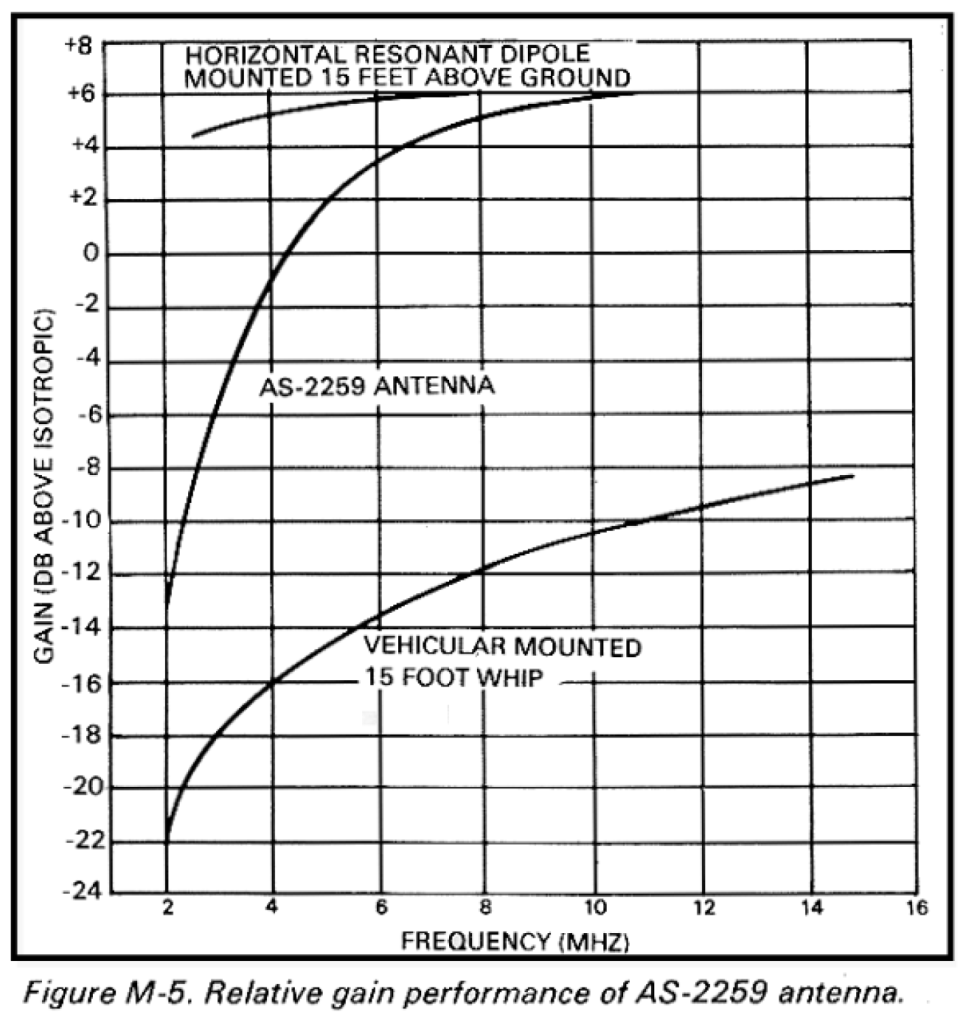
What about the AN/AS-2259?  Good question.  I built one back in 2007 and used it a few times.  It can be a pain to set up and I am not sure the juice is worth the squeeze. Concerning the AS-2259 vs a half wave dipole: In most cases, a standard dipole is as easy to install and performs significantly better (NVIS).

Height above ground.  There are two components to antenna height – the part you see and the part you don’t see.  The part you see is represented by the length of the mast holding the wire above the earth. The part you don’t see is the portion below the apparent surface through which the radio waves travel before reflecting. For very conductive ground, such as seawater, radio waves reflect on the surface.  For poor ground, such as freshwater, radio waves penetrate many feet.  An antenna lying on the surface of rocky soil, for example, might have an effective “height” of 40 feet or more. (NVIS) The second antenna is a military whip either 16’ or 32’ attached to a vehicle and used with a coupler. The whip is tilted horizontally away from the vehicle and the vehicle serves as a ground. This creates an asymmetrical dipole.  These whips are hard to get and are often expensive.  The whip can be replaced with a wire and the length can be extended to 60-100 feet or more and/or a counterpoise can be used.  This is a similar setup I used in Jacksonville, FL back in 2004.  Another variation of this antenna is Chameleon’s EmComm series.  All the antennas mentioned work. 

Remember an antenna NVIS should enhance near-vertical radiation and suppress ground wave radiation. Antenna 0.25 to 0.1 or less wavelengths above the ground should provide adequate or better NVIS performance. Any adventure into NVIS starts with a communications plan and propagation study. As I said at the beginning of this series, this is a Cliff Notes Version, enough to get you interested and going.  One thing that must be remembered is that NVIS doesn’t always work, and the communications plan should include a contingency for using long path or other forms of communication such as WinLink.  Thanks for your interest. 73 de Scott

What’s Up With NVIS

My first experience with Near Vertical Incidence Skywave (NVIS) propagation was during Hurricane Frances, in September 2004.  We were bringing two tractor-trailers full of food and supplies to an area on the east coast of Florida.  I was the EmComm Specialist, and my function was to ensure that adequate communications were available. I was new to this, and this was my second deployment.  I recently purchased an Icom AH-4 to go with my IC-706 MKIIG.  I was looking for something that could quickly be deployed and recovered while providing a reliable linkage.  I also had some Hamsticks with me.  The antenna was about 30’ of 12ga THHN wire and the counterpoise was about the same length of bare flat-braided wire. Before we reached our destination, we stopped in Jacksonville, FL to allow the hurricane to pass before we proceeded south.  That evening, I deployed the antenna to test it. This was a hurried callout and I had little warning.

That evening, I called to check into our 75-meter EmComm net. I was amazed that I sent and received a 59-signal report from an antenna that was only about 6 feet off the ground.  The distance between the two stations was about 300 miles! Back then, I didn’t know about NVIS, but I proved the concept. It works and it works well.

Today, there is a renewed interest in NVIS with Georgia ARES and Georgia AuxComm. I wanted to present a Cliff Notes version of NVIS to help others get a leg up on this form of propagation. Throughout this series, my two main references will be Near Vertical Incidence Skywave Communication, Theory, Techniques and Validation by LTC David Fieldler and Maj Edward Farmer, and FM-24-18 Tactical Single-channel Radio Communications Techniques. When I use a reference, I will abbreviate the (NVIS) or (FM24-18). Italicized text is a direct quote. What is NVIS? NVIS is skywave propagation where radio energy is radiated at or near vertical at a low enough frequency to be reflected by the ionosphere back toward the earth.  This causes an omnidirectional pattern like a fireman’s fog nozzle pointed up (FM24-18). This pattern eliminates the skip zone allowing communications within a couple of hundred miles and because the path is near vertical terrain such as mountains can be overcome.

Typical propagation with Skip Zone

NVIS Footprint or Fog Nozzle pattern

What is needed?  NVIS needs frequencies low enough to prevent them from penetrating the ionosphere (F1/F2).  This usually means frequencies in the 2 to 4 MHZ region at night and 4 to 8 MHz during the day.  This would include the 160-, 80-, 60-, and 40-meter bands (NVIS).  Note: It is important that tactical and emergency communicators develop strategies for implementing medium frequency (160-meter) NVIS paths (NVIS). There will be more about this in the discussion about propagation. Also needed are antennas that radiate at 75 to 80 degrees or greater from horizontal and that suppress groundwave radiation.  NVIS depends on skywave radiation.  Because of the time differences between skywave and groundwave radiation reaching the receiving station, there will be some cancelation in the form of fading (QSB) which may be enough to reduce effective communication. I will have more information about antennas in an upcoming discussion. NVIS isn’t mystical, magic, or arcane – well maybe a little arcane until now.  What successful NVIS operations need is a little effort from the participants.  There must be some skill with equipment, along with some knowledge about theory such as antenna design and propagation.  What it really needs is careful planning and an adequate communications plan along with practice. I have a couple of installments planned that should give the average ham enough specialized knowledge to be able to conduct successful NVIS operations. My one caveat for this section is that there will be times when NVIS will not work.  Your communication plan should accommodate that.