Yaesu FT710 final Review and Where to Go From Here

I’ve had the Yaesu FT710 for a while now and used it mainly in the field. That was and is my intent for this radio.  In general, I feel if I am doing an activity like Field Day or a multi-day POTA activation, and I am not carrying my gear more than a few feet, why not bring a full sized but compact radio.  These radios have more operating options and the controls are generally easier to use.  In addition, running a 100 watt radio at low power (20 watts or less), the radio doesn’t even get warm.  The radio works well with digital modes.  It wasn’t that long ago that Yaesu’s were a real pain to run digital.  Icom’s have had an easy interface since the IC-7100.  Today, the FTDX10 and the FT710 both are on par with the Icom’s when it comes to digital modes.  With CW, both brands are about equal.  In general, I feel both radios are interchangeable and it would be the matter of personal preference which would determine which is best for you. In the next couple of paragraphs I will describe the pluses and minus’ of the FT710 and the IC-7300. John WD8LQT provided input from his use of my radio during the WGARS Spring Fling.

Attenuation.  The IC-7300 only gives you 18dB of attenuation while the FT710 give you 3: 6dB, 12dB, and 18db.  Your more expensive radios typically have 3 like the FT710.  In an SDR radio, attenuation is your friend.  Preamp should almost never be used.  The nod goes to the FT710.

CW Tune.  Both radios have autotune but the FT710 has a CW tuning indicator right below the S-meter. I find myself using it quit a bit.  Some CW ops crank their filters way down and if you are a little off frequency, they won’t hear you.  My buddy John WD8LQT, also liked this feature. Nod goes to the FT710.

Sound quality.  The FT710 sounds a little better, but the IC-7300 has a lower noise floor.  I do not find either one objectionable. YMMV.  Draw

Waterfall.  The IC-7300 has an averaging waterfall and the FT710 does not.  That means that the FT710’s waterfall has to be manually adjusted every time band conditions change.  John noticed that when sending CW the waterfall would flash rather brightly, enough to be a little distracting. This may have been due to the waterfall level not being adjusted properly, but it is not an issue with the Icom.  Nod to the Icom.

Ergonomics.  Here the IC-7300 is the clear winner.  It has more of the right buttons on the control panel and it is easier to get to the most needed controls. The 7300 gives you 3 adjustable filters and the Yaesu gives you 2.  To adjust the Icom, grab a knob and give it a twist.  On the Yaesu, push a knob, twist the knob, push the knob, twist the knob.

Power consumption.  The FT710 uses about 1.2 to 1.3 amps at idle with normal volume.  The IC-7300 uses about 0.85 amps.  This doesn’t matter if mains power or generator power is available but when working off of batteries this can become an issue.

Sensitivity and Selectivity. The Icom has a lower noise floor, -133 vs -127 dBm for the Yaesu. Before I get into selectivity let me explain a little about Rob Sherwoods numbers.  Most people quote the 2 KHz blocking number, that comes with a couple of caveats. First, for the most part Rob measures 2 KHz blocking with a 500 Hz filter. That’s a CW filter.  Sideband filters usually run 2.4 KHz plus.  Unless you’re a CW op, this number is irrelevant. Here is what Rod Sherwood says, “I decided to sort the table on my website by close-in dynamic range at 2-kHz spacing. This was the “acid test” for CW contest / DX pile up operation.” He further quantifies his research with the following numbers. “What do you need in the way of close-in dynamic range? You want a number of at least 70 dB for SSB, and at least 80 dB for CW. A 10 dB safety factor would be nice, so that means you would prefer 80 dB for SSB and 90 dB for CW.” In the past I have compared the IC-7300 with the FTDX10 and the FT710 during a CW contest. What ever I could hear with one, I could hear with the other. The Yaesu’s had a little less ringing but I had no problem copying the signal from any of the radios.  

What this means is either radio will serve the vast majority of operators well.  Whatever your personal preference is, go for it.  There are things I love about the FT710 and there are things I love about the IC-7300. I never feel at a disadvantage with either radio.  I plan on keeping both.

Where do I go from here? That’s a good question. I don’t have anything in line to review. I have decided to take a step back from EmComm for a while.  I’ve been doing a lot of digital lately and need to get back to the joys of CW. I also have a couple of QRP radios that need to be taken out and used.  I still enjoy the smaller radios.  I’ll take a big radio on a camping trips/Field Days and may take a little radio for a quick activation. Sometimes it’s nice to grab a small box or bag and go. I have some antennas I haven’t used in a while, I need to get them out.  

Thanks for hanging with me.  I appreciate your company.  73 de Scott
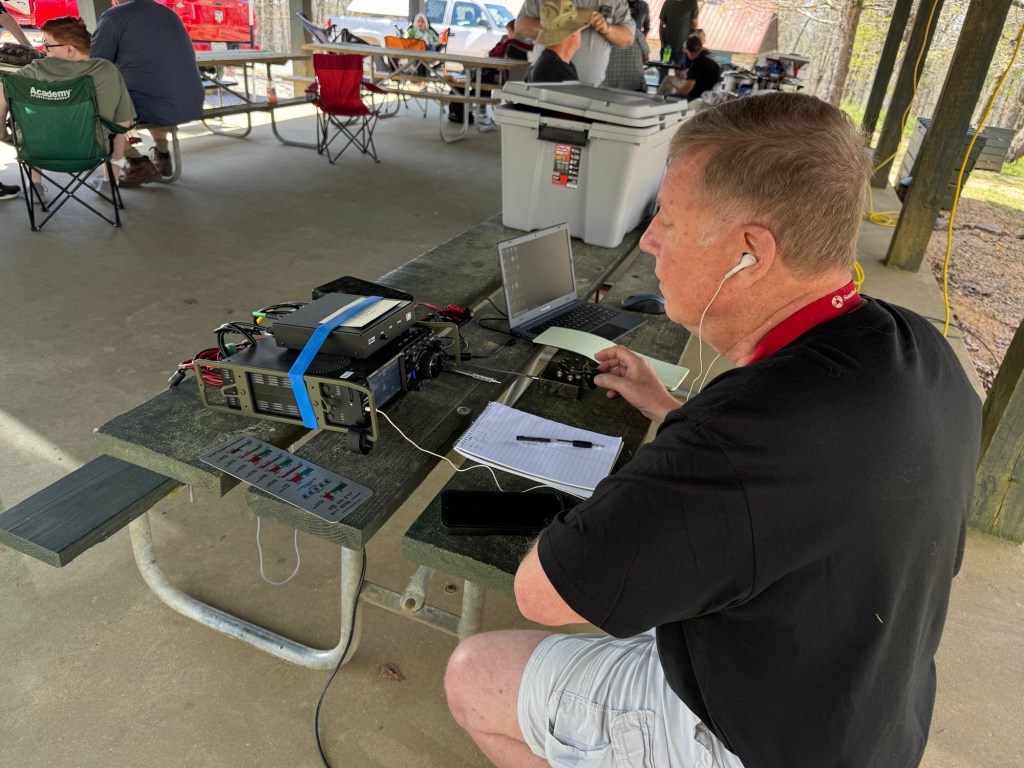
WGARS Spring Fling 2025

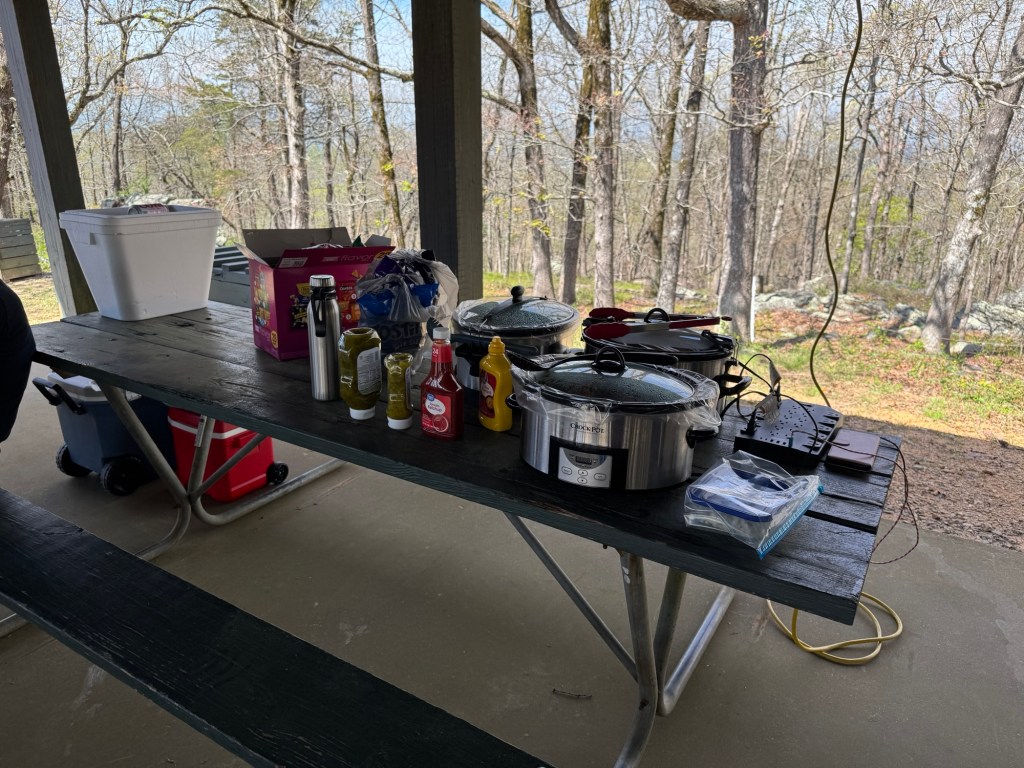
Today was the club’s semi-annual outing and this spring it was one of our old haunts, Cheaha State Park US-1037 in the fine state of Alabama. There are 3 things we as a club like to do, we like to eat, we like to socialize, and once in a while we talk on the radio.

As usual, food was in abundance.

We had several stations set up under the pavilion. QRM was held to a minimum. We had Xeigu G90’s, Tru-SDR, Icom IC-705, and my Yaesu FT-710. I set the radio up and turned it over to the club President John WD8LQT. John, like me is a CW op and I wanted his opinion of the FT-710. I didn’t have to twist his arm too hard. The setup was the radio feeding a Chameleon micro transformer with a 12’ whip and about a 20’ counterpoise. The radio was powered by a 20 amp-hour Bioenno battery and the paddles were a Begali Expedition.

Band conditions were poor and it took John most of the time at the park to get his 10 contacts. There were stops for eating and chatting. Early in the activation, I decided to change antennas to be sure we had an atmospheric issue and not an equipment one. I had my Diamond RHM-12 which recently proved itself to be a good performer. Once the switch was made and some searching through the bands, John started making contacts on 20 meters. I believe it was atmospherics and not the equipment. John got his 10 contacts and we called it good.

John’s comments about the FT-710 were quite favorable. Like any radio, there are pluses and minuses. In general he thought it was a very good radio for CW. There is more commentary from John on the YouTube video posted below. John did have one epic fail. The ear buds he was using which looked rather ancient finally gave up the ghost. I took it upon myself to intervene and unceremoniously threw them in the trash. John will thank me.

My review of the FT-710 is drawling to a close. I find that I like the radio. It performs well for its price point and has some features found on more expensive radios. It has its quirks as all radios do, but none that I find overly objectionable. I plan on keeping the radio and it has found a place among my field radios. I imagine the radio may make an appearance during this year’s Field Day.

Surprises at Laura S Walker State Park

I decided to travel a little further this time and head toward the Okefenokee swamp. this time I tried the Laura S Walker State Park. It was a five hour drive and about 320 miles but fortunately I was able to stay off the interstates for all but about 30 miles of the trip. The park is near Waycross, GA which recently suffered from severe weather. Even though it has been a while there it still plenty of evidence to attest to natures fury. The park itself was in good shape and I had a nice campsite.

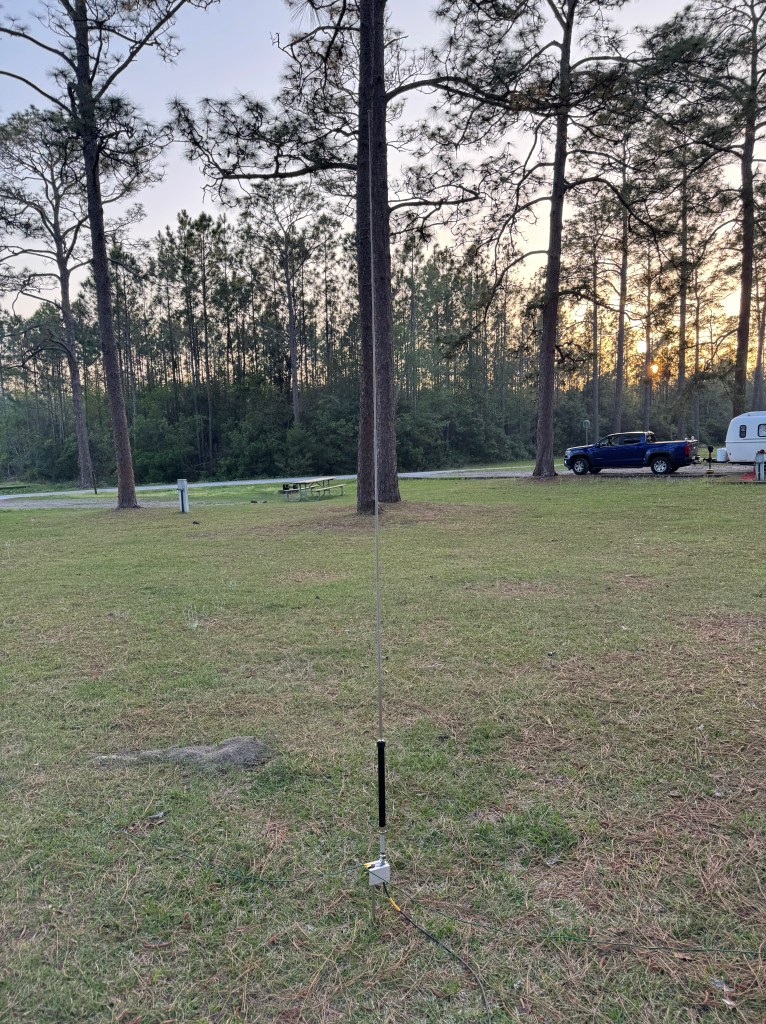
I would normally use my 28.5′ vertical antenna but I had a power line that passed almost directly over my truck and camper. I could have requested a better campsite but in the spirit of FunComm I decided to work with what I had. Instead of my usual antennas I deployed a new antenna. A Diamond RHM-12. This is a manual screw drive type antenna that is only about 7 feet tall and covers 40 meters to 440 MHz. With additional coils it also covers 80 and 160 meters. I set it up away from the power lines and used a Chameleon Spike to set it into the ground. I also had 2 counterpoises about 20-25′.

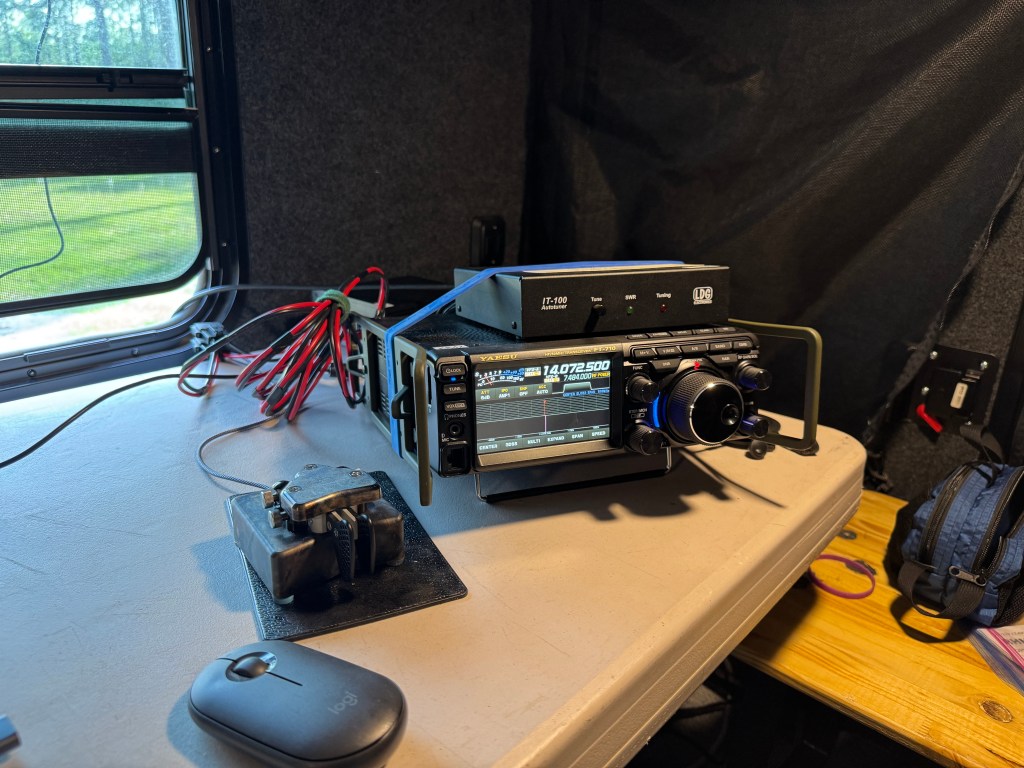
I was a little concerned about its performance. Inside the camper I had My Lenovo Laptop and Yaesu FT-710 with an LDG tuner.

I had a Rig Expert Pro Stick antenna analyzer with me and I was able to get the SWR down below 2:1. I guess I could have monkeyed with to get it lower but since I had the tuner…

I have really taken a liking to the FT-710. It has been performing well and since the last firmware updates, it has become a little champ. It is winning my heart. The radio, tuner, and computer all worked well together. I only ran 25 watts of power as that is about the limit on the antenna using FT-8. I was going to work some CW but the days I was at the park the temps were up around 90 degrees, far from the 43 degrees the morning I left my home QTH. I ran the air conditioning and when it is on I have trouble copying CW. Years in Army Aviation and other loud occupations have affected my hearing.

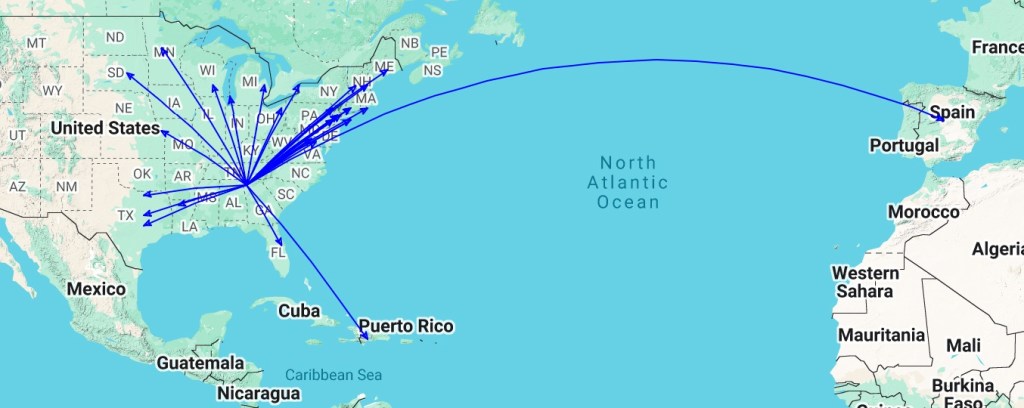
How did I do? Surprisingly well. In a 24 hour period which included sleep time, I made 400 contacts (7 dupes). I made contacts in 46 states (Not AK, HI, MT or RI) and 34 DX entities! I think that’s a new record for me during a POTA Activation. I got as far west as Australia and American Samoa, and as far east as Turkey, Bulgaria, and European Russia. The bands were up and down and I had to make a few trips out to the antenna to adjust it when I changed bands.

I never expected that little antenna to perform so well. The RHM-12 antenna has been assigned to permanent duty in my antenna kit.

It’s important to take your gear out and use it. Understand how it operates under various conditions. Know what your gear can and cannot do. This is good to know having fun but becomes critical when more is at stake.

It’s Good to be SEEN

Saturday, 09 March 25, I made the two-hour trip over to Bessemer, AL to attend a SouthEast Emergency Network (SEEN) meeting. The meeting was to start preparation for an upcoming Field Training Exercise (FTX) in April. I was here to support my friend and SEEN founder Billy N4WXI.

Billy started SEEN a couple of years ago to serve his local area in case of a communications emergency using GMRS. It has since grown into a service covering the Gulf Coast States including Georgia. These are the States most affected by hurricanes. Hurricanes when they make landfall can cause extensive damage over wide areas. The focus of SEEN is to provide communications during the first few days of a disaster or until government agencies can recover their communications. SEEN is also affiliated with the American Radio Redoubt Operators Network (AmRRon). This affiliation will allow SEEN to pass messages from the southeast to AmRRon to anywhere in the USA.

SEEN primarily uses digital modes to pass traffic because it is quicker, more resilient to interference, and more accurate. Billy feels the main role of SEEN is to pass health and welfare traffic to connect families and friends inside and out of the disaster area. SEEN uses 3 apps/modes: FLdigi, JS8CALL, and VARAC. Right now, FLdigi is the heavy lifter, it has multiple modes and is used by many organizations. This allows cross group communications. The second is JS8CALL. JS8CALL is a slower but more robust and because of its excellent weak signal characteristics, it is used when nothing else will work. VARAC is the new kid on the block and has a lot of promise. This app uses VARA which is also used by Winlink. It has pretty good weak signal characteristics, but speed and automatic error correction are its strong points. A message sent through FLdigi using a mode like MFSK32 can take 5 minutes. Using JS8CALL can take 10 minutes or more. VARAC using VARA can send the same message in about 30 seconds. A good part of this meeting was spent getting folks up to speed on these modes. These are the ones that will be used during the upcoming FTX.

One of the topics talked about me sending Billy an intelligence brief from my mobile using VARAC on 40 meters. That story can be found here: KK4Z SEEN FTX 2024. The radio install can be found here: KK4Z mobile install.

As with any ham radio related meeting, the topic turned to equipment and gear. Some folks were thinking about using a QRP radio for the FTX. Both Billy and I recommended against it. There are good reasons not to and I will name a few: 1) digital modes have a high duty cycle when compared to SSB and CW. This causes the radio to heat up quicker and because QRP radios are small, there is not enough heatsink to mitigate the excess heat. The radios overheat and then automatically reduce power or shutdown. I have done this twice with two different QRP radios. They have their place, but not with EmComm. 2) Power. The primary purpose of EmComm is to get the message through, this is not a contest of how low you can go. You can always turn a QRO radio down but you can’t turn a QRP radio up. With a big radio like an IC-7300, I can run digital modes at 40 watts all day long and the radio will not even get warm.

Antennas. Again, the purpose is to get the message through. Put up the best antenna you can. Bigger is better. Your antenna in the field will not perform the same as your antenna at the home QTH. The only way you will know how your field system works is to take it out to the filed and use it. When I go on my trips, I use the same gear as I would for an actual deployment. I have 1,000’s of contacts from the field. I know my gear. A comment was made that big radios use more power than a QRP rig. True but that is easily resolved with a bigger battery. You need more juice to run that laptop anyhow. I did a test when I got home last night and checked a couple of my radios current usage at idle. My IC-705 drew 0.21 Amps, the IC-7300 drew 0.83 amps and the FT710 drew 1.28 amps. My main EmComm radio for the field is my 7300. Remember, you are most likely not going to move your EmComm gear far so weight/bulk is not a problem. You need the power and you need the heat dissipation.

To quote Leroy Jethro Gibbs “Grab you gear, let’s go”. Take your radios out to the field often. I try to get out 6-10 times a year to include both Field Days. Know your gear, know how it works. If you manage to get out, get at least 20 miles from the home QTH. That is the minimum distance that is too far to return home to get something you forgot. Learn to make do, improvise, adapt and overcome. Most of all have fun. I do a lot of Parks on the Air (POTA). POTA activators, know their gear because they get out and use it. Stay safe 73- Scott

Night on Bald Mountain

This trip was to Cloudland Canyon State Park located in NW Georgia. It is a very nice campground about a 2 hour drive from the home QTH. I got at the campground Tuesday, around 2000Z and quickly set up. Radio du jour was the Yaesu FT710 Field which is currently under review. The antenna was my 28.5’ random wire vertical. I am also trying out my Maestro Evolve III laptop along with HAMRS Pro software.

Band conditions were a little off so I started on FT8. It was slow going but I made 15 contacts before the new day. After supper, I went back to FT8 to try to get 15 more contacts before the storms hit.

The whole time I had moderate winds and some pretty good gusts. Right before the storms I lowered the antenna and put a garbage bag over it to keep it dry. The antenna is weather sealed, but the push up pole when it gets wet, is a real pain to dry out.

How about the FT710? In general, I like the radio. I think it’s a keeper. It is fun to use and performs well. It has a few niggles that I camp about but I like it. I talk more about the issues on my YouTube video. I will say that this radio is very different than the first one I got. The first radio was probably released too early and still had growing pains. This radio just feels better. In general I feel this radio and the IC-7300 are about equal. Either one will work well.

Evolve III. This is a pleasant surprise. I paid about $122 for it and for a field laptop it does well. Last night I ran WSJT (FT8) and AcLog without any issues. I was also running. BktTimeSync with a GPS receiver in the background. It is a little slow to start up but once it’s running, it does fine. I run it with a Logitech M310 mouse.

I am also trying out HAMRS Pro. I have it on Windows, Mac, IOS (iPhone, iPad) and they all sync up. I will talk more about HAMRS in a follow up article.

This is Wednesday morning and I am going to try to do some CW before I pack up and go home. Bands conditions are so-so at the moment. I will break my normal procedure are hunt a while to try out some of HAMRS features.

I only managed to make one CW contact hunting and activating. I could tell I was getting out as I showed up on HamAlert. Here is a QSO map of the activation.

Screenshot

If I remember correctly, I had issues last time I was at Cloudland. The important thing was I got out for a while and I had fun. It isn’t always about the numbers. Below is a video about the activation and my thoughts on the FT710. Stay tuned es 73 Scott

Moving things around

Its been a busy 2025 so far. I have been involved with MARS and that by itself has kept me occupied. I decided to change the the shack around a little to better meet my needs. I pulled the IC-7300 out of the line up and replaced it with a Kenwood TS-890s. The IC-7610 was shifted to the left which is now pretty much dedicated to MARS stuff. The TS-890s will be for everything else. I have both of my paddles hooked up to the 890 along with my Heil PR-781 microphone. I haven’t had a chance to use the 890 much but it is one heck of a radio. It is a very enjoyable radio. I am hoping to get back into CW this year. Last year was not a good year in general for radio and so far this is looking better. I want to get my code speed up. Rounding out the shack lineup is an IC-9700 for FM/DSTAR stuff.

So what about the IC-7300? That has gone back to being a field radio. That is where I enjoy it most. I also have a Yaesu FT-710 Field that is my other field radio. Over the years, I have found that I prefer big radios with better controls when I am in the field. Both radios can go down to QRP levels and if needed I can crank the power up to match band conditions. I find myself operating in the 20-35 watt range mostly and these radios can do that all day long even with digital modes like FT8.

I still have an Icom IC-705 and an Elecraft KX2 for the occasional day trip. If I am at a park, I am in my truck and I can carry a big radio 40 feet to a picnic table. I do like my little radios, but they do not see as much use as the big ones.

I have a new project I am working on. I am building a T3FD antenna to use with ALE.

Mine will be 177′ long and it will be 90 degrees from my OCF dipole. That will give me an antenna oriented north-south (OCF) and one east-west(T3FD). In order to have the space for the antenna I had take down a few trees.

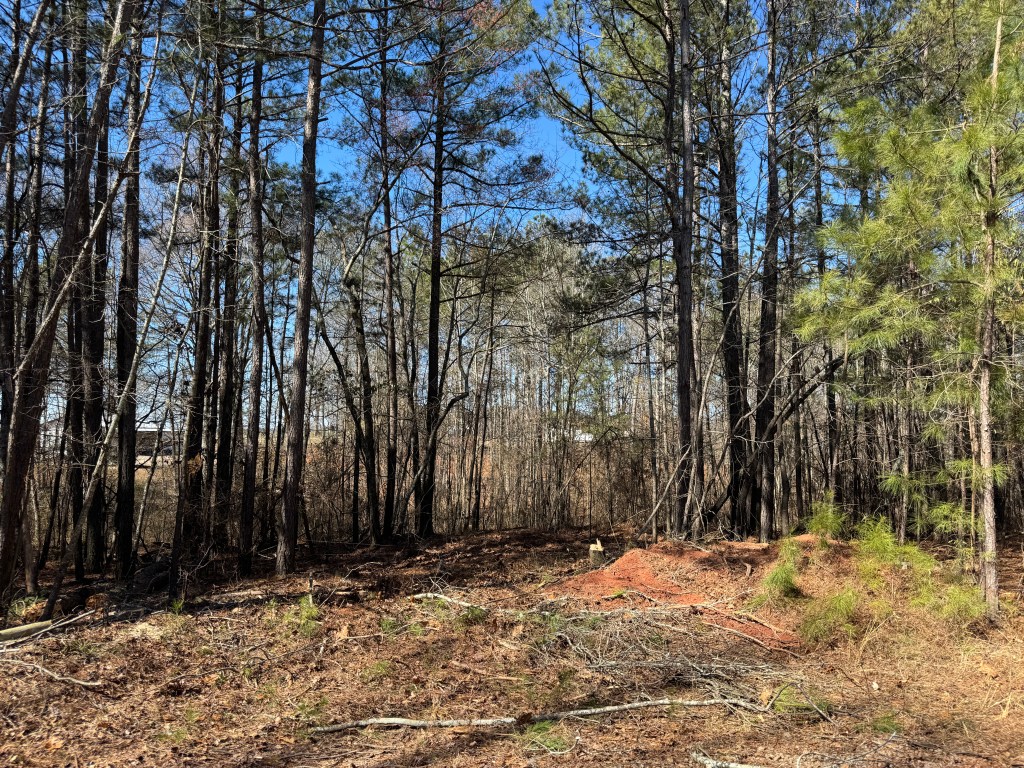
After the tree removal it looked like this.

During the last windstorm one nearby pine blew down creating a widowmaker.

These are fairly dangerous and I had to be very careful. The break was about 6′ off of the ground. Even though it looks straightforward, when the tree came down it broke into 3 pieces and actually fell back toward the stump. It was good I had an escape route planned.

The antenna will go over the top of the house, and attach to a red maple.

It will take me a couple of months to gather all the supplies I need for the antenna. Being on a fixed income doesn’t always fit into the “I want it now!” mindset.

As I write this I am recovering from a stomach bug, which can lay you out for 1 or 2 days. Another project I am working on is a mount for my Diamond RHM12 antenna. I hope everyone is doing well, that this year is better than the last, and I get the opportunity to work you. 73 de Scott

Hamcation 2025

This was my first Hamcation and it was a lot of fun. Lots of people, lots of food and lots of ham gear. I only spent one day there, but it was a fun-filled, packed. day.

One of the highlights of my day was the Begali Booth. Up until this point, I had 4 Begali paddles in my collection. Each one purchased directly from Begali and each one through Bruna. Buying a Begali key/paddle is like being adopted into a family. That’s how Begali treats their customers. I finally got to meet Bruna in person.

They had many of their paddles there — so many to choose from. I like to dabble with straight keys and my preference being a cootie key since they have the same back and forth motion as a paddle. Bruna had a Sculpture Swing and after sending a couple of characters, I was smitten, and I was lucky to get the last one, the display model. I also got to meet Bruna’s husband Roberto who packaged up my prize for me.

I hope to get a review done on the Sculpture Swing in the near future.

Diamond Antennas, one of my favorite brands for mobile/portable VHF/UHF antennas has a new portable HF antenna for the US market. I have seen this antenna on European website but this was the first time I have seen it in the U.S. It is a portable HF/UHF/VHF antenna that covers 7-440 MHz. With optional coils, it also covers the 3.5 and 1.8 bands.

The screwdriver portion of the antenna is 15″ long and the 1.8 MHz coil is 17″. For comparison the yellow packaging is 21″. This will be a great antenna for POTA/SOTA. I can’t wait to get this on the air.

Kenwood had a teaser for their new VHF/UHF mobile. Looks like it might be out by the end of the year. Here is a shot of a non-working model.

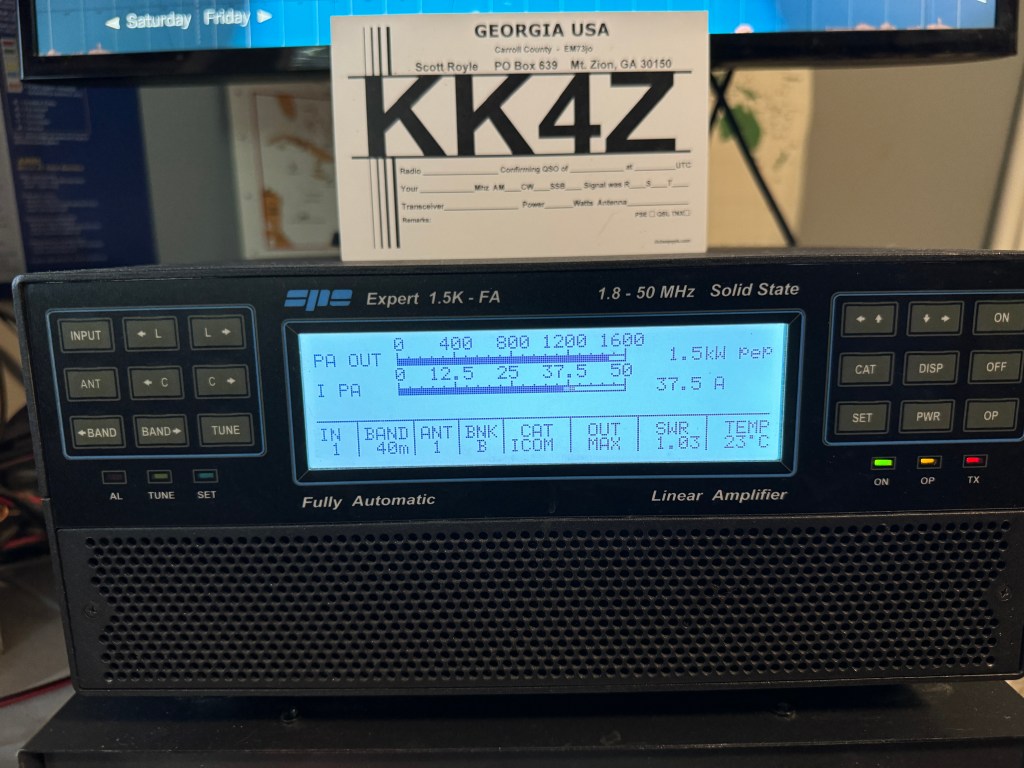
It looks pretty cool. I am mainly an HF guy and I stopped there to look at the TS-890. That is my current dream radio. I brought one of my amps down there to trade but the stars were not aligned. I have a nice lightly used SPE 1.5K FA up for sale or trade. I would like to get a TS-890 and may consider a FTDX101MP. I would also consider an Elecraft KPA/KAT500. It’s a great amp but it doesn’t do MARS so I had to get another amp that would (SPE 2.0K FA).

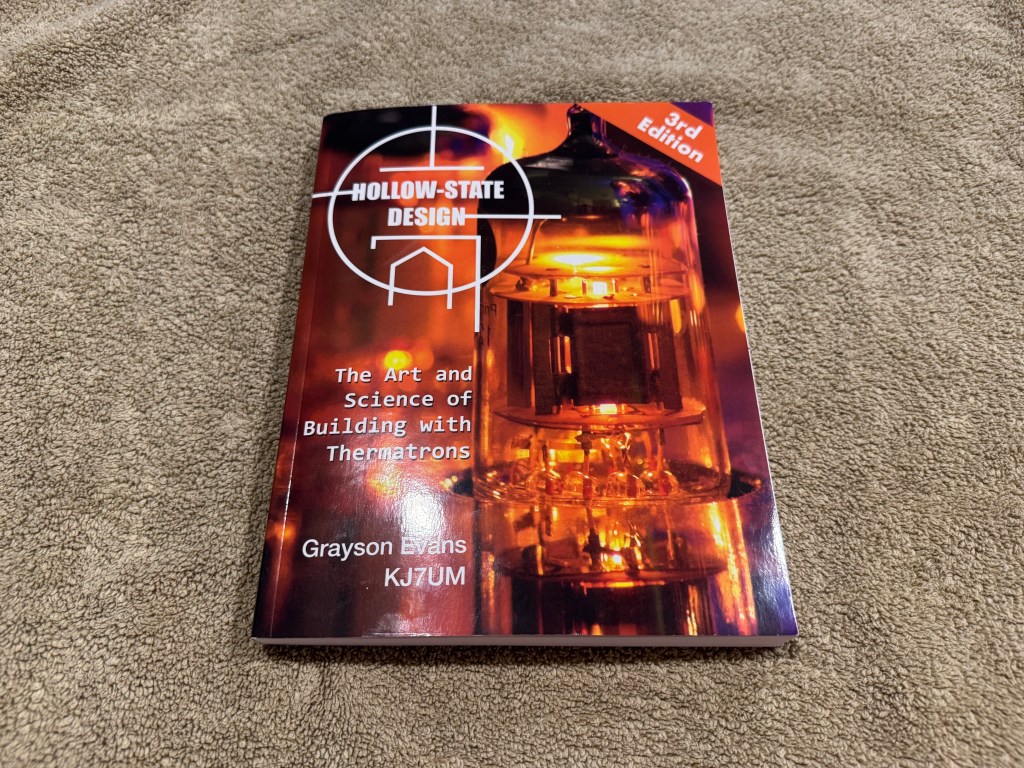
While cruisng the swap building, I came across this book:

I bought on a whim and Grayson autographed the book for me. I may never build anything out of tubes, but I thought the book would be a fun read.

I got to talk to a lot of people while I was there. I talked to one guy there that was looking to get a radio after being absent from amateur radio for many years. He was thinking about getting an IC-705. I asked him if he had any other radios and he said no. I suggested he look into getting an IC-7300 first. The 7300 is still my “if i could only have one HF radio” radio. Many times new or returning hams opt for the QRP route, not knowing how frustrating QRP can be for the less experienced. For a first or only radio I recommend a 100 watt radio. You can always turn a 100 watt radio down to 5 watts but a 5 watt radio is already at its max. A lot of times when camping, I am running CW at 20 watts.

It was fun seeing all the stuff, meeting people, and bringing home a few things. Hope to see you at the next one. 73- de Scott

Winter Field Day 2025

It was another fun Winter Field Day. Our club, we like to do 3 things: 1) we like to talk, 2) we like to eat, and 3) every once in a while we like to talk on the radio. This year was no different. We had a lot of fun, ate good food, and played on the radios. I think it’s the non-competitive spirit that helps us brave the cold weather. And it was cold this year with temps in the 20’s and 30’s. Not only does this tax our physical comfort, it also taxes our equipment.

Coax cables and extension cords were stiff and fingers went numb but we managed to get 4 stations on the air. I operated separate from the group to try to Get multipliers on JS8Call. I also copied the WFD bulletin and used Winlink to send and receive email. We had one member attempt to make a satellite contact and while he could hear other stations, it appeared no one was connecting. This year we ran QRP. Which was fun. Let me run through the gear and tell you how things worked.

The antenna this year was a 73’ inverted L with the vertical leg at 20 feet. This had a 60’ counterpoise connected to 1.5 KW Palomar Engineering 9:1 UnUn. I use the bigger UnUn because times when I run higher power (up to 40 watts) using digital, smaller UnUns get warm and saturated. This antenna works well down to 160 meters. I made contacts on different bands out to the west coast. A fail I had was I used a Chameleon RF choke next to the UnUn. It blocked all of the signal to the radio. Once I removed it, things were fine.

The radio was my new Yaesu FT-710. The radio worked well with no real issues. A quirk of the radio is the AF cuts the volume off louder than other radios. Sometimes when I am operating digital, I like to turn the audio volume real low so I can just barely hear it to keep tabs on what is going on. With the FT-710, it cuts off the volume while it is still louder than I like. Not a deal breaker. One of the benefits of operating a big radio QRP is the controls are easier to get to. While I prefer the ergonomics of Icom radios, the FT-710 is still pretty good. Another quirk with the FT-710 is the waterfall. It is not averaging like other radios, you have to adjust it manually. Overall, the radio performed well and compares favorably with the IC-7300. Either radio will equally get the job done. This radio feels more refined than my first one. It will be going on several more trips I have planned.

FT-710 accessories. I got the tuner issue worked out and my LDG tuner is playing well with the 710. I added Portable Zero rails which not only protects the sticky-outy things, but gives extra finger holds. I consider the rails a must have for portable big radios. Heil Proset Elite. I had to buy another headset for the FT-710 and the Elite was on sale at HRO. My Icoms use an electret mic which requires power. I already had an adapter from when I owned an FTDX10. I’ve been using Heil products for 25+ years and they are my goto. Mouse. I bought a Logitech M310 mouse to go the FT-710 thinking it might be easier to navigate through the menus. However, once I got the radio setup I was only changing a few things and found I didn’t use the mouse at all. I will probably not use a mouse with the 710 and I already found another use for it.

Maestro Evolve III laptop. I think I paid $122 for it. It works okay. It’s not zippy fast but all the software I used worked. It does appear to be RF sensitive though. During transmit, the mouse would freeze and sometimes the app window would close and open. What do you expect for a hundred bucks! One thing I did find annoying was the track pad. It was overly sensitive and would often treat a light touch as an “execute” function doing something I didn’t want it to do. My solution is to take the Logitech M310 mouse and use it with the Evolve III. A cool feature is I can run the Evolve off of my radio power supply or battery. Less “stuff” to deal with. The power plug for the Evolve also fits older Icom and Kenwood HT’s. The Evolve worked with my GPS receiver and I was able to easily sync the time for JS8Call. I will be taking this little laptop out again.

JS8Call. I think this will be the last time I use JS8Call. I was never fond of it and running a contest with it is almost a nightmare. For WFD, it doesn’t sync well with ACLog. People would send their Class and section info out without attaching a call sign to it so you would get something like 1O OH… and nothing else. That would be okay if only one person does it but when 2 or 3 others do it at the same time, you don’t know who is who. That and there wasn’t really enough JS8Call stations on the air to make it worthwhile. CW was the same for WFD. There were other contests going on. It appears the money maker for WFD is SSB. Which is interesting because the EmComm community relies heavily on digital modes.

As a group, we had a lot of fun. We always enjoy getting together. I had fun and I got to test my equipment. It is reassuring to have the knowledge that your equipment is ready. Even when I go on one of my FunComm trips, I load things up and go. I don’t have to check them because I already did. Final thoughts? Listening to the CW contests over the weekend reinvigorated my love for CW. I have been away from it while getting up to speed with MARS and SHARES, but there is still something to be said for the simplicity of me and the key. Hopefully, this will be a better year than last year, and I can get back into the swing of things. Stay safe, stay warm es 72 de Scott

Resonant Schmizonant

Does a resonant antenna perform better than a non-resonant antenna? The answer is no. As long as both antennas have similar impedances to the transmitter, they will perform equally well.

Let us start by defining impedance. Impedance is the resistive element of an AC circuit. It is described as a complex number with a real part and an imaginary part. A typical impedance may look like this: 50+j50 ohms. The real part is the first number 50 ohms which is the resistive component and what most people use when referring to impedance. The second number +j50 (could be -j50) is the imaginary part. The letter j stands for the square root of a negative 1. This number represents the reactive component of impedance and can be inductive (+j50) or capacitive (-j50). It is important when speaking about antenna impedance that the resistive and reactive components are referenced. One use of the imaginary part is to determine the phase relationship between voltage and current. When the imaginary part is +j0, both are in phase and maximum power is transmitted to the antenna system. Looking at our sample impedance (50+j50 ohms)we can deduce the phase using the following formula:

Because the imaginary part is positive (+) we know that the current lags the voltage.

It is important where the measurement is taken. Taking the measurement at the antenna will give a different impedance than one taken at the feed point. For this discussion, we will use the feed point where the coax from the antenna (antenna system) is hooked up to the radio or the antenna tuner. I want to take a moment here and discuss antenna tuners. Antenna tuners do not “tune” an antenna. All they do is match the antenna system’s impedance to the transceiver’s. Most if not all modern transceivers have a 50+j0 ohm impedance. A better term for an antenna tuner would be transmatch, which is an older name for a tuner.

A resonant antenna will have a purely resistive load which will allow the transceiver to transmit at full power. The reactive portion of impedance will be +j0. In most cases that would be 50+j0 ohms. But wait! 30+j0 ohms is also a resonant antenna and so is 80+j0 ohms. While the latter two antennas are resonant, they may not work very well with a transceiver that requires 50+j0 ohms. An antenna is only resonant on one frequency. Once you move off of that frequency, the antenna is no longer resonant. In fact, non-resonant or random length wire antennas often perform better on multiple bands because they are easier to match. I have made 1,000’s of contacts with non-resonant antennas.

Plotting the impedance on a Smith Chart gives us a VSWR of approximately 2.6:1. This shows about 20% of the total power reflected back. Because of a fairly low VSWR, most transceiver tuners can make an acceptable impedance match. The transmatch would apply a capacitance in the amount of -j50 ohms to the feed point which would cancel out the +j50 of the antenna system changing the impedance to 50+j0 ohms allowing full power to the antenna system.

This is a nontechnical view of antenna impedance based on a conversation I had over a year ago. I was musing about the subject and before I knew it, I had 3 technical books and about half a dozen websites open. There is a lot of cool math for antennas and if I can break it up into usable pieces I may try to post more here. In the meantime I’ll close with a quotation from the ARRL Antenna Book for Radio Communications 24th Edition, page 1.6.

An antenna need not be resonant in order to be an effective radiator, There is in fact nothing magic about having a resonant antenna, provided of course that you can devise some efficient means to feed the antenna…It is important to consider an antenna and its feed line as a system in which all losses should be kept to a minimum.

Well My Bags Are Packed, I’m ready to Go

The 2024 Hurricane Season started of slow but boy did it pick up steam. Right now, the country has been rocked by the devastation left by Hurricane Helene and now Florida is bracing for Major Hurricane Milton. There are lots of good people doing lots of good things out there. I want to give a shoutout to AmRRon and Grindstone Ministeries for all the work they are doing in the Tennessee/North Carolina areas. You can find out more about these organizations at https://amrron.com and https://grindstoneministries.com.

I have been blessed in that both of these powerful hurricanes missed me. Helene about 40 miles to my east and Milton several hundred miles to my south. Just because I got lucky doesn’t mean I should sit back and rest upon my laurels. Contrary to popular belief, ham radio operators in the affected area are typically not able to operate after a hurricane passes through. Their number one concern is the safety of their family and the protection of their property. Many have left the area and are holed up in a motel somewhere or are with friends/family. This is the time and the place for those not affected by the storm to lend a hand. With families and property safe and secure, amateur radio operators can travel to, set up and operate their portable stations, relaying valuable information to public safety and/or nervous families wanting to know that their kith and kin are safe.

For those able to deploy, preparations should start long before you leave hearth and home. Radios and coax need to be checked for proper operation, antennas checked for damage? Are all of your batteries charged, generators serviced, and solar panels operating properly? Is your vehicle ready: tires checked, engine serviced, lights work? Do you have enough fuel for your vehicle and your generators? Do you have a place to sleep and something to sleep on? Do you have water and do you have food? Always bring food and always bring water, regardless of what someone promises you.

And what about you? Are you in shape? When was the last time you were to the doctors? Do you have any conditions that may affect you and are they serious enough that not being near an emergency room might kill you?

I’m not young anymore and my days of traveling to a disaster areas are coming to a close. However, I am ready; I keep a running talley on my gear. How? I practice with my gear almost everytime I go to park or a campground. The same gear I use in a park is the same gear I use for a disaster. I know how it works and I know I have what I need. I call this FunComm, which to me, is practice for EmComm. My field radio stays packed and ready to go. My basic kit looks like this.

The top box contains my radio and associated gear.

The bottom box, contains my batteries, power stations and a couple of solar panels. I also have 2 larger solar panels that I would also bring. I do not always bring batteries with me for FunComm but I see that they are charged up several times a year. Two notes. 1) Check your gear. Out in a disaster, you probably won’t be able to get whatever it is you left behind. I recommend that when practicing FunComm, you go at least 20 miles away from home. That is about the distance too far to drive back home again — either make do or call it a bust. 2) Solar power generation is iffy. On a good day, a 100 watt solar panel puts out about 6 amps. Your radio at 100 watts output consumes about 18 amps. That means for every hour of transmitting, it requires 3 hours of solar power generation at max efficiency. Don’t forget, you will have to feed you laptop, lights, cell phone etc. Yes, a cell phone has other uses besides a phone. My battery box looks like this.

You EmComm types may chuff at Parks on the Air (POTA), but they know their gear, because they use it often. Take the time now. Check your gear, get it ready, get yourself ready, sometimes, when they need you, they need you now. My prayers are for those in the paths of Hurricanes Helene and Milton, and also for those souls who when the call came were ready. When the call comes, can you cry out “Here am I” 73 and God Bless de Scott