Night on Bald Mountain

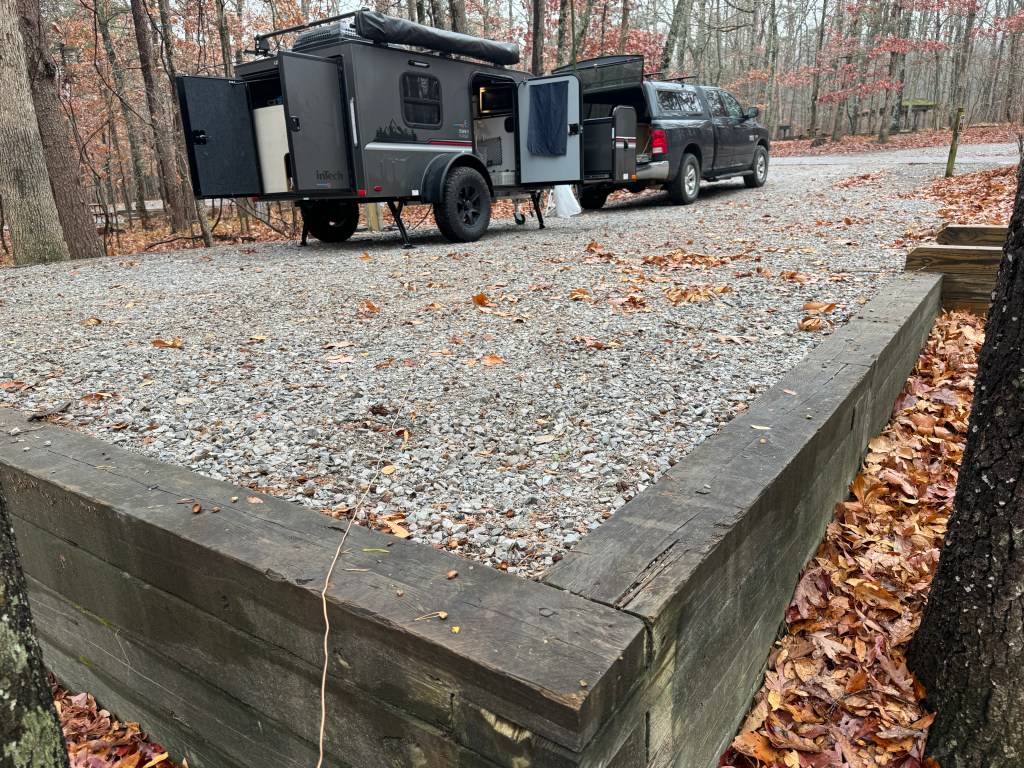
This trip was to Cloudland Canyon State Park located in NW Georgia. It is a very nice campground about a 2 hour drive from the home QTH. I got at the campground Tuesday, around 2000Z and quickly set up. Radio du jour was the Yaesu FT710 Field which is currently under review. The antenna was my 28.5’ random wire vertical. I am also trying out my Maestro Evolve III laptop along with HAMRS Pro software.

Band conditions were a little off so I started on FT8. It was slow going but I made 15 contacts before the new day. After supper, I went back to FT8 to try to get 15 more contacts before the storms hit.

The whole time I had moderate winds and some pretty good gusts. Right before the storms I lowered the antenna and put a garbage bag over it to keep it dry. The antenna is weather sealed, but the push up pole when it gets wet, is a real pain to dry out.

How about the FT710? In general, I like the radio. I think it’s a keeper. It is fun to use and performs well. It has a few niggles that I camp about but I like it. I talk more about the issues on my YouTube video. I will say that this radio is very different than the first one I got. The first radio was probably released too early and still had growing pains. This radio just feels better. In general I feel this radio and the IC-7300 are about equal. Either one will work well.

Evolve III. This is a pleasant surprise. I paid about $122 for it and for a field laptop it does well. Last night I ran WSJT (FT8) and AcLog without any issues. I was also running. BktTimeSync with a GPS receiver in the background. It is a little slow to start up but once it’s running, it does fine. I run it with a Logitech M310 mouse.

I am also trying out HAMRS Pro. I have it on Windows, Mac, IOS (iPhone, iPad) and they all sync up. I will talk more about HAMRS in a follow up article.

This is Wednesday morning and I am going to try to do some CW before I pack up and go home. Bands conditions are so-so at the moment. I will break my normal procedure are hunt a while to try out some of HAMRS features.

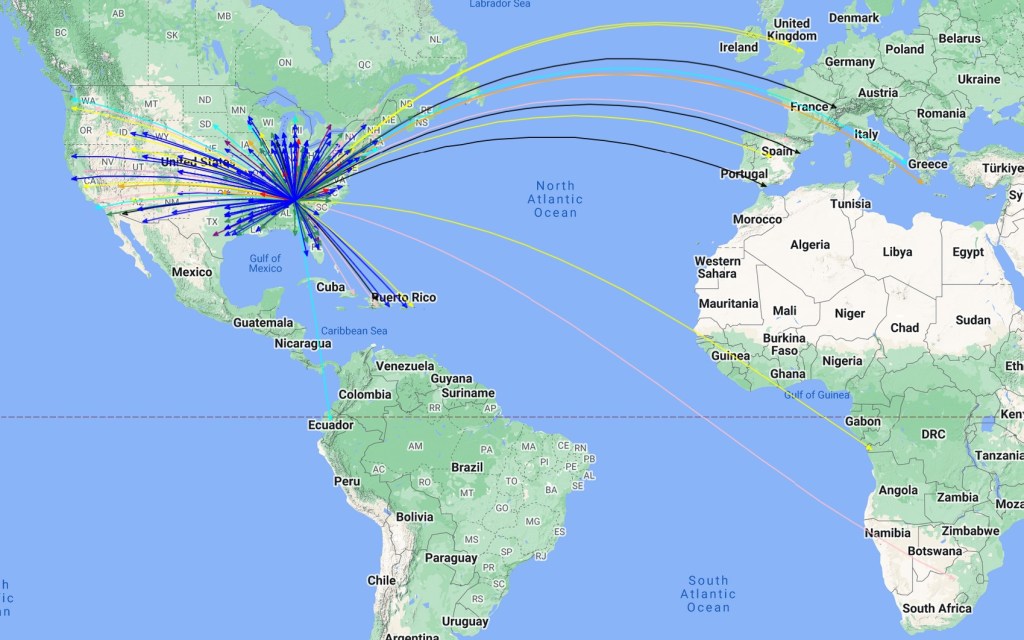
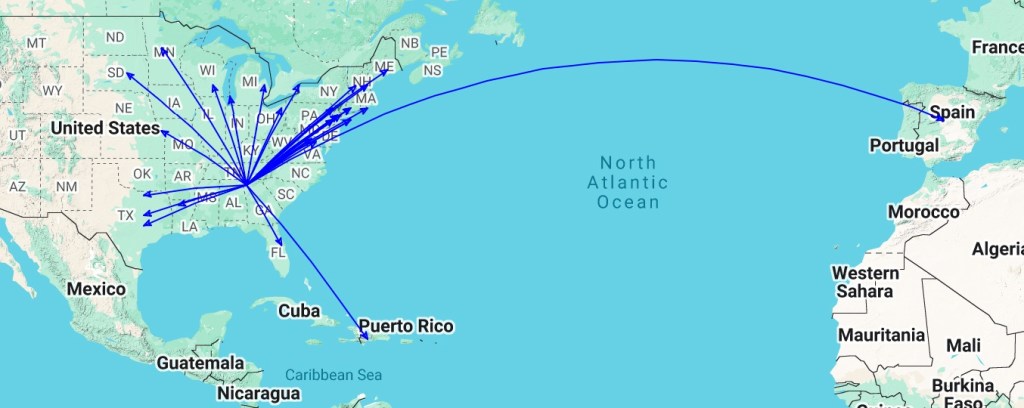
I only managed to make one CW contact hunting and activating. I could tell I was getting out as I showed up on HamAlert. Here is a QSO map of the activation.
Screenshot

If I remember correctly, I had issues last time I was at Cloudland. The important thing was I got out for a while and I had fun. It isn’t always about the numbers. Below is a video about the activation and my thoughts on the FT710. Stay tuned es 73 Scott

Hamcation 2025

This was my first Hamcation and it was a lot of fun. Lots of people, lots of food and lots of ham gear. I only spent one day there, but it was a fun-filled, packed. day.

One of the highlights of my day was the Begali Booth. Up until this point, I had 4 Begali paddles in my collection. Each one purchased directly from Begali and each one through Bruna. Buying a Begali key/paddle is like being adopted into a family. That’s how Begali treats their customers. I finally got to meet Bruna in person.

They had many of their paddles there — so many to choose from. I like to dabble with straight keys and my preference being a cootie key since they have the same back and forth motion as a paddle. Bruna had a Sculpture Swing and after sending a couple of characters, I was smitten, and I was lucky to get the last one, the display model. I also got to meet Bruna’s husband Roberto who packaged up my prize for me.

I hope to get a review done on the Sculpture Swing in the near future.

Diamond Antennas, one of my favorite brands for mobile/portable VHF/UHF antennas has a new portable HF antenna for the US market. I have seen this antenna on European website but this was the first time I have seen it in the U.S. It is a portable HF/UHF/VHF antenna that covers 7-440 MHz. With optional coils, it also covers the 3.5 and 1.8 bands.

The screwdriver portion of the antenna is 15″ long and the 1.8 MHz coil is 17″. For comparison the yellow packaging is 21″. This will be a great antenna for POTA/SOTA. I can’t wait to get this on the air.

Kenwood had a teaser for their new VHF/UHF mobile. Looks like it might be out by the end of the year. Here is a shot of a non-working model.

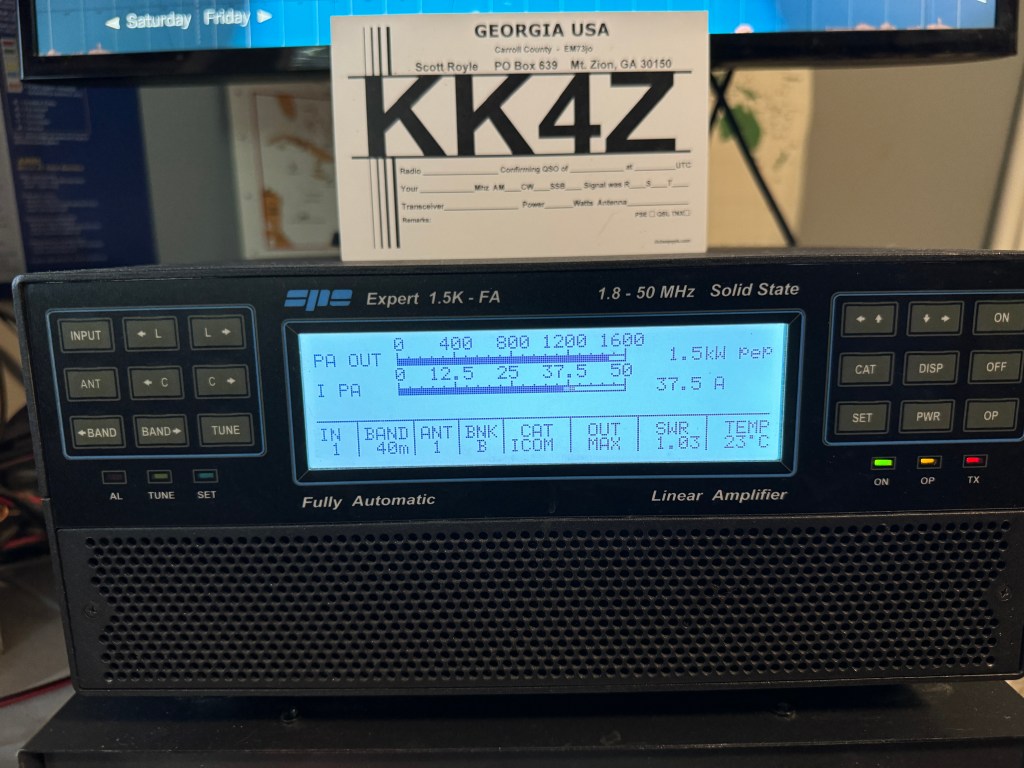
It looks pretty cool. I am mainly an HF guy and I stopped there to look at the TS-890. That is my current dream radio. I brought one of my amps down there to trade but the stars were not aligned. I have a nice lightly used SPE 1.5K FA up for sale or trade. I would like to get a TS-890 and may consider a FTDX101MP. I would also consider an Elecraft KPA/KAT500. It’s a great amp but it doesn’t do MARS so I had to get another amp that would (SPE 2.0K FA).

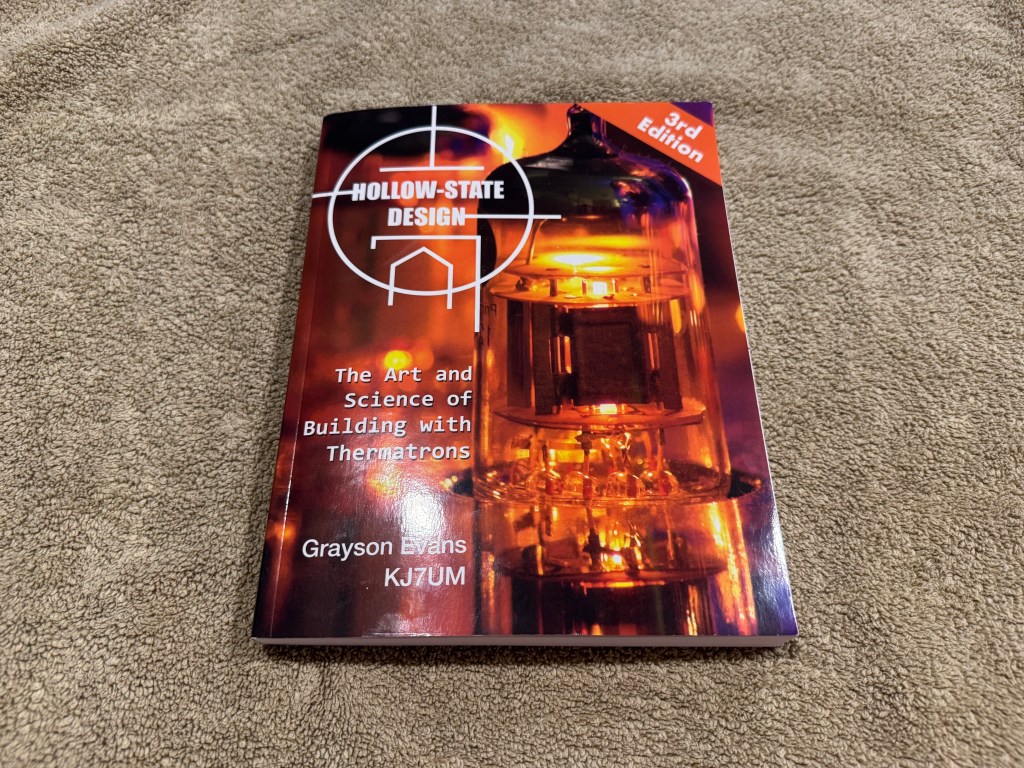
While cruisng the swap building, I came across this book:

I bought on a whim and Grayson autographed the book for me. I may never build anything out of tubes, but I thought the book would be a fun read.

I got to talk to a lot of people while I was there. I talked to one guy there that was looking to get a radio after being absent from amateur radio for many years. He was thinking about getting an IC-705. I asked him if he had any other radios and he said no. I suggested he look into getting an IC-7300 first. The 7300 is still my “if i could only have one HF radio” radio. Many times new or returning hams opt for the QRP route, not knowing how frustrating QRP can be for the less experienced. For a first or only radio I recommend a 100 watt radio. You can always turn a 100 watt radio down to 5 watts but a 5 watt radio is already at its max. A lot of times when camping, I am running CW at 20 watts.

It was fun seeing all the stuff, meeting people, and bringing home a few things. Hope to see you at the next one. 73- de Scott

Mobile Mount Upgrade IC-7100

There is always a better way to build a mousetrap

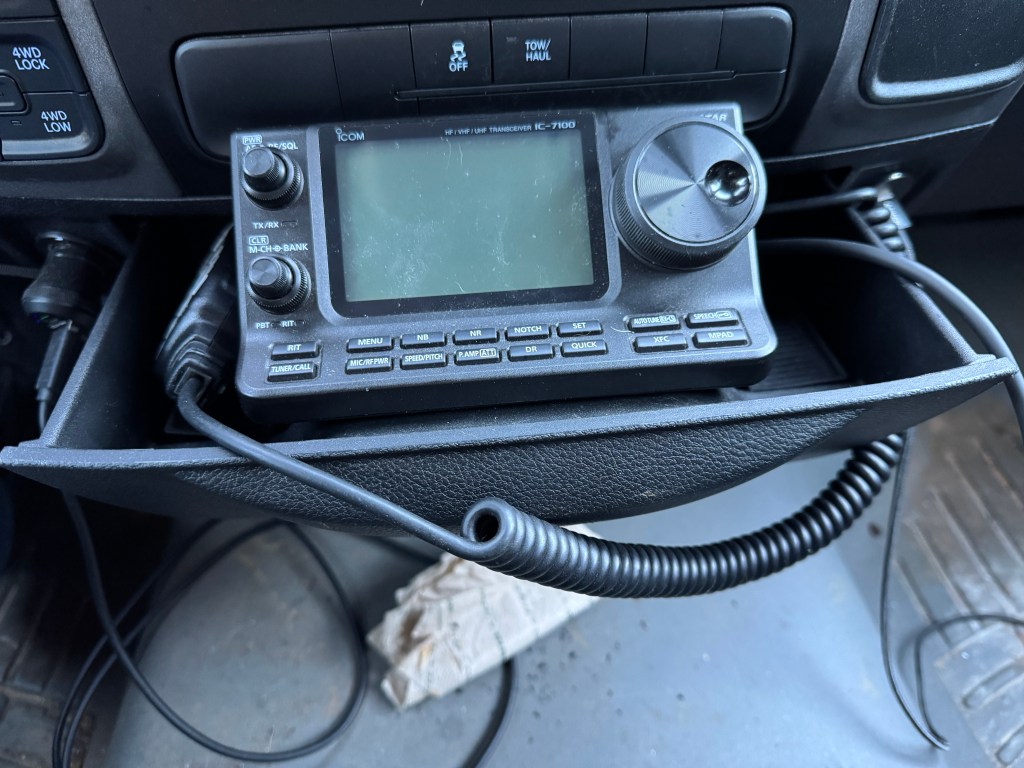
Last year I installed an IC-7100 in my truck. You can see the installation details here IC-7100 Install. The installation went pretty smoothly and I have used the radio on VHF and HF. The only fault I could find with the installation was how I mounted the control head. I used one of those Lido cup holder mounts. No matter how hard I tightened everything down, they still worked loose leaving the control head to wobble around.

Yesterday, I decided to fix this. It was simple. Using a 3 1/2” 1/4-20 bolt, some nylon bushings, washers lock washers and rubber grommets, I mounted the control head to the pull out drawer In my center dash.

I drilled one 5/16” hole in the bottom of the drawer. I put a lock washer and a washer on the bolt and pushed it through the bottom of the drawer. I then added 2-3 washers, a 1” nylon bushing (1/4” ID) a 1/4” rubber grommet, and another nylon bushing. The bushings, and washers acted like shims to keep the control head level and allow me to tighten the bolt without damaging the control head. The rubber grommet added a little extra “squeeze” so the lock washer would engage the bottom of the drawer.

It took me about an hour including driving to Tractor Supply for the hardware. It cost me about $6.

The control head is now firmly mounted to the truck and there is even a space for the microphone. The only thing I have left to do is reroute the control cable under the mat. This installation is more secure and looks nicer. I even get a cup holder back! 73-de Scott

Winter Field Day 2025

It was another fun Winter Field Day. Our club, we like to do 3 things: 1) we like to talk, 2) we like to eat, and 3) every once in a while we like to talk on the radio. This year was no different. We had a lot of fun, ate good food, and played on the radios. I think it’s the non-competitive spirit that helps us brave the cold weather. And it was cold this year with temps in the 20’s and 30’s. Not only does this tax our physical comfort, it also taxes our equipment.

Coax cables and extension cords were stiff and fingers went numb but we managed to get 4 stations on the air. I operated separate from the group to try to Get multipliers on JS8Call. I also copied the WFD bulletin and used Winlink to send and receive email. We had one member attempt to make a satellite contact and while he could hear other stations, it appeared no one was connecting. This year we ran QRP. Which was fun. Let me run through the gear and tell you how things worked.

The antenna this year was a 73’ inverted L with the vertical leg at 20 feet. This had a 60’ counterpoise connected to 1.5 KW Palomar Engineering 9:1 UnUn. I use the bigger UnUn because times when I run higher power (up to 40 watts) using digital, smaller UnUns get warm and saturated. This antenna works well down to 160 meters. I made contacts on different bands out to the west coast. A fail I had was I used a Chameleon RF choke next to the UnUn. It blocked all of the signal to the radio. Once I removed it, things were fine.

The radio was my new Yaesu FT-710. The radio worked well with no real issues. A quirk of the radio is the AF cuts the volume off louder than other radios. Sometimes when I am operating digital, I like to turn the audio volume real low so I can just barely hear it to keep tabs on what is going on. With the FT-710, it cuts off the volume while it is still louder than I like. Not a deal breaker. One of the benefits of operating a big radio QRP is the controls are easier to get to. While I prefer the ergonomics of Icom radios, the FT-710 is still pretty good. Another quirk with the FT-710 is the waterfall. It is not averaging like other radios, you have to adjust it manually. Overall, the radio performed well and compares favorably with the IC-7300. Either radio will equally get the job done. This radio feels more refined than my first one. It will be going on several more trips I have planned.

FT-710 accessories. I got the tuner issue worked out and my LDG tuner is playing well with the 710. I added Portable Zero rails which not only protects the sticky-outy things, but gives extra finger holds. I consider the rails a must have for portable big radios. Heil Proset Elite. I had to buy another headset for the FT-710 and the Elite was on sale at HRO. My Icoms use an electret mic which requires power. I already had an adapter from when I owned an FTDX10. I’ve been using Heil products for 25+ years and they are my goto. Mouse. I bought a Logitech M310 mouse to go the FT-710 thinking it might be easier to navigate through the menus. However, once I got the radio setup I was only changing a few things and found I didn’t use the mouse at all. I will probably not use a mouse with the 710 and I already found another use for it.

Maestro Evolve III laptop. I think I paid $122 for it. It works okay. It’s not zippy fast but all the software I used worked. It does appear to be RF sensitive though. During transmit, the mouse would freeze and sometimes the app window would close and open. What do you expect for a hundred bucks! One thing I did find annoying was the track pad. It was overly sensitive and would often treat a light touch as an “execute” function doing something I didn’t want it to do. My solution is to take the Logitech M310 mouse and use it with the Evolve III. A cool feature is I can run the Evolve off of my radio power supply or battery. Less “stuff” to deal with. The power plug for the Evolve also fits older Icom and Kenwood HT’s. The Evolve worked with my GPS receiver and I was able to easily sync the time for JS8Call. I will be taking this little laptop out again.

JS8Call. I think this will be the last time I use JS8Call. I was never fond of it and running a contest with it is almost a nightmare. For WFD, it doesn’t sync well with ACLog. People would send their Class and section info out without attaching a call sign to it so you would get something like 1O OH… and nothing else. That would be okay if only one person does it but when 2 or 3 others do it at the same time, you don’t know who is who. That and there wasn’t really enough JS8Call stations on the air to make it worthwhile. CW was the same for WFD. There were other contests going on. It appears the money maker for WFD is SSB. Which is interesting because the EmComm community relies heavily on digital modes.

As a group, we had a lot of fun. We always enjoy getting together. I had fun and I got to test my equipment. It is reassuring to have the knowledge that your equipment is ready. Even when I go on one of my FunComm trips, I load things up and go. I don’t have to check them because I already did. Final thoughts? Listening to the CW contests over the weekend reinvigorated my love for CW. I have been away from it while getting up to speed with MARS and SHARES, but there is still something to be said for the simplicity of me and the key. Hopefully, this will be a better year than last year, and I can get back into the swing of things. Stay safe, stay warm es 72 de Scott

Deja Vu all over again

The 2025 promises to be a better year. I am looking forward to being more radio-active. I am also looking forward to more blogging and more vlogging. I am hoping to undertake some long term reviews. I have two in mind. One is going to be a Maestro Evolve III laptop computer. I know a lot of hams use them so I thought I would give one a whirl. My other project is going to be another Yaesu FT710, this time the field version. I last owned one about a year and a half ago, I traded it off after a few months of use. The radio was going through some growing pains and was probably not ready for prime time. My general thoughts back then was the radio was a likable and fun radio and compared favorably to my IC-7300. I thought I would give it another look and a fair shake since it’s been through a few firmware updates since its release in 2022.

I am hoping this FT-710 is more polished than my first one. I can see at least two firmware updates since my last 710 and the manual has been updated. Hopefully Yaesu cured those early issues. I picked up the radio yesterday. I plan on using it as a field radio for POTA activations as well as for Winter Field Day and Field day with my club. In general the IC-7300 and the FT-710 are comparable, each with their pluses and minuses. Whichever brand you are married to, either radio will probably serve you equally well. One reason I got this radio is there are many members in my club that use Yaesu radios. Having familiarity with the Yaesu system allows me to help them with their radio problems.

My initial thoughts are similar to the ones I had a year and a half ago. It is a likable radio and it has a certain fun factor. I am going through my past blog posts and YouTube videos to make list of things I found with my first FT710 and see if they have been corrected. I will also post the settings I changed on the new radio to suit me.

I like big radios when I go camping or even on POTA day trips. I like having the controls I use handy and if band conditions get ugly, I can turn up the power. I normally run 20-25 watts for CW and digital. The rare times I am on SSB, I may go as high as 50 watts. Another plus with a big radio is I can run digital modes all day long and it will not overheat the radio. I do have a couple of QRP radios and I do take them out for a spin every now and again; but I can just as easily turn my big radio down to 5 watts. I am looking forward to using it in the upcoming Winter Field Day. 73 de Scott

What I ride!

“What a long, strange trip its been” a line from the Grateful Dead’s song Truckin’. This was one of those years for me. The beginning of 2024 started off normally — until Mary, my wife needed to have a hip replaced. Her recuperation went well, slow but well. That put a back log on things that needed to be done on the home and property.

November was my one year anniversary of retirement. I discovered that there were way more rabbit holes to go down and far too many “squirrels” that filled up my days. I was busy doing a lot of things, but this past month or so I started asking myself am I doing the right things?

I enjoy writing. In my professional life writing was a good part of it. Some of my work is published in a federal handbook. Writing is my creative outlet; I can’t draw (or cursive handwrite), and I am only a mediocre guitar player. I do sing solo — so low no one can hear me. In my retirement, I have done very little writing. I feel the pain. Work provided me with topics and content to write about, but in retirement, I was a ship without a rudder. Becalmed in a sea non-creative web-surfing, youtube sargasso, I was doomed to sink in the Bermuda Triangle of failure.

I can fix this; I can repair the rudder, start the motor, and navigate back to fair seas. I had to give myself a topic. I decided to write a book. I know in the movies, actors sit down behind a typewriter and bang out novel right before your eyes. For us mere mortals, it is not that easy. There is planning involved. Writing a book of 80,000 words is very different than writing a blog of 500.

This required some changes. I moved into a Mac machine. I have no qualms with Windows 11. The computer I use for radio is a windows machine. At issue are the apps in Windows. I find them clunky and disruptive when I am in a creative mood. The Mac environment and its asssociated apps are more elegant, they get out of your way and let you concentrate on content. Apple products are designed to work together. I can create on my Mac, iPhone and iPad, and easily switch between them. An analogy I use is a computer should be like a hammer. You pick it up, you use it — bang! If you have a hammer where you have to fiddle with the head each time you use it, you soon have a new hammer.

I am still setting things up to get ready to write. I have some reading to do, some new apps to get used to, but I am almost there. One issue I have is making sure I have enough time, and enough time at the right time of day to write. I need to introduce a little discipline back into my life. The current book I am reading is Getting Things Done by David Allen. It has been a big help in getting me back on track.

Where’s KK4Z? A question I often ask myself on this blog. I’m here and I am busy with radio, just a different busy. Living in Georgia, I was close to Hurricanes Helene and Milton. They affected friends. I have been involved in EmComm for 26 out of the almost 30 years of my involvment in amateur radio. In the past I have deployed to actual disasters, but as my wife and I age, going to a disaster is becoming less of a reality. I also took a look at POTA and what I was doing there. I have over 10,000 contacts in POTA and most of those are the same thing. I quick exchange and on to the next one. I need to do something else. I need to better serve my communities. I will still do POTA and some SOTA, it is fun, but I need to get back into public service. I have recently joined US Army MARS and SHARES (SHAed RESources HF radio program). Both are federal government sponsored programs. With both programs I keep my operations within FEMA Region 4 (Southeast United States). I also participate with my local ARES group. I maintain my position as an Official Emergency Station with the ARRL.

Retirement is a new world, a new beginning. You can either grab the bull by the horns, or lay down and die. I still want some adventure in my life, though it won’t be as hair raising as it was in my youth. If you still want a little gusto in your life you need to “Improvise, Adapt, and Overcome” (US Marines). 73 – de Scott

Cootie Cable

Part of my amateur radio adventures for 2024 is to become a better CW operator. What I mean by that is I want to do more than than POTA/SOTA/Contest exchanges. When I first started out 28 years ago, that’s what I did, called CQ and had a conversation. In addition to becoming more conversational, I wanted to try my hand at straight or mechanical keys. I recently ordered a sideswiper and a bug but they won’t be here fro another 2-3 weeks. I also thought about the money I had invested in paddles.

This thought process took me down to thinking about how to convert iambic paddles into side swipers. All it takes is shorting the dit and dah paddles together and setting your radio to a straight key. I wanted to make this easy. I wanted to be able to use all of my paddles on all of my radios as an iambic paddle or a sideswiper. Since this is my first journey into straight or mechanical keys, I wanted to be able to easily convert back and forth.

I made a short cable that goes between the paddles and the radio. It’s a simple operation. Starting out with plug nomenclature.

The tip is the dits and the ring is the dahs. The sleeve is the common. I had male and femlae 1/8″ stereo cables in my parts bin so I took my multimeter and coded the wires to the plugs. Basically you tie the common to the common and all the dit and dah wires together.

Twist them together, solder the joints, a little heat shrink and viola! Cootie cable. It weighs 0.5 ounces and will work with all of my radios. Now I can swith from Iambic to sideswiper in under a half a minute and use all of my paddles. See the included video that shows how it works. 73 – Scott

K4SWL+ Antenna

On a recent post on QRPER.com, Teri KO4WFP was at a park in Florida that did not allow wires (or anything else) in their trees. Many POTA activators use End Fed Half Wave antennas which usually require one end in a tree. While it doesn’t happen at all parks, not being able to hoist your antenna could bust an activation.

I realized this may happen to me even though Georgia appears to be pretty lenient when it comes to such matters, I decided to switch to a park friendly antenna. I have been a fan of QRPER.com for quite some time and occasionally Thomas will repost something from my humble blog. That being said, it was K4SWL that got me started using a random wire antenna. My basis for my antenna was his speaker wire antenna which was a 28.5’ vertical antenna with a 17’ counterpoise. I used it a few times in that configuration and then started to modify it. I call this antenna my K4SWL+.

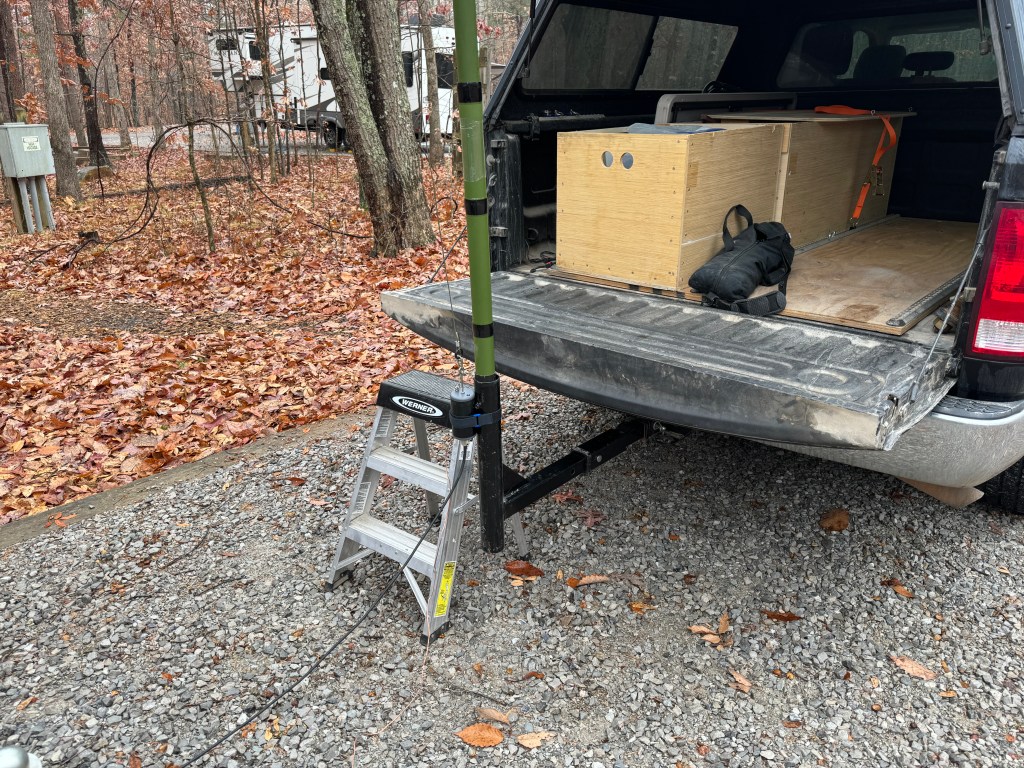
Some of the differences are I use a push-up pole to get the antenna in the air and at the base I use a 9:1 UnUn and a 1:1 Choke to keep RF out of the radio. A random wire antenna can feed RF back into the coax.

The wire is 14 ga. coated flex weave from The Wireman. This was left over wire from some other antenna projects. When I started this project I was using 22-24 ga. coated wire from SOTABeams but realizing there was no need to save weight, used the heavier wire. This allows me to dual purpose the antenna both for FunComm and EmComm. The insulator at the top is 3D printed with my call-sign and the base is U-type lugs. I find these are the best as I do not have to take the nut off of the antenna studs and if pulled hard will come loose instead of damaging the UnUn. I connect the antenna to the top of the push-up pole with a small Nite-eze “S-biner” size 1.

The 9:1 UnUn comes from Palomar Engineering. I have already created a blog post about how to build it and it can be found here: http://[https://kk4z.com/2022/05/28/91-unun-qro/]

Part of this blog post was to bring the different components together into one blog post.

The 1:1 Choke can be found here: [https://kk4z.com/2022/08/15/lightweight-choke-balun/]

I made two different types but I found the second works much better.

The project is pretty easy, the only caveat is to pay attention to what wire goes where. Putting it all together, you need a push-up pole, a Flag holder and maybe a trailer hitch extender. I will provide links below. The Flag Pole holder I used was not available so the link I used is a probable substitute. I have a trailer hitch on both my truck and my camper, When I pull into a campsite I have a choice of which hitch to use to keep my antenna clear from the trees. With the antenna up, I wrap the antenna wire around the push-up pole from tip to base, to prevent the wire from sagging near the tip. I attach the UnUn and choke to the mast with Stretch Velcro Straps. With my antenna up I have park employees drive by me all day along. Most of the time we exchange a friendly wave and occasionally one will stop by for a chat. I have had zero issues with this antenna at any of the parks I have visited.

How does it play? It has pretty much been a main antenna for just about all of my POTA activations. You can go back through my blog post and see what equipment I used with the antenna and the accompanying QSOMap. You do need an antenna tuner with this antenna and I typically use an LDG Z-11 Pro which I’ve had for 15+ years. The antenna tunes up from 80 to 6 meters and I have run the power as high as 65 watts. I normally run 10-35 watts depending on band conditions. I have tried it on 160 meters and while I can get a match, I don’t think much RF is leaving the antenna. I’ve made a few contact with it on 160. If you like to work 160 meters during a POTA activation, I suggest a Chameleon EmComm II with a 60’ antenna and a 50’ counterpoise. I run it as an inverted L with the apex about 20’ up my push-up pole and the end sloping down to something not a tree. Last time I tied it to the lantern stand at the campsite. It worked pretty well and I was able to make contacts on 160.

If you’re looking for an antenna that you can set up almost anywhere, with little or no hassles, take a look at this one. Don’t forget to check out the short video below. 73 — Scott

14 ga. Flexweave
Nite-Ize-Size-1-S-Biner
Jackite 31′ Pushup Pole
Flagpole Holder
Hitch Extender
Stretch Velcro Straps


POTA Activation K-2169, Me, VaraC, 160 meters and more

This weekend I had the opportunity to activate Cloudland Canyon State Park in NW Georgia. It was a digi weekend with me running FT8 and experimenting with VaraC. I also tried a new antenna combination to see how it would work on 160 meters.

The weather. I book my campsites 4-6 months in advance so I take what I get when I go. This weekend called for rain Friday and was supposed to clear up Saturday PM. It didn’t. It drizzled/rained from the time I got there until 0200 hrs Sunday morning. Since I mingle FunComm with EmComm, this was another test of my gear. The only issue I had was I needed to better seal the window where my coax goes into the camper. You shouldn’t let the weather stop you from going as long as it’s safe. I go year round and because of that, I have a good understanding of my gear and my clothing under varying conditions.

The gear. The antenna was a Chameleon EmComm II ver. 1. This version had a clunky antenna wire and insulator that is more from permanent/semi-permanent installation so I didn’t use it much. This year, Chameleon had a Black Friday Sale of 25% off. I decided to upgrade the wire to a 60′ Kevlar with a winder. I also ordered their new 40-meter OCF dipole which will be used on SOTA activations. I had some 14 gauge Flexweave wire that I cut to 50′ for a counterpoise. My intention was to use this antenna down to 160 meters. I ran the antenna as an inverted “L” ish. The vertical portion went about 25′ up my mast and the horizontal portion was more of a slope and facing north. The nice part was that the entire antenna fit within my campsite. I used the lantern hook on the site to secure the antenna. For rope, I used #36 tarred bank line. The rope is a little sticky so it holds knots well and does not absorb water like para-cord does. I used a clove hitch to secure the antenna ring to the mast and it held fast. The Bank line has replaced all of my para-cord.

The radio was First Peter, my IC-7300 that I bought new in 2016. I use an LDG Z-11 Pro that I have had for 15+ years to keep everything matched up. I was running 25-35 watts. My other IC-7300 is Second Peter. My backup radio was my new KX2. I keep it in a backpack so it is easy to toss in the truck.

Propagation. It was different, not bad, but different. There was a lot of solar activity and I believe it pushed the MUF up above 20 MHz. I had a lot of success on the higher bands which is typically not the case in the winter. My antenna easily tuned 160 meters and I made about half a dozen contacts using FT8. How did I do? I started at about 2030 hrs UTC Friday and finished up at about 2200 hrs UTC Saturday afternoon. I made a total of 325 contacts covering 42 states and 12 countries. Some of the interesting (to me) DX was Angola and South Africa. Both of those stations called me. Angola was on 10 meters and South Africa was on 12. No DX on 40 meters. I had a Facebook request to work 40 meters for local contacts. I did my best but 40 was rather flat this time around. It had the second-highest count of contacts. Breakdown by band was: 10 meters – 18, 12 meters – 18, 15 meters – 13, 17 meters – 7, 20 meters – 136, 30 meters – 19, 40 meters – 90, 60 meters – 12, 80 meters – 6, and 160 meters – 6. One of the surprises other than the lack of low band activity was that 17 meters was fairly dead. Typically on an activation, my money bands are 17, 20, 30, and 40. This time only 20 and 40 panned out. I manage 10 bands at this park in case I want to go for another N1CC award.

VaraC. For the past week, I have been evaluating VaraC mainly for EmComm. There is a lot to like about it. For one thing, it uses the same modem as Winlink. If you have it set up for Winlink, you are good to go for VaraC. VaraC can upload files and low-res pictures. PSKReporter showed favorable propagation on 20 and 40 meters. I made a few contacts with it and did some beaconing. I haven’t tried it yet, but it looks like I can create a document in FLMsg, save it, send it via VaraC, and reverse the process at the other end. pretty nifty. I think pairing Winlink with VaraC just might be the ticket.

Recap. Neither snow, nor rain, nor heat, nor gloom of night stays this operator from completing his park activation… I had a lot of fun. I try not to let the elements stop me from doing what I like to do. 73 – Scott