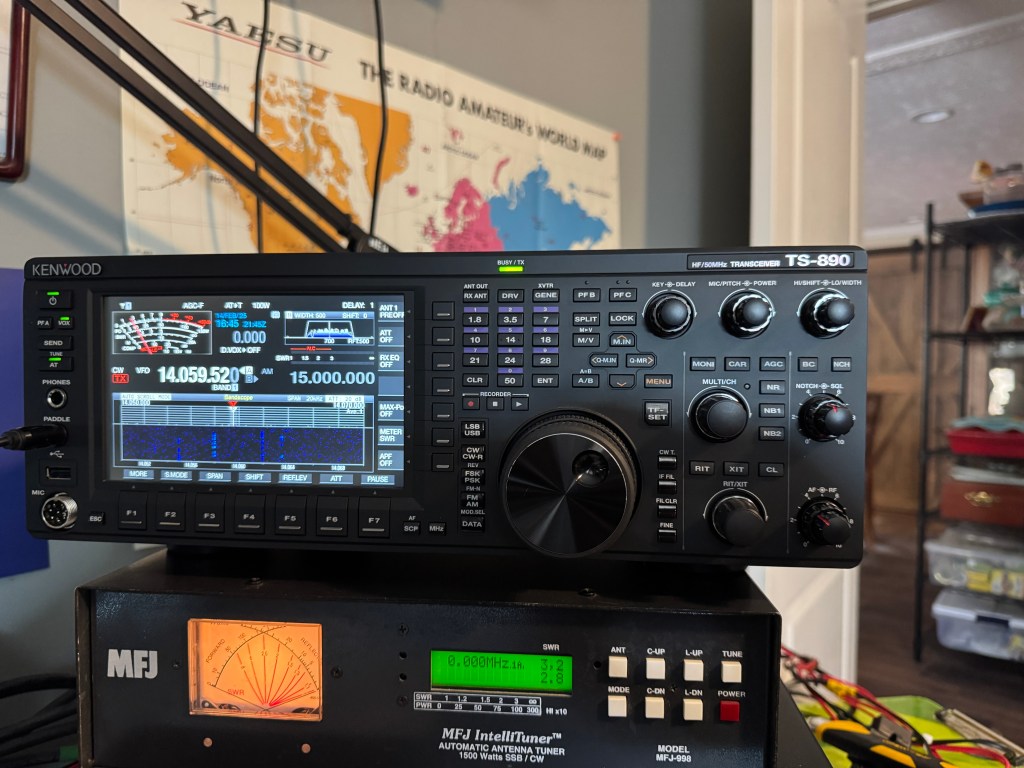
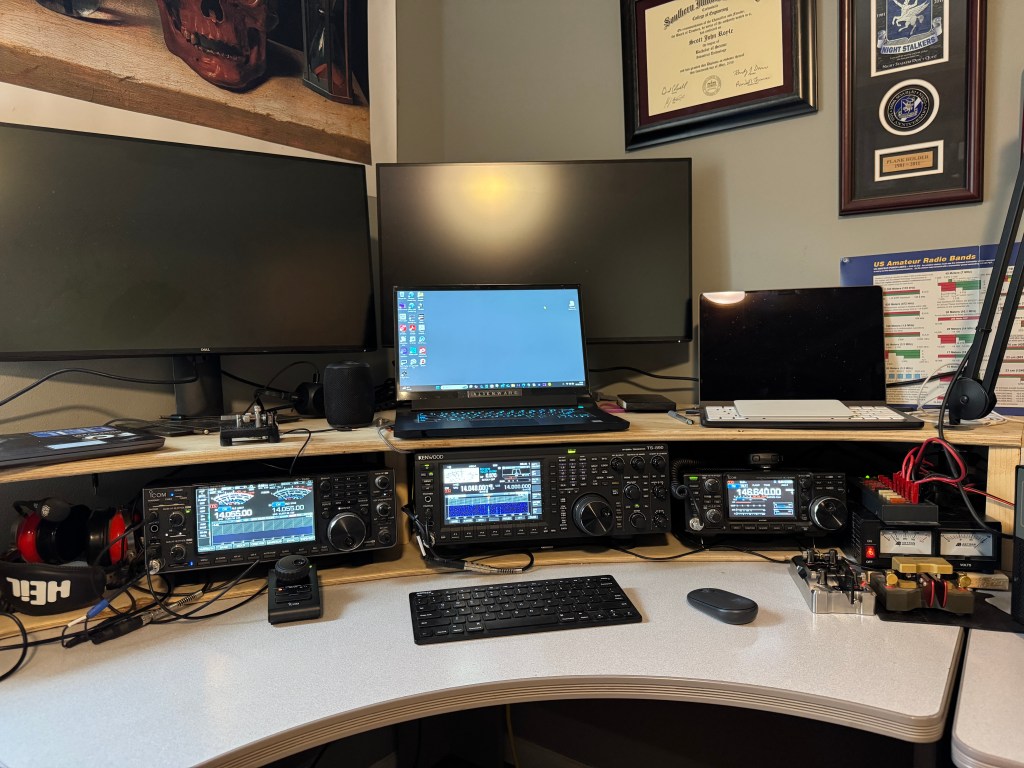
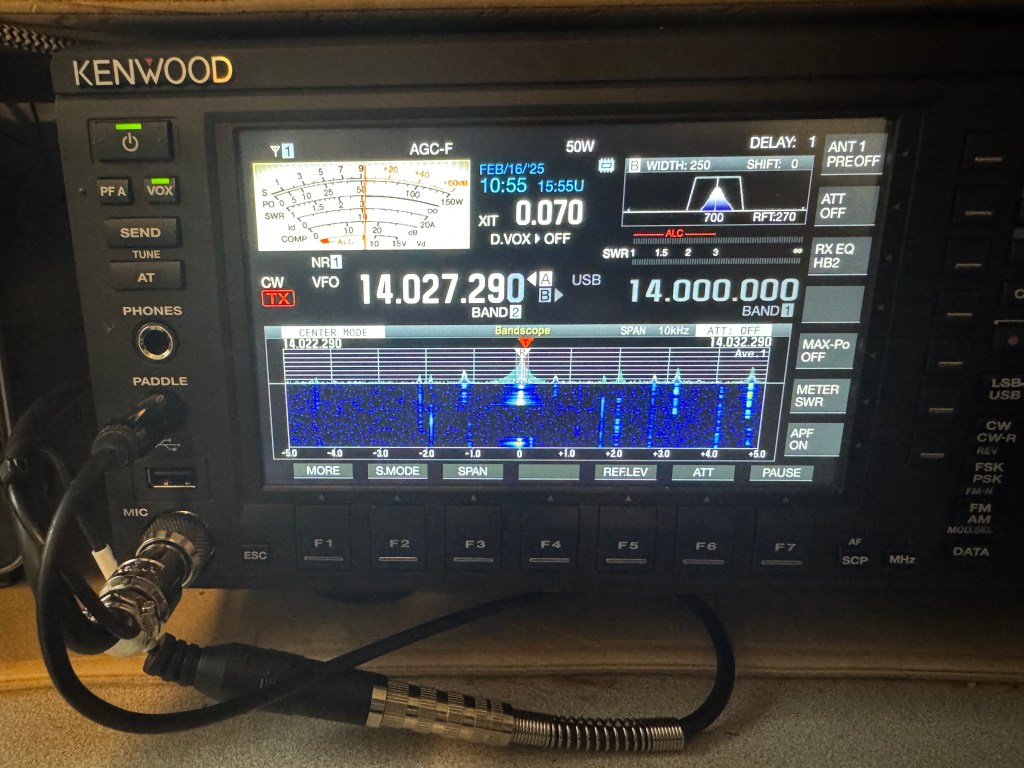
Its been a busy 2025 so far. I have been involved with MARS and that by itself has kept me occupied. I decided to change the the shack around a little to better meet my needs. I pulled the IC-7300 out of the line up and replaced it with a Kenwood TS-890s. The IC-7610 was shifted to the left which is now pretty much dedicated to MARS stuff. The TS-890s will be for everything else. I have both of my paddles hooked up to the 890 along with my Heil PR-781 microphone. I haven’t had a chance to use the 890 much but it is one heck of a radio. It is a very enjoyable radio. I am hoping to get back into CW this year. Last year was not a good year in general for radio and so far this is looking better. I want to get my code speed up. Rounding out the shack lineup is an IC-9700 for FM/DSTAR stuff.
So what about the IC-7300? That has gone back to being a field radio. That is where I enjoy it most. I also have a Yaesu FT-710 Field that is my other field radio. Over the years, I have found that I prefer big radios with better controls when I am in the field. Both radios can go down to QRP levels and if needed I can crank the power up to match band conditions. I find myself operating in the 20-35 watt range mostly and these radios can do that all day long even with digital modes like FT8.
I still have an Icom IC-705 and an Elecraft KX2 for the occasional day trip. If I am at a park, I am in my truck and I can carry a big radio 40 feet to a picnic table. I do like my little radios, but they do not see as much use as the big ones.
I have a new project I am working on. I am building a T3FD antenna to use with ALE.
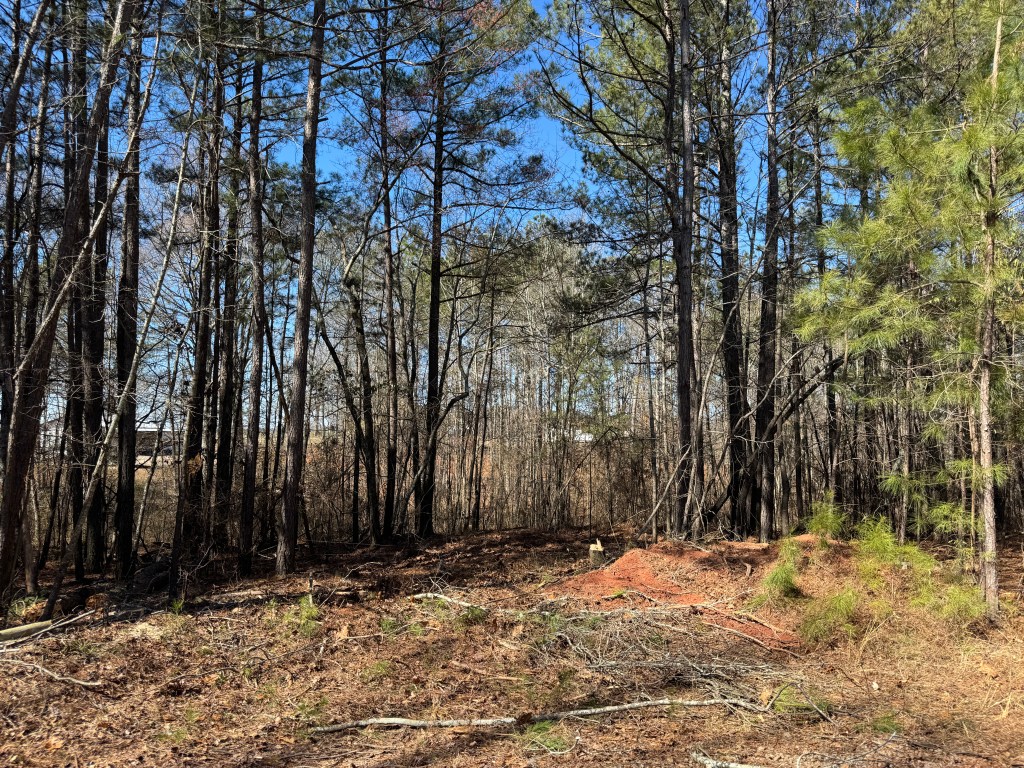
Mine will be 177′ long and it will be 90 degrees from my OCF dipole. That will give me an antenna oriented north-south (OCF) and one east-west(T3FD). In order to have the space for the antenna I had take down a few trees.
After the tree removal it looked like this.
During the last windstorm one nearby pine blew down creating a widowmaker.
These are fairly dangerous and I had to be very careful. The break was about 6′ off of the ground. Even though it looks straightforward, when the tree came down it broke into 3 pieces and actually fell back toward the stump. It was good I had an escape route planned.
The antenna will go over the top of the house, and attach to a red maple.
It will take me a couple of months to gather all the supplies I need for the antenna. Being on a fixed income doesn’t always fit into the “I want it now!” mindset.
As I write this I am recovering from a stomach bug, which can lay you out for 1 or 2 days. Another project I am working on is a mount for my Diamond RHM12 antenna. I hope everyone is doing well, that this year is better than the last, and I get the opportunity to work you. 73 de Scott
Life is full of changes. Some are expected and some are not. Over the past couple of weeks I have had some changes for the good. One is that 2025 is shaping up to be a better year than 2024. My wife and I had some trials and tribulations which hampered my radio-activity. We had deaths, surgeries, and a few other health issues that slowed us down. This year, things have appeared to clear up and I am already enjoying more amateur radio activity.
To start off, I have had another shack shake-up. In a prior post I had my SPE Expert 1.5K FA up for sale or trade. It is a great amp but I needed an amp that would do MARS and SHARES frequencies so I ended up with an SPE 2.0 K FA. When I get back from Hamcation, I had a trade offer. My amp for a TS-890s. I have never owned a Kenwood HF radio so I thought I would give it a go. The trade went smoothly.
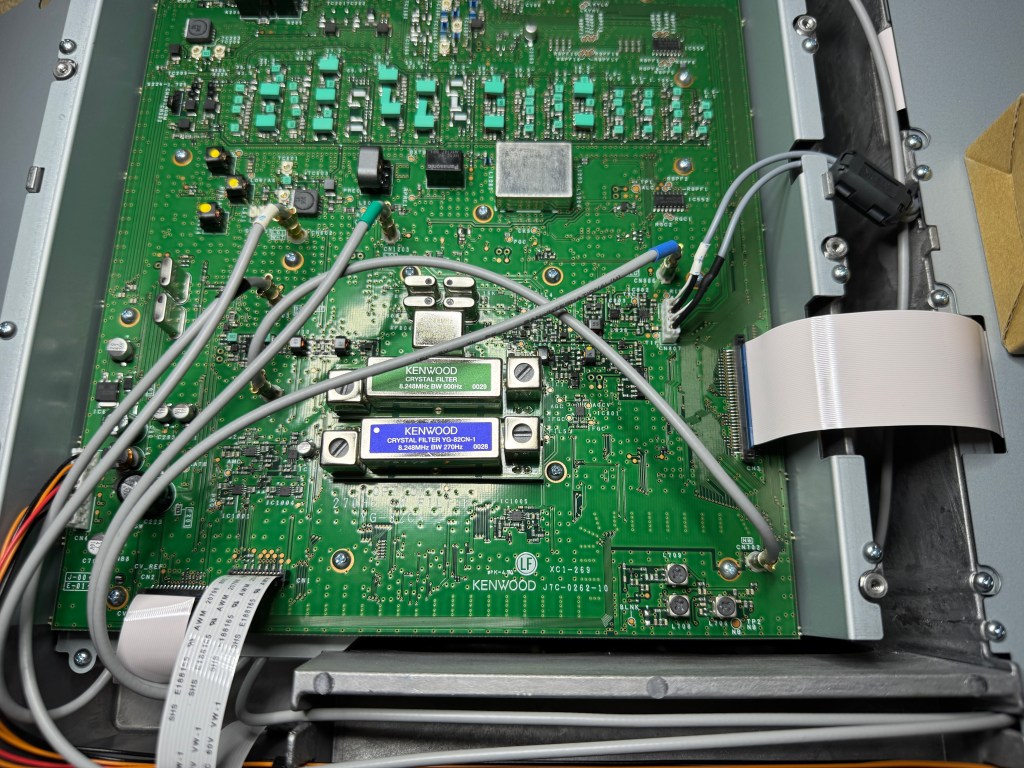
Before installing it in the shack I added the 270 Hz Roofing Filter and while I was inside, I did the MARS modification. I do not intend to use this radio for MARS, but in pinch, I am ready. My intention is to use the radio for fun and CW. I located it front and center on my desk. The IC-7610 was moved to the left which is where I set up for MARS operation. The 7610 plays very well for MARS.
As you can see in the above photo, I am using a Windows machine for radio control and logging. I really enjoy my Mac for everything else but when it comes to things radio, Windows machines are easier.
This weekend was the ARRL DX contest and the CW bands were crowded. this gave me a good opportunity to test the TS-890s. It performed very well.
The scale on the waterfall is 5 KHz on either side of the frequency. I had the 270 Hz Roofing Filter and a filter bandwidth of 250 Hz. The TS-890 easily blocked an adjacent S9+10 signal less than 500 Hz away. Even at less than 200 Hz away I could easily copy the target signal though there was some ringing. That is pretty impressive.
I am hoping to get back into CW this year. I made about 10 POTA contacts this morning with the TS-890s. It is a very pleasant experience. The TS-890s has more buttons and controls than my IC-7610 and even though I think the 7610’s ergonomics are great, The TS-890s’ is better. The 890 is a big radio and it is heavy. It’s built like a brick…
Tools of the trade for CW are my Begali Magnetic Signature and Sculpture Swing.
I joined SKCC last year but didn’t do much because of stuff. I hope to do better this year. A lofty goal I have in mind is to get my CW above 25 wpm. I think I am close. I need to practice. Hopefully this year will allow that to happen.
I hope everybody else is doing well and I hope to hear you on the air. I have a couple of camping trips coming up which should be me and the key trips. The IC-7300? It has gone back to being a field radio. Which is one arena it really shines. 73 – de Scott
Here is my first look at my second FT710. I will start with the settings I changed and then go over the list of issues I had with the first one. The first FT710 had the original firmware as it was new at the time. This one has several updates under its belt.
Settings/Changes
T710,Taped Power Cables every couple of inches to reduce tangles.
Added Anderson Power Poles to the power cable
Turned off 3DSS
Set waterfall span to 5K
Set waterfall speed to slow2
Set color to 6
Set level to +3.5 dB, peak to level 2 and contrast to level 14
Set tuner type to EXT
Set Tuner/Lin Port to Linear
Set keyer to Elekey B, repeat interval to 3 seconds, Weight to 2.7 and Pitch to 700Hz
QSK – on
Set MyCall to KK4Z and call time to 3 seconds
Set Mic gain to 60 and Processor level to 65
CW mode on
Meter Detector to Peak
Receive Audio SSB – Treble +3 Middle +5 Bass -2
Receive Audio CW Treble +3 Middle +1 Bass -3
Parametric Equalizer (processor on/off the same)
E1 – Freq 300 Bandwidth 10 level -3
E2 – Freq 1300 Bandwidth 2 level 10
E3 – Freq 2400 Bandwidth 1 level 10
Needs a 32gb (no larger) SD card. Scandisk Ultra SDHC UHS-I 32 GB works
Mouse. Seems the only wireless mouse you can use with the radio is a Logitech M310. It does not appear to be in production anymore. I had to buy a renewed one. I got the mouse working and I think it is a good addition to the radio. It does make changing parameters easier and if you click on a signal in the waterfall, the radio will QSY to that frequency. I wasn’t sure how I was going to like using a mouse, but I think I like it.
Here are the issues from the first radio:
Could not use LDG tuner with the radio — it was a surreptitious route to get a tuner to work. I started out with a different tuner, an LDG IT-100 which uses a different cable. I coupled the tuner with an LDG IC-108 cable. The cable is not listed as usable on the FT710. The other twist was setting the Tuner/Lin Port “Linear” instead of Ext Tuner. This little tidbit is not shared by Yaesu, I had to find it on an internet forum. To tune the antenna you push the tune button on the tuner (not on the radio) to get things going. This is where Icom shines. They have been using the same interface at least as far back as the IC-718 and the IC-706. A tuner I bought for my IC-706 MKIIG still works on my IC-7300 with the same cable and I can use the tune button on the radio. The other downside is you cannot use the FH-2 Remote pad when using the auto tuner as it uses the same port at the back of the radio. In addition, you cannot run an amplifier and an auto tuner at the same time. Icom has separate ports for the tuner and amplifier.
No Portable Zero Rails – I use rails on all of my portable radios. Portable Zero now makes rails for the FT710.
Could not use RT systems software – it took Yaesu until July 2023 to get the info to RT Systems. I have RT Systems software for almost all of my radios. RT systems software works fine now.
Auto Notch — I don’t remember auto notch working on the first radio I had. It works now.
Cannot edit/see QMB – another place where Icom shines. I can go into the memo pad (Icom’s QMB) and edit the entries.
RJ45 mic connecter instead of Foster (Icom)- Foster connectors are more durable than the RJ45.
Key clicks in the headphones using CW – They are still there but less pronounced. The CW is harsh sounding and can be fatiguing to listen to over long periods.
WSJT software would change modes when switching bands
Waterfall is not averaging like Kenwood’s or Icom’s. It has to be adjusted manually (and sometimes frequently)
Filter only has 2 selections vs 3 for the Icom. Narrow which only has predefined values and wide which is adjustable. The Icoms have 3 selections each fully adjustable. Icoms can also adjust the filter shape (soft or sharp. The FT710 has contour and APF. Contour is like a soft notch filter and APF boosts the center frequency like a CW signal. Icoms have dedicated controls on the front panel while the Yaesu has a mix of front panel controls and menu items.
Even with all of its quirks, I like the little radio. Yaesu appears to have fixed most of its problems, at least enough to make the radio fun. I still believe this radio compares well with the IC-7300 and either will serve you well. If I could only have one, I would still go with the Icom. The Icom has a lower noise floor, the settings (ergonomics) are better, and it hears as well as the Yaesu (at least in my side by side test). For CW again, the edge goes to Icom. However, the Yaesu has its pluses. The FT710 has a slightly better audio quality let’s say more fidelity but in CW the tone is more harsh than the Icom. The Yaesu has a better attenuator with 3-steps instead of one. With the Yaesu, you can transmit CW while in SSB mode. I like the filter window on the FT710. I can see how changing the filter affects the signal.
Later this week I have Portable Zero rails coming. They are pricy, but I find them very useful on my field radios. I also have a Maestro Evolve III coming which I will setup software for the FT710 on it. I hope to have everything ready for Winter Field Day.
I think a major difference between the IC-7300 and the FT710 is settings. Yaesu gives you settings on top of settings, while the Icom gives you what you need. If you like to tinker and tweak, the FT710 is your radio. If you want to get down and operate, then Icom is the way to go. Out of the box, I had to do far less setting up with the Icoms.
Compared to the FTDX10. I owned an FTDX10 for about 18 months. If I bought one today, the cost would be about $600 more than the FT710. I’m not sure the FTDX10 is that much better than the 710. My primary use for this radio is for the field. More to follow es 73 de Scott
The 2025 promises to be a better year. I am looking forward to being more radio-active. I am also looking forward to more blogging and more vlogging. I am hoping to undertake some long term reviews. I have two in mind. One is going to be a Maestro Evolve III laptop computer. I know a lot of hams use them so I thought I would give one a whirl. My other project is going to be another Yaesu FT710, this time the field version. I last owned one about a year and a half ago, I traded it off after a few months of use. The radio was going through some growing pains and was probably not ready for prime time. My general thoughts back then was the radio was a likable and fun radio and compared favorably to my IC-7300. I thought I would give it another look and a fair shake since it’s been through a few firmware updates since its release in 2022.
I am hoping this FT-710 is more polished than my first one. I can see at least two firmware updates since my last 710 and the manual has been updated. Hopefully Yaesu cured those early issues. I picked up the radio yesterday. I plan on using it as a field radio for POTA activations as well as for Winter Field Day and Field day with my club. In general the IC-7300 and the FT-710 are comparable, each with their pluses and minuses. Whichever brand you are married to, either radio will probably serve you equally well. One reason I got this radio is there are many members in my club that use Yaesu radios. Having familiarity with the Yaesu system allows me to help them with their radio problems.
My initial thoughts are similar to the ones I had a year and a half ago. It is a likable radio and it has a certain fun factor. I am going through my past blog posts and YouTube videos to make list of things I found with my first FT710 and see if they have been corrected. I will also post the settings I changed on the new radio to suit me.
I like big radios when I go camping or even on POTA day trips. I like having the controls I use handy and if band conditions get ugly, I can turn up the power. I normally run 20-25 watts for CW and digital. The rare times I am on SSB, I may go as high as 50 watts. Another plus with a big radio is I can run digital modes all day long and it will not overheat the radio. I do have a couple of QRP radios and I do take them out for a spin every now and again; but I can just as easily turn my big radio down to 5 watts. I am looking forward to using it in the upcoming Winter Field Day. 73 de Scott
I woke up this morning to fresh snow on the ground. I had the same excitement as I did as a kid. I got dressed and went on my daily 4 mile walk—in the snow while it was snowing. It was glorious, I remembered playing in the snow as a child and backpacking in it as a young adult. I also remember the grueling Army Field Training Exercises (FTX) in German winters. I have seen cold winters, my coldest was somewhere between -20 to -30 degrees F. Winters can be fun, and they can be dangerous. The most dangerous winter is like what we are seeing today on NW Georgia. Snow with freezing rain and temps hovering around freezing. For driving, this means ice on the roads and sometimes ice covered with snow. Drivers unaware that they are driving on ice lose traction and control of the vehicle. Often they are unaware they have lost control until it’s too late. I have driven cars, trucks, military vehicles, and 18 wheelers on snow and ice covered roads. Only through training and experience did I survive those encounters.
These conditions are also conducive to personal physical injuries such as immersion foot, frost nip, frost bite and hypothermia. Being cold and wet by itself may not kill you, but cold and wet, coupled with inexperience will. This blog post is not necessarily about amateur radio, but about operating amateur radio outside in these conditions. Using my 4 mile walk today, I will lay out what I wore and why.
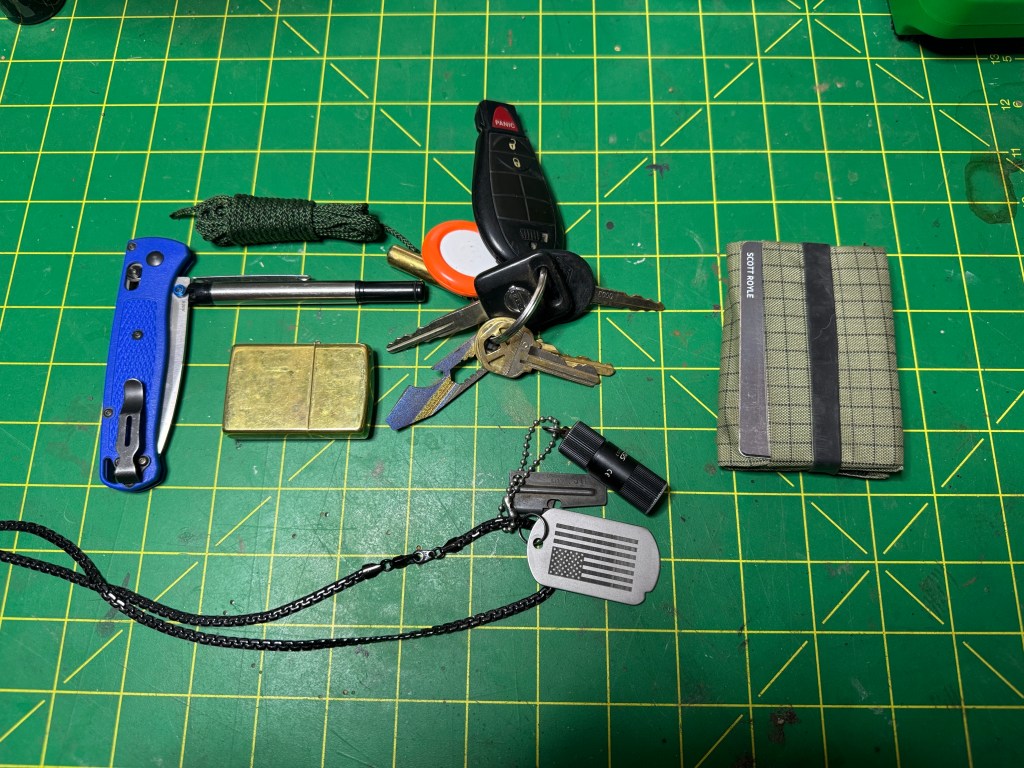
Let’s start with EDC. EDC is Every Day Carry which for me is every time I leave the house I have these items on my. Here is what I carry Every Day.
Knife – Benchmade Bugout. I love this knife. It is the perfect size and weight. I resides in a pocket on my cell phone holster.
Bandanna
Pen
Lighter – Zippo with a butane insert. I used to carry a Bic Flic but because it is so light, it would fall out of my pocket when I retrieved other items. I do not have this issue with the Zippo
Cord – 10-12 feet of 1/16” 100 lb test cord.
Car keys with a bottle opener
Cell Phone
Necklace with: P38 can opener (from my army days) Olight i1Reos flashlight. This is an amazing little light. Dog tag with emergency contact info and medical insurance info
Wallet with: Cash, Credit Cards and ID Signal Mirror Fresnel lens – for reading and fire starting A couple of bandaids Victorinox Swiss Card.
Other items may be added as necessary such as self-defense items or electronics to support blogging/vlogging and radio gear.
Clothing. Starting from the inside out. My undergarments are a mesh top with a bottoms made from 60% cotton and 40% polyester. The next layer was a Carhartt Force Cotton Tee shirt 65% cotton/35% polyester, and Levi blue jeans. I wore Darn Tough wool socks (I wear these year round) and Solomon XA Goretex trail shoes.
My next layer was an Eddie Bauer fleece pullover I got cheap from Sam’s Wholesale. It is 100% polyester. On top of that I wore a cheap Amazon Basics lightweight fleece vest again 100% polyester.
My outer layer was a Carhartt stocking cap 100% acrylic. A TurtleFur neck tube (polyester). Cotton Jersey Gloves and a British SAS Windproof Smock (50-50% Cotton Polyester (unlined and uninsulated). Through the rain/Sleet/Snow I remained warm and dry. My Smock got quite damp but the hydrophobic nature of my under layers and the heat I generated kept the moisture to the outside. If I wore one of my Goretex jackets, I would have been soaked in sweat as Goretex is not as breathable as the smock is.
While walking, I was warm enough to have to unzip my smock and my vest. My gear would have kept me warm down into the teens. I tend to dress one layer warmer than I need. In this case I added the vest. There is a myth that “cotton kills” It’s not the cotton, it’s the operator. Most military uniforms are about 50% cotton. My days in the Army go back to the BDU which is made from Nyco or 50% cotton/50% nylon. I wore that uniform from very hot to very cold and I lived to tell about it. Know your gear, know how it works in different conditions. How does it perform when wet. What I wore today was perfect. My smock got damp, my gloves got damp, but inside I was warm and dry. I walk year round and I walk in most weather conditions. I know how my clothes work. I made myself a promise when I got out of the Army, and that was I would only be cold and wet when I wanted to be. To date, that has not happened. Get outside, try your gear, know what to wear for different conditions. Be safe. Be especially safe when your community needs you. 73 de Scott
“What a long, strange trip its been” a line from the Grateful Dead’s song Truckin’. This was one of those years for me. The beginning of 2024 started off normally — until Mary, my wife needed to have a hip replaced. Her recuperation went well, slow but well. That put a back log on things that needed to be done on the home and property.
November was my one year anniversary of retirement. I discovered that there were way more rabbit holes to go down and far too many “squirrels” that filled up my days. I was busy doing a lot of things, but this past month or so I started asking myself am I doing the right things?
I enjoy writing. In my professional life writing was a good part of it. Some of my work is published in a federal handbook. Writing is my creative outlet; I can’t draw (or cursive handwrite), and I am only a mediocre guitar player. I do sing solo — so low no one can hear me. In my retirement, I have done very little writing. I feel the pain. Work provided me with topics and content to write about, but in retirement, I was a ship without a rudder. Becalmed in a sea non-creative web-surfing, youtube sargasso, I was doomed to sink in the Bermuda Triangle of failure.
I can fix this; I can repair the rudder, start the motor, and navigate back to fair seas. I had to give myself a topic. I decided to write a book. I know in the movies, actors sit down behind a typewriter and bang out novel right before your eyes. For us mere mortals, it is not that easy. There is planning involved. Writing a book of 80,000 words is very different than writing a blog of 500.
This required some changes. I moved into a Mac machine. I have no qualms with Windows 11. The computer I use for radio is a windows machine. At issue are the apps in Windows. I find them clunky and disruptive when I am in a creative mood. The Mac environment and its asssociated apps are more elegant, they get out of your way and let you concentrate on content. Apple products are designed to work together. I can create on my Mac, iPhone and iPad, and easily switch between them. An analogy I use is a computer should be like a hammer. You pick it up, you use it — bang! If you have a hammer where you have to fiddle with the head each time you use it, you soon have a new hammer.
I am still setting things up to get ready to write. I have some reading to do, some new apps to get used to, but I am almost there. One issue I have is making sure I have enough time, and enough time at the right time of day to write. I need to introduce a little discipline back into my life. The current book I am reading is Getting Things Done by David Allen. It has been a big help in getting me back on track.
Where’s KK4Z? A question I often ask myself on this blog. I’m here and I am busy with radio, just a different busy. Living in Georgia, I was close to Hurricanes Helene and Milton. They affected friends. I have been involved in EmComm for 26 out of the almost 30 years of my involvment in amateur radio. In the past I have deployed to actual disasters, but as my wife and I age, going to a disaster is becoming less of a reality. I also took a look at POTA and what I was doing there. I have over 10,000 contacts in POTA and most of those are the same thing. I quick exchange and on to the next one. I need to do something else. I need to better serve my communities. I will still do POTA and some SOTA, it is fun, but I need to get back into public service. I have recently joined US Army MARS and SHARES (SHAed RESources HF radio program). Both are federal government sponsored programs. With both programs I keep my operations within FEMA Region 4 (Southeast United States). I also participate with my local ARES group. I maintain my position as an Official Emergency Station with the ARRL.
Retirement is a new world, a new beginning. You can either grab the bull by the horns, or lay down and die. I still want some adventure in my life, though it won’t be as hair raising as it was in my youth. If you still want a little gusto in your life you need to “Improvise, Adapt, and Overcome” (US Marines). 73 – de Scott
I’ve been retired almost a year now and I have enjoyed it. With retirement comes age and with age comes “stuff”. Until you reach retirement, you really don’t know what it is really going to look like. I’ve had some discoveries along the way.
Time. You think you will have time to do everything you thought you were going to do. For me this was a case of my eyes being much bigger than my stomach. Over the past year, I have been paring down my list to about a half a dozen activities, amateur radio being one of them.
Money. In retirement I do not make as much money as I used to. My wife and I are not eating Alpo, we are living quite well, but I can feel the reduced spending power. I have to give a little more thought to how I spend my money.
Age Related. Getting older means your body starts slowing down. More trips to the doctor, more preventative care, reduced ability. I led a pretty active life with 8.5 years in the U.S. Army and 20 years in the trades. I am now on the receiving end of all that wear and tear. Things hurt. I have to think more about how I do things and for how long I can do something. I still walk about 100 miles a month but power lifting at the gym is out. Coming to grips with your body not doing the things it used to do can be a humbling experience. Getting old is not for the weak.
My wife and I are spending more time taking care of each other and our special needs daughter. This means more time at home. Writing this, I am at the back side of Hurricanes Helene and Milton. I had a strong desire to go, 20 years ago I would have left in a heartbeat. Today, my responsibilities have changed. In any EmComm or disaster situation, the first rule, is always take care of your family first. It is a good rule and a smart one. It is the rule that is helping me to let go. While I may not deploy anymore, there are still things that can be done at home. I have a good home station and just added an SPE Expert 2K-FA amp which is MARS modified. I can comfortably run digital up to 1 kW. This mission hasn’t gone away, it has changed. Plus, I can still do the occasional POTA activation when I find time between all the other things I do. Stay safe and enjoy life. 73 de – Scott
I’ve been busy lately, doing a lot of things for a lot of different people and even having fun with the process. I have been making some changes to the way I operate and how I am adapting to such things as getting older. The first change is I have added the remote VFO IC-RC28 to the shack. In the photo above, I have the RC28 next to my paddles. I like it there as I am often cruising up and down a band when doing activities like POTA. It is more comfortable with the dial being more horizontal and it is also enough out of the way when I am using my desk — well, like a desk. Just to he left of the RC28 goes my mouse. Everything right there one, two, three.
Another change coming to the shack is a new (to me) amplifier. I am getting an SPE Expert 2.0K-FA amp. This amp is capable of 1.8 to 2.0 KW of power and is set up fro general coverage (includes outside the ham bands). I normally never use more than 1 KW so what this gives me is a lot of headroom. The 2.0 is about twice as heavy as the 1.5 which I currently own. With the additional cooling I will be able to run digital modes up to 1 KW. However, I normally do not need anymore than 100-200 watts for CONUS coverage. I am adding an amplifier interface cable to the IC-7300 so both radios can each run the amp with a push of a button. The SPE Expert 1.5K-FA will be up for sale shortly.
Antennas. I’ll be putting up a new antenna. This is be a 203′ terminated end-fed non-resonant antenna. This will be a very broadbanded antenna and will allow me to operate on 60 meters. I also have some field antennas coming and I will post about them on a different post.
Power.
I added a 100 Ah battery to the list of portable power options. This battery will give me a full weekend of operating. This battery will also provide back-up power when black-outs or brown-outs occur. I have another set of solar panels on the way. This country is heading towards power shortages as fossil fuel plants are beign shut down and not being replaced. However, our energy usage is continuing to increase. Several parts of our country are already suffering from these outages.
I do have a couple of field trips planned in the near future and of course operating from home.
The wonderful thing about amateur radio is there are so many ways to enjoy the service. I do not call amateur radio a hobby as it is a service even we can enjoy it like a hobby. Until next time, get out there and get on the air, or stay at home. 73 de Scott
This past weekend I camped at Ft Mountain State Park in northwestern Georgia. One of my goals was to test NVIS and see if it would work during my stay. I collected data using FT8 from Friday afternoon when I got set up until about 2130 hrs eastern when the 40-meter band started to fade.
Conditions. I set up in the campground in Ft Mountain State Park. My elevation was approx. 2,400 feet above sea level located in a depression (-200 Ft.). The antenna was a Chameleon EmComm II ver.1 in an inverted vee configuration. The ends were 6-6.5 feet off of the ground and the apex was 10-12 feet. There was a counterpoise run beneath the antenna. The radio was an Elecraft K3(s) running FT8 at 25-35 watts.
During my stay I made 121 contacts on 40 meters. 7-8 MHz is considered the upper limit for NVIS operation. NVIS is also not guaranteed as it relies on proper atmospheric conditions to reflect the radio waves back downward. When creating the following maps, I only included states where I had 3 or more contacts. In addition, some states had no contacts and that may have been due to propagation, or no one was on at the time. Also, I reported the average signal strength for the state (not individual stations) as well as the percentage of the contacts from that state based upon 121 contacts. If you add up all of the percentages on the following maps, they will not equal 100%.
The first map shows all of the states with 3 or more contacts.
Generally, a good signal for FT8 is any signal above -10dB. A closer view shows that except for Texas the stronger signals are within 300-400 miles of the transmitting station. The circle in the map below has a radius of about 350 miles. As you can see there is a rather sharp drop off in signal strength beyond about 350 miles.
While this isn’t a proper detailed experiment, some generalizations can be made. The transmitting station was located in a depression (-200 Ft), there is a good probability that NVIS was used. The signals close in were stronger, meaning that the signals were within the skip zone and that signal strength beyond the skip zone (beyond about 350 miles) noticeably dropped off indicating NVIS operation. There were more stations contacted within the circle. As the transmitting station turned away from the sun the ability to copy close in stations diminished. The white elephant in the room is Texas. In my experience, there always seems to be a radio pathway between Texas and Georgia. Not sure why that is but in all my activations and at home there always seems to be at least one Texas station in the mix.
As amateur radio operators, we often think in terms of how far we can reach, how many miles per watt, to reach that atoll on the other side of the world. What is equally important and in some cases such as EmComm, is how close can we get. Sometimes the most important link is just on the other side of the mountain. Knowing how to utilize NVIS in your comms plans will help bridge that gap. You may be saving a life instead of collecting a QSL card. Below are some links to other NVIS posts I created. — Scott
This weekend I decided to camp at one of my favorite parks. Ft Mountain State Park. I go back a long way with this park. Thirty three years ago I spent a wonderful honeymoon there with my bride and princess. We recently spent a weekend there in the same cabin we spent our honeymoon in. Memories.
This time it’s a solo trip. I came up here for some radio adventure and I got it. On this trip, I did more EmComm related stuff. This was more like an FTX (field training exercise) than a simple POTA activation. I grabbed my normal gear and set myself some tasks to accomplish while out. I wanted to stretch my gear and me, do a grab and go like it would happen in a real scenario. I did not do any extra prep than I normally would do for a POTA activation.
My first task was to receive the National Intelligence Brief (NIB) from the Early Warning Network. I am the Communications Director (G6) of the Early Warning Amateur Radio Network (EWARN). We are building the EWARN system to best suit the needs of the Early Warning Network. This network collects information, analyzes it, and then disseminates the intelligence in products like the NIB.
Right now l receive the NIB via email and one of our projects is to be able to send the NIB to me and others via radio. We are looking at options to include using operators from AmRRon which we are developing a relationship with. AmRRon has some very talented operators. Getting back to my task, I received the NIB via my cell phone while on my way to the park. I pulled over in a gas station, connected my computer to my cell phone via the hotspot and downloaded the NIB onto my laptop.
I got the NIB ready to send over the radio. This includes formatting the document and then signing it using a PGP key. By signing the document this way, anyone with the public key can verify that the document was not altered. The document is not encrypted so it can be sent over the air. The next step is hooking up the laptop to the HF radio in my truck and sending the message. I decided to move since I didn’t think transmitting with a radio near gas pumps was a good idea so I moved. I found a pullover near the bottom of the mountain, on a road that leads up to the State Park. The radio wan an IC-7100 hooked up to ab AH-730 and a 102” whip.
Issue. I am having trouble formatting the file correctly when PGP signing the file in FLmsg. Next week I am going to get with a buddy who is a pro user and get this sorted.
I stopped, hooked the laptop up to the radio, turned it on and using VarAC on 40 meters connected to N4WXI near Birmingham AL. It took me about 2 minutes to send him the file. His group will inject it into the AmRRon system to be passed as traffic from coast to coast.
After I sent the NIB I continued up the mountain to Ft. Mountain State Park.
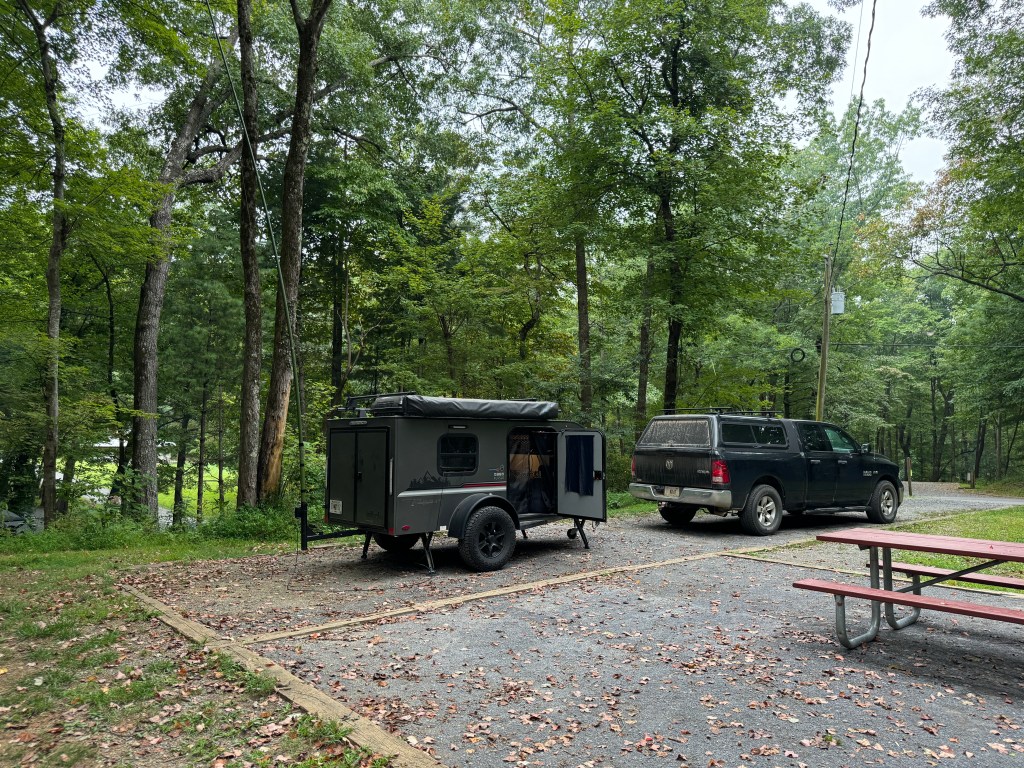
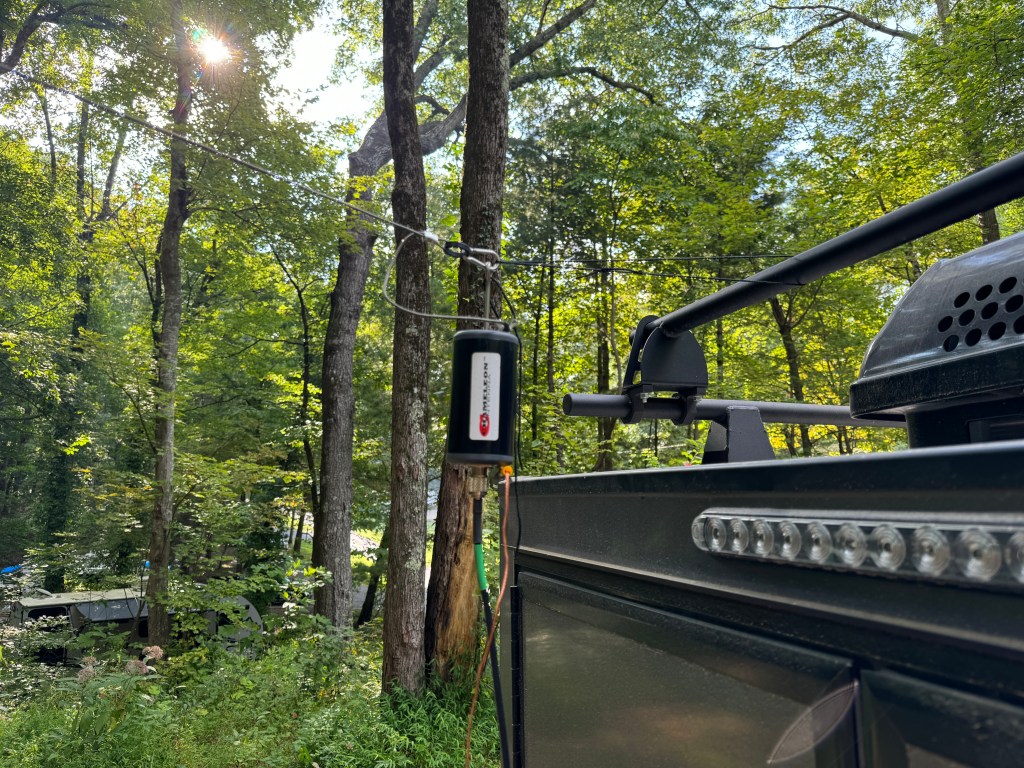
Antenna. I decided to use my Chameleon EmComm II ver. 1 for this FTX. Since I would be on the lower bands I wanted a larger antenna. I ended up configuring the antenna 3 times before I felt like I had the right combination. The first time I used my push-up pole to get one end of the antenna about 12-15 feet off of the ground and set it up like an inverted L with the counterpoise underneath the antenna. I didn’t like this version as I had power lines nearby and while I felt the setup was safe I erred on the side of caution. My second attempt was to attach the balun to the camper and elevate the center of the antenna wire in an inverted Vee with the counterpoise underneath it. I didn’t like this way because it left the counterpoise touching the camper and I didn’t want to radiate the camper. They say threes a charm and so it was in this case. I made a loop of cord between the camper and the unun which when the antenna was stretched, it pulled the unun and the counterpoise away from the the camper. The counterpoise was run underneath the antenna and this was the setup I ended up using. The radio was my Elecraft K3(s) and the laptop was a Lenovo Thinkpad T14.
Once the rest of the station was setup, I sent a quick VarAC vmail to my buddy in Alabama to make sure everything was working. My next task was to send out the NIB via Wnlink email to the regional NCS’. The equipment and the Winlink software worked fine. However, I had a fail. The note app on my phone failed to sync across my devices so I did not have all of the email address for the regions. Luckily I had two in my possession so I was at able to get the NIB out partially. One of the quirks of this campground is there isn’t any cell service. A good test of your gear and you.
Issue. App on my devices was not syncing. I am going to move my files to a better app.
After Winlink, I ran FT8 before and after the net. I did so to see if I was operating NVIS. The antenna was configured for NVIS but that doesn’t mean conditions were favorable. My initial impressions were that I was using NVIS to make many of the contacts I did on 40 meters. Forty meters is about the upper limit for NVIS. Between Friday afternoon and Saturday morning I made 121 contacts on 40. Charting out the average signal strength and percent of total contacts leads me to believe that NVIS was in use. More on NVIS in a separate post.
The net ran fairly well, I had 23 contacts and I was able to send the NIB using FLmsg. Flirig, and FLdigi. These apps worked well. The net macros worked well and need only a few adjustments. This completed another task.
FLamp was another story. I couldn’t get it to work right even though I had the most current version. I found out after the net that this version is quite buggy and I should have used the previous version. No cell service, no internet to fix it. Just like real life in EmComm. I will have to fix that when I get back home. Another issue I had was with the antenna. It does not do a good job running a digital net with above normal duty cycles. The balun would heat up causing the SWR to rise lowering the output power. If I run the net again I would probably only run FLmsg. I have a couple of other antenna options to try.
Issue. The Chameleon antenna was not up to the task of running a digital net with a high duty cycle. It would warm up, increasing the SWR. I was running 30-35 watts (I did reduce power). Further research showed that while the antenna was rated higher for Voice/CW, on digital it is only rated for 20-25 watts. This was not apparent on the website or instructions. For digital modes a rating of about 30% of PEP would be about max. My solution is to get a higher rated UnUn and derate it for digital.
Issue. Even though I had the latest version of FLamp, it was buggy and it wasn’t until I got my cell service back that I discovered that. The solution is to find an older version and install that or see if there is a patch to fix the current version.
Saturday morning the bands were in so-so shape. In addition, it looked like some weather was moving in so I broke down the station and started working on the video and this blog post. It was a nice day but I decided to go home this afternoon instead of tomorrow morning. So much to do, so little time.
Even though I’ve been doing stuff like this for 25+ years, there is still a lot to learn. Experience is only gained by doing so I leave you with a quote from Leroy Jethro Gibbs: “Grab your gear!” 73 de Scott.
Addendum. I had a total of 166 contacts. The 45 additional contacts were above NVIS and were not included with the 121 above. Here is a QSO map of all of the contacts.










 KK4Z
KK4Z 