Winter Field Day 2025

It was another fun Winter Field Day. Our club, we like to do 3 things: 1) we like to talk, 2) we like to eat, and 3) every once in a while we like to talk on the radio. This year was no different. We had a lot of fun, ate good food, and played on the radios. I think it’s the non-competitive spirit that helps us brave the cold weather. And it was cold this year with temps in the 20’s and 30’s. Not only does this tax our physical comfort, it also taxes our equipment.

Coax cables and extension cords were stiff and fingers went numb but we managed to get 4 stations on the air. I operated separate from the group to try to Get multipliers on JS8Call. I also copied the WFD bulletin and used Winlink to send and receive email. We had one member attempt to make a satellite contact and while he could hear other stations, it appeared no one was connecting. This year we ran QRP. Which was fun. Let me run through the gear and tell you how things worked.

The antenna this year was a 73’ inverted L with the vertical leg at 20 feet. This had a 60’ counterpoise connected to 1.5 KW Palomar Engineering 9:1 UnUn. I use the bigger UnUn because times when I run higher power (up to 40 watts) using digital, smaller UnUns get warm and saturated. This antenna works well down to 160 meters. I made contacts on different bands out to the west coast. A fail I had was I used a Chameleon RF choke next to the UnUn. It blocked all of the signal to the radio. Once I removed it, things were fine.

The radio was my new Yaesu FT-710. The radio worked well with no real issues. A quirk of the radio is the AF cuts the volume off louder than other radios. Sometimes when I am operating digital, I like to turn the audio volume real low so I can just barely hear it to keep tabs on what is going on. With the FT-710, it cuts off the volume while it is still louder than I like. Not a deal breaker. One of the benefits of operating a big radio QRP is the controls are easier to get to. While I prefer the ergonomics of Icom radios, the FT-710 is still pretty good. Another quirk with the FT-710 is the waterfall. It is not averaging like other radios, you have to adjust it manually. Overall, the radio performed well and compares favorably with the IC-7300. Either radio will equally get the job done. This radio feels more refined than my first one. It will be going on several more trips I have planned.

FT-710 accessories. I got the tuner issue worked out and my LDG tuner is playing well with the 710. I added Portable Zero rails which not only protects the sticky-outy things, but gives extra finger holds. I consider the rails a must have for portable big radios. Heil Proset Elite. I had to buy another headset for the FT-710 and the Elite was on sale at HRO. My Icoms use an electret mic which requires power. I already had an adapter from when I owned an FTDX10. I’ve been using Heil products for 25+ years and they are my goto. Mouse. I bought a Logitech M310 mouse to go the FT-710 thinking it might be easier to navigate through the menus. However, once I got the radio setup I was only changing a few things and found I didn’t use the mouse at all. I will probably not use a mouse with the 710 and I already found another use for it.

Maestro Evolve III laptop. I think I paid $122 for it. It works okay. It’s not zippy fast but all the software I used worked. It does appear to be RF sensitive though. During transmit, the mouse would freeze and sometimes the app window would close and open. What do you expect for a hundred bucks! One thing I did find annoying was the track pad. It was overly sensitive and would often treat a light touch as an “execute” function doing something I didn’t want it to do. My solution is to take the Logitech M310 mouse and use it with the Evolve III. A cool feature is I can run the Evolve off of my radio power supply or battery. Less “stuff” to deal with. The power plug for the Evolve also fits older Icom and Kenwood HT’s. The Evolve worked with my GPS receiver and I was able to easily sync the time for JS8Call. I will be taking this little laptop out again.

JS8Call. I think this will be the last time I use JS8Call. I was never fond of it and running a contest with it is almost a nightmare. For WFD, it doesn’t sync well with ACLog. People would send their Class and section info out without attaching a call sign to it so you would get something like 1O OH… and nothing else. That would be okay if only one person does it but when 2 or 3 others do it at the same time, you don’t know who is who. That and there wasn’t really enough JS8Call stations on the air to make it worthwhile. CW was the same for WFD. There were other contests going on. It appears the money maker for WFD is SSB. Which is interesting because the EmComm community relies heavily on digital modes.

As a group, we had a lot of fun. We always enjoy getting together. I had fun and I got to test my equipment. It is reassuring to have the knowledge that your equipment is ready. Even when I go on one of my FunComm trips, I load things up and go. I don’t have to check them because I already did. Final thoughts? Listening to the CW contests over the weekend reinvigorated my love for CW. I have been away from it while getting up to speed with MARS and SHARES, but there is still something to be said for the simplicity of me and the key. Hopefully, this will be a better year than last year, and I can get back into the swing of things. Stay safe, stay warm es 72 de Scott

Yaesu FT710 – Second Impression

Here is my first look at my second FT710. I will start with the settings I changed and then go over the list of issues I had with the first one. The first FT710 had the original firmware as it was new at the time. This one has several updates under its belt.

Settings/Changes

  1. T710,Taped Power Cables every couple of inches to reduce tangles.
  2. Added Anderson Power Poles to the power cable
  3. Turned off 3DSS
  4. Set waterfall span to 5K
  5. Set waterfall speed to slow2
  6. Set color to 6
  7. Set level to +3.5 dB, peak to level 2 and contrast to level 14
  8. Set tuner type to EXT
  9. Set Tuner/Lin Port to Linear
  10. Set keyer to Elekey B, repeat interval to 3 seconds, Weight to 2.7 and Pitch to 700Hz
  11. QSK – on
  12. Set MyCall to KK4Z and call time to 3 seconds
  13. Set Mic gain to 60 and Processor level to 65
  14. CW mode on
  15. Meter Detector to Peak
  16. Receive Audio SSB – Treble +3 Middle +5 Bass -2
  17. Receive Audio CW Treble +3 Middle +1 Bass -3
  18. Parametric Equalizer (processor on/off the same)
    1. E1 – Freq 300 Bandwidth 10 level -3
    2. E2 – Freq 1300 Bandwidth 2 level 10
    3. E3 – Freq 2400 Bandwidth 1 level 10
  19. Needs a 32gb (no larger) SD card. Scandisk Ultra SDHC UHS-I 32 GB works
  20. Mouse. Seems the only wireless mouse you can use with the radio is a Logitech M310. It does not appear to be in production anymore. I had to buy a renewed one. I got the mouse working and I think it is a good addition to the radio. It does make changing parameters easier and if you click on a signal in the waterfall, the radio will QSY to that frequency. I wasn’t sure how I was going to like using a mouse, but I think I like it.

Here are the issues from the first radio:

  1. Could not use LDG tuner with the radio — it was a surreptitious route to get a tuner to work. I started out with a different tuner, an LDG IT-100 which uses a different cable. I coupled the tuner with an LDG IC-108 cable. The cable is not listed as usable on the FT710. The other twist was setting the Tuner/Lin Port “Linear” instead of Ext Tuner. This little tidbit is not shared by Yaesu, I had to find it on an internet forum. To tune the antenna you push the tune button on the tuner (not on the radio) to get things going. This is where Icom shines. They have been using the same interface at least as far back as the IC-718 and the IC-706. A tuner I bought for my IC-706 MKIIG still works on my IC-7300 with the same cable and I can use the tune button on the radio. The other downside is you cannot use the FH-2 Remote pad when using the auto tuner as it uses the same port at the back of the radio. In addition, you cannot run an amplifier and an auto tuner at the same time. Icom has separate ports for the tuner and amplifier.
  2. No Portable Zero Rails – I use rails on all of my portable radios. Portable Zero now makes rails for the FT710.
  3. Could not use RT systems software – it took Yaesu until July 2023 to get the info to RT Systems. I have RT Systems software for almost all of my radios. RT systems software works fine now.
  4. Auto Notch — I don’t remember auto notch working on the first radio I had. It works now.
  5. Cannot edit/see QMB – another place where Icom shines. I can go into the memo pad (Icom’s QMB) and edit the entries.
  6. RJ45 mic connecter instead of Foster (Icom)- Foster connectors are more durable than the RJ45.
  7. Key clicks in the headphones using CW – They are still there but less pronounced. The CW is harsh sounding and can be fatiguing to listen to over long periods.
  8. WSJT software would change modes when switching bands
  9. Waterfall is not averaging like Kenwood’s or Icom’s. It has to be adjusted manually (and sometimes frequently)
  10. Filter only has 2 selections vs 3 for the Icom. Narrow which only has predefined values and wide which is adjustable. The Icoms have 3 selections each fully adjustable. Icoms can also adjust the filter shape (soft or sharp. The FT710 has contour and APF. Contour is like a soft notch filter and APF boosts the center frequency like a CW signal. Icoms have dedicated controls on the front panel while the Yaesu has a mix of front panel controls and menu items.

Even with all of its quirks, I like the little radio. Yaesu appears to have fixed most of its problems, at least enough to make the radio fun. I still believe this radio compares well with the IC-7300 and either will serve you well. If I could only have one, I would still go with the Icom. The Icom has a lower noise floor, the settings (ergonomics) are better, and it hears as well as the Yaesu (at least in my side by side test). For CW again, the edge goes to Icom. However, the Yaesu has its pluses. The FT710 has a slightly better audio quality let’s say more fidelity but in CW the tone is more harsh than the Icom. The Yaesu has a better attenuator with 3-steps instead of one. With the Yaesu, you can transmit CW while in SSB mode. I like the filter window on the FT710. I can see how changing the filter affects the signal.

Later this week I have Portable Zero rails coming. They are pricy, but I find them very useful on my field radios. I also have a Maestro Evolve III coming which I will setup software for the FT710 on it. I hope to have everything ready for Winter Field Day.

I think a major difference between the IC-7300 and the FT710 is settings. Yaesu gives you settings on top of settings, while the Icom gives you what you need. If you like to tinker and tweak, the FT710 is your radio. If you want to get down and operate, then Icom is the way to go. Out of the box, I had to do far less setting up with the Icoms.

Compared to the FTDX10. I owned an FTDX10 for about 18 months. If I bought one today, the cost would be about $600 more than the FT710. I’m not sure the FTDX10 is that much better than the 710. My primary use for this radio is for the field. More to follow es 73 de Scott

Deja Vu all over again

The 2025 promises to be a better year. I am looking forward to being more radio-active. I am also looking forward to more blogging and more vlogging. I am hoping to undertake some long term reviews. I have two in mind. One is going to be a Maestro Evolve III laptop computer. I know a lot of hams use them so I thought I would give one a whirl. My other project is going to be another Yaesu FT710, this time the field version. I last owned one about a year and a half ago, I traded it off after a few months of use. The radio was going through some growing pains and was probably not ready for prime time. My general thoughts back then was the radio was a likable and fun radio and compared favorably to my IC-7300. I thought I would give it another look and a fair shake since it’s been through a few firmware updates since its release in 2022.

I am hoping this FT-710 is more polished than my first one. I can see at least two firmware updates since my last 710 and the manual has been updated. Hopefully Yaesu cured those early issues. I picked up the radio yesterday. I plan on using it as a field radio for POTA activations as well as for Winter Field Day and Field day with my club. In general the IC-7300 and the FT-710 are comparable, each with their pluses and minuses. Whichever brand you are married to, either radio will probably serve you equally well. One reason I got this radio is there are many members in my club that use Yaesu radios. Having familiarity with the Yaesu system allows me to help them with their radio problems.

My initial thoughts are similar to the ones I had a year and a half ago. It is a likable radio and it has a certain fun factor. I am going through my past blog posts and YouTube videos to make list of things I found with my first FT710 and see if they have been corrected. I will also post the settings I changed on the new radio to suit me.

I like big radios when I go camping or even on POTA day trips. I like having the controls I use handy and if band conditions get ugly, I can turn up the power. I normally run 20-25 watts for CW and digital. The rare times I am on SSB, I may go as high as 50 watts. Another plus with a big radio is I can run digital modes all day long and it will not overheat the radio. I do have a couple of QRP radios and I do take them out for a spin every now and again; but I can just as easily turn my big radio down to 5 watts. I am looking forward to using it in the upcoming Winter Field Day. 73 de Scott

Winter Wonderland

I woke up this morning to fresh snow on the ground. I had the same excitement as I did as a kid. I got dressed and went on my daily 4 mile walk—in the snow while it was snowing. It was glorious, I remembered playing in the snow as a child and backpacking in it as a young adult. I also remember the grueling Army Field Training Exercises (FTX) in German winters. I have seen cold winters, my coldest was somewhere between -20 to -30 degrees F. Winters can be fun, and they can be dangerous. The most dangerous winter is like what we are seeing today on NW Georgia. Snow with freezing rain and temps hovering around freezing. For driving, this means ice on the roads and sometimes ice covered with snow. Drivers unaware that they are driving on ice lose traction and control of the vehicle. Often they are unaware they have lost control until it’s too late. I have driven cars, trucks, military vehicles, and 18 wheelers on snow and ice covered roads. Only through training and experience did I survive those encounters.

These conditions are also conducive to personal physical injuries such as immersion foot, frost nip, frost bite and hypothermia. Being cold and wet by itself may not kill you, but cold and wet, coupled with inexperience will. This blog post is not necessarily about amateur radio, but about operating amateur radio outside in these conditions. Using my 4 mile walk today, I will lay out what I wore and why.

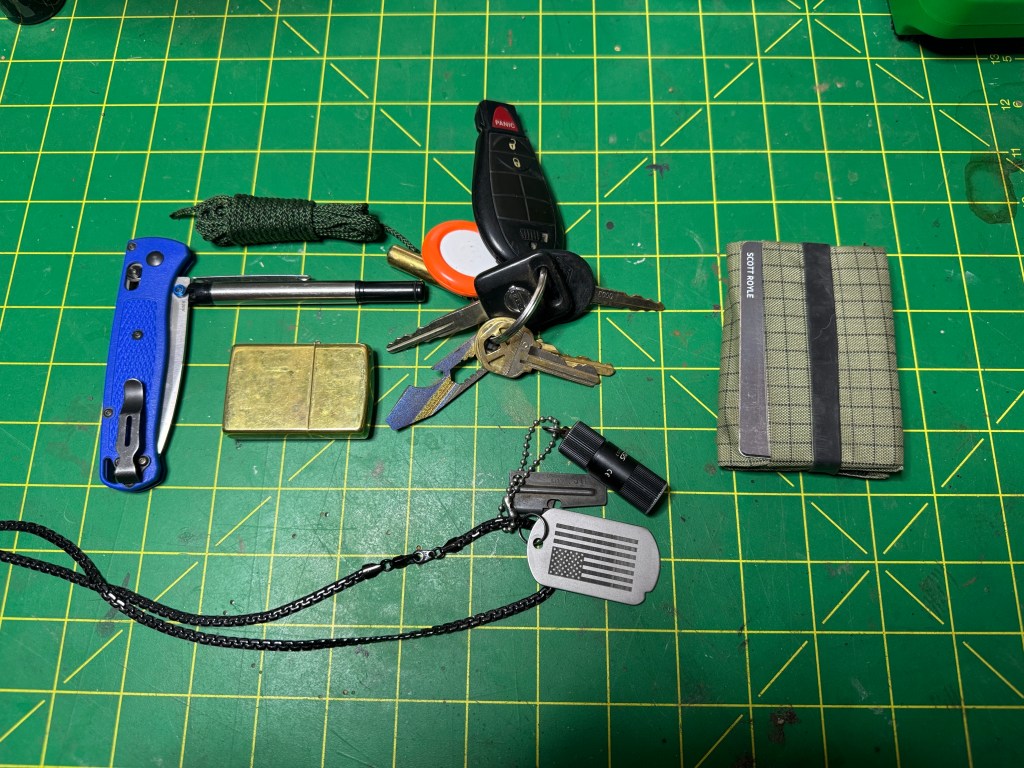
Let’s start with EDC. EDC is Every Day Carry which for me is every time I leave the house I have these items on my. Here is what I carry Every Day.

Knife – Benchmade Bugout. I love this knife. It is the perfect size and
weight. I resides in a pocket on my cell phone holster.

Bandanna

Pen


Lighter – Zippo with a butane insert. I used to carry a Bic Flic but because it is so light, it would fall out of my pocket when I retrieved other items. I do not have this issue with the Zippo

Cord – 10-12 feet of 1/16” 100 lb test cord.

Car keys with a bottle opener

Cell Phone

Necklace with:
P38 can opener (from my army days)
Olight i1Reos flashlight. This is an amazing little light.
Dog tag with emergency contact info and medical insurance info

Wallet with:
Cash, Credit Cards and ID
Signal Mirror
Fresnel lens – for reading and fire starting
A couple of bandaids
Victorinox Swiss Card.

Other items may be added as necessary such as self-defense items or electronics to support blogging/vlogging and radio gear.

Clothing. Starting from the inside out. My undergarments are a mesh top with a bottoms made from 60% cotton and 40% polyester. The next layer was a Carhartt Force Cotton Tee shirt 65% cotton/35% polyester, and Levi blue jeans. I wore Darn Tough wool socks (I wear these year round) and Solomon XA Goretex trail shoes.

My next layer was an Eddie Bauer fleece pullover I got cheap from Sam’s Wholesale. It is 100% polyester. On top of that I wore a cheap Amazon Basics lightweight fleece vest again 100% polyester.

My outer layer was a Carhartt stocking cap 100% acrylic. A TurtleFur neck tube (polyester). Cotton Jersey Gloves and a British SAS Windproof Smock (50-50% Cotton Polyester (unlined and uninsulated). Through the rain/Sleet/Snow I remained warm and dry. My Smock got quite damp but the hydrophobic nature of my under layers and the heat I generated kept the moisture to the outside. If I wore one of my Goretex jackets, I would have been soaked in sweat as Goretex is not as breathable as the smock is.

While walking, I was warm enough to have to unzip my smock and my vest. My gear would have kept me warm down into the teens. I tend to dress one layer warmer than I need. In this case I added the vest. There is a myth that “cotton kills” It’s not the cotton, it’s the operator. Most military uniforms are about 50% cotton. My days in the Army go back to the BDU which is made from Nyco or 50% cotton/50% nylon. I wore that uniform from very hot to very cold and I lived to tell about it. Know your gear, know how it works in different conditions. How does it perform when wet. What I wore today was perfect. My smock got damp, my gloves got damp, but inside I was warm and dry. I walk year round and I walk in most weather conditions. I know how my clothes work. I made myself a promise when I got out of the Army, and that was I would only be cold and wet when I wanted to be. To date, that has not happened. Get outside, try your gear, know what to wear for different conditions. Be safe. Be especially safe when your community needs you. 73 de Scott

Danger Will Robinson

We are under a Winter Storm Watch

…WINTER STORM WATCH REMAINS IN EFFECT FROM FRIDAY MORNING THROUGH

SATURDAY MORNING…

  • WHAT…Heavy mixed precipitation possible. Total snow
    accumulations between 1 and 7 inches with the higher amounts
    north. Ice accumulations around one tenth of an inch possible.
  • WHERE…Portions of north central, northeast, northwest, and west
    central Georgia.
  • WHEN…From Friday morning through Saturday morning.
  • IMPACTS…Travel could be very difficult. The hazardous conditions
    could impact the Friday morning and evening commutes.

PRECAUTIONARY/PREPAREDNESS ACTIONS…

Monitor the latest forecasts for updates on this situation.

For those in the northern states, this may not be a big deal. For us in the southeast it is. Mainly because a) most counties do not have a lot of, if any snow removal/sanding equipment b) folks don’t know how to drive in winter conditions and c) many homes are not constructed for the colder temperatures.

I was raised in the northeast and traveled to many cold climates. I have lived in/worked in everything from arid desert and subtropical, to temperate and sub alpine zones. When the weather turns wintry, I stay home. Not because I can’t deal with it, but because others can’t. If you live in the southeast, are you prepared. Did you go out and buy the requisite milk, bread and eggs? For those that don’t know, these are the first item to go prior to an event like a winter storm. What happens if the power goes out? This happens during a storm and it may be a while before power is restored. Do you have alternate heating. We have a fireplace and a lot of wood to burn. Our house is fairly well insulated and the fireplace place will keep the house warm, not toasty, but warm enough. If a tree comes down on your property, can you cut it up? Do you have a chain saw? Gas? Two stroke oil? A file to sharpen the blade? Do you know how to sharpen a chainsaw blade? You may not be able to get to a store to buy a new one, if one is open at all.

Do you have study, warm clothes to work outside? Temperatures in the 20’s and 30’s can drop to near 0 degrees F with enough wind. Do you have enough warm blankets? Enough to sleep in a cold house. Which brings us to electronics.

Do you keep your cell phone charged? Do you have a way to keep it charged if there is no mains power? It may be your only link to the outside world and maybe the only entertainment center for the kiddos. How about your radios? What if you antennas come down? Do you have spares? Do you have alternate power for your radios? Do you have gasoline for your generators? Do you have heating propane? I heat with propane and one of my 2200 watt generators can run the furnace.

Do you know what hypothermia looks like? Frost nip? Frost bite? How about immersion (trench) foot. It’s these middle temperatures where these injuries are likely to occur. Once frost bitten, you will be painfully reminded of your error in judgement each time that part of your body gets cold. Trust me on this one.

Take the time to get ready. Go to the store now. Fill up your vehicle gas tanks, get gas and oil for your chainsaw. Make sure you have adequate food in the house and alternates ways to keep warm. Most of all be safe. Think through your actions before you commit. Someone will probably die as a result of poor decisions during this weather event. Don’t let it be you or yours. God Bless, my thoughts are with you. 73 — Scott

Resonant Schmizonant

Does a resonant antenna perform better than a non-resonant antenna? The answer is no. As long as both antennas have similar impedances to the transmitter, they will perform equally well.

Let us start by defining impedance. Impedance is the resistive element of an AC circuit. It is described as a complex number with a real part and an imaginary part. A typical impedance may look like this: 50+j50 ohms. The real part is the first number 50 ohms which is the resistive component and what most people use when referring to impedance. The second number +j50 (could be -j50) is the imaginary part. The letter j stands for the square root of a negative 1. This number represents the reactive component of impedance and can be inductive (+j50) or capacitive (-j50). It is important when speaking about antenna impedance that the resistive and reactive components are referenced. One use of the imaginary part is to determine the phase relationship between voltage and current. When the imaginary part is +j0, both are in phase and maximum power is transmitted to the antenna system. Looking at our sample impedance (50+j50 ohms)we can deduce the phase using the following formula:

Because the imaginary part is positive (+) we know that the current lags the voltage.

It is important where the measurement is taken. Taking the measurement at the antenna will give a different impedance than one taken at the feed point. For this discussion, we will use the feed point where the coax from the antenna (antenna system) is hooked up to the radio or the antenna tuner. I want to take a moment here and discuss antenna tuners. Antenna tuners do not “tune” an antenna. All they do is match the antenna system’s impedance to the transceiver’s. Most if not all modern transceivers have a 50+j0 ohm impedance. A better term for an antenna tuner would be transmatch, which is an older name for a tuner.

A resonant antenna will have a purely resistive load which will allow the transceiver to transmit at full power. The reactive portion of impedance will be +j0. In most cases that would be 50+j0 ohms. But wait! 30+j0 ohms is also a resonant antenna and so is 80+j0 ohms. While the latter two antennas are resonant, they may not work very well with a transceiver that requires 50+j0 ohms. An antenna is only resonant on one frequency. Once you move off of that frequency, the antenna is no longer resonant. In fact, non-resonant or random length wire antennas often perform better on multiple bands because they are easier to match. I have made 1,000’s of contacts with non-resonant antennas.

Plotting the impedance on a Smith Chart gives us a VSWR of approximately 2.6:1. This shows about 20% of the total power reflected back. Because of a fairly low VSWR, most transceiver tuners can make an acceptable impedance match. The transmatch would apply a capacitance in the amount of -j50 ohms to the feed point which would cancel out the +j50 of the antenna system changing the impedance to 50+j0 ohms allowing full power to the antenna system.

This is a nontechnical view of antenna impedance based on a conversation I had over a year ago. I was musing about the subject and before I knew it, I had 3 technical books and about half a dozen websites open. There is a lot of cool math for antennas and if I can break it up into usable pieces I may try to post more here. In the meantime I’ll close with a quotation from the ARRL Antenna Book for Radio Communications 24th Edition, page 1.6.

An antenna need not be resonant in order to be an effective radiator, There is in fact nothing magic about having a resonant antenna, provided of course that you can devise some efficient means to feed the antenna…It is important to consider an antenna and its feed line as a system in which all losses should be kept to a minimum.

Roger, Wilco, Over and Out

Welcome to KK4Z.com of 2025. I am hoping for a smoother year and the opportunity to write more. Part of my plans for this blog are to include more posts about EmComm and more technical articles. I am also planning to up my game on my YouTube channel. I know I said this last year, but last year was well, wonky.

My first article of the year will be about the aforementioned Prowords used in voice nets. They are often used and often abused. I have been running nets for 25+ years at the local, state, regional, and national levels. Besides amateur radio (EmComm), I have run nets for Civil Air Patrol, and US Army Mars. I also participate in nets with SHARES. The best run nets in my opinion are MARS and SHARES with MARS being a little stricter on protocol.

These Prowords: Roger, wilco, over, and out, are the cornerstone Prowords for efficient net operations. These words have specific meanings and when used properly, provide the brevity needed to quickly handle information passed within and through the net. Let’s start with Over and Out.

First, over and out are never used together as their meanings are diametrically opposed. The Proword over means I am done talking, and I need a response from you An example would be:

ID1OT this is KK4Z How Copy over

This is ID1OT Loud Clear over

The conversation would continue back and forth using over at the end of each statement. To conclude the conversation the word out would be used. Out means the conversation with you is over and I do not expect a response. To finish the above conversation:

This is KK4Z Loud Clear out

Another way to use out is out to you This is used when finishing one conversation and starting another. For Example:

This is KK4Z Loud Clear out to you

N0OB this is KK4Z How Copy over

Out to you is an option and just saying out is fine to.

Roger means I acknowledge Example:

ID1OT this is KK4Z did you copy the traffic over

This is ID1OT roger out

Wilco means I understand and I will comply. Roger is generally not used with wilco. Example:

N0OB this is KK4Z QSY to channel Bravo over

This is N0OB wilco out

Other words/phrases used. As noted above some Q-signals are used. The ones I hear the most are QSY, QSL, and QRU. The word repeat is never used. As a Proword it means to repeat the last artillery barrage. Instead use I say again. The Proword break means to pause and is not used that much. Instead wait is used.

Phonetic Alphabet. Only use the ITU or NATO phonetic alphabet. The reason for this is during poor band conditions, having a reduced vocabulary makes it easier to transfer information. With the ITU Phonetic Alphabet I have 36 sounds for letters and numbers to listen for instead of several hundred because operators are making something up. The reduced vocabulary with distinct sounds makes it easier to pull the correct letter or number out of the static. Remember, voice becomes unintelligible at the noise level and not below it. Learning the ITU Phonetic Alphabet is a worthwhile investment of your time. It is used by governments, military, and the EmComm communities. If you are a DXer, it is also good to know. Besides, it makes you sound like you know what you are doing.

All of this is usable anywhere and anytime you are on the radio. EmComm nets are usually more tightly run so these Prowords and phonetic alphabet are important. For ragchew or roundtable nets, not so much; they are informal and if you miss a piece of information, it’s not life or death. 73 de Scott

A new day. A new year

With 2024 drawing to a close, I felt it was time for reflection. For my household, it was disruptive. It started out with Mary’s ex husband suddenly getting sick and then dying. He is the father of my stepchildren, Mary and the kids stayed in contact with him throughout the years. She made 3 trips to Texas while I stayed home and took care of our special needs daughter.

Shortly after that, she decided she needed a hip replaced. She got scheduled for surgery a week after her examination. She had to spend 4 days in the hospital and then several months recuperating. I was doing the heavy lifting in more ways than one.

During the winter we had a very cold spell which killed about 14 50-60 foot tall pine trees. I had to bring these down with a chain saw. It took some doing as I had to make sure they fell in the right direction. They had to fall into my open field and not in the woods possibly creating widow-makers. Because of the danger involved, Mary at least wanted to be present to watch me in case something bad happened—it didn’t. I put her in out UTV so she could keep an eye on me while she continued to recuperate.

We saw the great eclipse of 2024. We were in the 85% coverage range. In reality we didn’t see that big of change. It was fun to witness it though.

This summer we had a big family reunion. We rented a huge cabin in Tennessee where we all stayed for 4 days. It was a lot of fun, but it was exhausting. It was good to see all my kids and grandkids in one location.

We saw two major hurricanes hit the southeast with Hurricane Helene doing damage in North Carolina that will take years for recovery. Fortunately, the hurricane’s path just missed us.

Amateur radio had its own shakeup in my world. After 26 years of EmComm with my church, I decided it was time to do something else. I felt the program was getting a little stale and I was getting a little stale with the program. I have since joined US Army MARS and SHARES. I am enjoying both. I have let my CW skills trail off some. At the beginning of the year I enrolled in a CW class called CW Innovations or CWI. They helped me get my code speed up. With everything that was going on with me, something had to give and it ended up being amateur radio and CW. This included most of my camping trips.

I have been retired now for a little over year and while it has been a hectic year, I still enjoy retirement. I stay busy. Looking toward the new year, I am hoping to get back to some kind of normal. So far I have winter field day with my club in January and Hamcation in February. I plan on camping in March, April and May. I have yet to make the reservations. With MARS and SHARES there is a digital component so I will work on keeping those skills current. These nets have a specific protocol and run very efficiently. It takes some getting used to, but these are some of the best nets I have been on. CW was pushed to the side but hopefully I will get back on the paddles this upcoming year. The new year holds no promises of being any better than this past year, it is my hope it will be better.

On a final note, I wish to thank all of my supporters who have stuck with me during this past tulmulteous year. I wish you all the best with a safe and prosperous New Year. God Bless and 73—de Scott

What I ride!

“What a long, strange trip its been” a line from the Grateful Dead’s song Truckin’. This was one of those years for me. The beginning of 2024 started off normally — until Mary, my wife needed to have a hip replaced. Her recuperation went well, slow but well. That put a back log on things that needed to be done on the home and property.

November was my one year anniversary of retirement. I discovered that there were way more rabbit holes to go down and far too many “squirrels” that filled up my days. I was busy doing a lot of things, but this past month or so I started asking myself am I doing the right things?

I enjoy writing. In my professional life writing was a good part of it. Some of my work is published in a federal handbook. Writing is my creative outlet; I can’t draw (or cursive handwrite), and I am only a mediocre guitar player. I do sing solo — so low no one can hear me. In my retirement, I have done very little writing. I feel the pain. Work provided me with topics and content to write about, but in retirement, I was a ship without a rudder. Becalmed in a sea non-creative web-surfing, youtube sargasso, I was doomed to sink in the Bermuda Triangle of failure.

I can fix this; I can repair the rudder, start the motor, and navigate back to fair seas. I had to give myself a topic. I decided to write a book. I know in the movies, actors sit down behind a typewriter and bang out novel right before your eyes. For us mere mortals, it is not that easy. There is planning involved. Writing a book of 80,000 words is very different than writing a blog of 500.

This required some changes. I moved into a Mac machine. I have no qualms with Windows 11. The computer I use for radio is a windows machine. At issue are the apps in Windows. I find them clunky and disruptive when I am in a creative mood. The Mac environment and its asssociated apps are more elegant, they get out of your way and let you concentrate on content. Apple products are designed to work together. I can create on my Mac, iPhone and iPad, and easily switch between them. An analogy I use is a computer should be like a hammer. You pick it up, you use it — bang! If you have a hammer where you have to fiddle with the head each time you use it, you soon have a new hammer.

I am still setting things up to get ready to write. I have some reading to do, some new apps to get used to, but I am almost there. One issue I have is making sure I have enough time, and enough time at the right time of day to write. I need to introduce a little discipline back into my life. The current book I am reading is Getting Things Done by David Allen. It has been a big help in getting me back on track.

Where’s KK4Z? A question I often ask myself on this blog. I’m here and I am busy with radio, just a different busy. Living in Georgia, I was close to Hurricanes Helene and Milton. They affected friends. I have been involved in EmComm for 26 out of the almost 30 years of my involvment in amateur radio. In the past I have deployed to actual disasters, but as my wife and I age, going to a disaster is becoming less of a reality. I also took a look at POTA and what I was doing there. I have over 10,000 contacts in POTA and most of those are the same thing. I quick exchange and on to the next one. I need to do something else. I need to better serve my communities. I will still do POTA and some SOTA, it is fun, but I need to get back into public service. I have recently joined US Army MARS and SHARES (SHAed RESources HF radio program). Both are federal government sponsored programs. With both programs I keep my operations within FEMA Region 4 (Southeast United States). I also participate with my local ARES group. I maintain my position as an Official Emergency Station with the ARRL.

Retirement is a new world, a new beginning. You can either grab the bull by the horns, or lay down and die. I still want some adventure in my life, though it won’t be as hair raising as it was in my youth. If you still want a little gusto in your life you need to “Improvise, Adapt, and Overcome” (US Marines). 73 – de Scott

It’s been a busy month

Here in the southeast, life is slowly returning to normal. The exception is those hit hardest by Hurricanes Helene and Milton. These hurricanes are a stern reminder that none of us are immune to the effects of severe weather.

I’ve just completed my first year of retirement which is a round about way of saying I am not young anymore. These hurricanes caught me in the middle of other commitments that precluded me from going to help out. I felt the longing to go. I train pretty regularly for just such an instance. However, times change, things change, and some of the things I do now may be better done at the home QTH than out in the field. Over the years, I have become a pretty good NCS or Net Control Station. Much like playing an instrument, it takes practice to become proficient. There are not many NCS’ out there. The only path to becoming a good NCS is to be an NCS. YouTube cannot help you.

I may still have a few deployments left in me. I still like to take my radios camping a couple of times a year. This year I didn’t get to go out as much as I like. That and I have had a shift back towards EmComm. I am concentrating my efforts in the southeast United States or FEMA Region 4. In addition to ARES and AUXComm, I am involved with US Army MARS and SHARES. I also help with the SouthEast Emergency Network (SEEN). I’ve always had a penchant to serve, and I do so through radio communication. I have been doing a lot of digital modes, maintaining proficiency so I can get traffic through when needed. As Hurricane Helene proved, High Frequency (HF) radio communication is still needed in an emergency. CW for now has taken a back seat. Hopefully, I will get back to that.

Don’t wait for bad things to happen before you decide to “help”. On several deployments I have had an operator come up to me with a broken radio saying something like: “If you can help me fix this, I can help.” Don’t be that guy. Get your act together now. Get your gear together now. Be proficient in your skills. The next time a bad thing happens, you may be the most experienced guy. People who really need help, may be depending on YOU! 73 de Scott