EmComm

This past weekend we had a major storm event across the southeast. There were as many as 40 deaths reported as well damage from strong winds and tornados. there were 56 tornados reported across 10 states to include 2 EF-4, and several EF-3’s, I started watching the storm system as it crossed the Mississippi/Louisiana border. I paid particular attention to the system as it approached Birmingham, AL. I live just east of the Georgia/Alabama border.

My local EmComm group started a net on the local 2 meter repeater at 2130 hrs EDT. By that time I was already within the outer fringes of the storm. Lightning was everywhere. When lightning gets within about 20 miles of my QTH, I shut down and disconnect all my radios. In my 30 years of amateur radio, I suffered from 2 lightning strikes. Both came up through the mains (commercial) ground system. the first time about 20 years ago cost me about $3,000 and the last time in 2019 cost me about $7,000.

I broke out my HT and tried to check into the net. I could break squelch on the repeater and that was about it. I am a good ways away from the repeater. Radio comms was out of the question so I sent a text message to the NCS — no reply. I also sent him an email — no reply. Because of the intensity of the lightning, I also shut down and disconnected my computers, I was on my iPhone and iPad to monitor the storms progress.

Fortunately, the storm dissipated somewhat before reaching my QTH but there was still a lot of lightning and a lot of rain. When considering EmComm for any event, the best methods should always be used. In my case, it was not radio, but my cell phone. It was safer. Often in amateur radio EmComm we get fixated on using the radio when other means that may be more efficient and safer are available. In my case sending a text message and/or an email was the best bet. I remember an exercise a long time ago when I watched an operator try to send a message on his HT from inside the EMA. He had trouble hitting the repeater and the end user had trouble copying him. All the while he was sitting next to an operational FAX machine.

When we develop a communications plan, we should always consider the best means/mode available. If the cell phone works, use it, plan for it. When it stops working, then use the next best and so on and so on. It’s never a good idea to start with a 3rd tier system and work down from there. Here in the southeast, except for a major hurricane, cell service is usually working during and after a storm/disaster.

In my case, when the net started, I was surrounded by lightning and using a radio with a tower mounted antenna was not safe. While I had other means to communicate, there was nobody on the other end. It was a sobering experience. If you don’t have a plan, make one. If you have a plan, review it. Make sure you are using the best means/methods/modes available. Have a tiered approach, first A, then B, then C and so on. Relying only on one method is a recipe for failure. Remember the 7-P’s: Proper Planning and Preparation Prevents Piss Poor Performance.
Food for Thought

For those old enough to remember Popeye the movie with Robin Williams, there is a song called Everything is Food. When we talk about EmComm, we spend a lot of time talking about radios, antennas, batteries and so forth; but rarely does food come up. When deploying to an EmComm event, you often do not know if there is any food available (or available to you). I have been deployed to places where there was an active kitchen preparing meals, to living off of peanut butter and jelly sandwiches. I will tell that as much as I like. good PB&J sandwich, after a few days it gets old. On that trip, on the way home we stopped at the first burger joint we found open and a cheese burger never tasted so good.

During the aftermath of Hurricane Katrina, I spent 3 weeks in gulfport MS providing local and area comms. I was living off of 2 MRE’s a day donated by FEMA. MRE’s lose their flavor after about the first week. I’ve learned that you always bring food. ALWAYS! You never know what will or will not be there. When I am camping or on a deplyment, I want easy meals. I am usually busy doing other things to overly fuss about what to eat.

Back in my youth, I was an avid backpacker. Freeze dried foods were just coming out and they were expensive. I would mix and match them with store bought foods. I would eat instant oatmeal for breakfast along with a cup of instant coffee and maybe some Tang, lunch might be some granola bars and GORP (Good Ole Raisins and Peanuts), and supper might be one of those freeze dried meals. I only used my stove to heat water.

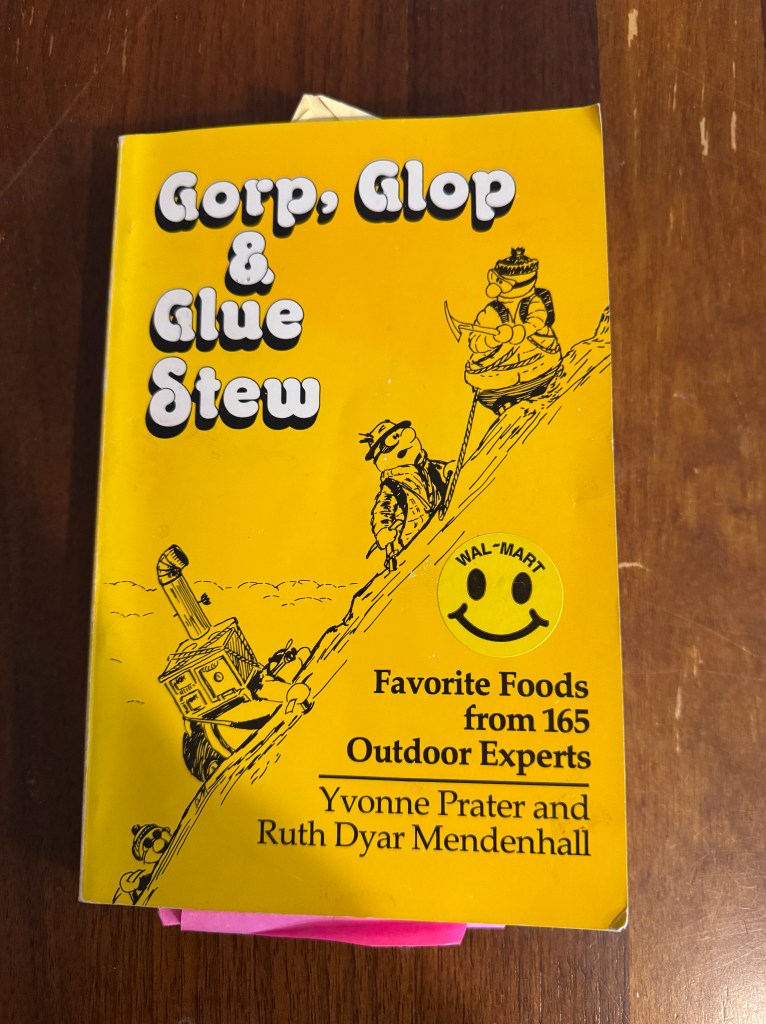
Today, I rarely buy MRE’s or Freeze dried foods. I bought a book Gorp, Glop and Glue Strew about 30 years ago. It’s a book about mountaineering foods that date back to pre dehydrated/freeze dried foods. These are the foods that conquered mountains. The foods are hardy, sturdy, and provide lots of calories. They are also quite filling. I like to make some of the mountain breads and fruit/energy bars. A little bit goes a long way and they do not require refrigeration. I can couple mountain bread with summer Sausage and cheese for the main course and then have some GORP for dessert. Drinks are usually coffee, tea, or some instant fruit mix.

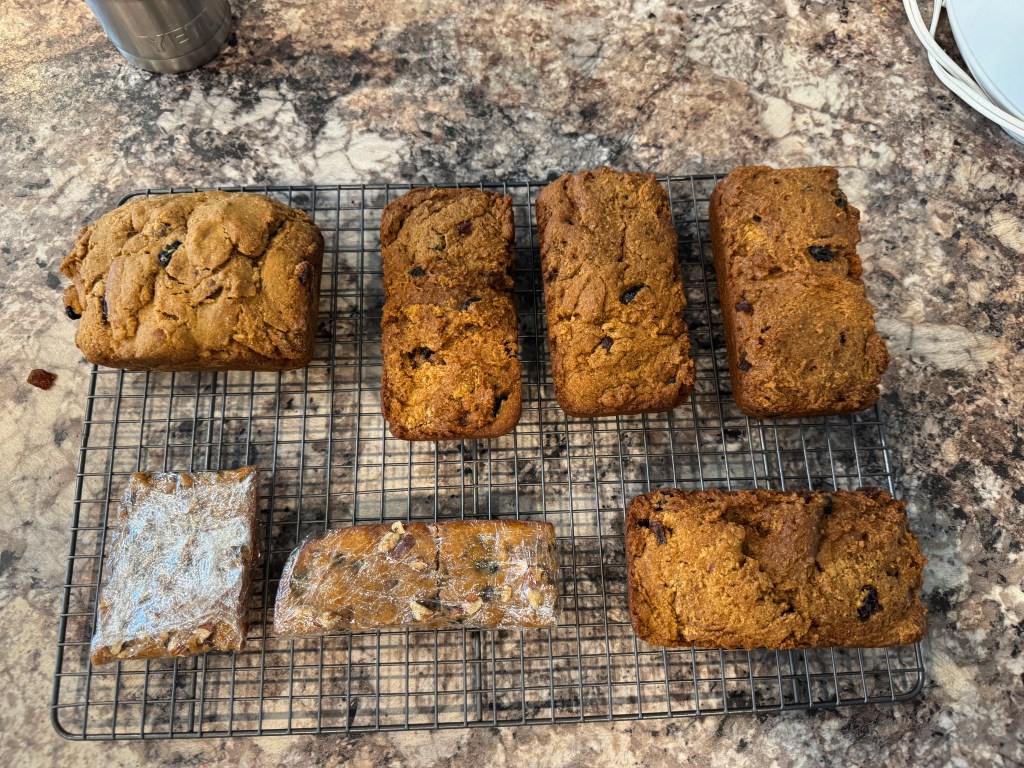
The loaves are Apple Logan Bread and the wrapped bars are Mince Meat Cookies. I will get them all wrapped and then freeze them. They last almost indefinitely. Some deployments may require a conservation of energy because those resources may be limited. Having foods that require no on site preparation is a bonus that allows you to operate longer. Sometimes, the Calvary doesn’t arrive just in time. Along with these foods, you can add Summer Sausage, Beef Jerky, Beef Sticks or canned meats. In addition to meats, cheeses keep pretty well and Ghee does not require refrigeration. Crackers or Pilot Bread are a good addition, try to find crackers that won’t crumble from the rigors of the road.

An old Army trick was to mix a little cold water with Hot Chocolate mix to make a pudding and doing the same to coffee creamer makes a field expedient whipped cream. It may not taste good at home but in the field… In the field I eat to live. These foods taste good to me especially out in the great beyond. One piece of advice; whatever food you plan to use on a deployment, start eating it now. Eat it during a POTA activation, an ARES event, or anytime you may be away from home. Now is the time to make sure your system can handle the foods you plan to eat. Having your bowels in an uproar away from home and nice “facilities” can be a very miserable experience. Stay safe es 73 de Scott

It’s Good to be SEEN

Saturday, 09 March 25, I made the two-hour trip over to Bessemer, AL to attend a SouthEast Emergency Network (SEEN) meeting. The meeting was to start preparation for an upcoming Field Training Exercise (FTX) in April. I was here to support my friend and SEEN founder Billy N4WXI.

Billy started SEEN a couple of years ago to serve his local area in case of a communications emergency using GMRS. It has since grown into a service covering the Gulf Coast States including Georgia. These are the States most affected by hurricanes. Hurricanes when they make landfall can cause extensive damage over wide areas. The focus of SEEN is to provide communications during the first few days of a disaster or until government agencies can recover their communications. SEEN is also affiliated with the American Radio Redoubt Operators Network (AmRRon). This affiliation will allow SEEN to pass messages from the southeast to AmRRon to anywhere in the USA.

SEEN primarily uses digital modes to pass traffic because it is quicker, more resilient to interference, and more accurate. Billy feels the main role of SEEN is to pass health and welfare traffic to connect families and friends inside and out of the disaster area. SEEN uses 3 apps/modes: FLdigi, JS8CALL, and VARAC. Right now, FLdigi is the heavy lifter, it has multiple modes and is used by many organizations. This allows cross group communications. The second is JS8CALL. JS8CALL is a slower but more robust and because of its excellent weak signal characteristics, it is used when nothing else will work. VARAC is the new kid on the block and has a lot of promise. This app uses VARA which is also used by Winlink. It has pretty good weak signal characteristics, but speed and automatic error correction are its strong points. A message sent through FLdigi using a mode like MFSK32 can take 5 minutes. Using JS8CALL can take 10 minutes or more. VARAC using VARA can send the same message in about 30 seconds. A good part of this meeting was spent getting folks up to speed on these modes. These are the ones that will be used during the upcoming FTX.

One of the topics talked about me sending Billy an intelligence brief from my mobile using VARAC on 40 meters. That story can be found here: KK4Z SEEN FTX 2024. The radio install can be found here: KK4Z mobile install.

As with any ham radio related meeting, the topic turned to equipment and gear. Some folks were thinking about using a QRP radio for the FTX. Both Billy and I recommended against it. There are good reasons not to and I will name a few: 1) digital modes have a high duty cycle when compared to SSB and CW. This causes the radio to heat up quicker and because QRP radios are small, there is not enough heatsink to mitigate the excess heat. The radios overheat and then automatically reduce power or shutdown. I have done this twice with two different QRP radios. They have their place, but not with EmComm. 2) Power. The primary purpose of EmComm is to get the message through, this is not a contest of how low you can go. You can always turn a QRO radio down but you can’t turn a QRP radio up. With a big radio like an IC-7300, I can run digital modes at 40 watts all day long and the radio will not even get warm.

Antennas. Again, the purpose is to get the message through. Put up the best antenna you can. Bigger is better. Your antenna in the field will not perform the same as your antenna at the home QTH. The only way you will know how your field system works is to take it out to the filed and use it. When I go on my trips, I use the same gear as I would for an actual deployment. I have 1,000’s of contacts from the field. I know my gear. A comment was made that big radios use more power than a QRP rig. True but that is easily resolved with a bigger battery. You need more juice to run that laptop anyhow. I did a test when I got home last night and checked a couple of my radios current usage at idle. My IC-705 drew 0.21 Amps, the IC-7300 drew 0.83 amps and the FT710 drew 1.28 amps. My main EmComm radio for the field is my 7300. Remember, you are most likely not going to move your EmComm gear far so weight/bulk is not a problem. You need the power and you need the heat dissipation.

To quote Leroy Jethro Gibbs “Grab you gear, let’s go”. Take your radios out to the field often. I try to get out 6-10 times a year to include both Field Days. Know your gear, know how it works. If you manage to get out, get at least 20 miles from the home QTH. That is the minimum distance that is too far to return home to get something you forgot. Learn to make do, improvise, adapt and overcome. Most of all have fun. I do a lot of Parks on the Air (POTA). POTA activators, know their gear because they get out and use it. Stay safe 73- Scott

Hamrs Pro

This past trip I was able to check out the new Hamrs Pro app. I must say I am impressed. I spent some time prior to my trip setting it up for a POTA activation. Here is my current setup:

Hamrs uses FLrig to interface the radio with the app. When the radio is connected, frequency, band, mode, and power is updated in the app. In addition, Hamrs Pro will set the RST to either 59 or 599 depending on the mode. Another nicety is when you add the POTA park number in “My Park” it will automatically add the Maidenhead Gridsquare to “My Grid”.

Tabbing is straight forward. It goes from left to right and top to bottom. In my set up I have received RST first since that is the first one I get and then a quick tab and I add mine. Time on is automatic. I always believed that computers should work for us and not the other way around. With Hamrs Pro, it does most of the heavy lifting for you.

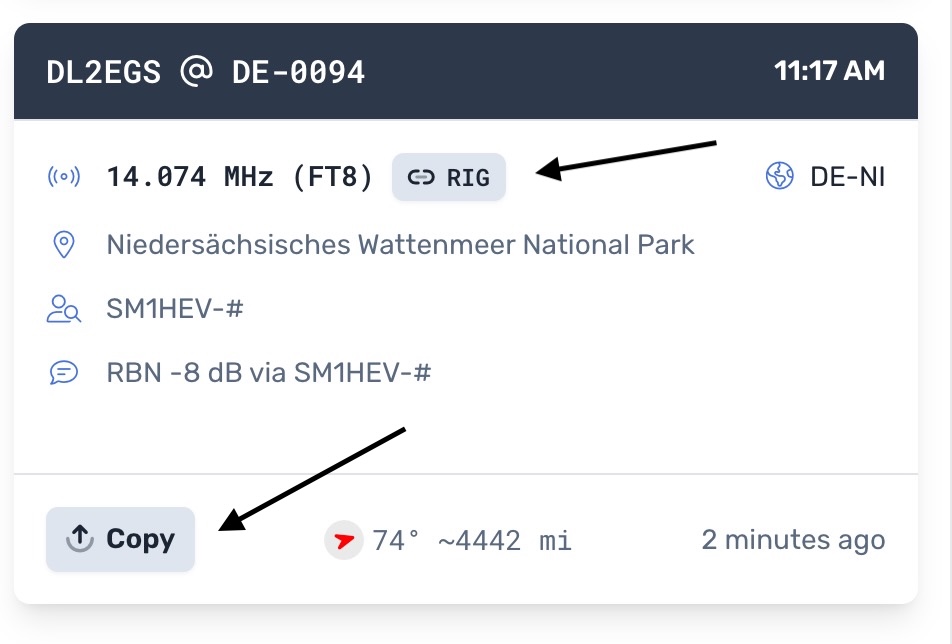
Another place where Hamrs Pro shines is the POTA spots.

There is a lot of info on the page to include compass heading and distance. If you click on the RIG button, Hamrs Pro transfers the frequency and mode to your radio. If you click the Copy button, the information is copied into the log. Add RST, hit save and you’re done. Pretty slick.

So far the only improvement I can think of is using Hamrs Pro with FT8. I don’t see an easy way to interface Hamrs with WSJT. This is not a big deal. All I do is log FT8 contacts in ACLog export the log as an ADIF, and then import the ADIF into Hamrs. It is easier than it sounds. Another way might be to use the WSJT log function and import that into Hamrs Pro.

Hamrs Pro with a $2 a month subscription allows you to sync your logs across platforms. I have Hamrs Pro on my Mac, IOS, IPadOS, and Windows. As along as I have internet or WiFi, they sync. This is great because I mainly use Windows for radio stuff and Apple for everything else. I can create a log on my Evolve III or my iPhone, and when I get home I can upload the log to POTA on my Mac — easy peazy.

I have been using Hamrs on and off since the beginning. This is a hugh step –in the right direction. I can see this as becoming my go to logging app. A lot of thinking and work has gone into Hamrs Pro. I can only see it getting better. Good job Hamrs folks. de – Scott

Night on Bald Mountain

This trip was to Cloudland Canyon State Park located in NW Georgia. It is a very nice campground about a 2 hour drive from the home QTH. I got at the campground Tuesday, around 2000Z and quickly set up. Radio du jour was the Yaesu FT710 Field which is currently under review. The antenna was my 28.5’ random wire vertical. I am also trying out my Maestro Evolve III laptop along with HAMRS Pro software.

Band conditions were a little off so I started on FT8. It was slow going but I made 15 contacts before the new day. After supper, I went back to FT8 to try to get 15 more contacts before the storms hit.

The whole time I had moderate winds and some pretty good gusts. Right before the storms I lowered the antenna and put a garbage bag over it to keep it dry. The antenna is weather sealed, but the push up pole when it gets wet, is a real pain to dry out.

How about the FT710? In general, I like the radio. I think it’s a keeper. It is fun to use and performs well. It has a few niggles that I camp about but I like it. I talk more about the issues on my YouTube video. I will say that this radio is very different than the first one I got. The first radio was probably released too early and still had growing pains. This radio just feels better. In general I feel this radio and the IC-7300 are about equal. Either one will work well.

Evolve III. This is a pleasant surprise. I paid about $122 for it and for a field laptop it does well. Last night I ran WSJT (FT8) and AcLog without any issues. I was also running. BktTimeSync with a GPS receiver in the background. It is a little slow to start up but once it’s running, it does fine. I run it with a Logitech M310 mouse.

I am also trying out HAMRS Pro. I have it on Windows, Mac, IOS (iPhone, iPad) and they all sync up. I will talk more about HAMRS in a follow up article.

This is Wednesday morning and I am going to try to do some CW before I pack up and go home. Bands conditions are so-so at the moment. I will break my normal procedure are hunt a while to try out some of HAMRS features.

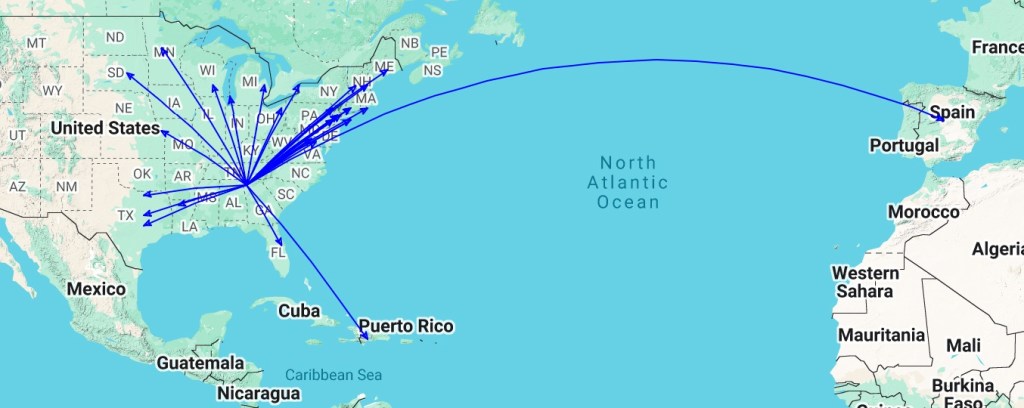
I only managed to make one CW contact hunting and activating. I could tell I was getting out as I showed up on HamAlert. Here is a QSO map of the activation.

Screenshot

If I remember correctly, I had issues last time I was at Cloudland. The important thing was I got out for a while and I had fun. It isn’t always about the numbers. Below is a video about the activation and my thoughts on the FT710. Stay tuned es 73 Scott

Moving things around

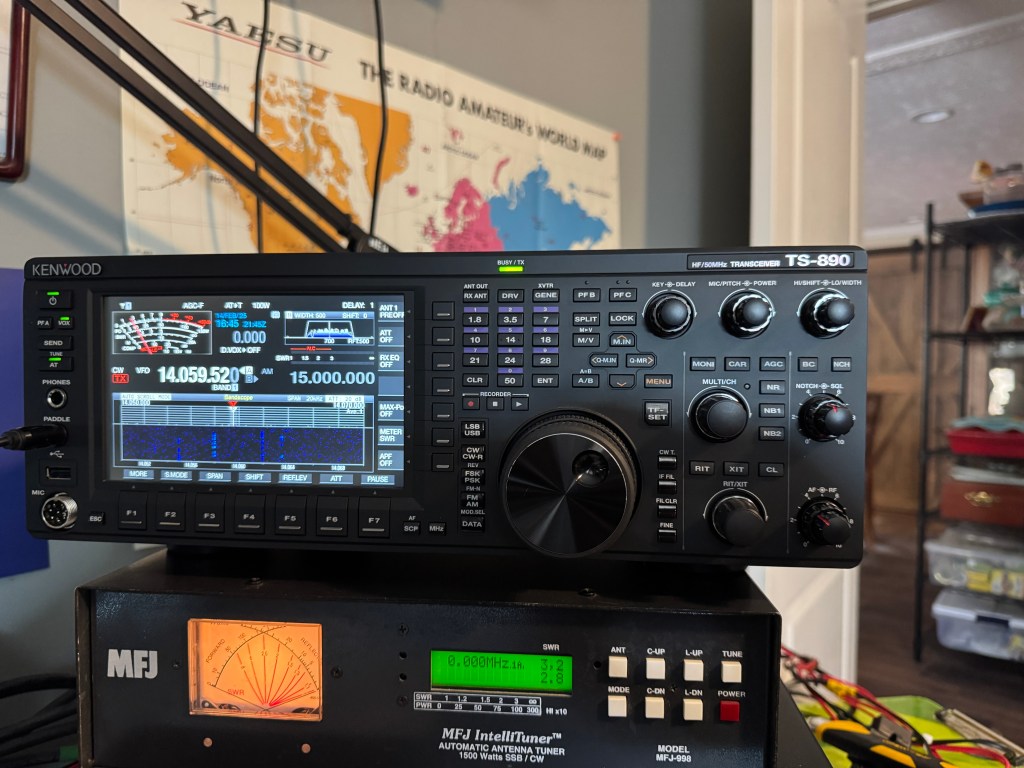
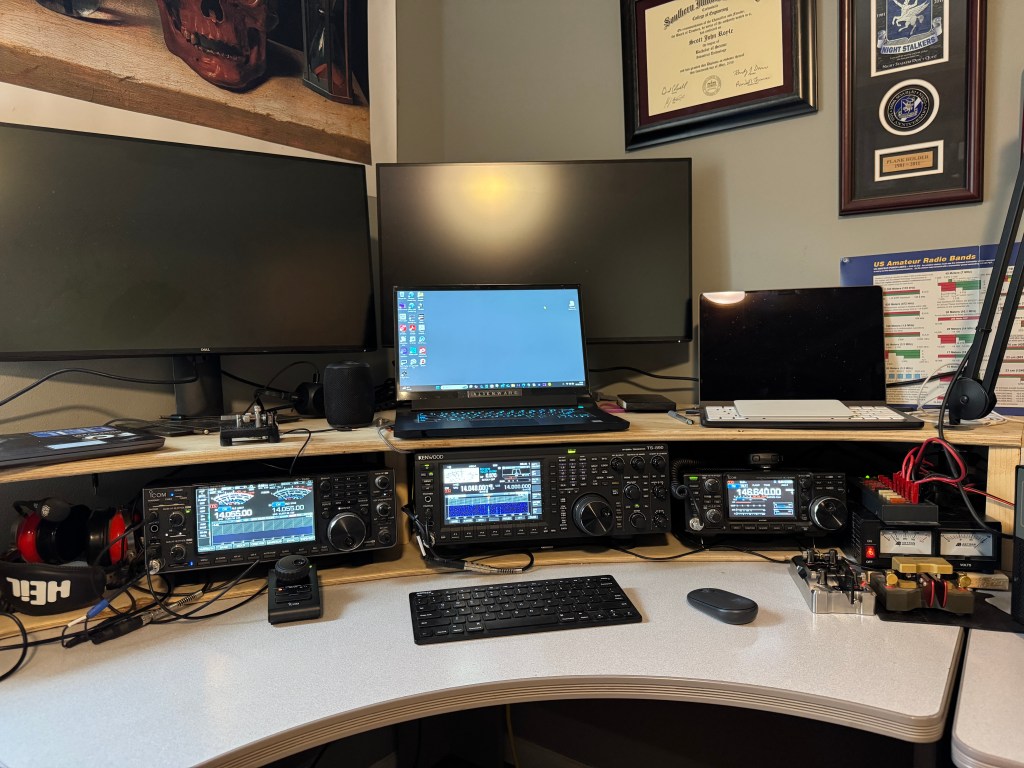
Its been a busy 2025 so far. I have been involved with MARS and that by itself has kept me occupied. I decided to change the the shack around a little to better meet my needs. I pulled the IC-7300 out of the line up and replaced it with a Kenwood TS-890s. The IC-7610 was shifted to the left which is now pretty much dedicated to MARS stuff. The TS-890s will be for everything else. I have both of my paddles hooked up to the 890 along with my Heil PR-781 microphone. I haven’t had a chance to use the 890 much but it is one heck of a radio. It is a very enjoyable radio. I am hoping to get back into CW this year. Last year was not a good year in general for radio and so far this is looking better. I want to get my code speed up. Rounding out the shack lineup is an IC-9700 for FM/DSTAR stuff.

So what about the IC-7300? That has gone back to being a field radio. That is where I enjoy it most. I also have a Yaesu FT-710 Field that is my other field radio. Over the years, I have found that I prefer big radios with better controls when I am in the field. Both radios can go down to QRP levels and if needed I can crank the power up to match band conditions. I find myself operating in the 20-35 watt range mostly and these radios can do that all day long even with digital modes like FT8.

I still have an Icom IC-705 and an Elecraft KX2 for the occasional day trip. If I am at a park, I am in my truck and I can carry a big radio 40 feet to a picnic table. I do like my little radios, but they do not see as much use as the big ones.

I have a new project I am working on. I am building a T3FD antenna to use with ALE.

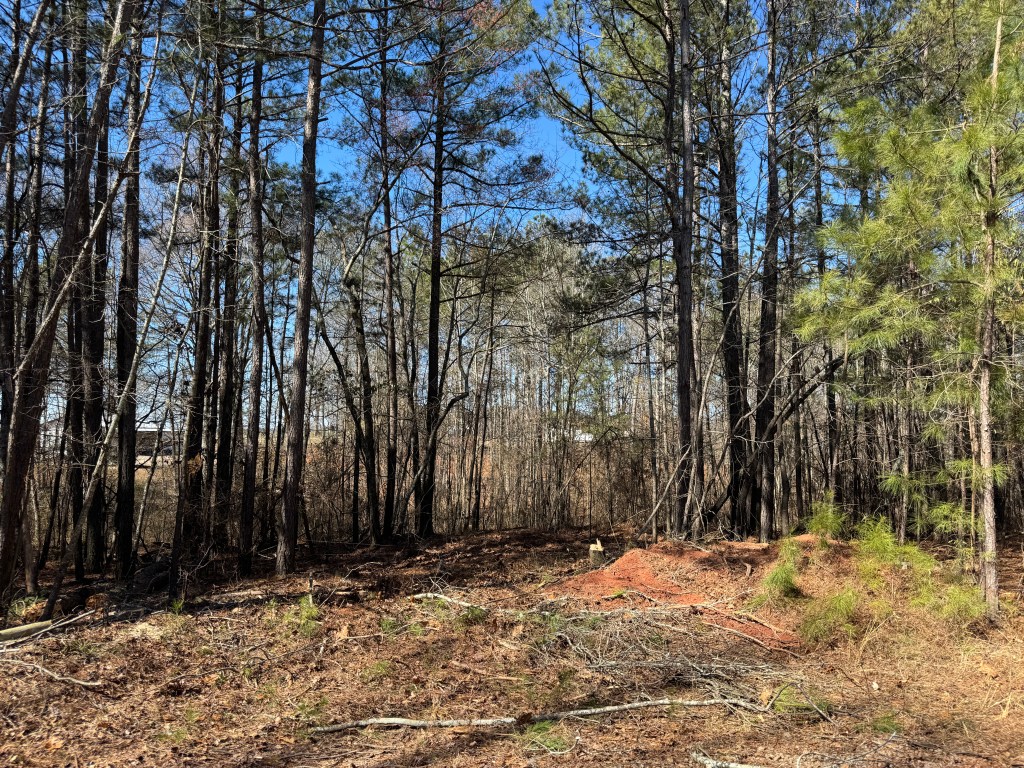
Mine will be 177′ long and it will be 90 degrees from my OCF dipole. That will give me an antenna oriented north-south (OCF) and one east-west(T3FD). In order to have the space for the antenna I had take down a few trees.

After the tree removal it looked like this.

During the last windstorm one nearby pine blew down creating a widowmaker.

These are fairly dangerous and I had to be very careful. The break was about 6′ off of the ground. Even though it looks straightforward, when the tree came down it broke into 3 pieces and actually fell back toward the stump. It was good I had an escape route planned.

The antenna will go over the top of the house, and attach to a red maple.

It will take me a couple of months to gather all the supplies I need for the antenna. Being on a fixed income doesn’t always fit into the “I want it now!” mindset.

As I write this I am recovering from a stomach bug, which can lay you out for 1 or 2 days. Another project I am working on is a mount for my Diamond RHM12 antenna. I hope everyone is doing well, that this year is better than the last, and I get the opportunity to work you. 73 de Scott

Changes

Life is full of changes. Some are expected and some are not. Over the past couple of weeks I have had some changes for the good. One is that 2025 is shaping up to be a better year than 2024. My wife and I had some trials and tribulations which hampered my radio-activity. We had deaths, surgeries, and a few other health issues that slowed us down. This year, things have appeared to clear up and I am already enjoying more amateur radio activity.

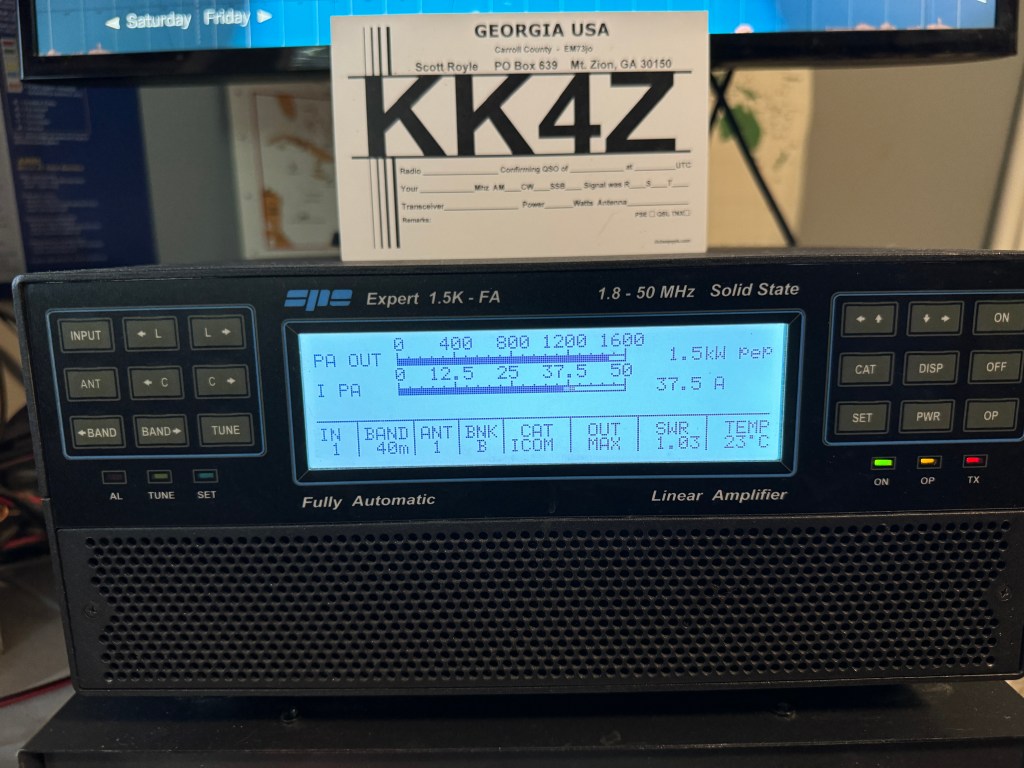
To start off, I have had another shack shake-up. In a prior post I had my SPE Expert 1.5K FA up for sale or trade. It is a great amp but I needed an amp that would do MARS and SHARES frequencies so I ended up with an SPE 2.0 K FA. When I get back from Hamcation, I had a trade offer. My amp for a TS-890s. I have never owned a Kenwood HF radio so I thought I would give it a go. The trade went smoothly.

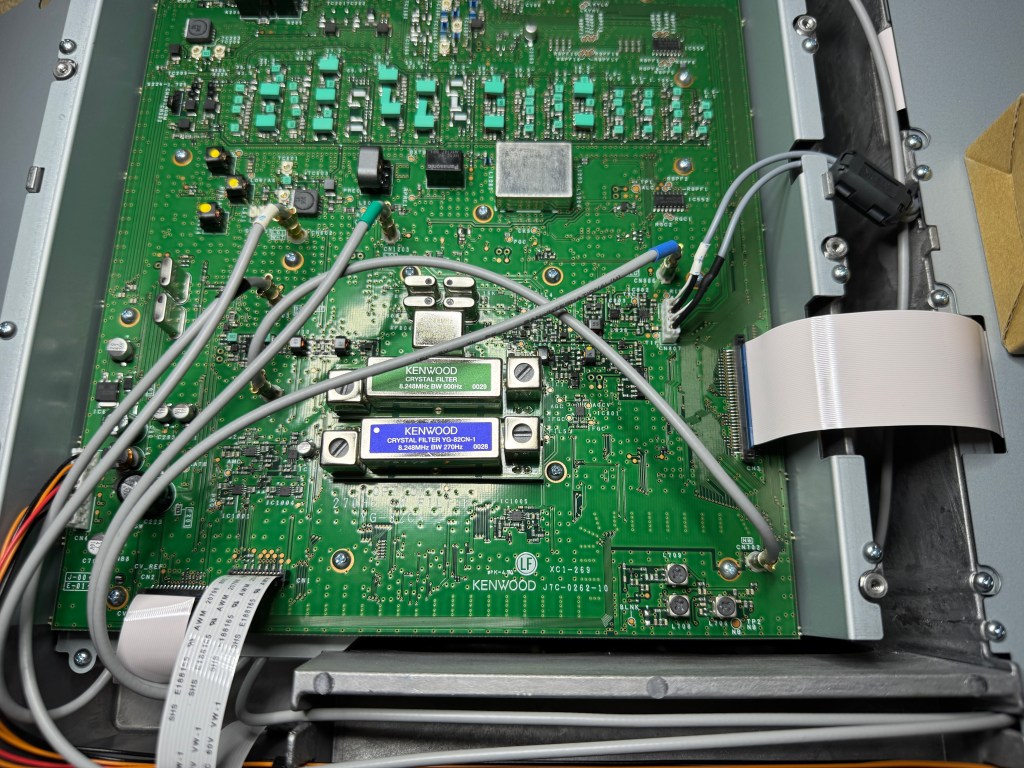
Before installing it in the shack I added the 270 Hz Roofing Filter and while I was inside, I did the MARS modification. I do not intend to use this radio for MARS, but in pinch, I am ready. My intention is to use the radio for fun and CW. I located it front and center on my desk. The IC-7610 was moved to the left which is where I set up for MARS operation. The 7610 plays very well for MARS.

As you can see in the above photo, I am using a Windows machine for radio control and logging. I really enjoy my Mac for everything else but when it comes to things radio, Windows machines are easier.

This weekend was the ARRL DX contest and the CW bands were crowded. this gave me a good opportunity to test the TS-890s. It performed very well.

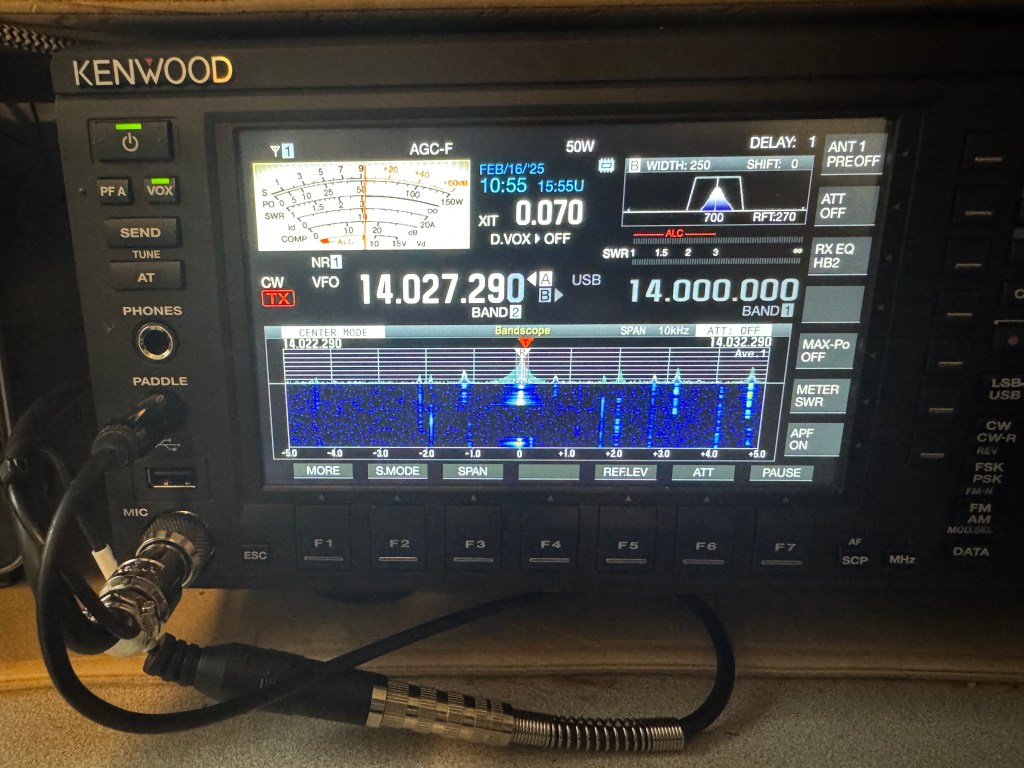
The scale on the waterfall is 5 KHz on either side of the frequency. I had the 270 Hz Roofing Filter and a filter bandwidth of 250 Hz. The TS-890 easily blocked an adjacent S9+10 signal less than 500 Hz away. Even at less than 200 Hz away I could easily copy the target signal though there was some ringing. That is pretty impressive.

I am hoping to get back into CW this year. I made about 10 POTA contacts this morning with the TS-890s. It is a very pleasant experience. The TS-890s has more buttons and controls than my IC-7610 and even though I think the 7610’s ergonomics are great, The TS-890s’ is better. The 890 is a big radio and it is heavy. It’s built like a brick…

Tools of the trade for CW are my Begali Magnetic Signature and Sculpture Swing.

I joined SKCC last year but didn’t do much because of stuff. I hope to do better this year. A lofty goal I have in mind is to get my CW above 25 wpm. I think I am close. I need to practice. Hopefully this year will allow that to happen.

I hope everybody else is doing well and I hope to hear you on the air. I have a couple of camping trips coming up which should be me and the key trips. The IC-7300? It has gone back to being a field radio. Which is one arena it really shines. 73 – de Scott

Memories past and Present

This past weekend I made a trip down to Orlando Florida to experience Hamcation. It was a lot fun. I got to meet some cool people and of course came home with some radio related goodies. The Region 4 U.S. Army MARS group had a dinner Friday night and I got to connect faces to voices. It was a good time.

This was also a time for some refection. On my way down and back I traveled on Interstate 75. This was the same route I used during the 2004-2005 hurricane seasons. I provided HF radio communication for the convoy bringing relief supplies right after a hurricane. I did this 4 times in 2004 and once in 2005. Back then, communications was not as well developed as it is today.

During those trips I would check into the South CARS net or the South Coast Amateur Radio Service net. According to South CARS: “The purpose of the net is to assist those seeking to contact other amateur radio stations, or areas; to provide weather and travel information; to assist in emergencies when needed.” They operate on 7.251 MHz from 0800 to 1300 hrs Eastern. I used the net to check my radios and listen for any travel information that might have affected the mission. I joined back then (#3773)and still occasionally check in from time to time.

On this trip I was traveling solo so I dialed up 7.251 and checked into the net. While the net was operational, they kept me company and I enjoyed listening to the net. At times, it brought me back to those disaster relief days. Good memories; I felt the sense of purpose I had back then. I appreciate South CARS today as much as I did back then. I know that if I was ever called up again to provide EmComm in Region 4, South CARS would be there for me.

Other good news is I may have a trade for my amplifier. I found a TS-890s and hopefully the trade will go though by the end of the week. I am not young anymore as I have retired twice now. I know that my days of deploying are numbered as the body starts to wear out. Currently I still go camping and therefore could deploy if needed. However, as time marches on I will become more home centered. The good news is ham radio offers opportunities both home and abroad. I have a pretty good home station and I am a pretty good Net Control Station. I plan to use the TS-890s for CW and other fun things.

I’ve had a good run. I’ve got to do some exciting things in my life. In retirement, I am still busy, I still have lots to do. My focus is changing. A fixed income doesn’t mean eating Alpo, it means careful planning. If I want something, I can have it, if I plan for it. The other option would be to go back to work and that ain’t going to happen. Life is good — de 73 Scott

Hamcation 2025

This was my first Hamcation and it was a lot of fun. Lots of people, lots of food and lots of ham gear. I only spent one day there, but it was a fun-filled, packed. day.

One of the highlights of my day was the Begali Booth. Up until this point, I had 4 Begali paddles in my collection. Each one purchased directly from Begali and each one through Bruna. Buying a Begali key/paddle is like being adopted into a family. That’s how Begali treats their customers. I finally got to meet Bruna in person.

They had many of their paddles there — so many to choose from. I like to dabble with straight keys and my preference being a cootie key since they have the same back and forth motion as a paddle. Bruna had a Sculpture Swing and after sending a couple of characters, I was smitten, and I was lucky to get the last one, the display model. I also got to meet Bruna’s husband Roberto who packaged up my prize for me.

I hope to get a review done on the Sculpture Swing in the near future.

Diamond Antennas, one of my favorite brands for mobile/portable VHF/UHF antennas has a new portable HF antenna for the US market. I have seen this antenna on European website but this was the first time I have seen it in the U.S. It is a portable HF/UHF/VHF antenna that covers 7-440 MHz. With optional coils, it also covers the 3.5 and 1.8 bands.

The screwdriver portion of the antenna is 15″ long and the 1.8 MHz coil is 17″. For comparison the yellow packaging is 21″. This will be a great antenna for POTA/SOTA. I can’t wait to get this on the air.

Kenwood had a teaser for their new VHF/UHF mobile. Looks like it might be out by the end of the year. Here is a shot of a non-working model.

It looks pretty cool. I am mainly an HF guy and I stopped there to look at the TS-890. That is my current dream radio. I brought one of my amps down there to trade but the stars were not aligned. I have a nice lightly used SPE 1.5K FA up for sale or trade. I would like to get a TS-890 and may consider a FTDX101MP. I would also consider an Elecraft KPA/KAT500. It’s a great amp but it doesn’t do MARS so I had to get another amp that would (SPE 2.0K FA).

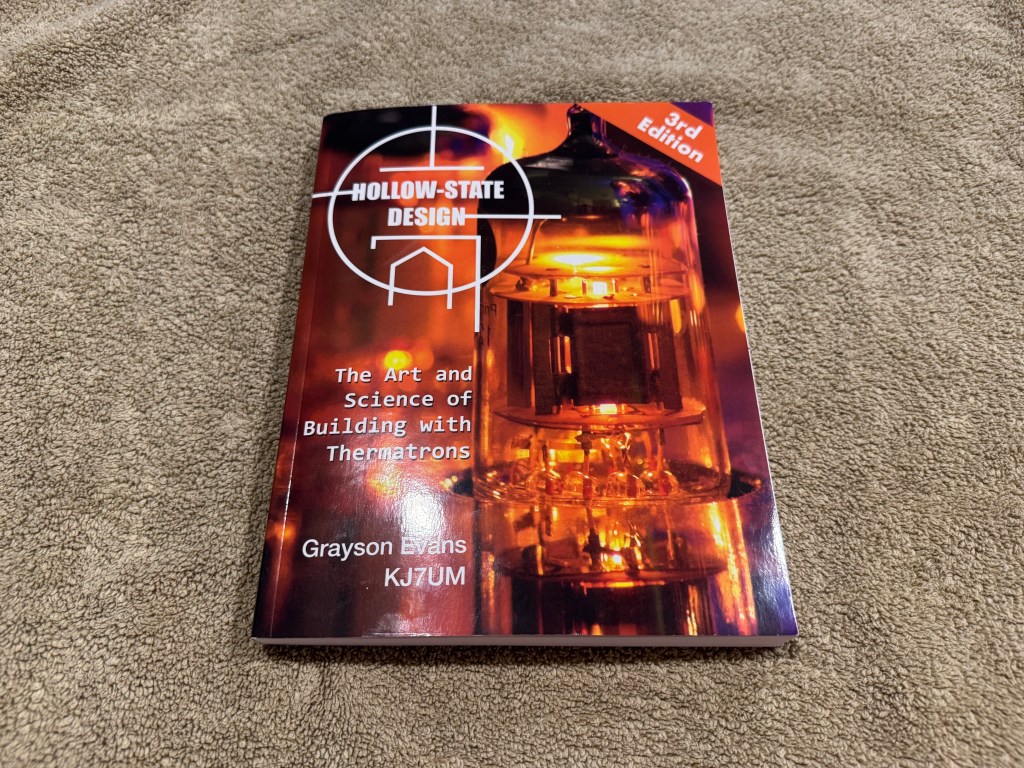
While cruisng the swap building, I came across this book:

I bought on a whim and Grayson autographed the book for me. I may never build anything out of tubes, but I thought the book would be a fun read.

I got to talk to a lot of people while I was there. I talked to one guy there that was looking to get a radio after being absent from amateur radio for many years. He was thinking about getting an IC-705. I asked him if he had any other radios and he said no. I suggested he look into getting an IC-7300 first. The 7300 is still my “if i could only have one HF radio” radio. Many times new or returning hams opt for the QRP route, not knowing how frustrating QRP can be for the less experienced. For a first or only radio I recommend a 100 watt radio. You can always turn a 100 watt radio down to 5 watts but a 5 watt radio is already at its max. A lot of times when camping, I am running CW at 20 watts.

It was fun seeing all the stuff, meeting people, and bringing home a few things. Hope to see you at the next one. 73- de Scott

Mobile Mount Upgrade IC-7100

There is always a better way to build a mousetrap

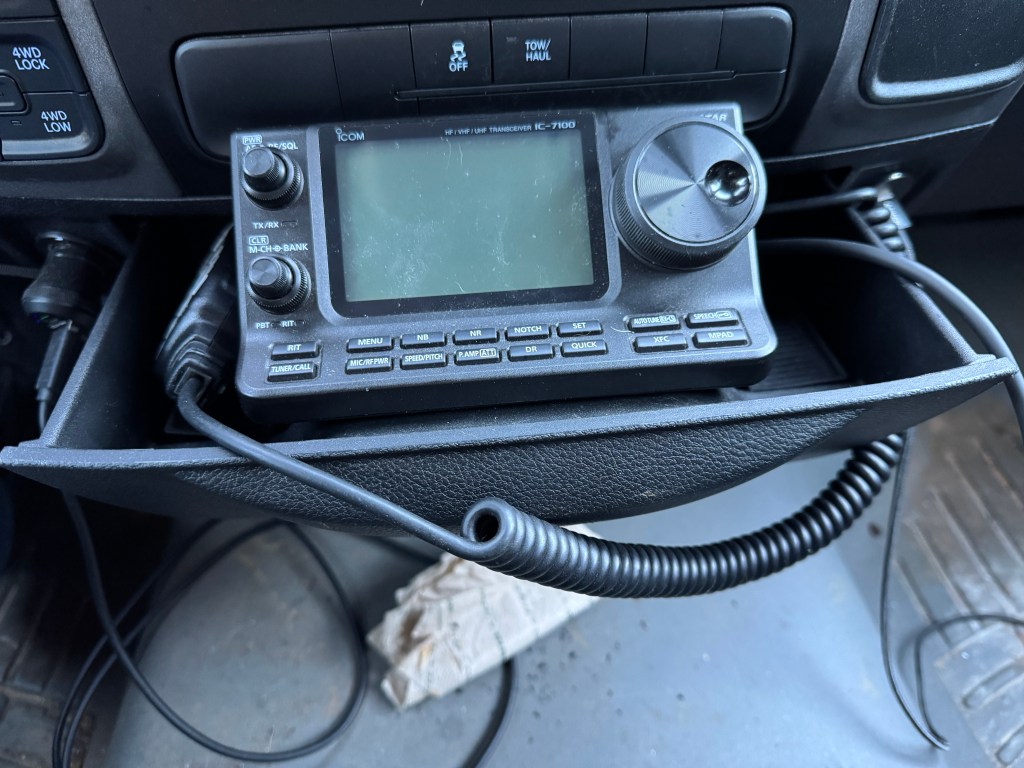
Last year I installed an IC-7100 in my truck. You can see the installation details here IC-7100 Install. The installation went pretty smoothly and I have used the radio on VHF and HF. The only fault I could find with the installation was how I mounted the control head. I used one of those Lido cup holder mounts. No matter how hard I tightened everything down, they still worked loose leaving the control head to wobble around.

Yesterday, I decided to fix this. It was simple. Using a 3 1/2” 1/4-20 bolt, some nylon bushings, washers lock washers and rubber grommets, I mounted the control head to the pull out drawer In my center dash.

I drilled one 5/16” hole in the bottom of the drawer. I put a lock washer and a washer on the bolt and pushed it through the bottom of the drawer. I then added 2-3 washers, a 1” nylon bushing (1/4” ID) a 1/4” rubber grommet, and another nylon bushing. The bushings, and washers acted like shims to keep the control head level and allow me to tighten the bolt without damaging the control head. The rubber grommet added a little extra “squeeze” so the lock washer would engage the bottom of the drawer.

It took me about an hour including driving to Tractor Supply for the hardware. It cost me about $6.

The control head is now firmly mounted to the truck and there is even a space for the microphone. The only thing I have left to do is reroute the control cable under the mat. This installation is more secure and looks nicer. I even get a cup holder back! 73-de Scott