It was time to clean out the shack. I have things that I have either replaced with something I thought was better or I don’t use them that much anymore. Here is a list of items I have up for sale.
I am the original owner for all of these. Starting on the left and traveling clockwise is the American Morse Equipment Paddle. It comes with a magnetic base and a leg strap (heavy metal base not included). $75 Next is a N3ZN ZN Lite with a plastic base. $200 All of these paddles are in good shape and work as advertised. I have more than I need. Anything not listed is sold.
There you have it. All nice stuff. Make an offer, make a trade. I don’t have to sell any of this so I am in no hurry.
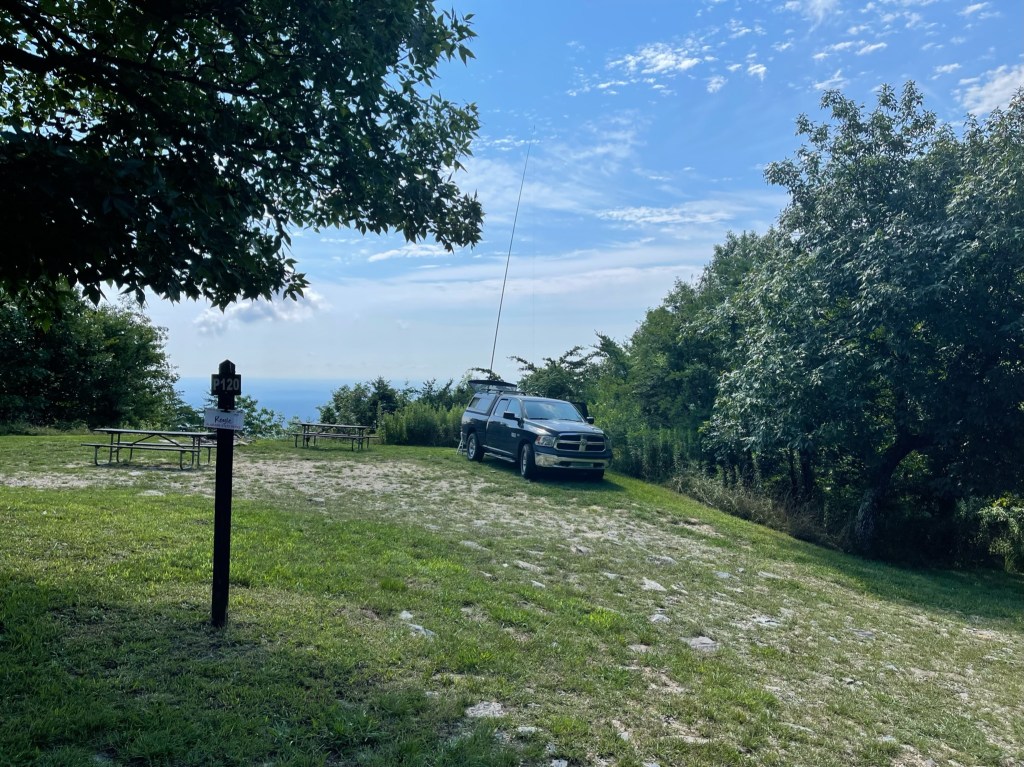
Cheaha State Park (K-1037) is one of my favorite parks and it is also the closest. It will probably be my first Kilo Award. The summer POTA Support your Parks Weekend fell on July 16 and 17 (Zulu). I got to the Park Friday morning to work a guy on 2 meters who was about 60 miles away. I did this as a part of N1CC award. I needed 2 more bands for this park. I stayed all day Friday and packed it in mid-morning Saturday. The whole activation was done using FT8 with a new app for my iPad.
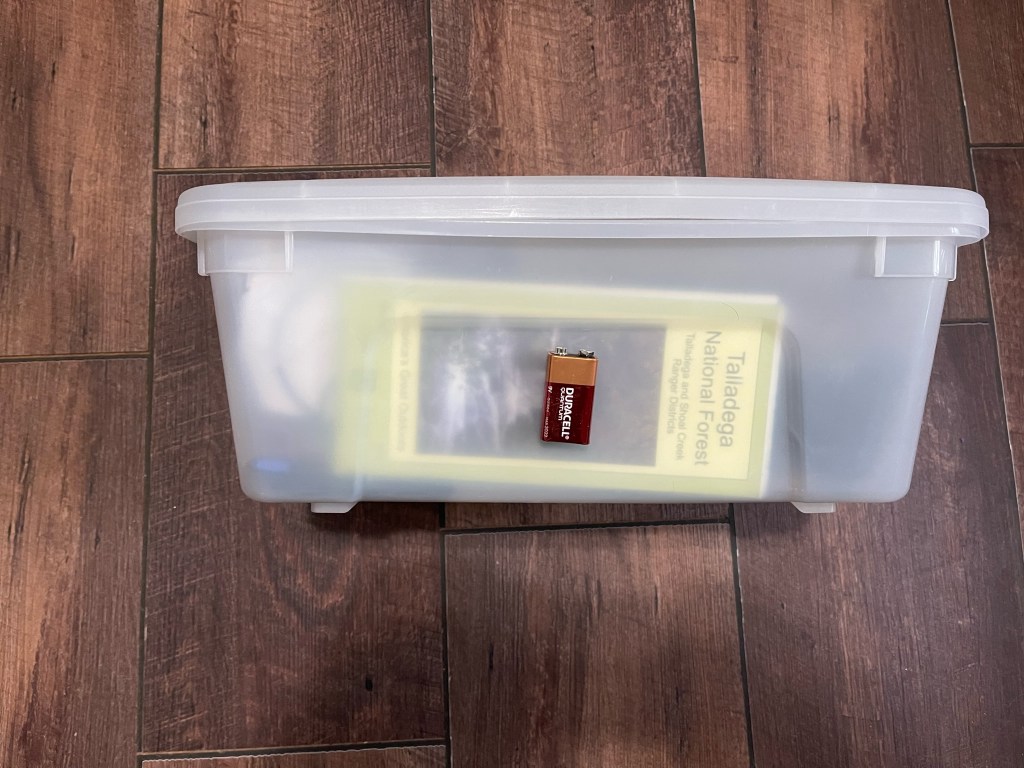
GEAR I brought a lot of gear with me mainly to try to accommodate the 2 meter sked and to try to have an antenna or two for 6 meters. Six meters turned out to be a bust this weekend. The radio was the IC-705. Normally my radio gear goes in a box like this along with a few antenna bits and a tablet/iPad.
The antenna was my K4SWL antenna was is a 29.5′ random wire antenna with a 17′ counterpoise. The antenna was matched with the Icom AH-705 tuner which did an excellent job.
The antenna was held up with a MFJ-1910 33′ push-up pole. The pole was attached to the truck with a Flagpole holder and hitch extender so I could flip the tailgate down. The campsite was a group camp and while it had spectacular views it also had little shade. This was a primitive campsite, so I could not bring my camper with me. Since this was a one nighter, I decided to sleep in the truck bed. It would be a little cozy, but doable. In the end I stayed up all night anyhow. The shack looked like this.
I had plenty of batteries with me as this site does not have electricity. I discovered that my Bioenno Power BPP-160 power pack could run things for a long time. I also brought my Bioenno 40 watt foldable solar panel to help keep the power pack charged up. Next time I won’t bring near as many batteries. The fan you see is USB powered.
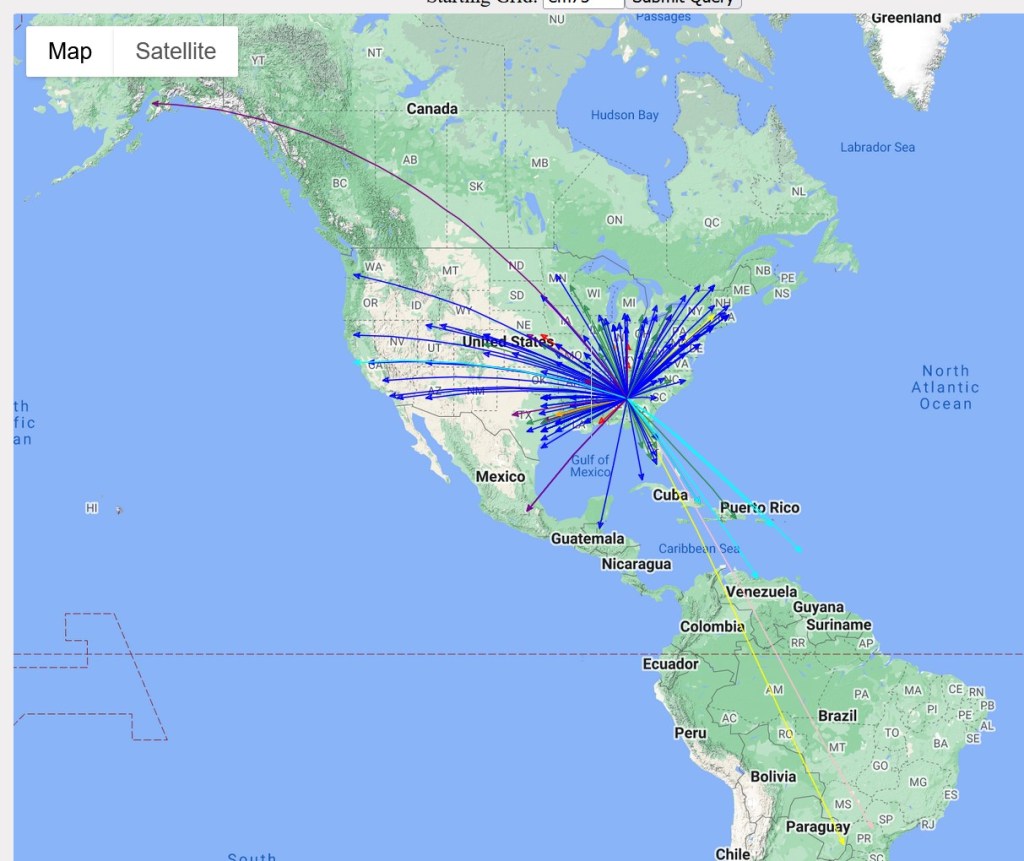
All in all, the station performed very well. I made 250 contacts all FT8 from all over the world. I even managed to get Alaska and Hawaii during the activation. Ten watts and a wire.
Glitches One of the things about getting out with your radios, is you actually see how they work in the field and then you can improve your setup. Apart from bringing too much stuff, I only had a couple of glitches. I’ll do the easy on first.
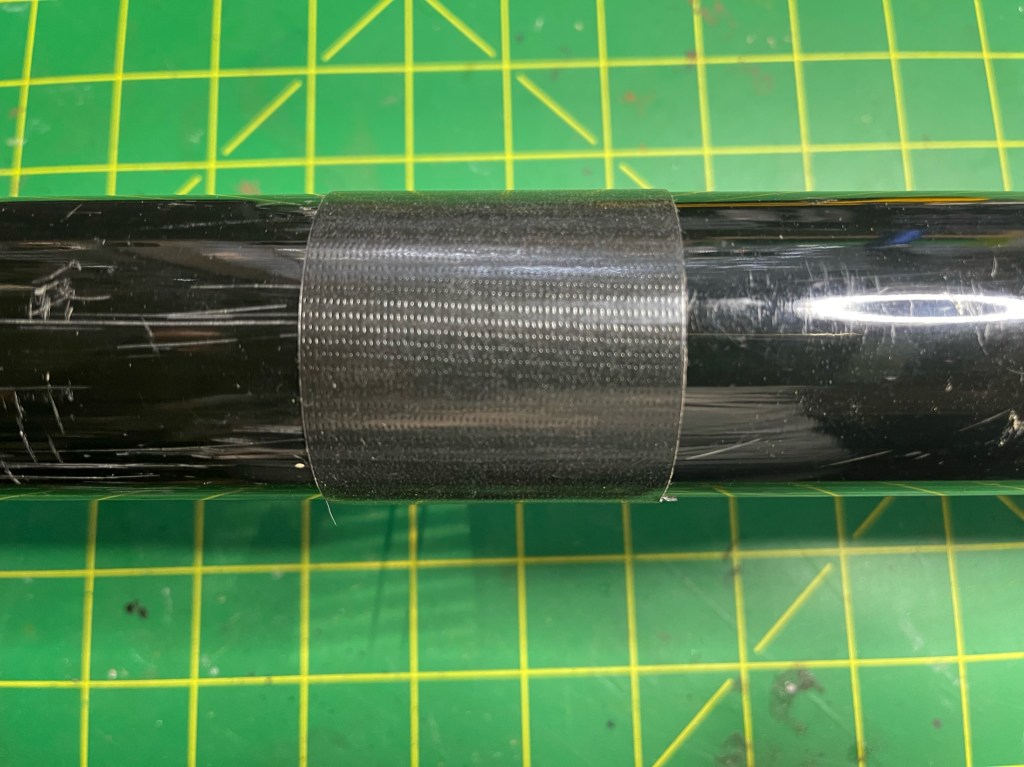
This is the first time I left my push-up in the flag holder for any length of time. I had some mild wind there and it caused the pole to rattle around some. Rubbing against the flag holder, scored the bottom tube a little.
The cure was simple. When I got home, an application of some Gorilla Tape, should take care of things.
The second glitch was the app I used on my iPad. It’s called SDR Control for Icom. It’s a really sweet app with a lot to like about it. Here are a couple of screenshots.
The interface was easy to use. I did not use a keyboard or a mouse with this. I did put the app through he wringer. I used it straight for almost 24 hours. I like using my iPad because I can power it from the same batteries as my radios — no AC adapters. I also liked being able to hold it in my hand to use it. The app does have a few short comings; enough to put it aside and allow the developer to iron out a few bugs. I spoke at length about these on my YouTube channel, so for here, I’ll give a summary: 1) The app randomly disconnects from the radio or completely shuts down. Restart/reconnect often take multiple tries and all data in the FT8 window is lost. 2) During FT8, the app will pause while another station contacts the DX. The app waits until it hears a CQ before it will transmit. The DX will often work several other stations without calling CQ. This allow other stations to “jump the line”. 3) The app will auto-log after both stations give a “73”. However, if another station call you prior to the “73”, the app will jump to the new station and the old station will not get logged. need to set the auto log to maybe RR73. 4) The logbook needs at least one user defined field that can be sticky. In POTA we use the ADIF field my_sig_info, to log which park we are at. RumLog has this feature.
It was a fun activation and I enjoyed pulling an all nighter; something I haven’t done in a long time. I didn’t plan on it but the DX stations kept rolling in. Until next time 73 –Scott
The Marines got this right. When planning for a POTA/SOTA trip. It pays to plan for contingencies. I am not talking about going overboard with this. You should still try to carry only what you need. This past weekend I did a POTA camp-out at Ft. Mountain State Park in northwestern Georgia. I usually reserve campsites several months in advance, so everything may not be perfect by trip time. Part of my planning was considering band conditions. The week prior, propagation was unstable. In addition, I was not sure about the geography of the campsite. My planning was to bring two radios; my IC-7300 (QRO) and my IC-705 (QRP). I brought my Frankentenna with an extra EmComm II transformer to handle more power.
The planning paid off. My campsite was down in a hole and the bands were not good. The site was great for camping and only so-so for radio.
One of the POTA awards I am working on is the N1CC award which is operating on ten different bands at 10 different parks. I needed 2 more bands at this park to check this park off. I chose to use the IC-7300 for more power. Since I had shore power available, I wasn’t worried about running out of juice. Station setup looked like this.
Band conditions were less than optimal, so for this trip I decided to use FT8. There were times when the waterfall on the 7300 went completely black, even on the FT8 frequency. Normally I run about 25 watts, but this time I had to go as high as 50 watts. QRP would have been a tough row to hoe. The antenna was my Frankentenna and I ran the Chameleon EmComm II transformer instead of the Hybrid Micro so I could run a little more power.
I operated from Friday afternoon until somewhere around 0100 hrs Lcl, with a couple hour break due to a thunderstorm. The next day was beautiful, much cooler than the day before when we were under a heat advisory. I operated most of Saturday until early evening when I pulled the plug with another round of thunderstorms inbound.
I made 161 Q’s including DX from Alaska and South America.
I was trying for 200 Q’s, However, the propagation Gods were not with me, but I was satisfied with the results. I have a couple of YouTube videos.
I am former US Army, so a tip of my hat to all those who serve(d). God Bless, God Speed, and 73 de Scott KK4Z
I’ve got a couple of activations coming up so I am trying to get a few things done to bring with me and evaluate. I bought the 705 because it is a small radio. I like that feature. When looking to protect the radio, many have darn near doubled its size so it is no longer a small radio. I tried a couple of padded cases and while they fit fairly well, they still felt too large. I don’t mind tossin a radio in a pack or bag as long as I can protect the important pieces. In the case of the 705 it would be the knobs and touch screen. I decided to make a cover for the front of the radio.
Icom has an STL file for the 705 https://www.icomjapan.com/support/IC-705_STL/ so pulling that into a CAD program, I was able to make a cover. I am not a CAD pro or even a 3D printer pro; however, I was able to scratch something together that is good enough. I roughed out the design and my son printed the cover out for me. It’s not beautiful. it’s not perfect, but it gets the job done. Here is the current prototype.
The inside is mostly hollowed out but the case is supported on the corners of the radio and the speaker area.
For POTA activations the radio resides in a plastic box with a latching lid. Should eb plenty of protection. Because I reduced the bulk and weight, it make the radio eligible for SOTA. I may make another one to adjust some of the dimensions but in reality, it works just fine. I can tweak this and burn a lot of time or I can get out and play radio. Remember “Perfect is the enemy of good”.
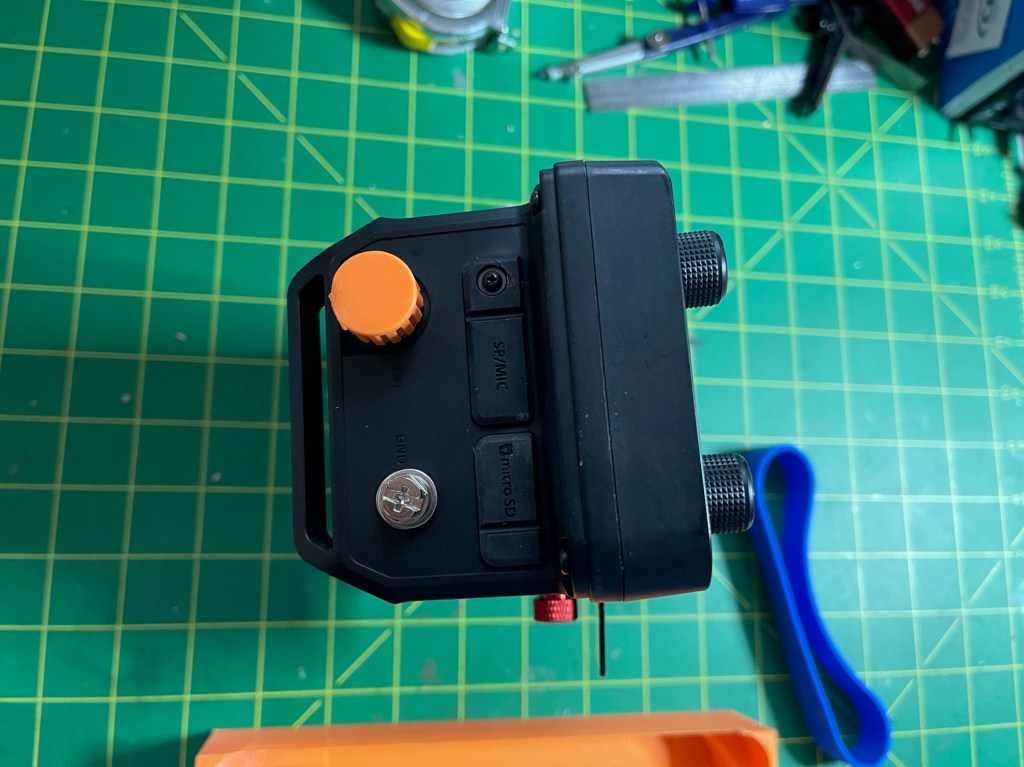
I made one other piece, BNC caps, which the STL files are available with a simple Google Search.
I like orange as I can readily see them if I accidentally drop them. Enjoy and hope to work you. Scott
I like to travel light. Less is better. When I do POTA or SOTA activations I really don’t like to have a lot of stuff. Just what I need with maybe a few essential extras. Over the past couple of activations, I have been doing battle with my Surface Go2. It’s pretty noisy in the RF spectrum range when recharging the battery. It works great as long as I do not have to recharge the battery. When I do have to recharge it, I need more gear because I cannot charge it from the same batteries I use for my radios. That usually means shore power, or an inverter — more stuff. Yes I know I can paper log or I can log on my iPhone using apps like Hamrs or RumLog but with today’s band conditions, it is nice to have FT8 in the toolbox. I decided to try SDR-Control for Icom. This app allows me to control my IC-705 from my iPad and it includes FT8/FT4! The stuff I had to bring with my surface looks like this.
This does not include whatever power source I need to recharge this. My iPad looks like this.
Whatever I use to run my radios, I can also recharge the iPad’s battery. Two of my solar panels have usb ports so I can charge the iPad directly from them while also charging a battery. This is something else I cannot do with the Surface. My truck has usb ports so I can charge from it. I set the app up with my IC-705 and it works as advertised. I have an activation planned this weekend so I will try to give the new setup a good work out.
There is a caveat, and that is the app works with the IC-705 (also the IC-7610 and IC-9700). This is not a problem as the 705 is my goto POTA radio. On the occasion I bring a different radio, I will either forgo FT8 or bring the Surface and work with its limitations. If I am doing something like a SOTA activation, I would either log on paper or my phone in which case I would not bring either the iPad or the Surface.
I may or may not add a keyboard to the iPad. It’s screen keyboard is pretty good. Another thing is I am using a 2018 iPad (6th Gen) so it’s not the most zippy out there but does fine. Most radio apps don’t require a lot of horsepower to run them.
I have another activation planned that does not include shore power at any of the sites. I will be relying on battery/solar to make it through the activation. I’ll dig a little deeper as I put a few activations under my belt with this new set up. 73 Scott
I was finally able to set aside some time to do an activation. Cheaha State Park is the closest to me and it is still over an hour away. It is my home park and I enjoy going there. Today’s mission was to try to pick up a few more bands for my N1CC award. N1CC is an award for working 10 different bands in 10 different parks. Propagation was not that good today so I stuck with FT8. I also reconfigured the back of my truck a little and it seemed to work better. I did a write up on my other blog here: https://canteenspoon.com/2022/06/26/hello-and-some-truck-organization/
From the outside back of the truck facing forward looks like this.
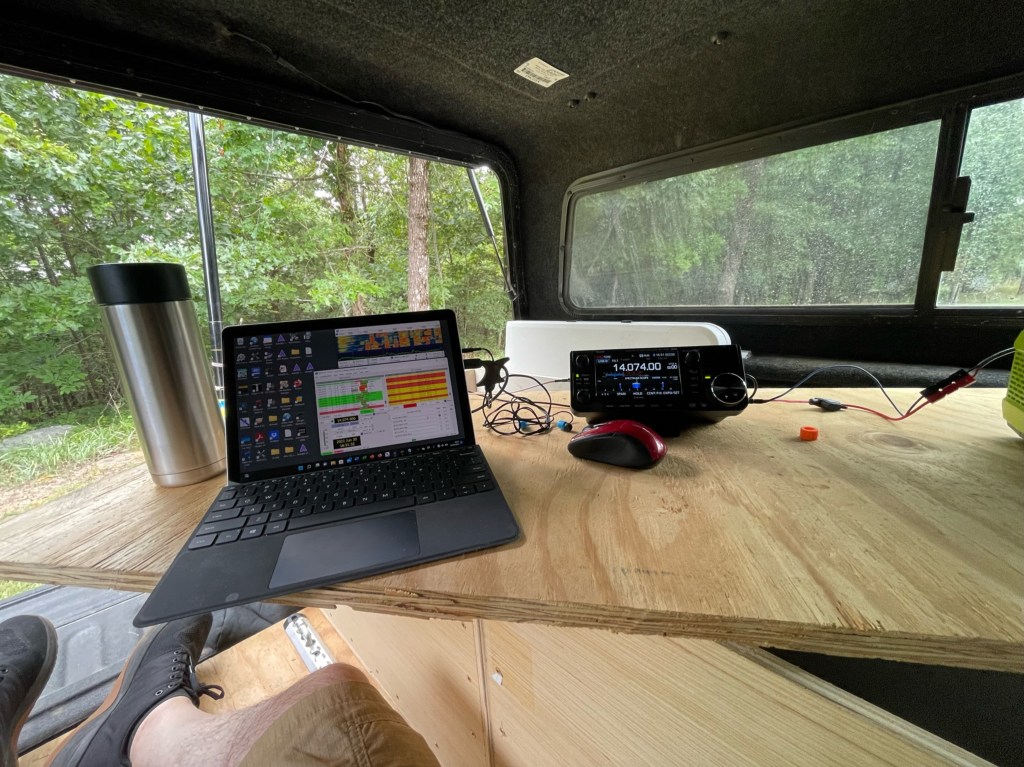
The boxes help me keep the back of the truck more organized. As a bonus, the boxes are at a good height for a desk. The current desk is just a piece of plywood I had. In the future, I will get something smoother. With the desk as positioned I can get in and out without knocking the radios around. I haven’t tried it yet, but I may see how my lounge chair fits in there. I may be able to sleep in there for a quickie activation. From the working position it looks like this.
Plenty of room to work and log. My other mode is CW and there is space for a set of paddles. The tablet is a Surface Go2 and while it works really well, the one caveat I have is when you try to charge the battery, it wipes out the receiver with noise. The waterfall almost turns white. But, I got almost 4 hours of playtime so while it is something I have to figure out, it can be later. The radio is an Icom IC-705 with the AH-705 tuner. This really is my favorite QRP radio.
The antenna was a Chameleon Hybrid-Micro with a 65′ antenna in the form of an inverted “L”. I used my hitch mount with a 33′ MFJ pushup pole. The other end was held up with my B&M 20′ crappie pole. I ran a 65′ counterpoise.
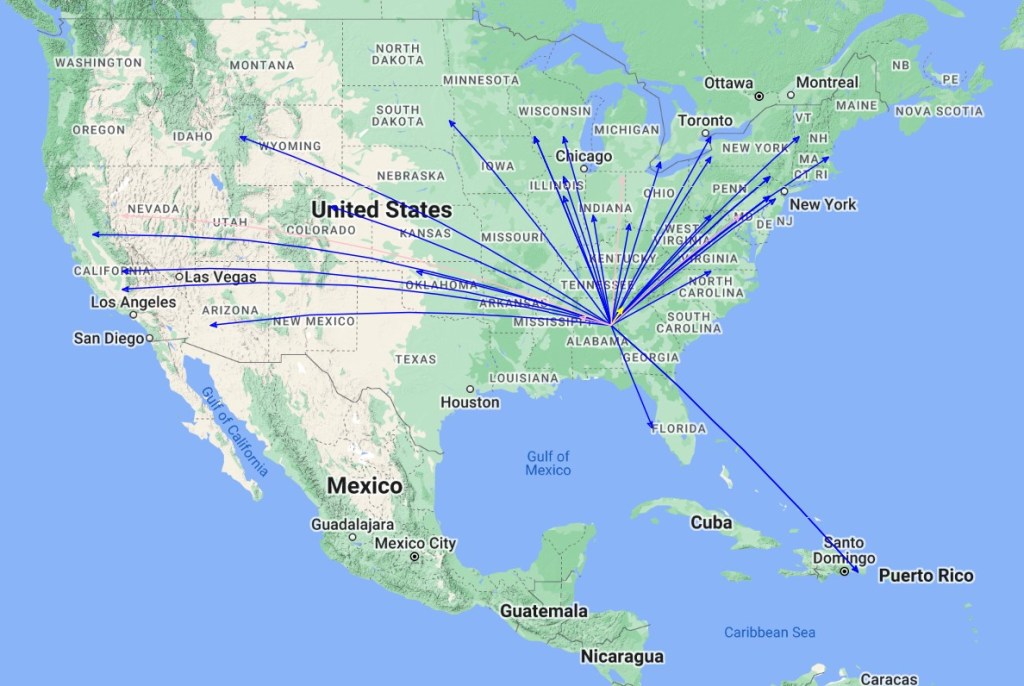
The antenna was okay. Next time I will probably run a vertical. Either my Frankentenna or my random wire. I didn’t feel like the extra effort to put up an inverted “L” was worth it. I like a small footprint so as not to attract attention to myself. I was running 10 watts with the help of a Bioenno battery. Band conditions were not that good today. I usually work a few more DX but I am satisfied with what I got. Here is an activity map.
I ended up with 38 contacts and I have 8 bands total. I will have to come back in the evening and pick up the last two bands 60-160m. Thanks to everyone who worked me today, some of the contacts were difficult due to unstable band conditions. 73 Scott
This past week I wound a few more toroids using a 77 mix. The toroids are 0.5″ in diameter and wound with 22 awg insulated magnet wire. I wound one with a single core and one with a dual core. My goal was to try to get a little better low band performance. I get a kick out making a few contacts on 60-80-160 meters. The finished UnUns are 9:1.
We’ve been going through a heat wave this week with a heat advisory every day. I got up early and tried a couple different antennas. Using antenna wire from my Frankentenna, I built an end fed with a 65′ antenna and a 65′ counterpoise. I also tried the 65″ antenna with a 17′ counterpoise. The set up looked like this.
For this antenna, the best combination was a 65′ antenna wire, a 17′ counterpoise and the single core 77 mix 9:1 UnUn. I got the following readings from my Rig Expert Prostick with 6′ of RG316. As a control I also tested my Sparkplug transformer. Band SWR (17′)—–SWR (65′)——Sparkplug 65′ 160 – 2.4 ———— 4.2 ————– 5.6 80 – 5.4 ———— 1.1 ————–8.3 60 – 1.7 ———— 2.3 ————– 12 40 – 2.9 ———— 3.5 ————– 1.7 30 – 6.9 ———– 4.5 ————– 16 20 – 3.8 ———– 4.0 ————— 1.5 17 – 5.2 ———– 5.7 ————— 9.7 15 – 4.1 ———– 4.3 ————— 1.1 12 – 6.2 ———– 6.9 ————— 10 10 – 4.5 ———– 4.6 ————— 2.6 6 – 5.9 ———– 5.8 —————-14 Fiddling with the counterpoise length could make things a little better, but overall the SWR’s are low enough to match with a good tuner. I realize that running a short feed line would affect the Sparkplug so in another test I added a counterpoise and it did bring down the SWR on some bands. However, to me the winner is still the single core 77 mix 9:1 UnUn.
Another antenna that I like is a random wire antenna I call the K4SWL antenna https://kk4z.com/2022/06/05/k4swl-antenna-plus/. I call it that because it was Tom K4SWL who I got the basic design form. It’s a 29.5′ antenna with a 17′ counterpoise. I built an UnUn based upon a QRP Guys design but wanted to try to get a little better performance on the lower bands. In this case I used a two core 77 mix 9:1 UnUn and got the following results. Band – SWR 160 —- 2.0 80 —- 1.7 60 —- 1.5 40 —- 1.5 30 — 1.5 20 — 1.4 17 — 1.3 15 —- 1.3 12 —– 1.2 10 —– 1.2 6 —— 1.2 Realize that this is a small antenna and will not be as efficient as a full half wave dipole (on 160 meters, that is 270′). However, it would be fun to see if you can make a contact on 160 or 80 meters in a park with a small antenna. So get out there and play radio! 73 Scott
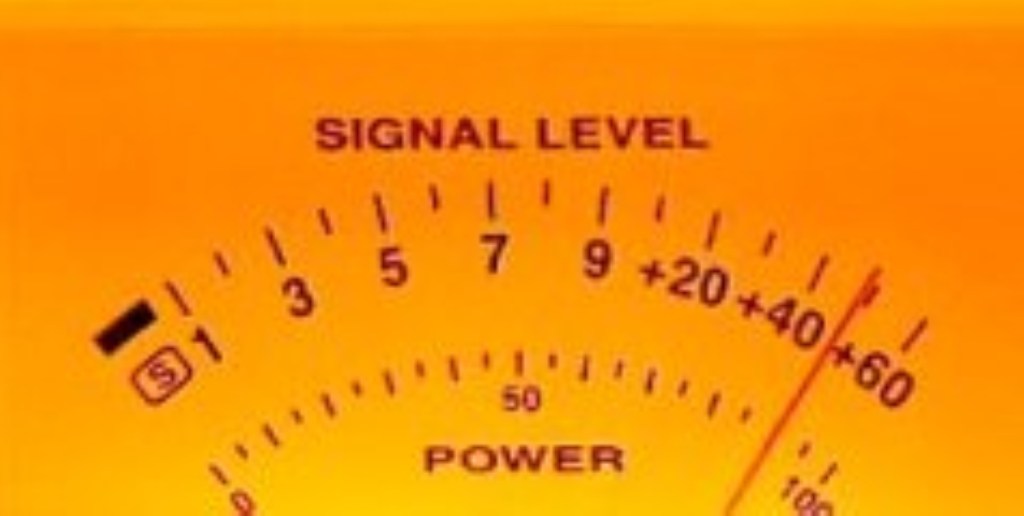
There is always a lot of talk about QRP vs QRO, 5 watts vs 10, ad nauseam. So today I thought I would run the numbers and see what the real deal is. First we need a few definitions. An S-unit in general terms is the minimum change in signal strength to be just noticeable (k3wwp.com). In more technical terms it equates to approximately 6 db in change. The decibel (dB) is a logarithmic number. Each 10 dB represents a factor of 10 difference. This may be a little out there for some so we will cut right to the shortcut. There are two types of logarithms. For calculating dB, use the common logarithm which is base 10. To see if your calculator uses the right one. Punch in 100 and then log. The answer should be 2 which equates to 10 to the second power which equals 100. This is not a technical paper but an entry way to see how changing the power levels affect the signal level of your transmitting signal. As you guessed, it is not linear.
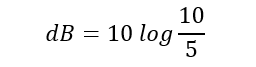
Let me introduce an equation:
Where Power P1 is the power you wish to evaluate and reference power P2 is your starting power. Let’s take going from 5 watts to 10 watts. The equation would look like this:
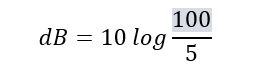
We take 10 and divide it by 5 which give us 2. Then we hit the log function on our calculator which gives us 0.301. Multiply that by 10 and you have about 3 dB in gain or about one half of an S-unit (remember 1 S-unit is equal to 6 dB). Let’s do one more by hand and tackle the QRP/QRO debate. How many S-units will increasing power from 5 watts to 100 watts give you? The equation looks like this:
Take the 100 and divide by 5 to give you 20 and then hit the log function to give you 1.301. Multiply by 10 for 13.01 dB. Divide 13.01 by 6 dB and you have 2.17 S-units. Going back to our definition that one S-unit is the minimum change in signal strength to be just noticeable shows that going from 5 watts to 100 watts is not that great of a change.
Let’s let the other shoe drop. What about going from 5 watts to 1500 watt? That will give you 4.13 S-units of gain vs 1.96 S-units going from 100 watts to 1500 watts?
This gives you a fairly easy equation to help you evaluate your needs based upon empirical data. Running 20 watts over 5 gives you 1 S-Unit. Using less power means less drain on the battery for longer operation. This is only part of the equation. Propagation, antenna, mode used, and station efficiency all play a part. Have fun and maybe don’t toss the QRP radio yet 🙂
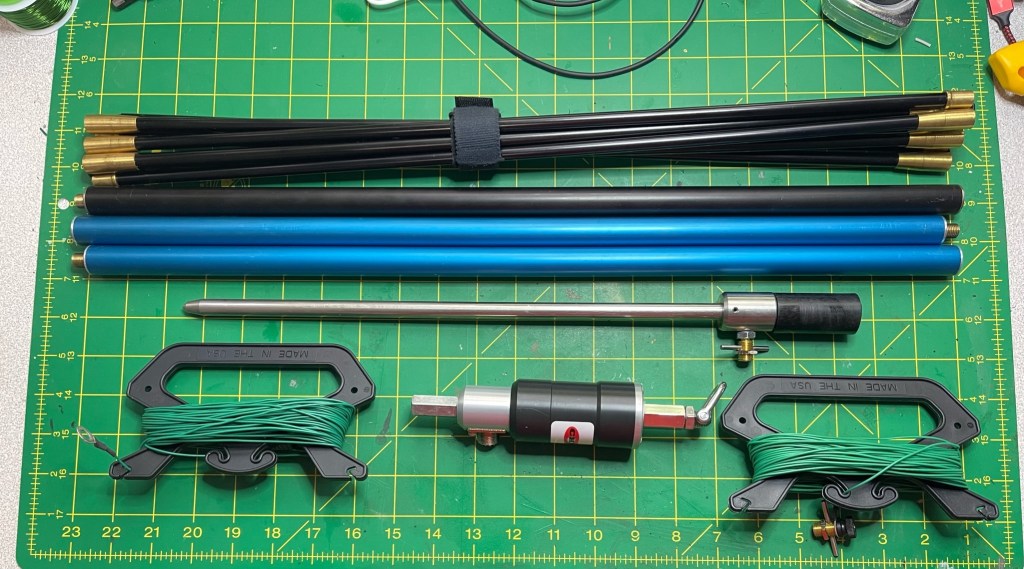
I have been playing with portable antennas for years. When operating portable, the antenna probably has the biggest effect on how well you portable station works. I have quite a few portable antennas. Some are specialty antennas and some are my “go to” antennas. When operating at a park for Parks on the Air (POTA). My Frankentenna is my go to. It has evolved over the years, but now I mostly tweak to get it how I like it. Here is the antenna and its parts:
This is the basic kit. With it I can make a vertical antenna, and endfed with a counterpoise, and even a dipole. The kit is pretty lightweight and easily fits into a standard Buddipole bag. While at park campgrounds, I usually run it as a vertical. I keep an arborist throw line and weight in with my station equipment. I have some tweaks and mods I have done. Two that you see here are the phenolic insulator and a mod to the spike.
The spike mod is an improvement on the current ground screw. It was a red plastic knob with about an 8-32 screw thread.
I felt it was too small since most counterpoises have either 1/4″ OR 3/8″ eye on the end. I carefully drilled out the hole and tapped it for 1/4″-20 thread.
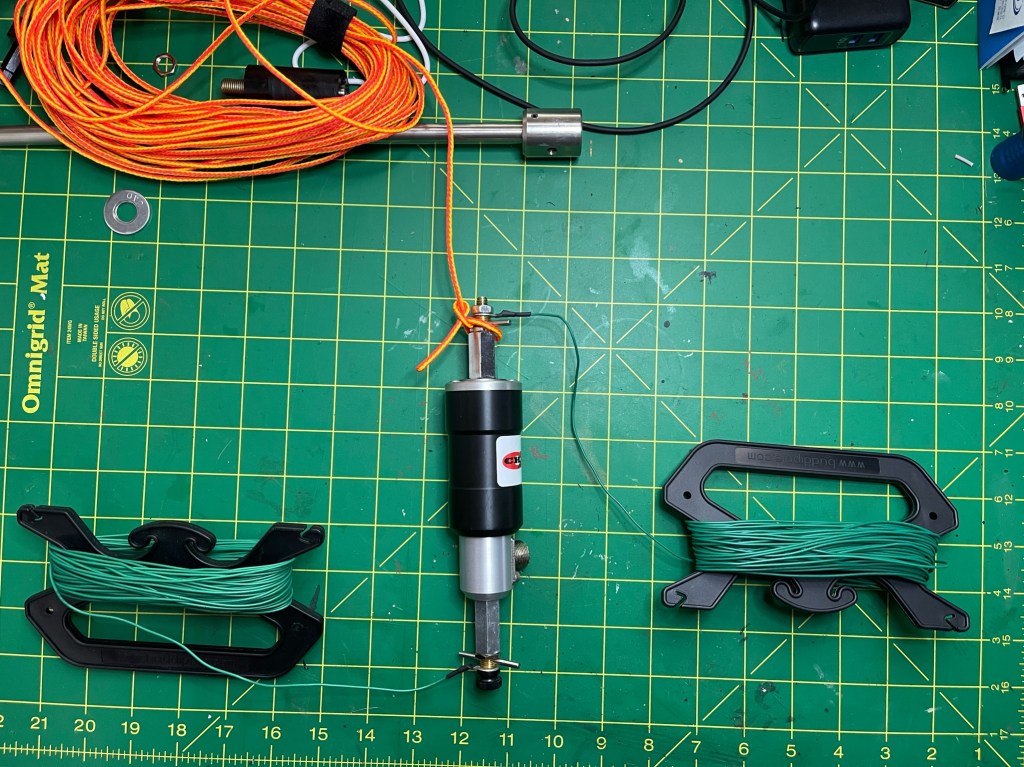
This now allows me to use a Buddipole Counterpoise Wire Adapter https://www.buddipole.com/noname2.html which is 1/4-20 on one end and 3/8-24 on the other. It gives a more secure connection between the spike and the counterpoise. These are the same adapters that come with the Buddipole Wire Assembly and you can buy them separately https://www.buddipole.com/noname2.html. finished, it looks like this.
One of the things I didn’t like about the Chameleon Micro was the shackle it comes with. The shackle is used to support the transformer when it is used as an end fed or a dipole since it is too heavy to be supported by the antenna wires. It was always kind of hincky getting the shackle setup right. Now I use the Buddipole Counterpoise Wire Adapters. So much easier and so much lighter.
The other mod is a phenolic (micarta) insulator. This allows me to use the vertical with something other than the Chameleon transformer. An example might be one of my homebrew 9:1 UnUn or a Buddipole coil. The insulator is threaded on one end and has an insert on the other, both 3/8-24.
How does it play? Quite Well. I tested 2 configurations I would most likely use during a POTA activation. The first is a 54′ end fed with a 50’ish counterpoise using the Chameleon Micro. Using my RigExpert Stick Pro I got the following. Format is Band — SWR 160m — 5.7 80m — 3.2 60m — 3.5 40m — 4.1 30m — 3.2 20m — 2.1 17m — 3.7 15m — 1.7 12m — 2.2 10m — 3.6 6m — 2.1 The second setup was using the Micro as a vertical. The antenna is approx 17′ (very close to the Chameleon) and running a 50’ish counterpoise. 160m — 6.7 80m — 3.7 60m — 3.5 40m — 2.4 30m — 1.5 20m — 1.3 17m — 1.3 15m — 1.9 12m — 2.8 10m — 3.1 6m — 1.8 During this last activation, I mainly used the vertical arrangement as that suited the space I had. The antenna performed well. I made 100 contacts here and abroad. To see a map check out my post about my activation at Kolomoki Mounds State Park.
What’s next for this antenna? I have two Black Accessory Arms and a Counterpoise Wire Adapter coming from Buddipole. The arms will make the antenna more stealthy and the extra adapter will reside on the spike. I may try the Buddipole coil to see how it plays and I just got some new toroids to see if they work any better. Overall, I really like this antenna. It’s light and compact and goes up anywhere. The SWR is low enough that almost any tuner, can tune it, even on the low bands.
I decided to try a park in SW Georgia and Kolomoki Mounds State Park looked interesting. It was about a 3 hour drive traveling back highways and byways. I spent two nights there with my wife and it was a very nice experience. The campground was quiet and the restrooms were clean.
Hot! it was hot and very humid while we were there. My little camper has AC but everything got damp in that kind of humidity. Ambient temperature was in the low 90’s and the high humidity made it feel hotter. I plan on going back there but maybe in the fall or winter.
The propagation gods were angry. While there, I suffered from R1 radio blackouts mainly due to flare activity. The bands were mighty quiet; however, I was still able to make 100 contacts over the weekend.
Testing! Test,test. I brought a couple of antenna projects with me to do some field testing with. These included some of the 9:1 transformers I wound. I will report on the results in a separate post.
Setup. This weekend, I brought my IC-7300. I brought it for a couple of reasons. I hadn’t used it in a while so it deserved an outing. Plus, I had foreknowledge of the possibility of poor propagation so I brought it to run FT8 and have a little more power. I ran it in the 25-35 watt range and the 7300 can run like that all day long. However, the antenna I used is happiest when the power stays 25 watts or less on digital. This was fortuitous, CW, my preferred mode, was non existent at my location. I made one CW contact on 60 meters. The antenna I used was my POTA standby, my Frankentenna.
I ran one 50 foot counterpoise off into the woods. In the photo, you can see the lower 2 Buddipole extensions, the blue is pretty easy to see. I ordered 2 black ones to better allow the antenna to blend in. The antenna was fed with about 31 feet of RG-316. The shack looked like this.
I used a LDG Z-11 Pro to match the antenna. To sync time for FT8 I use a GPS dongle I got from Amazon https://tinyurl.com/2p9595sz. I sync the time to WSJT using GPS2Time. I used N3FJP for logging. The set up worked well. Since my little camper has an awning, I stayed in the shade all day and drank plenty of fluids. I lost a pound of weight over the weekend. A side note. When I operate in a campground, I wear ear buds and run either CW or FT8. I do not make “radio” noise. Out of sight, out of mind.
How did I do? Pretty good actually considering the poor band conditions. I am attempting a N1CC award so I was trying to work 10 bands while at the park. Here is a QSO Map from the activation.
It was work. Sometimes I was just banging away and no one responding. The few pileups I had were never more than 3 or 4. QSB would rear its ugly head and I lost a few contacts as they faded away. In the end I made 100 QSO with 20 minutes to spare on my last Zulu Day. I managed 10 bands with my one CW contact on 60 meters which does not have FT8. What was interesting was I worked a couple of stations in Brazil and one in Europe on 10 meters. It was fun while being a challenge. It’s always good to have a plan B. FT8 was my backup, but quickly became my primary mode. In upcoming post, I will spend time going over my antenna results, and a few other kinks I am working on. That’s all for now. 73 Scott.


















 KK4Z
KK4Z 