
I have poured over a lot of documentation about antennas. Through it all I have come up with the following antennas for portable/field use. The best antenna is a horizontal half-wave dipole at 0.1 to 0.24 wavelengths above electrical ground. As long as the height stays below 0.25 wavelengths, its efficiency isn’t affected that much. Much of what I read has a height somewhere between 15-30 feet. There are even a few who advocate putting the antenna within inches of the ground. The antenna can be allowed to sag in the center for a little gain or it can be hung in an inverted vee as long as the apex angle is 120-140 degrees.

What about the AN/AS-2259? Good question. I built one back in 2007 and used it a few times. It can be a pain to set up and I am not sure the juice is worth the squeeze. Concerning the AS-2259 vs a half wave dipole: In most cases, a standard dipole is as easy to install and performs significantly better (NVIS).
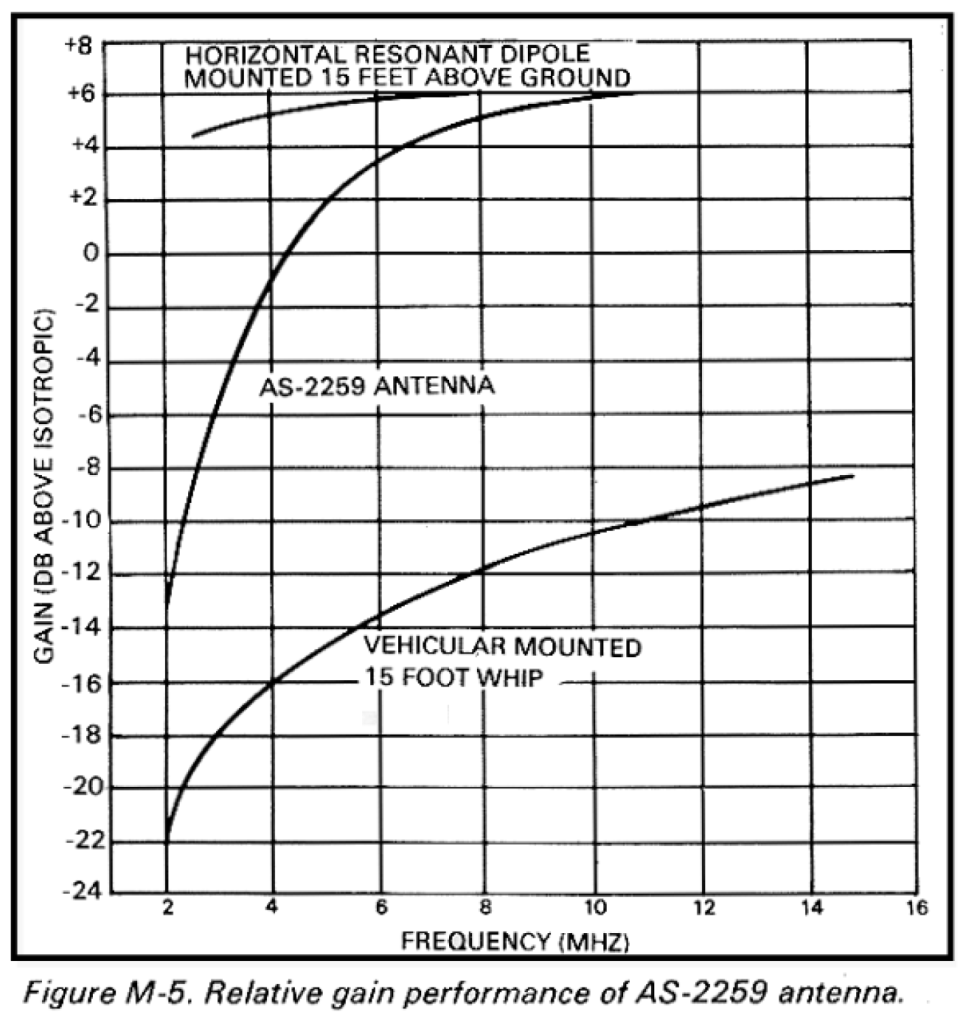
Height above ground. There are two components to antenna height – the part you see and the part you don’t see. The part you see is represented by the length of the mast holding the wire above the earth. The part you don’t see is the portion below the apparent surface through which the radio waves travel before reflecting. For very conductive ground, such as seawater, radio waves reflect on the surface. For poor ground, such as freshwater, radio waves penetrate many feet. An antenna lying on the surface of rocky soil, for example, might have an effective “height” of 40 feet or more. (NVIS) The second antenna is a military whip either 16’ or 32’ attached to a vehicle and used with a coupler. The whip is tilted horizontally away from the vehicle and the vehicle serves as a ground. This creates an asymmetrical dipole. These whips are hard to get and are often expensive. The whip can be replaced with a wire and the length can be extended to 60-100 feet or more and/or a counterpoise can be used. This is a similar setup I used in Jacksonville, FL back in 2004. Another variation of this antenna is Chameleon’s EmComm series. All the antennas mentioned work.

Remember an antenna NVIS should enhance near-vertical radiation and suppress ground wave radiation. Antenna 0.25 to 0.1 or less wavelengths above the ground should provide adequate or better NVIS performance. Any adventure into NVIS starts with a communications plan and propagation study. As I said at the beginning of this series, this is a Cliff Notes Version, enough to get you interested and going. One thing that must be remembered is that NVIS doesn’t always work, and the communications plan should include a contingency for using long path or other forms of communication such as WinLink. Thanks for your interest. 73 de Scott
 KK4Z
KK4Z 
One thought on “Antennas and More”