Assault on Dugger Mtn

On Saturday, June 10th, I decided to try a SOTA activation. I wanted a Saturday workout and test my gear, to see how I fair on a 6-point summit. I have eyes on doing a 10-pointer in the future. The summit reference is W4A/PT-002.

As I soon discovered, Dugger Mountain is no easy summit. From my starting point at a Forest Service Road where the trail crosses, it is a steady climb for almost 2 miles with an elevation increase of over 1,200 feet. After that, it is another quarter-mile climb bushwacking to the summit.

There was supposed to be a trail leading to the summit but I didn’t find one. It was probably overgrown with the summer foliage, I don’t think it would have helped much. Once I got to the top, I found a nice clearing with plenty of rocks to sit on. This time of year in the South is not a good time to sit on the ground, it is the middle of Chigger and Tick season.

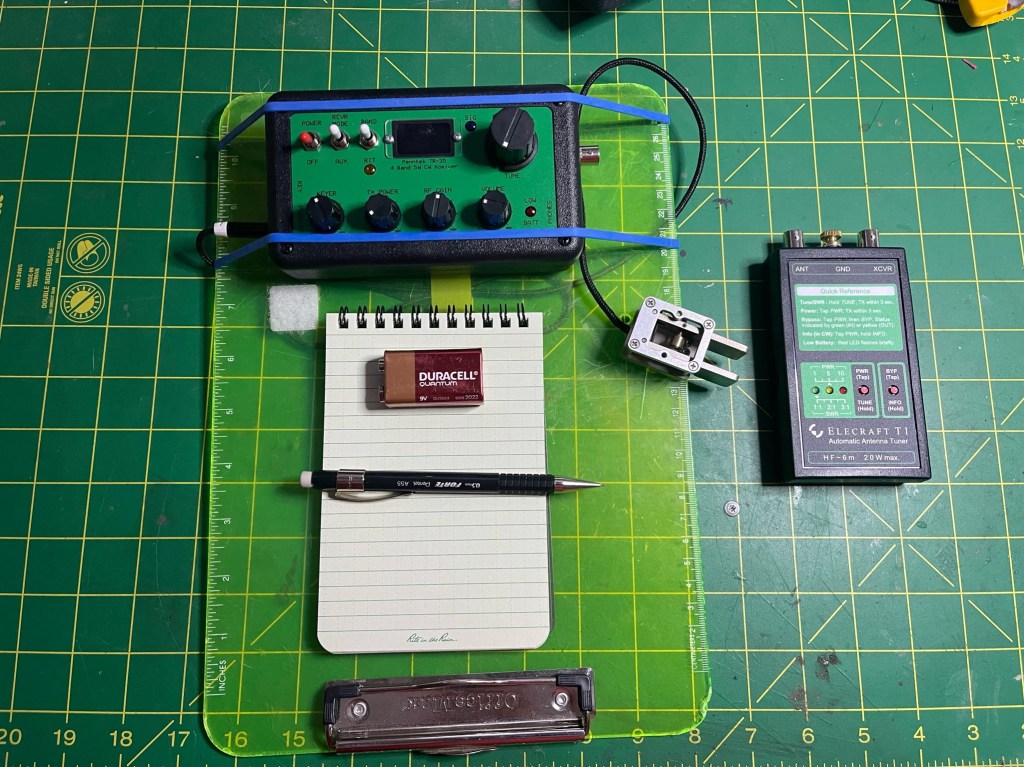
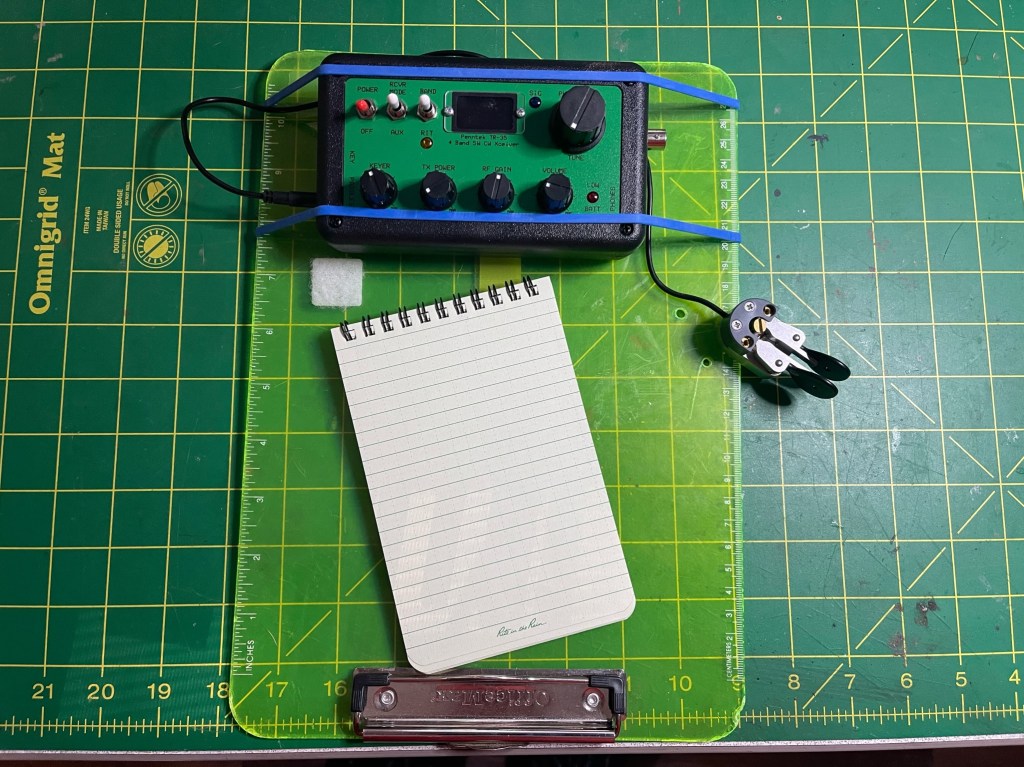
The radio du jeur was my Penntek TR-35. It is a nice handy radio covering 4 bands: 40, 30, 20,17, my workhorse bands. The TR-35 is a 5-watt radio which can put out slightly more with a good battery. The radio has an excellent receiver and there are no hidden menus. You could say it is WYSIWYG, What You See Is What You Get. The radio was powered by a Bioenno 3 amp/hour battery that was rubber-banded under my homemade Flight Deck. The Flight Deck is an inverted plastic clipboard with some holes drilled for my N0SA paddles. There is enough room left for a Rite-in-the-Rain 4 x 6 notebook and/or my iPhone. I also have a large Velcro strap to secure it to my leg if need be.

The earbuds are made by Skullcandy and I like them a lot. If you look to the left of the clipboard, you will see a red dot. That is a momentary on push button connected to the key input on the radio. The radio comes with 2-inputs, one for paddles and one for a straight key. I use the button to tune the tuner.

The radio is connected to an Elecraft T-1 tuner and the coax is RG-316, The antenna is a home brew 41′ Random wire antenna without a counterpoise. I use a 15′ coax between the tuner and antenna for the counterpoise. It is made by Chameleon and has a choke balun at one end. When running a random wire antenna it is good practice to use a choke to prevent unwanted RF from getting into the radio. The antenna uses a homebrew 9:1 UnUn.

Many parts of the Talladega Nation Forest are isolated and cell service is spotty at best. For this reason, I carry a Garmin Messenger with me. It allows me to send SMS/Text messages as well as location information. Since I am sometimes doing a solo activation as an old guy, it gives me a safety net and gives comfort to my wife.

QRV. After a short break and set-up, I went on the air. I expected bands to be poor; however not as poor as the actual conditions. It was probably not the best day to be operating QRP. I had to work pretty hard to get the 4 that I did (enough for a SOTA activation). If I had a wish at that time, it would have been to have higher bands like 10 thru 15 which were supposedly open then.

The trip was fun, Dugger Mtn is off of the Pinholti Trail. It is a fairly well-maintained trail and was easy to navigate. The elevation changes there and back will put your boots and socks to the test. I am happy to report no blisters were indicated. This hike gave me an opportunity to test out my kit. It has been a while since I did any hiking with a pack. One thing I am going to do is lighten the load. I didn’t feel too overpacked, but I need to lose some weight in the pack. I will work on that Sunday. Here is a short YouTube of the trip. 73 — Scott
Penntek TR-35 First Impressions

This weekend is the CQ WPX contest which means there is a lot of activity on the non-WARC bands. It was a great opportunity to take the TR-35 out for a test drive. As some of you know, I tend to do a running review that covers months instead of weeks or days. The same will go for the TR-35.

The first thing I learned is that the CW sidetone level is linked to the TX power. The higher the power, the louder the sidetone. When I adjusted it yesterday, I had the TX power turned way down. When I transmitted today at full power, the sidetone level was almost painful Plenty of volume available. It was a simple fix and I got it where I wanted it.

I fired up the rig using an Elecraft T-1 tuner into my 270′ OCF dipole. With the filter set to CW Wide, there was a cacophony of noise; a mix of static and CW while QSB brought the levels from a whisper to a mighty crescendo. The receiver took it all in stride, Having separate volume and RF gain controls made it easy to tame the beast. Listening to the noise was easy on the ears. Harsh but pleasant. Then I switched the filter to narrow and it was easy to isolate the desired signal. The filter is narrow, but not what some would call contest narrow. In a contest with signals often very close together, it is not unusual to set the CW filter to 150-300 Hz with sharp skirts. The TR-35 feels somewhere around 500 Hz. Could I contest with this radio? Yes, I think I could. The receiver never overloaded, and there was enough isolation that I could clearly hear most stations.

The ergonomics of the radio are excellent. There are 4 single-purpose knobs across the bottom: Keyer, TX Power, RF Gain, and Volume, all within easy reach. These are the controls you will be using the most and they are close at hand. The screen is small but easy to read. I haven’t tested it in direct sunlight yet, but you can reverse the colors to make it easier to read.

How did it play? Very well. I got on the air for a little while and contacted 5 POTA activators. Two of them were in with the contesters and I was able to easily pull them out and work them. I am impressed with this radio. I bought it to do SOTA and wanted a radio with a good receiver. I had read several reviews about the radio and it easily lives up to its reputation. The radio is fun! Small, light, and it is a good performer. Can’t wait to get it into the wild. 73 — Scott

Penntek TR-35 for SOTA

Yesterday, I received my Penntek TR-35. I am looking forward to taking it to the field next week. The radio is mounted on my homemade flight deck which is a modified clipboard. The 9-volt battery is for scale. The tuner is an Elecraft T-1 and the paddles are N0SA SOTA paddles. The notebook is a Rite-in-the-Rain 4×6″. I have been using Rite-in-the-Rain products for close to 50 years. There is nothing better for field use. In addition to the N0SA paddles, I can also use my Begali Adventure paddles.

Both the Begali and the N0SA paddles attach with a 4-40 screw.

I have made two adjustments to the TR-35. I had to adjust the sidetone volume and it was too low for my old ears. The adjustment was simple. Remove the 4 screws that hold the case together, split the case, and there is a variable pot next to the power port. A twist with a screwdriver and all is well. The other mod I did is I added 2 small tip-up feet to tilt the radio a little. I got this idea from John AE5X and you can find the feet here: https://tinyurl.com/2ht9yks2. They add just enough angle to make viewing the top of the radio easier.

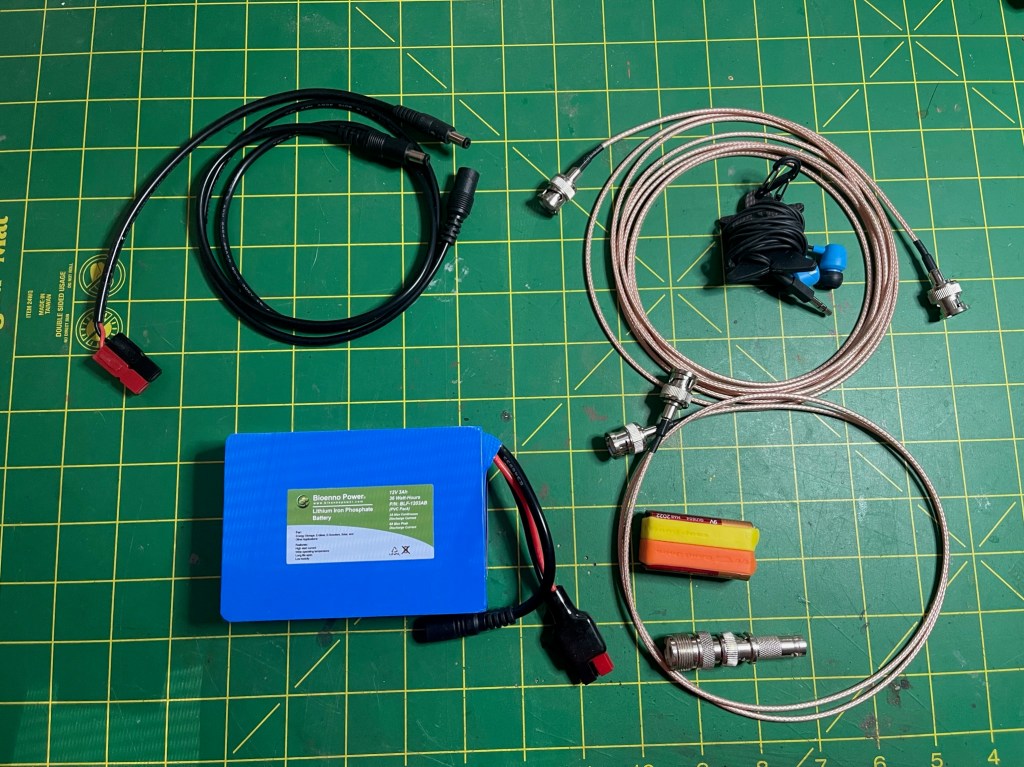
To finish kitting out the radio, I added the following:
6′ RG-316 cable
15′ RG-316 cable
Power cord with extension
Bioenno 3 AH battery
Skull Candy earbuds
Stereo to Mono adapter (not shown)
Spare 9-volt battery (tuner)
Cable Adapters

The stereo-to-mono adapter is for the earbuds. The TR-35 has a mono output and when you plug stereo earbuds in, you only get sound in one ear. Everything but the flight deck and the notepad fit into a Condor utility bag.

The bag and its contents weigh just shy of 50 ounces.

I have one addition and one modification to the setup. I have had an original In Reach satellite communications device for many years and it was showing its age. I now have a Garmin Messanger which works so much better. Many times even when I am doing a POTA activation, There isn’t much if any cell service. It’s nice to be able to spot in real-time. The Messenger is small and will reside on one of my shoulder straps.

I and using a USGI first-ad/compass pouch. I believe the one shown actually comes from my Army days. The Messanger also provides peace of mind for both my wife and I. I can send her a text message that I am okay and my location. I can also send an SOS if I have an emergency. It’s cheap insurance.

The last change I am going to make is the pack bag. The Camelbak HAWG is a great pack but for what I am doing it is just a little bit too small. It currently fits everything with a little room left over for food. Since I am out and about year-round, I need a little extra space for clothing and maybe my little Snow Peak stove. I’ll keep you posted. 73 — Scott