Changes

Life is full of changes. Some are expected and some are not. Over the past couple of weeks I have had some changes for the good. One is that 2025 is shaping up to be a better year than 2024. My wife and I had some trials and tribulations which hampered my radio-activity. We had deaths, surgeries, and a few other health issues that slowed us down. This year, things have appeared to clear up and I am already enjoying more amateur radio activity.

To start off, I have had another shack shake-up. In a prior post I had my SPE Expert 1.5K FA up for sale or trade. It is a great amp but I needed an amp that would do MARS and SHARES frequencies so I ended up with an SPE 2.0 K FA. When I get back from Hamcation, I had a trade offer. My amp for a TS-890s. I have never owned a Kenwood HF radio so I thought I would give it a go. The trade went smoothly.
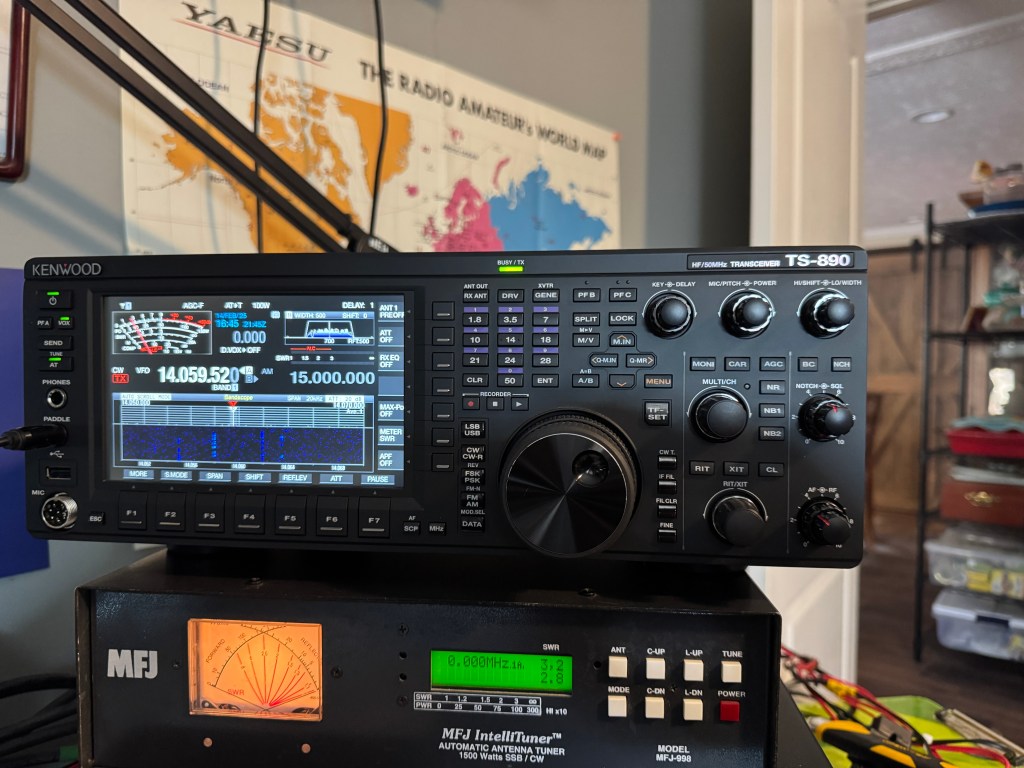
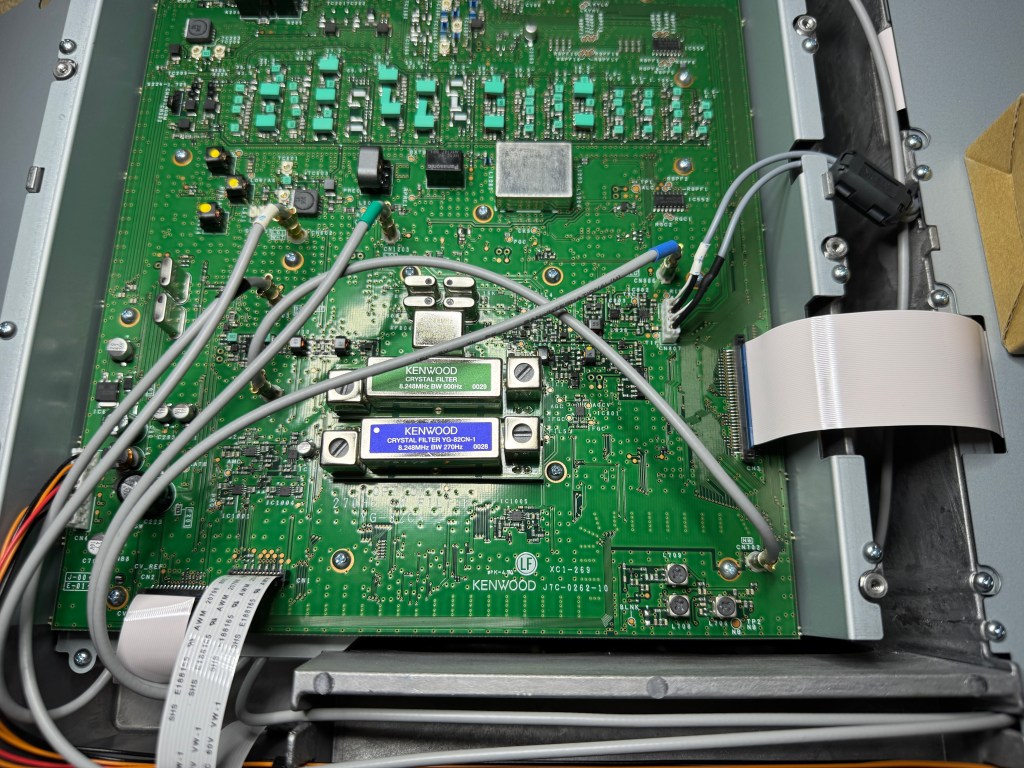
Before installing it in the shack I added the 270 Hz Roofing Filter and while I was inside, I did the MARS modification. I do not intend to use this radio for MARS, but in pinch, I am ready. My intention is to use the radio for fun and CW. I located it front and center on my desk. The IC-7610 was moved to the left which is where I set up for MARS operation. The 7610 plays very well for MARS.
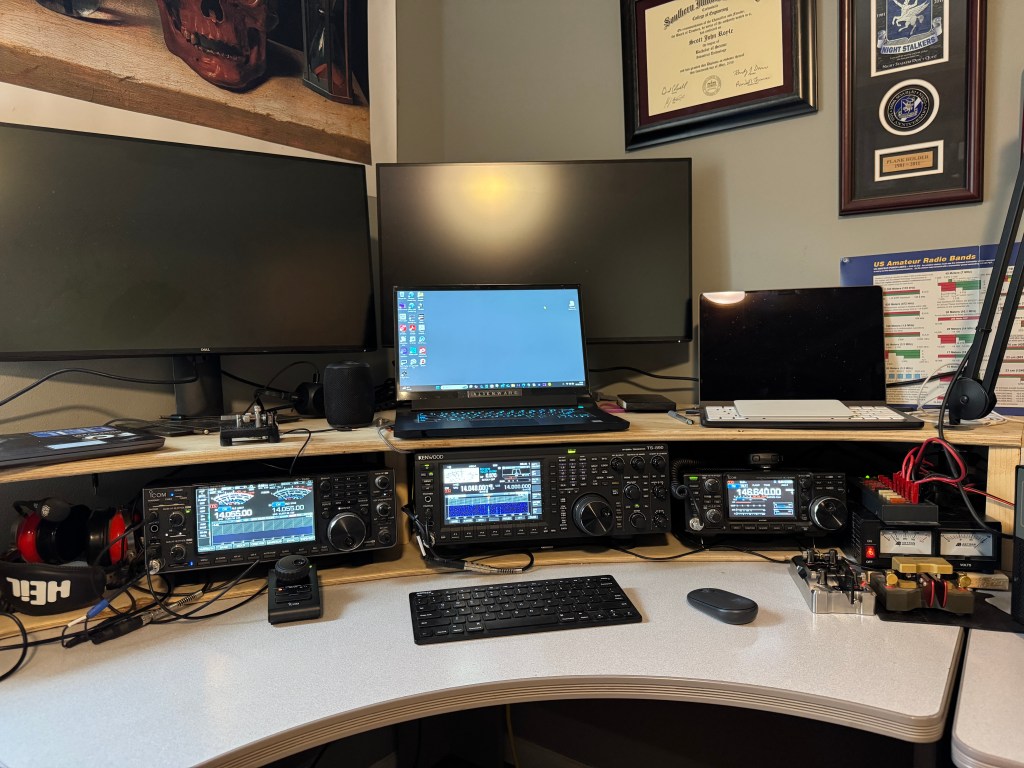
As you can see in the above photo, I am using a Windows machine for radio control and logging. I really enjoy my Mac for everything else but when it comes to things radio, Windows machines are easier.

This weekend was the ARRL DX contest and the CW bands were crowded. this gave me a good opportunity to test the TS-890s. It performed very well.
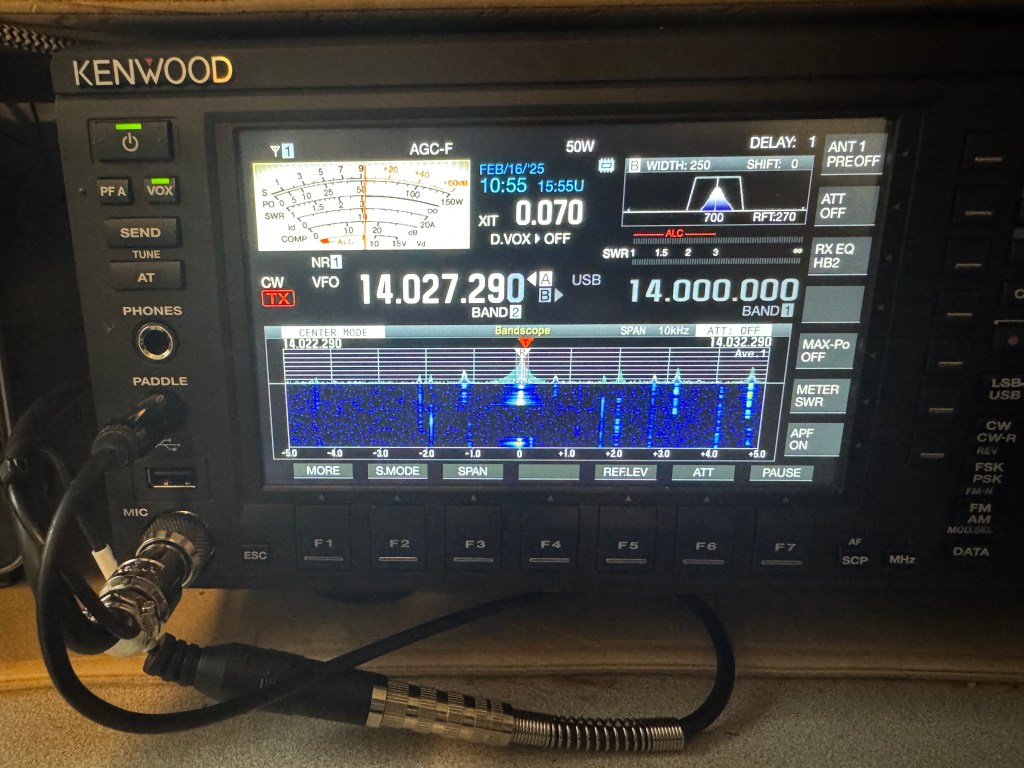
The scale on the waterfall is 5 KHz on either side of the frequency. I had the 270 Hz Roofing Filter and a filter bandwidth of 250 Hz. The TS-890 easily blocked an adjacent S9+10 signal less than 500 Hz away. Even at less than 200 Hz away I could easily copy the target signal though there was some ringing. That is pretty impressive.

I am hoping to get back into CW this year. I made about 10 POTA contacts this morning with the TS-890s. It is a very pleasant experience. The TS-890s has more buttons and controls than my IC-7610 and even though I think the 7610’s ergonomics are great, The TS-890s’ is better. The 890 is a big radio and it is heavy. It’s built like a brick…

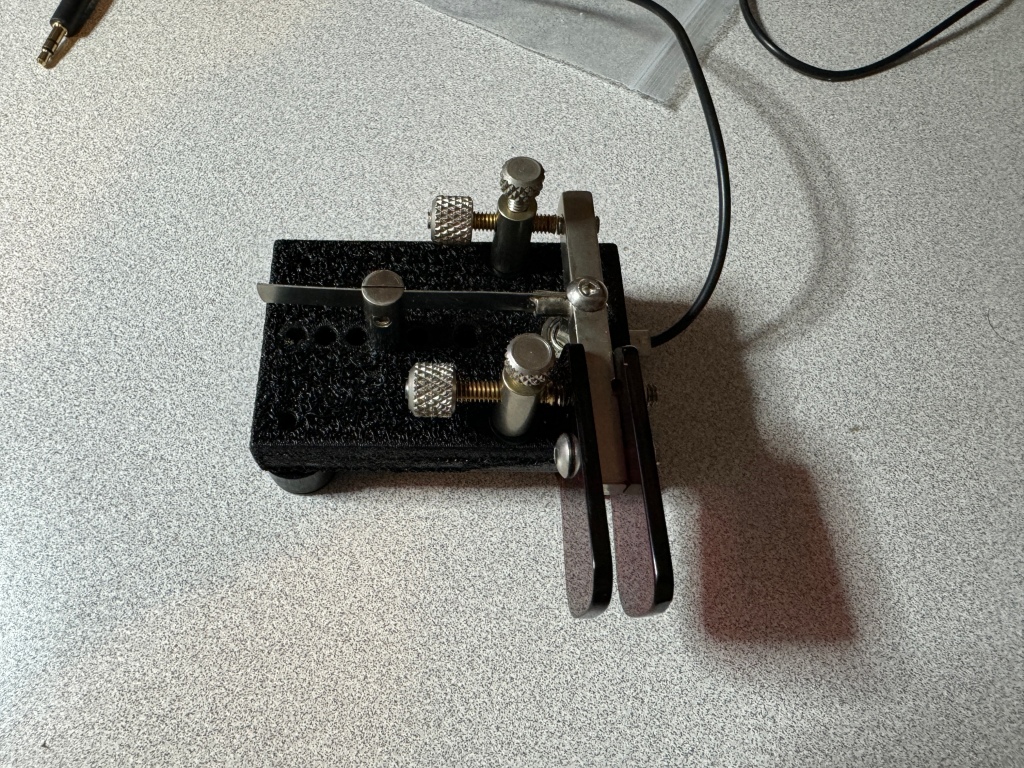
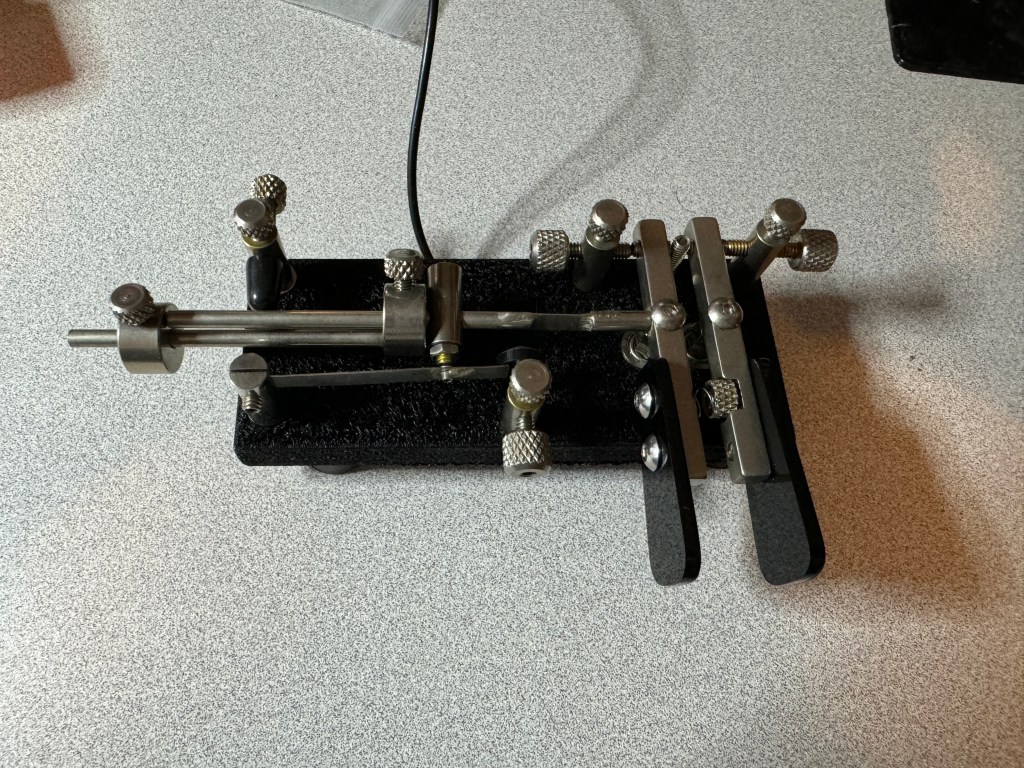
Tools of the trade for CW are my Begali Magnetic Signature and Sculpture Swing.

I joined SKCC last year but didn’t do much because of stuff. I hope to do better this year. A lofty goal I have in mind is to get my CW above 25 wpm. I think I am close. I need to practice. Hopefully this year will allow that to happen.

I hope everybody else is doing well and I hope to hear you on the air. I have a couple of camping trips coming up which should be me and the key trips. The IC-7300? It has gone back to being a field radio. Which is one arena it really shines. 73 – de Scott

Cootie Box

Sometimes you got to go both ways. I recently decided I wanted to do more straight key stuff and I setteled on a sideswiper as my weapon of choice. However, I am still much more proficient with a set of paddles. Often when I go to the field for activities such as Field Day (both) or POTA/SOTA I use paddles. Now that I’m gearing up for the Straight Key Century Club (SKCC), I want to have the opprtunity to make SKCC contacts also. I do own one sideswiper key from KN5YB, Tom makes nice keys and I like the one I got from him very much. I did realize that the feel between a sideswiper and paddles is very close and since I have some nice paddles, why not make them work like straight keys.

To make a paddle into a sideswiper all that is needed is to short the Dit and Dah contacts together. This can be done with a jumper or my cootie cable https://kk4z.com/2024/01/26/cootie-cable/. While these work, I wanted something a little easier to switch back and forth so I came up with the Cootie Box. Inside is the cootie that makes the magic.

The circuit is very simple.

It only takes a few parts.

These can be found on Amazon:
Project Box
3.5mm Stereo Jacks
20 ga Wire
Note: 20 ga was far too big. 24 or 26 ga. would be better
SPST Switch
I also used solder and some heat shrink I had on hand.

I connect 5 wires on one of the jacks 2 for the Dit and 2 for the Dah contacts. One of each goes to the other jack and one of each goes to the switch. The fifth wire is the common. Since I had wire that was too big, after I cut away the insulation on the Dit and Dah contact wire, I separated the strands into two groups. I then cut the insulation off of the wires that goes to the switch and attached them to the contact wires.

I soldered the two wires together and then trimmed them before I attached the other tail to the jack. I used heat shrink to insulate the connections

Before you go any further, feed the one jack you finished soldering through the project box and thread one nut with all five wires and fasten the jack to the project box. Then thread the nut to the other jack with the three wire that go to the opposite jack. Do not thread the switch wires through the second nut. Pass the wires through the hole in the project box and solder them to the opposite jack making sure you have the Dit and Dah contacts wired correctly or they will be reversed (trust me on this one).

With the switch wired and soldered it should look like this.

Wire and solder the oppsite jack, put together, label the switch and Viola! Cootie Box.

It does not matter which end of the Cootie box is plugged into what – completely reversable. One thing I like about the box over the cable is I feel the box is more durable.

Here is a short video of the Cootie Box in action:

Bit by the Bug

Over the past couple of days I have been trying my new keys. One is a bug and the other is a single lever/sideswiper. I kind of switch back and forth between then as well as use my paddles. I am the zippyest with my paddles so far. So here are some of my first impressions.

Single Lever/Sideswiper. It’s okay. Coming from years of paddle use, it seems it takes more effort to run a sideswiper. Between my paddles/keys, it is the slowest. I can run around 17 wpm. I also seem to be more error prone. In single lever mode, again it’s okay. I have trouble in my head switching from sideswiper to single lever. I could probably train out of it. I think the bottom line is, if I continue to use the key, it will be as a single lever.

Next up is the bug or semi-automatic key. A bit of history. Even though I wasn’t licensed until 1995. I built a Heathkit HW-8 in the early 80’s and was interested in amateur radio since the 60’s. Back then there weren’t electronic keyers or paddles. I was very enamored the Vibroplex key. I thought they were so cool. When I finally got licensed I started out with paddles. The philosophy I followed was start with the key/paddle type you intend to use from the beginning. I have been a paddle guy since 1995 until now. With my venture into SKCC, I needed a key. I was always a little intimadated by bugs. They were complex, had to be set-up and required additional skill to run one. I held off until now. 

I was in for a pleasant surprise, I got one of Tom’s KN4YB’s bugs and after watching a YouTube video by him to help me set it up. I was off and running. 

The conversion from paddle to bug was pretty easy. I was worried about my dah spacing after hearing some not-so-good bug operators, but what I discovered was my years of paddle use kind of ingrained my dit/dah spacing in my head.

After some practice and adjustment I tried the bug on my code-buddy. I did forewarn him I was using a bug for the first time. I set the bug for about 17 wpm. With my current setup,by moving the weights, I can go from 17 to about 21 wpm. By altering the setup, the bug has a range from 13 wpm up to about 40 wpm. I started the QSO, and afterwards, I called him on the phone for a critique. He said he wrote down my side of the QSO and only missed one letter. It was an “S” for an “I” in the word rain. That was also an SKCC contact (my first) and I passed my SKCC number to him. Besides being able to run the bug at the same speeds as my paddles; I am comfortable with the bug at 20 wpm, it also seems easier to transition from bug to paddles and back.

It appears I am bitten by the bug. My IC-7610 and my K3(s) have both a straight key and a paddle input so I can leave both hooked up at the same time ready to go. I am in a CW Innovations class and one of my goals is to get my copy speed above 25-27 wpm. Those speeds are very doable with the bug and the paddle. Because of the size and design of my bug (model DL-151RA) It is easily field portable. I am going to get a small padded case for it and take it to a park.

A new key, a new venue, and a new adventure awaits. Retirement is grand. I am having a blast. Stay safe, play nice and 73 — Scott

Cootie Cable

Part of my amateur radio adventures for 2024 is to become a better CW operator. What I mean by that is I want to do more than than POTA/SOTA/Contest exchanges. When I first started out 28 years ago, that’s what I did, called CQ and had a conversation. In addition to becoming more conversational, I wanted to try my hand at straight or mechanical keys. I recently ordered a sideswiper and a bug but they won’t be here fro another 2-3 weeks. I also thought about the money I had invested in paddles.

This thought process took me down to thinking about how to convert iambic paddles into side swipers. All it takes is shorting the dit and dah paddles together and setting your radio to a straight key. I wanted to make this easy. I wanted to be able to use all of my paddles on all of my radios as an iambic paddle or a sideswiper. Since this is my first journey into straight or mechanical keys, I wanted to be able to easily convert back and forth.

I made a short cable that goes between the paddles and the radio. It’s a simple operation. Starting out with plug nomenclature.

The tip is the dits and the ring is the dahs. The sleeve is the common. I had male and femlae 1/8″ stereo cables in my parts bin so I took my multimeter and coded the wires to the plugs. Basically you tie the common to the common and all the dit and dah wires together.

Twist them together, solder the joints, a little heat shrink and viola! Cootie cable. It weighs 0.5 ounces and will work with all of my radios. Now I can swith from Iambic to sideswiper in under a half a minute and use all of my paddles. See the included video that shows how it works. 73 – Scott

Maybe It’s time for a change

I feel a shift in the winds. Maybe it’s time to chart a new course. I feel if I continue on the current heading, I will end up in the doldrums. Not a good place. Parks on the Air (POTA) using CW has become stale. There is more to CW than a contest-like exchange. I have also noticed that the pile-ups in POTA have become a little more unruly. When this happens, it can extend the pileup time to double or triple what it used to be. CW pileups work well when each station sends their call once and not two or three times. Couple multiple calls with tail-ending, and a pileup could go on from close to a minute. These multiple calls often QRM the activator so no one can hear him, causing him to repeat the call they have chosen. While there aren’t any fast rules, there is an art to working a pileup from either end and, adapting to the ebb and flow of the pileup is key.

So where am I today? I think I need to try something different, not real different, just not what I’m doing now. After 1,000+ POTA CW contacts, I think I got it. Activations are still a bit of a challenge, but, it’s still just an exchange. I am currently enrolled in a CWI course to help break out of my stagnation. I want to become more conversational with CW, much like I was years ago. But insanity is defined as doing the same thing over and over again expecting a different result. This means I have to do something different than POTA, or SOTA for that matter.

My first step was to join the Straight Key Century Club (SKCC). SKCC does not allow any electronic means of sending CW. They allow 3 types of keys: straight key, sideswiper, and a bug. Yep, it takes a little more skill to run one of those babies. Twenty-eight plus years ago when I was a Tech+ I used Iambic Paddles and have used them since. I have another challenge, learn how to run a mechanical key. Couple that with learning to become more conversational should keep me busy for a while. I am also hoping that jumping backwards over the technological barrier, may be a place where things are a little less hectic.

I am looking at several different mechanical keys and when I get one (or more) they will show up here on the blog. Learning to use a mechanical key will be like learning a new musical instrument — how fun! I will still do POTA and SOTA, but I plan on opening new avenues to adventure. Hope to hear you out there. 73-Scott