Last year I installed an IC-7100 in my truck. You can see the installation details here IC-7100 Install. The installation went pretty smoothly and I have used the radio on VHF and HF. The only fault I could find with the installation was how I mounted the control head. I used one of those Lido cup holder mounts. No matter how hard I tightened everything down, they still worked loose leaving the control head to wobble around.
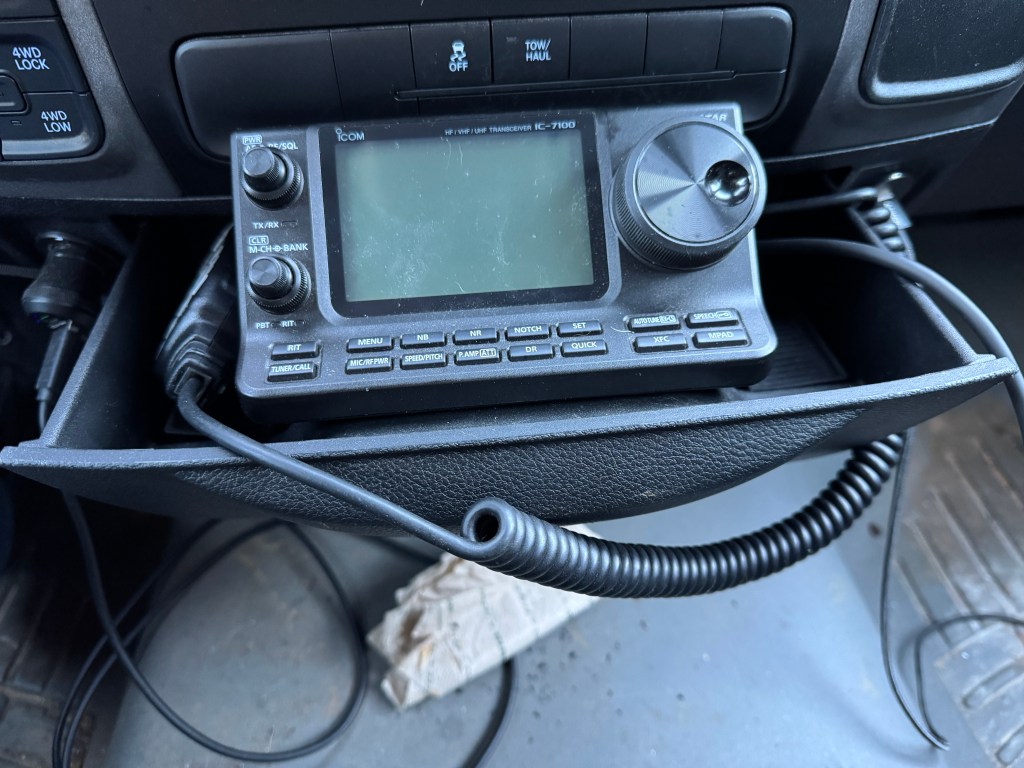
Yesterday, I decided to fix this. It was simple. Using a 3 1/2” 1/4-20 bolt, some nylon bushings, washers lock washers and rubber grommets, I mounted the control head to the pull out drawer In my center dash.
I drilled one 5/16” hole in the bottom of the drawer. I put a lock washer and a washer on the bolt and pushed it through the bottom of the drawer. I then added 2-3 washers, a 1” nylon bushing (1/4” ID) a 1/4” rubber grommet, and another nylon bushing. The bushings, and washers acted like shims to keep the control head level and allow me to tighten the bolt without damaging the control head. The rubber grommet added a little extra “squeeze” so the lock washer would engage the bottom of the drawer.
It took me about an hour including driving to Tractor Supply for the hardware. It cost me about $6.
The control head is now firmly mounted to the truck and there is even a space for the microphone. The only thing I have left to do is reroute the control cable under the mat. This installation is more secure and looks nicer. I even get a cup holder back! 73-de Scott
Here is my first look at my second FT710. I will start with the settings I changed and then go over the list of issues I had with the first one. The first FT710 had the original firmware as it was new at the time. This one has several updates under its belt.
Settings/Changes
T710,Taped Power Cables every couple of inches to reduce tangles.
Added Anderson Power Poles to the power cable
Turned off 3DSS
Set waterfall span to 5K
Set waterfall speed to slow2
Set color to 6
Set level to +3.5 dB, peak to level 2 and contrast to level 14
Set tuner type to EXT
Set Tuner/Lin Port to Linear
Set keyer to Elekey B, repeat interval to 3 seconds, Weight to 2.7 and Pitch to 700Hz
QSK – on
Set MyCall to KK4Z and call time to 3 seconds
Set Mic gain to 60 and Processor level to 65
CW mode on
Meter Detector to Peak
Receive Audio SSB – Treble +3 Middle +5 Bass -2
Receive Audio CW Treble +3 Middle +1 Bass -3
Parametric Equalizer (processor on/off the same)
E1 – Freq 300 Bandwidth 10 level -3
E2 – Freq 1300 Bandwidth 2 level 10
E3 – Freq 2400 Bandwidth 1 level 10
Needs a 32gb (no larger) SD card. Scandisk Ultra SDHC UHS-I 32 GB works
Mouse. Seems the only wireless mouse you can use with the radio is a Logitech M310. It does not appear to be in production anymore. I had to buy a renewed one. I got the mouse working and I think it is a good addition to the radio. It does make changing parameters easier and if you click on a signal in the waterfall, the radio will QSY to that frequency. I wasn’t sure how I was going to like using a mouse, but I think I like it.
Here are the issues from the first radio:
Could not use LDG tuner with the radio — it was a surreptitious route to get a tuner to work. I started out with a different tuner, an LDG IT-100 which uses a different cable. I coupled the tuner with an LDG IC-108 cable. The cable is not listed as usable on the FT710. The other twist was setting the Tuner/Lin Port “Linear” instead of Ext Tuner. This little tidbit is not shared by Yaesu, I had to find it on an internet forum. To tune the antenna you push the tune button on the tuner (not on the radio) to get things going. This is where Icom shines. They have been using the same interface at least as far back as the IC-718 and the IC-706. A tuner I bought for my IC-706 MKIIG still works on my IC-7300 with the same cable and I can use the tune button on the radio. The other downside is you cannot use the FH-2 Remote pad when using the auto tuner as it uses the same port at the back of the radio. In addition, you cannot run an amplifier and an auto tuner at the same time. Icom has separate ports for the tuner and amplifier.
No Portable Zero Rails – I use rails on all of my portable radios. Portable Zero now makes rails for the FT710.
Could not use RT systems software – it took Yaesu until July 2023 to get the info to RT Systems. I have RT Systems software for almost all of my radios. RT systems software works fine now.
Auto Notch — I don’t remember auto notch working on the first radio I had. It works now.
Cannot edit/see QMB – another place where Icom shines. I can go into the memo pad (Icom’s QMB) and edit the entries.
RJ45 mic connecter instead of Foster (Icom)- Foster connectors are more durable than the RJ45.
Key clicks in the headphones using CW – They are still there but less pronounced. The CW is harsh sounding and can be fatiguing to listen to over long periods.
WSJT software would change modes when switching bands
Waterfall is not averaging like Kenwood’s or Icom’s. It has to be adjusted manually (and sometimes frequently)
Filter only has 2 selections vs 3 for the Icom. Narrow which only has predefined values and wide which is adjustable. The Icoms have 3 selections each fully adjustable. Icoms can also adjust the filter shape (soft or sharp. The FT710 has contour and APF. Contour is like a soft notch filter and APF boosts the center frequency like a CW signal. Icoms have dedicated controls on the front panel while the Yaesu has a mix of front panel controls and menu items.
Even with all of its quirks, I like the little radio. Yaesu appears to have fixed most of its problems, at least enough to make the radio fun. I still believe this radio compares well with the IC-7300 and either will serve you well. If I could only have one, I would still go with the Icom. The Icom has a lower noise floor, the settings (ergonomics) are better, and it hears as well as the Yaesu (at least in my side by side test). For CW again, the edge goes to Icom. However, the Yaesu has its pluses. The FT710 has a slightly better audio quality let’s say more fidelity but in CW the tone is more harsh than the Icom. The Yaesu has a better attenuator with 3-steps instead of one. With the Yaesu, you can transmit CW while in SSB mode. I like the filter window on the FT710. I can see how changing the filter affects the signal.
Later this week I have Portable Zero rails coming. They are pricy, but I find them very useful on my field radios. I also have a Maestro Evolve III coming which I will setup software for the FT710 on it. I hope to have everything ready for Winter Field Day.
I think a major difference between the IC-7300 and the FT710 is settings. Yaesu gives you settings on top of settings, while the Icom gives you what you need. If you like to tinker and tweak, the FT710 is your radio. If you want to get down and operate, then Icom is the way to go. Out of the box, I had to do far less setting up with the Icoms.
Compared to the FTDX10. I owned an FTDX10 for about 18 months. If I bought one today, the cost would be about $600 more than the FT710. I’m not sure the FTDX10 is that much better than the 710. My primary use for this radio is for the field. More to follow es 73 de Scott



 KK4Z
KK4Z 