I have a stable of radios. I like radios. I have spent the past couple of years going through radios and finding the ones I like to use. I think I am getting close. In the shack, I like my IC-7610 and TS-890. They are big and all the controls I use are easy to get to. There performance is top notch. I am content.
QRP radios. This has been my greatest controversy. When I retired, I thought I was going to do a lot of QRP with little radios and maybe even do some SOTA. It didn’t turn out that way. I found myself using big radios at low power. They are easy to use and because of their heatsinks, they never overheat at low power. I did keep one little radio the IC-705, of all the little radios I had, the 705 was the one I grabbed the most.
Field radios. I went through a bunch of radios here too. I kept my IC-7300 which I bought new and has stayed with me over the years. I may sell it off for the new IC-7300MK2. I recently acquired a TS-590sg which went with me on my recent POTA activation at Black Rock Mountain State Park.
It was definitely a fun radio and I look forward to using it more in the future. Yesterday, an IC-7200 was delivered by UPS. The was a trade I had in the works. I always wanted an IC-7200. It’s a basic radio that has a military vibe to it. Being a Veteran, it appealed to me. The radio came with the rails and the MARS mod was already done. The radio is pristine. Power draw at idle is about 1 amp and at 20 watts it draws about 8 amps. Lowering the power level does not overly change the amp draw. Above 20 watts and the amp draw increases. Twenty watts is the happy medium. Here in the shack I had it turned on and was able to work N0SA. I have a set of his SOTA paddles from his last run before he retired. They are fun to use. I plan on taking the 7200 on my next POTA adventure.
During the past couple of years after making many POTA activations, Field Days (winter and summer), Army MARS, and SHARES I was able to shape how I operate. Some of it was a surprise as I was led in a different direction than when I started. I guess when it comes to radios, I may march to the beat of a different drummer. I prefer big radios (IC-7300 size) over little radios. I like that the controls are easier to get to and they don’t overheat. In the field I usually run around 20-35 watts. Most of the time I am in my micro-camper so I am not carrying the radios very far. I may have to lug them 50 feet to a picnic table. I recently bought one of those folding wagons so weight is no problem.
Another surprise was my use of FT8. Band conditions on many of my outings was poor. If it wasn’t for FT8, I may not have had a valid activation. Plus, I discovered I could work a lot of DX while in a park using FT8.
Yaesu’s. I don’t have any Yaesu’s. I have tried to like them, but they are just not for me. I had an FTDX10 for about 18 months, a FT-710 for about a year total, and a FTX1 for a couple of months. To me they are kind of quirky. The Icom’s and the Kenwood’s are solid performers and the ergonomics are superior. I know how to make them dance and sing. I know there are those who love Yaesu and I get it. To each his own. Find the radios that suit you best and enjoy them as I have. The journey is half the fun. 73 de Scott
I have a set of Begali Adventure Paddles. They are wonderful paddles. I have the mount for my IC-705, KX2, and desktop. Each mount works well. However, there are times when I do not have a stable platform for my radios or the paddles. At these times I usually hold the paddles in my hands. My go to handheld paddles are my N0SA SOTA paddles. I got mine from his last run. They are an excellent paddle.
I tried holding the Adventure paddles in my hand but I would cause errant dits and dahs. I first thought I would 3D print a box for the paddles–to much thought. I then thought about getting some square aluminum tubing. Too expensive. I scrouged around in my shop and found some 1″ angle aluminum. Perfect. Before I go on let me explain, that this was done with hand tools. A hacksaw, files, hand drill and drill bits. I also used a Dremel tool a little. This project is far from perfect. I never let perfection be the enemy of good enough.
Here is the piece roughed out.
The slot is where the finger guard mounts to the bottom of the paddler using a 4-40 screw. Mounted it looks something like this.
The guard extends past the end of the paddles to help protect the cable where it enters the paddle.
In use the paddle/guard combo looks like this.The guard keeps my index finger from touching the paddle lever and allows me to put my thumb below the paddle lever on the other side. It is very comfortable to use even with my large mitts.
A coat of primer, followed by paint and a clear coat and viola!, it is finished.
I will let it cure overnight and it will be ready for the next adventure. 73-de Scott
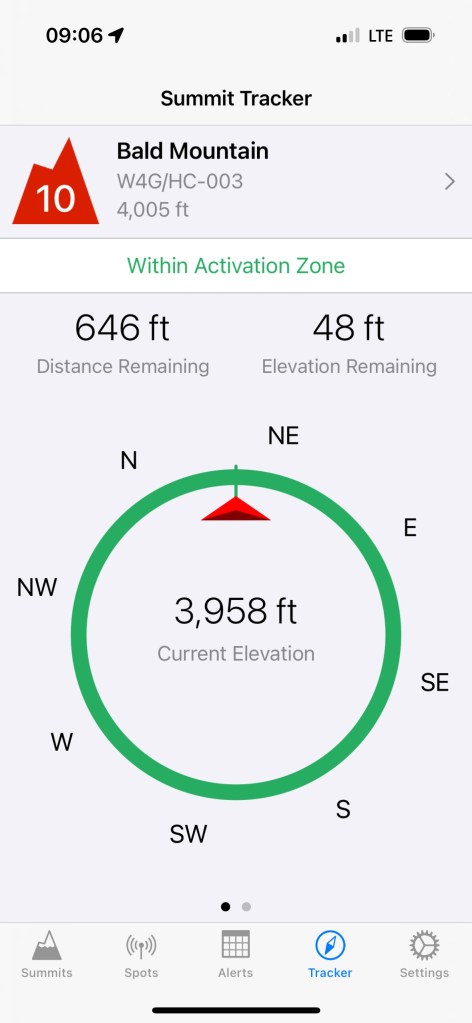
It’s official, I am retired. Fifty-three years in the making. Being on the north side of 66 does not mean you are wheelchair-bound. Maybe a little slower, but with patience and skill almost anything can be done. One of my first acts as KK4Z (ret.) was to do a SOTA activation. I chose Bald Mountain, a 10-pointer in northwest Georgia.
One of the reasons I chose a 10-pointer is I wish to get involved with a group called Southern Appalachian Summit QRPers or SASQ (SASQuatches). The group combines SOTA with a moderate level of Bushcraft. What’s not to like. There are skill-based membership requirements and one is a 10 pt SOTA activation within the past year. I wanted to get my 10-pointer in before the Park Service closes the roads to the summits during the winter.
I was originally planning on Tuesday for the trip, but the weather was going to be harsh that day. Lots of wind and rain. This is what I call the first winter storm of the season. Between the wind and the rain, it usually finishes knocking all the leaves off of the tree. So, I backed the trip up to Monday and checked the weather (Wx) – all systems go. Preflight check of the Wx 0600 hrs Monday showed VFR (good). The 10-point mountains are at least a 3-hour drive for me. Two hours on highway/improved roads and one hour on unimproved/gravel roads. That last hour covers approx. 20 miles. Along the way, I was confronted by a 6-8 pt deer who thought he was up to the challenge by a 5,000 lb Ram truck. After a few snorts, he thought better of it and scampered into the wood. Shortly after this, I heard Mussorgsky’s Night on Bald Mountain, an omen I didn’t recognize at the time. When I reached the parking lot below the summit, things weren’t so VFR. I checked the Wx again and now it showed rain on the way. The sky had closed in and the summit was in a cloud. I figured I had just enough time to reach the summit, make the required contacts, and retreat without getting too wet. When I started the trek, it was 60 degrees. By the time I reached the activation zone, the temps dropped, and the wind picked up. When I got back to the truck the thermometer registered 50 degrees. I estimated that the wind chill put temps in the low 40’s to high 30’s. Whenever I venture out, I always bring an extra layer, in this case, a Gore-Tex jacket. I forgot gloves and my CW suffered for it.
I climbed just high enough to get safely into the activation zone. My setup was quick and simple. I used a Chameleon 40-meter OCF QRP dipole. I like OCF dipoles. They do not have to get very high off the ground (10-12 feet is enough) and they are good performers. I prefer them over EFHWs. I sit on a cushion on the ground, so I use the supporting tree as a backrest. Coax is 15’ of RG-316 with a choke on one end. The radio was my new Elecraft KX2. I waited quite a while to get the radio. I did set it up at home and made one contact before taking it out. Since I was in a hurry, I set the radio on my pack and the notebook log on my thigh. The paddles were N0SA’s SOTA paddles. I got lucky and got one from his last run. I held it in my left hand. I sent a spot out and a few minutes later I sent QRL? On 7.057 MHz. I got a NO, they were waiting for me, I’ve never had that before. The wind was picking up and I had some difficulty hearing. As my hands got colder, my CW and handwriting suffered. I had a pretty good pile-up going and after 19 contacts I called QRT. There were still some calling, but Wx was not on my side.
I packed it up and headed down the mountain. By the time I got to the truck, it was starting to drizzle. I really didn’t mind the weather, I need to keep my hands warmer though.
The KX2. It was everything I had hoped it would be. I ran it 5 watts and it purred like a kitten. The quality of the received signal was great. I ran with the filter set to 1K Hz and it was fine, no overloading even with a pile-up. For SOTA, the radio is hard to beat. I like that I only have 3 cables to the radio, paddles, earbuds, and coax. Simple and easy.
Next time I will be sure to add some gloves to my pack. It was fun and I can’t wait to do the next one. If I knew retirement was going to be this much fun, I’d have done it a long time ago. 72 de Scott
On Saturday, June 10th, I decided to try a SOTA activation. I wanted a Saturday workout and test my gear, to see how I fair on a 6-point summit. I have eyes on doing a 10-pointer in the future. The summit reference is W4A/PT-002.
As I soon discovered, Dugger Mountain is no easy summit. From my starting point at a Forest Service Road where the trail crosses, it is a steady climb for almost 2 miles with an elevation increase of over 1,200 feet. After that, it is another quarter-mile climb bushwacking to the summit.
There was supposed to be a trail leading to the summit but I didn’t find one. It was probably overgrown with the summer foliage, I don’t think it would have helped much. Once I got to the top, I found a nice clearing with plenty of rocks to sit on. This time of year in the South is not a good time to sit on the ground, it is the middle of Chigger and Tick season.
The radio du jeur was my Penntek TR-35. It is a nice handy radio covering 4 bands: 40, 30, 20,17, my workhorse bands. The TR-35 is a 5-watt radio which can put out slightly more with a good battery. The radio has an excellent receiver and there are no hidden menus. You could say it is WYSIWYG, What You See Is What You Get. The radio was powered by a Bioenno 3 amp/hour battery that was rubber-banded under my homemade Flight Deck. The Flight Deck is an inverted plastic clipboard with some holes drilled for my N0SA paddles. There is enough room left for a Rite-in-the-Rain 4 x 6 notebook and/or my iPhone. I also have a large Velcro strap to secure it to my leg if need be.
The earbuds are made by Skullcandy and I like them a lot. If you look to the left of the clipboard, you will see a red dot. That is a momentary on push button connected to the key input on the radio. The radio comes with 2-inputs, one for paddles and one for a straight key. I use the button to tune the tuner.
The radio is connected to an Elecraft T-1 tuner and the coax is RG-316, The antenna is a home brew 41′ Random wire antenna without a counterpoise. I use a 15′ coax between the tuner and antenna for the counterpoise. It is made by Chameleon and has a choke balun at one end. When running a random wire antenna it is good practice to use a choke to prevent unwanted RF from getting into the radio. The antenna uses a homebrew 9:1 UnUn.
Many parts of the Talladega Nation Forest are isolated and cell service is spotty at best. For this reason, I carry a Garmin Messenger with me. It allows me to send SMS/Text messages as well as location information. Since I am sometimes doing a solo activation as an old guy, it gives me a safety net and gives comfort to my wife.
QRV. After a short break and set-up, I went on the air. I expected bands to be poor; however not as poor as the actual conditions. It was probably not the best day to be operating QRP. I had to work pretty hard to get the 4 that I did (enough for a SOTA activation). If I had a wish at that time, it would have been to have higher bands like 10 thru 15 which were supposedly open then.
The trip was fun, Dugger Mtn is off of the Pinholti Trail. It is a fairly well-maintained trail and was easy to navigate. The elevation changes there and back will put your boots and socks to the test. I am happy to report no blisters were indicated. This hike gave me an opportunity to test out my kit. It has been a while since I did any hiking with a pack. One thing I am going to do is lighten the load. I didn’t feel too overpacked, but I need to lose some weight in the pack. I will work on that Sunday. Here is a short YouTube of the trip. 73 — Scott
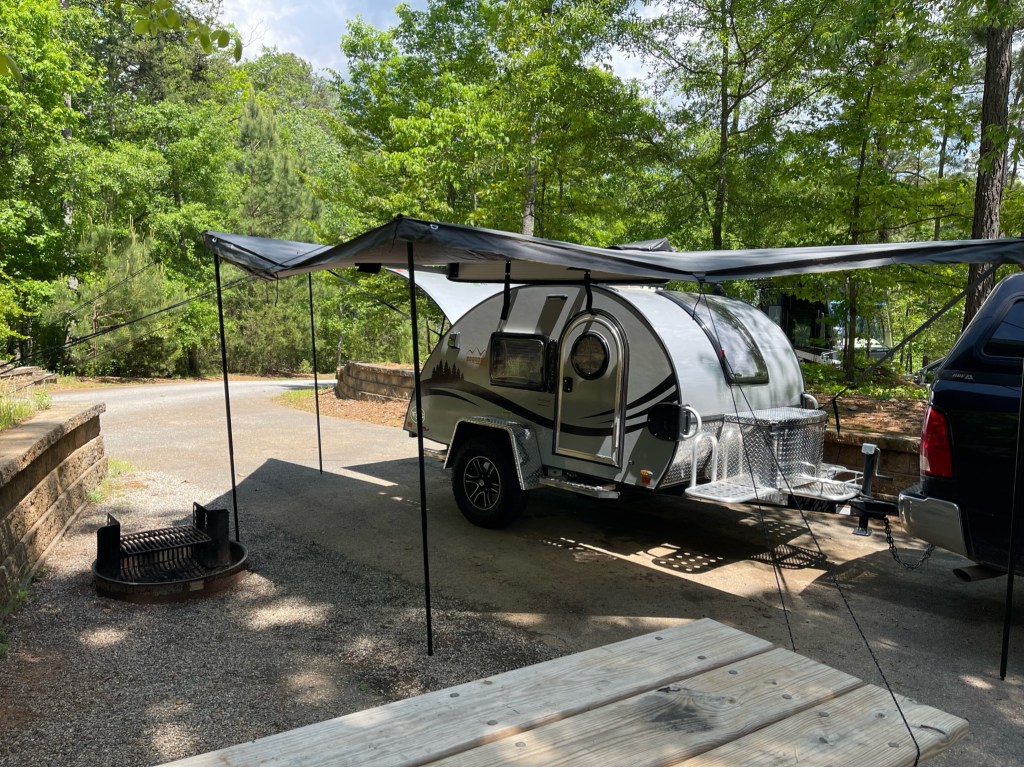
This past Saturday (05-07) was the Georgia POTA Meetup. It was held at Don Carter State Park (K-2171). The park is about a 2 hour drive so I decided to take my new teardrop camper out on its inaugural run. I drove up on Friday. One of the reason for purchasing the camper was to extend my POTA activation range. The camper is made by NuCamp and so far I am pretty impressed with it. It pulls well behind my pickup truck and I only lose about 1/2 mile a gallon for gas. Set up was easy. Since I didn’t disconnect the trailer from the truck, I was set up and good to go in about 15 minutes. Here is a shot of the camper set up.
The camper next door told me some strong winds and possibly a storm were coming so I added some additional guying to the awning. There were no problems.
Friday was a rather chilly day and because of the winds I did not set out my folding chairs and table until Saturday. I brought two radios and a couple of antennas with me. Traveling QRP doesn’t take up a lot of space even if you bring a couple of each. I wasn’t sure I was going to make enough contacts on Friday since I started late but I gave it a go anyhow. The first radio up was my Xeigu X6100 and I hooked it up to Chameleon Micro on a spike with a Buddipole 12 foot fiberglass antenna and two aluminum extensions. I also ran a counterpoise. I was only able to make 5 contacts Friday evening, furthest being Colorado. Band conditions were not that good from this location. The Reverse Beacon Network (RBN) didn’t even pick me up. I did start outside.
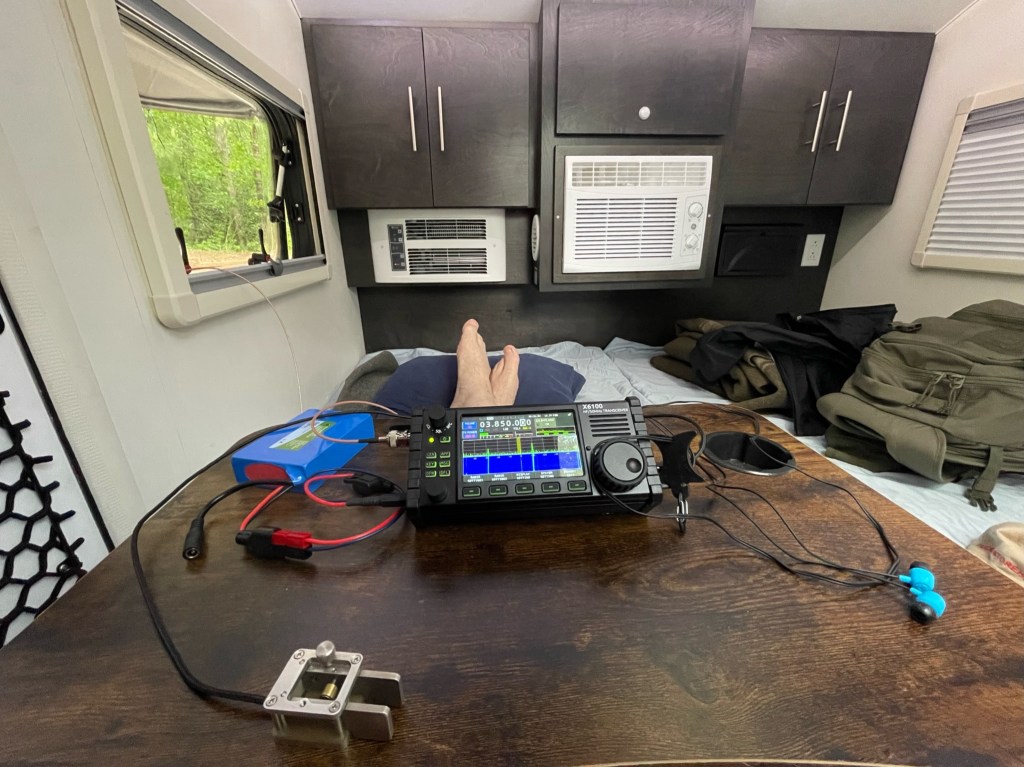
I worked this way for a little while until the temperature dropped and I started seeing chiggers on the table. I move the operation inside. I wanted to see how well I could operate from inside the camper.
The answer was quite well. I bought a lap desk for this purpose and I was quite comfortable. For logging, I used the Hamrs App on my phone. This was the first time I did logging solely from my phone. Band conditions were still not very good, so I spent most of the time hunting P2P. It was fun, doing a search and pounce while operating CW QRPish (10 watts).
How does the X6100 play? First let me describe the environment. I was in a a RV camping area that was mostly full. There were a lot of big trailers loaded with all sorts of electronic devices, switching power supplies, and whatnot. I was also down in an RF “hole”. The X6100 is fun to use and the display is top notch. Most of the controls are fairly intuitive. I had no problems operating CW and did use the memories. It does have its nits. As others have said, the receiver does overload rather easily, and while I can still work stations, I felt I may have missed some because of the added noise. Along with that, the audio is also rather harsh. While at a park, I often wear ear buds to be respectful of my neighbors. The audio can become tiresome. Adjusting the RF Gain helps. The last real nit was the Digital Noise Reduction. It needs work. Turning it on even at the lowest setting is way too much. Hopefully they will fix this in future firmware updates. The digital filters on the other hand are very good, almost on par with Icom. I did run the radio with a Bioenno 3AH battery so I could have 10 watts. There is a lot to like about this radio. You get a lot of goodness for the money, and Xeigu so far has been good about updating the firmware. When I use this radio again, it will be in quieter RF environments. such as, less popular parks, National Forests, Wildlife management Area, and SOTA. It really is a fun radio to use.
Saturday morning, I walked over to the GA POTA meeting up. It was about a mile and gave me the opportunity to get a little exercise in. There were about about 20 or so people there and they had a couple of stations set up. They also had the special event callsign W4P. It was good to meet fellow POTA operators and have a chance to chat with them. They served hamburgers and hotdogs along with chips, soda and condiments. After a few hours of chatting and a couple of hamburgers, I decided to head back to the camper and see if I could complete my activation for the day.
When I got back I broke out the X6100 again and used it for a while. Not having a lot of luck, I switched over to my IC-705. Yes it is a much better radio and it is more refined, and it does cost twice as much. The X6100 is an excellent value at its price point. I set the 705 up with the AH-705 tuner. I really like the AH-705, as is very versatile, much like its big brother, the AH-4.
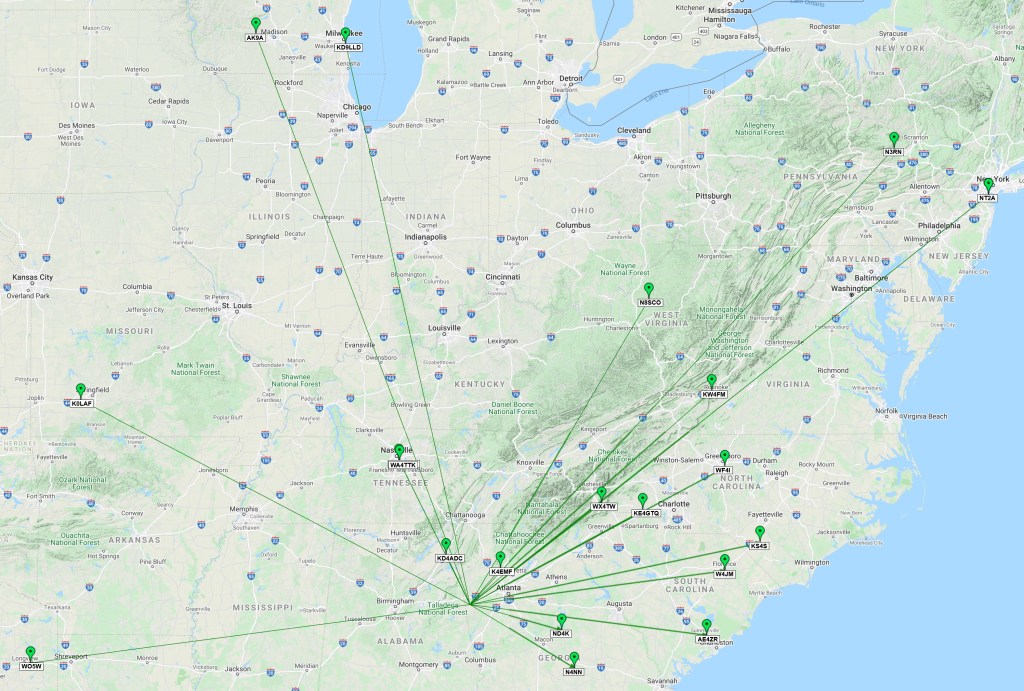
One nice thing about the Icom, is it works just like my other Icom radios. Easy to remember. The paddles du jour are my N0SA SOTA paddles. They are one of my favorites. With the better receiver and audio on the Icom, I made a few more contacts, but still not what I was expecting. QRP antennas can be light and small so it is nothing to bring a few along. I decided to swap out antennas. I took down my Chameleon/Buddipole antenna and put up my K4SWL 28 foot vertical with counterpoise. It is a homebrew antenna, but I got the idea from Thomas Witherspoon K4SWL. After putting this antenna up, I continued to slowly add contacts to my log. My method was simple. If I could hear them fairly well, I figured they could hear me, so I tried to work them. There were plenty of stations on the POTA spot page that I did not hear at all. By the end of the day, got enough contacts for an activation on Saturday. Here is a map:
Wrapping up and lessons learned. First, I had a lot of fun both at the meetup and at the campsite. I enjoyed taking up my camper for its first go. Everything worked except for the heater. I may have to bring it back to the dealer, but I had plenty of blankets. I am already planning a trip for next month.
Radios. If I am going to do a drive up POTA activation, my first choice will be the IC-705/AH-705. I like the X6100, its fun to use, and I imagine as time goes on it will get better. The X6100 will do well in quieter RF environments. I haven’t given up on it yet as I think there is still a lot of potential there.
Antennas. I had a surprise here. When weight is not a problem, I bring my my Frankentenna which is a mixture of Chameleon and Buddipole parts. On Saturday, when I switched from my Frankentenna to my K4SWL Random Wire antenna, it was on par and maybe even a little better than the former. The idea of carrying less on an activation has endeared itself to me. I can fit everything I need in a small 8 Liter Bucket Boss Bag https://tinyurl.com/3mwbk95r.
The important part is to get out and have fun. So pack those radios up, 10 watts or 100 watts SSB or CW, drive or walk, around the corner or around the world. I hope to work you and if I have, thanks for the contact. de KK4Z
I had a doctors appointment in the morning so that kind of scrambled my day. I decided to attempt a quick activation using my new IC-705 with the AH-705. Today was the best day to do it because we are supposed to get some real winter weather starting tomorrow. I’m not opposed to winter weather, I do not like driving around with a bunch of folks who are. And yes, true to southern tradition, people are at the stores buying milk, bread, and eggs. Can never to too sure.
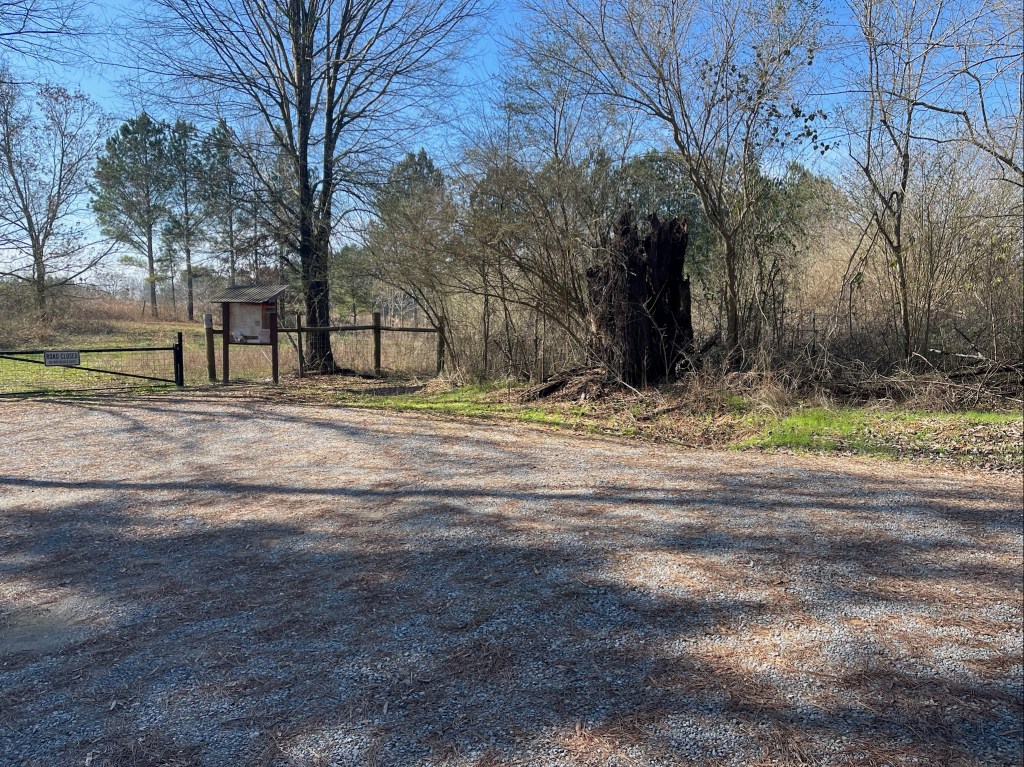
The J. L. Lester Wildlife Management Area is located in Polk County, GA near Cedartown. It is 477 acres with hunting and fishing opportunities. Even though I wasn’t hunting or fishing, I am required to have either a hunting or fishing license, or a land pass. The land pass is $30 and the hunting or fishing license is $15 per year. I became a fisherman. I parked in a parking area near the eastern boundary. I was nice and quiet.
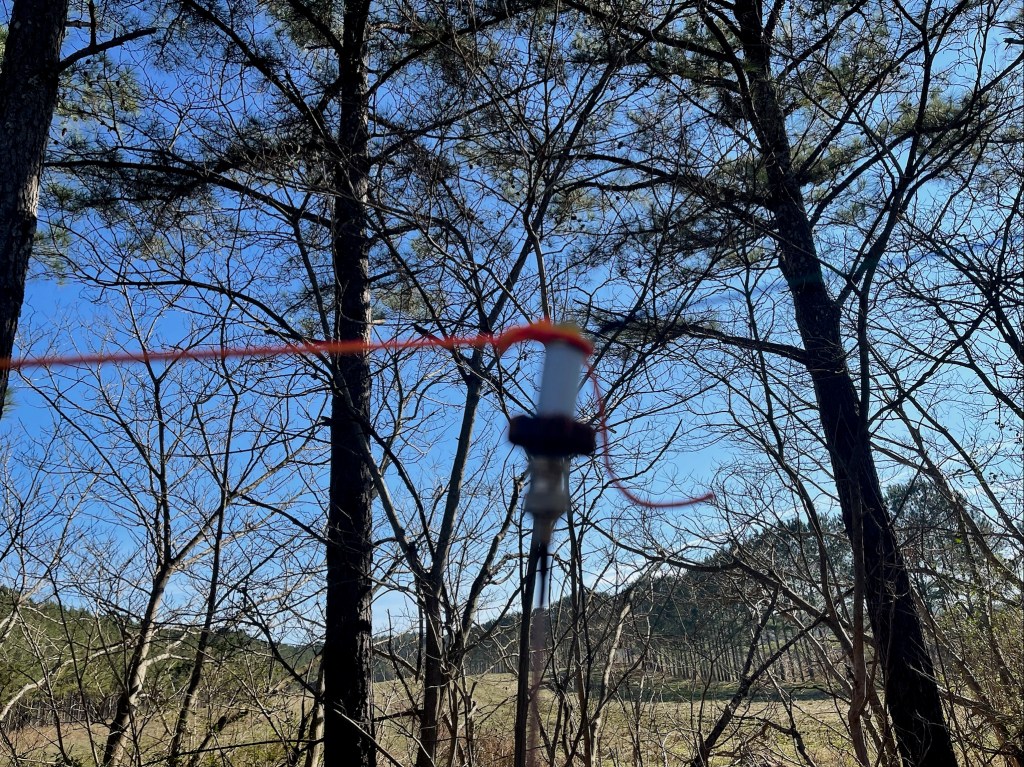
The setup was simple, the IC-705 running off of its own battery, N0SA paddles, AH-705 tuner and a Spark Plug EFHW with 65 feet of Buddipole antenna wire. The coax is RG-316. This is the first time I used the Spark Plug antenna. I hoisted the antenna wire about 20 feet up into a tree, and tied the Spark Plug off near my truck.
Here is the complete antenna set-up.
The setup in the truck was pretty simple. I used my center console desk and logged with paper. During the activation the AH-705 was on the passenger seat. Using the desk with the radio on it made it a little tipsy so for the photo, the AH-705 was a counter-balance. I will remedy this next time with a bungee cord. I had the earphones out; however, the IC-705 had enough volume for these not so good ears so the earphones were not needed.
I also discovered that I didn’t need the clock as the time on the IC-705 was easy to see.
How did everything play? Quite well actually, the AH-705 tuned the EFHW for the first time in less than 2 seconds. I was impressed. The AH-705 is more like a miniature AH-4. I have an AH-4 and it is a very capable tuner. I am looking forward to see how well the AH-705 compares to the AH-4.
One of the reasons I brought the IC-705 was for the keyer memories. I use keyer memories quite a bit. Using memories eases the QSO workflow. I started on 40 meters hoping to get 10 activations and if not maybe move to another band. However, I had a nice pileup going on for about 35-45 minutes and ended up with 21 QSO’s. As suddenly as it started, it stopped. I called CQ twice with no answer and then pulled the plug. the antenna and 5 watts were more than ample. Here is a map of the contacts.
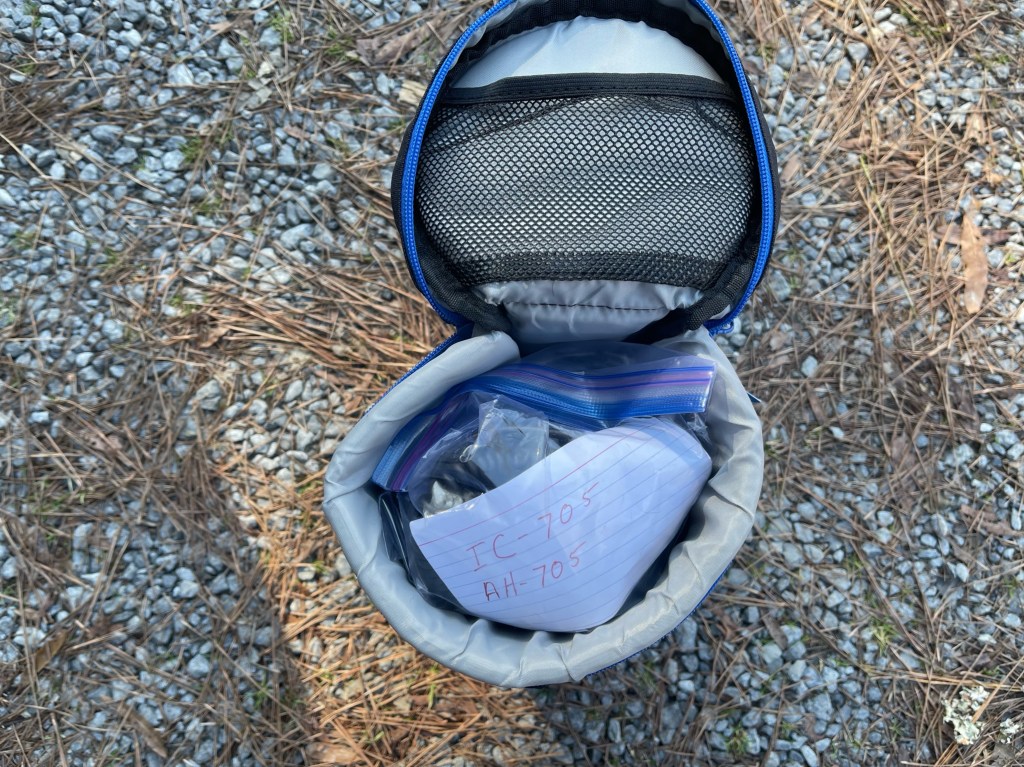
Packing up was a breeze, all my Icom stuff fits into one case. The only things that are not included is the antenna and coax.
All in all it was a great activation. It lasted just long enough and no one was left behind. I can see where the the IC-705 is moving up the ranks as my POTA radio of choice. Because I am very familiar with the Icom architecture, using it is almost second nature.
As I was packing up Marty K4JMG stopped by to say hello before he started his activation at the same place. We chatted a while and swapped a few tales. Marty and I belong to the same ham radio club. It is always good to see him.
Thanks to all those who hunted me, I enjoyed the QSO’s. See you down the log.
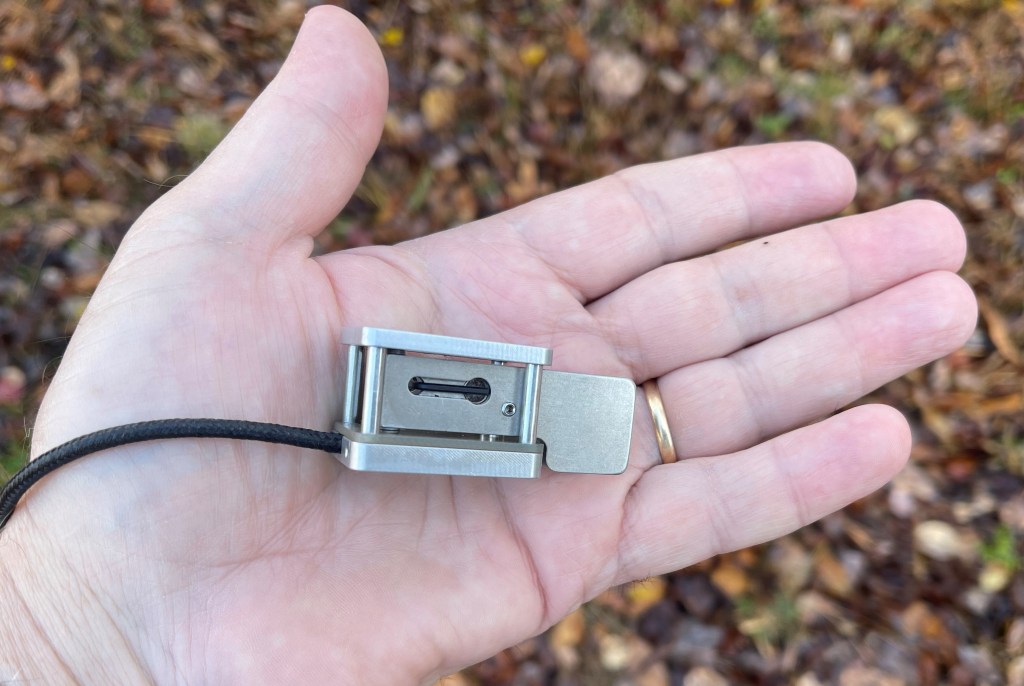
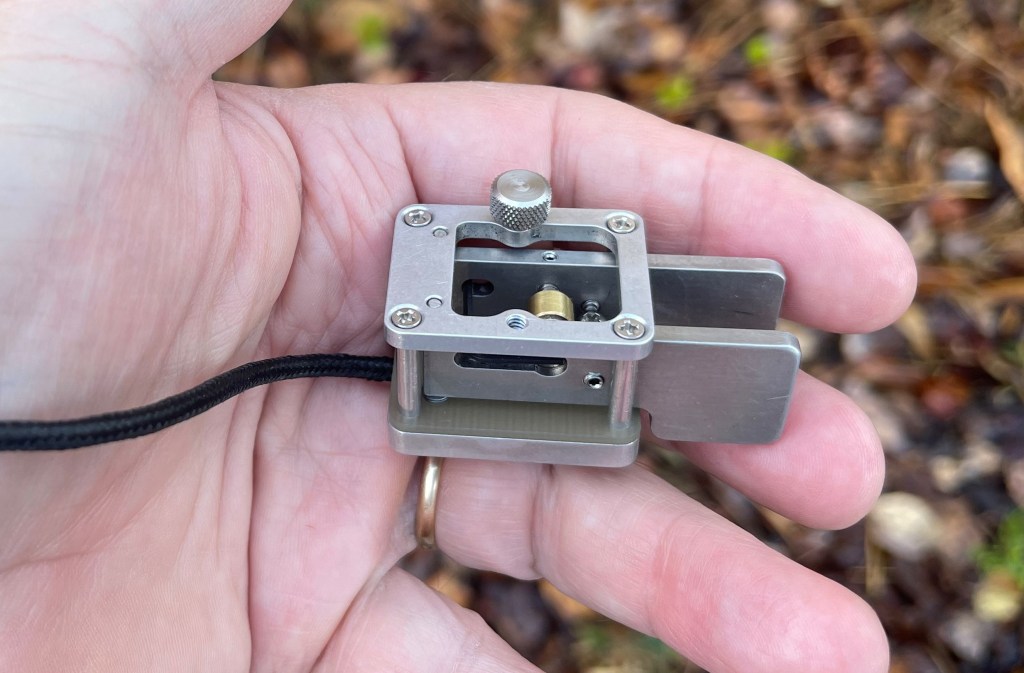
Larry Naumann N0SA builds keys and paddles as a hobby. He recently released a new design in a small quantity and I was lucky enough to get one. Larry is a CW guy and also likes to build paddles and keys. His new one is called the SOTA paddle and is designed for POTA/SOTA.
As you can see, it is a rather small paddle weighing 2 oz. including the cable. This is an amazing paddle with exceptional fit and finish. All corners are rounded and all edges deburred. The metal appears to be passivated which should provide a long lasting, corrosion resistant finish. Paddle tension is magnetic and Larry uses good sized magnets. You can tell they are there. The action is on par with other more expensive paddles. The action can be adjusted with the included hex key which is held in place by one of the tension magnets. I recently did an activation with this paddle along with my Lab599 TX-500. It was a cold dreary, drizzly day and both the radio and paddle did just fine. When I got home, all I did was blow dry the paddles with some canned air. You can see the YouTube video here:
The paddles can be attached to something using 4, 4-40 tapped holes (two on the top and two on the bottom) or it can be held in the hand. Because of my somewhat large, meaty hands, when I use the paddles as held in my left hand, I sent the occasional stray dah.
After my last activation, I removed the paddle from the flight deck and then had to do something with the knurled 4-40 screw I used to secure the paddle to the flight deck. I moved the screw from the bottom of the paddle to one of the holes in the top and put the paddles back in the bag.
A couple of days later, I pulled the paddles out to play with them. Yeah , I know, they do kind of grow on you. I made a few contacts from home, and I noticed that there were not any stay dahs! I looked at the paddle in my hands; the screw changed the geometry of how I held the paddle. The screw was pushing my fat index finger away from the dah paddle. Problem solved.
These are great paddles and fun to use. I enjoy using them both at home and in the field. Will they replace my Begali Simplex on the desk? Probably not, but if Larry decides to make a desk set of paddles… I don’t know when or if Larry is going to make another batch, but if he does, don’t hesitate, because they go fast.











 KK4Z
KK4Z 