I decided to take a look at the FTX-1 and see how it compares to the IC-705. I now have both (I own both) so I can take a good look at each in comparison. My intention is to treat this in a similar fashion as I did for the FT-710/IC-7300. My take is not an in depth technical review but how the radios are perceived through the eyes of a user/operator. First up is the physicality of the radios.
The screens are the same size on both radios. The FTX-1 is a little wider and the IC-705 is a little thicker.
Adding the batteries seems to equalize this as the Icom’s battery is set into the radio and the Yaesu’s sticks out.
One is wider, one is thicker, handling the two radios, I would say it’s a wash.
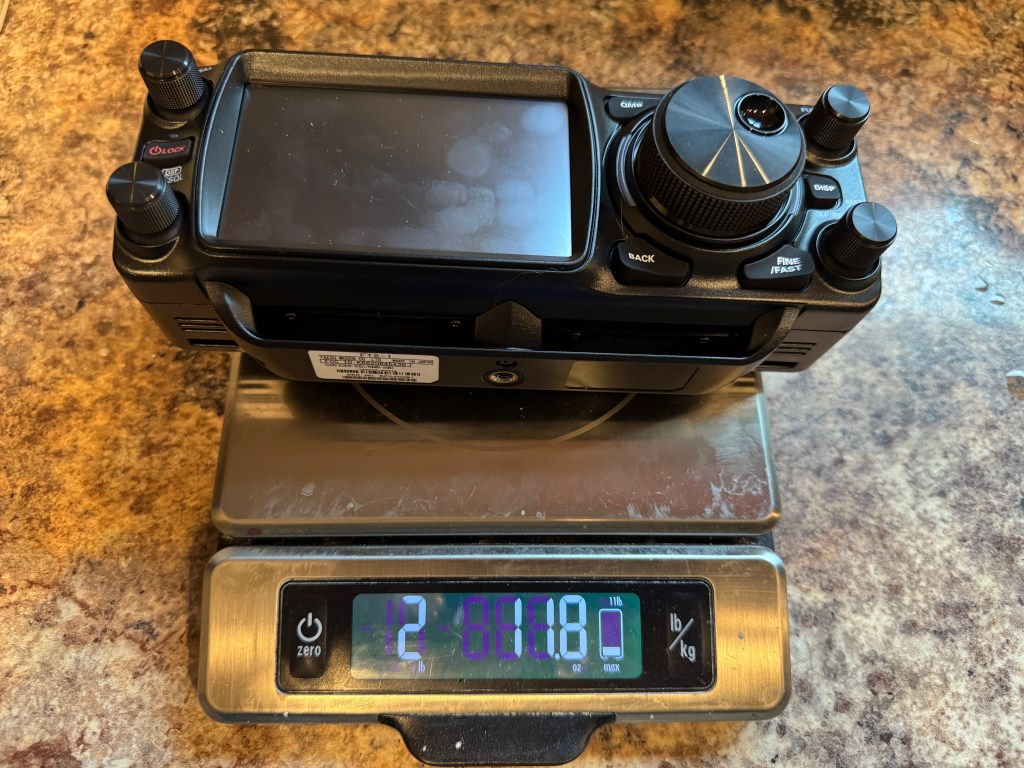
Weight Here there is a difference. The Yaesu weighs more. Handling the radios, the Yaesu feels heavier than it actually is. It feels like a brick.
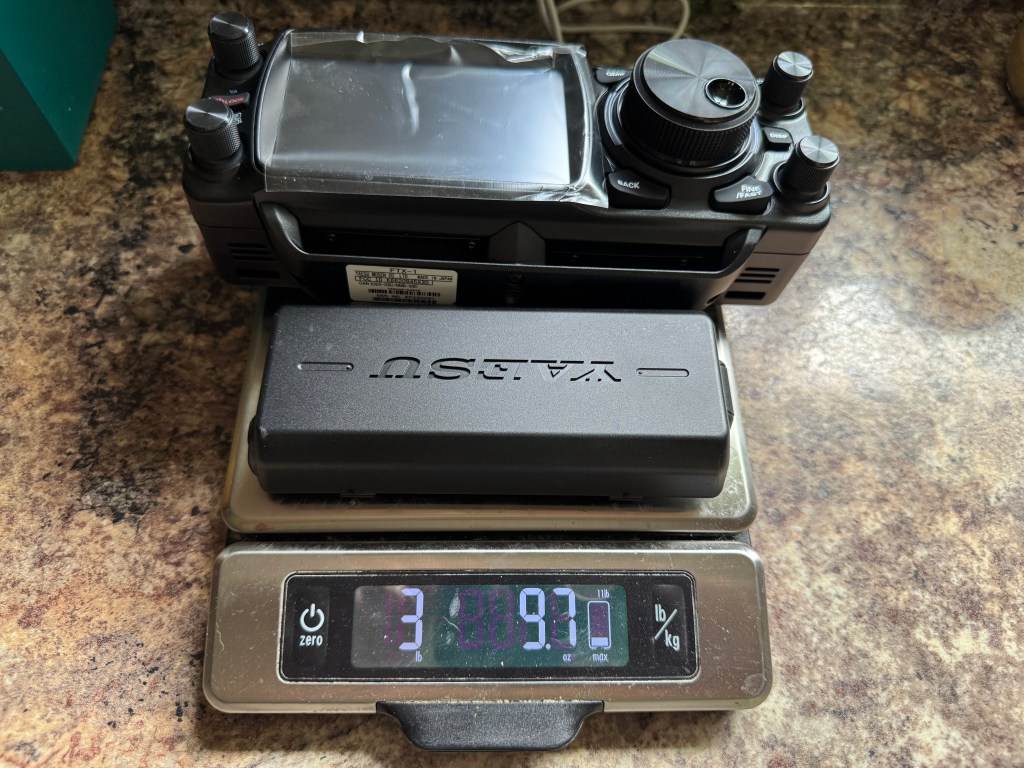
The FTX-1 is 6.3 ounces or 17% heavier than the IC-705. with out the batteries. Adding in the batteries.
For the Icom, I added to additional batteries to bring the total storage up to 6.3 Ah similar to the Yaesu’s 6.1 Ah battery. Even so, the IC-705 weighs less than the FTX-1 by 9.4 ounces or 16.34%. Note: The Icom with a 3.3 Ah battery weighs about 1 pound less than the FTX-1 with a 6.1 Ah battery (see the next post about power).
Size wise, I feel the radios are comparable, they would both fit in a pack or box interchangeably. Weight could be an issue for some. For those doing a POTA activation carrying their radio from the car to a park bench 50 yds away, weigh will probably not be an issue. For those who like to pack it in or do SOTA, weight would be a more critical concern. For me, my days of over hill and dale are pretty much done. If I had to travel light I would turn to my Elecraft KX2.
I woke up this morning to fresh snow on the ground. I had the same excitement as I did as a kid. I got dressed and went on my daily 4 mile walk—in the snow while it was snowing. It was glorious, I remembered playing in the snow as a child and backpacking in it as a young adult. I also remember the grueling Army Field Training Exercises (FTX) in German winters. I have seen cold winters, my coldest was somewhere between -20 to -30 degrees F. Winters can be fun, and they can be dangerous. The most dangerous winter is like what we are seeing today on NW Georgia. Snow with freezing rain and temps hovering around freezing. For driving, this means ice on the roads and sometimes ice covered with snow. Drivers unaware that they are driving on ice lose traction and control of the vehicle. Often they are unaware they have lost control until it’s too late. I have driven cars, trucks, military vehicles, and 18 wheelers on snow and ice covered roads. Only through training and experience did I survive those encounters.
These conditions are also conducive to personal physical injuries such as immersion foot, frost nip, frost bite and hypothermia. Being cold and wet by itself may not kill you, but cold and wet, coupled with inexperience will. This blog post is not necessarily about amateur radio, but about operating amateur radio outside in these conditions. Using my 4 mile walk today, I will lay out what I wore and why.
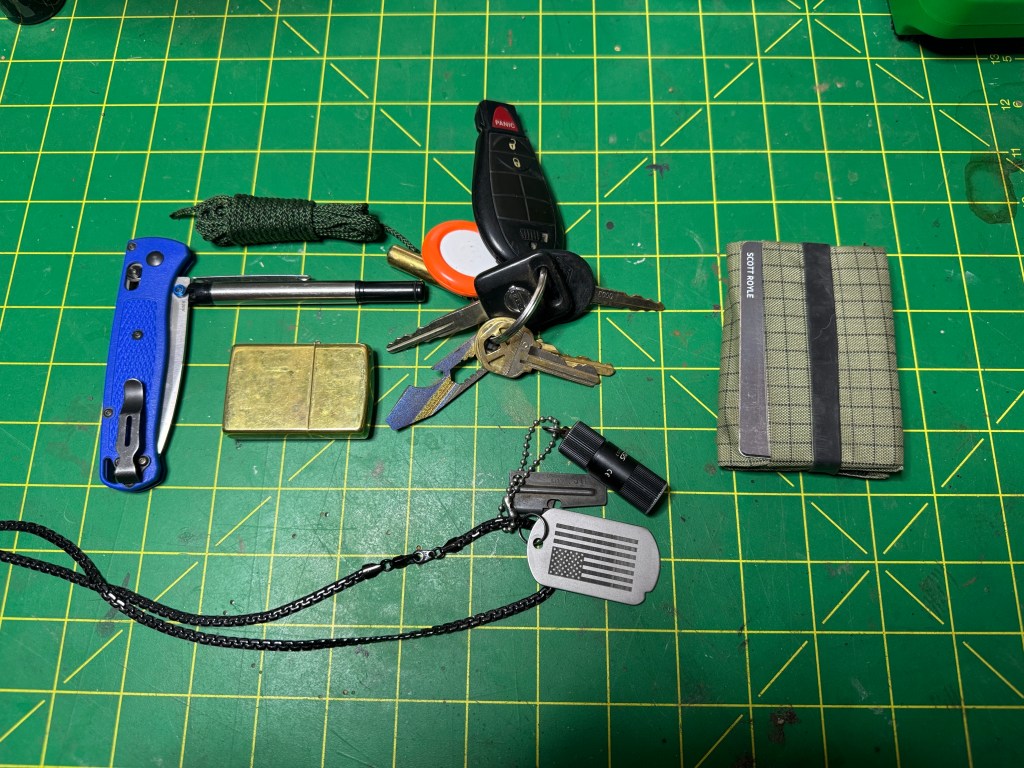
Let’s start with EDC. EDC is Every Day Carry which for me is every time I leave the house I have these items on my. Here is what I carry Every Day.
Knife – Benchmade Bugout. I love this knife. It is the perfect size and weight. I resides in a pocket on my cell phone holster.
Bandanna
Pen
Lighter – Zippo with a butane insert. I used to carry a Bic Flic but because it is so light, it would fall out of my pocket when I retrieved other items. I do not have this issue with the Zippo
Cord – 10-12 feet of 1/16” 100 lb test cord.
Car keys with a bottle opener
Cell Phone
Necklace with: P38 can opener (from my army days) Olight i1Reos flashlight. This is an amazing little light. Dog tag with emergency contact info and medical insurance info
Wallet with: Cash, Credit Cards and ID Signal Mirror Fresnel lens – for reading and fire starting A couple of bandaids Victorinox Swiss Card.
Other items may be added as necessary such as self-defense items or electronics to support blogging/vlogging and radio gear.
Clothing. Starting from the inside out. My undergarments are a mesh top with a bottoms made from 60% cotton and 40% polyester. The next layer was a Carhartt Force Cotton Tee shirt 65% cotton/35% polyester, and Levi blue jeans. I wore Darn Tough wool socks (I wear these year round) and Solomon XA Goretex trail shoes.
My next layer was an Eddie Bauer fleece pullover I got cheap from Sam’s Wholesale. It is 100% polyester. On top of that I wore a cheap Amazon Basics lightweight fleece vest again 100% polyester.
My outer layer was a Carhartt stocking cap 100% acrylic. A TurtleFur neck tube (polyester). Cotton Jersey Gloves and a British SAS Windproof Smock (50-50% Cotton Polyester (unlined and uninsulated). Through the rain/Sleet/Snow I remained warm and dry. My Smock got quite damp but the hydrophobic nature of my under layers and the heat I generated kept the moisture to the outside. If I wore one of my Goretex jackets, I would have been soaked in sweat as Goretex is not as breathable as the smock is.
While walking, I was warm enough to have to unzip my smock and my vest. My gear would have kept me warm down into the teens. I tend to dress one layer warmer than I need. In this case I added the vest. There is a myth that “cotton kills” It’s not the cotton, it’s the operator. Most military uniforms are about 50% cotton. My days in the Army go back to the BDU which is made from Nyco or 50% cotton/50% nylon. I wore that uniform from very hot to very cold and I lived to tell about it. Know your gear, know how it works in different conditions. How does it perform when wet. What I wore today was perfect. My smock got damp, my gloves got damp, but inside I was warm and dry. I walk year round and I walk in most weather conditions. I know how my clothes work. I made myself a promise when I got out of the Army, and that was I would only be cold and wet when I wanted to be. To date, that has not happened. Get outside, try your gear, know what to wear for different conditions. Be safe. Be especially safe when your community needs you. 73 de Scott






 KK4Z
KK4Z 