FTDX10 or FT710

Yaesu came out with too fairly closely spec’d radios at different price points. The FTDX10 currently sells for ~$1,500 and if you add in the 300 Hz filter, another ~$175. The FT710 Field sells for ~$1,075. Roughly $500 less.

The FTDX10 is a hybrid radio with a down conversion receiver feeding into a Direct Digital Synthesizer (DDS). The FT710 is a SDR radio similar to the IC-7300. I owned an FTDX10 for about 18 months and I am on my second FT710, total ownership time is approximately 10 months. I had the first FT710 a couple of months after the initial release. It wasn’t working the way I expected it to so I traded. About 6 months ago, after reading some of the update material, I thought I would give it another go. My second FT710, this time the field version, is much improved. It is my current go to field radio. I plan on keeping this one. Having used both radios if I had to do it again which one would I pick?

I would pick the FT710. The FT710 has 90-95% of the performance of the FTDX10 for $500 less. In fact, I do not think one could tell the difference between the two in a side by side blind test. There is a caveat, the receiver architecture is different between the two radios and it requires a slightly different skill set. SDR radios like the FT710 basically run wide open all of the time. Keeping that in mind, in most cases it is better to run IPO or attenuation rather than preamp. I almost never run preamp on my FT710. What is nice about the FT710 is it gives you 3 levels of attenuation: 6dB, 12dB, and 18dB; a feature usually only found on higher end radios. In contrast, the IC-7300 only gives you one, 18dB.

The other control you should become familiar with is the RF gain. On a Yaesu, RF gain starts in the fully clockwise position. When there is a lot of noise, slowly turn the RF gain counter-clockwise until only the desired signal is heard. Coming from analog radios years ago, my brain is still a very good filter. I use digital noise reduction sparingly. I often keep it at level 2 or 3, enough to take the edge off.

Perhaps the most compelling reason to chose the FT710 over the FTDX10 besides the cost, is the ergonomics. I have large hands and fat fingers. The FTDX10 clustered its controls close together so I had to be careful when pushing a button or twisting a knob. Even so, I would bump the frequency dial and throw it off frequency. I have remarked that the controls on the FTDX10 were more suited for the lefthand. In fact when it was a part of my home station, it sat to the left side. With the FT710, the controls spaced further apart and are easy to get to even with my big mitts. This is a real benefit for a field radio. The position of the radio or the lighting conditions may not be optimal so ergonomics are important. I find the FT710 a joy to use in the field.

If you are a dyed-in-the-wool FTDX10 owner, this post is not for you. I wrote this for the amateur radio operator looking for their first HF radio, or maybe a seasoned operator looking to venture into the Yaesu family. This is also for those who have limited funds and are agonizing over which radio to get and should they sacrifice funds for the more expensive radio over something else they may need for the shack. The FTDX10 is a fine radio. Its Achilles’ Heel is its ergonomics. The FT710 is a fine radio in its own right. I believe it is 90-95% of what the FTDX10 is but for much less money. Of all the Yaesu radios I have owned over the past almost 30 years, the FT710 is the one I have been most happy with. YMMV de Scott
Cha-Cha-Cha-Changes

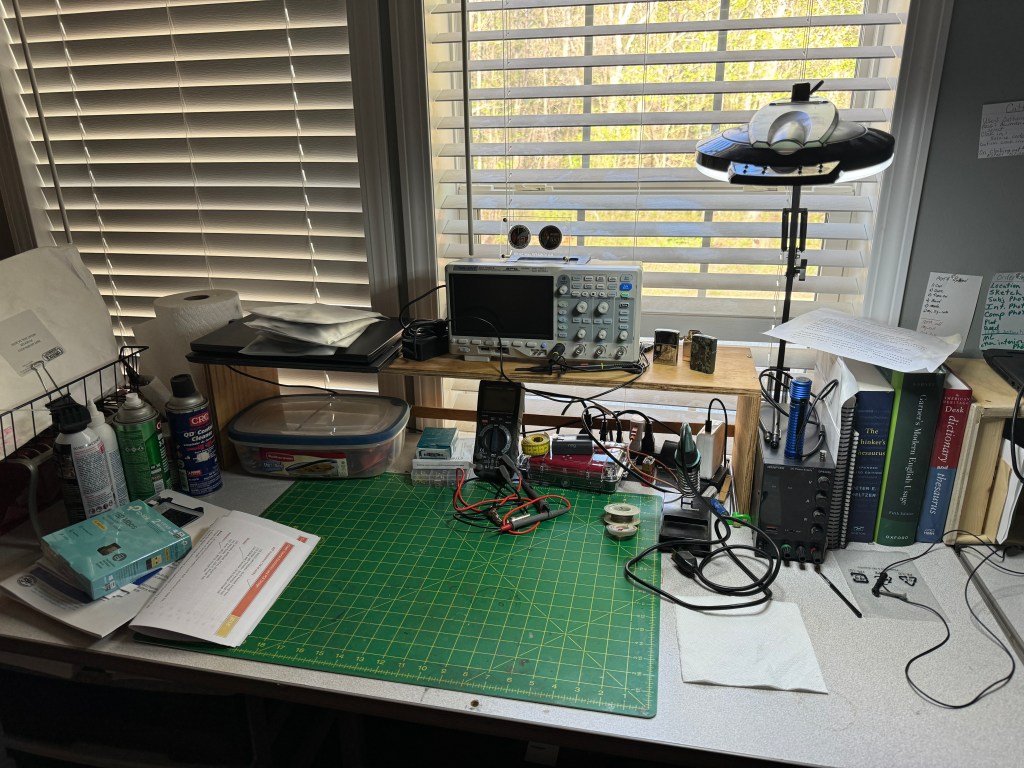
Change is inevitable. In this case my workbench. As I branch out into other fields of study my requirements for a workspace change. As I said earlier, I want to take the time and learn more about electronics. I’m not sure what I am going to do with it once I learn it — but that’s a story yet to tell. I recently added an o’scope to my quiver of test equipment. As I progress, there will be more to add. Looking at my current workbench (above) it was getting crowded and adding more equipment will quickly bring it to overflowing. Time to put on the thinking cap.

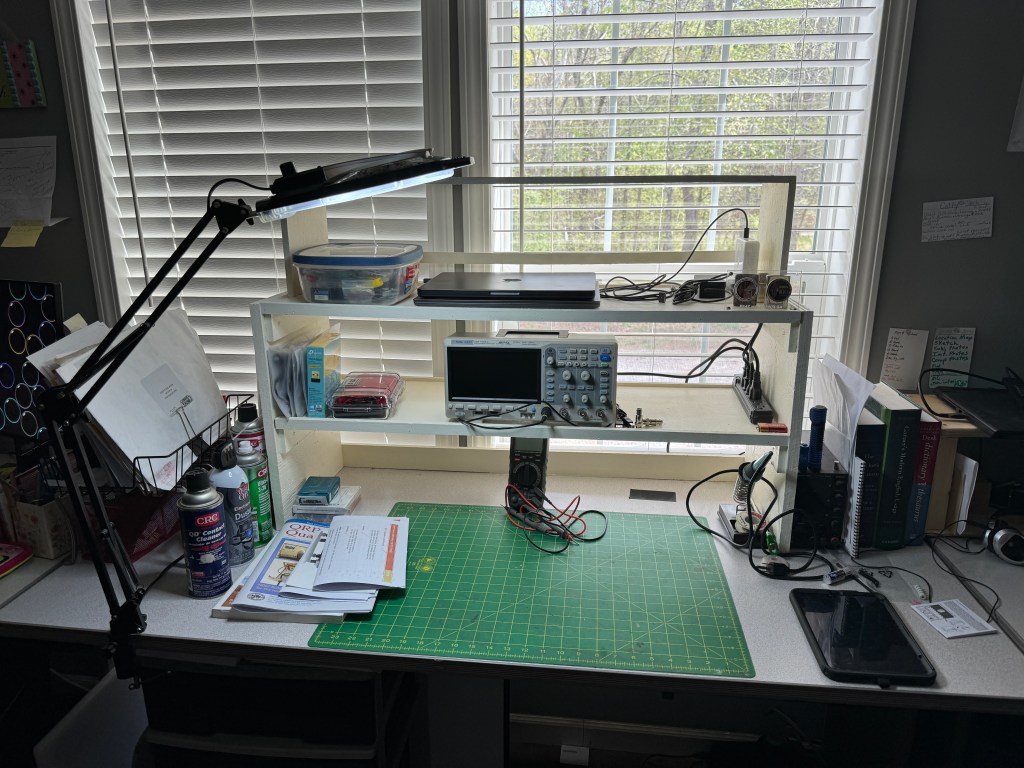
My first consideration was how to create more desk area. Horizontally, I am at my max so vertical was the only diredtion left. I decided I was going to build some shelving. I made a rough sketch and then took a trip out to my sheds. Using a mish-mash of plywood I was able to salvage enough from my scraps to build the shelves. The sides are 3/4″ CD plywood and the shelves themselves are 1/2″ premium grade. The shelves are 3′ wide and 12″ deep. vertical spacing is 8″ – enough for most test equipment. Some of the dimensions are a little off due to some warping of the plywood, but in general, the shelves are level and the whole unit does not wobble. Each shelf has a 1/4″ lip and the bottom of the shelf has a 2″ piece of plywwood across the back to prevent things from rolling where they shouldn’t. The shelf was glued, screwed and nailed using stuff I had on hand. The only thing I had to buy was some paint as all the stuff I had was dried out (I did look). I had to move my light to the other side of the bench so it would reach the work area. Fancy tools for this project included a table saw and a finish pneumatic nailer. The table saw is a godsend as it can quickly dimension lumber.

In the picture below, you can see that I now have more space with room to expand my test equipment. I believe next up will be an Arbitrary Waverform Generator with a Frequency Counter.

The third shelf was the original shelf shown at the beginning of the post. It was painted and repurposed. I will probably store my laptops up there.

Because the shelves are open in the back, they still let a lot of light in. I haven’t gotten my parts from DigiKey yet so the building/experimenting part is on hold. However, I am pressing forward with the written/video portions of my class.

Thanks for stopping by and checking out my (mis)adventures. When time permits I try to get on the air for a little CW fun. First quarter 2024 has been real busy, hopefully it will smooth out. Unitl next time 73-Scott

West Georgia Amateur Radio Society at Cheaha State Park

The West Georgia Amateur Radio Society (WGARS) is a great group. We like to do three things: 1) talk on the radio, 2) get together, and 3) eat. We did all three this past weekend during the Fall Support Support Your Parks on the Air weekend (POTA). We like to do about 4 gatherings a year namely Field Day, Winter Field Day, and the Spring and Fall Support Your Parks on the Air Weekends.

This fall we went a little uptown and rented one of the pavilions at Cheaha State Park (K-1037). This gave us shelter from the elements, power for the slow cookers, and plenty of benches to set up on. There were restrooms nearby with running water. Cheaha Mountain is the tallest point in Alabama and our pavilion was just a little down from the summit.

The weather was perfect. In the morning it was in the upper 40’s rising to the mid 70’s by afternoon. As I said earlier, we like to eat. There was an abundance of food, we had Chicken and Sausage Gumbo, BBQ, baked beans, buns, garlic bread, dunkin’ donuts, coffee, soda, and I am sure I missed a few. The bottom line is we could have fed half again as many and still had leftovers. There were over a dozen of us there.

We set up three radio stations. We had a Yaesu FT-991A and an Icom IC-7300. They were running FT8, CW, and SSB. I was running an Elecraft K3(s)/10 on FT8. My original plan was to run FT8 until it got warmer out and then switch to CW. However, we had a group gather around my station and we were doing what we like to do, kibitz and socialize. With FT8 I can run the radio and join in the conversation. We had a lot of fun chatting with one another. By the end of the day, I worked 40 states and 4 countries for a total of 120 contacts. The DX were Argentina, Canada, Ecuador, and Spain. States covered all 4 corners and in between. Not bad for 10 watts!

I had the pleasure of meeting Ward W4RE. Ward is a Vietnam Veteran and what made our meeting special is that we both served with the 101st Airborne Division. We were a generation apart with me serving between wars, but anyone who has served with the 101st understands that it is not a cakewalk; we had an immediate bond. Like me, Ward is a CW op albeit, much better than I. I am hoping that during one of our future meets, Ward and I can run a CW station together.

This was the trial run for my K3(s). I upgraded my K3 to a K3S. It is a QRP radio with a max power of 12 watts. The difference between 10 watts and 100 watts is about 1.7 S-units, a small change for CW. I operated the radio pretty much the whole time I was out there and it performed flawlessly.

While my K3 was in the shop for a repair and a going over, I put my name on the list for a KX2. There is about a 3-4 month wait for them and if things didn’t work out I could always cancel the order. When I received the invoice for the KX2, I asked my wife Mary K4SEZ about it, thinking it was worth a shot and as I was getting ready to cancel the order; she got on the computer and checked the books (she’s an accountant) and said “Happy Retirement”. I was ecstatic. I retire in 54 days and I have already made plans for that little radio. It was a great weekend that was full of surprises. Winter Field Day is right around the corner — can’t wait. 72 de Scott