IC-705 vs FTX-1 Power

In this post I will take a look at the power requirements of both radios. Again, this is not a detailed in depth scientific experiment, more in line with what the average user would do with equipment he/she may have on hand. One of the first things I did was hook the radios up to a power supply, in this case a Samlex SEC-1223BBM and I used one of those generic power meters. At idle:

That was surprising! The Yaesu uses 155% more power at idle than the Icom. One possible way to look at that is the IC-705 with a 3.3 Ah battery may have the same operating time as the FTX-1 with a 6.1 Ah battery. This makes the Icom even lighter because it needs less battery.

Next I hooked the radios up to a dummy load and Bioenno 3 Ah battery and did a key down at 5 and 10 watts to measure the power consumed. First at 5 watts.

Interestingly enough, the IC-705 is more efficient in its power usage. It is 340 mAh less than the FTX-1. Moving on to 10 watts.

The Icom again is more efficient being 240 mAh less power draw than the FTX-1. What does this mean? I think in rough terms a 3 Ah battery with the IC-705 will give you approximately the same operating time as a 6 Ah battery for the FTX-1. If you are a drive-up POTA guy, this is no big deal. If you are a remote POTA guy or a SOTA girl, power conservation may become an issue. For me, I will use my 3 Ah battery with the IC-705 and get a 6 Ah battery for the FTX-1. Note: The IC-705 with a 3,3 Ah battery weighs 1 pound less that the FTX-1 with a 6.1 Ah battery.

Now comes my first gripe with the FTX-1. The FTX-1 uses a different power connector than my other small radios. My IC-705 and my KX2 both use the same connector. Some of my other QRP radios in the past also used the same connector. Now I have to make sure I have the right connector for the radio. In the image below, the Yaesu connector is on the right. The center hole is larger than the one on the left (Icom/Elecraft).

From here, my reviews/blog post will become more sporadic as I have to get the radio setup and taken out in the field. Unfortunately for me, POTA parks are all somewhat far away and I can’t just pop over for an activation. I do have some big trips/roves planned and I will be bringing the FTX-1 with me. In general, I like the radio, it has a nice fun factor and it does some things very well. In the near future I plan on doing an a/b test with the IC-705 during a CW contest.

One thing to note is the FTX1 can use USB C to charge the batteries however it requires PD (Power Delivery) and needs 45 watts. That would mean a USB C charger similar to one you would use to charge a laptop. The IC-705 can be charged using a regular USB A to Micro USB cable. This might become important if you are trying to save wait or space.

Stay tuned de Scott

FTX-1 vs IC-705 Physicality

I decided to take a look at the FTX-1 and see how it compares to the IC-705. I now have both (I own both) so I can take a good look at each in comparison. My intention is to treat this in a similar fashion as I did for the FT-710/IC-7300. My take is not an in depth technical review but how the radios are perceived through the eyes of a user/operator. First up is the physicality of the radios.

The screens are the same size on both radios. The FTX-1 is a little wider and the IC-705 is a little thicker.

Adding the batteries seems to equalize this as the Icom’s battery is set into the radio and the Yaesu’s sticks out.

One is wider, one is thicker, handling the two radios, I would say it’s a wash.

Weight
Here there is a difference. The Yaesu weighs more. Handling the radios, the Yaesu feels heavier than it actually is. It feels like a brick.

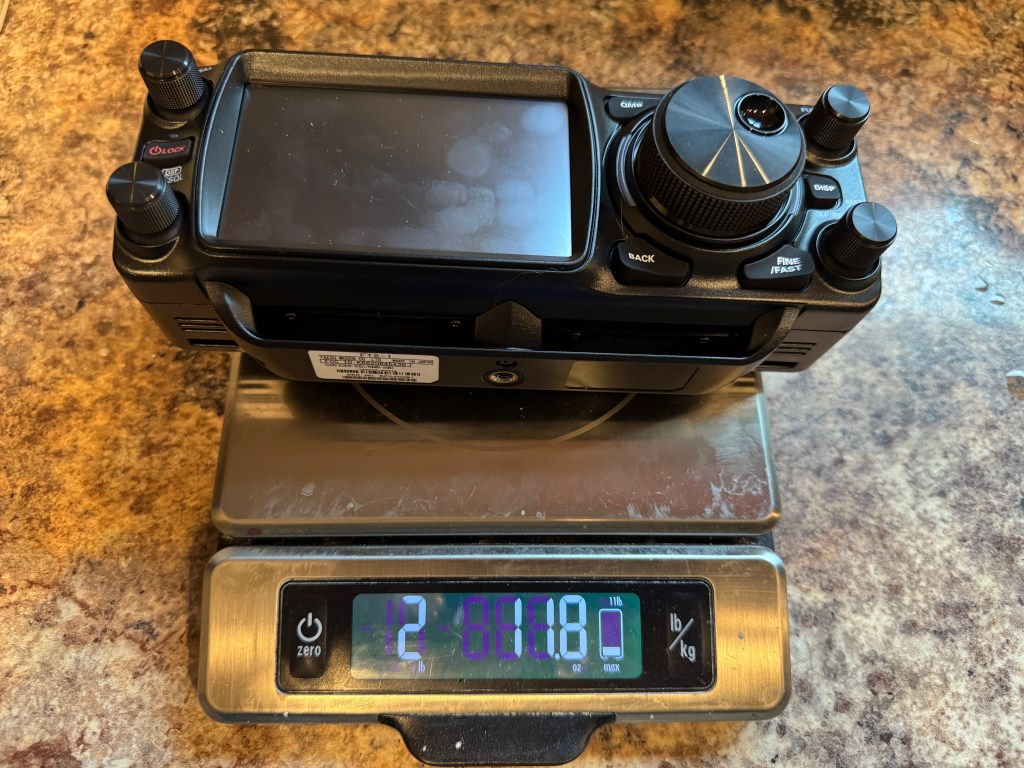
The FTX-1 is 6.3 ounces or 17% heavier than the IC-705. with out the batteries. Adding in the batteries.

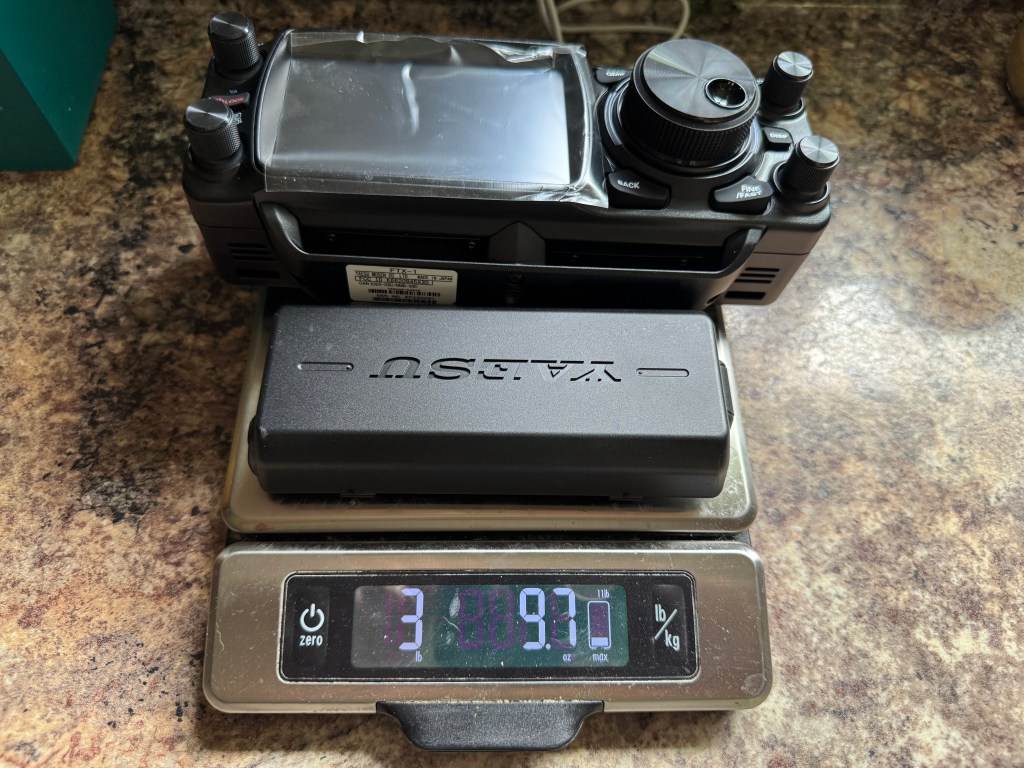
For the Icom, I added to additional batteries to bring the total storage up to 6.3 Ah similar to the Yaesu’s 6.1 Ah battery. Even so, the IC-705 weighs less than the FTX-1 by 9.4 ounces or 16.34%. Note: The Icom with a 3.3 Ah battery weighs about 1 pound less than the FTX-1 with a 6.1 Ah battery (see the next post about power).

Size wise, I feel the radios are comparable, they would both fit in a pack or box interchangeably. Weight could be an issue for some. For those doing a POTA activation carrying their radio from the car to a park bench 50 yds away, weigh will probably not be an issue. For those who like to pack it in or do SOTA, weight would be a more critical concern. For me, my days of over hill and dale are pretty much done. If I had to travel light I would turn to my Elecraft KX2.

Next up power with some more surprises de Scott

Yeah, I might be a little fickle

I’m not afraid to tell on myself, I can own up to it. Last night I decided to go ahead and order a Yaesu FTX-1 Field. Not without reason though. I watched a few YouTube videos from hamvention with John from Yaesu talking about the FTX-1. He mentioned that the performance of the FTX-1 would be similar to the FT-710. That could be impressive. I just finished up a review on my FT-710 so I have a feel for the radio.

Another cause and effect was yesterday, I pulled my IC-705 out getting it ready for some POTA activations. I had been remiss doing QRP CW activations focusing instead on low power digital with full size radios. I have been feeling the urge to brush up on my CW skills. Back to the 705, I like the radio a lot. It does indeed push all of the buttons. I was holding it in my hand thinking it’s not so bad for a portable radio and the FTX-1 is only a little bigger…I thought I might do another comparison series this time between the 705 an the FTX-1. I have a couple of big trips planned for the fall and winter and these radios will do nicely.

Another reason that pushed me toward the FTX-1 was the price of used radios, they are over the top right now. I was looking at a KX3 and it was the same price as the FTX-1. Even some of the other used radios were more than I cared to spend for them. One thing I forgot to mention, is I have grown used to waterfall radios. I have learned to use them to help me find places in the band to operate and to do a real time check on propagation. It’s amazing what you can glean from those screens.

Hopefully, over the next couple of months I’ll put the IC-705 and the FTX-1 through their paces. Up front I will say that I have a preference for Icom radios, but the FT-710, KX2, and TS-890s have found places here at the ranch. I am not adverse to using different brand radios, I use whatever fits me best.

The new radio should be here in a couple of days and then the games begin. This should be fun. 72 de Scott