Penntek TR-35 for SOTA

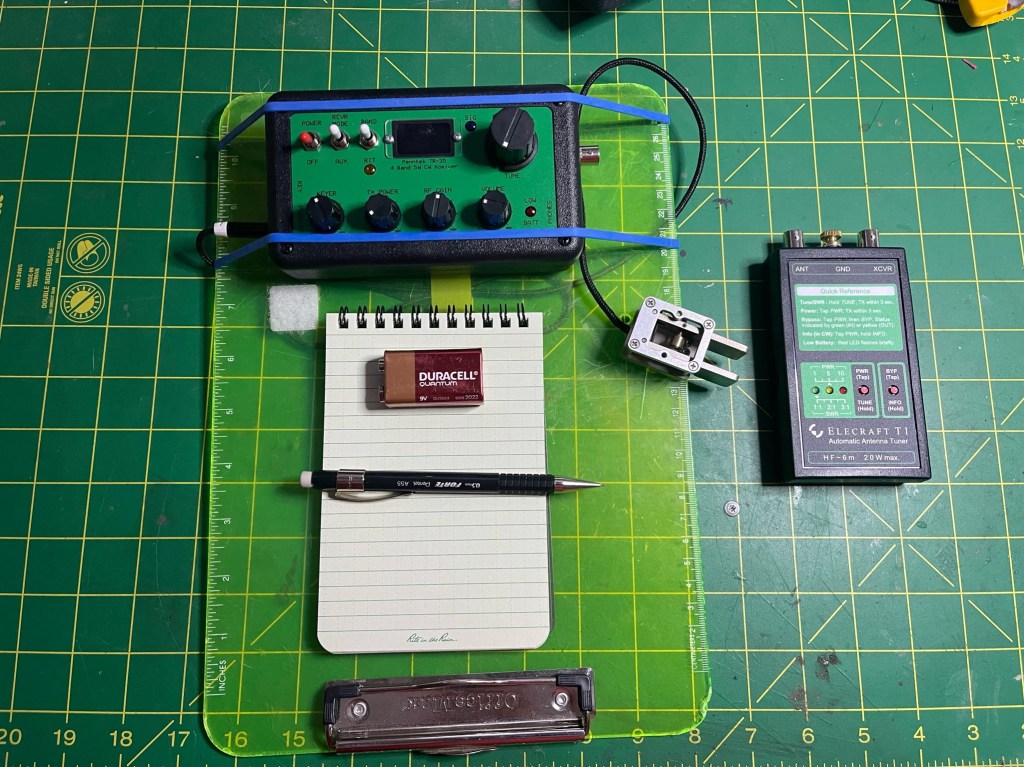
Yesterday, I received my Penntek TR-35. I am looking forward to taking it to the field next week. The radio is mounted on my homemade flight deck which is a modified clipboard. The 9-volt battery is for scale. The tuner is an Elecraft T-1 and the paddles are N0SA SOTA paddles. The notebook is a Rite-in-the-Rain 4×6″. I have been using Rite-in-the-Rain products for close to 50 years. There is nothing better for field use. In addition to the N0SA paddles, I can also use my Begali Adventure paddles.
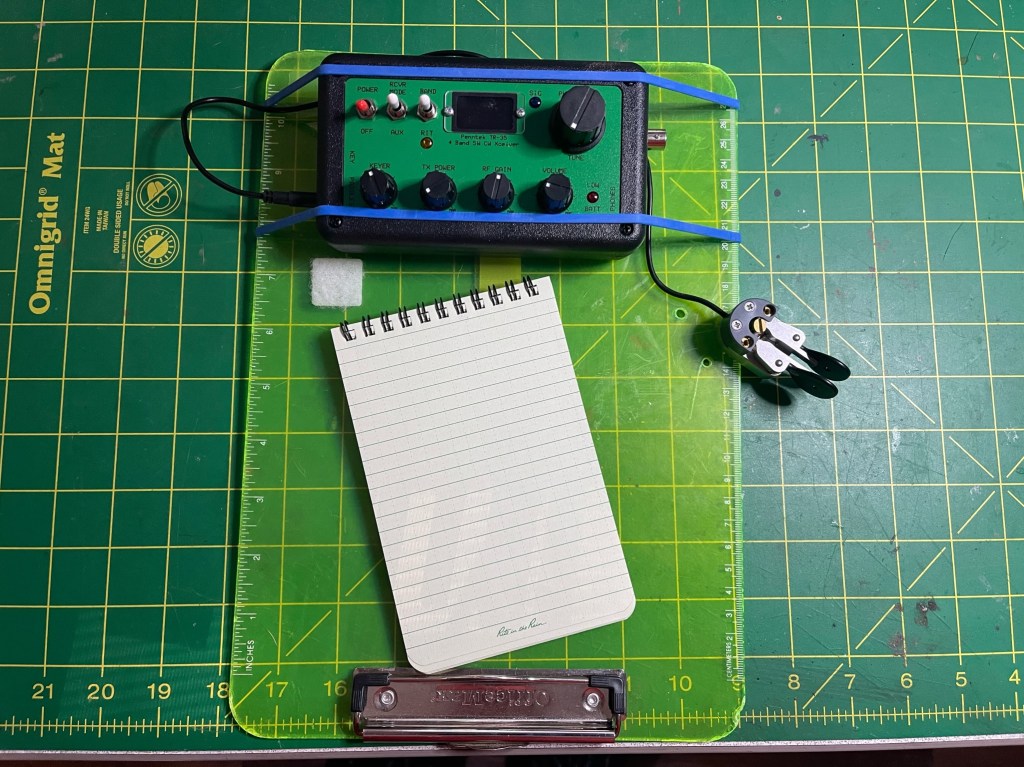
Both the Begali and the N0SA paddles attach with a 4-40 screw.

I have made two adjustments to the TR-35. I had to adjust the sidetone volume and it was too low for my old ears. The adjustment was simple. Remove the 4 screws that hold the case together, split the case, and there is a variable pot next to the power port. A twist with a screwdriver and all is well. The other mod I did is I added 2 small tip-up feet to tilt the radio a little. I got this idea from John AE5X and you can find the feet here: https://tinyurl.com/2ht9yks2. They add just enough angle to make viewing the top of the radio easier.

To finish kitting out the radio, I added the following:
6′ RG-316 cable
15′ RG-316 cable
Power cord with extension
Bioenno 3 AH battery
Skull Candy earbuds
Stereo to Mono adapter (not shown)
Spare 9-volt battery (tuner)
Cable Adapters
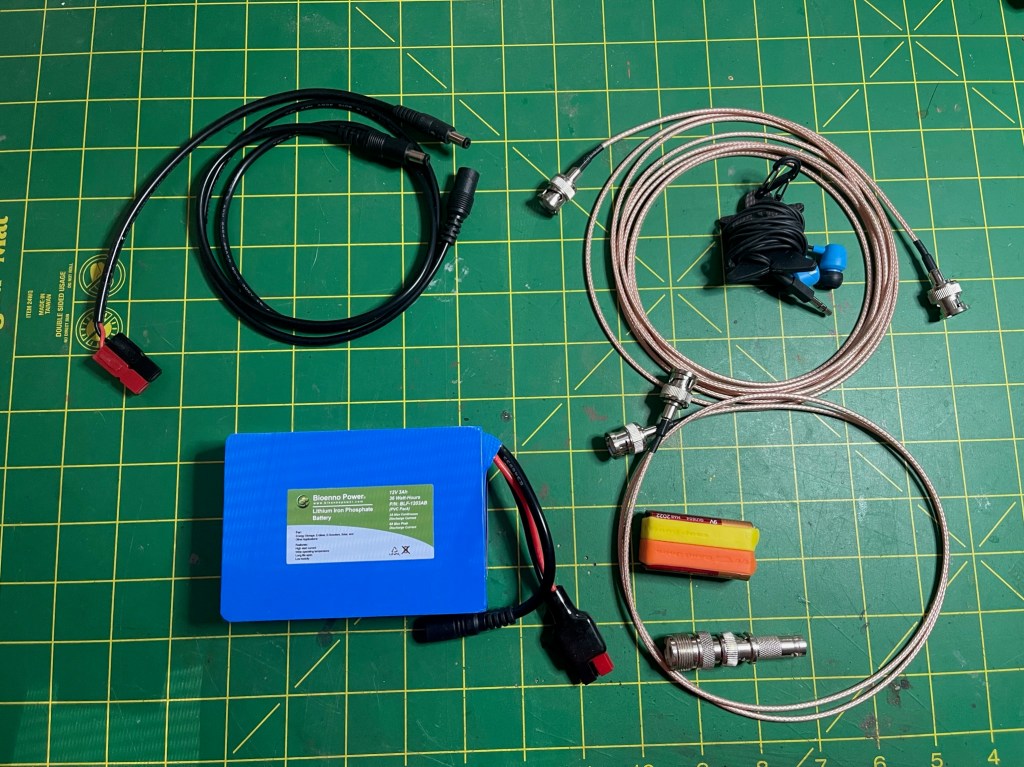
The stereo-to-mono adapter is for the earbuds. The TR-35 has a mono output and when you plug stereo earbuds in, you only get sound in one ear. Everything but the flight deck and the notepad fit into a Condor utility bag.

The bag and its contents weigh just shy of 50 ounces.

I have one addition and one modification to the setup. I have had an original In Reach satellite communications device for many years and it was showing its age. I now have a Garmin Messanger which works so much better. Many times even when I am doing a POTA activation, There isn’t much if any cell service. It’s nice to be able to spot in real-time. The Messenger is small and will reside on one of my shoulder straps.

I and using a USGI first-ad/compass pouch. I believe the one shown actually comes from my Army days. The Messanger also provides peace of mind for both my wife and I. I can send her a text message that I am okay and my location. I can also send an SOS if I have an emergency. It’s cheap insurance.

The last change I am going to make is the pack bag. The Camelbak HAWG is a great pack but for what I am doing it is just a little bit too small. It currently fits everything with a little room left over for food. Since I am out and about year-round, I need a little extra space for clothing and maybe my little Snow Peak stove. I’ll keep you posted. 73 — Scott
I Got Bit By The SOTA Bug

Meeting with the SASQ group at Cheaha State Park this past weekend renewed my interest in SOTA. Over the past year, I have gotten myself in pretty good shape making SOTA more doable. I started putting together a bag for hiking to SOTA Summits. I have hiked and backpacked at different parts of my life so I have an idea of what I need (and want) for a kit. Since I’m an old guy, I do not want to be carrying the kitchen sink with me. I have a QRP radio coming, but that’s another post. Here is the list of my current load out.

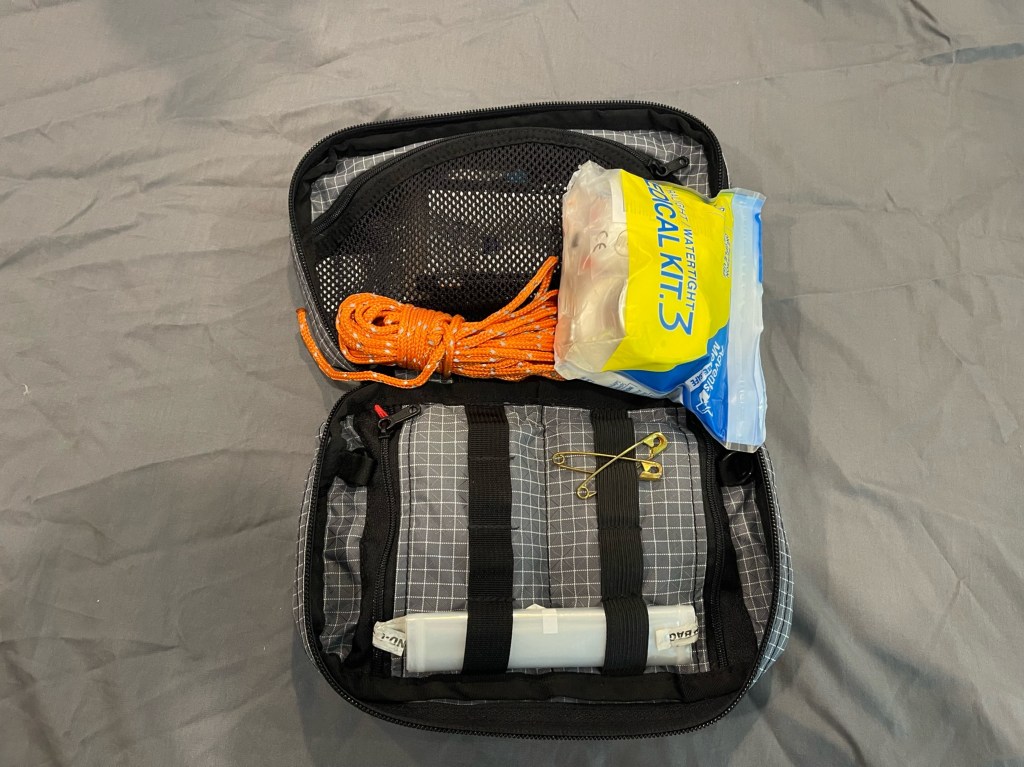
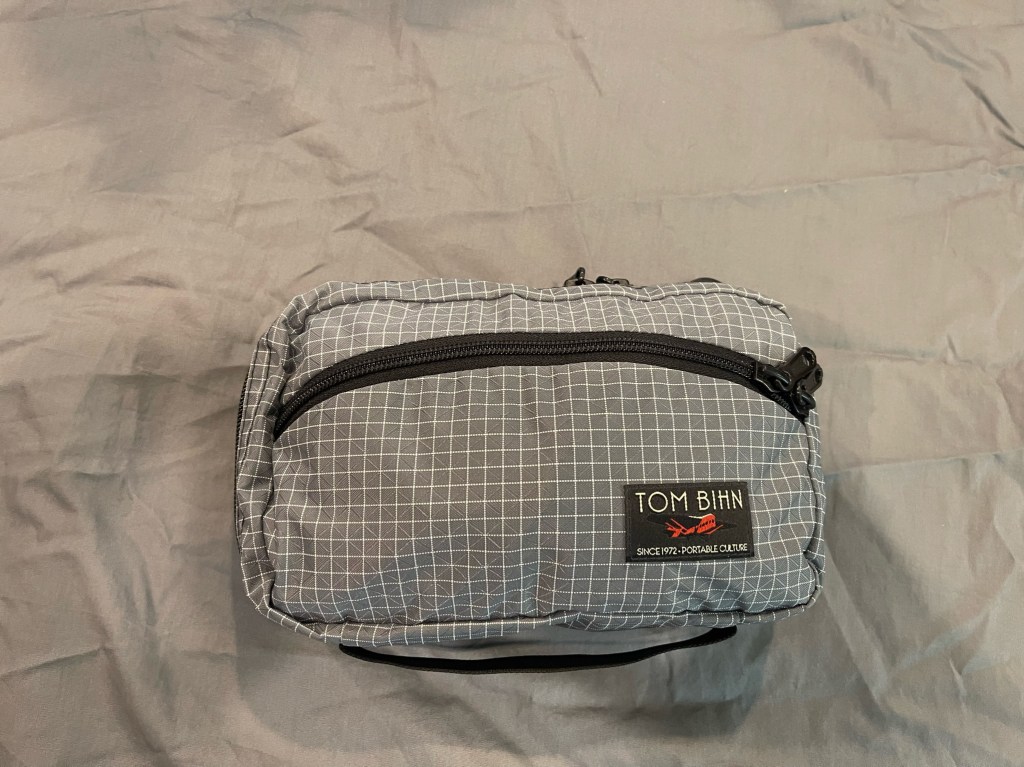
I’ll start with my E&E bag short for Escape and Evasion. Typically an E&E bag has the bare minimum of gear. This bag travels with me when I leave my home area. I move it from bag to bag as needed. The bag is a Tom Bihn Handy Little Thing (HLT) size 2. Loaded, it weighs 24 oz (1.5 lbs).

Here is a list of the contents:
Mechanical Pencil
Bullet (Space) Pen
Rite in the Rain Notebook
Mylar Rescue Blanket
2 – Eye Glass Cleaners
2 – Dude Wipes
Rope
First Aid Kit
2 – Safety Pins
1 – 1 Liter Water Bag
Compass w/signal mirror
Whistle
Survival Guide
Dental Floss
Ferro Rod, Striker, and Magnesium
Fire Tinder
Matches
Duct Tape
P-38
Mini Screwdriver
Flash Drive
Evidence Card
Large Magnifying Glass
Small Magnifying Glass

To carry the radio and associated gear, along with food, water, etc., I decided to use my Camelbak HAWG. It is the older style. I like it because it prevents me from overpacking. The bag and gear without the E&E bag weigh an even 6 lbs., 7.5 lbs with the E&E. With adding food, water, and radios, I am hoping to keep the weight below 15 lbs. I’ve done some Go Rucking with 40 lbs so this should be a breeze.

Here is the list:
Canteen, Cup, and Cover (canteen is Nalgene)
Potable Aqua
MRE Spoon
Poncho
Garbage Bag – Contractor
Rope Kit w/Duct Tape
Triangular Bandanna
Insect Repellent
Tincture of Iodine
Sit Cushion
Tent Stakes – 6

There you have it. enough to cover most events that may happen on an excursion into the wilds, but not too much where you feel like a pack mule. Next work on the radios. 73 – Scott

A little CW Project

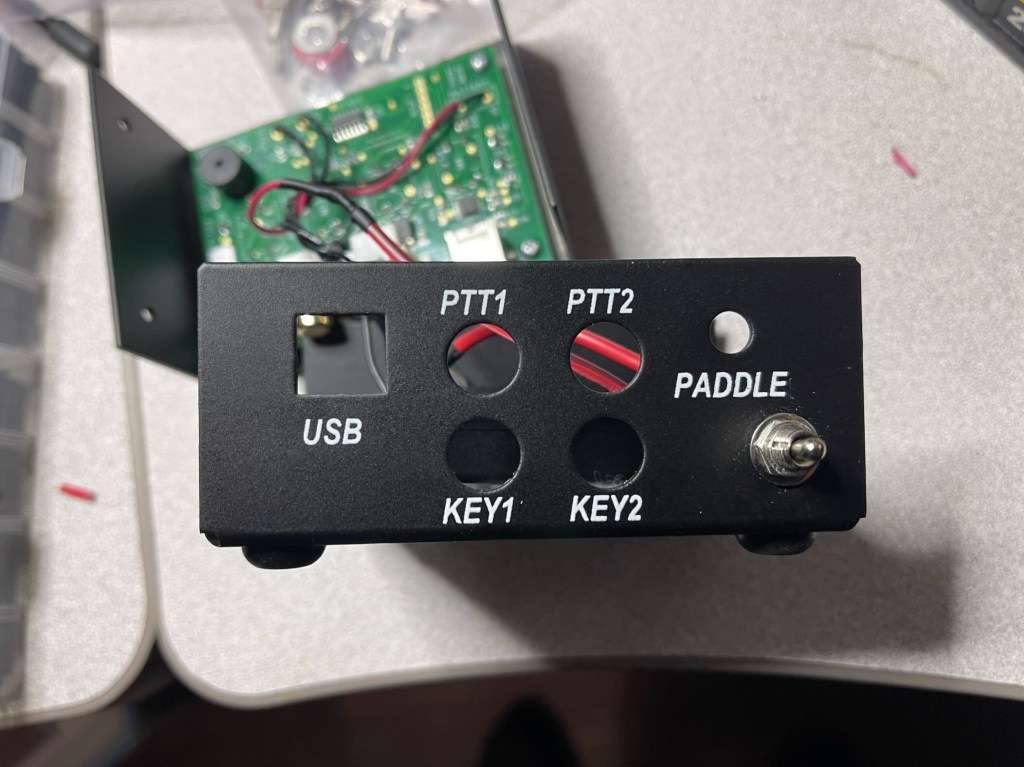
I have the K1EL WKUSB-SMT keyer. I like it a lot. I use it at home and in the field. I would normally either plug it into my laptop or a battery for power. However, I am trying to clean up my act and reduce some of the cabling I have. The keyer will run for months on 3 AAA batteries that stow inside the case. It is a little bit of a chore to change them out due to the 4 teeny screws that hold the clamshell case together. Fine at home, but could become an issue in the field.

I put the batteries in and placed the keyer right-side up in my field box. When I got to the campsite and took the box out of my truck, I heard “dah-di-dah-dit, dah-dah-di-dah” I must have bumped one of the buttons. I open the box and there was the keyer chirping away — with no way to turn it off. Luckily, the paddles were in the top tray so it was easy to hook them up and send a dit to stop the keyer.

When I got home, I scrounged a few parts. All I needed was an SPST switch, some wire, and shrink tubing.

I found an open spot below the paddle connector and drilled an appropriate-sized hole.

A little bit of solder and some heat on the shrink and I’m done.

Now when I travel, I just flip the switch to turn it off. It probably took me more time to write this than to complete the project.

I use the keyer a lot. It integrates with ACLog seamlessly. There is also an app that allows me to program the keyer with a keyboard. I can then save the different message banks on the computer and load the one I need for the trip. I have one for POTA, SOTA, and Field Days. One thing I like is I can slow the CW speed for certain words. I’ll do that with Park ID. Start at 18, slow down for the park number, and then speed back up again. All with the push of a button.

I hope this gives you ideas for your own projects. 73 — Scott

After a day with the FT-710

I gave the 710 a bit of a workout yesterday. Mainly ran CW and FT8. I did find some differences between it and the 7300. To some, the differences may be small, but to others, not so small. My initial ranking putting the 710 behind the 7300 still stands. The 7300 is a bit easier to use and for all practical purposes, they hear about the same.

Using FT8, the 710 would sometimes do funny things to WSJT-X software. It would change the mode to FT4 when I changed bands. Also when changing bands, the software would lag behind the radio before it would change. It may be a polling issue. I do have the latest revision of the software.

Below is a video of some of the differences I found between using the 710 and 7300. You will have to excuse the gaffs, sometimes it gets a little confusing when switching between two different manufacturers. I don’t edit the videos, this is me doing the things I do. I got the 710 packed up and ready to go on my next adventure. This will be the first field test of the radio.

Ramblings

This weekend is the Georgia Parks on the Air Contest. I will be at a park operating CW and FT8 depending on band conditions. I will not be contesting. I have participated in contests in the past, but now I look at contesting like I look at a job. Neither is really fun to me. If you see my signal, give me a call I will be uploading it into POTA and LOTW.

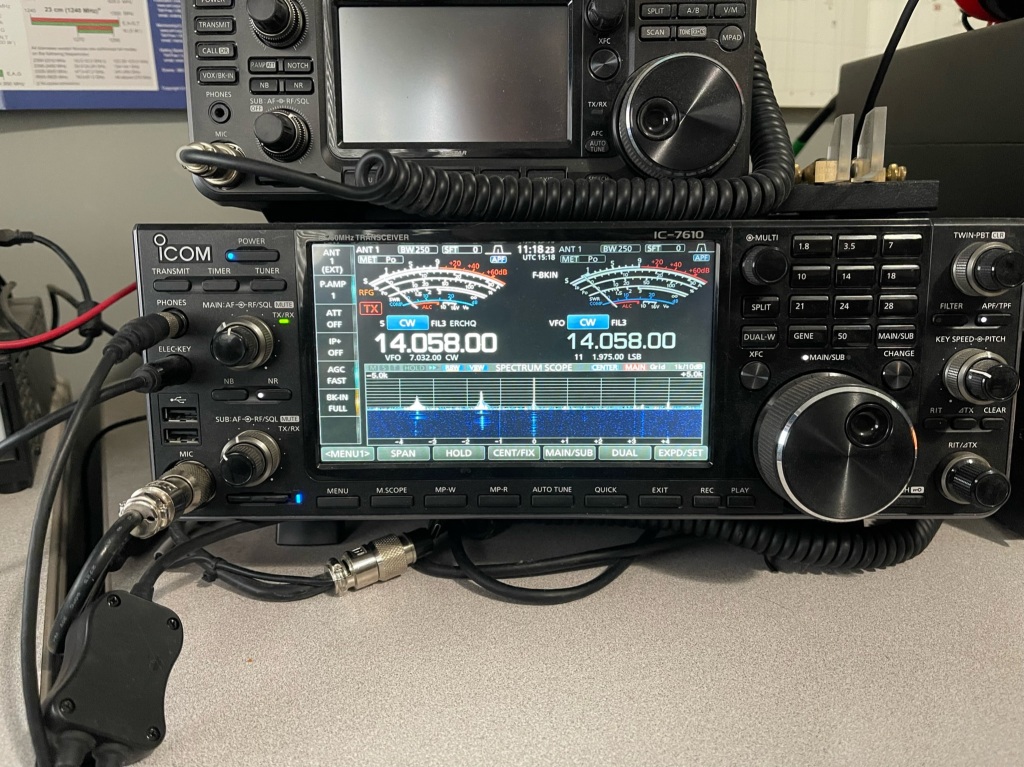
Radios. This weekend I will be bringing my Icom IC-7300. It is still one of my favorite radios. If I could only have one, the 7300 would be it. I still have the FTDX10 and it has become part of the home shack. It shares space with the IC-7610. The 7610 is still my workhorse and it is hooked up to the amp. It does everything well. That doesn’t mean that the FTDX10 isn’t used. I think I use them about 50/50. I like to use the FTDX10 for casual CW like hunting for POTA activators. I rarely go above 50 watts and the built-in tuner will tune my antenna well.

A side benefit of moving the FTDX10 to inside the shack, is I use it more and I am more apt to dig into the manual. There are things I like about the radio. One is the roofing filters. The filters, along with DNR do a pretty good job taming QRN and QRM. The radio is more pleasant to listen to. Another thing I like is the way split operation works. Once you set up the split, the main dial controls the receive frequency, and the outer ring controls the transmit frequency. As a chaser, I need to be able to move my transmit frequency around while keeping the receive frequency steady.

Another nice feature is the ability to transmit CW in SSB mode. The Icoms do not do this. I check into a net that also allows CW check-ins. With the 7610 I use the Memo Pad to switch between SSB and CW (with a -600 Hz transmit offset). I also use the second receiver set to the SSB freq. Once set up, when they ask for check-ins, I hit the memo pad read button, send CW and then hit the memo pad read button again to return to SSB. With the FTDX10 I set the TX Clarifier to -600 Hz and turn it on to send CW and off to send voice. Easy Peasy. The benefit with the FTDX10 is if the net moves due to QRM I am instantly ready, whereas with the 7610 I would have to reset the memo pad.

I find that I like the FTDX10 more in its role as a shack radio. It was okay in the field, but it is better at home. It sits on the left side of my desk which is ergonomically better. As I said in the past, it is a left-handed radio.

The FTDX10 is a keeper, the more I use it, the more it endears itself to me. The IC-7610 is not going anywhere. It still runs with the best of them. Is there an FTDX101 in my future? Maybe. If I get one, I would probably sell the 10 and still keep the 7610. If I make my desk just a little bit bigger…

73–Scott

Where’s Sheldon?

Sheldon is the name I gave my FTDX10. Like Sheldon Cooper from the comedy series “Big Bang Theory”, the radio is smart but at times awkward. I bought the radio back in October 2022 to compare it with the the IC-7300 as a field radio. I used the radio at home and in the field for the past 6 months. It gave me a pretty good opportunity to put it through its paces and here are some conclusions about my overall feelings for the radio.

I wish to start by saying, I do kind of like the radio. Even though there are a lot of things I don’t like about the radio, at the end of the day, well, I kind of like it. When evaluating the radio, at times I felt like I was trying to pound a square peg in a round hole. Once I realized that, I felt I was being unfair to the radio so, in the next couple of paragraphs, I will try to right a wrong.

What the radio is not. The radio is not a field radio. It draws too much power, it is awkward to use, it is too heavy and a little too big. The ergonomics leave a little bit to be desired. My QRO field radio remains the IC-7300 and it is still the radio I recommend to people just getting started in amateur radio. After 6 months, the FTDX10 will go to the field no more.

What the radio is. I recently redid my radio desk and decided to fit the FTDX10 in the mix. At home, it is a different radio. I have it set to the left side of my desk and that improved the ergonomics. I guess I am saying that the FTDX10 is a left handed radio. I am using it as a backup radio for my IC-7610. However, I find myself drawn to it when operating CW. I have the 300 Hz roofing filter installed and on CW, it is a joy to use. One of the things I didn’t like was the Mat-30 tuner I bought for it. At home, I have a 270′ OCF dipole that tunes rather easily, so I use the radio’s internal tuner. I’ve never had much luck using external tuners with Yaesu radios, in this instance, Icoms are so much better.

Conclusion. I had originally thought I was going to sell the FTDX10. But since putting it in its proper place, in the home shack, on the left side, I believe I am going to keep it. I really enjoy using it for CW and It does make a great backup radio. I do not have it hooked up to the amplifier, so it is a 100 watt radio. The Sheldon experiment was a success. It showed some of the radio’s shortcomings, but it also showed its strong points. 73’s Scott

Where’s KK4Z?

In addition to fun things like camping and portable amateur radio operating, I do a lot of emergency communications (EmComm) work. Over the past year and half, I have been setting up a communications network for my church over a large area (about half the state of Georgia). It is now up and running fairly well and I have enough trained net control operators to turn this function over to them. I still have more EmComm work to do but now it is at the local level. I also perform EmComm duties at the regional and national level; however, that is less taxing.

Over the past couple of months I had taken a hiatus from everyday amateur radio operation with the exception of winter field day with my local club. to be honest, I needed the break. One activity I enjoy is Parks on the Air (POTA) with CW being my primary mode. I used to visit the POTA Facebook page but I was finding the crowd becoming a bit churly. I guess that’s a function of growth and POTA is rapidly growing. Fortunately, the CW side of POTA is still rather civil and my cure was to avoid Facebook. I should have avoided it all along. So after giving myself a POTA rest, I am starting to venture out into POTA land, this time sans Facebook.

My gear hasn’t changed. At home, my primary HF radio is still the IC-7610 and has been with me for 5 years now. I had thought of maybe trying a Yaesu FTDX101 but after reading some reviews where they tried the FTDX101 but went back to the IC-7610, I’ll keep mine. A common theme is the ergonomics.

I still have my FTDX10 and I compare it to the IC-7300. It is part of my long term test. Like the FTDX101, the 10 suffers from poor ergonomics. At times, it gets in the way of itself. I know everyone is using Sherwood Engineering’s test data to tout how great the FTDX10 is; however, running the FTDX10 next to the IC-7300, the IC-7300 can and does work any station the FTDX10 can, even under contest conditions. In fact, the IC-7300 has a lower noise floor by a factor of 4. I admit that the FTDX10 does sound better, but overall performance still goes to the IC-7300. At this point in the game, I am not ready to sell either one, but if one had to go, it would be the FTDX10. Both these radios are used as field radios.

While testing the above 2 radios, I have been neglecting my QRP radios. Typically, when I go camping, I bring the bigger radios. I have room in the truck/camper, so why not. At most, I have to carry them 15-20 feet. My little radios have been languishing in the dark, unused and unloved. This year, I plan to break them out more. At this time, I have 3: IC-705, TX599 and TR-45L. Of the three, the IC-705 is the favorite. It’s just a good radio, with great performance. Nothing can touch it in it’s price range. If the trend continues, bringing big radios out to the field, one or two of the little ones will go.

I hope to hear your out there. Few things are better than spending a day or even half a day in a park, on a nice day, with a radio. 73’s Scott

Winter Field Day

This year the West Georgia Amateur Radio Society (WGARS) decided to hold winter field day at Little Tallapoosa Park in Carroll County, GA. I would call the event semi-serious. I don’t think any of us are real hard-core contesters, but some of us watch the numbers. The majority of our members operate using SSB and I was the only one operating CW. The plan was for me to get as many bands as I could for multipliers. That meant I had to be able to swap bands fairly quickly in order to advantage of changing band conditions. We had five stations set up, 4 of which had bandpass filters. Because I didn’t have any bandpass filters I was located about 100 yards away from the main group.

Gear. I brought the FTDX10 with me to see how it would do in a semi-contest environment. It fed a Mat Tuner, Mat-30 tuner, and then to my 29-foot random wire antenna. This has become my favorite antenna. I logged with N3FJP WFD software and used a K1EL keyer. The computer and radio were powered by a Honda EU-2200 generator (we ran alternate power). This generator is very quiet and is very fuel efficient. The rest of my camper was fed with shore power at the campsite. I kept warm with a little ceramic heater.

Operation. This year I tried something new. Not only did I use the N3FJP software for logging but I also used it to send CW, in other words, I did everything from the keyboard. I was a little apprehensive, aren’t we all when it comes to something new? But I found it worked quite well. Band conditions, on the other hand, were not that good. They were up and down with a lot of fade. By being able to jump around I was able to work 100 contacts on 5 different bands. I was hoping for more, but there weren’t a whole lot of stations out there to work. I thought it might have been my station, but looking at the QSO Map, I was getting out okay.

Cold weather may have kept some CW ops at home. It gets harder to work a key or paddle when your hands are cold.

FTDX10. Part of my ongoing review of this radio. You really can’t get a feel for a radio or any piece of kit unless you use it over a period of time. My other radios are feeling the pain of neglect. How did it do? Not bad really. I made an effort to try the CW decoder. There were times were I really needed it due to QSB (fading). Sometimes the band would drop as I was getting the exchange. The decoder often picked up what I missed. It is not a replacement for your ears and mind. But it did help and made me a little more efficient. My hearing is not that good. The decoder is sensitive to CW speed. It does best when it is close to the sender’s speed. I set the outer dial (MVLP) to CW speed for this purpose. While I normally set the function knob to RF power, because band conditions were so variable, I set it to level (waterfall level) which allowed me to adjust the waterfall as needed. The radio performed well and I appreciate the roofing filters. I had one issue and that was I would tune across the band and about every 10 KC the waterfall would go dark and I would have to retune the antenna system. That became rather annoying. There is an example of what was going on in the activation video below. Very quickly, I got a response from one of my subscribers stating that it was the tuner and not the radio. This morning, I broke out the radio and tested it with the Mat-30 to make sure I still had the problem here at home (I did). I then swapped the Mat-30 for my old LDG Z-11 Pro and viola! The problem disappeared. You can see the results in the second video.

I think my club as a whole had a good time. It is fun to get and socialize, plus throw in a little operating. When testing a radio, or any piece of kit, You can’t really do it justice over a couple of days. I’ve had the radio for a couple of months, and as I work through the issues, I find that sometimes we don’t know each other that well yet. It’s still early in the dance. I will say that I am warming up to the radio more than I thought but I still say that if I had to choose between it and the 7300, the 7300 would still be my choice. However, that gap is getting narrower. If Yaesu would make a few software upgrades…

A Tale of Two Radios

Ever since I was a young lad, I was interested in Amateur Radio. I bought books and read and got a few kits and bits from Radio Shack. My electronics mecca at the time. I had no help from my parents. It was a wonder my father didn’t burn down our house with the way he wired things. I felt sorry for the person who bought the house after my father left it.

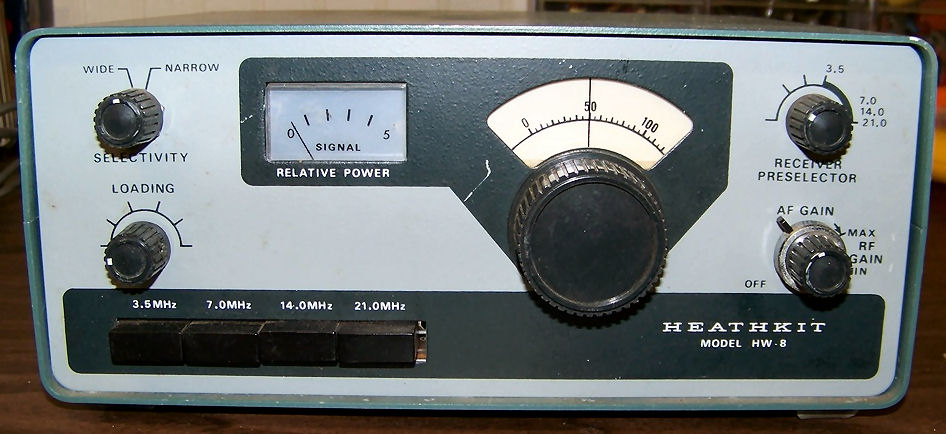
It wasn’t until years later that I took a more serious attempt at getting my ham radio license. I was in the U.S. Army as a member of the 101st Airborne Division stationed at Ft Campbell, KY. Being a member of a division that could move itself lock, stock, and barrel, in 30 days, kept us busy night and day. I decided I was going to build a radio in preparation for getting my license. I chose the Heathkit HW-8 as a fairly simple radio. Along with it, I got a Jensen Kits JT-6 Mean Little kit with enough tools for the project and a case to put the tools in when my workbench reverted to the dining room table.

Just as I finished up the kit and arranged for a friendly ham to help me with the alignment, I was placed on orders for Germany. It dashed my hopes of getting licensed and I ended up selling the radio to the guy that was going to help me. I never sent one dit or dah on it.

It wasn’t until quite a few years after I got out of the army that I finally got licensed. many years have passed and with that, many enjoyable minutes and hours enjoying the immense sphere of amateur radio. As I approach retirement, I have taken an interest in CW once again. It has become my favorite mode. I am no speed demon and my copy skills still need improvement, but as I lurch along, I am meeting new friends of all skill levels. At least in my old age, I can laugh at my guffaws.

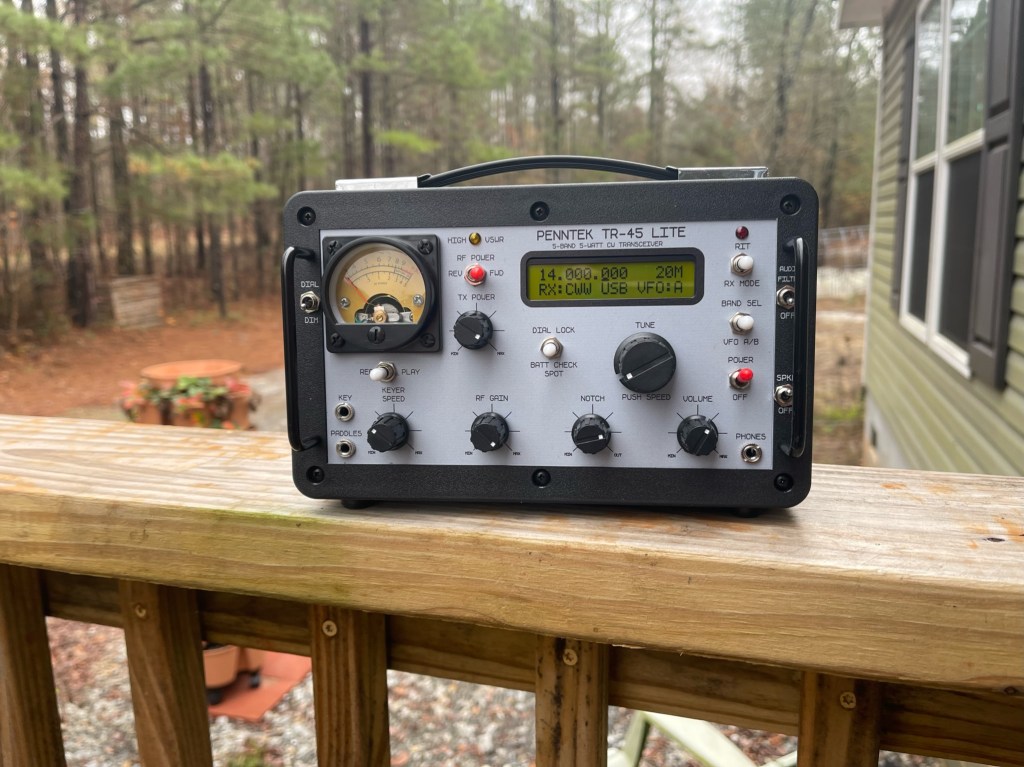
A couple of months ago, John Dillon of Penntek Radios released the details of his new radio, the Penntek TR-45L. I already have enough QRP radios and for grins, I went to Tom’s K4SWL’s website where he was reporting about the beta test he was doing. When I saw the radio, a flood of memories came over me. I remember the fun I had building the radio and dreaming of getting on the air. I also remember being a little saddened, when I realized, I would not be using that radio and that licensing would still be a few years away. But HOLY COW did that Penntek bring back that same vibe as the HW-8! I knew I had to have one. I placed my order and then the wait…

It showed up a couple of days ago and it brought me back to the early 1980s when I had the HW-8. I felt very nostalgic. This radio is more complex than the HW-8, but it has that vibe, that Joe Friday, “Just the facts ma’am” attitude. Easy to use, simple controls that remind you of a bygone era. Before cell phones, the internet, and computers. In a recent blog, I spoke about naming radios. I call this one Apollo as it is reminiscent of the Apollo era when man first stepped on the moon. The computer on the Apollo Command Module had less computing power than a high school calculator. There certainly wasn’t a “Hey Siri” either.

This is a busy time of year. So far, I have been able to play with the radio for a short while and was able to make a couple of CW contacts on 20 meters. I do have a weekend activation planned and the TR-45L is going with me. A nice back-to-basics, just me and the key weekend. Shoot, I may do the full monte and paper log. Over the next couple of weeks, I hope I get to work you on the air. If not, then a very Merry Christmas to all. 73 de Scott

Naming Radios

Men in general, have a habit of naming things. All sorts of things, cars, body parts, you name it, we will cast our own nickname on it. I thought I would share some of the names I have given my radios. Typically, I don’t just throw a name on something. I am around it for a while, before I decide what I am going to call it. My poor dogs, when I first get them, I go through a plethora of names until I find one that fits. My latest dog, a boxer mix from the pound was named Hawkeye by them. I got him home. I had to get to know him.

He ended up being Andy but likes to be called pup-pup. Maybe his last owners called him that. He’s still very much a pup but is going to be a great dog.

I will start with my main radio which is an Icom IC-7610. It is my workhorse radio. It is probably the best radio I have ever owned. I have worked the world on it and it does everything I need it to do. I call it Zeus, the king of all my other radios. I believe there is not a radio out there that can do anything that Zeus cannot do. Any improvements over Zeus would be marginal.

Next up is another Icom, the IC-7300. I’ve had this radio the longest. It is simply called Peter, after the Apostle Peter. This radio is my rock. It can do everything my other radios can do. Not as well, but if I could only have one radio, the IC-7300 would be it. I’ve used it as a base, I take it to the field, run it off of batteries, voice, digital, CW, it does it all.

The last Icom in my stable is my IC-705 whom I call Jack. Jack with the AH-705 can do it all. Jack is short for Jack-of-all-trades. It does everything quite well. Because the user interface is similar to my other Icoms, it is easy to use. I think Icom has some of the best ergonomics out there for modern radios.

The next radio on the list is my Lab599, TX-500. This is a fun radio with a simple interface in a small package. What sets this radio apart is it is weatherproof. I have taken out on cold rainy days without issue. Its name is Baal (pronounced bale) which is the Canaanite god of weather. This one doesn’t see as much use as the others, but when bad weather is in the forecast…

The last radio in my current quiver is the FTDX10. My most recent radio and one I wanted to try over a long period to see how I like it and how it compares to my other radios. I named it Sheldon after the main character on The Big Bang Theory. Like Sheldon, the radio has its moments of brilliance, but along with that an awkwardness that can’t be ignored. I will continue to use the radio and try to keep the firmware updated. Yaesu could easily fix some of the issues so we shall see. One thing that I do like about the radio is the roofing filters including the 300hz one.

The last radio on my list is a Penntek TR-45L This radio was due to be delivered last Thursday but has now been postponed until Monday (thank you USPS). This radio is already named Apollo, after the Apollo moon missions back in the 1960’s. I was fortunate enough to be alive then and watched the actual landing on TV. This radio has a 1960’s vibe to it so Apollo it is. More about the TR-45L once I get my hands on it.

These are my radios. I like them all and I try to rotate them as I go to the field. The past couple of months though has had horrible band conditions during my trips so I tended to bring the bigger radios for more horsepower. That and I was working on my POTA N1CC award. When I was at a faraway park I wanted a little insurance working 10 different bands. Gas prices were killer back then so I wasn’t sure about a return trip. Upcoming trips should see a more normal rotation. 73 — Scott