

This past weekend was the Support Your Parks on the Air Weekend. My local radio club, the West Georgia Amateur Radio Society (WGARS – https://wgars.com) operated from Cheaha State Park which is the tallest point in Alabama. While there I spent some time with a new ham and we got on the subject of CW paddles. He asked for a recommendation and at the time I didn’t really have a good answer. On the way home from the event I thought about it and if I was to make a recommendation today, it would be a Begali Simplex Begali Simplex Paddle. Currently they cost about $163 USD and are built to last a lifetime. I am a fan of their paddles and own 5. Begali paddles are built like tanks with the precision of a Ferrari. Their customer service is bar none.
While at the park, I set up my IC-705/AH-705 with a Chameleon Delta Loop. The 705 is a fun and very capable radio. The paddles I used were made by Modern Morse. These are very nice paddles and well built. However, during the operation, I was having trouble adapting to them. I made a lot of mistakes. It just didn’t feel right. I decided to check the paddle force or the amount of pressure it took to depress the paddles. I had been holding off getting a dynamometer but pulled the plug and I am glad I did. I first measured a set of paddles that I use well which were my Begali Expedition. They measured about 25 grams of force. As I went through my other paddles I discovered a wide range of forces between them. Some as high as 50+ grams.
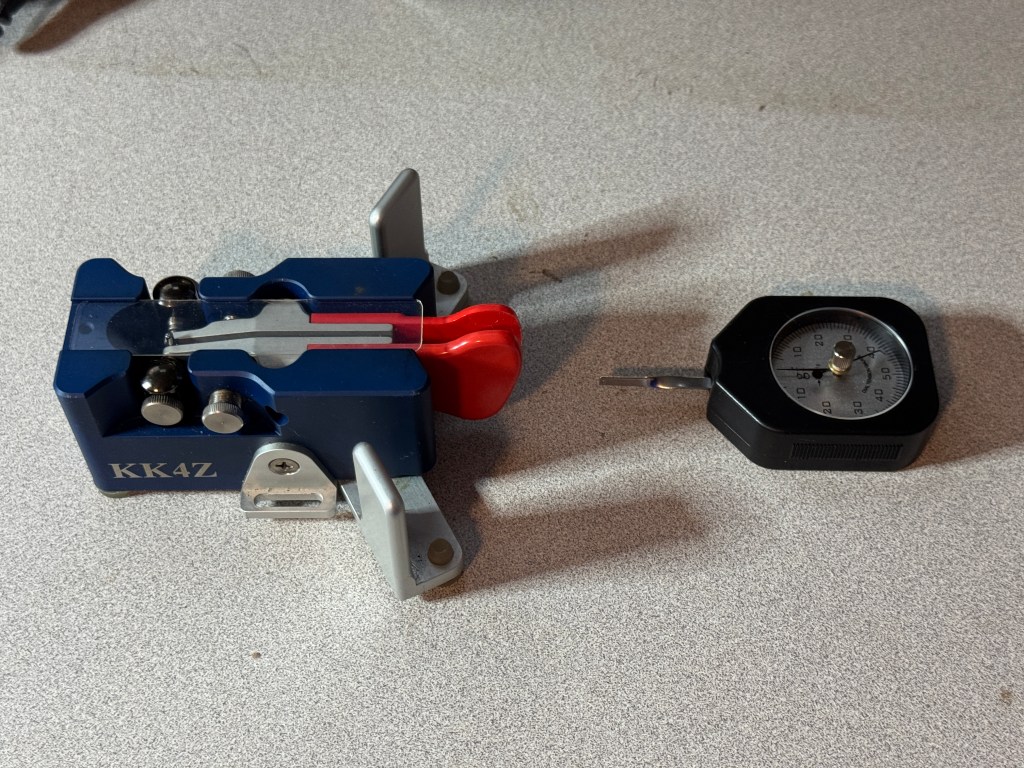
One by one, I got them all adjusted to 25 grams and switching between paddles has become much easier. Why didn’t I do this sooner? I got the gauge from amazon Amazon – Dynamometer.
QSK vs Semi-Break in. In CW, QSK means the the radio quickly switches between transmit and receive so you can hear dits and dahs from another station in between your characters and words you are sending. Some people love QSK, some people hate it. I like it because a good operator can send a dit at the right time to make you stop and listen for them. An example might be you calling CQ too fast and a well placed dit will get you to pause long enough to allow the other station to send their call and start a QSO or exchange. Some radios have noisy relays and QSK makes too much of a racket. Adding a little delay to make it semi-break in will cut down the chatter.
QSL. I no longer send out QSL cards. Life has gotten rather busy and I find myself not being able to keep up with QSL cards. I am usually very diligent about updating LOTW. Thanks to everyone who visits my blog and YouTube channel. I hope you are enjoying this fall weather as much as I am. 73 de Scott
 KK4Z
KK4Z 