
This weekend, I tried a new park, The James H. (Sloppy)Floyd State Park. With a name like that, what’s not to like. It’s a beautiful quiet park that is not too far from the home QTH. How convenient I thought.
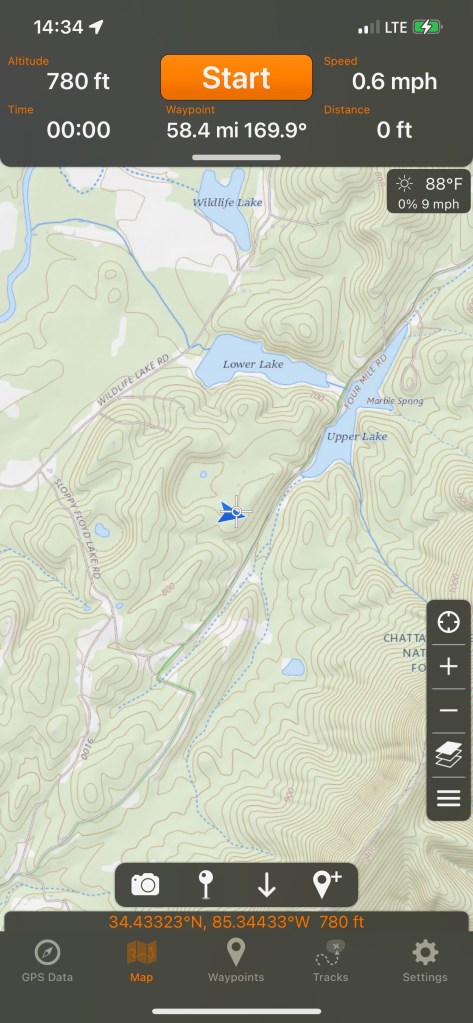
The Trouble I discovered was the park is located in a river valley. My campsite was well below the ridge and hilltops. It wasn’t until later that I checked my topo map. In addition, the bands were not in good shape but hey, I’m up for a challenge.
It is a beautiful park with lots of peace and quiet. The setup was my usual, my 28.5′ Random Wire antenna with the Yaesu FT-710. In hindsight, I should have rigged the antenna in a horizontal orientation rather than a vertical one to take advantage of NVIS or Near Vertical Incidence Skywave propagation. I have been reviewing the FT-710 and I thought I would finish up with the POTA Plaque weekend using CW. I even left the laptop at home to avoid temptation. I used HAMRS for logging and kept a notepad handy for scratch paper. Another thing I wanted to try was going paperless.

I started by calling CQ POTA but that wasn’t really getting me anywhere, I made a few contacts, but the deck was stacked against me. I switched over to Search and Pounce (S&P). I was going to do S&P but not right away. I wanted to S&P so I would be working with other activators. Making contact with someone who has a tribander and 1,500 watts is no challenge. Working other activators really gave the 710 a workout. I had to twist knobs and turn dials for a lot of the contacts. Many were S0 signal strength and often down in the static. It was a good test of the receiver. When I finally went QRT sometime around 1845 UTC and had 52 contacts. Not a lot, but each one a challenge. You will notice in the photo above, I have a weight on the paddles. To operate one-handed I need the extra weight to hold the paddles still. The weight is 500 grams or about 1.1 lbs.

How did the FT-710 do? Quite well. I was pleased with its performance. I was able to work stations I could hardly hear. The filtering worked very well. The DNR does get a little watery sounding as you increase its presence. I usually kept it between 2 and 6. With this radio and any SDR radio, RF gain is your friend and Preamp is not. Sometimes dialing in (actually taking out) a little RF gain is just enough to make that signal pop.
Issues? A few but none earth-shattering. When using headphones sending CW, there is clicking as the code is being sent. It happens at all volumes. It’s a little annoying, but not irritating. Another niggle is using the clarifier. When the clarifier is engaged, it uses the main tuning dial to adjust it. You have to turn off the clarifier to change the frequency. Yes, you can use the Step/Mch knob, but the lowest step is 1 KHz. The 7300 does not use the main tuning dial to set the clarifier.
One thing the 710 has that the 7300 doesn’t is the ability to send CW while in SSB mode. I really like that feature and I use it. The 710 is a likable radio and compares favorably with the 7300. Each has its pluses and minuses and I feel in the end, they equal out. I own both and unless you have a specific need for a specific feature that one or the other has, I think either one will serve you well.
This go around I used the HAMRS app on my phone to log contacts. I have the iPhone Max so I have a bigger screen and it wasn’t that difficult to keep up. Things did get a little dicey when signals were down in the noise but with a little more practice, it (and I) will be fine.
Even though my activation didn’t turn out as well as I expected (through no fault of the radio), it was a beautiful weekend to be out and about. I may not try another activation here, but it is a nice place for some peace and quiet. Until next time, 73 — Scott
 KK4Z
KK4Z 